All episodes
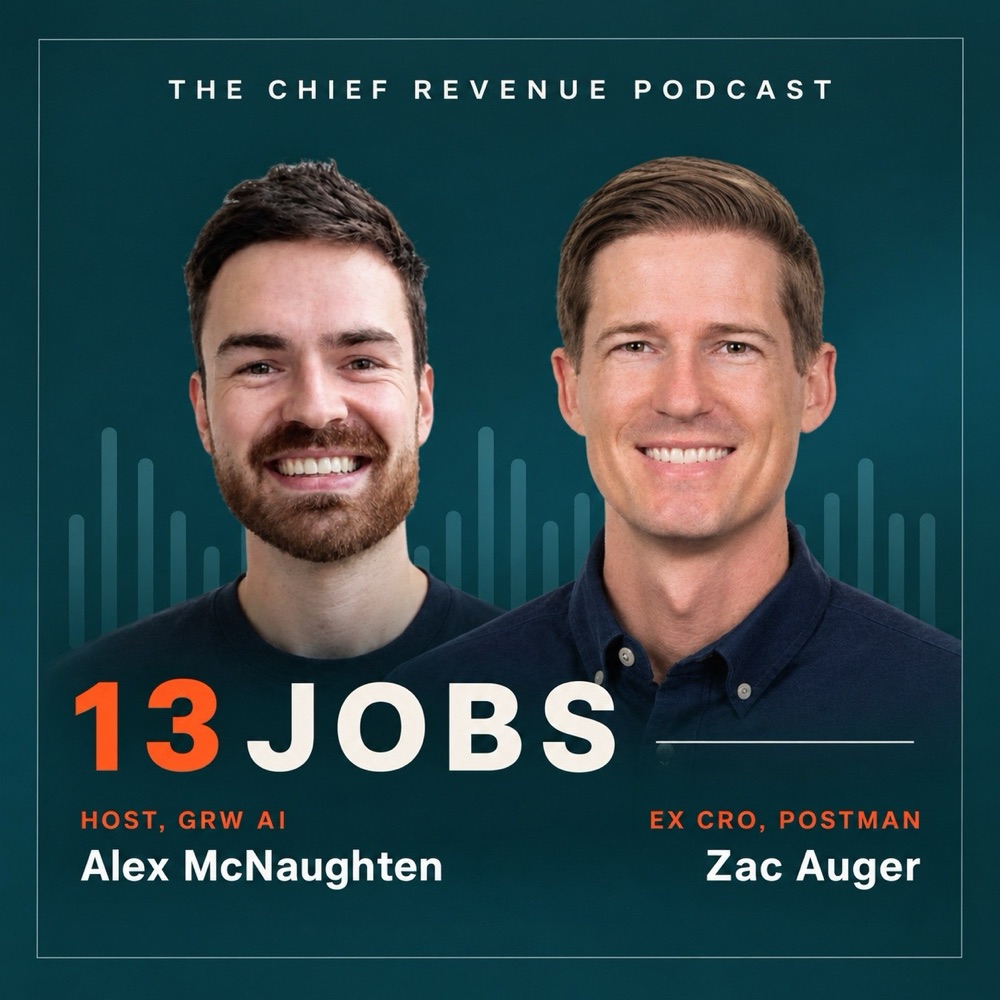
How AI is changing the revenue org with Zac Auger
Episode 078 · Nov 16, 2026
How AI is changing
the revenue org
0:0027:37

How AI is changing the revenue org

Why a 2,000-person revenue org can now run on a daily cycle instead of a quarterly one, and why Zac still would not fly solo as a CRO.

Hosted by Alex McNaughten
Share

Zac Auger · Ex-CRO, Postman

Zac Auger has spent two decades building revenue engines, from first sales hire to running go-to-market at global scale. He was most recently Chief Revenue Officer at Postman, the API platform used by millions of developers, where he led go-to-market as the company shifted to AI-native products. Before Postman he spent eight and a half years at Square, joining when Square acquired Framed Data, the Y Combinator machine-learning startup he had invested in and then joined full time to lead sales and customer support.

At Square he moved from Head of Account Management to Head of Sales and finally Head of Growth, running a global organization that peaked at 2,000 full-time employees and a thousand contractors across nine countries, reporting to Jack Dorsey as the business grew roughly tenfold to over $7 billion in annual revenue. Earlier he was the first sales hire at Quid, the Founders Fund-backed big data company. He studied law before falling into sales, and has been in the San Francisco tech scene for 20 years.

In this episode, we discuss:

  • From law school to sales, and going worst to first
  • Scraping his own leads, 20 years before everyone else
  • What changes when the team is too big to know everyone in it
  • Truth-seeking: finding the real customer experience across 30 products
  • From quarterly reviews to a daily operating cycle
  • Why the team gets smaller but never gets to zero
  • The two or three people in a pod, running the machine from HQ
  • The agent sitting in your Slack channel
  • Shadow agents: the Markdown files reps pass around off the books
  • Token spend, and the annual budget an agent burned in two days
  • Why better operations means hiring more sellers, not fewer
  • Two ears, one mouth: the advice Zac would give his first-day self

Quote of the show

“Once you're on a daily cycle, you can be a multi-billion-dollar company, but in theory, operate and react as fast as a nimble startup.”
Zac Auger, Ex-CRO, Postman

Key takeaways

  • Every rung up is a different job. Managing sellers, then managers, then directors who manage managers are three different jobs. By the top one the one-on-one relationship has stopped being a way to solve problems at all.
  • Truth-seeking is the executive skill. There is an objective reality to how a customer experiences the product, and it belongs to the CRO as much as to product. The work is finding it under 30 products and millions of customers, and deciding which fire is today's.
  • The review cycle is daily now, not quarterly. Agents reading the business every day surface what matters without an ops team building the report first. A multi-billion-dollar company can react at startup speed, but only once the data is already collected and organized.
  • Smaller team, not no team. Zac would not run a revenue org with sellers reporting straight to him. You still need player-coach frontline managers for escalations, deals and human coaching, plus professional operators. Think elite pod, in person, rather than headcount.
  • Your reps are already running their own agents. The motivated reps built their own flows in Claude or ChatGPT and share the Markdown files between themselves, in parallel with whatever the ops team sanctioned. You cannot train what you cannot see, and the off-script version is the one talking to customers.
  • The bill lands where you are not looking. Go-to-market agents usually draw on the same token budget as engineering, so you are competing with agentic coding for a finite resource. Integration spend is worse: Zac saw an agent burn a product's entire annual budget in two days.
  • Better operations means more sellers, not fewer. Every time the support around reps improved, the incremental ROI of the next hire went up and hiring went with it. More capacity to talk to customers is still the thing that drives revenue.

Transcript

Alex McNaughten

Zac, good to have you on the show. How are you doing?

Zac Auger

Awesome. Great to be here, Alex. Good to see you.

Alex McNaughten

So for those, for those who don't know Zac Auger, you are, or you were, I should say, the CRO of Postman. Most recently you ran growth for Square. Square for a number of years. But tell us a little bit about yourself and how you got into kind of the world of sales and leading revenue teams.

Zac Auger

Yeah, I think it was somewhat by accident, but also destiny. As it is with a lot of sellers, it's typically not a thing you study in school. But it is something that maybe comes more naturally for some than others. So I actually studied law and went to law school, but, but ended up joining what you could call a think tank, was, was doing work that, that wasn't initially sales, but I saw that the salespeople having a lot more fun, I think, on the other side of the office and driving nicer cars in the parking garage.

So I got to know them and joined the other side of the business and really enjoyed the work. And it's kind of one of those situations of going from worst to first. And figuring out how to be really efficient with, with my work. And that's, that's one of my big learnings over the years in selling is time management and working the numbers is, is a huge differentiator in, in being, being at the bottom or at the top.

Alex McNaughten

Yes.

Zac Auger

So, so one, one thing I did early on was just web scraping and figuring out how to do email blasts to generate my own leads. Back, this is over 20 years ago. So back when you could do those things and others weren't doing it.

Alex McNaughten

Yeah. Back when email wasn't quite so crazy, right?

Zac Auger

Yeah. Yeah, exactly. But that's kind of been the story ever since I ended up coming out here to San Francisco, working with tech companies and always figuring out how to get the job done one way or another, learning new products and new, and working with new types of customers. And, and always trying to be a good listener.

So I, yep, I've been in the tech scene for 20 years now in, in San Francisco, working for multiple companies, startups. We've had some exits. And I joined a startup called Framed Data, which was a YC company. I invested in Framed Data and ended up joining full-time to, to lead sales and customer support.

And we ended up joining Square. So we were acquired into Square. And that's how I ended up there and was there for 8 and a half years doing a lot of fun things there. So yeah, that's kind of my background. Happy to talk about it.

Alex McNaughten

It's an awesome story and it's so funny because I've been running this podcast for a number of years now and almost everybody fell into sales and revenue leadership. Like no one kind of left college being like, I want to be a salesperson. Like very few, like maybe 10%. Almost all of us somehow found our way here.

Zac Auger

Right.

Alex McNaughten

I'm curious, you know, run, you know, large, like at-scale revenue organizations, but then you've also had the startup experience as well. What do you think is the most important thing, you know, in terms of like a mindset shift when you go from, you know, like a scrappy YC-backed startup to like now suddenly you're running growth for, you know, Square?

Like, what did you have to change about yourself and how you were approaching things to be successful, to, you know, as you had such a much larger responsibility?

Zac Auger

Yeah, well, it really hits when you no longer are capable of knowing everyone you work with or who works for you.

Alex McNaughten

Yep.

Zac Auger

So, when the team is so large that the one-on-one relationships are not useful for solving problems. You have to learn to work through other managers and build managers. So the first level is becoming a manager of people, of individual contributors, actually doing the selling or talking to customers. But then the next level up is managing those managers.

And then there's another level of managing directors who manage managers who manage people actually doing the selling. And I think at each one of those levels, the job changes quite a bit to the point where when you are leading a very large organization, so at the peak at Square, my organization was 2,000 full-time employees plus 1,000 contractors in 9 countries.

So it was also kind of 24 hours always running and the customer's also always running 24 hours because these are small businesses and they're all over the world. It is, it The job changes to really being just an operator. And I think a lot of it is seeking the truth because the truth comes when you're talking to a customer and you can get it pretty quickly talking to the reps who talk to customers.

Right. But when you're levels removed and you're sitting and reading docs and looking at spreadsheets and trying to sort through data to understand what's happening. It is a much more difficult problem. It's a very different type of problem. And now I think with AI and these tools, it's becoming much easier again. It's kind of almost in a way flattening out organizations.

So that's definitely something I use a lot and dependent on. But kind of before that, you're dependent on ops people and others to prepare reports and And you end up, or I ended up spending just a lot of time reviewing reports and joining internal meetings. And it's difficult to be so removed, but the tools now make that a lot easier, including Gong.

Just being able to go directly in and listen to calls and search for a specific type of call or customer or product that I want to understand better, and then take that clip and send it to a product manager. All that stuff didn't really exist just 5, 6 years ago.

Alex McNaughten

No, exactly. What you said there is really interesting. Your job is to be truth-seeking when you're managing the people who are managing the people who are managing the ultimate frontline reps. Aside from just being really good at understanding the data and the reporting, what does it mean to you to be truth-seeking? How does that play out day to day?

Zac Auger

Yep. I believe there's an objective, there's an objective reality for how a customer is experiencing a product, what the customer actually needs and how you're showing up for that customer and really understanding what that customer experience is, is not just the responsibility of the product manager, whoever's building a product. It's also the responsibility of the CRO and the sales leaders or the customer support leaders.

And it's easy if you have 10 customers and 1 product, but at Square, that's over 30 products. That number is probably higher now, and millions of customers. So wrapping your head around what is the experience here, it's so many things happening at this given moment, and what do I need to focus my time on, and what is the biggest issue, what is the biggest fire that needs to be solved today?

And what can wait until tomorrow. So it is like being a detective, a kind of Sherlock Holmes, that you're always trying to find the right things. And it's similar to what I was saying earlier, being a very effective sales individual contributor. A lot of it is about time management and focus. That is the difference between, I think, being an excellent executive and an excellent seller is, okay, I got so many hours in the day today.

What are the most important things? That I need to fix and solve and improve for the customers. I think what is a common thread for success for anyone in tech building for consumers or building for other businesses is like the better you understand your customer, and you hear this a lot, this is what YC and everyone is saying, but it is just the truth that if you understand your customer better, you understand the problems better, you're going to build better solutions.

And if you can do that better than the competition, You're going to win. And that's what so much of the work goes into. But again, I think it was almost an impossible problem to really do at scale and do it very, very well. Very few companies can do it well. And eventually they kind of plateau and someone comes in and takes their customers, creates a better solution.

But I think that's changing now with AI tools. I think it's just giving people superhuman capabilities with, for executive management, for operating large companies at scale.

Alex McNaughten

I agree with you and we're certainly seeing that. I'm curious, you know, how this kind of technology changed your role over the last few years, you know, as a senior revenue leader, like how did your role change? And then I'd love to dive in after that, like, How did it change how you think about like the organizational design as well?

Zac Auger

Yeah, it changed in that things, the cycle times, it changed in many ways, but I think one of the most powerful is the cycle times have changed from quarterly reviews, having teams put together. So let's say it's 2,000 people spread across like 100 different departments, they're all working on their OKRs and rolling up to an annual plan if it's all organized well.

And then you do quarterly reviews to, to check in and see how things are going. If you're real ambitious, maybe you do it twice a quarter, but you do these mega reviews and you go through all of this stuff. At Square, we were doing it through docs, which is, I think, more efficient than presentations.

Decks that would take a very, very long time. Docs are more efficient, but it's, it's still a lot to sort through. And you're doing this, um, at, at, at a, like, a quarterly or, or twice a quarter cadence. Now you can work on a daily cadence. You have the ability to go through everything that's happening in the business today, kind of in real time, and these agents can pull out the most important things that are happening and surface that to you, and you can adjust and pivot and be just a— just react so much faster than you could before.

So once you're on a daily cycle, you can be a multi-billion-dollar company, but in theory, operate and react as fast as a nimble startup. And you can, you can be kind of removed from your customers physically because you're operating this thing, but actually understand them just as well as if you were at their shop or sitting down with them because you are just getting the full picture.

And you need AI for that. You first, you need data to be collected and organized in the right place. Right. And I think that has been solved through Snowflake and all these tools. And then we can marry like clay data, external data with internal data. You have all these analytics tools that have improved so much over the years, like Segment.

So you can bring the data together, put it in a data lake. But then what's happened over the last few years through LLMs and tools like Claude is it can then sort through all of that through prompting. You don't have to sit with data scientists. So before I had to like make specific requests and the data science team will go do some research and come back.

And maybe they'd build some custom models and create some custom reports. And you have Looker and dashboards, but now it can all be done just through prompting. And the current iteration that we're living in today, the latest cutting edge is to have the agents always running, always doing this work. So you don't even have to prompt, surfacing the most important things you need to know and getting you closer to that truth.

And that's where we are. And it's amazing. And it's going to change how all companies operate.

Alex McNaughten

Did you— I've spoken to a lot of execs about this. And I'm curious on your perspective, like, did you, or do you find it ever overwhelming with the amount of like raw data that like you can now have at your fingertips? And like, it is almost like another job now of like, sorting through it because, you know, like, and we've seen it with customers, we've seen it internally, like you'll have like all of these workflows running, you'll have all of this data at your fingertips, but then suddenly it's almost like you become the constraint because you actually can't, as a human, like sort through all of it.

And I'm curious, like, did you encounter that? And like, what did you do about that? And how did you manage it?

Zac Auger

Yeah, so that's why you asked about organizational structure. The teams can be much smaller than before, especially in operations, but you still need a team.

Alex McNaughten

Yeah.

Zac Auger

I don't think we're at a place yet where I could fly solo as a CRO and just have sellers reporting directly to me. You do need frontline managers. You need human coaching. They need to join for customer escalations and help close deals. That's very important. You need those player coach managers and, and you need professional operators working with you, helping you sort through all of this.

But it's more like an elite team. I think we're seeing a lot more in-person too. So—.

Alex McNaughten

Yeah.

Zac Auger

Like imagine a team of people who just 2 or 3 that are sitting with you in a pod all day long operating this machine from an HQ. I think we'll see a lot more of that. But it is currently too much just for, for one person. Uh, but that said, I do think the agents will continue to improve and learn, um, get to, to a point where it is not going to be overwhelming and they can make a lot of, some decisions autonomously for you.

And, and what does get escalated to you has been so neatly curated.

Alex McNaughten

Mm.

Zac Auger

They'll probably do that even better. Than the best A-team. But where we're at currently, the cutting edge, I think, is the agents working alongside very small teams of very engaged, hardworking, bright people. And those agents often exist in like a Slack channel. So it's a team member kind of in that channel with you, which has kind of been an interesting phenomenon.

Yes. And I think that's becoming more common and an interesting place Slack is has found itself in this agentic revolution we're in.

Alex McNaughten

Yeah, it has. Yeah. And sort of this like headless concept of like agents kind of just showing up in the surfaces that you want them to be, whether that's Slack, whether that's text, whether that's across your email, et cetera, et cetera. One thing we're kind of seeing across customers and like being a lot more thoughtful of now is, you know, Slack can very quickly get overwhelmed.

Like what are the other, like What makes sense to put where is basically like the problem, because if you just have like Slack notifications going crazy, then suddenly you'll start to just mentally skim them and like mentally block them out. Whereas, you know, like what should go to text? What should go to email?

What should go to Slack? And like how, you know, how, what is the best medium to communicate different things at the right time? As you've been like rolling this, you know, technology through organizations, What have been some of the challenges that you've started to encounter? You know, and like, you know, what we've seen across the, you know, the hundreds of teams we've worked with is adoption is often like a challenge that organizations had been having.

Measurement and success, like measuring the actual results of all of this agent work going on has been another question mark. But I'm curious, like what you saw across your organizations.

Zac Auger

Yeah, definitely both of those. So adoption with tools has always been a challenge with sellers.

Alex McNaughten

Yep.

Zac Auger

So you, you, the ops team will put a lot of work into rolling out a new solution and then nobody uses it. Same problem if you're building for an external customer, you gotta, you solve that by actually sitting with the sellers physically and observing their workflows and really, really making sure you're building things that are relevant.

I think for AI, what has been interesting is the sellers themselves, the ones who are very motivated or more savvy with these things are using Claude or OpenAI or Grok and these tools directly, and then building their custom flows, their Markdown files and sharing them amongst them, amongst themselves. And you have kind of this ungoverned shadow agent thing happening.

And at the same time where the operations team and the company is doing something that's more official and they're running in parallel. So I've seen this personally. I've talked to other leaders who have this issue. So the governance and control of these things is a real issue because what it means is the sellers may be going very off script and giving inaccurate information to customers, setting the wrong expectations.

And it's hard enough to train them based off of enablement materials and product materials to train the agents. And keep it on track. But if you have the kind of the shadow agents going on, then it's impossible as you don't even have visibility. So that's, that's, that's been a challenge. And the agents do tend to, and this is the challenge with LLMs, they tend to eventually deviate.

Alex McNaughten

Yes.

Zac Auger

And then you try to bring it back with training and they deviate again. So, as far as I know, that's not a solved problem. Governance and control, and then like visibility to measure ROI because the token spend on this can, can really rack up. That, that also, these problems aren't fully solved. There are a lot of companies working on it.

Postman is working on various solutions to, to manage and govern agents. But, but it's not a solved problem. And it's, it's, it is, yes, the expenses can, can really run out of control. So, you gotta— kind of stay on top of that. And they tend to be, if you're talking about the tools for go-to-market, it tends to be coming from the same token budget as engineering.

So you're also kind of like pulling from what the engineers, because they also need this for, for agentic coding to build the actual customer products. So you're kind of competing for that, that finite resource. And if you take too much, that, that can be an issue. The other spend that I've seen balloon is in the integrations themselves.

So if the agent is pulling data from like ZoomInfo or Clay, it can just rack up a bill. And I've saw the case where like the entire annual budget for that product was spent in 2 days from an agent.

Alex McNaughten

Yep. And I think like, I think, you know, we've heard similar stories of, you know, organizations not understanding commissioning of agents and accidentally having salespeople export the entire Salesforce database and then leave to a competitor. And we've seen all sorts of stuff like this through speaking to revenue leaders and operations leaders. It's interesting that governance and control was only recently seemingly to be talked about.

Up until I would say halfway through this year, I wasn't hearing that when I was speaking to CROs and RevOps leaders. I wasn't really hearing that. But then really in the last couple of quarters, it's been coming up. I'm curious on your perspective as to why now this is becoming more into the public consciousness and what are you seeing companies trying to do about it?

Zac Auger

Why now in terms of seeing the agents Becoming the governance of agents becoming a problem.

Alex McNaughten

Yeah. Like why, why, why now? Like why are companies just, just now kind of cottoning on to this being something that needs to, like they need to get a grip on?

Zac Auger

I think because it's new, just having employees using agents in this way is a relatively new thing. So it was a wild west and kind of a free-for-all. I think the bottoms up started long before companies really were aware, on top of it. I think a lot of these tools were initially, the focus was on engineering.

Alex McNaughten

Yep.

Zac Auger

And how can we integrate them then into our products that serve our customers? But to have all the other teams within a company start to use these tools, it was, that would be like the next step to, for officially sanctioned work and projects, but it just started to happen organically very quickly. And I think a lot of employees are using these things in their personal lives.

I think probably most people started using ChatGPT in their personal lives and then brought it to work and then saw the engineering teams using Claude Code and then said, wow, this is cool. Started using Claude and that took it to the next level. And then operating, creating agents, operating things that are more automated.

That became easier within these tools and they just started doing it. And then companies kind of caught up and started to do more officially sanctioned projects across all the internal divisions. And that's when you, then you start to see, oh wow, okay, there's a lot happening here and we're not really in control of this and it's going to do, say all these wacky things and our customers are going to get bad information and complain.

So I think it's, it's just a very recent phenomenon, but that's, that's a massive tech opportunity. Yeah. For, for existing companies and, and, and startups alike to, to govern, to help companies govern these agents, really understand the return on investment, make these agents more efficient, more effective. I think, and it's in, and in many cases, don't like, don't expect to replace employees and labor.

Usually what ends up happening with all these tools, and I've been working with kind of similar machine learning systems for a very long time, long before ChatGPT, you end up actually making these employees so much more efficient that you can do more with them. And, and the incremental ROI of the next hire goes up.

And so you hire more.

Alex McNaughten

Yes.

Zac Auger

Especially with sellers, as you have, if you can have more sellers, that means you're talking to more prospects and customers, then you can drive more revenue. I've only seen the hiring go up as the operations supporting the sellers improves. So now it's like on this exponential improvement, I would think that sellers are just going to be more in demand than ever.

I think you're going to see companies just hiring more and more reps because they're just so incredibly effective.

Alex McNaughten

Exactly. I tend to wholeheartedly agree with you there. Zac, I've got one last question for you today before we wrap this, this recording, which is knowing everything you know today, go back to your first day on the job as a sales professional. What is the one piece of advice you'd give your younger self?

Zac Auger

Yeah, 2 ears, one mouth. And this is not new advice. It's the old school sales advice. Nothing has changed since the day of Dale Carnegie and How to Win Friends and Influence People.

Alex McNaughten

Yep.

Zac Auger

Those principles are tried and true for sales, for business, for your personal life. Really listen to what people are saying, try and understand them, try to understand their needs, and do your best to be honest with them. Honesty goes a long way. I think the first mistake that most new sellers make is, is they talk too much.

They're excited about the product, hopefully, and what they've learned about it. And they really want to make a sale, but it may not be a fit. And it's, it's really best to just listen and be brutally honest and not waste anybody's time. These relationships, these are relationships that you are forming with customers for the long term.

And you want, you really, if you don't have a sale today, maybe you probably will tomorrow. And if not at that company, maybe another company. Yeah. But these careers are long and the relationships are long. So listen and always be very honest and you will do very well if you follow those. That'll differentiate you from 90% of the other sellers out there.

Alex McNaughten

It's old school, tried and tested advice for a reason. Like there's a reason that that is good. That is still Like the best advice you can give a new seller. So I agree. And I think the honesty point as well, you're right, it really does differentiate you. And, you know, it's incredible how relationships from like 5 or 6 years ago, if you treat someone really well as a customer, come back later.

And like, for example, when we started Grw, one of our very first customers was a customer of mine from 2 businesses prior. Who has been a customer of every single business I've ever had. And all because we treated him so well first time round that he would, you know, almost no matter what we were doing, he would find a way to work with us.

And you're right, you know, in a 20, 30-year career, if you're doing good work and treating people right, it should theoretically get easier the longer you're doing it because you're gonna have those incredible relationships to help carry you.

Zac Auger

Exactly. Yep. Yep.

Alex McNaughten

Zac, this has been a great conversation. We've covered a lot in a short period of time. If any of, you know, if any of this resonated with our audience and they want to connect with you or learn more from you, where's the best place to find you?

Zac Auger

I'm on LinkedIn, so find me on LinkedIn, send me a message.

Alex McNaughten

Nice. Perfect. Zac, thank you so much for coming on the show. Really enjoyed it.

Zac Auger

Okay. Thanks, Alex. Great to be here.