
Building CS at scale
Nineteen years at SAP, the last seven building a digital customer success practice for tens of thousands of customers, taught Tony that the whole game starts with talking to the customer, and that consumption, not the renewal, is the number to chase.
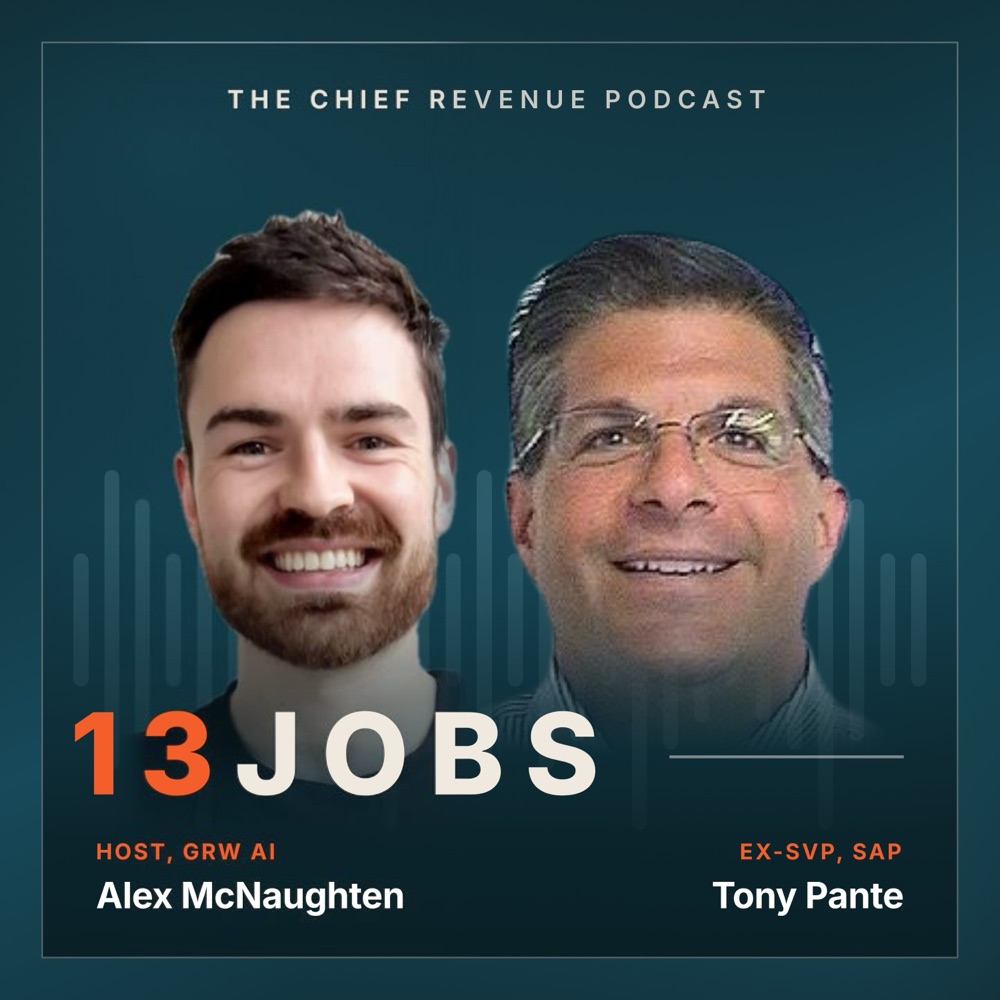
 Hosted by Alex McNaughten
Tony Pante · Ex-SVP, SAP
Tony Pante was most recently Senior Vice President of SAP's Global Customer Success Practice, closing out a 19-year career there in January 2026. The last seven of those years were in digital customer success, where he was the first hire on the digital sales team and went on to build and scale a practice covering the long tail of SAP's medium and smaller customers, many thousands of them, through hubs in places like Barcelona and Singapore. He led customer success strategy and built and ran the company's Global Digital Center of Excellence within the Customer First organization.
Before SAP he spent 20 years in SaaS already, including a stint at LivePerson in the early days of chat and voice-over-IP software, and earlier work as a management consultant. He believes customer success is a revenue driver built on proactive retention and growth, hires for curiosity and a people-first mindset, and has picked up the informal title of godfather of customer success management. Since leaving SAP he has gone deep on applying AI to post-sales work and change management. He holds an MBA from Harvard Business School and played football at Lafayette College.
In this episode, we discuss:
- Nineteen years at SAP, the last seven building digital customer success for the long tail
- The starting point was simple: talk to your customers and show them what they already own
- Mapping the customer value journey, self-service in local languages and where to put the human in the loop
- How they measured it: customers reached, then satisfaction, then usage, then renewals as the lagging indicator
- Should CS own the renewal? Trusted advisor in years one and two, a renewal office for the commercials
- Compensating CS without a quota: satisfaction, consumption and net bookings
- Where sales and CS break down: the sales handover and compensation that pulls in different directions
- Bringing the CSM in before the deal closes as a lever to win it
- LivePerson 20 years ago: account management already was customer success
- Hiring CS leaders: servant leaders who are passionate about developing people
- The airport test, and asking why someone wants to lead
- AI in customer success: a thought partner for the CSM first, agents in the process next
- Advice to his younger self: really care about people, and make mistakes
Quote of the show
“If you're using product and you have good experience, the renewal rate happens.”
Key takeaways
- Start by talking to your customers. SAP had some of its best content and experiences sitting unused because customers did not know they existed. Tony's digital practice began with the simplest thing: ask customers how they are doing, show them the feature, the community and the training, and good things follow.
- Map the value journey, then decide where the human goes. With a digital CSM covering a hundred or more accounts, you cannot be everywhere. Map the journey from purchase through implementation, go-live and first use, cover most of it with self-service in the customer's own language, and put people only where they change the outcome.
- Consumption is the number to chase. Renewal is the lagging indicator. The metrics evolved from how many customers did we talk to, to satisfaction, to usage, to renewals. Engagement lifted satisfaction, satisfaction lifted consumption and consumption produced a steady, linear improvement in renewal rates.
- Trusted advisor and commercial closer are two different hands. At SAP the CSM carried the relationship in years one and two and a centralised renewal office ran the negotiation. CS still needs a line to revenue, through satisfaction, consumption and net bookings, but a pure upsell motion erodes the trust that drives usage.
- The sales handover is where it breaks. Reps sell potential and do not always document the value and use cases they promised, so the CSM restarts discovery with a customer who thought they were done. Treat the handover as an event, align sales and post-sales compensation, and bring the CSM in before close on bigger deals.
- Hire CS leaders for people development above everything. Every leader Tony hired was chosen for caring about growing people, and he watched them go from individual contributor to VP. Ask why someone wants to lead and listen for people in the answer. Get it wrong and you see it quickly.
- For the next year or two the power is a CSM using AI, not AI alone. Summarising meetings is table stakes. The step change is AI as a thought partner that makes a generalist CSM smart across every product, with agents taking pieces of the process over time. Technology without change management gets done the wrong way.
Transcript
Tony, thank you for coming on the show. How you doing today?
Yeah, good, Alex. Thanks, looking forward to this.
So for those who don't know Tony Pante, he was most recently the SVP of Global Customer Success Practice at SAP. But Tony, I'll let you kind of introduce yourself and share your story because you have been in the customer success world for a long time.
Yeah, it's just finished up a fantastic 19-year career at SAP. The last 7, were in the digital customer success arena, really had the opportunity to build and scale customer success practice to focus on the long tail of customers, many thousands of customers, and to provide great experiences at scale. So it's a great company, great people, and just had that, you know, real good opportunity to see the impact that you can have on customers by focusing on them, even if it's in a digital way.
And 19 years is a rare stint. You know, it's not often you meet people who've stuck, you know, in one organization. Obviously you had multiple roles in SAP. Like, that's a rare long stint, which is awesome to hear. Now SAP has some of the most like complex enterprise deployments on the planet, and you know, it's a huge beast of an organization.
I'm curious, like, what did running CS at that kind of scale teach you that you wouldn't have been able to learn elsewhere?
It was an amazing experience and it was the digital team that we built focused on medium to smaller customers. And I tell you that the simplest thing to me was if you talk to your customers and ask them how they're doing,.
You.
Know, if they understand how to leverage your product, and if they know about the best practices of your product and you actually care for them and you listen to their answers and you help guide them through some of the complexities that they're dealing with, good things happen. And that literally was, Alex, the starting point for us is let's just talk to our customers.
You know, and you're right, SAP is pretty complicated. We support the largest of the large companies of the world and we also have really good products for some medium to small customers, but it really boils down to Making sure that you're talking to your customer, making sure you have a good understanding of what it is they're trying to solve for and how your software may help them.
And then simple things like, hey, were you aware about this capability and feature? Hey, here's the community that you can go to to learn about practitioners, say, from our, from our HR products. Here's the communities that you can go to. Here's the education that you can go to. If you have a support problem, here's how to raise a trouble ticket.
It's those basic things. That help you build the relationship with a customer and that help make sure that they understand some of the best practices. And it was, we talked about this all the time about we had some of the best experiences and best content that customers didn't know about and we just had to make sure they knew about it and knew how to drive the business value from the software they purchased.
And look, I can definitely like relate to that last point you've made. I think it's especially hard today with how quickly you're developing things like new features and new functionality and new products are coming out so quickly. And it's hard to keep every single customer up to date all the time on everything that you've got.
And I'm curious on like, how do you strike the right balance between, you know, like speaking to your customers every single day, every single week versus, you know, like not enough? Like how did you kind of navigate that? You know, I think that, I think it's a, it seems to me to be a fine line where you could get it just right.
It is, and it's a lot of trial and error. And we had the circumstance where there were tens of thousands of customers in the size of the business that we were dealing with, and we just, it was physically impossible to talk to all of them all the time, right? So you could have a digital CSM that could have 100+ customers.
And that's a lot when you think about the different solutions and different, different types of things that you need to focus on. So we did a lot of prioritization, we did a lot of process mapping, and we said, hey, what is the, what is the process that a customer should go through? Right?
From when they purchase the software to thinking through the implementation, thinking through the training, you know, getting the live experience right, and then getting to first use, and then getting to continued use. So we really did spend a lot of time thinking about the customer value journey and mapped that out and said, hey, where are the touchpoints that we should have with a customer?
How can we support as much as we could along the process with self-service, with videos, assets, and content? I mean, it was almost by definition we had to do that given the amount of customers that we had. Yeah. But we had amazing content. And if you think about the perspective from a customer and if you actually provide them with access to the information they need, a way to get self-service answers to their questions and then be there if they had questions or concerns.
So that was one approach that we took. And then we were proactive on other approaches and said, hey, let's look at our customer base, let's segment customers by potential and size, and let's do some targeted reach out to those customers along their value journey. And we work through both of those and the technology.
I mean, if even if you think going back 5 years, You have so much data-driven technology back then. We had really good video capabilities. We were just starting to get into some of the, the AI capabilities, far different than what we have now, but we had good video, good content. The big thing we found as we were globally deployed is make sure you had local content.
Make sure a lot of the useful pieces of information that you wanted to share, if you're talking to German customers, it should be in German. If you're talking to Spanish customers, and that was that to us. We made, we made a targeted investment on understanding the processes, understanding where we could put people into the, into the journey, local content in local language the best that we could.
So we did a lot of customization into many, many languages to make sure customers could have access to what they needed. Really focused on self-service, really focused on learning, right? We looked at cohorts of customers and said, hey, what's the logical pain point they can have and how do we proactively work through that?
We did use technology a lot. We had to. We migrated to a platform called Gainsight that allowed us to automate a lot of the value journey. And that was the starting of a game changer because you could start to trigger actions and you're getting smarter and smarter. And it's all about being smart of where you could put the human in the loop, if you will, in the process.
Yeah. You didn't need them everywhere. You couldn't do it with that many customers, but you were smart in where you needed to be. And then we would always ask at the end, how are we doing? What more do you need? And then we'd use that information to then say, hey, how can we get better?
But I tell you that the self-service component, we would cover tens of thousands of customers in, in self-service ways, just understanding the journey, understanding the top features to use, how to get assets and content to them. And many customers were happy with that.
Okay.
And then if they needed to talk to someone, they can come back to us and do that.
How did you measure success? You know, like as you were rolling this program out, like what was the before and after? And like, how did you measure that transformation?
You know, quite frankly, we had it, we knew the customers, we knew where they were, we knew the consumption wasn't stellar for many of those customers, and we knew the renewal rates weren't stellar either.
Right.
And when you, you know, it may be a small customer, but over time when you have thousands of them, that adds up. So that was the compelling case that at the time the president asked me to solve is, hey, we've got, we're doing some good work. We've got a hands-on approach to the biggest customers as you should.
Yeah.
But we're missing the mark in the medium to smaller ones and we gotta figure out how to support them. And, you know, we literally started with how many customers are we talking to? And that was the first metric. I remember building with some of our data teams, we were building these in Excel spreadsheets.
They then say, how many customers did we talk to? What do we talk to them about? How was the experience and what did they need? And then we just huddled together to learn and said, hey, we started with one product area and we huddled together and say, hey, let's try this, let's do that.
And then as we progressed over time, we got smarter at understanding where the customers were and what best practice that we could share and how do we, how do we get more proactive along the journey to help customers? And honestly, by just engaging, and helping, we'd start to see an uptick in the customer satisfaction and then you'd start to see an uptick in usage.
And then as you drive an uptick in usage, you start to see the lagging indicator, which is renewals. Yeah. You know, consumption and renewals. And then we saw really a very nice linear improvement in renewals over time as we started to engage with more customers, providing great assets and content and great experience.
So we started measuring How many are we engaging with? What are we talking about? And then we got to a point where you can get more proactive to say, hey, here, here's the other things you need to be thinking about. And then it ultimately came to consumption. Were customers using the products that they purchased?
If you're using product and you have good experience, the renewal rate happens. Yeah. That happens over time. And then, you know, the lagging indicator was the renewal component. And we saw very sizable increases in consumption, and then that led to a substantial increase in renewal rates.
What is your take on whether CS owns the renewal number or not? Because you kind of see different types of CS organizations. You see some who are deliberately focused on, hey, we're here just to help the customer use the product. Yeah. And then you see other CS organizations who are quite commercial actually, and that's, you know, they're effectively owning the whole account management, renewal, upsell, cross-sell.
And I'm curious, like, what's your take on this? And, you know, where makes the most sense, or is it very organizational dependent?
Yeah, it's gonna be organizational dependent because you see the different levels and the different pieces. And we really wanted to make sure that we were the trusted advisor for the customers, right? And if you take that kind of mindset and say, I want to be here to help you, I want to share best practice.
I want to share common solutions, if you will, across the customer base, the customer community. If you take that approach and you drive good engagement, you drive good experience, you're going to drive good usage and you're going to get to the renewal conversation. And the way that we had it is we'd have our CS team support most of the relationship for previous, you know, future years, right?
If you think of a 3-year contract, the CSM would be highly engaged in year 1 and year 2. And then you get focused into the year of the renewal. You still have the CSM involved, but we had experts in some of the financial and some of the negotiation work in a renewal office.
We had a centralized team that would handle the commercials, and that's what they were really good at. There was a connection between the groups. You'd have the CSM connected with the renewal agent, but the renewal agent was a rep expert, if you will, in the commercial terms and the negotiation pieces. So that kind of two-handed approach helped.
To make sure that, hey, you know, as a CSM, I could focus on consumption, best practice usage, clearly a great relationship, and then a tight connection with the renewal representative that would handle the commercial negotiations. I'm starting to see the trends where companies are doing everything right. You're responsible for the whole thing.
We always had that constant balance. If you want to be a trusted advisor, how far can you go without getting into the discussion around the commercial terms? And we would find that if you provided a great experience, if you provided best practice assets, content consumption would go up. As consumption would go up, you'd start to get the realization of the business value.
Always have to be in the business value conversation because if the customer sees the value, the renewal happens. Yeah. So that's, we would always be, you know, trusted advisor focused on business value for the customer.
Yeah, I got it. And like the renewal will kind of come from that, but you're not directly— your team wasn't directly like running that renewal process. That makes a lot of sense. And I've kind of, before building companies, I've worked in organizations that had both approaches, and I didn't really feel like strongly either way in terms of like what makes sense.
And I think like what I'm hearing from you is like it probably just depends on like what you're selling, size of sales, types of customers, your organization. But I can definitely see like the benefit in having a CS org that is truly just like a trusted advisor and is not there trying to upsell, cross-sell directly to me.
I think it does, I think it does like take away that kind of like sales pressure. Yeah. That could potentially creep into that org otherwise. Which kind of brings me on to my question is like, how do you compensate the CS org If they're not kind of tied to the revenue number, so to speak, like what do you compensate them on?
I think you still need to be tied to the revenue number for sure. And, you know, we were focused on experience, we were focused on satisfaction, we were focused on consumption, right? So then you kind of, and then net, you get this term called net bookings, which is the new upsell less churn, right?
So if you have new opportunity, as you provide great experiences, the new opportunities happen. That it was fascinating to see. We would track upsell opportunities in pipeline. Some of that would go back into the sales organization. Some of that would go to other folks doing the commercial piece. But as we built that relationship, customers like, okay, this is fantastic.
I do want to extend my seats and my licenses to drive and do that. SAP always changed, we changed compensation often, and I don't think we ever got it right. We were getting better and better at If you look at this concept of net bookings, which was, you know, current revenue plus upsell less churn, I kind of like that because that gets you to, if you're driving value, you're gonna drive consumption, the goodness happens, right?
And if you're not, or if it's oversold, you're not gonna realize the full value, then the churn will happen. So the compensation piece is always challenging. I think you do want to have everybody thinking about the customer and thinking about the growth of the business for sure, because it gets expensive. The, you know, these are people and resources and you're starting to see all over the place now is that I'm sure we'll get there when you think about how much can AI support and do.
Yeah. CSMs can get expensive. It's a person that you're putting into the loop. And our argument was always, hey, if you can make sure the customer sees value and then you've sold them the right amount of capability for that customer to grow into, you're gonna have a good experience. And then you can be a trusted advisor that allows you to grow that customer.
But I do think you need to still have some element of sale component, if you will, into that mix. We'd always like to have a customer satisfaction component, whether that be NPS or something else that talks about the customer relationship. I think that's super important. When we'd have an MBO component, because again, every year we seem to have changed the, we changed the comp structure at SAP, but when we had an MBO component, we would put in a pipeline, you know, how much new upsell opportunity did we identify?
Because that would always happen as you're building good relationships, you're gonna identify new opportunities to grow. And sure enough, we would always far exceed that metric because it would come from the good relationships that we'd have.
What are the most common breakdowns you see between the sales organization and the CS organization?
There's a few. It starts right at the front. You know, what is— and that's the sales handover and we physically called it a sales handover and it was an event. And you've got great salespeople that are out there trying to sell potential, right? Trying to sell business benefit. Sometimes they don't necessarily document the right values and the right use cases.
And then all of a sudden it's just handed off to the CSM and the CSM is like, wait a second, what'd the customer buy and when? We were getting better over time to get that handoff done right. But that's, that's just, there's tension there because you've got, you know, folks that are 100% comped on value, not necessarily consumption and other pieces.
They gotta, you gotta do a better job aligning the sales compensation with the post-sales compensation. And we started to do some of that at SAP. I think that's the biggest one is making sure that sales handover is done the right way. And then keeping the salesperson in the loop when you start thinking about, as you get into the renewal conversation, if there's expansion opportunity over a couple of years, You know, if it's the salesperson that's doing that conversation along with the renewal agent, having those relationships sorted and who's doing what.
But I think the biggest thing is making sure everybody's aligned back to the value of the customer. And if you're selling the right software, you're selling the right business value and that's documented the right way. As we got into the Gainsight deployment, it's all about business value. And if you don't have the right goals and outcomes, It's hard to drive the value to that, right?
If the handoff just happens, that's a challenging experience because then you're actually almost restarting the sales process again with the customers. They're getting ready to do the implementation, right?
Did you ever loop in CSMs like late in the sales process, like before the deal actually closes, but like start getting them in, you know, especially if they're, you know, responsible for like part of the onboarding? Yeah. Okay. Interesting.
100%. If we could do that where you could almost use it as part of, you know, the value journey. Yeah. Say, hey, here's, here's the CSM. And particularly with the bigger contracts, absolutely fully. Because, you know, once you're sold, it's all about value and that's an ongoing, you know, multi-year journey. But we would always try to get, if we could go early enough where we could assign a resource, we would try to do that and, and use it as part of the close process to say, hey, this person's gonna be responsible for making sure you're successful.
And we would even, we do that on the large-scale customers absolutely all of the time. We'd start to do that with the larger part of the digital customers.
Interesting.
Just to say, hey, because what do we, what do CSMs know how to do? They know how the software gets implemented.
Yeah.
And you may be working with a partner that's going to do the coding and the implementation for sure. But we, you know, we've done hundreds if not thousands of implementations. That's what we do. We can help you through that and use that from a, from a sales standpoint to say, hey, I can guide you to success.
And here's the person that's going to help drive that success, and it just happens to be a CSM.
Yeah, it's actually like a really effective, I think, tool leverage, like leverage like in that late-stage sales conversation to bring that CSM in. Like I remember like doing that when I was a rep and like it was always, it always helped, you know, because like what are the, what are the questions that the customer has at that point?
It's like, what does onboarding look like? What does ongoing support look like? Who better to put in front of them than them that's actually gonna run it?
They have no idea how to implement ERP or HR. That's what we do, right? So that's where it's like, hey, flip it around and say, let me help you.
Yeah,.
Guide you through your practice and processes. I'm smiling here because 20 years ago when I was working, prior to SAP, I worked for an internet company called LivePerson and we did a chat email, started to get into voice over IP, all software as a service. So back 20 years and we had account managers and they were responsible for making sure the customer was engaged, was implemented super easy, relatively easy to do, was using the product.
And oh, by the way, it just happened to be that you can upsell the product within the product because you could just add your credit card to do it. So the account manager took on a role of making sure that implementation was done the right way. Business value is being driven. And oh, by the way, let me help you with the upsell cross-sell.
So a lot of this stuff's existed for 20 years when you think about internet software and that monthly recurring revenue. And if you're not driving back then, if we weren't driving monthly revenue, customers would churn. It's the same thing now. If you're not driving the value, you're gonna see churn.
What is the key difference between account management and customer success, Tony? Because I think they're sometimes used interchangeably.
I would, I still do. I still do to this day. When I think about the talent, we're talking about sales and post-sales and renewals. It's different talent.
Yeah.
Right. Sales talent is different than a CS talent. You're definitely relationship-driven, but the way the things that you think about and the processes that you go through as a CSM is different than sales. But I'd say it's very comparable to an account manager. The way that we would run account management was, hey, you're responsible for a set of customers that they're driving value.
They understand how they're implemented, they've gone live, they're using the product the right way, and then hopefully they're either upselling or continuing the relationship. Once you get into that monthly discussion, you know, you know, it is, if I'm using something, great. If I'm not using it, it's pretty easy to just say, hey, I'm not gonna use it and cancel the contract.
Yeah. Flipping tack a little bit, like what about when you were hiring CS leaders?
Yeah.
Like, what does a great CS leader look like? And, you know, I, I, it's kind of like, you know, when you're hiring salespeople and then promoting, you know, it's not always the best sales rep that makes the best leader. And I'm curious, like, what were you looking for as you were building these orgs when you were hiring the leadership side?
Yeah, it's, this is probably the best part of my experience at SAP. I was literally employee number 1 in our digital sales team, so I had to start with people. Yeah. You're gonna go to the business. And I honestly, I really looked for, and I was fortunate enough to have worked with many of the folks on the sales side as I moved into post-sales because the early part of my career was on the digital sales side.
I was looking for really good people that were passionate about people development and that the CSM business is about developing and learning and caring about customers, and that's a certain mindset. And you need a certain leader that cares around people development. So we put a lot of stock in finding people leaders, uh, servant leaders, those that would wanna help engage and support the growth of their teams.
We put that above everything. And I, and I, to a name, every single leader that I hired, I was fortunate enough to watch them progress, uh, from, uh, individual contributor to manager to directors. Many of them now are VPs. Over the years as we grew, and they were all really, really good at developing talent.
And part of it was the nature of the business in that as we were digital, we were sitting in hubs. So we could have 50, 60, 100 people in Barcelona supporting all of Europe, but they're all sitting together. So you can constantly build and develop on a daily basis because you're coaching and developing.
Coaching is a huge part about what the CSM leaders had to do. So you had to have a coaching mindset.
Right.
You need to care about the development of the people. We would always have off-the-charts leadership trust employee engagements for our entire teams because that's what we focused on. You had folks that loved customer engagement, did not necessarily want to have the pressure of a quota.
Yep.
They wanted to be customer-facing. They were passionate about driving business value. And then the leaders were passionate about building people, building teams. And that worked. That recipe was super successful as we grew the team. We started to bring a lot of those frameworks even to our large-scale CSM business to say, hey, let's start thinking about leadership development for our people.
Because the minute you start losing, everybody's focusing on AI and that, sure, you still need to think about developing people. And that comes back to servant leadership and supporting your teams. So that to me was, I looked for that characteristic and that's what we hired for.
How do you find that? Makes a lot of sense, but like, how do you identify that? Because that, That doesn't seem like something you could just like pick up easily off one interview.
Yes and no. I mean, it is. We used to do this airport test when I was a management consultant many moons ago. And it was like, hey, if I'm stuck in an airport for an hour with this person, could I have a good conversation with that person? And the odds are yes in an interview, then I could probably continue a conversation and work with that person.
You ask for it and you look for it. You look for, you know, you ask the mindset of, hey, why do you want to lead? You know, and just say, hey, well, I want to lead because I really care about developing people. Okay, great. That's a, that's a great indication. And you could see it in the responses and the follow-up about people.
And we'd look for that and we'd, and we'd look to hire for that. Part of it's luck. If you, you know, you're right, because it's, it's hard to do. But if you can get a good conversation going with folks, and I remember to this day the conversations I had with the first 5 or 6 leaders, and they were really good fun conversations to have.
We had common values. We cared about people. We cared about customer. You can absolutely get into those conversations like, hmm, and did we? I'd say maybe 90-95% of the time we made out really well. The challenge is if you don't, and we hired for— if you, when you don't hire a leader that way, you can see it pretty quickly too.
Yeah, exactly. So yeah, we were fortunate in hiring really good people and then developing. We built the leadership culture that would always reinforce how are we going to learn, how are we going to develop. And that to me was the biggest thing for the CSM. You have to be wanting to learn and develop all the time.
That makes a lot of sense. Um, and I don't know, I don't know if— because I ask folks like what do they look for when they're hiring— I don't know if I've heard like that answer before. Um, you know, and I think it's probably a culture, it's probably partly a cultural thing, I'm guessing, at SAP.
It's like that was like a big part of the culture, it's like you know, learn, you know, folks who like learning, folks who cared about people, coaching, like, as like a value. Like, that's interesting. But I think that that sounds very cultural because I think if you ask like 10 other large organizations, you'd probably get quite different answers.
I think like if I asked an Oracle leader, I think I'd get quite a different answer to an SAP leader, to a Microsoft leader.
I think you probably would. I think you may see some of the common traits at Microsoft. I know a lot of the leaders over there and they're good people leaders.
Yeah.
But I think you're right. I think you— and it's a mindset shift. I mean, I was fortunate to work for some fantastic senior leaders that were very focused on people. And you could tell the difference of folks that weren't, for sure. And, you know, I always took that approach and said, hey, if I'm going to be able to build a team and I want people to grow and develop and I want to help and support them and the results will come and they do.
That was pretty neat to do. And it builds on itself because then as you build leaders that have those same mindsets and as they progress, you start to see that, you start to see that happening. But I do think that was indicative of SAP and it was a global phenomenon because like when I think about the leaders that I hired in Singapore, in parts of China, all about Europe, there was a common people trait that we did look for in the interview process.
And I, that was throughout SAP for sure. Yeah.
Last thing I want to touch on today, Tony, is AI and like how that is changing customer success. Like it feels like AI, you know, like I've got an AI company, like things move very quickly, like It feels like we're launching new stuff every day and like the progress is intense across the whole industry.
And I'm curious like how it's— what you noticed and how it was impacting customer success. And also I'm curious like where you think it's gonna go.
Yeah, it is. It's fascinating. It's a fascinating time. I mean, it is the last 3 months I've gone really deep into all different elements of AI, how to use it as a practitioner, how to think about it from a change perspective. It is gonna radically change, and it is radically changing how companies operate, but it's also really complicated because it is, I, I consider it as a, as a, a really smart, fantastic tool.
Mm-hmm.
That you need to, you know, fit within the process of, of, of supporting what you need to get done. So it's that process and technology working together. This goes back to the business process re-engineering days where technology can drive change for sure, But if you don't think about that change management and how it's going to help within the processes, that's where it's going to possibly be done the wrong way.
We fit it in piecemeal as we got started. I think 2 years ago, right, we were using Copilot or some tools to help either create a presentation or summarize a meeting, table stakes stuff to get going, which was fantastic. There was a good amount of AI capability built into Gainsight that we were just starting to use when you think about intelligence and, hey, if this happens, do that.
Right, that we weren't even calling it AI. We just knew the intelligence was in there when you're looking at customer health and other components. When you look at AI now as a, as a, as a thought partner to help, I mean, if you just think about a wicked smart person that's right next to you that could answer any question about anything and be pretty darn accurate, it blows your mind.
But you need to think about, okay, are there things that, that technology can do By itself. And we were doing that as part of our tech touch motion, right? We would have an automated engagement for a good part of the value journey for many, many customers. And we were just smart in thinking about the process and how technology could provide content and then get feedback and then learn and provide content.
Now that content could be a video, it could be a variety of different things, but that was an element of AI that was helping us move forward. Then you start thinking about, okay, how can AI help with best practice and content for a CSM? So CSM is smarter, right? Then I'm thinking about, hey, if I'm a generalist and I'm supporting all these products, I've got a knowledge base and a smart advisor thought partner that's right next to me that can help.
And then you start thinking about the agents within the process that we're just starting to get into. Is there a renewal agent that maybe could process the whole process?
Yeah.
And I know that's, there's a big, big discussions of things that are happening now. But I think even when I think about your guys' products, if I have a really good powerful coach that can be there that, that can help me. I'm noticing it as I'm using either Claude or, or GPT now, as it's getting more and more educated on me, the recommendations are getting better and better.
Hmm.
So then I'm figuring out how to use it better and better. So then I'm like, wow, if I step back as a CSM and I'm supporting thousands of customers, hundreds of customers, right? Then I start thinking about, wow, I could be really smart With a, with a copilot next to me. And then you start thinking about, okay, how do you bring that into the process?
It's fascinating when you start thinking about all these different pieces. I still think though, for the foreseeable year to 2 years, the powerful ones are going to be with a CSM using AI to help.
Yep.
And slowly we'll start to have pieces of the process that can be automated. I don't know if you're gonna automate the whole process 100% of the way yet. Time as the LLMs get smarter and it gets smarter. But I think the CSMs that know how to use the technology to support their customers, I think those are gonna be the ones that are gonna really be powerful.
So I'm a big believer of the CSM in the loop, if you will, with AI pushing some things forward.
Yeah, I think like that tends to be how I, like my view of the world at the moment is that like the folks that I see who are crushing it are the ones who are just leveraging AI in better, more meaningful ways. And I think it kind of comes down to what you said a little bit there is you've got some folks who are still kind of back a couple of years ago where they're using it to help draft their emails or build a sales presentation.
And that's great. There's nothing wrong with that. But then you've got other folks who are using it as a thought partner to help figure out how to approach more complex problems. And I think that's the difference between getting a small uplift and getting, you know, 50, 100% uplift. And, you know, now we are increasingly seeing AI kind of take and do parts of the process really well.
It can't do all of it, but it's certainly doing parts. And it's kind of doing, maybe you consider them some of the lower value parts of the, you know, of the work to be done, which actually frees up that human. Exactly. More of the high-value work or do the high-value work better.
Yeah. So yeah, as you say that, I think about, I mean, I was a management consultant at a business school and we did business process re-engineering and it was using technology to support process, people, and culture. And I'm taking that same approach now. I mean, I left SAP in January and I've been using the last couple of months to do 3 things, get really deep into the applications of AI using it.
In solving business problems. Also spending a lot of time in change management and leadership. And then thinking about the third piece is, okay, how does this all come together?
Yeah.
Right? And whether, you know, as I think about, you know, getting into the next level of my career, whether it's working with a larger company again, I definitely am super passionate about post-sales and customer success. So really starting to connect with a lot of different companies around that. But there's an opportunity for driving change management, leveraging exactly what you said.
How do you leverage this thought partner? How does that process change come about? Some companies are doing it well. Some companies are trying to think through it, but the opportunity is huge.
Yes.
And I'm just, I'm literally just stepping back and thinking through, you know, where can we as humans create the most value and how can this spectacular tool that's getting smarter by the day fit into the mix and then how together can we start to really drive, really drive, drive change? It's gonna be a fascinating— I've never— I mean, we're all living it, but the rate of speed, right?
It's gonna be the least performing as it ever will be as we go forward in the next couple of months. Fascinating.
I know, it is, it is, it is, it is crazy. And I use that word like, literally, like, it sometimes feels crazy, like, how fast things are moving. And it's probably the most exciting time, certainly in my career in the technology industry, like, It's the most fun and the most exciting time I think I've ever, ever been a part of.
And you're right, like, this is the worst it's going to be today. Like, it's going to get better and better and better. Tony, fascinating conversation, and I'm sure we could keep going for a lot longer, but I want to be respectful of your time. Last question for you today, which is, knowing everything you know today,.
Yeah.
Go back to first day on the job, you know, like, you know, first day, like proper, like professional job, like you just graduated, just get into the workforce. What's like the one piece of advice you'd give your younger self?
Really care about people. And just not as lip service, but I think if you, if you help others, whether it be customers, your teammates, if you really think about adding value to others and intentionally doing that, That will, that will lead you forward. It will take you to the right place always. I think that's, that's one.
Second one that kind of fits to that is, is make mistakes. Don't worry about that. I was talking to my son the other day. It's, you know, just make a couple mistakes and you'll learn from it because you're never going to be always right. So I think if you, if you help others, serve others, and you're not worried about making mistakes and move forward and learn from it, my gosh, the next 3 years next year, if you think about what mistakes we're going to make, and I'd love to have this conversation in a year from now and see kind of what was right or not right.
But you got to take that mindset of always wanting to intentionally help others, learn from your mistakes. You do those 2 principles, those 2 things, I think you'll end up in a better place for sure.
I think that's great advice for anyone in their career, actually, not just when you're at the start of your career. I think that advice kind of transcends. You know, the whole way through. Tony, great conversation. I really appreciate you making the time. If people want to connect with you, learn more about what you're doing, where's the best place to find you?
Yeah, thanks, Alex, and great spending some time with you. Yeah, just connect with me on LinkedIn, Tony Pante, T-O-N-Y Pante. I'll be there. You'll start to see more coming from me soon on different things that I've been thinking about, but that's probably the best place to connect. Would love to connect. With as many of your listeners as possible, folks that are passionate about learning how technology is going to drive change.
Fascinating times ahead, my friend, for sure.
Exactly. Tony, thanks for coming on the show. Really appreciate it.
You bet, Alex. Thank you.