All episodes
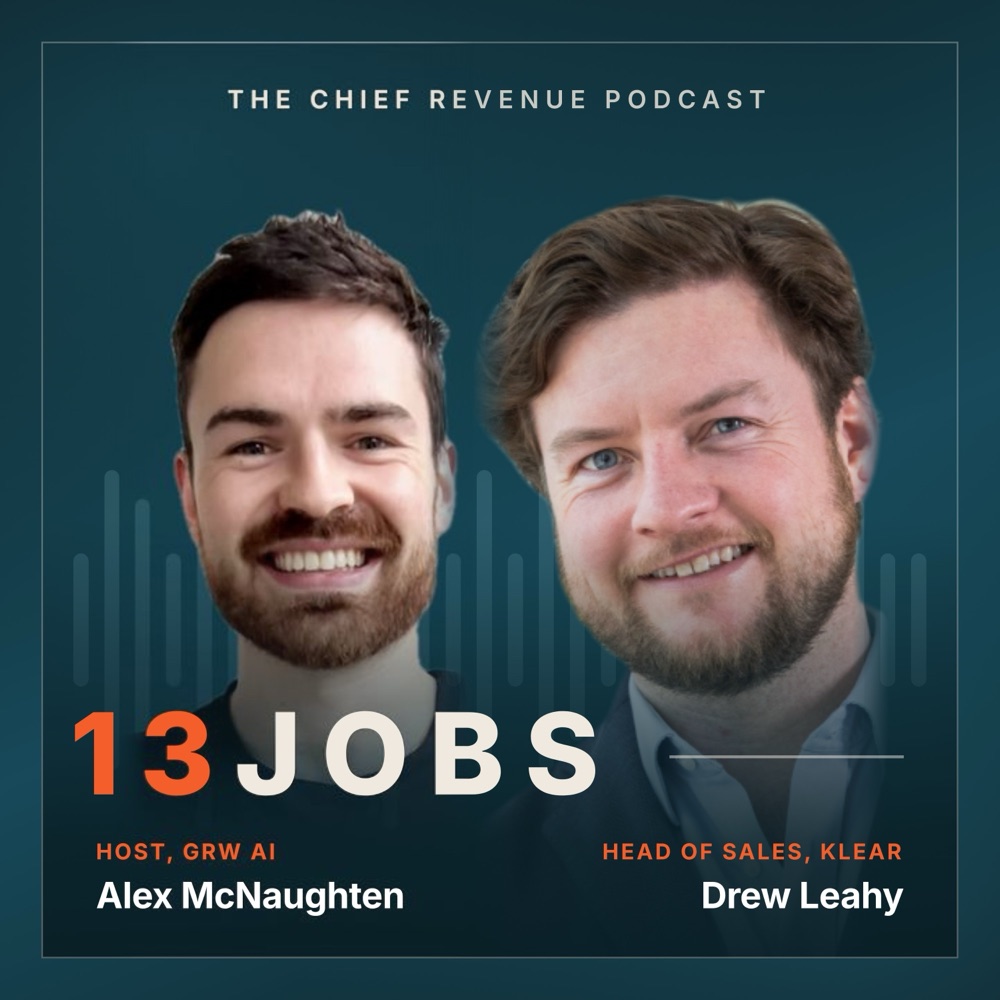
From VC to Sales Leader with Drew Leahy
Episode 075 · Sep 22, 2026
From VC to
Sales Leader
0:0031:45

From VC to Sales Leader

A decade picking horses in venture taught Drew that almost nobody has go-to-market figured out by Series A, so he took the sales seat himself, and hires for grit before skills.

Hosted by Alex McNaughten
Share

Drew Leahy · Head of Sales, Klear

Drew Leahy is Head of Sales at Klear, which finances aerospace and defense suppliers, and teaches Startup Sales at the University of Michigan's Center for Entrepreneurship. He joined Klear after eight months selling its trade finance to investors through SupplyFi, a private credit vehicle he helped build at SupplyCap, and asked the CEO for the job.

Before that he spent a decade on the allocation side, co-founding Hawke Ventures in Los Angeles, managing venture deals for a family office and doing a stint at a fund in New Zealand, where he met Alex. Earlier still he was a dorm-room founder at Michigan with MyBandStock, ran partnerships, marketing and product at Grooveshark, Mobile Roadie and Fullscreen, and built SnapSuits.com with his brother to a couple of million in revenue. His mantra: ideas are cheap, execution is gold. He is based in Detroit.

In this episode, we discuss:

  • A record label at 16, TechCrunch in 2008, LA startups and a custom-suit business with his brother
  • Why leave venture for a sales seat: zero default rates and a rocket ship from employee fifteen
  • Nobody has the go-to-market motion figured out by Series A, and every ICP needs a different one
  • Slap AI on it and it will just work? No. Everything takes three times longer
  • Living with uncertainty: known unknowns, unknown unknowns and building the plane in flight
  • January to June to get HubSpot to a place where the data can drive decisions
  • What 2026 tooling changes: Claude, Grw and HubSpot wired into the daily workflow
  • Hire for grit, personality, passion and a little bit of skills
  • Spotting grit: the audacious thing they did before you ever met them
  • Date before you marry: 100-day trials and hiring from your orbit
  • The AI workflow he could not live without: pre-call context and the follow-ups
  • Advice to his 18-year-old self: burn your hand on the burner and keep at it

Quote of the show

“I hire for grit, personality, passion, and a little bit of skills.”
Drew Leahy, Head of Sales, Klear

Key takeaways

  • Nobody has it figured out as early as you think. From the seed investor's seat, most companies are still working out their go-to-market at Series A and B. Every market, ICP and product needs its own motion, so stop looking for the box that runs itself and start experimenting.
  • Selling is the job you have already been doing. Founder, partnerships, marketing, product, fundraising: it is all selling in a different flavour. Drew moved into the sales seat because it is the same craft, pointed at a company he believes can be worth billions.
  • Budget three times longer, then live through it. Flying to the conference that produces no leads is not a failure, it is the method. Growth was strong month over month at Klear and the machine still took far longer to get right than anyone wanted.
  • Name the known unknowns, then get the data to close them. The early operator's job is to sort what you know you do not know from what you have not seen yet. Klear's HubSpot took January to June before the pipeline data was complete enough to make resourcing decisions on.
  • Hire for grit and teach the skills. Drew would rather take an unusual, hungry background and teach the sales than inherit someone's bad habits. He looks for the audacious thing they did before he met them and asks how they work when nobody is watching.
  • Work together before you hire. You cannot be sure from four hours of interviews. Do a project together, agree a 100-day trial where the law allows, and keep tabs on the people in your orbit who might fit a role you do not have yet.
  • The micro actions compound. Pre-call context, follow-ups written in his own voice, call notes landing in the CRM. None of it is dramatic alone, and together it is the difference between his day and a slower one.

Transcript

Alex McNaughten

Drew, thank you for coming on the show. It's good to see you, my friend. How you doing?

Drew Leahy

Thanks for having me. I'm doing, doing great. It's a good Friday here in Detroit and the end of the quarter is coming up here soon. So we are in the end of quarter scramble, get as many wins on the board as possible. So that's where we're at.

Alex McNaughten

I know the feeling. That's what it's all about at this time of the year. So for those who don't know Drew Leahy, Head of Sales at Klear, you're also a lecturer at University of Michigan and their engineering school. But tell us a little bit about your background and how you ended up in sales.

Drew Leahy

Yeah, thanks for asking. So I grew up with a dad who was Head of Sales of a territory here in the '90s selling software. But he was selling like floppy disks, you know, boxes of floppy disks to enterprise corporations, right? So yeah, I grew up with computers and technology and a father who worked in sales and, you know, I really, and then my mother was a social worker.

So I got the human side of growing up and being, you know, helping out all kinds of people. And then the the kind of capitalism sales side of things as well. You know, for me, I always was an innovator even growing up. I had a record label when I was 16 years old.

I was a lead singer of a band. I was recording bands and putting out their records and putting on shows. And, you know, before I even knew what GAAP accounting was, I was like selling stuff and had an LLC and We were in the music business. And so, I got into University of Michigan in the music school.

And quickly at music school, I ended up starting a company, an internet company called MyBandStock.com, built a team in Ann Arbor. We were actually featured in TechCrunch in like 2008, a really long time ago. Like, I've been in the startup game for 2 decades. It's kind of wild. But yeah, so raised a seed round of capital, moved to Los Angeles, music technology business.

Like, you know, we were living in a startup house, all of us, and building code and having parties. It kind of looked like The Social Network, that original movie. It kind of, that house was sort of like that and around a similar time too. But yeah, as many startups do, startups go one of two ways.

Didn't work out. But we all ended up getting jobs in Los Angeles. So I went to be the head of partnerships at a company called Grooveshark. Then I was head of marketing at a company called Mobile Roadie. And then I was a product manager at a company called Fullscreen, which was in the YouTube MCN space, ended up selling to Otter Media and AT&T for almost $1 billion.

I went back to school and got my degree because I left early to run MyBandStock in Los Angeles. Then I started another company with my brother called SnapSuits.com. SnapSuits.com was custom suits for $250 delivered in 14 days. And we sold primarily to weddings, to groomsmen and brides getting married. So we had a really beautiful sales motion built out there.

We had a free swatch kit that we sent out in the mail. We got people on the phone, we built a sales team, we had a whole marketing funnel to capture brides and grooms that are experimenting where they wanted to go for their groomsmen suits, or for some, it was like jeans and cowboy boots and a shirt and a vest with a cowboy hat.

So, we'd build the shirt and the vest for them. So, we could put all together all kinds of packages. So, my brother and I ran that company. We did a couple million in revenue. As brothers in business, sometimes you stop getting along. So, I decided to go I decided to go into the venture capital world and my brother kept running the company.

I said, I love you. I want you to be my brother, but I don't want to be partners with you anymore. So, we amicably split ways. You know, the divorce was amicable. And yeah, I went and built a $30 million venture fund in Los Angeles called Hawke Ventures. Previous to, right before that, I was working at a family office managing all of their venture capital deals.

And angel investment deals. So I built that. Then I moved to New Zealand. That's when I met you, Alex. Joined a venture fund in New Zealand. That didn't work out. Moved back to the United States, joined a deal-by-deal venture firm called SupplyCap, and we started a company called SupplyFi. That was a private credit initiative for family offices to get access to deals that Klear was actually servicing on a platform.

So we raised a little under $10 million for that. I got to know the CEO through that whole process. We also placed an equity check into Klear for a little under $2 million through a family office group that we worked with. And I looked at the CEO and I said, hey, you know what?

You don't have a head of sales. Like, I want to join the company. I spent the last 8 months learning trade finance as an asset class, selling it to investors. Now I'm also selling it to you know, the front end of Klear to, you know, essentially industrial, the most radical industrial suppliers in the United States.

Like, I want to join the company and I want to build Klear with you on the management team. And he said, great, sounds good. So there we go.

Alex McNaughten

Wild career over the last 2 decades, Drew. You've done more than most. Why now wanting to get into a sales seat? Of all the things you could go and do, like why sales today in, you know, 2026 or into 2025 when you joined?

Drew Leahy

Yeah, um, you know, I spent a decade as on the allocation side, so actually deciding like which horses you're gonna back in venture capital, uh, which jockeys, which horses. Um, turns out, as everyone knows, the loss ratio is massive. And that's an interesting thing to sort of realize in your career. We have multiple billion-dollar companies that we invested in, by the way.

So like, it's not for lack of success or lack of doing a good job in VC, but I'm really happy to be now working in a position where we're talking about like 0% default rates of the capital that I represent. Right? And that's very different than venture capital, right? So, what I got to do is not only still talk to world-beating, absolutely innovative companies every single day, which I got to do in VC, but I'm also offering them a product that's infinitely scalable with them that isn't risk loss, that we're not risking loss, right?

Because of the way we underwrite these loans. Clients. And I get to be part of a, what I think is a multi-billion dollar company at the end of the day that is going to be really successful. And so I built my entire career operating. I built a VC firm that was centered around operating inside of the deals that you cut checks to.

And so ultimately the ability to join a rocket ship and ride that into the sunset. I've never been a part of a, you know, 15, you know, early employee at a multi-billion dollar company. I've joined billion dollar companies when they're, you know, much later stage, you know, post-Series C or whatever. But that's not the same thing as building a rocket ship that goes to the moon, right?

So that's what I wanted to do. And to me, I've been doing sales my entire career, whether you're the CEO of a startup, whether you're running partnerships, whether you're running marketing, whether you're doing product, you're selling constantly. If you're raising capital for a venture capital fund, all you're doing is selling all day long.

Raising capital is selling. It's just a different flavor, right? Yeah, for sure. So the opportunity to join Klear, build a sales team from day one, from ground zero, build the culture, build the decision-making around sales with the CEO and the management team, And to continue in our success resourcing and building that culture and continuum of success at the company, I was sold, you know.

Alex McNaughten

What's been the most challenging part about building a sales org from scratch? Because you're right, like when you join a company in the first 10 or 15 employees, it's very different. 'Cause you're literally, you know, willing things into existence. Like what's been the hardest part about building the sales org?

Drew Leahy

As a seed, pre-seed investor, you make allocations into companies that still haven't figured this out yet, right? For the most part, some of them when they do figure it out, it's like, it's amazing, right? And you're able to kind of see that and understand how that works. Most organizations, they haven't figured out their GTM motion.

They haven't figured it out by Series A. They're still figuring it out Series B. Like if it was working like a well-oiled machine, like you'd be the most attractive company in the world. Like everyone's still figuring it out. Our best performing companies in our portfolio were extremely good at sales. Onboarded companies every month, retained their customers, 100% plus NRRs, right?

100% plus with teens involved, right? So like we're talking like really sticky, really fast growth, all that stuff. I'm trying to build that, but it's not figured out. And it, in every market, every ICP, every technology, every product solution, has a different motion. There's no like, put it in this box and it'll run itself, right?

Alex McNaughten

Mm-hmm.

Drew Leahy

Slap AI on it. Don't need an operator. Like, it'll just work, right? None of that works. You have to have experimentation. You have to try stuff. You have to fly to that conference and realize you're never gonna get any leads from that group of people that you thought were perfect. So, It's just, it's absolutely a trial and error kind of thing.

And so I think the hardest part is that I just, I'm really passionate about getting this to work and go really well. We have awesome month-over-month growth, quarter-over-quarter growth. Like we have all that stuff, but I'm really just, I really want the machine to continue to get better. And so I think everything takes 3 times longer than you expect.

I know that, you know that, the world knows that, but when you have to live through it, it's just painful, you know? And so—.

Alex McNaughten

How do you deal with that, Drew? Like, how do you deal with— because I think that's one of the hardest things about early stage team building and all building is that it's so uncertain and you don't know what's gonna work. Like, How do you deal with that uncertainty every day?

Drew Leahy

I think I'm uniquely suited for uncertainty because my entire life has been built around uncertainty, from being a lead singer of a band at 16 and starting a record label at 16. Those are like the riskiest endeavors you could ever like be a part of, right? Yeah. And now I'm in a position where 20 years later, I'm a Lecturer at university.

I'm the head of sales of a well-funded startup that's growing like crazy, like that doesn't have loss ratios of their capital. Like that my risk continuum, if this is the highest risk and now I'm at like the lowest risk, like I'm actually like, I've come really far down the risk continuum. And so, I like, I'm okay with the uncertainty because there's a lot of certainty.

Comparatively speaking with all of the, like, moving my entire family to New Zealand and having it not work out, like, is a pretty crazy thing to have happen.

Alex McNaughten

Yeah.

Drew Leahy

So, for me, it's like, this feels really good. And I welcome the uncertainty kind of in 2 categories, right? Like, you have known unknown and then you have unknown unknown. And so, the job is to figure out known unknown. And work it out. And then it's to call out where the known unknowns or the unknown unknowns are.

Like, I don't, right? And so you're just constantly kind of circling that. The goal of an early stage operator is to identify the known unknowns and then to work on create, like creating ROI from that. Right. And to use data is a really big piece. So like we're, We're just getting through our first, like, total HubSpot, like, data completion, right?

Because you're, like, building the plane as you're flying it.

Alex McNaughten

Yeah.

Drew Leahy

And you're, you're making mistakes and you're sucking, you're sucking all this information into your funnel. And over time, like, you build this piece, you build that piece, you have this process, you have that process. And then you got to go backwards and go, all right, we got to get all this figured out.

Like this deal, this source, this opportunity, like you got to go backwards. So we're just getting to the point where with, you know, thousands of contacts and hundreds of deals and all this stuff where we're like, okay, we're operating now at a, like, these are all known knowns, right? So let's go make decisions off that information now that it's complete.

But like, you know, we really started with our HubSpot instance in January and it's taken till June to like get to a place where we're like, okay, we can now start making decisions with this information. It just doesn't happen overnight, right?

Alex McNaughten

What has been different about building this sales organization in 2026 compared to when you've built sales organizations in the past? And, you know, I guess what I'm alluding to there is like, has technology changed? In terms of like how you think about it, how you resource it, like decisions you make?

Drew Leahy

Yeah, I would say that, you know, even though I'm like sort of complaining that like January to June is like a long time, it's like if I was doing this 10 years ago, like I would be— no, I would— there's no way I would be able to have the systems that I have today between, you know, Claude integrated to HubSpot, between Grw AI, Integrated with Slack and with HubSpot, and like all these systems that I get to use every day are so powerful.

It is it's it's incredible, right? My workflow automation is absolutely zooted today, right? A lot of it's Grw AI. I I have to call out is like one of the one of the best tools that I that I use in my daily. Usage as a salesperson. And so for me, the technology that is available today and how quickly I can work to learn about pipeline, move pipeline, have follow-up cadences the way that GenAI can come up with them, data-informed, information tracked, like that speed is just incredible to be able to have access to that.

And once our kind of HubSpot instance and our RevOps instance is fully working at the capacity that I want it to be, which like I kind of have a high bar for that.

Alex McNaughten

Yeah.

Drew Leahy

Once it's really, really working, like we could start really resourcing capital, make decisions, make spend, execute spend, you know, that sort of CRO level resource allocation like that, that's where everyone has to get to as soon as possible. As a venture-backed organization, and it takes a lot to do that. The tools are helping speed that up.

We also have an amazing RevOps company that we've outsourced to help us with all that. And Paul and Pierce at SMB are just incredible at getting our systems ready to go. So for us, you know, even though I'm impatient, if I take a step back, I'm like, we're actually doing pretty good. I just want things to go faster.

Alex McNaughten

I think, I think that's pretty common across folks in the startup world is impatience and wanting to move 2 times, 5 times, 100 times faster than they're already working. I'm curious if your approach to hiring is different in 2026 than how it has been in the past. Like, are you looking for different skills when you're hiring or do you think actually—.

Drew Leahy

No.

Alex McNaughten

No. Okay. That's interesting. Tell me about that. Nope.

Drew Leahy

I hire for grit, personality, uh, passion, and a little bit of skills.

Alex McNaughten

Okay.

Drew Leahy

But I would way rather teach you sales, teach you partnerships. I would way rather teach you how to do it than have you come in and be like, I, I know how to do this. I'm like, nope, you're probably gonna have bad habits. You're probably gonna do things differently than best practices. I would much rather have someone come in and learn how to do some of this stuff and be a little bit more patient and manage a little bit differently than like go get someone who's done it 100 times, put them in the seat and like not manage that process.

So I tend to hire for what I would say a little bit more soft skills combined with really cool and interesting backgrounds. And I want to put them in a position where they can be a leader and learn and make mistakes and fail, but like, but really just work their butt off. Right.

I would, I would much rather hire that for that person than like, I've done this 6 times, put me in.

Alex McNaughten

How do you identify that? Like, how do you identify that grit that like, I don't know, like, I guess what you're describing is that like raw makeup of like someone you can mold into an A-player salesperson? They're not there yet, but they've got that raw makeup. Like, how do you identify that? I think that's hard.

It's a hard challenge.

Drew Leahy

So it's 3 things. Um, one, it's audacious things that you've done in the past that are like crazy or really cool, right? So like, oh, I was a robotics entrepreneur and I sold a $300,000 robot to a furniture company before I ever built it, and I like cold called and emailed and like did the grind to like to do that, right?

And I'm like, oh, that sounds like somebody that I would love to have on my team. You know, so it's like that kind of that story, that narrative, that personality that they had before you ever met them that you're like, oh, that's super cool, and you're unique. And I want to work with you, you know?

That's basically the background of my GTM engineer who like has a background in philosophy and computer science from NYU.

Alex McNaughten

Like, okay.

Drew Leahy

Like super, super, like super interesting backgrounds, right? So I try to find folks that are just cut from a different cloth, you know, and I try to I try to size that up personality-wise, what they've done in the past. And then also it's just sort of what's your work style? You know, are you a like close the laptop at 5 o'clock person or are you like, I'm up late because like I'm tinkering and I want to figure this out person, right?

Some people want to close the laptop at 6 o'clock and like have a life and like don't want to get stock options. 'Cause like they're just not in it for that, you know?

Alex McNaughten

Sure.

Drew Leahy

That's fine. That's totally cool. You know, probably not a fit for my team in a sales organization at a startup, you know, but everyone's got their own journey. You know, some people wanna like break into tech and grind it out and learn and, you know, they have just a different like trajectory of where they wanna be and who the person they wanna be is a year from now, 5 years from now.

And like, I love working with those people who have a mission, a drive, a purpose, and I'm gonna be, I'm gonna help enable them to that end goal, right?

Alex McNaughten

Um, one thing, one thing I've always found hard is a lot of people say that, but they don't actually do it. You know, like they'll say they wanna work really hard, they'll say they wanna work, you know, the weekends, et cetera, et cetera, but then when it comes down to it, actually, they'd rather, they'd rather pop up at 5 or 6, and they'd rather have like more free time.

And like, no judgment against people like that, but I think in the interview process, people will talk a big game and not always deliver. How do you identify like the real, like the folks who are real in that sense?

Drew Leahy

Well, it's, I mean, truly, it's impossible to be 100% sure. I think most, most, most like, hirings for me are like, let's get to know each other. Let's see if this is a fit for you. Let's see if this is a fit for me. Like, you know, let's, let's not dream that we're gonna be together for 5 years when we've never dated, you know?

So I think it's very important to like make sure that every— it's a fit for everyone, you know? It's like, hey, let's, let's try this for 100 days and make sure everyone's comfortable, you know? By the way, good luck doing that in New Zealand. Because yeah, like, like, it's hard to do stuff like that.

Very hard to do stuff like that. Um, meanwhile, like, I, I just think that people should make sure that everyone's happy with the decision once you actually get into the grind of things. Um, you know, like my last associate, uh, at Hawke Ventures, I met her through a venture program that I put on.

Meanwhile, before that, like, I met her from University of Michigan and her and her boyfriend at the time, now married and having a family. Like, I got to know them. And so, like, some of these hires are people that you orbit for a little bit with each other and you kind of see how you operate and you see how you execute.

Maybe you do a project together, maybe you have a, you know, I did this venture capital course for folks to break into VC and like, she took that course and I got to see all of how amazing her potential was and her work ethic and all these things. And so sometimes hiring is like, you know, the person that you just met off the street who threw in their resume, who, whatever, sometimes that's just a really hard thing to hire with.

You know, those referrals are really helpful proximity. So I'm always kind of seeing people in my orbit and, you know, oh man, that person might be really good for this role someday or whatever. So, It's hard. It's actually very— hiring is one of the hardest things for entrepreneurs and business professionals to get right.

It's very hard. It's why people hire their friend's kid, or it's why they hire their cousin or whatever, because it's like, I know that I can get accountability out of this person. Like, I know it because they're not a stranger. Like, and so I just, I understand some of that nepotism pieces, but It's also like, you know, it's who you know, you know?

Alex McNaughten

I love the kind of like keeping mental tabs of who's in your orbit and who might be a good fit for specific roles. Even if you don't have a role today, it's kind of like taking those mental notes and you're so right, you know, it's that proximity and that time can then give you more confidence in that person that they can do what you need them to do.

Because like, if you do just get someone off the street, here's their CV, you spend maybe 2 to 4 hours getting to know them over a hiring process. Like, how well do you really know them? Like, you could do tests, but you don't really know them yet.

Drew Leahy

Yeah, I always, I always recommend people work on a project together before they hire, you know.

Alex McNaughten

That's what my co-founders and I did before we all kind of jumped in and, and, and, you know, got married together effectively. You know, we did a project for a few months to see how it was like to actually work together. I have 2 questions then for you, Drew, before we wrap. Super interesting conversation.

I've taken away a bunch from this. Penultimate question is, what's the one AI workflow or AI use case you couldn't live without? Like if someone took it away tomorrow, it would ruin your whole You know, ruin your month?

Drew Leahy

That's a great question. You know, I work at a very fast pace. And so these like AI summaries before calls, the AI follow-up messaging that's baked into like all the other messages that I've written before, these This GenAI combined with context that lives in my day-to-day workforce. So the information before a call, the post-follow-up call, like I could not get as much done on a daily basis if I had to come up with that myself.

And if I had to follow up myself, you know, all these little micro actions.

Alex McNaughten

Yeah.

Drew Leahy

Add up massively. And so, you know, one of the things that I'm really excited about for AI to do is to start essentially using the context of a phone call and then putting that information inside of HubSpot in some way, right? I'm excited to kind of get Work on systems to get that better because we have a pretty, pretty, pretty basic sales process for like, who do you sell to?

What are their names? Are they big companies? Are they small companies? Whatever. And it'd be so great if it was like, like customer they talked about A, customer they talked about B, like, oh, here's the, like it's Boeing, it's Anheuser-Busch. Like there's some like little things that I'd love to start that next level deeper of integration with the systems.

And like, you know, for me, it's all these micro actions add up to me being able to be more productive, you know? So I really appreciate that.

Alex McNaughten

Last question I have for you is knowing everything you know now, you know, across your 20 years, you know, in business and at work, Go back to your first day on the job. What's the one piece of advice you'd give your younger self?

Drew Leahy

Like, which younger self? I've had a handful of them.

Alex McNaughten

I don't know, like maybe you at 18, you know, like you're just about ready to like kind of get out there in the world. Like, what's the piece of advice you'd give yourself?

Drew Leahy

Yeah, I'm kind of like a no regrets, like you just gotta kind of go through all the sludge and like You gotta kind of experience life. You gotta burn your hand on the burner to like know that you shouldn't put your hand on the burner. Like, I'm just kind of like one of those people.

And, you know, I think I would tell my 18-year-old self to like just keep living life with like no meat on, like just pick all the meat off the bone. Like just, you know, live in abundance. Experience everything. You know, mistakes are going to hurt, but they're going to make you learn for the future.

Continue to be just a good person out in the market and do right by people. You know, live with integrity. Do sales and marketing with integrity. And like everything will kind of work out. Like just, but just wake up every day with a passion and a vengeance and Keep going and and do work with people that you love and people that you like, and churn out people that you don't like working with, or people who are not honorable, or people who don't have integrity.

Like, don't work with those people, you know? Yeah, I'd tell my 18-year-old self to just keep at it, man. Just keep doing it. Just keep waking up and and and living living large, you know? And yeah, like. Sometimes all you can afford is like wings at 7-Eleven and like a, like a 36-pack of PBR.

It's cheap, you know, like sometimes that's, sometimes that's all you can do, you know? And like, work harder, you know, like, get better, you know? So yeah, I don't have any like life-changing, like changes that I would make other than just keep at it. Never stop.

Alex McNaughten

I love it. Drew, thank you for coming on the show. Great conversation, a bunch of gold in there. Where can people find you if they want to connect with you, consume your content, all the rest of it?

Drew Leahy

Yeah, I'm on LinkedIn. I post pretty frequently and yeah, that's like probably the best way to interact with me. And Yeah, always, always happy to answer anyone's questions or, or be connected.

Alex McNaughten

Awesome. Drew, thanks so much. Good to talk to you.

Drew Leahy

Yeah, thanks, Alex. Appreciate you, man.