
Nobody taught me how to be a sales leader
Todd's second book exists because nobody taught him the job. The part he thinks companies most neglect is telling people why their work matters.
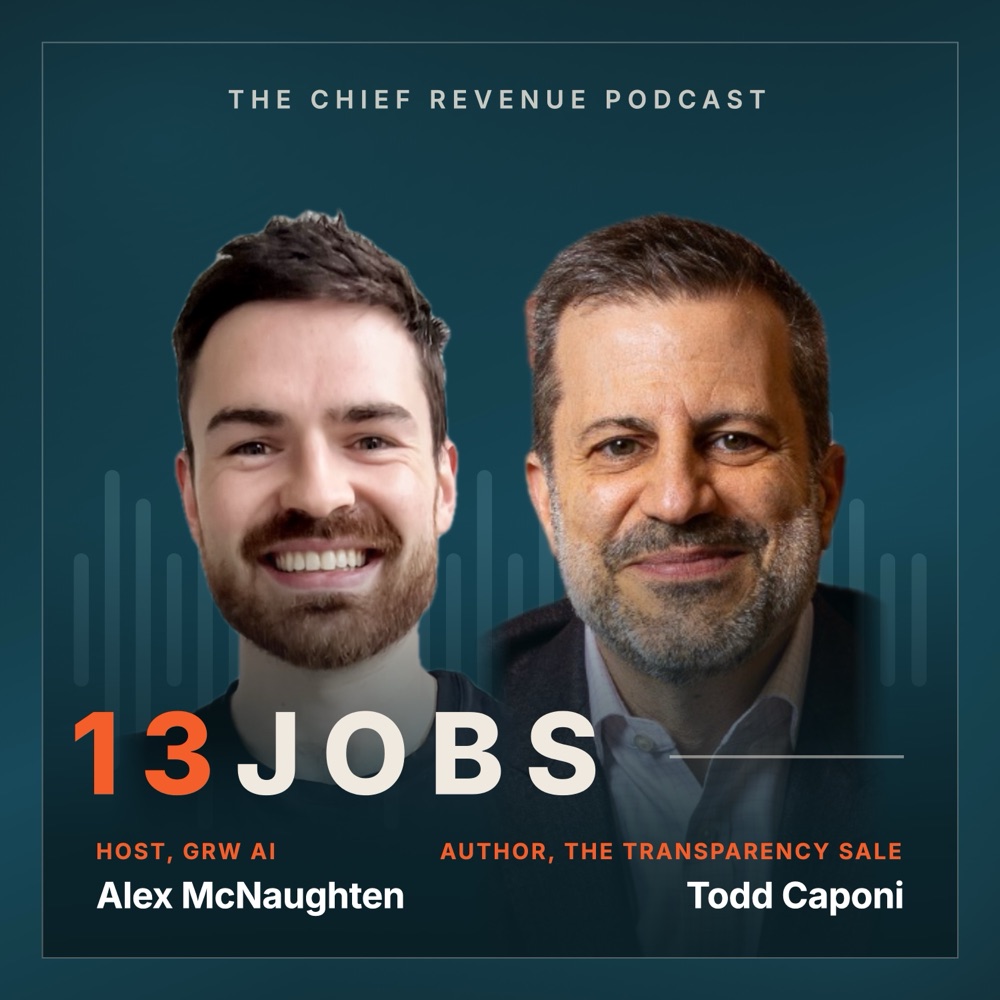
 Hosted by Alex McNaughten
Todd Caponi · Author, The Transparency Sale
Todd Caponi is the author of The Transparency Sale and a student of the behavioural science of how people make decisions. He was chief revenue officer of Power Reviews in Chicago before a research study with Northwestern University redirected his career.
This is his first appearance on the show. He came back later for episode 036, the throwback recording of his webinar on selling in uncertain times. Here he is mostly on sales leadership, and the book on it that he was writing at the time.
In this episode, we discuss:
- Behavioural science, and how people actually make decisions
- What lockdown did to the market for salespeople
- When leaving costs nothing, physically or emotionally
- Zoom happy hours had their moment, and it has passed
- The PRAISE model, and six intrinsic drivers
- We are prediction machines, and uncertainty is the enemy
- Aim: the driver almost everyone under-indexes
- The plant with no turnover, and who they brought in to speak
- Interview your customers to find out why the work matters
- Leadership habits born in a one-and-done sales world
- Discovery that feels like a witness stand
- The New York meeting where he first tried leading with a flaw
Quote of the show
“I don't see companies spending a lot of time just making sure that they're interviewing their customers to know why their work matters.”
Key takeaways
- Leaving got cheap. No commute to change, no colleagues you have ever met in person. Both the physical and the emotional cost of moving jobs fell to near zero at the same moment demand for sellers spiked.
- Security was the whole focus for fifteen months. Understandably so, in early 2020. But the other intrinsic drivers went untended for over a year, and that is what the turnover is made of.
- Aim is the neglected one. Does this person know how their work lands on the company, the customer, and the customer's customer. Almost nobody invests in answering that.
- Go and ask the customers. A renewal is not an explanation. Interviewing customers about why the work matters gives a team something a happy hour never will.
- Happy hours solved a real problem, once. In mid 2020 they were genuinely valuable. Still running them eighteen months later is answering a question nobody is asking any more.
- Discovery is not a deposition. A list of qualifying questions fired at someone is a witness stand. You do not walk into a bank and make withdrawals before you have made a deposit.
- Perfection makes them go looking. Presenting as flawless sends buyers off to do their own homework, which is where your competitors get to position against you.
Transcript
Todd. It is good to see you again. How are you doing?
I'm fantastic, and it's always good hanging out with you, brother.
Thank you. It's good to have you here. So today we got Todd Capone. He is a sales leader, author, speaker, guru, sales historian. Todd, tell us about yourself.
I think you just nailed it. I'm I I don't know where this started, but I've always been. Really enamored by the kind of the behavioral science of how human beings make decisions. And as I moved into sales leadership, so I'm a multi-time sales leader, I've just found that it really made a big impact on my career and the way that I not only treat people but treat clients and prospects.
And, uh, you know, a couple years ago, a crazy research study led me to quit my job and write a book called The Transparency Sale. And I, when I wrote it, I thought there was a 50/50 shot that it would suck because I never written a book. But it has done incredibly well.
And it's turned into a business where I, you know, a lot of keynote speeches, a lot of workshops, teaching reps to enhance their messaging, positioning, and even negotiating, optimizing for the way that buyers engage, prioritize, decide, and buy. So that's what I'm up to.
That's awesome. And I think a lot of people who've kind of tuned into my content for a while will have definitely heard me mention The Transparency Sale. It's actually one of the key books we recommend to our Apprento— what's the word— sales grads as they're coming through. It's one of our number one books that we recommend them to read as they're getting started with their career.
So it's good to have you on again, Todd. Today we are going to talk a little bit about sales leadership and then also sales leadership in the context of today. And there's a lot of things going on right now. And I think one of the buzzwords that we've heard about, and it's just about creeping into the New Zealand, Australian type ecosystem, is this idea of the Great Resignation.
So maybe we'll start there. Todd, could you tell us a little bit about what is the Great Resignation all about? And for those who don't know, and then let's get into how sales leaders need to think about leadership.
Yeah, I mean, there's a couple of things. So, you know, what has been happening here is a couple of things, obviously, with lockdowns, and you've got reps that are working remotely. In many cases, they've never even met the people that they're working with, right? You can do Zoom happy hours all day long, but it doesn't ever replace that connection that's made by being in the trenches with the individuals and doing actual happy hours and going to lunches and grabbing drinks afterwards and all that.
And so you combine that with the fact that because of lockdowns, the requirements across organizations around enhancing their technology spend has gone way up, right? Like, we need to be able to enable businesses to continue to flourish even when they're remote. So as a result, You know, there's a term here in the US they call unicorn, right, which is these companies that are being invested in with these multi-billion dollar valuations.
And there's been more in 2021 than like the last 6 years combined.
Yeah.
As a result, you've got a huge demand for salespeople and the supply hasn't changed, right? So the supply can't keep up with that demand. So this great resignation is a couple of things. First of all, if you look here in the US at the— there's something called the US Department of Labor Statistics.
The number of people changing jobs every month is the highest it's been since they started recording that as a data point.
Wow.
Right? So people are changing jobs at the highest rate they ever have since they recorded that. And then you combine that with the fact that there's a website here called ZipRecruiter, which is a big one for recruiting. And job postings. And at one point earlier in the summer here, so your winter, was there were over 700,000 open sales roles in the US alone.
And that's not retail, that's not car sales, that's not real estate, that's like B2B sales. 700,000.
Wow.
All right, so let's take all of those pieces together and think about this idea that if your physical cost of changing jobs is practically non-existent Meaning you don't have to change your commute. Maybe I send you a new laptop and here's some logoed socks to make you feel part of the family, right?
Um, so like the physical cost, practically nonexistent.
Yeah.
And then you combine that with the emotional cost of changing jobs being practically nonexistent because we've never met, right? Again, I— it's easier for me to leave you if I've never actually, you know, pressed the flesh with you and had a drink or hung out with you. Then the triggers by which we change jobs become much lower.
Yeah.
Meaning, you raise my quota? Oh, all right, see ya. Um, I'm working on a deal that, uh, I've been working on a long time and it just didn't close, and now I don't like my pipeline. Uh, you know what, before I get in trouble for that, see ya. Uh, you just shrunk my territory, see ya.
I went to a party and one of my buddies is talking about how great their company is and how they're hiring and how much money they're making. Oh, I'm gonna go there. Like, our connection physically and emotionally to our jobs has gone down. Yeah, the supply is so high. As a result, we're just seeing people that are, you know, jumping at the slightest trigger today.
Whereas in the past, physical cost was higher, emotional cost was higher, you're not going to see the turnover. Now you're going to see it.
Yeah, it's super interesting. And I think one of the— I wrote about wrote about this and this sort of how it was starting off here in New Zealand for Business Desk recently. And I think one of the things we're seeing, and I presume it's very similar, is that people are just getting offered more and more and more money just to move.
And they're, you know, they're, you know, one, one, one particular story that for, from, for a client of ours that we, we heard was, um, someone given a pay rise in March, that's really quite substantial pay rise in March, okay, not a small one. Then by June they're being offered more money by a competitor and more responsibility.
And then the, the incumbent company has to turn around and offer this person even more money in June, July to keep them. And we're seeing that sort of behavior going on all the time. And I think, you know, I think you've summed it up beautifully there. It's, it's because it's so easy to move.
Because if all I need to do is just change all my login details to a new company on my computer, Not a big deal, right?
What's keeping me here? Well, yeah, and I think that, you know, when I'm looking at sales leadership through the lens of the behavioral science of it and thinking about this idea that, you know, we're trying to hone in on like, oh, you know what, we better fix one of those. We can't fix the physical, uh, connection, so let's fix the emotional.
More happy hours. Like, ugh, you know, like we're all tired of that. And there's nothing unique about that. Like, I can do a Zoom happy hour with any other company There is, uh, so I'm writing a second book right now. It's called The Transparent Sales Leader, should be out April, May of 2022.
But in it, I hone in on this. I've got a model, it's called the PRAISE model of intrinsic inspiration, meaning what are the elements, and there's 6 of them, they happen to start with letters that make the word praise, lucky me, that drive us intrinsically to stay to do our best work and to become potentially an advocate for others, which is what you want.
And I'll kind of walk you through quickly the praise model.
Yeah.
And I want to, as we talk about this great resignation or whatever it is, there's, there's one element that I think we're under-indexed, but we're over-indexed on the whole happy hour concept and like trying to make connections. So the praise model—.
Just, just before that, Todd, I just want to ask you really before you dive in, Quick question, kind of a semi-funny one. It's like, what do you think about these Zoom happy hours? Because the feedback I get from reps is, oh my God, a happy hour on a Friday. The last thing I wanna do is log into Zoom at 4:00 PM and like pretend to drink.
What do you actually think about them?
Well, I think that it's been amazing when you think about this model and the evolution of what's happened since March of 2020, right? Where all of a sudden you're locked down. So you've got sales leaders that desire certainty and control. You got reps that desire independence and autonomy. And all of a sudden the leaders are like, I can't see you, I can't see anybody.
So you know what we're gonna do? We're gonna do morning check-ins and afternoon check-ins every day. What are you gonna work on today and how did it go? Right? Like, that's what we do. And that's— so we did that for a few weeks, but we realized very quickly that, that was driving disengagement, partially because the reps are spending half an hour before that call going, what kind of BS can I come up with that's gonna make everybody happy, but not make me sound like a brown nose?
And then at the end of the day, the exact same thing, like, what am I gonna share that's gonna, even though I didn't do anything today? So we did that for a month. And then the recognition came that, hey, listen, the emotional connection just isn't there. We need to do more connection and making people feel secure and safe and part of a family.
And right, and that's where the Zoom happy hour started. And I think rightfully so, like we needed to loosen up. We needed to make sure that we were still having the opportunity to like tell jokes and be human beings with each other, 'cause we were alone, right? When we're alone in our homes, not with anybody, our, you know, our safety mechanisms go off.
Yeah.
And so we needed to do that, but the problem was, We started doing those in really May, June of 2020. Here we are, the end of 2021, and we're still doing Zoom happy hours. Like, enough already. Like, we fixed that issue. That ship has sailed.
Yeah.
And there's other elements. So I think the Zoom happy hours had a place. Okay. They were really valuable for a while, but I think we need to get past that.
Right. There's fatigue from it now.
Like, and it's not unique. Everybody can do like happy hour. What does your company offer? Right? And so that's where I think this PRAISE model is really important. There's 6 things that drive us intrinsically as human beings, right? And so it starts with the word praise. The P is predictability.
Mm-hmm.
So like we as human beings, we're prediction machines, we're forecast machines, right? Like we do our best work when we can predict. When we can't, uncertainty drives us crazy. Go back to March of 2020, go to your local grocery store and see everybody lined up to buy toilet paper. Why? Because there was uncertainty and like, we're going to hoard toilet paper and hand sanitizer.
Like, that's, that's what we do. We're prediction machines and we go crazy when we can't. The R is recognition, meaning we do our best work when we're recognized for our efforts. Like when we're given validation, praise, feedback, reward, like that sort of thing. Um, it means more in many cases than the dollars.
And Meaning, like, if we're publicly praised for the work that we're doing, recognized, validated for the effort, we continue to work hard, right? That's a driver of intrinsic inspiration. The third one is the A, which is aim, meaning what is the aim of our work? What's the mission? What's the purpose? What impact are we having?
Am I just a number with a number, or does my work actually mean something? And we're going to come back to that one because I think that's a missed opportunity. Is making your work matter. All right, the I is independence, meaning like I said, we do our best work when we've got a feeling of independence, control, we're given trust and the resources to do our best work without being micromanaged, right?
The S is security, which is we do our best work when we feel safe, when we're secure, when we're part of something like family, right? You're part of a pack. Uh, you know, if you're out in the woods by yourself, you're in survival mode. If you're with people, you feel a little bit safer and kind of think, all I have to do is be faster than the slowest person, right, to survive.
So I do better work. And then the 6th, uh, letter is the E, which is equitability. Meaning, is the juice worth the squeeze? Is the effort that I'm putting in— am I getting the rewards back that are equal? And is it fair? Like, Meaning when I say equitability, politics, somebody getting paid to do the same job more than me, that drives the intrinsic inspiration down.
Yep.
So when we go back to your question and think about all of this, we over-indexed on security for a while, right?
Yeah.
For a while, meaning 15 months. I think there is a tremendous opportunity for us to, as organizations, start to focus on aim, the aim of their work, and make sure that our reps know it and they're feeling it and they're living it. And what I mean by that is it's unique to your company that what you do goes far beyond your forecast and your numbers.
Right.
How does my work impact our company? How does our impact impact— or how does our— my work impact our customers, like, in their day-to-day lives? Like, is it making a difference on them? And then what about their customers? How does my work make our customers' customers' lives better? If I don't know that, and if I don't feel that, then again, see ya.
Oh, higher quota, see you later, right? Oh, you're being a jerk today, I quit, right? Like, we got to get out of that. And if, you know, I'll give you an example, and it might be a cheesy example, but hopefully for everybody listening, it's a place to start. There was a company, uh, that I had heard about that, um, they had a number of their employees that sat in a warehouse and stacked basically parts to put together medical devices.
Okay.
Right, so they've got the employees 8 hours a day, they're just like— it's like, it sounds like the most menial work in the world.
Sure.
The reps, or they're, they're those people, no turnover. Attendance rates were fantastic. They did great work. But like, you wonder why. That sounds horrible. Like, well, here's what they did. Every couple of weeks, they would bring somebody in and do a lunch and learn. And that person that they brought in was wearing one of the medical devices.
And they would talk to the people and say, hey, listen, if it wasn't for you doing that and doing it right, I wouldn't be here right now. And then all of a sudden, their kids would come in and be like, I wouldn't have mommy, right?
Yeah.
And like, the next thing you know, they're like, crying, everybody's crying together, and they go back and they stack, right? I think with every one of our organizations, we're making an impact beyond our own number.
Yep.
Where when we're selling technology, when we're sending— selling services, we're selling anything, we're making people's lives better. And we better know in a unique way, because I think that's the unique magnet that keeps people doing what they do, is if they know that their work matters, the aim of their work matters beyond just the number.
I think that's a tremendous opportunity that companies are not spending any time on.
Right. And do you think that of the— in the PRAISE model that you just laid out, do you think that's a uniquely large opportunity right now compared to some of the other ones? And if so, what makes you say that?
Well, I just think it's under-indexed, right? The best leaders in the world know that, hey, we've got to help our team predict, right? We got that. We gotta provide opportunities to recognize their work and validate them, give them feedback, that sort of thing. We're trying to create, like now they're all home, they're working remotely, so they've got independence.
We're trying to give them the tools to do that while we still maintain some level of certainty and predictability on our side. We're doing the Zoom happy hours. Yeah, that's great. And we're trying to be as equitable as possible. There's a real focus there.
Yeah.
But I don't see companies spending a lot of time just making sure that they're interviewing their customers to know why their work matters. You get a customer that renews with you, let's say you're in a SaaS environment. Have you ever asked them why? Like, have you ever asked them like, hey, of all the things that you could be focusing your dollars and your attention on, why did you renew with us?
And like, what's a couple of unique things that make you feel proud of what you sell and what you do? Right? And make that connection and start to vet out those themes. Because again, like, you know, my last role, I was the chief revenue officer of a company selling ratings and reviews technology.
Who cares? Well, you know who cares? The end user, the person that's spending their hard-earned money and trying to make a good decision on something that is going to impact their life. Ratings and reviews help them make smarter decisions with where they spend their money and when they make those smarter decisions, their lives are better.
Yeah, that's what we do. We don't sell reviews. We're not trying to hit a target. We're trying to make people's lives better. And as cheesy as that sounds, until you have a mission behind your work that's unique to you, people could just get up and leave tomorrow. And I think you will be surprised by who does.
I think that's a really, really good point. Because when people feel like they have a real connection with what they do, and they feel valued beyond the number, right? You know, if we look in the context of sales, you know, if they feel valued beyond the number, they can see that what they do actually has a broader impact.
They're far less likely to jump ship for another $20,000, $30,000, right?
Yes.
Or they're far more likely to overlook the fact that maybe their quota has been bumped up because they love what they do and they feel connected to it. And I think I think you're right. I think broadly speaking, we have lost that connection between what we're selling and how it's actually impacting other people's lives beyond just the fact that we need to hit a number.
Why do you think that was lost? Or do you think it was— or maybe a better question is, was that ever there?
Mm-hmm.
And then a follow-up is, okay, what does good look like? How does a sales leader actually start to instill that in a sales team?
Yeah, I mean, where it came from is it's kind of like the reason that I decided I had to get this next book out is when I first moved into sales leadership, nobody taught me how to do, how to be a sales leader, right? Like, you know, I always thought that like my job is to get to the number.
It was almost like being like caveman, right? So like me, Build pipeline, me close it, me hire, me fire, right? Like, that was it. And so, like, who's to know that you're supposed to do this, these things, and balance out the things that drive us intrinsically when nobody's ever been taught it? And so that's, that's part of where this comes from.
It's nobody's fault. It's, hey, listen, I hired you to hit a number, I hired you to build a team, go, right?
Yeah.
And I just think that we need to illuminate that there's some other elements that actually, you know, result in the performance and the tenure stickiness that you're looking for in your teams. And it's these things, right? To make sure that you're balancing them out. You know, it's like fear is a motivator, right?
But it'll motivate you to leave. Like there's certain things that I was taught as a sales leader from the leaders that I worked for before that literally drive the opposite of intrinsic inspiration.
Yeah.
And so I just think we've gotta level set and get people to, start thinking this way. Now, just like that med device company that is bringing people in that are talking about, hey, your work is keeping me alive. There was like a road construction crew that's building highways. They would bring people in like families that are like, hey, listen, your work is not only saving us money so we don't have to buy new tires every year, but you're keeping my family safe as we go back and forth to to grandma's house.
Like, it's, I just think that like what looks great is to make sure that we're bringing in customers and we're not just talking about like the ROI that we're getting from like solution, we're talking about the impact that it's having on individuals and their lives. When we do that, your customers want you to be successful because they wanna keep working with you.
Bring them in, interview them, talk to them with your teams, and start to illuminate that, yeah, it's not just about hitting the number, it's about making people's lives better. I just think it's a missed opportunity that nobody's doing.
I'd say it's probably also, if we look at it as from a revenue function perspective, I think there's also marketing's role in that as well, right? Is actually helping to tell these stories not only internally but also externally. I'd imagine that that's a really good powerful story to share too.
Yeah, well, yeah, exactly. It's your customer base. You know, so many of our approaches of leadership are born in the one and done type of sales environment, right? Like sales leadership from even in technology. Like when I started in technology, we were selling what was called perpetual licenses where you buy the software and then you pay a maintenance fee every year.
So like the bulk, 90% of your long-term investment in the technology is done after one year.
Yeah.
So as a salesperson, you jam it in there, See ya. Like, yeah, good luck, right? And we're in a different world now where you've got to maintain those relationships with your customers if you want them to stay, buy more, and advocate. Now, I think that also means though that your relationships with your customers are stronger and you've got better opportunities to inquire with them and build those relationships and ask them, right?
I think it's just a huge opportunity to make a real concerted effort, not only in marketing teams, but in client success teams, To spend more time understanding the impacts beyond just the ROI and the numbers and helping them hit their bonus or whatever. Like, what are we doing that are like unexpected benefits that they're getting from working with us, right?
Like, pull some of that stuff out and then share that with the team. And it just, again, it glues your team to the mission and purpose, which is unique to your company. When they unplug and go somewhere else, it's a different mission and purpose than what you've got. And once they've made that connection, I think there's that emotional cost of changing jobs.
You've got to figure out how to make that higher, but you're not doing it for evil. You're doing it for good because your performance goes up when your intrinsic inspiration goes up too.
Yeah.
Yeah.
Well, that's the other thing, right? Is not only do you— are you more likely to stay, you're actually more likely to perform better because you'll go the extra mile, you'll work a little bit later because you're tied to it. You're emotionally invested.
And you'll start doing more read, like you'll follow Twitter accounts or whatever, you'll start reading about it because you want to be smart on it because you care about it. If you're selling something you don't care about and you don't really care the impact, you're really not going to get that great at it.
If you really care about the impact that you're making, you make it your life's work.
And I think it comes down to curiosity a little bit as well, which is I think one of the things that we don't teach reps enough. Or leaders actually in general. I just don't think in sales in general we emphasize this idea of curiosity enough and actually asking more than just the basic qualification questions, you know, going beyond just what's your budget to, hey, you know, tell us why you chose us.
Tell us how it's impacted you, how it's impacted your teams. You know, those are the kinds of questions that we're not really asking. I think if we're Broadly honest with ourselves as you know as a sales leadership community, and you're obviously encouraging this massively, which is awesome because I think it's massively needed.
What would you? One of the things that we've been—it's a slight change of topic—but one of the things we're we're really trying to instill in the reps that we're coaching is this idea of curiosity and how important it is. You know, two ears, one mouth. Rather than the traditional kind of pitching approach to sales.
You got any thoughts on that?
I got lots of thoughts on that.
Okay.
You've come to the right place. You know, I think that goes back to, you know, obviously this whole transparency piece from my first book, right? Which is, it's born of this idea that imperfection actually sells better than pretending to be perfect. You know, like the greatest companies in the world embrace what they give up Or they make it easily accessible what bad experiences customers have through reviews, right?
Like Amazon, they've done pretty well, I think. I think you've all heard of them. You know, they were the first to put negative— like, you bought a product, you didn't like it, you come back, you write about why you didn't like it, we're going to display it right under the product.
Yeah.
It aids customers in their pursuit. And the reason why is that, again, our brains are prediction machines. We subconsciously know that perfection is not a real thing, which is why 85% of us, when reading reviews, go to the negative reviews first. We skip the 5s, go right to the 4s, 3s, 2s, and 1s.
And a product that has negative reviews will sell at a higher rate than a product that has no negative reviews. Now, the reason I say that is it's a disarming mechanism to our brains, right? That when we are able to assess, is the juice going to be worth the squeeze? I know what the juice is and I know what the squeeze is gonna be, I'm able to trigger a decision more quickly, but it builds trust.
Now, the whole 2 ears, one mouth thing is born— like, I got in a debate with somebody that's just like, we should just listen more. Well, I'm also a believer in you've gotta earn the right and you gotta earn the trust. And what that means is instead of coming in and going, hey, we're awesome, did I mention how awesome it is?
Tell me about your challenges. You haven't earned nothing, right? You haven't earned the right to have that conversation. But if you change it a little bit and say, hey, listen, before we dig into this, couple of things. First of all, companies like yours, here's a couple of things that we don't do perfectly, right?
That maybe a competitor might be a better fit for. If that's gonna be a problem, let's vet that out first. Oh, and our pricing, based on our understanding of your organization, the pricing is probably gonna be between X and Y. If that's way out of whack, let's address that now. Because again, if you're selling a 6-figure solution to a 4-figure buyer or vice versa, one of you is in the wrong discussion.
Probably want to know that now. But then you talk about, hey, listen, some companies like yours love this, some don't. Let's dig in and vet like what your desired outcomes are and make sure that we've got alignment before we get too deep into this. Because again, you'll win fast that way, but you'll lose fast that way.
But the point being is I believe you can earn the right to have really good listening conversations by earning the right to ask the questions and get trust-based answers.
Right. I see what you mean.
That's, that's the difference, is so many of us are taught to do discovery where it's like, hey Alex, you're up on the witness stand now, I have questions to ask you, and I just start pounding you with witness stand-esque questions. You're going to be defensive on your like, what is this going to be used against me in a court of law later?
Right? Or you can act like a human being and earn the right by basing it on trust and go, hey, listen, I genuinely want to figure out whether this is going to work for you or whether it's not. I've got some questions to ask you that's going to assess fit. Let's go through those and really have a good discussion around this so that, you know, we can part as friends right away.
Or maybe this is the thing that's going to get you that desired income, that outcome that that matters. So my point being, use transparency to earn the right, and then yes, your discovery questions will garner you much better, broader, most— more trust-based answers if you do it the right way.
Yeah, I think that's really good feedback. Uh, it's sort of how you ask the questions. It's not just interrogating someone, which is, I think, sometimes where inexperienced people, when they've been given their qualification checklist, kind of lean into, and they just kind of turn into the police interrogator. Um, which is not a great experience for the buyer.
So like one of the things we often say to people is like, hey, think about how the buyer is going to feel, like the other side is going to feel with your approach that you're using today, and just put yourself in their shoes for a second and then see, okay, maybe that's not so good.
Maybe they're going to feel like they're on the witness stand.
The analogy is also like you're not going to go to the bank and ask to make a bunch of withdrawals unless you've made a few deposits, right? Like they would just be like What do you— why are you asking me like for money? You haven't made any— there's nothing to withdraw against. You got to make your deposits first.
And I think that those deposits are do a little teaching, earn trust through transparency, and earn the right to ask the questions that you are. And it's not that hard, right? This isn't rocket science. This is being a human being.
Yeah, that's right. I think sometimes we forget to be human when we're selling. Yeah. I've got one final question for you, Todd. If you were kicking off your sales career again and, you know, knowing everything you know now and you were going to start off again, what's like that one piece of information that you wish you'd known that would really have just accelerated whether it's your progress or results or both?
Well, I think we already talked a little bit about it, but I swear when this research study came out around the power of transparency.
Okay.
Back in 2017, and then I started trying it. Like the first interaction I had after I got the research and then I studied the behavioral science, I was in a deal. I don't remember if we talked about this in the prior podcast, but like there was, I was in New York. I had an afternoon open.
We got an incredible inbound lead from a client that was right in our sweet spot. And so I talked to my— I was the CRO, Chief Revenue Officer. I talked to my VP of Sales when the lead came in and I was like, hey, tell me about it. What's going on? And they're like, well, they're starting an evaluation for our type of technology.
It's going to be us and our competitor, and they're going to issue an RFP. And then based on that, we're going to fly up to New York and do the full dog and pony presentation and all that. I was like, New York. I'm in New York right now and my afternoon just canceled.
I know this is a 1 in 100 shot, but could you have the rep reach back out to their head of e-commerce, who we are selling to, and let them know that I'm in town, I got an afternoon open if he wants to go grab coffee? And so I was like, but no pressure on the rep, because I know it's not like the guy's sitting around going, oh, I'd like to talk to a sales leader.
Well, they did. The guy said yes. So I go to the office, I meet him at the elevators, we go into his office. As we walk into his small Manhattan office in downtown New York, um, the first thing he does is hands me the HDMI cable for his monitor and he's like, here, you can plug this in for your presentation.
Like, presentation? Like, I thought we were having coffee. Like, what's going on? And then I look to my right and people are wheeling chairs in the office. And it was not just people, it was like 6 or 7 of them. So we're jammed in this office, there's an expectation that I'm going to be presenting.
And so my wheels are turning, I'm not quite sure what to do. This guy, uh, if you know New York, uh, this guy was New York, meaning there was no small talk, he just came right after me. And again, I'm fresh off all of this research, and I've got a theory that leading with transparency might have magical impacts.
And I'm by myself here, like I'm not with my reps, my solution engineers, This guy starts the conversation by saying, Todd, listen, we're talking to you, we're talking to your competitor. How are you better? Like, I could feel all the—.
That's so New York.
Yeah, exactly. Like, all the eyes are on me and like, you could feel like arms are going up, like, here comes the sales pitch. And I was like, hey, listen, before we get too deep into this, our competitor that you're talking to, they just released an add-on that not only do we not have, but it's not even on our roadmap.
And so before I talk about how we're better, let's talk about how they might be better. And I don't know if it's applicable to you, but I would like to vet that now, because if that's going to be important and it's going to be a decision criteria that matters, I would rather know now before even you issue the RFP.
You don't want to do that. We don't want to fill them out, right? Like, we don't want to fly everybody to New York. It's a big expense if we're— if that's going to be the criteria. And they're like, no, we hadn't even heard about it. Like, all right, well, here's what it does.
And I literally pitched it as though I was the competitor. Now, what ended up happening is a few minutes in, the guy, the head of e-commerce and everybody else were like, no, that's not something that we've even considered. How would you handle it if we do decide to consider it at some point?
I was like, I don't know, it just came out yesterday. Like, I don't even know yet. We haven't talked about it, but here. We don't do that because we want to be great at our core, and our core is being the best in class in this area. That's an add-on. And so again, we give that up to be great at our core.
15 minutes into this conversation, he kicks everybody out of his office saying, hey, I've heard enough. Have you? And they were like, yeah, we're good. We're cool. And they're all smiling. They roll their chairs out. This guy pulls out his budget and shows it to me. The first time I'm trying this, the guy is sharing his budget.
He's like, 5th line down, ratings and reviews technology. He's like, can you hit that number? And so we ended up getting in a great conversation about the pricing model and how it's structured. 10 days later, I'm in my office, I get a call, and the caller ID is this company. And I'm like, oh, I'm going to get that.
I think I was in a meeting, but I was like, I got to answer this one. It was the head of e-commerce telling me that they've decided not to do their RFP. Not to fly people around, that they've made a decision for us, that they just felt more comfortable, that it was a good match, and that there was a real partnership there from those initial discussions.
And I was like, all right, I'm on to something here.
Yeah.
That again, when we present our solutions as perfect, we drive the buyers to do more homework, more homework, which obviously leads to empowering the competitors to position against us, more homework that leads to higher risk that you're going to lose to the status quo, that their brain is not able to make an accurate prediction.
And so, Alex, I've given you the longest answer you're probably ever going to get to this, but—.
It's a good answer.
Transparency and embracing the things that you give up to be great at your core sells better than pretending to be perfect. Stop presenting yourself as a perfect 5-star solution. And what you're gonna find is your sales cycles speed up 'cause you're helping buyers predict. Mm-hmm. Your win rates will go up partially because you're working deals you should be working 'cause you'll qualify them better.
And partially because you'll lose the deals you're gonna lose anyway, just faster so that your pipeline efficiency is better and you get to spend more time on the opportunities that you should win and finding more that you also should win. So transparency sells better than perfection. And my last line there is, if the truth won't sell it, don't sell it.
Yeah. All right. So like, embrace that.
I think that's such good advice. And I can hands down be a testament that that works because we fully embraced that kind of idea of transparency in terms of how we've sold. And it's so much easier. I'm so much better when weights went up. We stopped trying to pretend to be something we weren't.
And yeah, it's, it's really, really good advice. Um, so Todd, I just want to say a massive thank you. Not only did we cover the topic we set out to cover, but we also dived into a few other topics as well that I think are super valuable for people, um, to learn about.
Um, just final thing, where can people find you if they want to connect with you? And, um, kind of engage with any more of your content as well?
Yeah, absolutely. So, um, you know, obviously my website, toddcapone.com. Um, you can find the book anywhere books are sold. The new book will be out in the spring. Follow or connect on LinkedIn, but if you connect, let me know where you heard me. Uh, that really helps out a lot versus the crazy terrible LinkedIn connection requests I got.
And then, you know, you and I were talking a little bit before we started recording that I'm also a massive history nerd as it relates to sales. Got a whole collection of sales books from the early 1900s. And I really dig into it. It's my weekend hobby. And I also do a podcast on it where I cover different topics around sales from a modern perspective 120 years ago called the Sales History Podcast.
I just do it for fun. It's monologue where I cover a different topic with every episode. Like where do comp plans come from? Where does sales process and methodology come from? All of that. So if you're into that like I am, like the nerd I am, check it out. I would love to hear what you think of it.
And if you've got ideas for other research or topics you want me to dig into in the history piece, I would love to. That's where I get a lot of my ideas.
I think that's our next podcast, Todd, is talking about that because Yeah, it's fascinating. You're the only person in the sales community, as far as I'm aware, that even looks that far behind in terms of history, in terms of how it's impacted sales, which I think is so cool. It's amazing. So thank you so much and look forward to chatting with you again soon.
Thanks for having me.
It's always a blast talking to you, so we've got to make this a habit.