All episodes
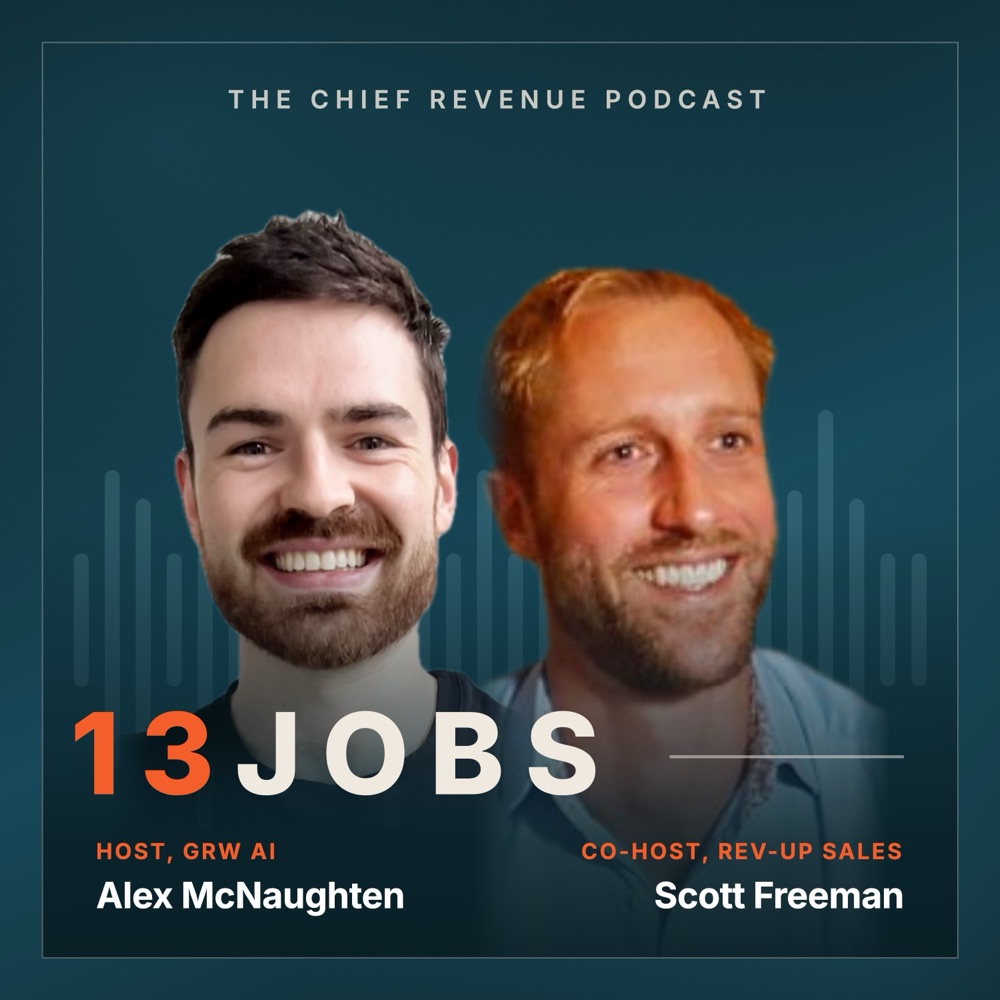
Sales as a profession has a bad rap with Scott Freeman
Episode 001 · Dec 26, 2021
Sales as a profession
has a bad rap
0:0024:43

Sales as a profession has a bad rap

The first episode. Alex and Scotty on why the profession has the reputation it does, and what they wanted this show to be.

Hosted by Alex McNaughten
Share

Scott Freeman · Co-host, Rev-Up Sales

The first episode of the show, and a co-hosted one: Alex and Scott Freeman setting out what they think is wrong with selling as a profession and what they wanted to do about it.

Both of them fell into sales rather than choosing it, which is the pattern they keep running into and most of the reason the episode exists.

In this episode, we discuss:

  • Both of them fell into it rather than choosing it
  • Problem one: what people think the job is
  • The wrong people arrive, for the wrong reason
  • Universities still do not teach it
  • Two in three miss quota, and the consistency gap
  • The Wild West, and the absence of any standard
  • Funded companies scaling before the foundation is in
  • The great resignation, arriving late in New Zealand
  • The skills that outlast the job title
  • The reward sits on the other side of the rejection
  • What you can earn, and how early
  • What the show is going to be

Quote of the show

It's the Wild West. There's no standard.
Alex McNaughten, host

Key takeaways

  • Almost nobody chooses it. Both hosts fell in. That is the norm, and it is upstream of most of the profession's problems, including who ends up doing the job.
  • People person is the wrong filter. Being sociable is not the trait that predicts performance, and hiring for it puts people into a role their preferences were never suited to.
  • There is no standard. Law, accounting and the trades all have a path in. Selling has none, which is why two in three reps miss quota and why the spread inside one team is so wide.
  • Fast growth exposes it fastest. Funded companies hiring quickly are the ones who feel the absence of a foundation first, usually about a year after they needed one.
  • The skills outlast the career. Listening, framing, handling a no. They are useful long after anyone stops carrying a quota, which is the part nobody mentions to a graduate.
  • The good part is behind the hard part. Helping people is what makes it rewarding, and you only get there through the strangers and the rejection. Both are the same road.
  • The earnings arrive early. Years two and three in technology sales compare with almost anything else, and there are few other careers where a twenty-something can get there.

Transcript

Alex McNaughten

The first episode of the RevUp Podcast. And today, we're going to talk a little bit about sales as a profession. You know, what's it all about? What's going wrong in sales as a profession? You know, what do we think of the opportunity areas? And then equally, what's good about selling as a profession and like the rewards for getting into it?

But before we dive into the topic, we should probably given this is the first episode, introduce ourselves. So Scotty, tell us a little bit about you and how you fell into sales.

Scott Freeman

Yes, I did fall into sales. I didn't, I didn't purposely choose it from a young age. Although, if I think back to probably what influenced some of me falling into it was Dad had always been in sales. So he was in, he was in a role with a company for a long time.

And then he moved into more of a training training role. Mom, I remember mom had this side hustle and at Christmas she would sell these personalized calendars, yearly calendars to companies as well. So maybe that influenced things, but I went to uni in England. I studied English and business, which really meant I could do everything and nothing.

And I came out unsure. Then it was the OE, so I got to delay having to go to work properly for another probably year and a half. And then I got back to England and I was like, oh shit, I've got to— what am I going to do? And I thought, got to the grad fairs, went to speak to the army, the police, applied for the graduate schemes, didn't have the grades that they wanted.

And I got chatting to a guy who was in a recruitment company and the next thing I'm working for this company and they also did some training as well. And I remember the first 3, 4 months, I had really no idea what I got myself into. I remember my dad coming to see me at— I think it was just as we were about to break up before Christmas.

And he said, are you all right, son? I said, I don't know. I don't really know what I'm doing. He said, nah, just hang in there. All right? It'll come. You'll be all right. And look, basic advice, but I keep looking back to that and I laugh at dad now, is that I got through it and had a couple of years there.

And look, sales has allowed me to come to New Zealand and get my first job in New Zealand. And then I've, you know, I grew a career at a company for 12 years. I ended up leading significant teams and started 2 businesses. So at some point I decided to choose sales rather than feel like this victim had fallen into it.

And I'm really lucky, you know, and I think you know, part of setting up Apprento was that many people have the wrong impression of sales and it can offer up such a great career. So what about you? You know, you tell me you fell into it as well.

Alex McNaughten

Yeah, like, like pretty much everyone who we've spoken to anyway, we've all sort of fallen into sales. So my dad was an investment banker originally by trade and I thought, without really giving it any thought at all, I thought, oh yeah, maybe I'll do something in finance. So I went and did a finance and accounting degree at university.

Didn't give it enough thought because I was hating it from day dot, literally hating it. My first year of uni, my attendance was basically zero. Wasn't sure what I was going to do. And then I think it was my— I think the first semester of my second year at uni where I saw this internship advertised at a tech startup.

And just on a hunch, I applied. It didn't even have a job description. And that became a sales role. And I ended up doing outbound selling. I was like, my first day I was given a list of construction companies in New Zealand and told to call them, which was absolutely terrifying as like a 20-year-old or not, I think 19-year-old being told to fuck off like 10 times a day by gruff tradies.

Scott Freeman

Yeah.

Alex McNaughten

But then that— but then I did quite well and that role ended up into kind of like a key partnership manager role where I managed a relationship with New Zealand's largest telco and we did a joint product launch. And then through all of this, I ended up having a team of about 15 under me by the time I think I was 20 or 21.

And I was just like hooked on sales. I just loved it. And then After that, I went and worked at big US companies in various sales roles and then came back and did another startup in New Zealand, worked with another tech startup. And through that journey, I noticed that how Kiwis approach selling was very, very immature compared to how the Americans were doing it.

They just were streets ahead in terms of like strategy, process, how they enable teams and their people. So Then I decided to try and elevate New Zealand selling a little bit in my own way. So I started doing advisory work and ended up doing like a lot of revenue operational sales leadership advisory work and sales training for about 2 and a half years, probably it's been working with just over 120 tech companies in New Zealand.

And then that's how we met. And we both connected, I think, on our love of sales as a career, but then equally as like as a skill, as a useful life skill, and wanted to build something to raise the bar for professional selling. And ergo, Apprento was born.

Scott Freeman

And I think we wanted to address— so if we go back to those problems we were talking about, you know, we wanted to address some of those problems and challenges that exist within the profession. And, you know, number one is just the perception of what it is as a profession. You know, we did a— last year we did that survey and there's about 78% of people had fallen into the profession that had taken our survey, quite a big survey in our network.

And half of those, when we surveyed those people, had not chosen it earlier on because they had a negative impression of what it might be. And I like I remember that. I remember that growing up. I mean, I remember the double glazing salespeople that used to phone our house. It was like between 5:30 and 7.

Remember mum saying, don't answer the phone, don't answer the phone if it's between 5:30 and 7, because invariably it'd be the double glazing salesman. And so that stuck with me for probably quite a while. And I remember when I came out of university, sales was the I was like, if there's nothing else left and you can't get into these other things, and, and marketing's cool and sexy, but you, you know, you need better grades.

If you can't and you really— there's nothing else, you go into sales.

Alex McNaughten

Yeah, sales.

Scott Freeman

And I think unfortunately that also means the wrong people go into it as well, you know, because, you know, they talk about, oh, it's people, people, you know, if you're a people person, you get Well, no, like if you're a people person, you're always trying to please, you don't want to, you just care, like that's wrong.

That's the, you shouldn't be in sales because you just get battered, you know?

Alex McNaughten

Yeah. I can relate to that perception thing because I remember, you know, early 20s mates asking me what I did and I'd be like, oh, I'm software sales at the time. And they're like, wait, what? Like what do you, you sell software? Like it was just like alien. They couldn't wrap their heads around it because no one had ever never, we hadn't heard about it at high school, uni, nowhere had ever even mentioned selling as a career.

Scott Freeman

No, no. And the universities didn't and still don't really. And that's from my experience going back to university a few years ago to do a postgrad, you know. So it's no wonder we've got generations of people who only later on then discover how, you know, how good it can be. So I think, you know, that's the biggest thing, you know, is that perception.

But then, you know, it's also the lack of, I think, consistency of performance and lack of standards and, you know, lack of associations. You know, it's like the Wild West so that pretty much anyone can get into it. There's no standards. So no one's held accountable to anything. You know, unlike law or accounting where you want to do that, you, you got to qualify.

You want to go into sales, do what you like.

Alex McNaughten

Yeah. And that's probably one of the reasons why 2 in 3 sales reps globally don't hit their quota every year because this can, this idea of the consistency gap is huge. And that's a big problem for companies. You know, if you've got a team of, if you've got a team of 3 salespeople and 2 of them are underperforming, That's not ideal.

Scott Freeman

Yeah.

Alex McNaughten

So, you know, definitely agree there's this massive lack of consistency in selling. And I think part of that is because, as you said, it's the Wild West. There's no standard. Most companies or a lot of companies aren't investing in developing their salespeople's selling ability. They'll teach them the product, but they won't teach them how to sell.

And, you know, that has a flow-on effect in terms of results.

Scott Freeman

Yeah. And I think especially now there's a lot of companies, especially tech companies who've got investment, they're looking to grow quickly and, you know, that's great and that's exciting, but you've got to put the time and attention into making sure you're getting the right people. There's too many of the wrong people and companies don't actually understand the sorts of people who should be in their sales roles.

Let alone knowing what to train them on. So that's interesting. And then I think that the big issue that's global at the moment, but will really— and is hitting New Zealand hard and will hit even harder come near Jan, Feb onwards 2022 is just this supply shortage. Hmm. There just aren't the people around.

Everyone wants someone with a bit of experience. There aren't even enough of those people with experience and what is good experience. So that's a real issue. That's a real issue. And there hasn't been enough done to bring the right people through and create the right sort of pathways. You know, if years ago, I'm talking a few years ago, there used to be these wonderful sales development programs in some of the bigger companies, you know, your Yellows and your Xeroxes and all those sorts of companies.

You know, some of those or a lot of those, if not all, have fallen away as well. So, you know, we are short of the right sorts of people. So it's gonna need a reset or something to happen because companies just aren't going to get the level of performance because they're just not gonna have the people.

So yeah.

Alex McNaughten

And then the other side of it is this like great resignation going on where people are very quick to shift jobs at the moment and resigning in record numbers globally. And I think it's probably hit New Zealand a bit later than some of those other countries, but it's hit definitely now. And part of that is because, you know, think of it this way, you join a company and it's a remote-only environment.

And then, you know, 3, 6 months later, you get a better offer and you've never actually met anyone in the team. Yeah. And your only connection is your laptop. Yeah. The—. It's very easy to move. Yeah. No friction in moving. So that's part of the problem as well as companies that the talent pool's tiny and then companies are just poaching an even tinier talent pool who are already in work and just poaching them and they're just moving every 6 to 12 months.

Scott Freeman

Yeah. I think that's been really difficult for some companies in the last few months. And then leaders, it's the first time they've gone through this situation as well. So They're trying to work out how do I motivate— it's the office dog, excuse me. How do I motivate? How do I keep people going?

And I think for some salespeople, not all of them, not the clichéd how everyone's an extrovert, but some, a lot of the people who are more extroverted on the continuum have really struggled not being around people and because they get their energy and bounce off them. Some of us ambiverts, you know, hey, it's not such a problem.

But I think, yeah, that great resignation and I think come January, February 2022, it's gonna be a real issue. Yeah.

Alex McNaughten

So, you know, those are, I think probably, and I think you summed them up well, the kind of 3 key problems, right? It's one, sales as a profession has a bit of a bad rap, doesn't have the best perception in the world. And one of the problems with that is that you just don't have enough good people getting into it.

And then, you know, the second one is this consistency problem within sales. It's like the Wild West. You've got some, you know, a small number of people doing phenomenally well. You've got the middle who are kind of just average or not so good. And then you've got some people who are really not very good at all.

And, you know, what does that mean in real terms? It means 2 out of 3 reps are not hitting their number. And then the final thing is this idea of supply shortage. So, you know, particularly if you're a growth company and you're trying to build up your sales team, you need to double it in the next 6 months.

That's very difficult.

Scott Freeman

Yeah.

Alex McNaughten

So we've talked about the problems. Let's talk about some of the positives. Let's talk about—.

Scott Freeman

Well, there's some good stuff, right? There is some good stuff about being in sales. And I mean, look, I think is something that comes to you a little bit later on, but you realize that actually the lifelong skills that sales— so forget career and money for the moment, we'll talk to those, but just the lifelong skills that can give you.

And I think how it can build resilience first and foremost and character and tenacity is huge and how it helps you understand people and connect to them better and build your empathy and and influence in the right way, I think that's a wonderful thing. And I think, you know, even in the last couple of years, my own, you know, learning around empathy, even dealing with my kids and some of the sales skills, and I don't mean trying to influence them without them knowing, I just mean empathizing with them and building better relationships at the right time, especially in moments of conflict.

Like that sort of stuff is great. And then once you can understand that and how you're on a mission to truly help people in sales, you know, it's not about just trying to influence them just to force them to, you know, buy something. So—.

Alex McNaughten

You know what's interesting on that? Sorry to cut you off. Yeah. Is I did a survey not too long ago of LinkedIn asking people what, you know, saying the question, well, sales is a tough but really rewarding career. What do you think is the best part of it? And interestingly, the number one answer was helping people with problems.

That was actually the most rewarding thing that people like most about sales.

Scott Freeman

Well, I think that's the, it's this sort of conflict because to help the people and feel good, you gotta almost go through the initial harder challenges of speaking to strangers or getting knocked back and getting rejected. You know, it's this sort of really unique continuum or journey you go through in a sales process.

And I think for a lot of people, they find especially that first part quite hard or aren't trained enough in a way to be able to deal with it in the right manner. So I absolutely get that. So I think, yeah, I mean, number one for me, look, you know, being a touch older than you, just a touch, it's the lifelong stuff.

It's given me and will continue to give me. Yeah. You know, but it's career as well. And tied in with that is the career opportunity. I mean, you know, you look at what you've done, which has been quite a bit in a few years. I feel really grateful that, you know, I've been able to move countries with sales.

I've been able to lead teams, businesses, start 2 businesses and help a bunch of people. I mean, in the recruitment space, You know, we're helping people into careers, come back to that helping thing. So, but you don't have to lead teams, right? You can, we talk about being an individual contributor and there's some people doing some excellent things without leading teams, but making a massive impact.

Alex McNaughten

Yeah, absolutely. Look, I know you're right. Not everyone wants to go lead a team or start a business. Some people want, you know, some people love being an individual contributor in sales. And I think it's one of the few careers where as an individual contributor, If you're crushing it, you're rewarded appropriately and recognised for that impact.

You know, there's a few people I've worked with, you know, prior to doing my own thing in various companies, you know, like veteran sales guys, you know, enterprise sales guys who are doing multimillion-dollar deals every year. And then you ask them like, you know, do you have ambition of doing anything else? And they're like, no.

Like, I love this. I love helping companies and people solve problems and I earn more than the CEO. So why would I move? And that's often the case, right? And that kind of brings us on to like the second thing is earnings or third thing actually is earnings. Yeah.

Scott Freeman

Yeah. So yeah, I mean, and earnings comparatively, when you start out, it's always that sort of entry level, but particularly in sales and particularly in technology sales, you know, years 2, 3 onwards, comparatively to other functions and probably your other peers, you'll be earning way above. Now, it's not, you know, there's some hard work to get there.

And on the other side of that is some excellent earnings. So, you know, money sometimes can be a contentious issue and people are like, oh, we're not money motivated. And sure, but, you know, it can make a difference. And for some people, it's not about the money, it's about the signal that they're achieving.

So I think, you know, particularly if you look at the cost of living for anyone, especially if you're living in the main centers in New Zealand or globally.

Alex McNaughten

Anywhere.

Scott Freeman

Anywhere, right? So your ability to earn and set yourself up from an early age, sales gives you that. Absolutely does.

Alex McNaughten

Absolutely. And I know Kiwis don't like talking about earnings and money perhaps as much as other countries and more open about that sort of thing. But, you know—.

Scott Freeman

We're just a little bit more understated and, you know, which is good and that's fine. And there's also some other things about that which don't necessarily help this, you know, us Kiwis being in sales roles as well. And we'll talk to some of those things in the future episodes.

Alex McNaughten

That's right. But there's very few roles where you can be in your like first or, you know, second year of earnings doing 6 figures.

Scott Freeman

Yeah.

Alex McNaughten

You know, as a 20-year-old, which is pretty awesome. And, you know, thanks to sales, I was able to buy a property at 24, I think, or 23. And, you know, I definitely wouldn't have been able to do that in accounting or, you know, banking like some of my mates went into. So, you know, it's one of— and I think it's one of the few roles where if you're crushing it, you're earnings, there's no cap, whereas in other career paths, there's often a cap, which I think is really cool that you get recognized for the actual work you're doing and the actual impact you're making.

And then, you know, effectively you're remunerated for the number of people you're helping. Yeah.

Scott Freeman

Yeah. I mean, there's different ways to look at it. And I think that's an important point you make around that connection to the role. And I think one of the other things that, that we'll touch on in future episodes is just how there's better connection created to the role, especially for new people into sales.

And, you know, sales, if you just talk about numbers and calls and budgets and earnings, it's very dry and very hard. And if you can create as a leader better connection to what you're doing, how you're helping people, and make the, the new people into sales help them realize what their impact is and what that product or service, what that impact is, then it goes a long way.

So we'll talk some more about that stuff. We'll talk about some of these challenges. We'll talk about, you know, a whole variety of things. So what have we got coming up?

Alex McNaughten

So, you know, like you said, we're going to talk about a lot of things. This podcast is going to be kind of everything B2B sales. We're going to talk about leadership, sales process, sales tactics to help people actually better it, you know, with their, you know, B2B selling. We're gonna look at the mental health aspects and kind of the mental side of selling as well.

But in terms of what we've got coming up in terms of our next episodes, so we've got Todd Capone, who's gonna be our first guest. So Todd is a bestselling author of The Transparency Sale and is about to release another book. About transparent sales leadership. So we're gonna have him on. Then we're gonna be chatting with Jason Bay, who's an absolute guru when it comes to outbound selling.

Scott Freeman

Yeah.

Alex McNaughten

We've got Kyle Coleman on after him, who's the VP of sales and revenue at a company called Clari. And Kyle's awesome and he's always just posting about sales and really passionate about sales as a career. And we've got, You know, a bunch of other awesome guests lined up, um, as the year goes on.

So it's gonna be really exciting and, um, to bring in all these different perspectives and share them with you.

Scott Freeman

Yeah, yeah. Well, look, we're excited about it and, uh, we hope everyone else, um, enjoys tuning in.