
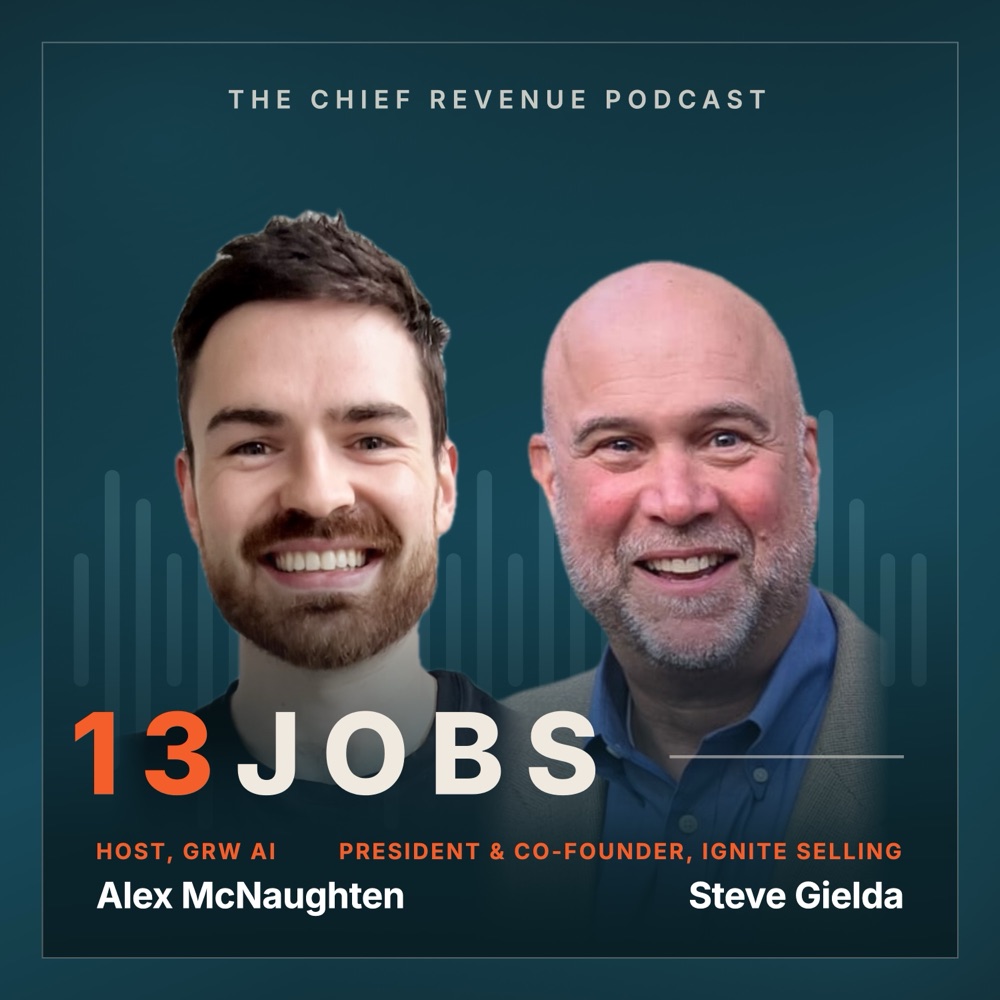
Assumptions are killing your deals
Steve's team runs the win-loss analyses. Deals stall in three predictable places, and all three are things the rep assumed rather than asked.
 Hosted by Alex McNaughten
Steve Gielda · President & Co-founder, Ignite Selling
Steve Gielda is the president and co-founder of Ignite Selling, a global sales enablement firm. He is a former VP of Sales and has worked on the field effectiveness of more than 15,000 sales and marketing professionals, across IT, finance, medical devices and pharmaceuticals.
The views in this episode come out of the win-loss analyses his team runs with clients, which is also where his second book, Ignite Your Sales Strategy, came from. Its subtitle is a field guide to accelerating your pipeline.
In this episode, we discuss:
- The second book, and testing your own assumptions
- The three places assumptions quietly lose the deal
- Losing on price, when price was never in the top three
- Knowing what the person opposite you is actually measured on
- Profit as the outcome of helping the client execute their strategy
- Connecting one person's metrics up to the company's
- Asking questions without sounding like an interrogation
- Doing the homework so you are not the third rep asking the same thing
- The litmus test to run on every question you plan
- Assuming last deal's influencers are this deal's
- Who is my competition speaking to that I am not
- Finding someone who will challenge your thinking before the meeting
Quote of the show
“Come to find out, in many cases, price doesn't even hit the top 3 decision criteria.”
Key takeaways
- Three assumptions lose the deal. Business metrics, key influencers, decision criteria. Every one of them is something the rep assumed rather than asked, and the loss analyses keep finding all three.
- Price is rarely the real reason. Reps report losing on price constantly. Go and check with the customer and price often does not make their top three criteria at all.
- Know what they are held accountable to. Two or three metrics for the individual, and how those ladder up to what the organisation is trying to execute. Without that, alignment is guesswork.
- Run a test on every question. Does this benefit me or does it benefit the customer? Some have to benefit you. If most of them do, stop asking so many.
- Do the homework or waste the meeting. "How is the downturn affecting you" is the question every other rep already asked. Know the industry well enough to ask something they have not answered five times.
- Last deal's influencers are not this deal's. Especially with a new product. The people who bought from you before may not be the people the value lands with now.
- Get someone to play devil's advocate. New or experienced, the fastest route is a partner who will challenge what you think you know, before you walk into the room rather than after.
Transcript
Steve, good to have you on the show. How you doing?
I'm doing great, Alex. It's great to be with you.
Thanks for coming on. So for those of you who don't know, Steve Gilder is the President and Co-Founder of Ignite Selling. Steve, tell us a little bit about yourself.
Yeah. So I reside here in Austin, Texas, not a native Texan, been moved from Northern Virginia outside of Washington, DC about 5 years ago as our daughter announced that she was pregnant. So my wife and I moved down here to help out her and her husband with our new grandson. So it's been a great move out here to Texas.
But as you mentioned, I am the co-founder of Ignite Selling, and we are a global sales simulation company. We help organizations improve sales performance through competitive simulations, and we address those fundamental skills from how do you have better customer conversations to how do you think more strategically about the opportunities that you're trying to accelerate through the pipeline to how do you negotiate better.
But we do that all in kind of a non-traditional manner. Without using any kind of traditional PowerPoint or role plays or workbooks. We do everything through an interactive peer-to-peer competitive simulation.
Very cool. Tapping into the salesperson's kind of natural competitive instinct there. And you've also written a book recently as well.
We have. We've written our second book. It's called Ignite Your Sales Strategy. And this is a book that really helps or sales representatives think about what are they doing to help accelerate an opportunity from the early, middle to late stages of their pipeline process. The subtitle is kind of a field guide to accelerating your pipeline.
Gotcha.
And it kind of explores a series of tools that we have and provides a series of questions that sales representatives should be asking themselves, kind of test their own assumptions.
Very cool. And that sort of brings us into our topic very nicely. And that wasn't planned, but God, it's It was so smooth, it might well have been. And what we're talking about today is this idea that assumptions are killing your sales. So break that down for me. What do you mean by that?
Yeah, we believe from our research, we've conducted a lot of win-loss analysis and what got us to this book and the things to which we teach come from the win and loss analyses that we conduct with our clients. And we have found from many of the loss analyses that opportunities are being lost or maybe at best are being stalled because sales representatives are making assumptions in 3 areas.
Number one, they assume they understand the business metrics that their customers are trying to improve. Now, right? And so that's number one is they assume they understand the metrics. Number 2, they make an assumption that they are proactively influencing those key decision makers involved in the buying process as opposed to maybe hanging out with just those people that they know.
Right.
And number 3 is they're making assumptions around their customer's decision criteria. You often ask a sales representative, why did you lose? They'll often say we lost because of price. That's assuming that price was the number one decision criteria in this decision. Come to find out, in many cases, price doesn't even hit the top 3 decision criteria.
Right. So let's go through those because those are interesting. And I think, you know, anyone who's been in sales or sales leadership long enough has probably seen this happening. But talk a little bit about this. Let's start with the business metrics one. Like, make that a little bit more real. Like, what does that look like?
Yeah, I mean, think about it. I mean, you've been, you're in sales today. I'm in sales today. A lot of your listeners have some responsibility for driving quota. Well, I think if we ask ourselves a question, what are the 2 or 3 business metrics the individual that I'm speaking to is being held accountable to?
Do we know? Top sales performers today recognize that they are more likely to win a sale if in fact they can demonstrate how their product or service helps that customer achieve better outcomes for whatever it is they're held accountable to. So when you ask the question, just regarding the individual that you're talking to, What are the 2 or 3 business metrics that this person is being held accountable to?
Do they know? And if they do, another question that we need to ask is, how well were they, were they successful last year in exceeding the business metrics?
Hmm.
Or what were the challenges to which they ran into? And so if we just take this topic of business metrics, we can really explore that from the individuals to whom we have to engage with all the way up to the clients to whom we have to engage. You know, one of the things that we say here at Ignite Selling is that the profits and revenues of our business are merely an economic outcome of helping our clients achieve better outcomes.
Yep.
So what are the clients trying to do? Are they trying to expand market share? What's the threat to that today? Do I have a solution that can help do that? Are they trying to execute a strategy where they're trying to retain their top talent?
Hmm.
Maybe that's the strategy and the metric is to reduce turnover amongst top talent by 5%. Well, if that's the business metric, do I have a solution that can help reduce turnover of their top talent by less than 5%. So in absence of knowing that, how well can we align our capabilities to that particular client in a meaningful manner?
So sales representatives make a lot of assumptions that they think they really know those.
Yeah, interesting. And the other thing I think you touched on there is like there's different levels of this as well. So there's the person you're speaking to or the people, the different stakeholders, and they might have different metrics to what the business is, you know, to know what the CEO cares about, right?
And, you know, how important is it to understand all of those different, I guess, metrics, business metrics, KPIs that the different people actually have, not just what the business cares about?
Yeah, I think that top performers are able to kind of align those individual metrics that somebody has to And having that conversation that says, as a result of you achieving your things you're being held accountable to, how does that help the company?
Yeah. Okay.
So top performers are able to actually have that dialogue that connects it maybe from an individual to the department to the organization because they're developed in the opposite manner, right? Any director of, say, cloud security has to report up to a vice president. Now, the business metrics to which that vice president put upon that director of cloud security came from the corporation's directives.
Yeah.
So we as professionals selling into maybe an organization where these influencers are involved, we have to kind of understand what is it you're being held accountable to? What traps have you run into in achieving those outcomes in the last couple of years? Or have you had success along the way? Where did that success come from?
What are you being held accountable to this year that you weren't held accountable to last year? The more that we understand those business metrics of the individual, the department, and the organization, we can have a better conversation about how our solution can actually help you be more successful.
I think one of the things salespeople worry about is that they're coming across like an interrogator and they're just, you know, playing 20 questions. How do you do this in the right— because, you know, you ask some great questions there, right? And super valuable information as a salesperson and hopefully a valuable conversation for the customer as you, as you're, you know, doing some exploratory conversation.
But how do you do this in the right way where it doesn't just feel like someone's reading off a discovery checklist or, you know?
I think it's a great question, Alex, and it's a common trap for even most experienced salespeople is to find themselves kind of falling into the trap of asking questions that only really bring them value.
Yeah.
Right. So I think it's important, first of all, to always do a little bit of homework. Don't ask the same questions that every 3rd salesperson that's walked in the door is asking. Do a little bit of homework.
Yeah.
Understand their business, understand the trends in their industry so that you're asking the questions around, you know, say if it's around, you know, you're trying to explore their challenges that they're having right now with organizational layoffs, okay, or downturn in revenue. Don't just ask, so how's the downturn in revenue impacting you? Well, it sucks.
You know, it's kind of a dumb question. You really wanna be more thoughtful about, you know, I've read, I've looked at your 10-K, I've looked at some of your reports online. I noticed right now that you guys are getting ready to, let's just say, launch a new product. What's, what's, what's, what's your accountability or responsibility to launching that new product?
And how are you gonna measure success? So does the question help me? Yes. Hopefully it's also gonna help them. Or you ask the question, what are the potential traps that you're gonna run into in launching this new product? And how do you plan on overcoming some of those, those particular barriers?
Yeah. It makes sense. It's the homework.
It's the homework, but I think it's also a litmus test and you asking yourself the question, does this question benefit me or does this question benefit the customer?
Yeah.
You need to ask both. But if you find yourself, the majority of the questions only benefit you, stop asking so many of those questions.
Yeah, it's a balance, right? It's a balance because You know, you don't— you— I think you framed it well there. It's like, ask questions that you know they haven't been asked by 5 salespeople previously. I think that's a really good one, you know, because— and that litmus test of like, does this question actually add value to my customer?
I don't think enough salespeople ask themselves that question. Talk to me around that second assumption you mentioned there. So we talked about a little bit about metrics and you talked about Assume, you know, salespeople are assuming that they're proactively influencing key decision makers. Unpack that one a little bit more.
Yeah, I think that, you know, we as salespeople have to kind of ask ourselves not just the obvious question, who's involved in this decision-making process? But we have to really challenge that. Because sometimes just asking that question to ourselves forces us to answer the question, in a manner that gives an answer based upon the individuals that we have relationships with.
So if I've worked with this company in the past, the people that are most likely gonna be involved in this decision-making process are, give the names, the same individuals who were involved last time. Well, that's a very dangerous assumption.
Hmm.
So to assume that the individuals that gave you your opportunity in the account are the same influencers involved this time is a dangerous assumption. We were working with a firm not too long ago that had a new product that they were launching to the marketplace.
Yep.
And this new product brought some tremendous new value to anybody that was doing X in the field. Okay, won't bother kind of getting into the technical aspects of it, but this product allowed a quicker supply chain Okay, reduce the impact of a delayed supply chain that a lot of organizations were struggling with because of the pandemic or whatever the case might be.
But if the sales representative was only going to talk to the individuals to whom they were selling to in the past and not go to the director of procurement to have a conversation about the impact and reduction in supply chain, it was a missed opportunity.
I see.
So we have to ask ourselves the question, Who's my competition speaking to that I'm not?
Hmm.
Because if in fact this is a competitive opportunity, a competitive bid, and you don't know who your competition is speaking to, or you're not asking the questions, who can our value truly benefit in the organization? And we're only hanging out with those people that are willing to meet with us. Or people that we like, we're missing an opportunity.
So I think the critical questions are, who's our competition speaking to that we're not? And who does the value, the quantitative value of our capability truly help in this organization? And am I meeting with them?
I think sometimes salespeople get in the— get into a routine and they just kind of go through the motions and they're not critically thinking like this in their deals. You know, as I'm listening to you here, there's a lot of, I guess, self-critical kind of questioning and thought process, you know, in terms of your frame, your model, I guess, that you're operating within.
Yeah.
How does it, you know, perhaps a more junior salesperson start to really develop this sort of model? Because it's obvious that those conversations that you're describing are far more valuable than the spray and pray, come in and do a generic demo, send a proposal and, you know, hope that it pays off. Yeah, talk a little bit about that.
How do you develop this model as, you know, if you're a bit newer to sales or maybe, you know, completely fresh?
Yeah, I think that Whether you're new or even if you're experienced, I think that the common, the best and the quickest way to do this is to find a partner who's willing to challenge your assumptions. What I'm demonstrating in this conversation are kind of strategic conversations. They're conversations that we need to think about before we go meet with the customer.
Hmm.
Who am I gonna go meet with? What is the value that I bring? Who am I not talking to? How do I get access to those individuals? What are the business metrics? How do I find out what this person might be held accountable to? What are the business metrics of the organization might be trying to achieve?
Where do I go find that research? It's all of those things that you do before you go see a customer. But strategy is not something that is to be developed on your own. It is to be developed with a partner. Now that person could be a colleague that's selling inside that account. That you can bounce ideas off of, or maybe even better, a sales manager that simply just says, hey, these are 4 things that I know about this account.
Bob and Mary are the 2 highest level of influencers. They're what they're— with the business metrics that I've learned that the organization is trying to improve is to try to improve greater sustainability, a greater carbon footprint in the— reduced carbon footprint in the marketplace. Whatever the metric might be. This is what I know.
Can you help me? I want you to play devil's advocate with me. What don't I know? Let somebody that you trust kind of challenge you and start just asking you those fundamental questions. How do you know that Bob and Sally are the 2 highest level of influencers? Well, think about that for a moment.
It's somebody just asking you the question. Or what role does Bob and Sally have in their objective to reduce their carbon footprint?
Hmm.
So it's simply about having somebody to whom is willing to play devil's advocate and challenge your thinking about what you know and what you don't know. Now, you know, a real cheesy answer is to buy our book and look at all the questions that we have in the back of each chapter. But there are a lot of resources out there that provide kind of these, what we call kind of challenge questions or validation questions for salespeople.
And I think the validation questions or the challenge questions need to be specific to the topic that you might be making an assumption around.
Yeah.
Is it around the business metrics? Is it around the key influencers? Or is it around that third one I gave you, which is around the customer's decision criteria that they're using to compare you against competition? Salespeople make assumptions, but we need people around us to play devil's advocate to challenge those assumptions.
And I think one thing I've observed with sales teams is that they, the salespeople in those teams often operate in isolation to the other members of the team. And that they don't, they don't do what you've just described, which is bounce off each other, practice with each other as much as they could.
They do a little bit, but definitely not as much as they could. How do you, how do you start to change? Because, you know, now, now we're sort of talking a little bit about almost team culture. How do you start to change that?
Yeah, I believe that Salespeople are not likely to change until they see value in something. Let's face it.
Yeah.
You know, the arrogance of salespeople, and I'm one of them, right? The pride to which we carry was that we believe that we know the best way to go about doing this. I'm gonna continue doing what I'm gonna go do because it's driven me success to this point. So why should I change?
Well, one reason why you should change is because the world around you is changing. And if you're not aware of all of those changes and how they impact the individuals to whom you're talking to in your customer organization, you're gonna find yourself one day behind. And these younger salespeople are gonna be coming up and taking that top 10 position from you at your company.
Mm-hmm.
So yes, it is a cultural shift, but we've had our greatest success by helping salespeople in a loss analysis. Take a major sale that you just lost and ask somebody to dissect it for you. And maybe even ask somebody to go interview your customer as to why they chose to go do business with the competitor.
You might have a good enough relationship which you can go interview your own customer and simply saying, you know, The business is gone. I'm not gonna try to convince you to go stop implementing something to come implement with us. But I do wanna have some conversations with you about some real fundamental things.
I feel as if maybe I was misaligned. What were the business metrics that you're trying to drive or achieve right now? Find that out. Maybe who else was involved that I wasn't talking to? Who was my competition speaking to that I wasn't? But I think culturally salespeople need to have that mirror kind of put up in front of them to expose to them the potential gaps and risks that are involved by continuing to operate the way that they do.
Yeah.
And sometimes asking these kinds of questions forces that to be exposed because they don't know the answer.
What about the final assumption there around decision-making criteria? You know, you mentioned that prices and we see this all the time, right? You know, salespeople saying, oh no, it's too expensive. That's why the customer don't buy. And it's all, whenever you look at win-loss reason, it's almost always price. It's the most common.
What's going on? Is it really or are people just not asking the question and actually truly understanding what what is my customer actually making a decision on here?
Well, let's keep with the theme of the psychology of the salesperson. Why do you think salespeople are quick to blame price?
Something they can't control. So it's sort of, it's not their fault.
Not their fault. It's simply projecting that off to something that I couldn't control. So I didn't lose the sale. Because of my sales ability. I lost because my manager wouldn't give me a lower price, or we're just too priced high in the marketplace. I can deflect that. Now, you hit it on the head when you said that most salespeople will blame price.
We've done research for our book. We find that 77% or 72% of the time, sales representatives blame price as the reasons why they lost the sale. Now, when we go back and we interviewed those customers to where the salesperson said we lost because of price. Price wasn't even in the top 3 decision criteria 88% of the time.
Price fell in the top 1 or 2, 22% of the time. So salespeople didn't lose because of price.
Hmm.
They lost because they got outsold. And the way that you can actually test this is ask yourself this question. If you lost because of price, ask yourself these couple of questions. Number 1, other than price, what was the customer's decision criteria? Give me 2 or 3 other criteria other than price. If you don't know, that could be the reasons why you lost.
Yeah.
If in fact you give me an answer that, hey, the other reasons that they The other criteria was integration with, with existing systems. It was experience in our industry and ease of use of our, of our product. So you had experience, integration, ease of use, and price. So now you know that. So now the question is, is whose criteria is that?
Because we know that it's not just one person making the decision. So whose criteria is that? Who did you validate this criteria with? Does supply chain and marketing and security all have the same criteria? And so you simply begin to explore and challenge your assumptions around that. You begin to find out that maybe price wasn't the most important criteria, and it's not the reasons why you lost.
The reason why you lost is because your competitor was talking to the chief of security and involved the security architect involved, got involved, and their criteria was different than the procurement manager to whom you were talking to.
Yeah. Yeah.
So price wasn't even on their radar. What was on their radar was backup systems. Whatever, security protocols. Yeah, you didn't speak to security protocols. You spoke to the ease of use. You spoke to integration, and they didn't give a damn about that.
Mm-hmm.
So, but it's easy for us to blame price. And frankly, I'll share with your, with your listeners one, one other quick thing. When we ask the customers in our loss analysis, sometimes their greatest champion Why did you choose to do business with Company A? They'll sometimes say, oh, they'll give us an answer of, well, they were easier to use.
They had training that, that the other company provided. What did you tell the sales rep? Did you tell the sales representative that the reason that you chose to do business with this other company was because they had a better systems integration or they had better security protocols in place? No, I told them it was because of price that they had.
Why did you do that? In essence, what they're saying in several different ways is the fact that I knew that he would accept it.
Interesting.
Now, why is that? Sales, you know, your buyer doesn't want to hurt you.
Yeah. Yeah.
So it's very— we were very surprised that many of the loss analyses, the customer told the sales representative the reasons why they're going with the other competitor is because they're lower priced. But in all reality, in many cases, it wasn't because of price. It was simply because the competitor was talking about the issues that mattered most to the influencers that were involved.
And the one person, the champion that the sales representative was engaged with, simply went along with what everybody else thought they, they should go do. People don't want to hurt people.
Yeah.
You know, so it's an easy answer and they know salespeople are gonna accept it.
Why is this happening? Why are salespeople letting these assumptions kill their sales? Is it just they don't know better?
I think it's a multi-pronged answer. I think that number one is that the more experienced a salesperson, the more assumptions they make.
Yep.
Yeah, let's think about that. Now, now, why is that?
Pattern recognition. They, they think they've seen it all before.
Correct. Been there, done that. Okay, so that's number one, is that I'm successful, I've gotten to this point in time, and when I lose, I'm simply gonna— I'm gonna blame some of the reasons why I lost, but it wasn't because of my assumptions. And in fact, it was, but because you believed that you've been there, done that, you know exactly the path this can take, you know exactly who's going to be involved, you know exactly why they're making this decision.
You know what's driving the sense of urgency, and therefore you provided your recommendations, and your recommendations wasn't anything to what they really wanted. Your competitor did a much better job of really exploring what their customers are trying to do, and they offered a solution that was a better fit than yours. Okay. But number one, the more experienced a salesperson, the more assumptions that they make.
The other reason is, though, is that salespeople are busy.
Yeah.
What's their manager doing? In most cases, are their sales managers asking questions like we're talking about today, challenging their assumptions, or is their sales manager driving a number?
It's almost always the latter. Why is forecast not updated? Where's the number?
Correct.
Fill in Salesforce.
And they're coaching the deal.
Yeah.
They're not stepping back from it. There's someone saying, what do we need to do? Who are you talking to? What do we need to do? Who do you need me to go see? And they're coaching in the real-time deal as opposed to saying, stop for a moment. Let's slow down so that we can go faster later.
Yeah. Yeah.
Think a little bit about that. And sales managers are not challenging the assumptions of their sales reps. So therefore, reps just simply moving along. They're fast. Sales is fast. Managers are looking for revenue.
So, yeah, yeah, interesting. And then look, the, the final question that, you know, that, that this, um, leads me to is what do we do about it? You know, you've, you, you've, um, I think surfaced the problem and I think you've, you've given me some examples of questions to ask, um, you know, salespeople or to self-reflect on as a salesperson?
What else can we do about this?
Yeah, what we recommend is you're not going to change your own behaviors overnight. But what we do recommend is salespeople to select 1 or 2 opportunities, most critical opportunities that they must win this quarter. Something that's in the early stages of their pipeline process, not late. So where their decision is gonna come down in the next few days or next few weeks because they can't influence that.
It's a little bit too late. Find one or two opportunities that are in the early stages of your sales pipeline and say, these are the ones to which I'm gonna challenge my assumptions around. I'm gonna partner up with somebody And I'm gonna ask somebody to do a litmus test for me around kind of what assumptions might I be making.
I want somebody to play devil's advocate, really kind of help me dissect and tear apart this opportunity and just break it down. There's a lot of different sales tools out there, all right, that, that give you things to which you need to be filling out. Salesforce.com, There's, you know, Strategic Selling from Miller Heiman.
There's just, there's so many different things that are out there. Stop filling out the form.
Stop.
It's not helpful. You're merely just saying, what do you know? What don't you know? Start challenging what you think you know. Hmm. Miller Heiman's Blue Sheet is a great, is a great tool. But it's not being intended in most businesses the way that it was It's not being used the way that it was intended.
It's being used as a repository of data.
Yeah. Yeah.
So, and what do managers do? Managers pat their reps on the back for filling out the blue sheet. A 3rd grader could have filled out that blue sheet if they would have been taught how to kind of go do a couple of, ask a couple of questions inside of an organization. Who's the technical buyer, the user buyer?
It's compliance. Is what it is. It's compliance. It's not compliance. It's not actually moving a deal. Correct.
It's compliance and managers pat their reps on the back and say, well done. Well, when I was a distributor for Miller Hyman, I saw this happening so often that it drove me crazy. So therefore, we decided we started Ignite Selling to kind of be, to provide a set of tools that supported people that had strategy forms.
And there are a lot of companies out there that have strategy forms. But forms are repository. It's a compliance action. It doesn't challenge critical thinking. So we created a series of tools that are designed to challenge the critical thinking of salespeople. And guess where they fall? Around business metrics, around key players, around urgency.
And around decision criteria. So we've dissected those forms that are out in the marketplace today and provided a tool that double-clicks on any one of those areas to challenge your assumptions around them.
Interesting. Steve, we're running a little bit low on time here. I could talk to you about this for a lot longer. I've got one last question for you. And then tell people where they can find you. Knowing everything you know today, and obviously you've been in sales a long time, you've been doing this a long time and you clearly very much know your stuff.
What's the one thing, like if you go back to day one, Steve's first day on the job, what's the one thing you wish you knew?
The importance of relying on other people in my company, right? My peers.
Right.
I would have, because I too was a lone wolf out there and I was successful. But when I hit those hard times and back in the '80s when I was a sales— started in sales, if I would have really recognized that I could leverage my peers better to have them challenge my thinking or to bounce my own ideas off of instead of being a lone wolf, my career would have had not just quicker trajectory but more consistent trajectory.
Many salespeople see a lot of highs and lows. You want to avoid those highs and lows? Partner with somebody. Have— be the devil's advocate for each other.
Yeah.
That's the one thing that I think I wish I would have really taken advantage of because there's a lot of talented people on your team. How are you using them?
Yeah, it's a great point. Steve, where can people find you if they want to connect, if they want to engage with your content, they want to learn more about you, buy the book?
Yeah, well, we'll go one step further that if they reference this podcast, well, first of all, they can find us at igniteselling.com. Okay, so go to igniteselling.com. There's a bunch of white papers and research papers, some of the things that we're talking about. Some questions, some tools. That's all free content out there.
But if they want to reach out for us, they can just do an inquiry or find— hit me up on LinkedIn and I'm happy to talk with them. But anybody who reaches out to us either through the website or through my LinkedIn or through my email address, we'll give them a copy of the book for free.
And in the back of that book, has several of these questions that we're talking about at the end of every chapter. So whether it be around process or influencers or urgency, whatever it might be, there's a series of questions and we ask users because this is a field guide. We're simply saying, think about an opportunity that is in the early to middle stages of your sales pipeline and ask yourself, can you answer these questions?
If you can't effectively answer those questions, the likelihood that that opportunity is gonna stall Or be lost to the competition. And so we provide probably 30 different questions, maybe 40 different questions in the book.
Great, fantastic. Um, it's been a great conversation. I've really enjoyed it.
I have enjoyed it as well.
It's, it's been great, and I'd love to do it again sometime. Um, thanks for coming on the show.
Thank you for having me, Alex. It's been great to listen, great spending some time with you. Keep up the good work.