All episodes
AI will not replace sellers, it raises the bar with Scott Freeman
Episode 042 · Sep 13, 2023
AI will not replace sellers,
it raises the bar
0:0024:01

AI will not replace sellers, it raises the bar

A conversation rather than an interview. Alex and his co-host Scotty on why the profession's first instinct with any new tool is to do more of the same, faster.

Hosted by Alex McNaughten
Share

Scott Freeman · Co-host, Rev-Up Sales

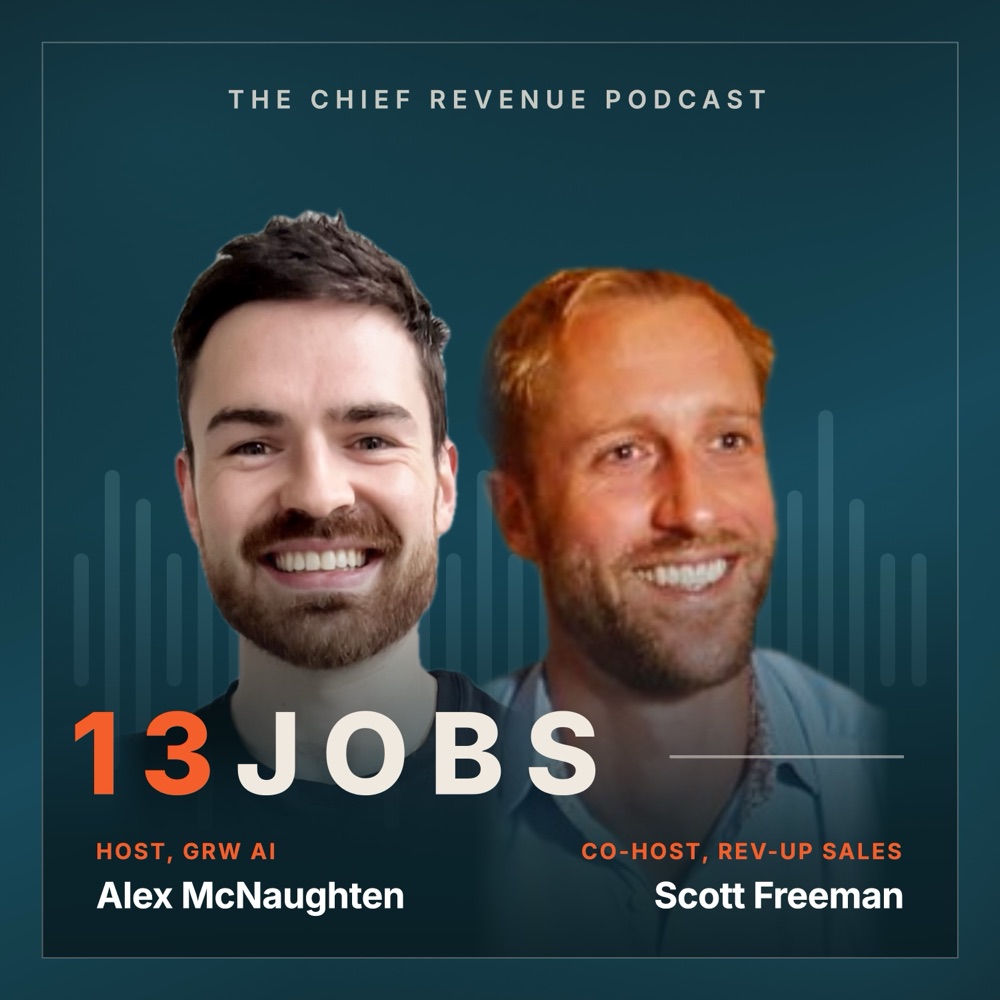
This episode is a co-hosted conversation rather than an interview. Scott Freeman, Scotty, is Alex's co-host on the Rev-Up Sales podcast and the CEO and co-founder of Apprento, the sales acceleration business the two of them built together.

They recorded it a few months after generative AI reached the general public, working through what it changes for sellers and what it does not.

In this episode, we discuss:

  • AI has been here a while, and sales is not the important part of it
  • Why salespeople ruin every bit of technology they are handed
  • Low barriers to entry, and technology as the shortcut
  • The default use, and how little of the opportunity it touches
  • What the profession has to be better at to justify itself
  • AI as a research assistant, and walking in with more context
  • Thirty percent of the week in front of customers, and where the rest goes
  • Buyer expectations rising as the top one percent pull ahead
  • Will salespeople be replaced, and the honest answer
  • Where a seller still earns their place: complexity and uncertainty
  • Every previous technology that was going to end the profession
  • Dabbling, rather than using it in any structured way

Quote of the show

Salespeople only spend something like 30% of their time actually in front of customers.
Scott Freeman, co-host, Rev-Up Sales

Key takeaways

  • The first instinct is always more volume. A new tool arrives and the profession reaches for automation and throughput. It is the path of least resistance, and it is why sales tends to spoil what it is handed.
  • Writing emails is the smallest possible use. Generative AI produces decent copy. Treating that as the opportunity misses nearly everything else it could do for a seller.
  • Point it at research instead. Walking into a conversation carrying far more context than you otherwise would is a real edge, and it is available right now.
  • Most of the week is not spent selling. Around thirty percent of a seller's time is actually in front of customers. The administrative remainder is where the tooling should go first.
  • Buyer expectations move with the best sellers. As the top performers get sharper with these tools, the standard every buyer expects rises for everyone else.
  • Some roles will go. That is not the profession going. Where the product is simple and the buyer already has intent, a seller adds little. Complexity and real uncertainty are where the value stays.
  • Dabbling is the common state. Most teams are putting novelty prompts into a chat window rather than building anything structured, or any way to bring what works back to the team.

Transcript

Alex McNaughten

Scotty, it's been a while since we've done a podcast together.

Scott Freeman

It has been. I'm trying to think of the reason for that. Other far more interesting people, I think. I've just been waiting to get my beard to the right length to come on screen. But we need to talk about this one. We do.

Alex McNaughten

We do. AI and sales. It's, the world has really changed in the last 6 months. Like, it's kind of been this or longer than that, actually. It's probably, probably more like 9 months, but it really has gone through this big shift with the advent of AI coming into the public sphere. And it's definitely impacting sales.

Scott Freeman

Yeah. I mean, I mean, AI is most people don't realize it's been around for quite a while, right? In other spheres, you know, and the great thing, I mean, if you think about AI, I mean, it's doing some life-changing world-leading medical stuff which is saving lives, right? So let's contextually, sales is important, but there's other, you know, bigger causes.

And look, sales is, you know, as it does, it's finally sort of cottoned on to it. I mean, it's generally behind most other professions in terms of you know, sophistication. But we are at an interesting point, right, for AI and in our profession. And I think, look, we've got really interesting platforms. I mean, there's one that we've got involvement with which are looking to, you know, provide bigger solutions.

I think that there's a lot of noise. There's a lot of, right? You think about all these point solutions, more automated emails or videos or like—.

Alex McNaughten

Yeah, let's maybe talk about that for a second because that does seem to be the default in sales. Whenever a new technology comes along, the sales profession's answer is, oh great, let's just automate more things and let's just do more volume. And I think, you know, look, and Todd Capone, I remember him saying this to me, he says, he said salespeople ruin every bit of technology they're given.

And it all started with the telephone. And he said that to me and it was, you know, it was quite a, well, to me anyway, I found it quite a profound statement because I did think about how a lot of these technologies that we give sales teams just ends up getting abused and we end up propagating bad practice at scale.

And, you know, AI to me is nothing different to what, you know, outreach sequencing tools were and auto dialers were, you know, not that long ago, kind of when I was a seller, a rep. So what are we seeing?

Scott Freeman

Well, I think, and generalizations come in a little bit here, right? And look, human behavior is to go to the path of least resistance. And I think unfortunately, because of the sales profession having low barriers to entry, attracting a lot of the wrong people into it, the use of technology is a is just a lazy way of people thinking, yep, I can shortcut and improve my results by just pressing a click, you know, clicking a button.

And I think AI is not gonna help with that stuff at all. So, you know, if you think about some of these point solutions, which means we can now send instead of 100 emails, we can now send a million and they're slightly more tailored and they're personal. And they're personal, like that doesn't help because actually on the other side there's AI which is working on people's inboxes to keep these emails out, right?

So you sort of just got this war going and it's detracting from what, you know, we believe the very essence of sales is about how we connect in a meaningful manner with people, right? So I think that the noise around speeding up and more emails and it's gonna be able to, you know, impersonate a human and like, I don't know whether people wanna sit on the other side feeling like they're talking to AI or they're being tricked into believing that, you know.

So I think there's still a lot of noise and figuring out what is the right thing here.

Alex McNaughten

Like how can it actually help the profession? Because I think the default, yeah, the default from what we see certainly at a rep level is, oh great, this is gonna write my emails for me. And, you know, yes, it can be helpful. You know, generative AI can be helpful in terms of, you know, generating content and generating sometimes quite high-quality content.

However, I think that that's barely scratching the surface in terms of how we can truly use it. To like you were talking about there, which is how do we actually connect with our prospects better? How do we have a higher quality conversation when we actually are in front of them? And that actually, I think, is one of the superpowers of AI right now that's probably untapped by the vast majority, certainly from what I'm seeing, by the vast majority of salespeople.

Scott Freeman

Totally. I think, you know, in terms of being a sales professional, we have to compare to other professions or functions in the business. We have to be able to connect with people in a far more meaningful way and have to use more skills or show more awareness to understand humans, right? I mean, that's fundamentally about what we do.

Marketing might argue that they're that's more their role, but on a one-to-one level especially. So you think about, look, how does that happen? How do we speed that connection up? Well, how do we speed that credibility up? So for me, a lot of it is about how do we amass more knowledge quickly?

How do we show that we understand that customer and their world and their pains more quickly? And that is where AI can really help, right? So if we think one area of sales before we've even met the customer, how do I become more credible? How do I supercharge my knowledge so that when we have that first meeting, there is that first reach out, whatever it is, it comes with so much more depth and thought because I've been able to use AI.

And when I say AI, I mean, Look, there's, there's, geez, there's so many tools, right? Every week there's a, there's a company coming up with something, but the one that's most accessible that's, you know, been in the press that most people are using and, and, you know, cost, cost effective is, is ChatGPT or even Bard, which is free, right, by Google.

So being able to use that to improve your credibility by doing, you know, some research and putting prompts in and we'll talk about prompts in a moment. For me, that's where we can, no matter whether you're going into sales for the first time and you're going, oh God, imposter syndrome, I don't know a lot of stuff.

Well, geez, there's your personal research assistant. But also if you're in sales, like the amount of information you can get to help you become more credible is massive. So I think that whole credibility And before you've started your sales process or at the beginning is one area and then, you know, you look at going, well, look, when you're in the sales process, what can you use it for as well?

Alex McNaughten

And I think that the term you use there is like personal research assistant and I think that's quite a good way of looking at it is if you can go into your next conversation with a prospect or existing customer just armed with so much more contextual knowledge than you normally would have been.

That's an edge up against your competitors. If you're going into the conversation really understanding the psyche, let's say you're selling to a CEO of a, you know, a large corporate. If you can go into that conversation really understanding the psyche of your buyer and use, you know, ChatGPT to quickly digest their most recent annual report and summarize it into some talking points as an example of something, a way you can prepare quickly.

Really what we're talking about there is we're compressing time. Like we're able to now do a week's worth of research in a day or a day's worth of research in 20 minutes. And I think that's really the power because now we're going into our conversation with a far elevated you know, far elevated thinking.

So I think that's like the first thing. And then I think the second thing that is also very underutilized is around using AI from a sort of a note-taking perspective as well, is, you know, having your little AI note-taker. You know, there's a bunch of tools out there, Fathom, Otter, you know, Zoom I think has a transcription service now as well.

Like there's so many of them and they're gonna continue to proliferate. And like proliferate, and I think the cost is gonna come down to virtually zero across them because it's gonna become very commoditized, is using that. And then again, you know, using tools like ChatGPT to summarize it. You know, you've had an hour conversation with someone, turn this into bullet points of the conversation, and then there's your CRM notes, there's your planning for your next meeting.

And I think that's really the power. The power of this stuff is condensing time.

Scott Freeman

Well, I forget which study it was, probably a Gartner one, right? But it went along the lines of salespeople only spend something like 30% of their time actually in front of customers. And, you know, and there's a high percentage of time spent on low-level administrative tasks, right? And You know, and they might be important things like, you know, updating notes or taking notes or get, but because they are, you know, they're low level, they're boring to the salesperson, often they don't get done.

So, you know, we're missing, you know, we're missing this ability to keep things updated, which then become valuable later on to make us more credible. So, you know, it's a sort of a downward spiral. This stuff can make that stuff easier, right? It can do all those painful, it should be able to do all those painful things.

That you just, you don't like doing, which, you know, improve your credibility over time. And, you know, if you've got to do research and you think, going, right, I've got to spend half an hour or an hour trying— it's like a lot of people then just don't do it, right? They just default to going, no, I'll just go and wait, I'll just go and have a chat, right?

And, and so that is what happens, you know, the world over. So we're not talking about much. So what this does is, as you said, it gives you the ability to get this credibility, whether it's through research, whether it's giving you some better questions or insights into your buyer persona, but do it literally in minutes, read it through, go into your meeting.

If you just did that, you would be head and shoulders above most, right?

Alex McNaughten

I think that's a really good point as well is because the buyer expectations of the seller are going to increase because they're gonna be exposed to really, you know, initially it will be the top 1% who are doing this. And by the way, I think the stats on the performance increases that top performers are getting from using AI across their sales process, it's something huge.

I think I saw a stat that it was something like 30 or 50% increases in terms of the revenues they were able to generate. I'll have to find the exact, the exact study, but it's huge. And even around mid-level performance as well, there's a pretty significant bump in terms of when they start using AI.

But, you know, the buyers are gonna expect this because they're gonna— the bar of what's tolerated in a sales conversation is just going to go up. Because if you're not coming into the conversation informed with a view, you know, with a valid point of view, having done your homework and research. If you haven't done that, the buyer is gonna be like, well, what value are you adding to my conversation?

Like, what value are you adding to my world? And then, you know, there's— it's gonna get to a point where there's just no excuse not to be informed going into conversations. I think for a long time, salespeople have got away by building relationships and being charismatic. And I think that'll take you so far.

But I think the bar for that being acceptable is probably gonna increase now that you actually have to come in informed with a good point of view too, if you wanna be a top performer.

Scott Freeman

Totally. I mean, otherwise there's no point having the, you know, the salesperson. I mean, you know, technology is at a point now where, you know, solutions to a certain value, you know, they don't need someone. So if you're gonna have a salesperson, there has to be some kind of value there. And we're at a point in time now where actually, you know, it always used to be that the salesperson had the information, that was their power.

That shifted to the buyer who's got the information now. We're now at a point in time where there's almost too much information. So that is, you know, and this is where some of this indecision comes from as well. So the opportunity here is to be able to use a tool like AI or ChatGPT to help curate all the relevant information to then deliver to your buyer in a convincing manner.

So I think we're at an interesting inflection point in the role of a salesperson to be able to take all this noise and go, well, look here, Mr. Buyer, here's what you should do. Here's the interesting stuff. Here's the relevant stuff. And Follow me, I'll help you make this decision, right? Trust in me.

As opposed to just like you said, turning up, not really knowing too much and having a chat. I think those people are going anyway. I just—.

Alex McNaughten

I think so. What about, and this is maybe a controversial question, but I think it's one that I've seen asked is, What does this, you know, does this mean salespeople are gonna get replaced? What do you think?

Scott Freeman

Hopefully, yeah, some of them. Like, I mean, I, you know, and up to a certain level, right? Up to a certain level. And like, you know—.

Alex McNaughten

Level of what, Scotty? What do you mean by level?

Scott Freeman

Oh, sorry.

Alex McNaughten

Like value of product?

Scott Freeman

Yeah, value and complexity of product. You know, and it's just that people, you know, psychologically, whatever that value is, and I'm sure there's been some studies done, but if I'm a buyer and I've got intent and I know, then hey, why do I need a salesperson, right? I think where there still is and where there always will be value is where there is both a level of complexity, but also the buyer sort of doesn't even know perhaps they got a problem.

Or they're unaware, or they might have a slight understanding that something's wrong, but they don't really understand the full impacts of that. And so therefore they need the probing skills of a human. And look, the emotive response of a human, humans respond in an emotional manner to others, whether people admit that or not, but at some kind of level we make decisions based on emotion.

And we're gonna do that with another human, not because we've got an AI tool engaging with us. So I think that certain product solutions of a certain level of complexity and perhaps certain types of buyer at a certain stage. So I think there will absolutely always still be a place for salespeople. This is gonna ensure that those salespeople have to sharpen up And level up what they're doing.

And I think that's a great thing for our profession. You know, we're looking, you know, since there was the snake oil salesman back in, I don't know, when was it? Todd Capone would know about this stuff, the sales historian. You know, we've been looking at how we've advanced this profession and I think a mixture of, you know, now we've got the data plus AI this profession is finally gonna start to, you know, be up there and taken as seriously with some of the others.

And I think that's a wonderful time for us. So it's real opportunity stuff for people who are serious about the profession and want to stay in it. For the others, they gotta catch up or get out.

Alex McNaughten

Yeah, I think that AI will change sales a little bit. But I don't think it's gonna get rid of the profession. I think we just look at history and we're always hearing about how sales is gonna disappear. Like, God, every 5 to 10 years there's a piece of technology that says sales are getting rid of, salespeople are getting rid of, you know, first it was like catalogs, then it was e-commerce and, you know, this is, you know, chatbots and, you know, now this is kind of the latest iteration.

What's actually happened is the number of professional salespeople globally has increased by about 4% every year and continues to do so. There's about 14 million salespeople, B2B salespeople in the Western world, roughly speaking. So I don't see that all changing anytime soon. I think I tend to agree with you. And I think this trend will continue is that the value that people are willing to spend without speaking to someone will probably continue to creep up.

But fundamentally, people buy from people. They have done for, you know, hundreds, thousands of years. I don't think that's fundamentally going to change, particularly for high-value complex sales. The only question mark I potentially have is on the more junior roles in sales. I think those roles might change a little bit. Like, I don't necessarily see in 5 years or 10 years an SDR dialing 100 times a day.

Like, I don't necessarily see it being quite the same. And yeah, there's an element of like, well, yeah, you know, hopefully not because the current conversion rates are not great. I know it's effective, but, you know, 1% conversion or whatever it might be in an outbound function isn't amazing. So I think that's probably the biggest area that's ripe for disruption in terms of warming up prospects before that point.

But no, I don't think salespeople are going anywhere.

Scott Freeman

No. So then you just go, well, look, you know, if that means that function or that particular type of role is going to change, where does it mean that people can enter into the profession? And I think that will just evolve, right? And if it means that it's, you know, you start as a prompt engineer in the sales function and then you might move into more of a pre-sales type role, but you're, you know, you're doing research and then you're accompanying someone on meetings, you know, I just think that that stuff's gonna evolve.

As opposed to, you know, just like you say, $100 a day.

Alex McNaughten

So AI, there's a lot there and it's a big topic. And, you know, I think to summarize, I guess our position on it is we think this is a massive opportunity for the sales profession to level up, to increase the capability, to increase how we show up for our customers and the quality of interactions that we have.

And it's pretty exciting and it's a space that's moving very fast and, you know, we could probably talk about it all day, but I think we'll pause here and we'll do a follow-up conversation where we dive into the detail of actually as a sales leader or as a seller, what practically can I do and how to actually do it?

To incorporate AI into my workflow?

Scott Freeman

Yep. As I say, I think there's a ton of things and I think some from what we're seeing is some teams and leaders we're talking to, they're actually overwhelmed and either just dabbling and maybe putting some comedy prompts into, you know, into ChatGPT But not necessarily using it in a structured way.

Alex McNaughten

Yeah.

Scott Freeman

And then even having a way to innovate and bring that back to the team. So let's, let's dive into that into another session and give some people some takeaways and some action points.

Alex McNaughten

Awesome.

Scott Freeman

Cool.

Alex McNaughten

See you again soon.

Scott Freeman

Forward to the next one.