
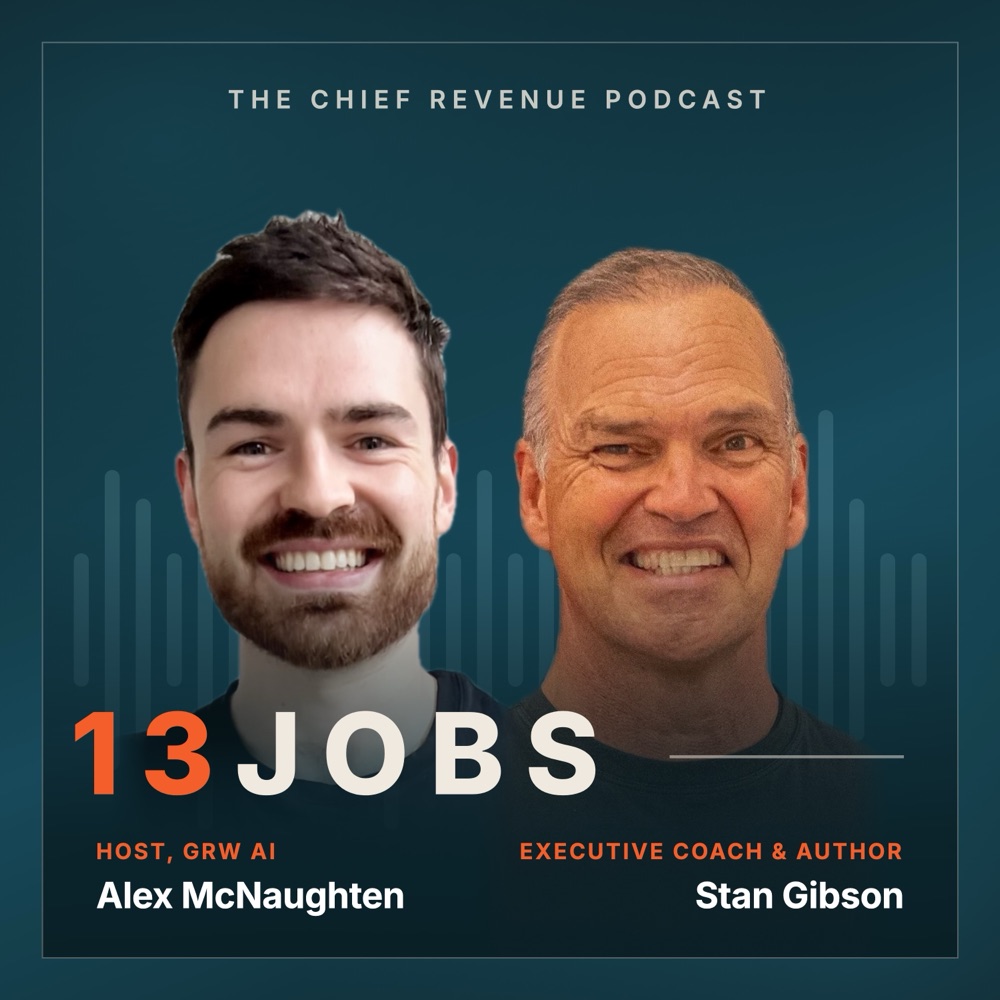
If you're not good at home, you're not good at work
Stan's case is that leadership development starts with the whole person, and that a manager's real job title is coach.
 Hosted by Alex McNaughten
Stan Gibson · Executive Coach & Author
Stan Gibson is a business consultant, executive coach, author and speaker who has spent more than 35 years working with executives and teams across a range of industries, as both an entrepreneur and a corporate leader.
His coaching brings together multiple certifications with research on wellbeing, on the view that the personal and the professional are one system rather than two. He wrote Living a Rich and Intentional Life during the pandemic.
In this episode, we discuss:
- Three decades in the corporate world, and why life is the training
- Writing a book during the pandemic, and what it was really about
- Being blindsided early in his career, and what he decided afterwards
- Knowing your own strengths before anyone hands you a framework
- The company that replaced every manager with a coach
- The head coach who admitted he knew very little about football
- Worst to first, by handing the leadership to the players
- Building a cadence with people two levels below you
- What turnover actually costs once you put a number on it
- The sentence that keeps people in the building
- Sales turnover, and whether leaders should own it
- Overestimating the day, underestimating the year
Quote of the show
“Wherever your career takes you, we have a vested interest in making you the best version of you.”
Key takeaways
- Home and work are one system. If you are not good at home you will not be good at work, and it runs both ways. Development that only addresses half of someone is doing half a job.
- Know your strengths before you take the framework. A leadership model dropped on someone who has never worked out what they are naturally good at, or what their kryptonite is, does very little.
- The manager's real job title is coach. One company replaced its managers with coaches and the return was substantial. Listening and asking questions beat being the subject matter expert in the room.
- Worst to first came from handing it over. A head coach who openly knew little about the game gave the leadership to the players on the field, and they took the team from bottom to best in the country.
- Put a number on turnover. Replacing a hundred thousand dollar role costs roughly two hundred thousand. Moving from twenty percent churn to sixteen runs into millions.
- Say the sentence, and mean it. Wherever your career takes you, we have a vested interest in making you the best version of you. Say that and back it and people stay.
- Product-first cultures work briefly. Hit quota, miss it, work harder next month. It produces numbers for a while and has no sustainability, and the churn rate is where it shows up.
Transcript
Stan, good to have you on the show. How you doing today?
I'm doing fine, Alex. How are you doing?
I'm doing okay. I'm a little tired. I think I'm jet-lagged, but I'm excited to be talking with you today. So for those who don't know Stan, Stan, you're a speaker, you're an author, and then you're an expert in leadership. But tell us a little bit about yourself and how you ended up doing what you're doing today.
Oh, thanks, Alex. I'm excited, you know, I think we're all aspiring experts in leadership, but I think, you know, life, life is the best form of training. And so I think, you know, the more we go through it, that's probably the one thing about me. I've been in the corporate world both as an entrepreneur and as a leader for, you know, 30 to 40 years.
And so, you know, a lot of times when I'm working with either Gen Z, millennials, that's the one thing you have is you've got you've been in enough situations where all of a sudden it's like, I was there, done that. Hey, can I give you some advice? And so I think that, you know, that helps from a leadership perspective.
But, you know, to kind of build on that a little bit, Alex. Yeah, I've, you know, I've been in business for a long time, seen a lot of things and, you know, good, bad, ugly, been through a lot of economic headwinds and, you know, watched how leaders were able to kind of, you know, migrate through those times.
And, and so anyway, it's just a collection of experiences. And, you know, one of the things I did was, you know, I, I, I really started, uh, doing my own thing about 2 and a half years ago. And when people ask me, they say, you know, when did you, you know, start becoming, you know, an author and a speaker and, you know, all of this stuff?
And, you know, I guess the, the real answer was I started my company 2 and a half years ago. But the real, the the real answer is I actually started about 10 years ago. And, and while I was very upfront with my employer that, you know what, I enjoy doing motivational speaking, I enjoy working with, uh, executives before and after work, I enjoy, uh, am passionate about leadership, they were great about, you know, having me kind of live this dual life.
But I tell a lot of people, you know, Never wind down, wind up, and know what that Plan B is going to be, Alex. Because, you know, as we've talked about in today's society, um, you know, we're probably not getting that gold watch being with a company for 20 or 30 years. We are probably looking at— I think, you know, you had used a word, redundant.
Uh, a lot of times companies are looking for efficiency, and you might be the odd person out. But the important thing is what makes you wake up in the morning? What is it? I know in Japan they call it ikigai. In fact, there is no word in Japanese for retirement. You ask somebody, you know, when they're going to retire, they look at you and they got this crazy look on their face.
But their word is ikigai. It's, you know, what makes them wake up in the morning. And so, I really challenge a lot of people as to what makes you wake up in the morning, what excites you. And, you know, we do a lot of assessments in order to understand where that excitement comes from.
But, uh, so I've been, uh, I've been working with, uh, individuals. I've been working with organizations, um, on my own for about 2 and a half years. And again, doing a lot of keynote speaking. I do a lot of corporate speaking, coming in and working, uh, on corporate retreats and helping them, uh, you know, with some of their business planning.
But really, it's a lot about helping leaders become coaches. And, and a lot of times my clients say, can you help me become a better leader? And I said, well, let's, let's take a step back. Can I help you become a better coach? Because what got you into your current leadership position is you've got a lot of knowledge.
But when you step into that position and you start telling people what to do, then you're enabling. And that's not leadership, Alex. That's, that's a, that's a totally different element of, of, of, of leadership that is not sustainable. So getting that ability to ask better questions, to listen, to basically draw out from the team so that they develop more confidence, that's a lot of, uh, you know, some of the elements that I work with the various clients.
So, so speaking, leadership workshop development, uh, and executive coaching are, uh, is really, uh, what, uh, that's my reason for waking up in the morning.
That's That's your— what's the word you use? Ikigai. I'll probably pronounce that terribly. But so let's talk a little bit about— let's talk about leadership. And I think I want to start with, I guess, the experience for most new leaders, which is— and you sort of alluded to it— which is you're promoted because you've got some knowledge.
And you probably demonstrate you've got a bit more knowledge than everyone else, or maybe you've been there a bit longer. And now you're a leader. And the experience for most people is they get promoted and they get no support. They're just like, all right, you're the leader now, off you go. And then what I've observed typically happens is people revert back to what they're good at or what they know.
So they end up kind of being the player coach. So they end up taking over or they end up kind of inserting themselves, especially when I think of sales leaders, they, you know, inexperienced ones, they start inserting themselves in their team's deals. And then they get frustrated and the team's frustrated and it doesn't really go anywhere good.
Any comments on that? Is that something you've seen? And then I guess, how do we change someone from being that, I guess, player coach to being the proper coach, the manager, the leader of that team?
Well, it's a great question. And if I look at it, you know, Again, never let a good pandemic go to waste. I used that year to write a book called Living a Rich and Intentional Life. And, you know, the thing about what I believe is, is that if you're not good at home, you're not good at work.
If you're not good at work, you're not good at home. So you really got to take some special interest in, in, in kind of the total package, Alex, of you as a leader at home personally and at work. And, and so part of that, you know, I've done a lot of research around what I call doubling down on you.
I think as a leader, first thing we have to do is we have to do 2 things. Number one, we have to have extreme self-awareness of who we are and who we're not. Having that authenticity and being able to bring that either at home or at work is absolutely critical. The second thing is what I call doubling down on you, and that's taking care of you.
That's everything from the science, the neuroscience, the physiological aspects of getting the right sleep, getting the right nutrition, Uh, you know, having, you know, the right exercise regimens in order to keep active. It's all the basic elements of living with intentionality. And again, I call it a rich and intentional life. So, to your point, Alex, we come in and we're thrust into this position and it's like, now what?
Yeah.
There's no manual. There's nobody to teach. So, I will tell you that I ran into a situation early in my career. Wasn't my fault, but I believe that, you know, some things worked against me. And all of a sudden it was like, Stan, you've got a 30-day notice, ship up or ship out.
And I was like, wow, I just kind of, you know, kind of got blindsided. And this was early, this was 30 years ago. But the one thing I went home and I, I said, you know what, I can't let anybody else dictate my present or my future. I own that. I own that.
And what are the 3 to 5 things that I'm gonna do over the next 4 to 5 years to make sure that I'm not dependent on other people being in charge of my leadership? I, I'm dependent on, on my own knowledge, my own certifications, my own leadership development. You have to take care of you.
I think that's really critical is that we, we don't feel like other people are going to take care of us, Alec. We have to take ownership of our own life. So to me, that is, again, that's doing it at home and it's doing it in the workplace. I believe those are 2 very fundamental, uh, areas that we need to focus as a leader.
And then I think that self-awareness, um, almost the first thing I do when I work with clients, quite honestly, is we go through self-awareness. We talk a little bit about, uh, there's a, there's many different assessments. We've all taken assessments. One that— 2 actually that I lean on. One is StrengthsFinders, but it isn't just StrengthsFinders.
I've worked with many different industrial psychologists who work on how do you take that and morph it into something even more meaningful. How do you take— and if you're not familiar with StrengthsFinders, StrengthsFinders, there's 34 strengths, and you wake up with 5 of those strengths every morning. That's your gift. That is just— When you're in that element, you're not working, you're playing, you're having fun.
And so taking those 5 strengths and being able to dive even deeper into each one to where you can create this paragraph around what Alex looks like when he's in his element. I mean, it's like almost an unfair fight. Alex is having so much fun because he's so good at these 5 things.
Why would he play in any other— why would he swim in any other swim lane than that swim lane? And so I work with people on knowing that swim lane. But here's the interesting thing. There's many times when we're not taking care of ourselves or, or, or we're under stress, and those same 5 strengths that become what makes us so good can actually become kryptonite.
They can actually morph into what I call good Stan, bad Stan. And in those same strengths, for example, one of them is I'm an activator. It's one of my 5 strengths. So I love to get things going. That has served me very well in the corporate and entrepreneurial world. However, it's also played against me because sometimes I activate and I get things going so fast that I've left people back wondering, hey, why didn't we explore other options?
What do we do? And, and so knowing where you are best and knowing what your kryptonite is gives you a leg up from a leadership perspective. So that is one element. I also go into another called Enneagram, which is basically there's 9 elements of, of, of kind of how we're developed from a DNA perspective.
And, and it's very, very fascinating. And when we start to get into, to that, then we're starting to get into mastery-level self-awareness. Because then I start to take my clients and we say, wow, you know you better than anybody. But the next level is then how do you want to show up at work?
We know how you're wired. How do you want to show up? And then we start to get into the neuroscience basically of, of saying, okay, now let's take all the things you've fed into your subconscious forever, and some of them you deem as reality. Let's now start to put some things into the conscious brain as to how you want to show up.
We'll work on some specific routines and, and habits so that they become a new Alex McNaughton or a new Stan Gibson in how you want to show up as a leader. So that self-awareness is a key piece, and then taking care of you is a, is a, is a key piece from a wellbeing standpoint.
Yeah, it's interesting you started with that, right? Because I think that's where potentially a lot of folks go wrong is they just think, I'll just plop a framework on this person and then they'll be a great leader. Or I'll give them, you know, the A to Z, the idiot's guide to leadership, and they'll be fantastic.
But I think if— you're right, if you don't know what you're good at, really, like you don't know where your strength, your natural strengths are, your natural happy places.
Yeah.
And equally where your kryptonite, as you put it, and then your personal life, your home life is not in a good way, you'll never be anywhere near as good a leader as you might want to be. Another thing you said that I wanna pick up on is around, you know, you talked about making leaders coaches.
Why is that so important? And does that sort of beg the other question is, do you think that's the primary responsibility for a good leader is to be a coach?
I really do, Alex. And I'll tell you what, you know, there was a company within the last year that they, I don't know if they terminated, but they basically got rid of all their managers and they brought in all coaches and the coaches You know, the return on that investment was quite handsome, quite honestly.
I mean, they looked and all of a sudden these subject matter experts that were removed from the company, they brought in people that were able to listen, to ask questions. They were able to ask open-ended questions. How would you solve that? So how would you suggest we, from a leadership A leadership point of view.
How can we help you? What would be a better way to deliver this, this, you know, this, this product to the client? How, how would you say— when you start to, to get input from those on the front line, Alex, that's when you start to develop what we call a people-centric leadership. Um, I learned this concept back when I was in college, actually, and I, I played football here in the United States.
And my, my first year of playing, I thought this was going to be a really phenomenal team that I— yeah, a university that I played for. And we won one game that entire year, and it was really deflating.
Yes.
So you don't, you don't keep your job as a, as a head coach if you only win one game. So they brought in a new guy, and this guy was, was, was, you know, his name was Darryl Mudra, and he, he admitted he knew very little about football, which was surprising for a guy that was— his nickname was Dr.
Victory. And yet he comes in and he's got this humility. And, you know, one of the things he said that really stood out to me was he said that You know, you as the players, now we're going to surround you with some really good coaches. And they did. They surrounded us with some really good coaches.
But he said, you as the players, you're the coaches out on the field. You know, if you're getting beat, you know, if you're beating the guy across from you, you know what's going on in the field. We don't. Unless we have that intelligence, can we make in-game modifications? Well, that was a very interesting perspective.
Find out the specific capabilities that lead to success in your environment using our Sales DNA assessment platform, as well as uncover potential capability gaps to inform your The most interesting thing about this story that I'm telling you is that team that won one game my freshman year, that very next year, very next year, within 12 months, that team won the national championship.
Right.
Best team in the country. I mean, to go from worst to first. And some of those elements that he brought to the table were people-centric leadership, of basically passing a lot of a lot of the coaching and leadership to the employees or the players on the field. And, and again, I think that you asked a question around, is it really important to be a coach?
Yes, to listen, to ask questions, to get intel from those out in the field that are actually selling the product, those that are actually making the product, those that— I mean, you know as well as I do from your sales background, if You know, if you listen to a lot of engineers and you're out trying to sell something that doesn't, you know, doesn't manifest itself into a good product, um, you know, it's failure.
So, so, so there's this element of listening and just getting this collaboration that seems so simple, and it's not. We make it very hard in today's, today's world because we all get a little caught up into you know, our own department versus thinking about it from a collaborative standpoint.
You've talked about listening and asking questions as being, you know, it's a common theme I've heard as you've been talking about coaching. Is that it? Is that all coaching is? Or, you know, what else makes someone a good coach? How can someone, you you know, starting at zero, build themselves into a good coach?
What are the fundamental things that's required?
Well, one of the things, and I talked with a client about this the other day and we talked a little bit about, you know, Theodore Roosevelt, you know, was a US president who he had a quote and he said, you know, people don't care how much you know until they know how much you care.
Right.
And, you know, that's a very interesting thought. And I know that for me, when I was in the corporate world, I was very intentional about, you know, the relationships with not only the people that reported to me, but the people that reported to my direct reports and those throughout the organization. So for example, you know, I had, uh, you know, I had a specific cadence.
I met with those that reported to me twice a month. And, you know, the first 15 to 20 minutes was probably more personal conversation. How's it going at home? What's going on? You know, what's affecting— you know, just getting to know people at a personal level is very important. And again, it's not that they— it's not that they want to know how much, uh, uh, you know, what you know.
They want to know how much you care. But once we have the, you know, that 15 to 20 minutes of personal conversation, then we can get into— so, you know, we've talked a little bit about some of the things that are going on. Can you help me understand? What do you think about what would you suggest?
And you start to get into this, this, this two-way conversation versus, versus this one-way conversation, and that becomes very meaningful. And, and I will tell you that, that the biggest thing that U.S. companies— and this is really across the world— but the biggest thing they, they work— they, they fear today is turnover.
I mean, turnover, people come and go. And the thing about turnover is, is that it costs 1.5 to 2 to to 2.0 salary dollars of the position you're replacing.
Yeah.
So if it's a $100,000 position in the US, that's a, you know, a $200,000 expenditures just getting somebody back into that position and retraining them and getting them up to speed. It's very costly. So if you move from, let's just say you've got a, uh, you know, 20% turnover, and if you were to get it down to 16 or 17%, which might be an industry standard, That can run into millions of dollars.
So the ability to teach leaders to become coaches and to then mitigate that turnover by showing people, hey, we, we really want to, to, to, you know, coach, lead, understand you. You're an integral part of this company. If you can get people to do that, I will guarantee you employees will make a committed, uh, investment back into the company.
I have a saying, Alec, um, and I, in fact, I just told another client this the other day. We can never guarantee employment. We just can't. No company can guarantee employment, but we can guarantee employability. And employability means, you know what, we're gonna make you the best version of you, whether you work here, your next job, whatever.
Mm-hmm.
Wherever your career takes you, we have a vested interest in making you the best version of you. I will tell you right now, you take that mentality into any company right now, any organization, and I will guarantee you employees will stay with you.
Hmm.
Employees will stay with you. I really believe that. And to just expand on it, when I said I have meetings with, with, with, with the people that report to me, I even met with people that I would call a, you know, once removed from me or a 2 down, somebody who didn't report to me.
I would meet with them about once every 6 weeks, 6 to 8 weeks.
Right.
And then I also picked out people throughout the organization that I felt, uh, in other, other departments that I should, you know, put on, you know, calendar my time to, to, to have these, these integrated relationships. I think as a leader, you talked about being a coach. I think that really comes down to taking a vested interest not only in those that report to you, but those that are within your department and those that are within your organization.
That's what starts to elevate you as a leader in the company, as a listener, as someone who understands all the working parts in the company, in your department. I believe that those are all elements of coaching, Alex.
Interesting. I'd like you to comment on something. So in sales, this is a bit more specific, but I'd be curious on your take on it. So sales has a real turnover problem. So it's about 25% churn year on year. And the average tenure of a VP level of sales is now sitting at about 18 months.
And the average tenure of a sales development rep is about 14 months and somewhere in between for the rest of sales roles. So in other words, a year and a half or less. It's very hard, you know, as a leader, for example, to do what you've described, or it seems like it would be very hard to do what you've described and understand the team, understand the environment, have those kind of key stakeholder relationships outside your core team when it's changing all the time.
What are your thoughts on that? And how do leaders, I guess, adapt into what is unfortunately becoming, and not just in sales, in most, I'd say in most roles, this has trended this way in a more transient work environment. What needs to change from a leadership perspective?
Well, let me kind of, maybe when you say when things are changing all the time, can you help me, can you help clarify that when you say things are changing?
When the people are changing all the time. When the people are changing out all the time, you know, when your team is, 25% of your team is churning on average every year and you're in a leadership role, you know, in VP level, you're there for 18 months on average. It makes it, it's quite hard.
Is this, you know, is this something that leaders need to kind of, you know, own and say, well, this isn't good enough, we need to do better? Or, you know, or what are some strategies that as a leader, if you're going into a sales environment, for example, and that is kind of the current state, like how do you adapt?
How do you win?
Well, you know, every company is gonna be very different, but I tell you what, companies that are forced, that are facing that kind of turnover, there's an underlying current that needs to be understood. And I don't know what that is until, you know, I was able to get in. But, you know, whether it's the product, whether it's the, you know, it's whether it's the compensation structure, whether it's not spending the time to basically coach, understand, lead through different elements.
I would have to probably fight back on that very hard with a company and say there is an underlying current, either it's with our leadership or it's with our product, but there is something that we haven't went in. When I talk about a people-centric or a human-centric environment, we haven't done a good enough job of either interviewing on the way out or interviewing on the way in.
Yeah.
As to what the expectations are gonna be and that we are more of a people-centric environment versus a product sell at all cost environment.
Yeah.
I don't wanna paint companies into one or the other. I can just tell you when it becomes very much a— trying to think of the word I'm looking for, but when it becomes a product, just a product first, out the door sales, hit your quota. If you don't hit it, work harder next month.
It isn't gonna have sustainability to it. It works for a short term, but it doesn't have sustainability to it. That's where I'd be honest with you. I really would. I would look at the the style of managing and I would start to work more from a people-centric environment versus a sales environment. Because again, let's think about that for just a second.
A lot of the people that were really good salespeople in the field, they get promoted and they come up and you know what, here's what worked for me. So it must work for you. And that isn't always the right answer. We're all different creatures. We all sell differently. Some of us are better cold callers.
Some of us are better at closing the sale. Some of us are better at multiple things. Knowing how to put people in the right spot, in the right swim lane is critical as opposed to a one size fits all.
Stan, I've really enjoyed this conversation. I've got one question left to ask you, which is one we ask just about everyone who comes on the show, which is knowing everything you know today, go back to your first day on the job. What's the one lesson, one thing you wish you'd known on that first day of employment?
You know, we often overestimate what we can do in a day and we underestimate what we can do in a year. And I think, you know, for me personally, it's spending that and calendarizing your time, whether it be on the weekends or, you know, wherever you can best think through what does the next 12 months look like?
What does the next 36 months look like? Because while we get busy and we have a to-do list with 10 things on the list and we get to 4 of them each day, I will guarantee you the marginal improvement that we can make just working towards whatever we— whatever those big rocks, those big boulders are that we deemed important 12 months out, 36 months out, 5 years out.
I have a lot of my clients tell me exactly what their life will look like 5 years out, and we work towards making that a reality. Don't get discouraged. On a daily basis. Keep your eye a little bit out into the future and we can work on marginal improvement each and every day to reach those dreams.
Great advice. This has been a fantastic conversation. Where can people find you, Stan, if they want to connect with you, if they want to reach out, they want to consume your content, where's the best place to find you?
So they can reach me at oxygenplus.com and that's That's the full word, O-X-Y-G-E-N-P-L-U-S, oxygenplus.com. And, and, and, and I would even say this because I believe so much in what I call doubling down on you. I did create a, you know, I created a, a, a just a 2-page worksheet on all the neuro and physiological science around getting better sleep, around nutrition, around living with intention and, and, and, and, you know, calendarizing Uh, you know, your work life.
And so it's, it's this great sheet that's almost like a cheat sheet for leaders to basically live with more intention. And if it's okay with you, I'll, I'll, I'll, uh, yeah, we could put it in the show notes.
Yeah.
Um, and if people go on, they can, you know, grab a copy of it. And I hope it helps. But again, I believe it's really important to double down on you as a leader. And I think this is a great, uh, um, uh, a great, uh, framework for being able to do that, Alex.
Thank you, Stan. This has been a great conversation. I've really enjoyed it. We'll definitely put that in the show notes and when we promote it on LinkedIn as well. So thanks for giving us your time and sharing your wisdom and look forward to speaking again soon.
Thank you. Thank you very much. I appreciate it. You've got a great podcast. I've listened several times and I will promote you as well, my friend. Thank you and everybody, may you all live a rich and intentional life.
Thanks, Dan.