
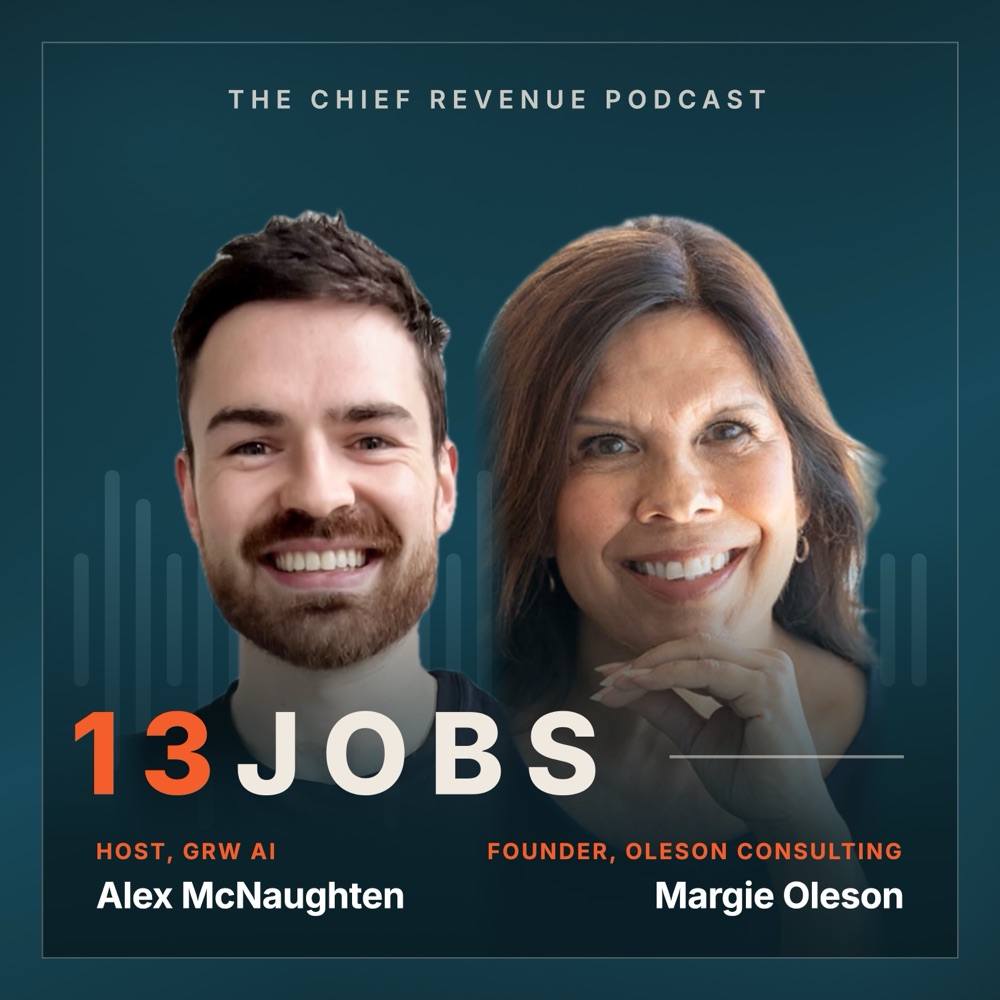
Meetings are an $85 billion problem
Four decades in corporate America and a doctorate spent on one question: why teams with all the information still cannot execute. The answer keeps showing up in the meetings.
 Hosted by Alex McNaughten
Margie Oleson · Founder, Oleson Consulting
Dr Margie Oleson is an executive coach and organisational change consultant, and the founder of Oleson Consulting. She has advised leaders and their top teams through change for more than twenty years, at organisations including Target, Cargill and Lockheed Martin.
She spent four decades in corporate America first, and holds a doctorate in Organisation Development. Her dissertation asked why teams and groups have had the research available to them for a century and still do not act on it. That question became Top Team Accelerator, the programme she built around it.
In this episode, we discuss:
- Four decades in corporate America, and being let go more than once
- Staying too long, and never giving yourself permission to leave
- A century of organisational research that almost nobody applies
- Meetings as an eighty-five billion dollar problem, and an easy one
- Nobody teaches leaders how to lead
- Imagine if there were no law school, just a couple of trainings
- Why teams miss the number, and everything they blame instead
- What a high-performing meeting actually looks like
- What happens when tactical and strategic share a room
- Inviting people out of fear of missing out, and politics
- Finishing early to review decisions, owners and the parking lot
- The people who like meetings exactly as they are
Quote of the show
“It is the absence of alignment and clarity. They don't have the same view of things with each other.”
Key takeaways
- Companies hire experts for compliance and assume anyone can run a team. A hundred years of organisational research exists and is well understood. Almost none of it gets required of the people running teams.
- Meetings are an eighty-five billion dollar problem and one of the easier ones. They are broken for the same reason everything else is broken: nobody is having the open conversation underneath it.
- Separate the tactical from the strategic. Put operations and strategy in one room and fifteen minutes disappear into a hiring question with the wrong people present, while the actual agenda goes untouched.
- The invite list is decided by politics and fear of missing out. Fortune 100 companies included. That alone accounts for a fair share of why the meeting does not work.
- Finish ten minutes early. Review what was decided, who owns what, what is still open, and what goes to the parking lot. Someone will say "no, we decided that", and three other people will disagree.
- Missing the number is usually an alignment problem. Not the market, not the new hire, not the workforce. A team that cannot state the same view of things to each other will not execute.
- Some people like the meetings exactly as they are. They get to sit there. They are also the reason nothing about the meeting ever improves.
Transcript
Margie, good to have you on the show. Thanks for giving us some of your time today. How you doing?
Doing well. How are you?
I am excellent. I'm really well, thank you. So for those of you who don't know Margie Olson, an organizational change consultant, you've built a business around this, but give us the short version of your history.
Sure. So I was in corporate America for 4 decades and I have the benefit of having been laid off and fired many times. And each time I thought, I can do better. I can stop giving so many opinions, or I can be more of a team player, or I can be a better leader, or I can calm down and not try to bring my gifts to everything.
And so I tried that over and over and over again. And I'm sure some of your listeners resonate with We're getting messages that we probably should do something different. And I just kept arguing with it. And I had always wanted to be an entrepreneur. I always wanted to be able to own the decisions and take responsibility for how it goes.
And I just wasn't sure. I was a single parent. I just wasn't sure how that risk was gonna feel day in and day out. And so, I waited a long time. And by that time, I saw in organizations whether it's for-profit or nonprofit, government, social services, large organizations, Fortune 500, Fortune 100, small organizations, they had— have the same issues.
Very, very similar issues because they are rowing in different directions, even though the greatest thing that they could do is for everybody to be rowing in one direction. And they are burnt out and they're fighting fires. And the leader has been waiting to be in a leadership role. And now they're here and they look around and it feels like preschool teaching or some sort of herding cats.
And when once I— and then I had gone back to school to earn my doctorate in organization development. And while we were in our 4 years of coursework, and this was not that long ago, 10 years ago, I learned that we knew everything we need to know about those organizational dynamics, about how to lead, about how to be an effective team.
We had known that for 30 years at that point.
Right.
So now 40. And so my dissertation subtitle is, what the heck? What's going on with teams and groups in organizations that they have all the information available to them and they've had it for decades and they're not making it happen? And so that became my passion. And I started to focus in. I've done a lot of change and transformation consulting and organizational consulting.
And then I finally developed Top Team Accelerator. And we can talk about that. Top Team Accelerator is a methodology to come into the organization and help the leader and the leadership team or a senior leader in one big division, take the information that we know and execute it in a way that helps you, uh, make it stick in the future.
So there's a lot of training and consultants and coaching, and this pulls it all together and gives you the building blocks so that we don't have to— after 3 months after I leave, everything goes back to the old way. You actually can begin to set up the processes that work for you. And that's why it fits every industry and every size, because you are having some of the same issues and some of the same reasons for why you haven't been able to solve it up to now.
Fascinating. And I just mentioned something you said earlier is like getting fired can be such a pivotal moment, right? Or made redundant. Or, you know, I remember it happened to me quite early on in my career when I was about 24, 25. And it really changed the trajectory of where I was going from then on.
Like, it really changed things. It's such a pivotal moment. So it's interesting that you had a similar experience.
I did. And when I look back, my issue is I stay too long. And I think some people can relate to that. We stay too long because we think we can just do something different when what we're really saying is, I see what's happening and I can be a better fit somewhere else or some other way, but I haven't given myself permission to do that.
So today we're gonna talk a little bit about leadership. We're gonna be talking about, I guess, but what I'm really curious about is what's going wrong in organizations. So you're You're saying that it sort of doesn't matter the size, doesn't matter the shape of the organization, they're all having common problems. So maybe let's start there.
It's like, what are the common problems that you're seeing across organizations?
Yep. And so it starts with, there is an art and a science to what we know about organizations, organization development, organizational communications, organizational management. This has been studied for 100 years. There's a lot of experience, a lot of companies getting really, having a lot of time to go through the emotions and practice.
And so companies are very comfortable requiring that they hire for compliance, make sure the experts on compliance are the ones that we are hearing from and are making our decisions. They bring in finance and accounting people who are experts in that realm. They would not expect to be able to do it themselves.
Same with supply chain operations. All of those things require a level of knowledge and knowing what it has worked and knowing what it is that you're going after. And then comes to behaviors and leadership, we think we can or have to wing it. And I'll say my very first leader is the person that was there when I was born.
And my very first team is whoever's in that household. And then as I start to have jobs and go to school and be in sports or music or whatever, think about that. So if the brain and I, and we can talk about the brain, very important part of this work. If the brain needs to keep me alive and it does, it's going to commit 99.9% of its resources to the potential for threat.
So that means that pretty much everything I do every single day is automatic pilot. Wow. So if I had to relearn when I get out of bed in the morning, if I had to relearn how to get that glass of water, how to make my breakfast, how to get my car out of the garage, if I had to relearn that every day, I'd probably never make it happen.
And so most of what we do is automatic pilot. So if my first leader's And my first teams were all those people that were around me coming up. How did they know how to do that? And then we go on and we do our after-school jobs, and then we come into our careers or we start a business, and we only have our past leaders to, um, as input on knowing how to do this.
So then companies do then bring in models for certain types of learning about how to be a leader or certain models for how to be a team. But then because they're not recognized what investment of time and energy and focus it takes to change those habits that you've developed because your brain loves habits.
Then they'll do the class and a couple of people will totally get it and love it. And everybody else will go back to their default, which is what their brain is used to. And so, you know, you've heard culture eats strategy for breakfast. I would say our habits are eating our goals, our desires, our strategies for breakfast.
So these leaders with all good intentions, nobody gets out of the bed in the morning and says, today I want to have a terrible team and I want to be an ineffective leader. These leaders are coming in and they truly are like, what is happening? And they look around and sometimes they inherit the team and sometimes they're hiring it one person at a time.
But imagine the complexity of the two of us right now in this conversation. You have your whole history, your brain, your own automatic pilot. I have mine. Add 7 people to that.
Yeah.
Imagine that complexity. But, and so the beauty of the pains that people are experiencing, terrible, terrible meetings. Meetings are an $85 billion problem in the US, and they're one of the easiest things to solve. And the reason you have those issues is the same reason you have other issues. So if someone tries to fix their meetings and all they do is one little thing here, they haven't gotten to the root cause.
And the root cause is they're not having open conversations with each other. They're not following the methodologies that we've known about for years, like high-performing meetings. And they're not speaking openly to each other about what is happening and what is needed. And so people are too isolated. They're in silos. They're leading their teams in silos.
And it's kind of like you expect to hire someone who has a great background and you just expect them to show up and bring their organizational effectiveness and they don't have it. They never had it to start with. And if you're not in a company or an organization that has it, you actually have no idea what I'm talking about.
And what I'm talking about is if someone has the propensity to gossip about one of their colleagues on the leadership team. So we have a meeting, leadership team has a meeting. And then I'm a member of the team and I go away. So I'm the sales leader. I go away and I go back to my team and I'm, oh, it's happening again.
They were— we're given these goals that are unrealistic. We are the— they tell us to do these metrics, but they're not incentivizing us in a way that helps, blah, blah, blah. So as soon as I go back to my team, I have now violated the benefits of being a cohesive, high-performing leadership team.
Doesn't mean I'm a bad person. It means that I'm A, uninformed, and B, it means that I don't realize I don't know what to do to be successful with my team. And I'm doing that because I'm trying to help them. So you've got each of these leadership team members coming to the leader to solve their problems, coming, and the leader's like, okay.
And the leader is helping because they don't know that they shouldn't have to. And so we start with the uncovering of pain that people feel comfortable talking about. And then we begin to put the building blocks in place to help someone like me, that sales leader, feel less inclined to talk to my team about my colleagues.
And I build the team with my colleagues, sort of like how you would build the adults in a household. I build the team with my colleagues, and we come to know each other, and we come to understand each other's work, and we come to learn together how to do organizations, how to be a leadership team, how to be a leader.
And then pretty soon, we start to have wins. One of the first things we do is fix people's meetings. And when you start having meetings that are high performing and you start having conversations that are open and honest, it changes everything. Now, it's pretty complicated. If you only did that, you may last for a little while, but eventually you're going to default back to all those automatic other processes that are in play.
So when you build these pillars, you're starting to fold in challenges and taking the newness with you to go to the next one. And that's why it takes a year. And that's why it's an investment of time. People have to say, I recognize the pain, I recognize the problems. And if we start with the end in mind, I'm a leader.
I want a team that rows their own teams in the same direction. And it's the direction of my goals and my current priorities. I want a leadership team that dukes it out with each other metaphorically. They kind of mix it up and have healthy conflict and then work and then make decisions, or I make decisions and go forward before they go back to their teams and tell their teams, um, what is happening and what's gonna— and, and what is next.
I once worked with a medical device, uh, transformation leadership team, global, and a year of no traction. No traction. They're spending hundreds of thousands of dollars on travel and meetings and, and people coming off of projects to be on their project. And now there's all that staff time, but they're not actually getting any traction.
So they brought me in. What's happening? And we planned a conference. And within a day and a half, this leadership team, because we did a few of these basic fundamental foundational aspects of how to be a team together, within a day and a half, they had pulled together and accomplished more collaboration and alignment than they had in the previous year.
And by this time, they had already had team members who were asking to come off of this transformation. They came onto it excited, and now they want to leave because there's not traction. One of the first things that changed was a reduction in politics. They started to be open and honest with each other and not blame others.
And people started to ask to be on the team. And they had not even recognized that those were the causes of their issues and that that was how to fix it.
Let's pause for a second. There's a lot there and I wanna unpack a few of these things. It's really interesting. So one question I have for you is, and it kind of relates back to, you were talking about like most people like have their own, you know, all their kind of life experiences and habits and they're kind of taking that into the workplace.
Yeah.
I think one of the other problems that I've seen, you know, if I look at sales leaders, which is where I play mostly, they don't get— no one teaches them how to be a good leader. Like, no one tells them this is how you should lead a sales team. Here's what effective leadership in general looks like.
And then, you know, I think the other problem is also then the few that do get some coaching or training on this, it's exactly like you said, it takes time to change behavior. And if we're just doing like a once in time, here's a training session. All right, now you know how to be a leader, go.
Go for gold, you'll be effective. It doesn't stick. So is the problem that we're not training people? Is the problem that we're training them in the wrong way? Is it a combination? Yeah, like how do you see the problem? Like, because I see this massive gap at a leadership level in general in sales.
There is. I see it too. I see it too.
Yep.
Imagine if you said we don't have lost school. There's no law school. People come have a couple trainings. I want you to do some reading. Do you have passion for this? Do you have the skills? There's a, there's an, I think, a lack of awareness of the complexities of the art and science of what happens.
And also, everybody talks to everyone else. So we think we know how to do that. We think we know how to be together. We think we know how to partner. Maybe I ran a volunteer committee, I think I know how to lead. I'm certainly a leader in my family. And then you have culture that says it is not okay for me, the sales leader, to say out loud, I don't know how to do this.
I need help. I'm feeling vulnerable. I don't feel supported. I am actually not sure how to hit these numbers. And you, leader, don't want to hear that. So I have to tell you we're going to hit these numbers.
Yeah.
And actually what happens with companies is they don't hit their numbers and it's not because they blame the market. It, or they blame the new person that was just hired, or they blame the workforce issues right now. And actually, and I don't even know them, and I can tell you it is the absence of alignment and clarity.
They don't have the same view of things with each other. I once worked with a 4-person team that had been together for a year. And when I came in, they had 4 different views of what they were supposed to be doing together. And they kind of laughed with each other, and then they kind of cried.
They were appalled that you could spend that much time and be an intelligent person. But it's because the way to behave is not in people's minds. And then their habits are all the old ways. Your habits are all your old ways. So if you came through sales, your habits are make the sale, make the sale, be successful.
And what does any of that have to do with the incentives for collaboration and being organized? And then you may go, you may bring in someone that is doing some great things in sales training. I actually participated in some amazing sales training when I was trainer, sales trainer. And, but then it's all in what happens after that.
And usually what happens is companies are, they're not investing the time and they themselves don't know. So they can't appreciate what it's going to take. They want this to be enough. They want a 3.5-week sales training to be enough. And if it's leadership, maybe you do a 2-full-day training in a particular model and then maybe you do a check-in for a couple of hours the next few quarters.
But the problem is those leaders don't come. They don't even come. And part of the reason they don't come is because they're not implementing what they learned in that classroom. They don't even remember. That is not how they learn. What I've heard from senior leaders and CEOs, um, number one, they do not think this is possible.
So why would they even speculate on the possibilities when they don't know anybody that talks about it? So you said there's a huge gap. Yep. They're all experiencing it. So nobody knows what to talk about or what to say. Number one. Number two, Sometimes they think they should outsource it. They, I'm a sales leader.
This isn't my work. HR will take care of that. Or, um, the, the CEO is taking care of that. Or, um, the owner. This is not, you didn't hire me for that. And also, if, if we're truly being honest and we're kind of opening up to each other, that all of that vulnerability, all of the, I'm not, I can't talk to you about what I'm really thinking, that I don't know how to do this.
It's kind of hard for the leader to make sure that I have what I need. Need in terms of training and execution, practice and adjusting if I couldn't even say out loud and comfortably, I actually don't know how to do this and I would like help.
Yeah. Is, you know, I bring it back to meetings actually because this is an interesting one because I tend to agree with you that a lot of meetings are pretty valueless. Like they have no value and actually sometimes meet like some of the meetings can be actually just negative value.
They actually are.
Many. How do you structure a good meeting? Like, what does a good meeting look like? Because I don't think many people know.
Yep. So I will tell you, I'll give you a little primer on high-performing meeting and then we'll say, and why aren't people doing that? So high-performing meeting number one is the right people at the right time on the right topic. And so the first thing that you do is you separate out your tactics from your strategic.
So you are not gonna have sales operations discussions in the same meeting as you have sales strategies.
Right.
And you're, you're changing the organization and you're doing big hires and you, you're being really strategic. And so then what happens is when you are, when people combine those, then you're in a meeting, you're talking about the day-to-day fires, the operations, and then someone brings up a hiring issue or a strategic plan for for a new market or a new product.
And pretty soon 15 minutes go by and you talked about that, but you don't have the right people there to even have that conversation. All you're doing is feeling good that you're talking about something that you know about.
Mhmm.
And, and meanwhile, all the reasons why you came into this meeting are still hanging out there. So the first— and, and so what happens is, and I wish this wasn't true, you've got Fortune 500, Fortune 100 companies creating meetings and inviting people because of FOMO.
Right.
They do not. They are fear of missing out and, or politics. I have to invite that person. I have to invite this person. Okay, well, that's why your meetings aren't working for you. So the first thing is you separate out your tactical and your strategic, and you say which ones those are, and you start to set up shop for those.
And then at the very beginning, and then you align as a group. By the way, this is gonna be a little awkward. You're being disinvited to some meetings. Don't take it personally. We're really just trying to get the work done. You kind of do it as a group. And then you kind of help each other along and deal with the problems that come up, the conflict when I really am not happy that you don't invite me to this meeting anymore.
So then at the beginning of each meeting, you just say out loud, what's the purpose of the meeting? And do we have the people here that we need to in order to do that? And then go ahead and do your meeting and then end 5 to 10 minutes early every single time. Every single time.
Right.
Pause wherever you're at and say, Let us go, let us review what we came, what we decided, who has follow-up actions, and what questions do we still have? And a reminder of the parking lot, the things that you came up, the strategy or the other pieces that came up that had nothing to do with this meeting, and they'll get dealt with somewhere else.
And invariably, that piece, you do that and someone will say, oh, no, no, no, no, we decided that. And then 3 other people go, no, we didn't. You can have 7 people or 17 people in a meeting and come away and they all think they have the same view and none of them has the same view.
Okay.
Multiply that by 150. And so, but then if it's so, and it really isn't rocket science, if it really is programmatic and you can do it this way and you learn that people do that, they come and they bring in a coach or a consultant to learn how to do better meetings and they've had all those trainings.
What's happening then is the other aspects of your culture and your habits are preventing you from turning this into the future. So you kind of, you don't hold each other accountable. People aren't holding you accountable. You're not starting a meeting and saying, okay, remember, we're following this new meeting thing. And kind of like walking around the block or jogging or getting to the gym, you got to do that 20 times.
My habits don't change the first day that I try a new meeting format. So I have to try it 20 times. And what happens in organizations is they just don't think they have 20 times. And also, so-and-so is really not happy that they're not in this meeting, or we have to talk about this fire because it's burning right now.
We can't talk about this strategy because we're fighting fires. Trust me, it is just a lot of trial and error and awkward practice. But eventually, you start humming, you become a well-oiled machine, and people's meetings become much more natural because it really is intuitive to do it that way. It's just that our habits are of really, really bad meetings.
Yeah. So separating out the tactical and strategic, that seems like I've definitely seen those lines getting blurred in a meeting. And you're right, it doesn't lead anywhere good because you kind of leave the meeting without anything really figured out. I like the finishing 10 minutes early and kind of having that time to I guess, reflect and kind of look at, okay, well, like what's actually gonna happen after this meeting and the car park, like what are the things that were kind of brought up that we haven't covered, but maybe we wanna cover another time.
And I think, yeah, making sure the right people are there. I think I see a lot of meetings exactly like you say where there's a lot of people there that really don't need to be in that meeting. And, you know, often those people are actually frustrated that they're there in the first place.
They're like, why am I here? This is taking me off what I should be doing. Like salespeople get frustrated with that.
Of course. They're glad to be there because they can just sit around.
Well, that's the other side of it, right?
And those are the people that are keeping meetings from getting better because they work for them.
It's such a complicated topic and there's so much to it and we've barely scratched the surface today. And, you know, obviously you studied a long time to kind of learn this and then lived it through organizations. So, you know, we scratched the surface, but there's a couple of things that I've taken away from this conversation.
For the listeners, if they want to go deep on this, where can they find you? Where can they connect with you? And then are there any other places like resources or books or things like that that you'd recommend outside of obviously your body of work that have you found helpful?
Yeah. So first of all, I can be found at oleson-consulting.com and it's Olson with a silent E. So oleson-consulting.com. You'll find all kinds of resources on high-performing meetings, high-performing teams, videos. You can download a case study and see how Top Team Accelerator comes to life. And then I'm on LinkedIn, Margie.Oleson on LinkedIn, and I post content every single day.
I have articles and videos and information out there for you. The one thing I would leave you with, so when we start the first 3 months and we're just trying to fix things right away and understand that if you're a fit, one of the first things we do is fix your meetings. And the other thing we do is we implement working Working Genius.
Working Genius is a new Patrick Lencioni assessment. It's been around for a couple of years, and he's the one that did the 5— he and his team did the 5 Dysfunctions of a Team decades ago. And now this is probably my favorite assessment. This is productivity and teamwork. And what it is, imagine the acronym WIDGET, W-I-D-G-E-T.
There are 6 geniuses: Wonder, the people that ask the questions about why or why not, the Inventors, the I, the Discerners, people who, without understanding why, they seem to be able to know if something's gonna work or not, or they're connecting dots that other geniuses just don't have. Um, G is galvanizing, pulling people together to make stuff happen.
E is enablement, the people that really know how to get things done at work. And T is tenacity, people that are inspired to check something off the list. And WIDGET in that sequence is so like high-performing meetings. WIDGET is a sequence that you lay on its side and say, if we're in a meeting right now and we are talking brand new about something, You're up in the WID phase.
But what happens to a lot of teams, even the smartest, most highly successful in certain areas teams, is like the strategy coming up in a tactical, you'll be in a meeting where you're actually launching, you're actually rolling out, and the sales are already done. You've turned it over to the operations, whoever is in execution, and you're at a meeting and somebody questions the product.
Or somebody questions the service and multiply that by 150 because it happens over and over again. And there are whole companies who don't realize that they never meet budget or they never finish on time or they don't ever finish because somebody is too busy taking us back to square one when we've passed that.
We agreed that we passed that. Or products or service to market aren't the right ones because they went right to execution.
Yeah.
It makes it sound so simple. But when you build that discipline, so that's why we do it the first thing. When you build that discipline, you find the people that are good at which of those pieces and you follow those sequences to be much more programmatic and methodical in your behaviors and your decisions and your execution the way you're methodical about the other parts of your business.
So interesting. Yeah, it's the skipping ahead or being in the kind of the wrong phase at the wrong time.
Always.
And that's actually making you go backwards. Yeah, definitely something that I've encountered.
And teams can get really good at doing it differently. They just need the knowledge, they need the practice, they need some coaching. It works.
Marge, this has been great. This is a really good conversation. And thank you. I'm conscious of time, otherwise I'd keep going for another, you know, 30 minutes or longer. Um, so thank you for coming to the podcast. It's been an absolute pleasure. And, um, yeah, everyone go reach out to Margie, consume her content, and, and learn, uh, because there's a lot there.
Thank you.
Take care. Thanks.