
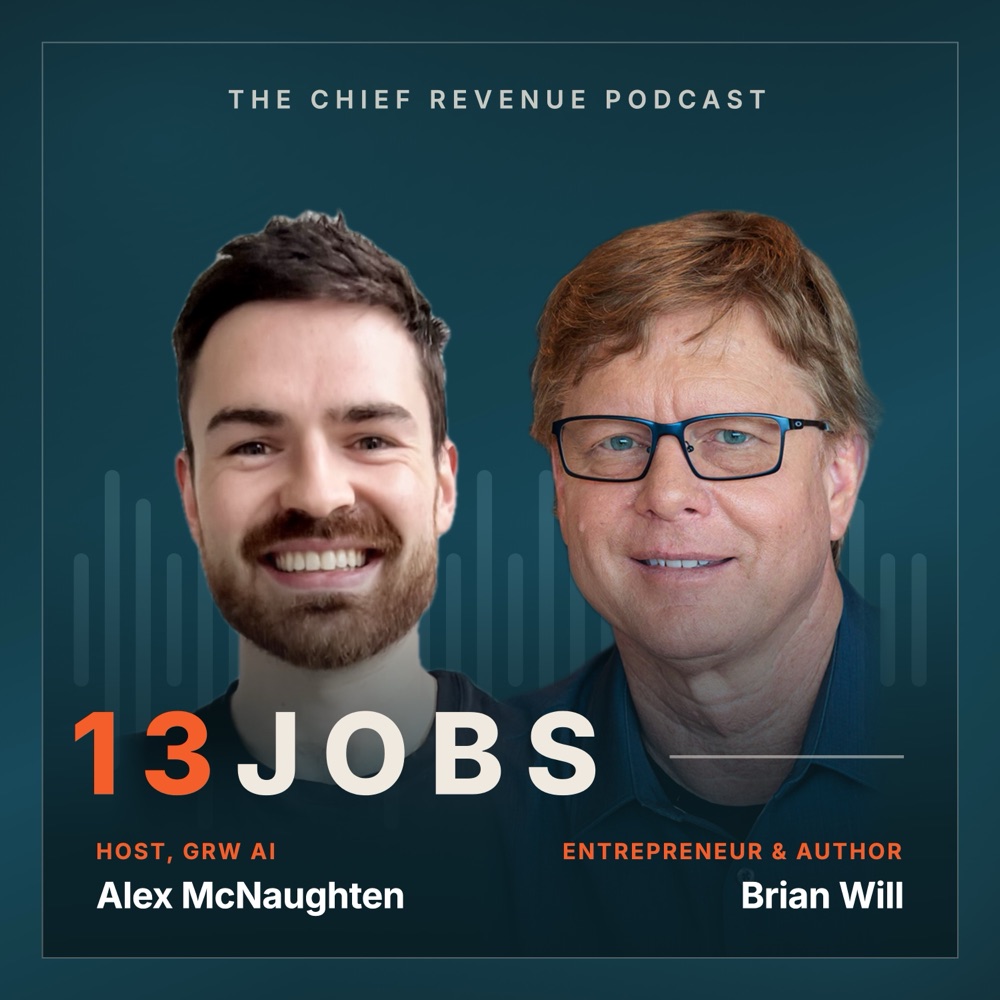
They don't dislike you, they're afraid of you
Brian handles objections before the buyer has them, starting with the one nobody names: that being sold to is something people are afraid of.
 Hosted by Alex McNaughten
Brian Will · Entrepreneur & Author
Brian Will is a serial entrepreneur and business and sales management consultant. He has created or co-created seven companies across four industries, worth over half a billion dollars at their peak, starting with a landscaping business at 21 that he built for eight years before it collapsed and he lost everything. He has also run turnarounds for companies from startups to the Fortune 500.
His books The Dropout Multimillionaire and The Psychology of Sales and Negotiation both reached the Wall Street Journal bestseller list. He owns a chain of restaurants in the Atlanta area and a residential and commercial real estate business in Georgia and Florida, sits on the city council in his hometown of Alpharetta, and runs an executive advisory practice and a mastermind for entrepreneurs between $1 million and $10 million in revenue.
In this episode, we discuss:
- Landscaping at 21, and losing all of it
- Why objection handling belongs at the start, not the end
- Not dislike but fear: of being sold, and of the unknown
- The opening that takes the wall of mistrust down
- Fact finding, and the questions that come before any pitch
- Six folded pairs of arms, and putting the deck away
- Active listening, and what you would say at a bar
- Skippy the lot stalker, and letting people fall in love first
- Every room has a different trigger
- Pause for effect, and the check-in that catches a lost buyer
- The deal is closed in the fact find
- Three things he wishes he had known on day one
Quote of the show
“You don't close a deal in the close process. You don't close it in the presentation. You close it in the fact find when you're asking your questions.”
Key takeaways
- The first objection is you. Every buyer starts with a wall of mistrust, and it is not personal. They are afraid of being pressured and afraid of not knowing what happens next. Both come down before anything else can happen.
- Say what is about to happen, then do it. Questions first, a recommendation only if there is a fit, then pricing, then their decision. Naming the process removes the fear of the unknown, and keeping to it is what earns the trust.
- Objections are known in advance. Whatever you sell, there are four or five you get from everybody. Handle each one inside the process. Meeting them at the end means you lost the buyer somewhere earlier.
- Let them fall in love before the detail. Nobody reads the owner's manual before the test drive. Lead with what the product does for them, and keep the technical depth for the people who ask for it.
- Pause and check in. A buyer retains 20 to 30% of what you say, and stops listening entirely the moment you use a word they do not know. Stop, tie it back to a problem they named, and ask if it makes sense. A yes is a buying sign.
- You are always selling to a person. IBM did not decide anything. A person who works there did, and they had the same morning everyone else had. Connection is not a soft skill layered on top of the process, it is the process.
- Get a coach earlier than he did. Sales runs the world, know the numbers behind your business cold, and check your ego enough to be taught. He went 20 years without a mentor and says everything changed when he got one.
Transcript
Brian, Thanks for coming on the show. How are you doing today?
Alex, I'm doing good, man. I can't believe I'm on your show in New Zealand. This is awesome.
Yeah, it's great to have you here. You were saying at the start that this is your first New Zealand podcast, which, yeah, happy to be helping facilitate that.
Yeah, I've been in Australia about 4 times. It's my first time in New Zealand, so I'm excited.
That's great. And, you know, for those of you who don't know Brian, you're a serial entrepreneur, you're a sales expert, multi-time bestselling author. But tell us your story, man.
Yeah, Alex, I started my first business when I was 21. It was a landscaping company, very blue collar, built it up over about 8 years. And I always like to say it did really good until it didn't. And then it crashed and burned and I lost everything and had to start over. And so I learned a lot of good lessons in that.
From there, I went into the insurance business and that's what the first sale I did to a venture capital group was in 1999 when the internet was really cranking and we had built a direct-to-consumer call center in the health insurance space, which didn't exist. So Sold that company. It went public and then back private.
It's basically behind our whole Medicare system today. Did another deal in the online insurance space, which I sold to another venture capital firm out of Silicon Valley. And today it powers, I think, 9 or 10 states in the US. Our entire healthcare system is, you know, moving toward this socialism kind of thing, but we power about 9 states there.
Went and did an online lead generation company that we sold to a private equity firm in 2006. As well. And then went into consulting and sales and management consulting for Fortune 500 companies doing again, direct-to-consumer type stuff. Started another company that we sold to an Indian call center company. Didn't make any money on that one.
Sometimes they don't all work, you know, and wrote a couple of books on building businesses. My last book is a sales book called The Psychology of Sales. And both of those hit Wall Street Journal bestseller lists. Got into politics here. I sit on city council in my hometown, and currently I'm running an executive advisory and coaching business and a mastermind for entrepreneurs from $1 to $10 million in revenue.
So that's kind of my 2-minute story.
Fantastic, Brian. Thanks for sharing. It sounds like you've had some varied and interesting experiences over the years.
All over the board, man. I'm ADHD, so I'm always changing something.
I can relate to that. It was like magpie syndrome. Shiny object syndrome, um, a little bit at times. Um, we're going to talk a little bit about the psychology of sales today. And, you know, you said something at the start of the— at the start before we started recording around really understanding why our buyers make decisions and, and bring, you know, and, and addressing objections before they become a problem.
Correct.
And I thought that was really interesting, so I thought we could start there.
You know, I see these sales trainings all the time and anybody who's been in sales always knows, well, we have to learn how to overcome objections, right? But the problem is all of these sales training systems push the overcoming objections part to the end of the sales process. And I always tell people, listen, if you're trying to overcome objections at the end of the sales process, it's because you lost them somewhere in the sales process.
They don't understand what you're talking about. You never made the connection and you never took the opportunity in the process to figure out what those objections are gonna be and go ahead and overcome them. Right? I say no matter what product you got or what you're selling, you primarily have, probably have 4 or 5 objections that you're gonna get from every buyer.
And they're always the same, right? It's price, it's quality, it's, it's whatever it is. They're, they're generally all the same. And if you can build a sales system, and I'm big on using scripts, whether they're personal or for a sales force, and you can learn to understand what the client's thinking and learn to overcome those objections prior to them having them, And by the time you get to the end of the sales cycle, you're not having to go back and go, but, but, but, but, right?
You don't understand. You don't understand. You don't understand. They don't understand because you didn't already tell them. And I always start this with most salespeople forget the number one objection, and it's always the first objection that every client has. And it's interesting because I listened to one of your other podcasts and one of your guests who's a big sales guy basically said the same thing.
And the number one objection is, People don't like salespeople. Or maybe it was you that said that.
It's probably me.
People don't like salespeople. And it's not that they don't like you, right, Alex? You're probably a great guy. You coach Little League on the weekends and you have parties at your house. You're a good guy. But when you put on your salesperson hat, people have a natural aversion to you because you're a salesperson and they don't like you.
Now, it's not— I always say it's not that they don't like you, it's that they're afraid of you. What does that mean? Well, what they're afraid of is they're afraid of being sold, number one, because nobody wants to be pressured into buying something they don't want or pressured into buying something that costs more than they could have gotten it for.
They're afraid of being sold because they think you have some magic voodoo salesperson thing you're gonna do to them to make them do something they don't wanna do. And they're also afraid of the unknown. They don't know what's gonna happen next in the sales process. As long as they don't know what's gonna happen next, They've got this natural wall of mistrust between you and them, right?
They got their, their mental dukes up. They're ready to fight you. They don't trust you because they don't know what's going to happen next, and they're ready for you to try to pull something on them or say some slick line. And that wall of mistrust between you and the client has to come down at the very beginning of the conversation, or you're going to be battling it during the whole process.
Mm-hmm.
So we have to understand that first objection. We have to understand how to get around it. They don't want to be sold. They're afraid because they don't know what's going to happen next. Right? They're afraid of the unknown. We need to take those 2 walls down. Those 2 barriers need to come down first, or you are just, you're fighting a battle that you don't need to be fighting the entire time.
So we learn the first wall, the first objection, we learn to overcome it. We do it through scripting, and then we move them through a process I call the 4 boxes of the sales process. And we, every, everything we do along the way is overcoming the next objection that, you know, they're going to have, the next objection, you know, they're going to have.
And if you've been selling whatever it is you're selling, you know what those objections are. So deal with them upfront so that you don't have to deal with them on the back end.
I think you raised a really good point there, which is sort of the perception of the salesperson to your average buyer, you know, and it's not good. You know, I saw a stat recently that 77% of B2B buying experiences were described as unpleasant or difficult. By the buyers. That's not a great testimony to the profession.
Oh, it's because most salespeople aren't listening. They're not listening to the client. They're not reacting. And I call it active listening and active reaction. You know, one of the things you said to me when we got started is I'm just gonna listen to what you say actively and then we're gonna respond in our conversation today.
That's what salespeople, good master salespeople do. They don't just talk. They listen, they ask questions, they move a buyer through a process, right? Too many people in sales think they gotta talk, talk, talk, talk, talk, talk, and they talk themselves right out of the sale and they make it unpleasant for the other person.
So how do you, you know, I'm coming, you know, let's imagine I'm coming into this conversation to sell you something and you've got your guard up, right? You know, you said, you know, you're protecting yourself because you think, oh God, here we go, a salesperson. I'm gonna be, I'm He's gonna try sell me.
How do you overcome that initial resistance? What do you do?
Right. So pick up, pick whatever industry or product it is. And if, and if, and I'm, I just met you, I'd say, Alex, I understand you're looking for whatever product or service and you go, well, yeah, listen, here's what I need to do. Okay. In order for me to be effective, I need to ask you some questions and I'm gonna ask you some questions because I need to understand if my solution or my product is gonna work for you.
So I'm gonna ask you some questions. We will decide whether my product works for you. If I believe it does, then I'll make a recommendation. I'll go over some pricing, and then I'm gonna let you decide if this is something you'd like to move forward with. Now, is that fair enough?
Mm-hmm.
And so what I've done is I've told you what's gonna happen next. I'm gonna ask questions. I'm gonna present you with something. I'm gonna give you some pricing. I'm not gonna sell you. I'm gonna let you decide. And then I threw out this simple affirmation, is that fair enough? Which gets you to say, Okay.
Yeah, that's fair enough. And as long as you do what you just said you're gonna do and you don't try to sell me something, then I've started to build a little trust with my client. I've started to get that, that wall down and he's told me that we can go ahead and move through the process.
And then the next thing I do is I start asking questions. And in the question, we call it the fact-finding phase. We start finding the connection we need to make and figuring out how we relate some way and, you know, trying to get that likability and trust factor built in. But it's a process based on your product.
We build different scripts to do that with. But everything we do and say is about bringing that wall of mistrust down and overcoming those eventual objections.
So, great. So, and you started doing it there, but break down a little bit why that's more effective. Like, why does that approach upfront, you know, and I suppose what you did there was a mixture of being transparent about what's gonna happen next, asking for permission effectively, like getting buy-in to the process that you're about to take someone through.
But yeah, I guess why psychologically is that the right way to go about it?
Because if we know that the client is afraid of being sold, the first thing I want to tell them is I'm not going to try and sell you, right? I'm going to give you your options and I'm going to let you decide. And as long as you get to decide, then I'm not selling you.
And if you're afraid of the unknown, that wall of mistrust, because I don't know what you're going to do next, I'm going to tell you exactly what I'm going to do. Ask you questions. If we feel like we have a fit, make the presentation, run over some pricing. And those are, there's a whole system behind all that.
And then I'm gonna let you decide. And then I say, is that fair enough? Because I want them to give me that yes, we can start the process. They need to know we're moving through a process. I need to know we're moving through a process. We've already agreed to it upfront. We might not take down every wall of mistrust, but we've begun to bring it down.
And as long as we do what we say, then we're in good shape. And then we move on to the next, which is, you You know, there's a whole 2-day course behind teaching people how to get through that process.
Sure, sure. Um, and then, you know, the next thing you touched on there was, was questioning, and you mentioned active listening. And, and I, I tend to agree with you. Probably the biggest gap that most salespeople have in their arsenal is they ask too few questions or they ask ineffective questions. Um, and they don't truly listen to what's being said and they just sort of have this internal agenda that they're trying to run to.
So they're not paying it, they're not really paying attention to what the customer said. How do you go about crafting a question set that's actually effective? Let's start there.
Depends on the product. Yeah, it depends on the product, right? So If, if for instance, I, I did a consulting project for an insurance carrier and they're selling insurance. I don't, I don't know if you have insurance in New Zealand.
Yeah.
That you have to buy. But the first thing we would ask the client, if, if the client called us or we called them, is do you have coverage now? I'm not gonna go jumping in and trying to sell you something if I don't even know if you have something already, because that wouldn't make any sense.
The first thing that's important to me as a salesperson is do you have coverage? If you do, what do you have? How much does it cost? Right? What are you paying now? And why are you shopping? These are the who, what, when, and whys, right? And if you tell me, well, I'm with, you know, XYZ company, and they just raised my rates, and they're, they're gonna be making me pay this.
Well, then I know what I've got to work with, right? I know what your objections are out front. So I'm gonna go start working on those one by one. On the other hand, if you're selling insurance, they say, well, I've got a bunch of massive medical problems. And, you know, they're not covering all my bills.
That's probably not somebody I need to deal with, right?
Mm-hmm.
They probably need to stay where they are. If I'm selling software, I'll give you an example. I went in, uh, selling a software package to an insurance carrier in this case, and we went into the room and I had 6 people sitting at a long table, all with their arms folded, staring at me.
And I've got a team over here on my right and a PowerPoint behind me. And I walk in, I thought I was running the gauntlet and they expected me to stand up and start pitching them with my PowerPoint behind me. And I made a decision on the spot not to do that. So I grabbed a chair, I pulled it up to their table and sat down with them.
I said, I'm not here to sell you something, to pitch you something. I wanna find out what's going on with your company and why we're even here today. Why, why'd you even agree to have us come in? What's the challenge? And we sat there for 30 minutes talking and, and after 30 minutes they were telling me what their problems were and asking me if my, my solution could fix it, right?
Hmm.
My team's over there thinking, what the hell am I doing? But I was really just trying to make a connection with people who were going into this situation hostile. Not angry, hostile, but they just, you know, here's another guy pitching us a product. I don't wanna listen. I'm wasting my time today. Yeah.
And I think it's something, you know, something that's coming to me just there is, you know, I think sometimes we forget in sales that we are speaking to people and—.
Oh my gosh.
We're trying to qualify business problems and sometimes we forget that actually, you know what, it's just a person or a group of people in front of us. Yeah. Any thoughts on that?
I say this, I say this all the time, Alex. People go, oh my gosh, well, you know, IBM did this or this giant company did this. And I always stop and I go, no, no, no, a person did that that works for IBM, which is just a title on a piece of paper.
You're dealing with people at every level of any company anywhere. You're still dealing with a person. It's the same person that had to get up this morning. They were late for work. They gonna go home tonight. They may or may not argue with their spouse. Dinner might not be what they want. They're just a person.
So you've got to learn to deal with people as a person, right? And not as a client or a customer or whatever else. And if you can deal with them as a person, make that connection, I don't care who they work for, you can figure out a way to make that connection with them.
And I think part of making that connection is actually listening to them. Talk to us about active listening. Like, what does How do you actively listen?
Well, so I think it's funny and I do this in sales training all the time and we do it in our, in our role playing and I always hammer this point about listen to what the client's telling you and don't, don't just be so regimented in what you think you need to say that you're not listening to what they say and having a natural reaction.
Like I was doing a sales role play and, and I said, okay, so tell me about yourself. You know, what do you do? What do you, what is your wife into? Well, my husband, He sells fire engines. And I asked the client, I told the client this, well, my husband sells fire engines.
And the salesperson goes, oh, okay, well, let's talk about the product. That's not actively listening, right?
Yeah. Yeah.
If you were sitting at a bar and somebody said, my husband or my wife sells fire engines, what would you say? You'd be like, kidding me. Like, that's interesting.
How do you get into that?
Like, how are, what color do they come in? I mean, I've seen yellow, green, and red. Do they have blue? I mean, That's active listening, right? Or I'll joke around, people say, so do you have kids? And they're like, yeah, I've got 2 kids. How old? You know, 5 and 12. Either one of them married yet?
And they always go, what? It's like, I'm just kidding, man.
Yeah.
It's just having a conversation. I always tell people, think about your friend. You're sitting at the bar having a beer and your friend says, hey man, tell me about your product. You raise your voice an octave and start talking real fast and try to sell them something? Or do you just like be like, oh well, Here's what my product does, and you have a conversation, you kind of explain it to them.
If you can learn to have a conversation with people without acting and sounding like a salesperson, actively listening to what they're saying and responding to them, and don't think you're always in sales mode, there's a connection mode you need to be in a lot of the time, then you'll get much, much farther down the road in making those sales.
People buy from who they like, right? They buy from who they like, who they trust, who they think is looking out for their best interest, who comes across as a professional, and who made a connection. Those are the 5, the big 5. So you got, you gotta do that and you can build that into your sales process as long as you don't stay so darn regimented in what you think you're supposed to say and do.
One thing I heard, and I, and I couldn't even tell you where I heard it, but it's, it was decision making is emotional and then we use logic to back it up. Do you agree with that? Any thoughts on that statement?
Yep. So I use this example in my book. So if you ever read my book, The Psychology of Sales and Negotiation, I like to use car sales as an example. Because car sales is something that like everybody understands. Everybody's been down to a car lot, everybody's bought a car and everybody hates— I call him Skippy the Lot Stalker, right?
Skippy the Lot Stalker is your car salesman and he makes every classic mistake in the book, right? So, but in car sales, it's a perfect example of what you just said. When you go down to buy a car, and I use this example all the time, let's say, Alex, you went down to a car lot.
Have you ever been to a car lot and bought a new car?
Too many times.
Too many times, right? When you walked on the car lot and Skippy come up to you, did he hand you the owner's manual of your car and say, here, I need you to read this before we talk about buying the car?
God, no.
No. Did he say, listen, before we take this for a test drive, I need to go back to the finance department and show you how that 32-page contract works and the financing derivatives? No. He asks you what color you want, automatic, standard, cloth, leather. Do you like this one? Let's take it for a ride.
And the reason he does that is because he wants you to fall in love with the product. Before he gets too deep into the details. And too many salespeople think they need you to understand everything there is to know about the product before you fall in love with it. And people want to fall in love with your product.
What can it do for me now? What solution is it going to solve for me now? Don't get into the technical details as much if I'm not asking for them. Tell me what I need to know to fall in love with your product. And once I get you past that point, once we get past the test drive, Then we can start talking about the rest of it.
First, you gotta get 'em to make that emotional decision that I love this product.
Yeah, I think that is a pretty good example that most people can relate to because it's not logical at all. Like there's, there's almost no logic in, in buying a car really. It, it's, it sort of comes down to I like that one.
And I picture myself driving by my neighbors looking cool going, yep, look at me in my new car. Yep, that's right.
Yeah.
Right. It's, it's emotional.
And then you back it up later and you're like, oh yeah, the fuel economy wasn't too bad and oh, the insurance is gonna be fine. And, but it's all of that comes after. Do you think that's the same, you know, if you're buying a, you know, a B2B software solution? Do you think it's that same emotional journey with logic afterwards or do you think there is a distinct difference?
It depends on who you're talking to in the company.
Okay.
That would be my answer. If I'm talking to the IT department, they want to know the technical specifications. If I'm talking to, you know, the sales department, they want to know what it's going to do for their customer. If I'm talking to the finance department, they want to know how we're going to make money, right?
Who are you talking to and speak to that audience? I think that's the deal, right? The finance guys are like, holy crap, this thing's going to make a ton of money. We can buy this at a much cheaper price. The SaaS rate's much better. The technical guys are going, holy crap, this thing has the AMD 754317 chip that goes 17 times faster than everything else.
We can have a million people online at the same time. And, you know, the CEO is going, this is gonna be really good for the company. And the marketing guys are like, we can really pitch this to the market because it's a great story. So it depends on who you're talking to. Everybody's got that trigger that they want.
That's a really good point is, do you come, you know, do you recommend coming armed to the conversation with that kind of preconceived finance is gonna care about this thing, marketing's gonna care about this thing?
100%.
Right. So you do?
I do.
Walk me around that process.
I joke around as a salesperson. I jokingly say that I only know enough buzzwords to make you think I know what I'm talking about, but there's no way I understand the technical side of IT. But what I would always, you know, do is I'd have my CTO over here and I'd have my biz dev and finance over here and I would act like I know what I'm talking about.
And when they would ask me a technical question, I would literally just, I don't know if anybody can see this on video, I'd like turn my head and look at my IT guy and that was his cue.
Yeah. Yeah.
To start talking to the IT people. Right. And if they asked me a question about the marketing or whatever, I'd turn around and look at this person over here and I'd let them talk.
Right.
My, I was a fall in love guy. I let other people talk to the people that relate to them better. And that's, and we killed that sales process.
What if you're the only sales rep? Like, what if, what if your sales motion is, you know, one salesperson runs the whole show? Are you saying that you have to, and you've got multiple stakeholders to deal with, you've got to just be able to go between the 2 worlds and speak, you know?
I think so. Yeah, you better be more educated than I was when I was doing sales in the IT world. But if you really know what you're talking about, again, I I guess understand who you're talking to and bring the right resources to the table would be my answer.
Cool. What else? So we, you know, we're getting over this kind of initial objection. We've got our kind of 3 to 5 key objections that we know come up in most sales. Are you suggesting that we handle the, you know, sorry, you are suggesting that we handle those before they become an issue?
Does that mean that we kind of bring them up in conversation? Because I've heard some approaches is to bring it up before the customer does. So say, hey, look, I speak to a lot of customers and a lot of them say that X is an issue for them and you tell a story about that or, you know, like, yeah, how do you think about that?
So we use what we call pause for effect and check-in.
Gotcha.
Right. So the sales process is like one of the most critical things you need to understand if you're gonna be really, really good at sales, right? And I always use this example that if you're in a sales situation, your client is probably only gonna remember about 20 to 30% of what you say because you're the expert in what you do and they aren't, right?
And that means the more that you talk, the less they're gonna remember. This is, we're, I'm giving you the basis for this answer. And the, the problem with that is, is If you say something technical in a conversation that a client doesn't understand, what do you think they do? And I ask people this, Alex, have you ever been in a conversation and said something, somebody's talking to you and they say something you don't understand?
What does your brain do? It stops.
Yeah.
And it starts thinking about what they said and it's like, well, he just said, you know, supercalifragilisticexpialidocious. I don't really understand what that— and then your brain stops for a couple seconds while you're trying to figure that out. And then you either do or don't, and then you reengage. And the problem is that salesperson's still been talking and now your brain's trying to play catch up.
Oh wait, now I gotta, what did he say? Because you're listening in your peripheral, but, and your brain's trying to catch up. And because you're trying to catch up, you're not retaining that information, right? And so one of the first things you need to understand if you're gonna be really, really good at sales outside of understanding your audience is don't overtalk your audience.
I'm talking to the IT guys, let them talk IT. If I'm talking to finance, they're not talking IT. I'm talking to sales and marketing. They're not talking IT, right? So I, I always use a pause for effect. If I make sure that I talk at a, at a more simplistic level without being too technical, and then I always stop.
I say, Alex, did— now what I just said, does that make sense to you? And I'm, I'm gonna wait for your response and you're gonna go, well, re-explain it one more time. If anybody ever does that, you lost them.
Hmm.
Okay. Okay. So let me re-explain that to you. So I pause. Alex, Alex, so what I just explained to you, Remember when you told me that you were worried about your cost per acquisition on so-and-so, and this is how we're gonna solve that. Does that make sense to you? And if you say, hold on, do it again.
That's 'cause I lost you. If you say, yes, that makes sense to me, what you've really done is just got a buying sign because you understand that your problem was a cost per acquisition, by the way, one of your objections, and I just explained it. And then I ask you if you understood it and if that made sense.
And if you do, then I'm, I've moved you one step closer to the close, right? And then I'll continue on and I'll stop again. Now, you remember when you said this? So here's how, what I'm, here's how what we can do is gonna solve that for you. Does that make sense to you?
And you're gonna say yes or no. And if, and if it doesn't make sense to you, then I know that I gotta back up and do it over again.
Yeah.
Too many salespeople go through an entire sales presentation. They get to the very end. They never did a pause. They never did a check-in. They never asked their client whether they understood. Their client got lost somewhere along the line. But the client's never gonna admit that because they don't want you to think that they don't know what they're talking about, or they're not as smart as you, or they don't understand what you're saying.
So they just go, mm-hmm, yeah. Oh yeah, that makes sense. Okay. Mm-hmm.
Mm-hmm.
And you get to the end of the sales presentation and that you, they're totally lost. Right? Is this something you'd like to go forward with? In their mind, they're thinking no, cuz I don't really know what the hell you're talking about. You lost me 5 minutes ago.
Yeah.
And they say no. And now you've gotta start over. Objections, right? Well, and then they start, you know, they start giving you objections that sometimes don't even make sense. But the objections are based on the fact that you didn't address it way back in the process. You didn't stop. You didn't make sure they understood what you're talking about.
You didn't pause. You didn't ask them. It's just the psychology of the way they're thinking that you got to deal with in the sales process. You don't close a deal in the close process. You don't close it in the presentation. You close it in the fact find when you're asking your questions. Talking to them through the solution of what they want, explaining how your, your product can fit that solution.
So by the time you get to your presentation, all you're really doing is explaining things they already know, explaining how what they already know is gonna fix their problem, right? You're just explaining what they're gonna buy. And then you get to the end. So it sounds like you've understood everything I've said, and, and according to you, everything makes sense.
I mean, is this something you'd like to go ahead and get rolling with? I mean, it, that's pretty much my close. Is that something you'd like to get started? Is that something we can move forward? Are you ready to make that decision? Or whatever it is, but they've said yes to me so many times in the process.
And they've told me that they understand how my solution is going to help them. That if they don't say yes, then I've, I've got to go back and figure out what I did wrong again.
Yeah, I think that's a good point is most sales do not go wrong during the close. It's actually they were open badly. It was the open. Is actually, and I always say to reps when I'm coaching them, it's like you need to go slow to go fast. Like spend more time in your discovery, spend more time asking good questions.
Yes, because it's gonna speed everything else up because then you're actually gonna make the right moves. So yeah.
You won't be overcoming silly objections down the road, right? That were basically because you screwed up the process.
I've really—.
I watched a sales training the other day. I watched a sales training the other day and the sales trainer, he's training people how to sell, right? Big, big guy in, in America. And he's like, all right, he pulls a guy up outta the audience. He's got an audience of a couple hundred people.
He goes, all right, you just pitched me your product. I'm gonna give you objections and you have to overcome 'em. Ready? Well, that's just BS. You can't pull somebody out cold out of an audience who hasn't had a chance to pitch a product and then have a master trainer who's gonna slaughter this guy in a training, you know, start throwing objections at him rapid fire and expect that guy to succeed, right?
You can't. That guy never had an opportunity to handle those things in the process. You're trying to train him how to do something that's not realistic. It makes trainer look good. Salesperson doesn't have a shot in that process.
Yeah, it sounds like a bit of theater, to be honest, rather than effective, effective coaching. Um, Brian, I've really enjoyed this conversation. And, you know, I think in particular, the bit that's resonated with me is the kind of unsaid objection around, you know, you're a salesperson and overcoming that and kind of earning that trust with the buyer, which will then allow you to move through the sale.
I think that's the bit that's really stood out and really resonated today. I wanna ask you one final question. Knowing everything you know today, go back to your, you know, your first job, you know, your first day on the job. What's the one thing you know now that you wish you could take back with you to then?
I would say I'm gonna, I'm gonna, sorry, but I gotta expand on that because there are 3 critical things I wish I'd known. One is sales run the world. Yeah, I don't care how good your product is. If nobody sells it, nobody buys it. And you're out of business. So sales run the world.
If you want to, if you want a career or a path or whatever that will never go out of style, will always have demand, you need to get good at sales. Number 2, if you're going to do that, you need to understand the numbers behind your business or your product like cold. You need to understand how that thing runs.
And number 3, you need to learn to check your ego and get a coach and a mentor to help you. I didn't have one for 20 years. Never succeeded. When I finally got one, I blew up. I mean, my whole life changed. So critically important that you are able to check your ego and learn.
Those are my 3.
I think it's a very good 3. I, no problem with expanding on your answer there and giving us more than one. Bryan, I've enjoyed this conversation. It's been fascinating. Tell us where people can connect with you if they want to, where they can, you know, Read or watch your content, get your book.
Yeah.
Www.brianwillmedia.com. My podcast, my guest appearances, my books, my coaching, everything is on the website, brianwillmedia.com.
Fantastic. Brian, you have a great rest of your day and hopefully you make it down to New Zealand in person someday.
Alex, this is awesome. And if I do, I'm gonna come knocking on your door. Just so you know.
Absolutely. I'll see you soon.
Thanks, Alex.