
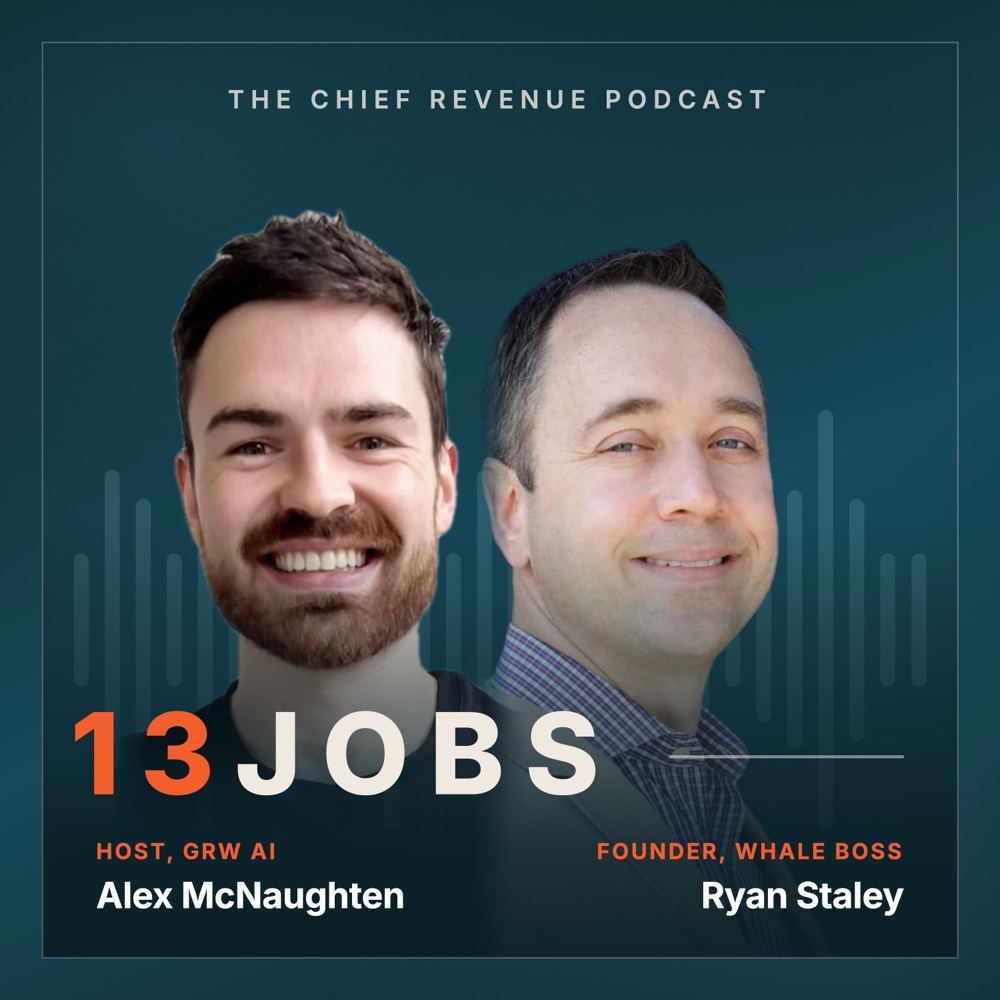
The bottom third of sellers are going to be axed
Ryan replaced a $600 video editor with a $50 tool and got faster turnaround. He is blunt about what that implies for reps whose only value is knowing the product.
 Hosted by Alex McNaughten
Ryan Staley · Founder, Whale Boss
Ryan Staley is the founder and CEO of Whale Boss, where he works with founders and revenue leaders on scaling. He has held every position in sales from door-to-door through SDR to enterprise sales leader as a VP and partner, and grew a business unit from zero to $30 million in ARR in five and a half years with four salespeople.
This is his second appearance on the show. He has spent longer than most actually working AI into a sales motion rather than talking about it, which is what this conversation is about.
In this episode, we discuss:
- Every position in sales, and zero to thirty million in five years
- Eight hours into twenty minutes, and ten years of meetings into months
- Identifying the outcome and letting the tool build it
- Looking like an expert graphic designer, with no aptitude for it
- People are the biggest expense, and where founders point AI instead
- Training wheels against a two hundred mile an hour motorcycle
- Show the team what is possible before asking for their time
- Does any chief executive want more email
- Focus on very little, whatever your profile happens to say
- Why the bottom third goes this time, and not the profession
- A six hundred dollar editor replaced by fifty dollars a month
- Relevancy: how they are paid and what they are measured on
Quote of the show
“76% of customers would rather not talk to a sales rep.”
Key takeaways
- Compression happens at two scales. Tasks that took eight hours now take twenty minutes. Separately, business acumen that took ten years of live meetings can be reached in months once you know what to ask.
- Almost nobody is really using it. A couple of sentences typed into a chat box is training wheels. The gap between that and what is available is not incremental.
- Show people what is possible before asking for their time. Nobody invests focus in a use case they cannot picture. Demonstrate it, then set the assignment a week later.
- It makes the volume problem worse, not better. No executive is hoping for more email. The profession's instinct is to point new tools at output, which is exactly what is already failing.
- Knowing the product is no longer value. A one-pager does that. If articulating what the product does is the whole of what a rep offers, they are the ones at risk.
- Three barriers, in order. Relevancy first: how they are compensated, what they are measured on, the pressures in their industry. Then their communication style. Then the emotional connection.
- Focus on very little. It is the recommendation that holds regardless of someone's profile, and the opposite of what most teams ask of their people.
Transcript
Ryan, good to have you back on the podcast. How you doing?
Happy to be a second-time participant, I believe, Alex. So it's not third, right? Second. Yeah, second.
I think it's second.
So happy to be on the show, man. Where's the third? Might even be third.
I think I jumped on yours, so it's definitely our 3rd podcast, but I think it's 2nd time on our one. And look, for those of you who don't remember Ryan from last time or didn't watch that first episode, Ryan's an expert, a sales expert basically, expert sales consultant, previous sales leader. But Ryan, tell us a little bit about yourself for those who don't know you.
Yeah, man, I'll give the super quick version. So Had every position in sales, starting with door-to-door to the old school SDR, which is inside sales, complex sales, mid-market, basically then enterprise sales leader, which was a VP and partner, had multiple exits that I experienced as a result of the progress and basically grew a business unit from $0 to $30 million in ARR.
In 5 and a half years with 4 salespeople in a red ocean, completely saturated market. We didn't have SDRs or anything. So, uh, on that was before, about 3 years ago, I left the corporate life, started my own gig, have a podcast called The Scale Up Show. Uh, and in addition, right now what I do is I help companies do really— or 2 things that I'm focused on right now.
One would be referral-led growth, like helping companies systemize customer to prospect referrals to basically create a scalable pipeline that isn't attached to SDRs or people. So that's one. And then the second is I've been obsessed with AI since a founder on my podcast introduced me to it in November of last year. And so I have been deep into that for the last, I think it's probably 8 or 9 months now and have a new product that's being released called— well, I'm not gonna say what it is.
I'm not sure on the name yet, but what it will do is like make you a world-class sales performer or a sales leader in the enterprise sales space, right? So, uh, also applicable for founders, and it's combining the 25 years of grizzled veteran work that I have combined with AI so that you don't have to learn all the sh*t that took me a long time to learn the hard way.
And that's awesome. And that's one of the reasons I wanted to have you back on the podcast is you've been playing around with AI in the sales space quite a while now, or a while in terms of how long AI has been kind of mainstream, I suppose. And I wanted to get your take and that's what we're gonna talk about is AI in sales.
But I wanted to kind of get your take on how this is gonna change sales. And what do sales leaders, sales practitioners, you know, what do they need to change? So let's start with that, that kind of high-end, high-level opening question is, how is AI changing sales in your view?
Yeah, that's a great question, Alex. And so I was thinking about this, like how to distill this in like a super easy format and I broke it down really into 3 areas of the outcomes that I've seen. And I wasn't like playing around with it. Like, I'm like, it started off as like, oh yeah, let's play around with this, right?
When I was like sitting there like showing my daughter how DALL-E works, right? And typing a couple words and creating cool cat pictures on the moon or whatever the hell it was in cartoons, right? With rainbows coming outta their butt. So that was the playing around phase. So once I saw that and heard like multiple billionaires be like, this is gonna be the single biggest change in mankind that we experienced because of what's gonna happen.
I, I'm like, all right, I'm gonna go all in on this, right? And so that's why— how I became obsessed with it. On top of once I started using it and saying, okay, I'm gonna commit an hour and a half every day on this, utilizing it, not just reading about it, but actually using it and learning it and knowing it and understanding it.
And these were like the 3 outcomes that I experienced. And then I'll get into your question, cuz this is gonna set the stage.
Mm-hmm.
Number one, there were tasks and workflows that used to take me 8 hours that I could do in less than 20 minutes, right? So that's step 1. So the compression of time from a micro perspective, that absolutely blew me away. Number 2 is, I would say, time from a macro perspective. So there were things that I learned once I unlocked the right questions to ask that took me 10 years of live meetings to experience multiple times.
That if I just ask the right questions in the exact right sequence, I could unlock that in seconds.
Right.
So that's another one. So you got short-term time, you got more like the macro acumen business experience time. And then the other thing that I would identify are capabilities and execution. And so what I mean by that is I'm a person who loves outcomes. I'm very driven. And so I can identify outcomes.
And then the AI will create it for me. Okay. That's 3. I said there's 3. I lied. There's 4. And then the last but not least is, have you used Midjourney at all before?
I haven't personally, but I know what it does and I've, I've, yeah, seen what it can generate. Okay.
So Midjourney's pretty comprehensive and like, I, you know, full disclosure, I suck at graphics work. Like not my strong suit. I am not good at it whatsoever. Right. I can, trying to come up, like create something, it might take me 3 hours to do it and it looks like, you know, a 5th grader created it, right?
Mm-hmm.
So I used Midjourney and I looked like an expert graphic designer in minutes because I orchestrated it the right way. And so why I tell that story is it's really critical cuz it enables me to do things that I couldn't do before in a very, very tight window. So like if you stack all those things on top of it before, it's gonna be transformative for a lot of reasons, but specifically in revenue, right?
Because like if you have a C player that's now an A player because they're leveraging AI and you're not, that's huge, right? Those are people that either you'll have peers pass you up, Mm-hmm. You'll have competitors that will outsell you, or, you know, you'll have other options and experiences that are not going to be optimal if you wait on the sidelines for this.
So like, I throw that as a cautionary tale for revenue leaders and reps, because that's what's going to happen if you don't take advantage of this because of the previous outcomes that I mentioned that it could deliver. Yeah.
And I think it's interesting you say that because I did a quick survey of LinkedIn, of the network the other day. And it was still something like about a quarter of salespeople in my network anyway, still weren't using AI at all. And that kind of struck me as a little bit, a little bit of a, a little bit scary, a little bit of a missed opportunity, because those people, if they're the sort of people who are clearly like against it or don't like it for some reason, or maybe just don't understand it yet.
But if they're not using it in a long enough timeframe, you're right, they're gonna get left behind. Because of, I think even just because of the time compression. And I like how you split it into those areas. What do you think right now of those 4 it's best at or most valuable in with a sales lens?
Yeah, with the sales lens. So it's really interesting because I've talked to a lot of founders about this and You know, if you look at just an organization as a whole, most founders are really, really focused on including this in their product, right? But what's your largest expense? Like your, what's your second largest expense?
It used to be real estate. It's people, right? Maybe it's even people, people might even be larger than real estate now. And but people are, but leaders are not focused on this, systemizing the use of AI with their people to create these asymmetrical or exponential results. And so kind of the way I look at it, when, when you're doing it, there's really a lot of— that's kind of a loaded question you ask, like what's the best way for sales, right?
Hmm.
There's ways where you could use it for prospecting. There's ways where you could do it even for like, I did something amazing the other day and I put it together for research, right, on customers. Ranging personality types down to their LinkedIn profile, down to company demographics. That was something that took minutes to do that would have taken maybe 20 minutes, 30 minutes to do, right?
So there's a lot of use cases like that that stack up. So I think if it were me, the best way I would look at this and let's say through a sales leadership lens and I would apply this formula. Is to get the most use out of it from your team, and then you'll get exponential results within your team.
So you're gonna have exponential individual results and exponential team results. And so if you look at it, the way I would approach it is basically you have to first of all show your team what's possible, right?
Mm-hmm.
Because most people are like, yeah, I play around with AI, you know, they'll throw like a couple sentences in there or ask it a question and like, that's okay. But that's, that's not even scratching the surface, right? That's like, it's like training wheels and riding down the street for like 30 feet when someone has like a 200-mile-an-hour motorcycle just blowing by you, right?
Yeah.
That's the difference. And so like step one is show your team what's possible. Like, like if they don't understand the use case or what's possible, they're not gonna invest time, focus, or energy. So that's step one. So I would say that's one. So do that, have a meeting with your team, do that.
Okay. Then the second, a week from them, basically after you show them what's possible, you assign them homework for them to essentially experiment with it throughout the week with what they're doing and identify ways that they could come up with the use cases that exponentially improve what they're doing. Right. Then they're, they're responsible.
Every person's responsible for sharing 3 use cases at the next meeting. So if you have a team of 5, that's 15 use cases. They bring together 15 use cases, everybody shares it, you cross-pollinate, and there's gonna be new ideas that come from that. And then what you do is you have that as an iterative process, only needs to be a meeting 1 hour a week where you keep doing that, you upvote the most beneficial ones, and then you have those people that discover those, teach those to the rest of the team, keep iterating and repeating.
And before you know it, like, ridiculous things are gonna happen with your team. Mm-hmm. Because you're compounding basically results with the fact that this is happening so fast, you can't just do it once and then forget it. So I think that's like super, super simple that you can implement like today that'll blow people away.
Yeah, I think that's a really good point. And, and it is super simple and it basically comes down to just invest, make it a priority or make it a, make it not even necessarily a priority, but, but make space for it with the team. Like make space where they actually can go and experiment for an hour a day, 30 minutes a day, and then talk about it and learn fast because, you know, it's easy to dismiss stuff like the new tools and, you know, new tech as it comes along.
It's like, I am busy, I've got customer conversations, I've got this to do, that to do. But, you know, I think, and this is kind of to the leaders and reps who maybe haven't embraced this yet, is if you make space for it, you're gonna have more time and be able to do those things better, um, than probably you're doing them right now.
What's, you know, what I've noticed from speaking to a lot of the reps in our community is the first thing they default to doing is getting it to write an email. That seems to be like just number one thing that everyone who's in sales looks at AI for and they're like, oh cool, I don't have to write an email again.
I see a few problems with that. But yeah, any thoughts on AI generative content right now?
Well, you're CEO. Do you wanna receive another email? Are you looking to— are you like, hey, how can I amp up and get more emails from people that I don't know?
Well, exactly. And that's one of my primary concerns of it is it allows this— what we've seen over the last certainly 4 or 5 years is just this explosion in outreach. And it sort of follows us now on every platform we play on, you know, whether it's Instagram, LinkedIn, Twitter, email, it's everywhere.
And you can't really, you know, and it's It's almost getting so much now it's just white noise. And that's probably my primary fear with AI generative content and reps kind of just diving into, oh cool, I can use this to write my emails and sequences, is that it's just potentially going to lead to a lot more bad outreach.
But I equally think like, but on the flip side, I do think it can help. You know, not every rep is an amazing sales professional, is an amazing copywriter. So can it maybe edit? Can it maybe help them? Yeah, for sure.
Yeah, I think, um, I, I, I think that is one of the things, and that's why I'm creating the product I am, is because like creating content or being a marketer or, you know, being a good copywriter or being a good assistant or, or, or, or Like there's 18 different skills you need to be successful at high ACV sales, even mid-market ACV sales, right?
And let's face it, like most people are not good at 18. They might be good at 3. And so that's why there's such a high failure rate is like we're expecting people to be Renaissance men or women and be the coverall and bingo every single time. We're like, well, why aren't they successful, right?
Like this really, I think, um, have you taken the Kolbe personality test before?
I haven't, but I've taken a bunch of other ones. Okay.
So literally, so I've done a lot of, uh, evaluation of myself. What are my strengths? All those things. Right. And this kind of smacked me across the face the other day. Um, and I was talking to someone about this is basically like with my Kolbe score, I'm not gonna say what the score is or anything like that, but essentially one of the things that she told me was she's like, there's basically an MO, like a modus operandi or mode of operation that people default to.
And to optimize what you're doing, it gives you advice on it, right? Based on, you know, what your grades are. Are you a fast start, slow start, fast finish, whatever, right?
Yeah.
And one of the things she told me is that there are 2 recommendations that no matter what your Kolbe profile are, or is, I should say, are the same and they're embedded in there. And one of them is focus on what you're doing, but focus on very little, right? So, and that's on every single area.
Like, we are basically asking people to focus on everything and wonder why they're not successful. It's like the equivalent of like you know, this happened with Justin Fields last year in Chicago for the Bears. Like, it's basically like saying, okay, you're a quarterback, um, go figure this out and do really well. And they got a terrible line, they got no receivers, and you're just setting up for failure, right?
And the really, really good ones will rise up above that, but it's not natural for 95% of the population. So what if we flip that, right? And that's That's what I'm looking to do and help people with because I've seen people that are exceptional at connecting with customers but are terrible writers and are terrible at like understanding the strategic components of certain pieces of it.
And so if I could give them that, compress, you know, the 25 years of knowledge I have in sales, layer AI on top of it so they could customize it to their unique industry, then you're gonna have superhuman people that are selling at amazing rates. Because of that. And that's, that's kind of my vision for the future with this.
Yeah, that makes sense. I think that's a good vision.
What do you say?
Because then, you know, every time, and I've seen this happen before in sales, but every time there's like a new technology, and I think the last time someone, you know, this kind of narrative was around, it was maybe around 2015, 2016 around e-commerce and how it was gonna remove the need for salespeople, right?
That was kind of the narrative that I saw. Quite a few times. And obviously that didn't happen. The sales force grew quite substantially over those years. And I'm starting to see that again is, oh, AI is gonna replace salespeople.
Yeah.
Care to comment on that?
Yeah, I think so. I'll give you a real-world example of why I think it's different this time. And I'm not saying all salespeople, but the bottom third, right, I think are gonna be axed.
Okay.
And so, and this is super simple, but for example, there are, for my podcast, right? The Scale Up Show. I wanted to create clips, like short clips from the videos of when I interview people that were, you know, succinct that I could share on YouTube, that I could share on LinkedIn if I want, and just repurpose that content.
So previously I was able, I finally, it took me a really long time. Finally found someone that I thought was good at it that did a great job that wasn't ridiculous, right? And they were gonna charge me for a month full of videos. This was about, I think, 4 or 5 videos a week.
They were gonna charge me $600 for it.
Okay. Right?
Professionally done, all that. The turnaround time for me to submit the video to get the video back was 48 hours each time.
Okay?
So that's one opportunity, $600, 48-hour turnaround. Good quality of work. Okay. I found an AI solution that does the same thing and I pay $50 a month and the turnaround is 15 minutes and I get even more videos than I did with that person. So like, that's just one example of a service, like a whole company that basically got destroyed by one product.
And I don't mean destroyed in a negative way, which sounds really negative, but basically got made obsolete through one individual product, right? And that most people don't know about or whatever. So like not everybody knows about it. However, my point is there's different situations like that that happen with sales as well. And so if you're very transactional, there's not a lot of depth to what you do, there will be a way that that becomes automated.
And so that's why I think it's different this time because I'm seeing whole companies get knocked out with what's possible versus just a role in a company. And so that's why I'm trying to like, I don't wanna be like the town crier, like the sky or Chicken Little, like the sky is falling or anything.
Cuz there's probably gonna be a lot of new opportunities. Actually, there will be a lot of new opportunities that result of it. But that's why I'm like, hey guys, gals, wake up. Like, Mm-hmm. Wake up. Like, and you could, you could, I'm going on a rant here. Anyways, does that make sense? Because I got a follow-up to that too that I could tell you.
No, keep going. I don't want to cut you off mid-flow. Keep going. It makes total sense.
All right, so here's the other thing of it, and I saw this. I saw a famous investor the other day who talks a lot on LinkedIn and other social channels. I'm not going to say who the person is, and that person wrote a post about how they talked with an enterprise sales rep and how that person was all pissed off because they were making $350K, right?
And in 2020 to '22, they're making $500,000, right? So this year they're on pace to make $350K. So basically that's 70% of what they were making before, and they're working probably 130% of the time or 140% of the time, right? And that person's comment was like, oh well, that person was lazy, they had the good life before and they didn't know it.
Blah, blah, blah, you gotta work again. And I'm like, you know what, dude, that's bullsh*t. Like, if your company revenue went down 30%, you wouldn't just be like, oh, I'm just, I'm just, you know, I had the good times before, I'm just gonna deal with it, right? You know, like, that was kind of bullsh*t.
But here's, here's where I look at it, right? And it might have been a good market, now it's a bad market, but AI is a way to offset that, right? If you know how to use it, you get all that 140% of time back and you get closer to the $500K you were making by leveraging this.
And so that's kind of where I see you can make up for it in opportunities like this. So anyways, that's my rant in 2 directions there.
Yeah, no, I tend to agree. And I guess how I've been positioning it with sales reps right now is a little bit like this. If your only value to the customer is that you know the product and can articulate what the product does, and that's all you do as a salesperson, you are ripe for being replaced because a one-pager can do that, let alone AI.
Well, 77, 70, I think it was 76% of customers would rather not talk to a sales rep.
Yes.
Like, seen that study? So it's like, all right, either we get our sh*t together or we get shipped out, right? Like, that's it now. Like, that is even before all the hyper-personalization comes in, you know. So either we transform what we're doing or we, we get transformed out, you know.
And yeah, and that's the thing, and then it's a terrible indictment on a profession that employs, you know, 13 million, 14 million people in the Western world, uh, and it's a terrible indictment that 3 quarters of those people are obviously not not doing what the customer wants. They're not adding the value that the customer wants.
Um, and, and I think the saving grace here is that there's a quarter who are, and there's a quarter who are doing it really, really well. Um, so, and what that says to me is that it can be done and custom— customers can be delighted. Um, but I think as professionals, everyone needs to level up.
Fast because otherwise it will just get automated because it'll come down to, you know, the cost of a rep is X and the cost of this AI tool that doing, you know, that's sending emails and doing a lot of what they're doing is Y. What am I gonna pick as a business owner?
Which is, you know, which is, it's, which could be seen as scary for people. But I think it's kind of like you said, it's like, how do we use it to turbocharge how I'm operating and how I'm spending my time.
Exactly. And like, go— oh, keep going. Sorry, man.
No, I was just gonna— I'll just finish that thought and just say, look, you know, rather than just— and this is how I've been kind of thinking about it— it's like, rather than just looking at it, looking at it as a tool to like write my emails for me, for example, it's actually how can I go into my next customer conversation so well informed And with such a strong, unique point of view and hyperlearn.
It's kind of like you said, it's like, how do I take, you know, 10 years of practice and being a, and, you know, building expertise? How do I do that in 20 minutes so that I go into my next customer conversation with the CEO of whoever and can have a really, really good conversation and connect with them and really just add value just through being there?
And I think that's one way that it can really be a superpower right now.
Exactly. Yeah, you nailed it, Alex. And like, so, and I was thinking about this, I think it was this morning. Yeah, I was thinking about this this morning because I'm really passionate about this. And, and so I've seen, I had a smaller team when I grew that enterprise group. And the value of having a smaller team versus a massive team was I was involved in every single big conversation that was had, right?
Like in terms of like proposals and strategy meetings and like the really, really big like initial meetings, not very often, but the really, really big ones, right? And so one of the pieces of feedback that we got from customers all the time was that we were different because we were, we understood their business.
We understood their exact role, their vertical, what was important to them, right? And so I was, it got me thinking, and I don't know why it hit me this morning, but there's like gates that you need to pass that not only earn you trust with the customer or the prospect, but then also transform the experience that, that you're delivering through that selling motion.
And it's really simple.
It's 3.
The first, the first one is relevancy, Right. So what's the difference in a sales interaction if you walk in and like you're saying, you just talk about your product, you ask some questions, you know, high level about the company versus another rep who walks in, knows how that person's compensated, what KPIs they're evaluated on, the vertical pressures in the industry, and they share with you information about their own industry that that person didn't even know.
Right? It's like night and day. Holy sh*t, this person's good, right? It's like entertainment. Okay, so that's gate 1. So you do that, that's good. Gate 2 is the communication method, right? So that's like the way I look at it, to cut it up super simple, is the DISC profile, right? Are you familiar with the DISC profile?
Mm-hmm.
It's like dominant, influential, supportive, and conscientious, right? Basically, D and I are extroverts, S and C are introverts. And so if you have a D or an I, they want more of the high-level details. And then you go to the S and C, they want all the dirty details, right? So if you give someone who only wants the high-level details all the dirty details, they do— you're like, you sound like Charlie Brown's teacher to them.
They want you to get the hell out of there.
Mm-hmm.
That's when people start looking at their phones, right? Or they start doing other stuff if you're doing it remotely. That's step 2. So you hit the relevancy first. They're like, okay, this person's good. Step 2, you, you talk to them the way they wanna be talked to, their communication love language. And then what happens is step 3, that opens up the gate for you to connect with them at an emotional and personal level, right?
Mm-hmm.
That's like the trifecta, the holy trinity, whatever you wanna call it. But if you execute on those 3 barriers, that's when people are like, it completely changes the experience and you go from someone trying to sell 'em sh*t to actually becoming a personal friend of theirs that they invite to their children's birthday parties.
And then it's game over.
Mm-hmm. Yeah. And I think when you look at it with that lens, if you're doing those things, you can't be replaced. Exactly.
And that's what's different, right? Yeah. And so that's what I'm trying to, that's what I'm incorporating into this because it took me 10 years to learn that sh*t. It took me 20 years, 10 years to learn it as a rep. It took me, you know, even longer, but then to like infuse that into people, it takes a while, right?
So it's like, hey, what if instead of trying to beat you over the head to learn AI yourself, what if I just gave you all the cheat codes, stacked them all together and gave you everything that you needed, right? So—.
It's very cool and I love the vision for what you're doing. Ryan, I know I've asked you this question before on the podcast, but I'm gonna ask you again and see if your answer's changed. You know, knowing everything you know now, you go back to your first day in the job, first day in sales, What's the one thing you wish you knew?
You know what's funny? I don't even remember you asking this question because I think it was on the podcast so long ago. So I hope I don't give the same response that I gave before because that would be really terrible, or it would just mean I'm consistent and I haven't grown as a person, right?
But that's— I think that's egregiously false on so many levels. Um, here's the one thing, and I don't know if I've talked about this before, But like, I was satisfied once I made a certain amount of money because it was what I had in my head, right? And that was like my measure of success early on.
Like, all right, I want to get 6 figures. All right, I want to get $250K. All right, I want to make $500K. Like, these were like the levels. So it was more related to money. And I think it's because it's an easy scoreboard. And my vision wasn't big enough for what I wanted to do.
I just was kind of doing that and progressing my career that way, which turned out really good. But over the last probably 5 years, I've grown more in the previous 5 years or last 5 years than I did over the previous 25 years. You know what I mean? And so I think my advice to myself would be that I'll throw in a bonus, right?
Which salespeople might or might not like this, the second one, right? But it would be constantly like, take time for space and reevaluate your vision and what you want to do on a monthly basis, right? Versus just like look at it like, I want to make X amount of money this year. That's what I wish I knew back then because probably the impact I had on the world would be exponentially larger if I had that.
And I would I, I think could help a lot more people. That wasn't my thought back then, but I might have came to that a lot earlier. So that's, that's the big one. The bonus— this is the bonus, Alex, and the audience might— and you, the listener, I'm not saying the audience, we're talking to you, right?
You might or might not like this, but I would say, Ryan, I look myself and say, I say, Ryan, don't drink so much when you're younger. That's the other thing I would say. Don't drink so much when you're younger. You don't need to drink that much, you know, because we're talking about productivity.
I probably lost multiple years of productivity due to drinking that I know now is crazy. So anyways.
No, I think, you know, there's probably a whole podcast in that second one. But yeah, I don't drink at all and I haven't for quite a long time. And It made a serious difference in terms of my performance, but then also just life in general was better. Which is strange because you go through like your early 20s and you drink probably way too much and you think it's the best thing since sliced bread.
Yeah, this is what I was talking about, man. But yeah, I think you're right. There's years of missed or potentially missed. Productivity there. Ryan, I always love having you on the show. Awesome to have you back on. And yeah, look forward to speaking with you again soon. For people who want to connect with you, consume your content, check out what you're doing, where's the best place?
So what I would do is I would say, so my website is getting redesigned right now as of the time of this recording. So I say the best, most up-to-date content I have, which is gonna change soon, is on my LinkedIn, right? Follow me on LinkedIn, connect with me, told me you heard me on the show.
Um, tell me if you're interested in anything I, I talked about and would love to give you a free trial of the, the, the beta solution that I have right now. Um, and then at the same time, if you love listening, jump on the Scale-Up Show. I interview SaaS founders. And I've been really focused on AI SaaS founders recently and getting into their go-to-market, how they grow the business.
And it's been like a PhD in understanding for me. So LinkedIn, connect with me, direct message me, and, and then on basically the podcast. Those are the 2 best ways. Thanks for having me on, Alex.
Awesome, Ryan. Speak to you soon.
All right, buddy.
See ya.