
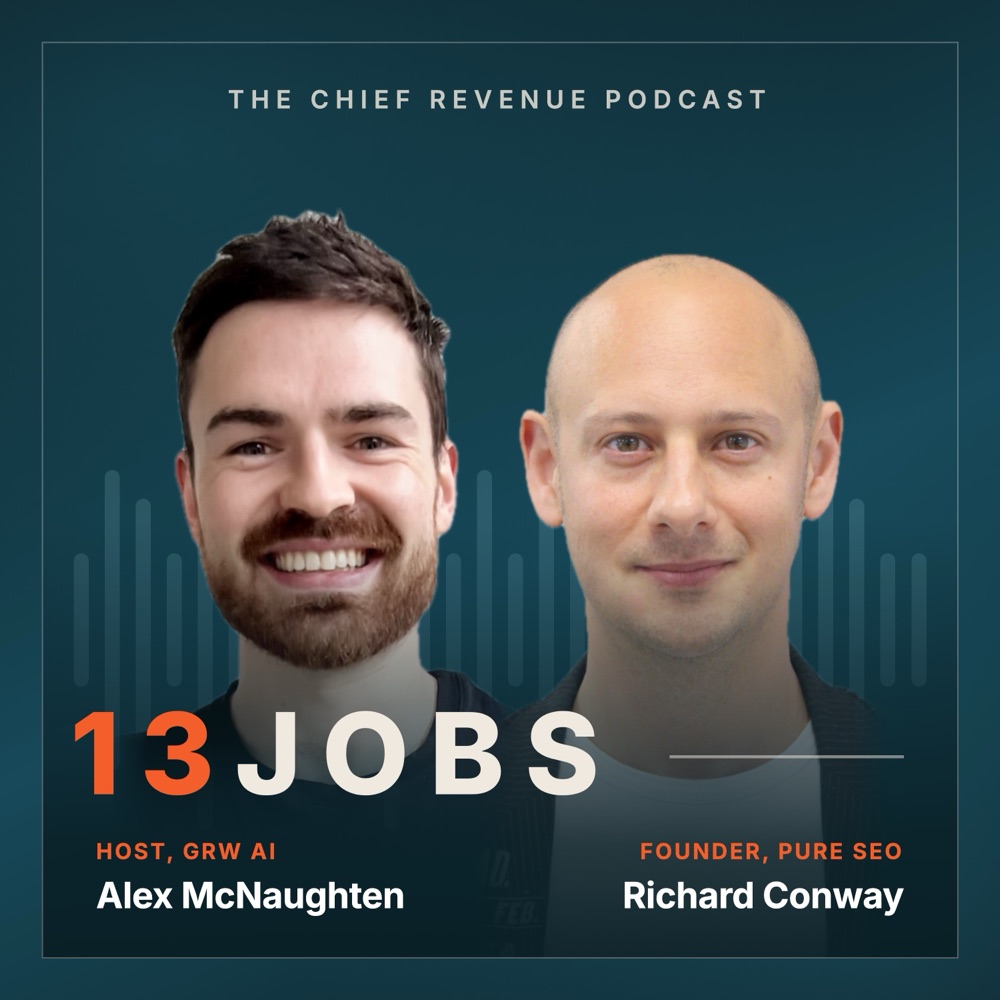
It wasn't the salespeople, it was our systems
Richard spent years hiring people he thought were good and watching them miss target. The fix turned out not to be better hiring.
 Hosted by Alex McNaughten
Richard Conway · Founder, Pure SEO
Richard Conway is the founder and chief executive of Pure SEO. He arrived in New Zealand from the UK in 2009, could not get anyone to hire him for want of local experience, and started the company in his living room with $200.
Pure SEO is now by far the largest agency in its niche, with around 70 people across four countries, working in search engine optimisation, search engine marketing, Google Ads, programmatic and social. He is also a published author and a long-standing member of the Entrepreneurs' Organization.
In this episode, we discuss:
- Two hundred dollars and a living room in 2009
- Not bad salespeople, bad systems
- The basics, starting with returning the call
- Uncapped commission, and a base that is not comfortable
- Black and white rules on who owns a lead
- Coaching the top of the team, not the bottom
- Two tests everyone in the business knows by heart
- Turning down a deal, and firing a client
- Two teams, two managers, and the first-deal clap
- Grafters beat naturals over a full year
- Cold calling works if you bring something worth the call
- What he would change: the wasted hires and the .co.nz
Quote of the show
“It wasn't crap salespeople we had, it was rubbish systems and processes.”
Key takeaways
- Blame the system before the hire. Years of salespeople missing target looked like a recruitment problem. Bringing in a sales manager showed it was the absence of repeatable process, and the hires were being set up to fail.
- Spend the coaching time on the top. The instinct is to pour effort into whoever is struggling, which quietly penalises everyone doing well. Run it like a sports team and get the best players better.
- Never cap commission. A good base, but not so comfortable that anyone can coast, and no ceiling above it. The biggest cheque means the biggest deal, so it is a strange thing to want to limit.
- Write down who owns a lead. In the CRM, first in owns it, but it goes back in the pool after a stretch of no contact. Rules that are black and white kill the arguments before they start.
- The grafters win the year. Naturals close a couple and ease off. The people writing proposals in the evening and back on the phone the next morning end up top of the board by following the process.
- Leave the meeting worth paying for. Go in intending the other person to think they got a couple of hundred dollars of value out of half an hour. Lose the deal that way and they still tell people about you.
- Values only count when they cost you. A deal is turned down if the GM does not believe it will return. A client paying five grand a month was fired for how they spoke to staff. The tests are simple: would you be comfortable reading about it, and would you accept being treated that way.
Transcript
How are you? Thanks for joining me today.
Yeah, not bad. Not been out much recently, but yeah, not too bad.
Yeah, it's funny that, um, same here. Look, really appreciate you giving up some time to have a chat to me today. So for those who don't know Richard, he is the founder of Pure SEO. Tell us a little bit about your story and of how you came to be doing what you're doing today.
Cool. All right. Pure SEO started in October 2009, shortly after I reached New Zealand from the UK. Came over here all arrogant thinking I'll roll into a job. No one wanted to give me a job, no Kiwi experience. So I thought, bugger it, create my own job. So Pure SEO was started in my living room with $200.
Kind of built it from there. We're now by far the largest in our niche. We've got about 70 people across 4 countries. And we specialize in search engine optimization, search engine marketing, Google Ads, programmatic, social and just the digital marketing kind of field.
And I think one of the reasons I want to talk to you today is because you've done a phenomenal job of building out a really high-performing sales team and wanted to kind of pick your brain on what are some of the principles you've put in place to keep performance? Because I think what a lot of companies struggle with is that, you know, their first sales hires will perform, but it's hard to maintain that performance the bigger the team gets.
So yeah, tell me, what are some of the key things that you think have led to your team's success?
So first, it's actually not me. It's not my skill set that enabled that. So going back, we had my first sales guy still with me, and he was brilliant, but that was luck of the draw. Then we went through a period of years where we were getting what we perceived to be good salespeople, and they were all failing.
They were all not hitting targets and dissent and things like that, and I just thought our recruitment process was wrong. We then— I then did a presentation about this in my EO forum, And what I then decided to do was find a really good sales manager. And so I asked around and 3 names came up.
And so I tapped each 3 of them on the shoulder and got them to come in for interviews. We employed one of those 3 as my general manager now. And it turned out that it wasn't crap salespeople we had, it was rubbish systems and processes. We weren't allowing them to, um, to succeed.
I think for a salesperson, they need those systems and processes because everything's repeatable. So for example, cold calls— they know how many cold calls they need to make to arrange a meeting. You know, the really good salespeople, when they get a no, they think they're one closer to getting a yes. So they know it all averages out.
And how they get that cold call, you know, they pick up the phone, they do a bit of work beforehand, they identify a good prospect, and then they look on page 2 of Google. You're on page 2 of Google, your competitor's on page 1. Look, give us half an hour, I'll explain why they're on page 1 and you're on page 2.
Let's grab a coffee. Why wouldn't you? Then once you're in front of people, then, yeah. You're likely to have a good chance of closing the deal. And then have the view that even if you don't win the business, go into that sales meeting with the idea that that other person will come out of it thinking, I'd have paid a couple hundred bucks for that, I've got so much value out of that.
Because if you don't even get the deal, they're going to have a positive impression of you and they're going to tell other people. So provide value. Don't be ultra salesy, provide value, value, value, and a solution to what their particular need is. And then it's all around process, you know, how many cold calls, how many have you chased up, have you asked for the deal?
You know, a lot of people do work and then they don't even ask for the deal.
Mm-hmm.
You know, simple things like calling people back. There are so many companies you put an inquiry in and then nobody gets back to you. I wanna spend my money with you, but yeah, you're not phoning me back. So getting the basics right and putting in a good process, and I'd love to take credit for that, but yeah, it was people I brought in that actually put those in place.
Yeah, I think you've touched on a few really important things there that I see earlier stage companies get wrong all the time, is they first look to hire that unicorn salesperson. Now, it sounds like you were lucky and actually did find the unicorn salesperson, but they are unicorns.
Yeah.
And if you try to do that again, you probably wouldn't. If you try to do it 3 times, you probably, maybe if you're lucky, get it once. And I think what you said there around process being the ultimate in terms of why the difference between a successful team and an unsuccessful team, I think that's really, really important.
So what does that look like for you? What are some of the systems and tools and processes that that you have in the business that enables that at scale?
So, um, I think there's an important thing first is around remuneration and around how they're incentivized. So we pay quite a high base, we pay, uh, for a car, we pay a phone, we pay petrol, but we don't pay too high a base that they become lazy because they don't need anything. And we pay really high commission and we uncap the commission, you know, the guys can earn several hundred grand a year if they're successful.
Now, I never understand why people cap commission. Like, it just doesn't make sense. So I want my sales guys to have the biggest checks because that means they're doing the biggest deals.
Hmm.
In terms of systems and processes, we were using Highrise. We've just moved over to Xcello. The reason being is Xcello for us is a more holistic product. Which encompasses the whole organisation. That being said, we've moved over it. It's been a few months, but we only moved over it in the last few weeks, so it's very new.
I see.
But Highrise was what we were using before, and it measures, you know, they can have an app, it measures when to call back, how many touchpoints, how likely you are to close the deal, and all that kind of stuff. It also, we've got quite a large sales team now, we've got 15 people, someone puts it in Hi-Rise, or now Xcello, no one else can go after that person.
However, if it's been in there for a certain period of time and there's been no contact, then it's fair game. And so I think having the rules that are crystal clear across the board negate any of the problems. Because, you know, someone comes in, they sign a deal, oh well, I had that in Hi-Rise.
Well, you hadn't contacted them in 6 months, it's my deal. Fair enough, that's the rule. Or, look, I contacted them 3 weeks ago and you've just come in and closed the deal. Well, that's not your deal because it's their client. So having those black and white, I think, keep away a lot of the tension that could go wrong and things like that.
I agree with you on the commission plan situation in terms of remuneration. There is definitely— I see no benefit whatsoever to capping commissions. I think it's a fool's game because if your salespeople are not incentivized to keep earning, then you're not gonna be earning as a business because they're gonna stop selling. So 100% agree with you there.
And I also like how you've couched it there. It's like you pay them a good base salary so that, you know, they've got enough, but not enough that they're comfortable.
Yeah.
Because you want your salespeople, especially new business-focused salespeople, you want them to be pushing and earning big commissions. It shouldn't be that their base salary is 80% of their earnings. It should be like 50/50 or 60/40, or even in some cases, I've seen organizations pay super low base but have their reps earning $300,000, $400,000 a year with a base salary of $60,000.
So, you know, I think in principle, I think some of the things you said there are great. And then equally from a visibility and the rules perspective in terms of how you manage the team, I think that's really important. So you don't have infighting within your team because that can turn toxic very quickly.
When you— with— do you have a very good view in terms of the numbers and like percentages? Like, you know, you talked about how many calls you need to make to get a meeting. Do you have that right the way through your pipeline? And if so, what are some of those key things you track?
We track phone calls to meetings, meetings to presentations, presentations to signed deals, and everything in between. It's my sales manager and then the— or the 2 sales managers and then the GM that focus on that. I just get presented in the board report once a month the sort of salient things figures. But an important thing, I think, more than anything, I learned a number of years ago that it's natural to try and want to make the worst salespeople better, and by doing so, you negate the better salespeople.
They're disadvantaged by the fact that you're spending loads of time on the ones that aren't performing. In my view, you've got to look at it like a sports team and put your main focus on the people who are doing well and get better and better and better rather than spend all your time and disadvantage people who are doing really well.
It was a— what's his name— it was an American sales guy that taught me that. But it's brilliant because you're naturally— you You naturally want to help the people who aren't succeeding so well. That's human nature. But you look at a high-performing team, the manager focuses on the best players and gets the best out of them.
And why is a business any different?
It's a good point because I think from coaching quite a few sales leaders, one of the things they often say, and I've heard this consistently, is that a lot of our time is spent working with the underperformers and trying to bring them up.
Yeah.
And then a frustration often from a business perspective and from a rep's perspective, which you've just called out there, is that the top performers or, or middle-of-the-road performers even are not getting the support and coaching they need to be even better. So you're actually missing out on a lot of growth potential by focusing all your effort on that one person or a couple of people who are effectively underperforming.
And, and actually sometimes you can't help them. Like sometimes the underperformers, there's actually nothing you can do. They're just wrong for your business. It might not even be that they're a bad salesperson. It's just they're wrong for the product that you're selling for your business. So where does values, you know, what, where do values come into this in terms of, do you have like organizational values or sales team values that roll into this?
Yeah, we do have our company-wide values. It all stems from the overarching thing, which is doing digital the right way.
Mm-hmm.
Our sort of core values are trust, respect, integrity, and family, but there's quite a bit underneath that. But ultimately, it's all about doing what's right, doing what's right for the customer, doing what's right for the business, I have these 2 things that everyone in the business knows. One, if you do it and it was then on the front page of the Herald, would you be comfortable with it?
If it's not, don't do it. And the other thing is, if you treat someone in a certain way and you wouldn't be comfortable being treated that way yourself, don't do it. Simple. Treat people the way you want to be treated yourself. And we also have our sales guys incentivized to sell, but we've got the GM looks at every single deal that comes in, and if he doesn't believe that we're going to be able to help them or we're going to be able to give them a return on investment, he will turn down the sale.
Right.
And the guys know that, and they know that they shouldn't bring in— because we're not for everybody, you know, you're selling a couple of dollar product, it's going to take years and years or mass volume in order to get it back from SEO, SEM, programmatic, it might not be the right channel for you in this first instance.
So, um, we really don't want to, um, we don't want to take on the wrong customers. Uh, that being said, you've got the other side of things, you know. We also expect to be treated in a certain way, uh, by customers. I mean, one customer recently who they paused during the first COVID, and we let them pause for a long time.
They were in the jewelry business, and they were still spending money on Google Ads. And so after about 7, 8 months, I said, look, you're the last company to come back who hasn't left. And I met the guy face to face, and he shook my hand and said, yeah, we'll come out, we'll see the end of the contract.
And then 2 months later, he's asking for another pause. And you just like, you know, I shake someone's hand and say something, and that really like, that's not a pure client because I don't think that's ethical. I don't think that's the right kind of people that we want to work with. I had a big old client paying us 5 grand a month in early doors, and they were so rude to my staff, effing and blinding and telling them to come straight over to their office, and just thought it's just not worth it.
It's not worth it. So we fired them. I think you need to live your values. Yeah. And they need to come from the top, I think.
Yeah, I think so. I think that's it. It's cool how you've got some values there that you can really picture. I particularly like the NZ Herald one, you know, like, you know, would you be comfortable with this on the Herald? I think that's really cool because it might, you know, that's something that sticks in your mind and you can you would live that every day, you know, you wouldn't want, you know, that's a really good reminder.
What about sales success? Do you celebrate it as an organization?
Oh yeah, we're always celebrating sales success. You know, it's up on the board, all the sales of the month, etc. New sales guys come in, their first deal gets a massive clap around. There's a bit of competition Cool. The sales team got so big that we split it into 2, and the 2 sales managers got to pick their own teams, and now they compete against each other.
Both the sales managers have been with us for a number of years. They're both top salespeople, and they're still salespeople, but they're just nurturing and training the others. And that's something that's actually really good in our organization, is how the salespeople go out their way to help the other ones. It's— yeah, they're hunters though.
They're all hunters in our business. They need to be able to generate their own leads. We get 2 or 3 inbound leads a day to our business. Not at the moment, not during lockdown. But they still need to go out, they need to cold call, they need to knock on doors, they need to network, they need to hustle, they need to constantly be looking and generating their own business.
They hit their target, they get really good commission. I mean, they get really, really, really strong commission. For example, someone signs a $10K a month deal, they'll get $10 grand commission there and then, you know, in month 1. So, they'll get a nice $10 grand check on top of their base, on top of everything else.
So, they're incentivized to sign the 12-month decent deals. Yeah.
It's cool how you celebrate sales success as a wider organization. And I particularly like what you've just said there about for your very first deal, there's a bit of a song and a dance. I think that's quite cool to kind of bring new reps into the fold and make them feel, you know, loved and that success celebrated.
One of the things we often see is that I think particularly in the startup space where things are often very much product-led companies, that sales success isn't celebrated and it's often a bit of an afterthought. And then those companies then kind of wonder why their sales don't grow as quickly perhaps as they'd like.
What would your kind of message or lesson be, or, you know, to companies who are just starting out, you know, in terms of creating that kind of sales culture, which by the sounds of it, you've built a brilliant sales culture. Within the organization? What would your kind of recommendations be there?
So I think every business is a sales and marketing business. It doesn't matter what product you have, what service you have, sales and marketing are what's going to make the business a success, right? If you've got the most incredible product and nobody knows about it, you know, it doesn't matter, does it? And so I think any business, their core focus needs to be getting those sales, and getting that marketing on pat.
Like, if you don't do that, it's very hard to, um, to scale a business. Like, in the early doors, it was just me, and I can go out and I can sell stuff because I've got passion for it. And, you know, I'm going to be believable because I believe it myself. And so if I believe it, I'm going to be able to convince someone else it's true.
But no one else is going to have that passion that you have because they're not, you know, all invested. And so how do you find that person who can sell your product in the right way? Because our product has to be sold in a certain way, um, and understands the limitations and things like that.
And I think what you need to do is you need to find firstly people who are hunters, but also culturally the right kind of people. I mean, we've had a few bad eggs in the past and their deals invariably fall over because they do anything to get them across the line, and they're just not right for the business.
It just creates noise. You want the salespeople who genuinely care about their customers' businesses, the clients they bring on, and they really want them to succeed, and they really know the limitations of the product, and that they want to stay in touch with these people, and they want to hear the successes because, you know, that's where all the fun gets.
And then they utilize that to generate more leads because you've done well for someone, you've stayed in touch, you know, why wouldn't they recommend you? And our really successful salespeople are hunters and relationship builders. But another interesting thing is we've had salespeople who've come in and at the beginning they've really struggled, right?
And the ones that succeed that struggle are the ones that are sitting there at home doing proposals in the evening working really hard and then banging on the phones during the next day. And they may not be natural salespeople, but they're grafters, and they will often outperform the natural salespeople just by following process and grafting.
Yeah.
The natural salespeople get a couple of deals, then get a bit lazy again, and, you know, and so on and so forth. They'll always be there or thereabout, but they often won't be top of the board because the grafters end up being the top of the board, the ones who are really just working it, just constant, constant work.
And it's not complicated, um, it's just following a process and working hard.
Yeah, that was it. There's an interesting book written about this, um, and I've— as I've said that, I've forgotten the name of it, but it's basically about introverts actually often make the best salespeople, not the typical extrovert that you'd imagine, because they're more diligent to a process. And, you know, your extrovert might have an amazing month But then the next month when their mood's not so good, it might dip down or if they get a bit lazy like you said, whereas then, you know, your process-driven introvert will just follow the process and be methodical and in the long run will outperform, which is often the case, which is actually not what the kind of popular belief is out there is that, you know, most people think your salespeople, your relationship-driven, loud extroverted types, and they can be, but not always.
Um, I also think, um, a lot of people, especially in New Zealand, are anti-cold calling. Cold calling doesn't work. Yeah, it's rubbish. Cold calling does work, but you have to think about the way you cold call. You can't just pick up the phone, is, is Bob there? Yeah, can we meet up? Um, I've got something you might be really interested in.
You have to create that need, you have to find out something, and you have to offer value. You offer value and you go in there without a sale. You just go in there and provide value, and if that eventually leads to something else, all good. But if you've provided that value, then that cold call's been worthwhile.
And so it's thinking about how to provide that value on the cold call, or what, what value you're giving. It's not about just picking up the phone and just churning through the phone. And the better you get at it, you see, like, you know, I think it's sort of average, sort of 1 to 10 is for a meeting.
But, you know, some of them have got them down to 1 to 3, 4 calls because they just know the pattern. They know to identify the right companies who are going to benefit from it, and they know the figures. They know that they've done a bit of research beforehand, and so they're not phoning up cold, and they're targeting verticals that work.
And so Cold calling does work, and it needs to be, certainly for us, one of our streams. Obviously, we spend £5,000, £6,000 a month on Google Ads bringing in leads. We're top for SEO. I do a lot of speaking gigs. We do our own marketing. So there's all these things. We've got, what, 25, 30 branded cars on the road.
So we've got all these different things which build the brand, which give credibility, because invariably, you phone up Love to chat with you. Have you heard of Pure SEO? Oh, you have? And then it's thing. It's not like with some company they've never heard of. And it's all about that separate brand building on the side.
But even with all of that, you still get a large chunk of deals coming from cold calls. Which I think if there's one thing that companies take away from this conversation, there's been a lot of things for people to take away, but there's one thing to take away, it's that, is that for even an organization who's spending of money on ads, has a good brand, you've got a founder who's out there and who's known and you've got great brand awareness, you're still doing cold calling to grow.
And, you know, for any of the naysayers out there who don't think cold calling works, well, I think really they're just missing out. They're missing out on pretty significant business.
Yeah. If it was easy, everyone would be doing it, you know?
That's right. And I think too, like when I first started getting advisory work, I probably did about 1,000 outreaches to get my first 100 clients, something like that, maybe a bit more. And it's like you said, if it was easy, everyone would have, you know, more clients than they knew what to do with.
And I think actually just on that, even companies like HubSpot and Salesforce who have probably the most sophisticated marketing engines ever, even their teams are probably doing about 20 to 30% of their deals are coming from cold calling, from cold outreach.
Yeah.
Sometimes more in certain teams. So last question for you, Richard. If you knew everything you knew now when you were starting your business from a, you know, with a sales lens, what would you have done differently?
Loads of things.
Pick 2 or 3.
I wouldn't have wasted those hundreds of thousands of dollars on salespeople that didn't have the process. Okay, we were setting them up for failure. They were coming in, it's hundreds and hundreds of thousands of dollars I wasted there. The other thing, which is less sales-focused, more kind company-focused is I thought too small when I started the business.
I had the.co.nz. I should have thought global from day one. Why couldn't we be a global business?
Okay.
Yeah. And that was a real mistake. And it cost me only $4,000 to buy the.com a couple of years ago. Yeah. Within months of getting it, we had deals coming in from Hong Kong and stuff. Like, I should have done that at the beginning, but you don't know what you don't know.
It's great. Thank you so much. And where can people find you if they want to connect with you or, or follow some of your content or anything like that?
Cool. We've got a blog at pureseo.com. I'm on LinkedIn. My email is richard@pureseo.co.nz. Drop me an email, follow me on LinkedIn. I'm pretty relaxed. You know, yeah, same, same.
Brilliant. Hey, look, really appreciate your time today, mate, and there's been some great insights there for, um, you know, business owners, sales leaders, and, and reps.
Uh, thanks for having me.
See you next time.