
Marketing is convincing them to call you
Craig's agency asks the client and their customers the same five questions about why people buy. In a thousand clients, the two lists have never come back in the same order.
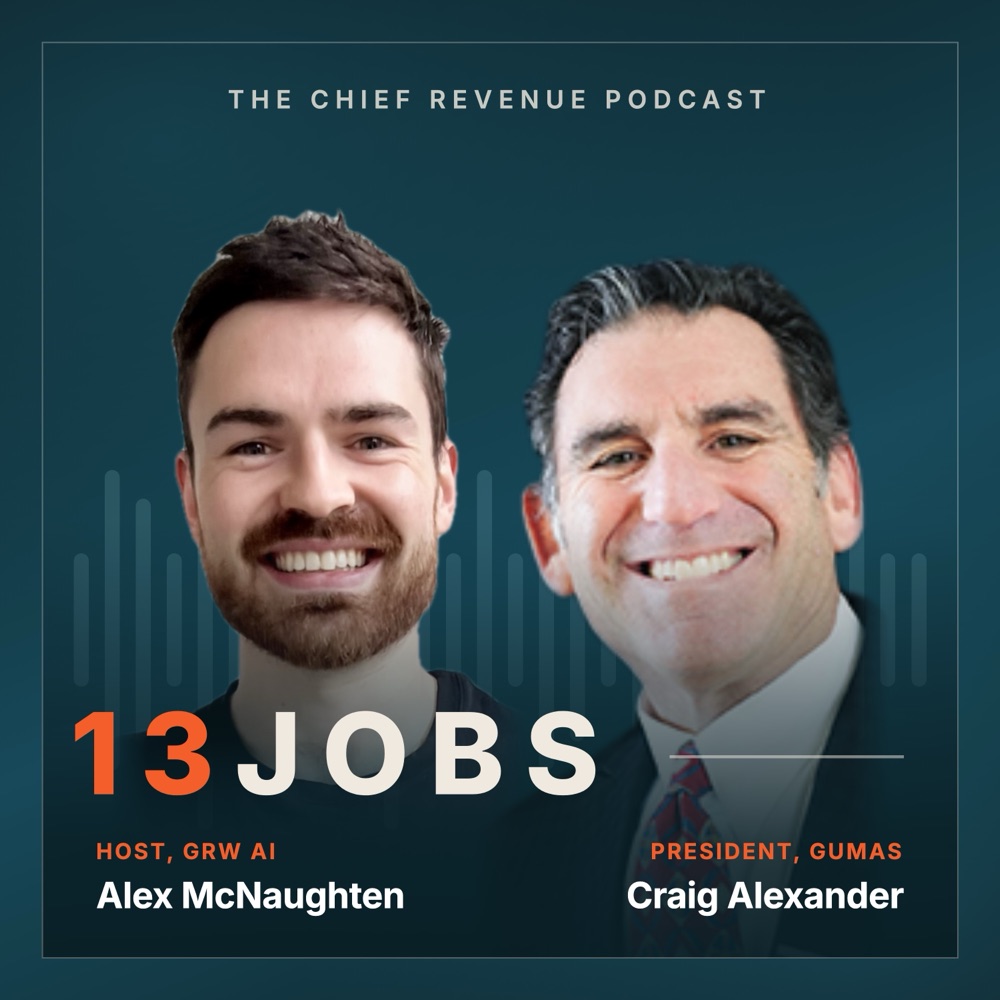
 Hosted by Alex McNaughten
Craig Alexander · President, Gumas
Craig Alexander is president of Gumas Advertising, the longest-tenured full-service independent agency in San Francisco, founded in 1984. He has more than 30 years in branding and advertising and has worked on Microsoft, Sony Pictures, Carl's Jr., Esurance, NASDAQ, The Walt Disney Co., AOL and The Miller Brewing Co.
The agency works exclusively with challenger brands, anyone who is not number one in their category, and has trademarked the phrase Challenger Brand Marketing. Craig co-wrote the book of the same name with the agency's founder John Gumas, who he met playing baseball and softball three decades before they started working together.
In this episode, we discuss:
- The agency, the book, and the trademark
- What makes a challenger brand, and why Nike could be one
- The first spend goes on understanding the buyer
- There is no business to business, only human to human
- Twenty minute phone calls, not focus groups
- Why the company puts price higher than its customers do
- Thirty seconds, forty five words, and why a tagline is not optional
- A startup with no customers researches the competitor's
- Sales reaches out; marketing gets them to call you
- Why every placement has to be one click from buying
- Seven seconds on the homepage: we do X for Y so you can Z
- Twenty three, on the beer account, asking too little
Quote of the show
“Sales is reaching out to prospects, getting them to buy your product. Marketing is convincing prospects to call you so that you can close them.”
Key takeaways
- The research writes the strategy. When the interviews are done properly the messaging is the easy part, because the customers have already said what matters to them. Most marketers skip this and go straight to building a website.
- Ask the client and the customer the same question. Five reasons someone buys, ranked. Across a thousand clients in forty years the two lists have never matched, and price is almost always higher on the company's list than on the customer's.
- Nothing is business to business. A business has never made a decision about another business. A person did. That is the argument for messaging that connects emotionally rather than by specification.
- Forty five words is the ceiling. Who you are, what you do, what makes you special, and what difference you make for the buyer. Anything longer than a thirty second pitch is overselling.
- Challenger media has to be clickable. No billboards, no magazine spreads. Digital, social, search, email and streaming, because the point of every placement is a prospect who can act on it immediately.
- Seven seconds on the homepage. We do X for Y so you can Z. What you do, confirmation the visitor is in the right place, and what they get out of it. In real, searchable words.
- Ask more questions, earlier. At 23 he wanted his clients to think he had it together. He would trade that for the vulnerability of asking, which is what actually brings an agency and a client close.
Transcript
Good to have you on the podcast. How you doing today?
Alex, hello. Good morning to you from San Francisco. Thrilled to be talking to you.
Yeah, thrilled to be talking to you as well. So Craig, tell us a little bit about yourself. You obviously are based in San Francisco. You're the president at Gumas, a market— a full-service marketing agency over there. But yeah, tell us a little bit about yourself, your story.
Happy to. So glad to have the opportunity. So I, along with my partner, John Gumas, we run an advertising agency in San Francisco. Cleverly called Gumas Advertising, and it is dedicated to serving what we refer to as challenger brand marketers or challenger brands in general. And we have trademarked the phrase challenger brand marketing, and we've just written a book called Challenger Brand Marketing.
We'll show it to you in reverse if you get a chance to see it. And Challenger Brand Marketing is all about Working with marketers who find themselves in complicated marketplaces, up against competitors who are better resourced. Frequently, that means they have more money, which allows them to gain a lot of the resources that we're trying to tackle, like greater brand awareness, greater distribution, larger sales forces, geographic coverage, all the things that you'd hope for.
As a challenger brand to be able to get for yourselves. And so working with those sorts of marketers, we take a little bit of a different approach to help them take down their industry gorillas. And all has to do with identifying what it is that their prospect needs to hear from them that's going to drive them to action.
And although that seems simple and obvious, and you didn't need me to write a book to tell you that, What isn't obvious is that most marketers go through 10 steps before they even start thinking about what that messaging needs to be. They start building websites and creating collateral materials and further iterations of a particular brand or product when the first thing that needs to be done is making sure that the messaging is clear.
And that's where we come in, is to help understand that that prospect's motivation and what it is that emotionally is going to connect with the brand to drive them to action. And so our agency based in San Francisco, as you noted, we're a full-service independent. In fact, we're the longest-tenured full-service advertising agency in San Francisco.
We were founded in 1984. John found the agency then. And he and I have been working together for the past 12 years. And although he and I have been close friends for 30-plus years, as he and I have been playing baseball and softball together, traveling around, we got to know each other through sports.
And he was running his agency. I was working at other agencies. And I was running an agency that got sold. And once that was sold, then he and I came together and began this great journey that led us to the book Challenge of Brand Marketing and to this conversation that we're having today.
Cool. And obviously that's what we're here to talk about today is Challenge of Brand Marketing. So look, let's start with maybe the really obvious thing and I sort of, you started going there, but but let's try and do this fairly logically. What is a challenger brand? Like, how do you define it? And let's start there and then kind of work through, I guess, some of the key principles.
Yeah, well, they're obviously challenger brands, right? When you're not number one in your category, you're a challenger, right? So Pepsi's a challenger to Coke and Burger King's a challenger to McDonald's, although it would be hard to argue that either Pepsi or Burger King, and I'm using American references, either Burger King or Pepsi aren't gorilla brands.
They absolutely are, but they are being out-resourced. Gorilla brands can be challenger brands. And in the book and in some videos that we have, if you visit our website, gummis.com, you'll see us talking about if Nike, which we accept as a gorilla brand in athletic apparel shoes, et cetera. But if they were to roll out a sports drink and they were to compete against brands like Gatorade and Powerade and BodyArmor and Vitaminwater and hundreds of brands around the world that have a presence, but more importantly, have shelf space, Nike— and although they could use their guerrilla influence to push brand presence at retail, would find themselves as the challenger brand and having to market differently than they do with their typical golf and tennis and baseball and football and soccer apparel.
And it's that mindset that they have to approach it differently. They can't just go dollar for dollar generally with those guerrilla brands, because if it's just a case of spending money, they're, they're going to lose. They won't be able to, to dedicate enough budget to compete in traditional advertising channels— radio, television— to, uh, to go up against, uh, Coca-Cola brands, uh, as it stands now.
So really what they need to do is, is better identify the marketplace and connect on an emotional level with that consumer to drive them to sample the new product and demonstrate a point of difference, evolution, changing the way that people are drinking, you know, sports beverages. That would be a little bit of an example of how a guerrilla brand could be a challenger brand.
But for the most part, and this is We think it's one of the benefits of working in an advertising agency that targets challenger brands is just about anybody is a challenger brand. Traditional for-profit products, nonprofits are all almost by definition a nonprofit is a challenger brand, right? They don't have the budgets to compete.
How does a nonprofit present themselves in a compelling way to go up against more recognized brands. And then business-facing, consumer-facing, challenger brands are agnostic. They don't care. They're in competitive environments, whether the end buying decision is made by a corporation or made by, you know, a stay-at-home mom. It crosses all channels.
So as I understand it, a challenger brand is anyone who's not number one, you know, anyone who's not the biggest or most dominant in their category. Why is it, as if we go back to your example, why is it not as simple as just more money? Like, why doesn't that work?
Well, because most challenger brands don't have unlimited budgets.
Right.
And most brands can't compete dollar for dollar in nearly any category with a marketer. If they could, then we wouldn't take a challenger brand marketing approach. We would take a guerrilla brand marketing approach. And we would look at it, if our budgets were unlimited, we would own space, whether that's traditional media, it's non-traditional media, it's digital, we would absolutely own space.
And that's what gorillas do. But most challenger brands can't. So we have to be very specific about where that message is, what the message is first, and then where it goes.
So break down then a challenger marketing approach. You know, you're a smaller company, you've got a smaller budget than your main competitors. What do you do? Where do you start?
Yeah, so love the question, Alex. The first The first step is set budget aside to understand your buyer.
Right.
Whether it's a consumer, it's a decision maker at a procurement department within an organization on a business-to-business environment. And by the way, like I'm sure many of your listeners hate the term business-to-business or business-to-consumer, B2B, B2C. I know it's— everyone understands it, but From a challenger brand marketer's point of view, everything is human to human, right?
Because never in the history of mankind has a business made a decision to work with another business, right? It's always been a human being at a business who's made the decision to work with another human being at a business. And that to us affirms the need that all messaging needs to connect on an emotional level.
Mm-hmm.
Whether you're talking to a corporate officer or you're talking to You know, somebody who's looking to buy a bag of chips. So the specific approach is setting money aside to understand that end user, that buyer. And so we would recommend research consisting of talking to current customers, talking to prospective customers, and talking to the marketer.
Talking to the client, uh, and understanding what the essence of that organization is. Understand where the emotion lies, extract that, articulate that, put it in front of prospects, connect them to you. So we, we would do a series of phone interviews, really purposeful, right? That it's not a focus group, it's not even a Zoom call, it's not being in a room together, it's old school on a telephone, one-on-one.
Our calls are generally 20 minutes, and that's because people are a lot more candid when they're behind the security blanket of a telephone. They're not looking you in the eye. They're not telling you what you think you need to hear. They're not influenced by anyone else in the room who might have a louder voice during a focus group.
The one-on-one conversation, we've confirmed, is the most fruitful. So we'll have these conversations with current users, customers, to ask them a series of open-ended questions that are all emotionally based. This is not a survey. It's not fact-finding. It's how do you feel about this company? How do you feel about this brand? How did this product change your life?
What is it that you love the most? What makes them special? We'll identify a list of priorities of what helped make their decision, and we'll rank them in order of importance. We'll go through that again, all in about 20 minutes. We'll run that same series of questions through the client. So we'll have one-on-one calls with leadership at the client, get their opinion, because we want to compare what the client thinks the customer wants to hear versus what the customer is telling us what they want to hear.
Is that often very different? Is, is that very different, or are they— it's always different?
Always different. The distance, you know, the, the delta of difference varies from, from client to client. But, and we've probably worked with 1,000 clients over our nearly 40 years as an agency, um, and never once has the, uh, responses from the customer and the responses from the client matched up entirely. There's always a difference in, in like parallel lines.
Why is that?
Yeah, what, like, yeah, why? So I guess, I guess it may be I've asked the question better. Why are companies so unaware of why their customers buy from them?
Yeah, it's the old adage, you can't see the forest through the trees. The idea that the client is so close to it that they can't possibly get the objective opinion that customers will tell you if you ask them. Just the one example that I touched on a moment ago is that we will ask, The customer will give them five reasons why they use or would use the particular our client's products, right?
Price, customer service, availability, the way it makes me feel, and impact that it has on my job. Just to give you five, and they'll rank them in order, and we'll aggregate it so you have an average number of way it turns out. We'll ask the client the same thing. Here are the five reasons why a potential customer would use your products.
Put them in order of importance as you believe it is to the customer. It's only 5 items. We'll ask them, we'll average it out, and almost never is the order the same. Frequently, the, the client will put price way higher than the customer. That's generally the first thing that goes wrong because the client The customer, rather, the customer end user is less interested in what it costs to get something than it is to, to, to get the, the value, the impact of what that product does for them.
Mm-hmm.
It's almost always that impact is higher than the cost point. And the client almost always put the cost ahead of the impact of the product. Uh, so that's just 2 items and the other 3 kind of fall in place. So that's one area where there's usually a, a lack of alignment between the customer and the client.
Can a company do this themselves or is it the independent nature of the interviewer really important?
Yeah, so super smart question. They absolutely could, but there's a sense of a third-party authority that will get more out of the interview than they would. And I think there's a sense of candor that comes out of a customer who's talking to a company who does this for a living than the marketer who is just trying to get an idea of, you know, what's best.
Yeah.
Typically, marketers send out surveys all the time, right? Some more complicated than others. They're always getting a read on what their customers like or don't like about them, like or don't like about their products. But that's typically a binary conversation. You like this? Yes, no. You like that? Yes, no. The fill-in-the-blank stuff is really tough.
That's why this third-party interview conversation is really important, because the questions that we ask and in the order we ask them gets an emotional response that really no survey is going to do.
Right. And what makes you focus so much on the emotional? Piece? Like, why the emotion?
Yeah, that's where the messaging lives, right? So that's right back to the beginning of this conversation of the first thing that, that the Challenger Brand approach is, is getting the messaging right. And the messaging lives within the emotion of the customer's responses. So when we do our research, we go through all this and we study the competitive environment as well.
We also put our clients through a half-day branding symposium to really get a sense as to where they are and align their leadership team so that before we leave, they're all in agreement where we're going. All of that goes into our salad spinner to get us the data that's going to lead us to the messaging strategy.
The messaging strategy, although most would think that's the most complicated and difficult part of any marketing approach, When the research is done right, that's the easiest because the research writes the strategy. The strategy just jumps right outta the research. There's consistency in the responses that make it clear this is what we need to say that's going to connect with the consumer because the consumer told us, this is what I'm emotionally interested in.
This is why I use this product. Now we just have to write the language that provides that value, whether that's in a full 30-second elevator pitch, uh, which we believe 30 seconds, 45 words, that's the longest format you ever need. Uh, if you're writing more than 45 words in your marketing materials, you are overselling whatever it is that you're trying to say.
Mm-hmm.
Our elevator pitch is who are you? What do you do? What makes you special and how you make a difference for your consumer, for your user, for your buyer? If you string together the answers to those 4 questions, you're going to write a compelling elevator pitch. So that's the longest format, 30 seconds, 45 words.
Within that lives your, your mission, your vision, your positioning, your value, and your tagline. And for us, challenger brands absolutely have to have taglines. You have to be able to attach some piece of language that lives with your wordmark, your logo, whatever it is that will do the talking for you, because no sales team could ever be everywhere at the same time.
But you can certainly put your brand out there and make sure you've got that language that is emotionally charged, is a battle cry, is a proclamation, a mission, lives within the confines of your wordmark or your logo. So That's the beginning stages. That's why the emotion is so important, Alex, that that's the messaging and that's what's gonna connect with the, uh, with the prospect.
Now importantly is, is once that messaging is done, how do you put that in the marketplace where you surround that prospect with this message and drive them to you? And we can talk about that.
Yeah. Um, before we go there, I, I guess another question that came to mind is What about if you don't have customers yet? How do you do this?
Startup.
Yeah, like you're a startup, you've got an idea or you've got like an MVP, but you don't have a paying customer yet and you don't have, you know, 20 customers to go interview to understand why they like, you know, why they wanna use your thing. What do you do if you're a startup?
Yeah, so our first question is to that startup is what's the competitive market look like? Talk to us about who currently is buying whatever it is you're selling. Maybe it's not exactly what you're offering, right? Because startups always believe that, well, nobody competes with us. We've got something that no one else has.
But apparently the world has gone on for however many millions of years and no one seems to be asking for your product. Whatever that need is, they're using something else. Let's understand what that is and that'll help us identify who the buyer is right now. So we'll identify who the buyer is based on the competitive set and then we can have conversations with competitive consumers, users of that product or service.
So we would go onto the competitive side and study them. That would be a good place for us to generally begin in a startup environment.
Gotcha. But you still have the same goal, you're just understanding why the emotions behind why they're using a competitor or a series of competitors rather, you know, to understand the emotional drivers that will align with this startup.
Absolutely. And we may have to create a scenario in our interviews that lay out the offerings of this startup in a way that the customer said, oh my gosh, where's that been all my life? Let's Let's talk about that and why that would appeal to me.
Right. So in other words, process is basically the same. You're just starting with competitors instead of obviously customers.
Users.
Yeah. Going back to where we were, you know, how to get the message out there. I think that's a really, it's a tough question. And, you know, a lot of, you know, the companies we work with and have worked with over the last you know, 3 years at Apprento, a B2B SaaS. And, you know, it's just like every space, it's crowded.
There's a lot of noise. So, you know, cut-through is difficult. So, you know, I guess my first question is, how do you know what channels to use? And then the follow-up to that is, and then how do you stand out on them and actually get some mindshare? Yeah.
Um, so let me begin by, um, defining the difference between sales and marketing.
Cool.
So in, in our, in our, in our mind, sales is reaching out to prospects, getting them to buy your product. Marketing is convincing prospects to call you so that you can close them.
Mm-hmm.
Clearly, the better your marketing, the better close rate you're going to have, because anyone who calls you to make a deal has got a better chance of saying yes than somebody you're reaching out to, right? So in order to pursue the marketing side, we create plans that surround the prospect in ways that they see you all the time.
And the way they do that is spend the time to identify the prospect, and that's with the client, right? The client has their personas, or they have their target audience, and different ways they know who, who generally is going to buy their products or services. We focus on them, uh, demographically, uh, geographically.
Other ways as well, but we'll focus with those on the time, and then we'll create plans that will target that audience with strictly digitally based media options. We need to make sure that no matter what is in the marketplace, that it has the opportunity for a prospect to click to a chance to buy.
Immediately. So you're not going to see a lot of challenger brand marketing plans that have outdoor billboards, right? Mass marketing, see the message, great brand awareness. I can't buy something by looking at it at a billboard, right? Unless I click on a QR code or something. I can't do that, right? You're not going to see a lot of magazine ads, although again, you can click on a QR code, but that's effort.
What you are going to see in a challenger brand marketing plan is digital media that socially based, search-based, email-based, anything that you can put in front of the right audience that's going to get them to click once. And from there, once they get the first click, then we've essentially got the opportunity now that's bringing them to you.
Right, in the traditional marketing way. It's bringing the prospect to you. Then we, we can close them on whatever that call to action is once they click. It could be take a tour, uh, speak to a salesperson, uh, watch a video, sample the product, whatever that might be. Uh, it's a, it's a digital-based plan focused on surrounding the prospects so they just keep seeing your brand all the time.
Um, a lot of connected TV, YouTube-type video where somebody can see your ad while doing other things, click and go. So there's a lot of that. You won't see traditional television, but you will see streaming media.
Mm-hmm.
Again, ways to see, click, connect, move on. So that's the theory.
Gotcha. And then to the second part of my question is how do you actually stand out? Like, how do you cut through? Is that the messaging piece or is there more to it?
No, you were right with your instinct. It's the emotion associated with the message. So we will stand out because we took the time to understand what that prospect will connect with, right? So what we're saying in whatever that digital copy is that's in front of them, we know that that's exactly what they're looking for, that that's, that's the emotional tone because the value is in that language.
What do I get out of this relationship? It's in that messaging. That's what's gonna stand out from anybody else is understanding that. So it's the messaging. Of course you want compelling graphic that goes along with that. And you want it consistent and you wanna build a brand that, that lives up to the messaging graphically.
All that just supports the emotion behind the message that connects with that prospect.
Yeah, that makes sense. One mistake I've seen a lot from companies is they waste a lot of good marketing leads. And what I mean by that is, you know, I think I saw a stat fairly recently that the average number of touches to an inbound lead, it's something like 10. to convert it to a meeting.
Maybe it was 8, but anyway, it was a lot more than most people think. And most people sort of get an inbound lead, they follow up once, maybe twice, and then they're like, oh, bad lead. Like, you often, you know, you see that tension, right, between sales and marketing sometimes where sales is saying, hey, marketing, you're bringing us rubbish leads, and marketing like, you're not closing the leads.
Yeah.
Any, any thoughts on that? Anything you've seen, um, you know, over the years?
Uh, yeah, so I, I have no quarrel with your, your 10 touches. I, I, I might have guessed that it would take more. Um, and that's, that's a sales commitment, uh, to continue to, to follow up. However, guys, this is going to sound really just redundant and like a broken record, right? To show my age in that reference.
If the message is compelling, you shouldn't need to connect with them 10 times, right? It should just be, yeah, this is just what I've been looking for. Where can I connect with somebody? So we would think that the messaging applies across that challenge as well.
Mm-hmm.
Yeah, reducing the number of touches to close a deal. You know, there are strategies associated with that, that I'm sure your listeners have a great history of different tactics to connect with prospects in ways that are more than just, you know, 12 emails every other day. There are other strategies that might involve incentive.
It might involve, you know, value really to us. You have to appeal to that prospect's value. What do they get out of this relationship? And if it's just another opportunity to— for them that they get every day, then that's why it's going to take 10 times. But if it's not the kind of an opportunity that they get every day and it's something that is really connecting with what they find most valuable, where the impact's going to be greater, all in the messaging.
That should reduce the number of touches, I would think.
Yeah. So I guess what I'm hearing a lot of here is, and maybe, you know, to summarize somewhat, is it seems like a lot of companies are not spending enough time trying to understand their buyer at an emotional level. And in so doing, their messaging is perhaps off, or most likely off, which is why sales is having to work so hard.
To speak to leads. Whereas when you actually spend more time upfront to understand your buyer and craft a compelling message, they'll actually want to talk to you.
Absolutely. Exactly. So much better stated than I just spent 15 minutes talking about. But yeah, that's it. And when you think about it, Um, we, we look at, at the website, right? Which is our nerve center for all marketing. Um, I'm sure nearly every one of, of your listeners recognizes that the, the website is ground zero.
If you're gonna create messaging that is compelling to a prospect, the first place you want it to live is on your website. Um, that's your positioning statement so that when somebody does come to your site, whether they were directed because of a cleverly placed digital ad, or they just did a search and your name came up, or they mistyped something and there you are.
Mm-hmm.
Uh, they're, they're gonna have 7 seconds, right? We say 7 seconds from the time that they land on your homepage to determine who you are, what makes you special, and what's in it for me, right? It's— we refer to it as the XYZ. You know, we do X for Y so you can Z.
Create that positioning statement on your homepage. We do X. This is what we do.
Mm-hmm.
For Y. Y is me, the, the, the prospect, the visitor to your website. It's clear in the messaging that I'm in the right place, that you are targeting me. This is for exactly what my need is. We do X for Y, me, so I can Z. This is the impact, the value, what I get out of the relationship.
So 2/3 of those 3 points in your 7 seconds of messaging. The first point is you. This is what we do. The second point is me defining that I'm in the right place for me. And the third point is Z. This is what I get out of the relationship. This is the value.
This is, this is the closing line of any kind of a sales pitch. It's the one thing I'm gonna take away that I sign here and I'm going to get whatever that peace of mind is that's gonna make my decision easy. We do X for Y so you can Z. 7 seconds to com— to articulate that on the homepage in writing, real words, searchable, Googleable words on the homepage leading to a click.
Rest is a sale.
I've got 2 kind of final questions for you. The first one is, do you have some examples of who's done this really well? I think particularly with that like homepage example, like who's really good at this, you know, like brands that people, you know, well, yeah, any links that you could share for people to go look at?
Yeah, it's probably better for brands that you don't know.
Mm-hmm.
And, and brands that, you know, I'll share with you because any challenger brand needs to do this, right? It's one of the first things that we do with a client. And, and you look at, I'll give you some different categories. Food service, Mi Rancho Tortillas. We built that brand. Built their site, built their language.
You'll know when you go there that we create tortillas through our pure tortilla joy that, that we, we offer. Mi Rancho Tortillas. Medical devices, um, Monahan Medical. They create inhalation nebulizer, uh, devices that help you inhale medication.
Mm-hmm.
Very cool. Right off the gate, you'll, you'll, you'll recognize them right out of the way. What others would be a good another category? Financial services. You could look at brands like Unitus Community Credit Union. Unitus. Unitus is a great brand. Excite. Excite Credit Union. Another place that understands we do X for Y so you can Z.
Giants Community Fund, San Francisco Giants Baseball Club. That's a place, and it's juniorgiants.org is the actual website. Jrgiants.org will get you there. All-Stars Helping Kids. I'm just going to start filling out. This is too many, Alex. All-Stars Helping Kids is a philanthropy that Ronnie Lott famous defensive back for the San Francisco 49ers, Hall of Famer.
It's his organization. You'll see it there. The Bay Area Sports Hall of Fame, another place. So all these challenger brands are some examples of places that you can go and take a look.
Yeah, I think it's useful for people to see, I guess, what good looks like.
And, you know, and koomis.com, Alex. We can't leave out our own agency.
That's a good point. Go ahead, Alex.
I'm sorry.
Final question for you is, you know, like knowing everything you know now and, you know, many years, you know, in business and in this marketing space, you know, go back to your first day on the job. What's the one thing you wish you knew then that you know now?
That's a pretty— I like time traveling questions. And I love to go back to my first job at my first advertising agency, which was one of the greatest times of my life. So at 23 years old, I was working on the Miller Brewing Company account exclusively.
Wow.
So beer at 23 years old, everything I was doing was beer. I was so naive and so uninformed. And I think what I know now that I should have known then was I needed to ask more questions. I needed to ask more questions of my clients, ask more questions of my colleagues, people who knew things that I didn't know, which was absolutely everybody.
Mm-hmm.
And I didn't ask enough questions, and especially of clients. And I think that you so much want to impress people and you want people to think that, you know, you've got it all together. But early in my career, like everyone, you don't, you're just hanging on.
Yeah. Yeah.
And I think that if I would've confidently asked a lot of questions, particularly of the Miller Brewing Company clients, I think I would've not only, of course, learned more, but I think there's that sense of vulnerability that brings clients and agency people together that I never would have accepted as a 23-year-old. But I think now that would have made a difference.
I think that's a fantastic one and it's very much on theme in sales as well where most people do not ask enough questions of their clients and then just in general for life, right? I think if you're curious, You know, I think it can be a real superpower for life and help you get anything you want.
So I'm glad you shared that with us. Craig, this has been great. I've really enjoyed this conversation. I've learned some things and I'm sure the audience is gonna really appreciate you sharing your wisdom. Where can people find you if they want to connect with you and learn more about, you know, you and the book and, or if they want to buy the book?
Yeah, well, What's the best way to get in touch and connect with you?
Terrific. Yeah. So website was gumas.com. Books available on the website, Amazon. The book is Challenge Your Brand Marketing. And connect with me, please do. My email, calexander@gumas.com.
Awesome.
Alex, thank you so Thanks so much. This has been great.
Thanks for, thanks for coming on, Craig. Really good to connect with you. Speak soon.