
The biggest mistake is not posting
Ryan trained roughly a thousand people through lockdown. The mistake at the top of his list is the simplest one: they never post.
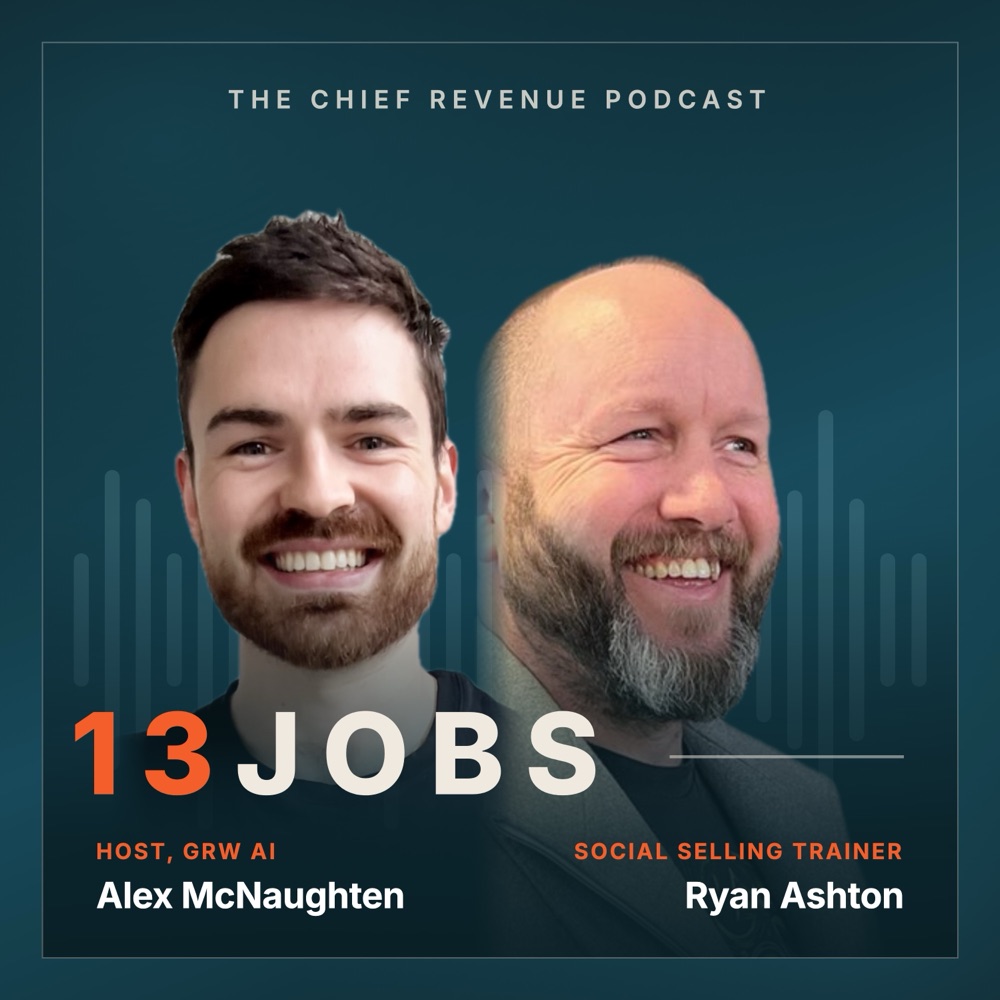
 Hosted by Alex McNaughten
Ryan Ashton · Social Selling Trainer
Ryan Ashton, better known as Ryan the Lion, runs A Few Quiet Yarns, the New Zealand networking events business built on personally introducing everyone in the room to everyone else. There is a no-selling rule, and you are not allowed to ask what someone does until the third question.
He has worked across sales, marketing and agency, from copywriting and art direction through to sales management and CRM deployment, and trains people on LinkedIn and social selling.
In this episode, we discuss:
- Where the nickname came from
- The biggest mistake is not posting at all
- Twenty years of material, and the belief you have nothing to say
- What posting is actually for
- Hook, sub-hook, then the subject
- Hope we may connect, and giving the power back
- Twice a week, Tuesday and Thursday, and not at half twelve
- The post every leader should be writing
- Earning the invite with a comment first
- Why the automation tools get accounts deleted
- What people actually react to
- The one thing: sales is service
Quote of the show
“It's not about collecting connections, it's about creating relationships.”
Key takeaways
- Post before you optimise anything. Everyone he trains opens with not knowing what to say. Twenty years of career is the material. The fear is of getting it wrong, and getting it wrong is how the learning happens.
- Three lines do the work. The opening line is the hook, the second builds the suspense, the third introduces the subject. Everything before the more button has to earn the click.
- Hand the power back in the invite. Ending with hope we may connect leaves the decision with them, which is the opposite of what most connection requests do.
- Comment before you invite. A thoughtful comment or a good question on their content means that when the invite arrives there is history behind it, rather than a stranger with a salesperson label.
- Twice a week, off the hour. Tuesday and Thursday work best, and half past twelve is when everyone's scheduler fires at once. Going a few minutes early beats going into the crowd.
- Automation is a false economy. Some tools break the terms of service outright, and there are cases of tens of thousands of accounts being deleted. Do online as you would in person.
- Sales is service. He was originally taught tricks. The version that works is being the person people call with a problem, including the problems you cannot solve.
Transcript
Ryan, good to see you, sir. How are you?
I'm very good, thank you, Alex. Yourself?
I'm well, I'm well, and really excited to have you on the show. So for those who don't know you, I know a lot of people in New Zealand do know you, they've probably seen you all over LinkedIn. But for those who don't know you, tell us a little bit about yourself, who you are, what you're up to, what your mission is.
Sure. So I'm Ryan the Lion. And if you read my LinkedIn profile, you'll get an explanation as to why I use that nickname, which stands out like Well, the usual thing we used to say is stands out like dog's bollocks, but I don't know if lion and the dog should ever meet. And it's been a great marketing ploy while also having some great purpose behind it.
But to tell you a little bit more about myself and my mission, I guess I found this wonderful word that describes me. I'm a multipotentialite, apparently. Whereas 20 years ago, my parents were freaking out because I wanted to do all these different things, and I have done all these different things. So I actually use that old saying, jack of all trades, master of none, and have recopywritten it to jack of all sales, marketing, and agency trades and master of some.
Right.
Which means that I have worked across sales, I've worked across marketing, I've worked across agency. I've done everything from copywriting to art directing to sales, sales management, marketing, marketing management, I have deployed CRMs, I have managed, trained CRMs, marketing automation, you name it. Probably the only thing I haven't touched really hands-on myself is Google SEO.
And that's one of the dark arts that I leave to one of those specialties. But the beauty of being a jack of all of those trades is that I can holistically see what needs to be done and how they will all work together and be orchestrated together. And what to expect out of people or expect out of deliveries.
So I guess I can go into a situation pretty eyes open, which has enabled me to save and resurrect various sales and marketing, I guess, organizations or organize that aspect of the organizations and come in and do what I can do with the bits I master and also pull in the specialists to do the bits that I can't do, but I know how I want them to be done and delivered at a high level and leave the doing up to them.
And of course, that's now led to me running my own business, A Few Quiet Yarns. And it's kind of an embodiment of that multipotentialite because we're— I guess you call us a hybrid agency in some regards. We run events specifically, A Few Quiet Yarns, with the no-selling rule, which is of course very particular to you and your sessions.
So that'll be fun to talk about. But we run events, we do sales and marketing consulting. I've just finished a massive competitive analysis for a particular area of software. And we provide, of course, LinkedIn social selling training. And that's going to be the subject today, I know. But the thing I'll say is whether you call it social selling, thought leadership, personal branding, it's all the same mechanics, all the same actions that you need to do.
It just depends on what your purpose is, because you may not be a salesperson, you may be a CFO, for example, but you still want to use LinkedIn using the same mechanics just for a different outcome or different purpose. So I guess the final thing I'll say, you know, our mission is, or what AFQI is about, is we're about creating healthy human emotional connections.
And that's why we have the no selling rule at the event. It's also why we have the fact you can't ask what a person does until the 3rd question because instantly they will judge you. Oh, you're a CEO, you're really important. Oh, you know, I want to talk to you. You're a PA?
Oh, I don't need to speak to you. And that's the classic one that happened to my wife who is a PA. And there's a bit of a story behind that that we'll go into later on. But that probably gives a bit of a roundup. So Ryan the Lion, AFQY, centered around events, but we do a range of work across a range of areas.
That's all around creating healthy human emotional connections because, you know, mental health is the new black. And we didn't talk about it when we started 14 years ago, but we did all these things that work towards creating a much better, healthier way of working.
I think the genuine human connection thing is such a That's an important part of what you do and probably what stands you apart from others in the social selling space is you're clearly very big on actually genuine connection, not just—.
Yeah.
Shared numbers, which I think is why you've been so successful. And it's also why your events are so brilliant as well. So that brings us nicely onto the topic of social selling, which is what we're going to kind of unpack today. You're an expert in the space. You've been doing it for a long time.
And, you know, I think the first question I wanted to ask you is where do people go wrong? Like what are the, what are like the, what's the one big mistake or maybe there's a few that people are making on LinkedIn right now?
So I'll say the same, the one big mistake is the same big mistake that everyone finds the hardest thing to do. And that is they're not posting.
Okay.
So everyone I train starts off with saying, I don't know what to say, I don't know what to post, I don't know what to write. And I reply by saying, you haven't been in your career for 20 years getting to where you are now by saying the wrong things. So there's a bit to unpack here, but the simple thing is if you go back to when I started in 2007 and I used LinkedIn in 2007 like I did today, And LinkedIn's only recently exploded in use as a social media tool because you look back, back then people would say LinkedIn's just for finding another job.
Sure, we won't look at it for 6 months or 12 months or whatever it is, but when we need a job, we'll look at it. And of course, it didn't have the activity it has today. And in the last probably 5 years, especially the last 3, it's really ramped up. And the number of users versus the number of people producing content is quite drastic.
It's something scary like 3 to 5% of LinkedIn users are producing content.
Hmm.
And I don't quite know how they measure it, but I would say producing content regularly. So you might put one post out and that means you've written a post, but you're not regularly producing content. And it's like anything, whether it's painting your nails or spiral passing a rugby ball, anything takes practice and knowing how to do it to get better at it.
So what happens is people write one post it's a flop or something goes wrong and they go, oh, I'm never doing it again, right? Or it's hard and they don't do it. But I learned everything I did, um, by mistake and success. So learn by doing is what I would encourage everybody to do.
If you want to work with a trainer like myself or any of the others out there, there's some great people out there, um, then do so. It will accelerate you. But if you don't, just start and learn by doing.
And so are you saying that the biggest mistake people are making right now is actually just not utilizing the platform to its fullest potential?
Yeah.
Why is posting so important on LinkedIn?
So posting is what helps attract your audience and build your personal brand. So let's find some real different comparisons. Usually I'll use the example of, say, a gangster and their tone of language to the Queen and her language. So, you know, imagine some gangster out of some American movie like Al Pacino. Oh, I'm gonna make you an offer you can't refuse.
Well, the Queen doesn't speak that way. She might say, it would be lovely to have you along for a cup of tea, you know. And think, so that's tone of voice, right? So you have to communicate in your tone of voice to be genuine and authentic. You have to share your stories because no one else has got your stories to provide, again, your tone of voice, but especially your competency.
So I have a wee saying, which is, well, a couple of wee sayings, but the first one is trust through transparency. So by posting and sharing about your experience, you are saying to a client, I could help you in the same way. So if you were sharing a story about how you helped a client achieve XYZ, then when some other one, other person reads it, A, they'll be excited and go, wow, you can help me do that.
B, they'll look at the engagement from others and if no one's calling you out, because it will happen, if you say the sky is pink with green polka dots, there'll be a lot of people that will put in comments, I think the sky is blue. So by the fact of other people engaging in your content, it provides social proof that you really do know what you're talking about.
And if someone's excited about what you've achieved and thinks you could do that for me, and then here's all these other people saying, wow, this is really cool, then it's selling you and your capability just by you sharing your story. So it doesn't have to be anything amazing. It doesn't have to be anything special is what I mean.
But I do teach a storytelling process because coming back to the healthy human emotional connections, while in the business arena back in the '80s, they would say, you know, it's business, it's not personal. Absolutely everything's personal. There was some great saying made up by someone who used it as an excuse once upon a time.
Everything is emotional. We're emotional people. Our memory is driven by emotion. Our thoughts are driven by emotion. Everything is. You can hide it, you can deny it, but the truth is that it's emotional. So emotional storytelling in your post will get people more engaged. And you can look at the dark arts, the dark side of it, and, you know, the dopamine effect and how we get hooked on social media and all the rest of it.
That is true, but that's if you're using it way too much. But if you're just using it on a sort of pretty normal level, then making use of emotional storytelling in your posts is a great skill and a great way to engage people. So just practically or simply, having your opening line aligned to the image, and that opening line has to capture, has to create interest, ideally a bit of suspense, but it definitely— they want to click on that see more button.
They have to click on the see more button because they wanna know what the rest of the story is.
Mm-hmm.
And then they'll then go through to the next part. So it's opening line is the hook. The second line is your sub-hook, still building suspense. The third line is where you introduce your subject. And then people have their emotional reaction. Oh, I know about that. Or I don't know about that. Or I hate that.
Or I like it. Or I love it. Or this is interesting. The fourth part is the meat of the sandwich. That's where you're providing some real detail. And the fifth and closing part is your call to action, which may not actually be a call to action. It could just be a closing summary, but it closes out the story.
And you can try, but most often, you know, don't ask a direct question is the way I finish. And that generates this huge level of engagement. You can call it a viral post, but everyone that likes it, everyone that comments on it, it gives you the opportunity to then connect with them. And they obviously want to connect with you at some level because they have engaged on your post.
So it's kind of like an invite of saying, engage with me. So I will look through their profiles and look at those who are potentially relevant to the work that we're talking about, or what the post is talking about, and send them an invite and say, hey, Alex, thanks for liking my post.
I'm not sure if that means you'd like to discuss it further. But if you do, let's connect. And if not, no problems. Thanks very much. And a little trick that I use that I actually learned from Campbell Such. Do you know Campbell?
Yeah.
Is always asking for help. So the first, the most foremost important words are asking for help. So the way I frame it up is in every invite, I finish it off with, hope we may connect. And it's in a way, it's asking for help in a You know, not— it doesn't have the word help in there, but what it does, what I say it does, is it gives the power back.
So if you imagine you've liked a post because you read it and you went, oh yeah, it's kind of all right, I like it, but I haven't liked it enough or had any compulsion to add to it by writing a comment. And then this person invites me to connect. I'm like, what?
Stuff off.
So that hope we may connect just gives them the power back. So it's not like me saying You've liked my post and I want to do business with you, so let's connect. You could be an opportunity. It's saying, if you would like to, then, you know, you're welcome. And what happens is it generally makes people feel they're making their choice, that they are empowered to make the choice, and they do so more regularly to accept the invite than not.
It's a magic trick.
Cool.
I like that. To summarize, the biggest mistake people are making is is not posting, and they they are scared about getting it wrong or doing it wrong. That's how you learn. So don't worry.
No one.
In fact, Ben do you know Ben de Chateau?
No.
Ex Cordia now at Umbrella. When I was training them at Cordia, he he come up with a saying. He said. I said, so just put it out there and if you need to, you can delete it. And he's like, so no babies will die if I make a post and it's wrong? And I was like, to begin with, I was like, what did you just say?
Like, no baby will die? Like, it's not the end of the world? I was like, no, that's right, you can delete it. Yeah. So no babies will die if you make a mistake in your post.
I think that's important to recognize because I think you're right, like human beings, we have this innate fear of rejection. And it's scary sometimes to put ourselves out there in a public forum, you know, or a digital public forum.
Absolutely.
So I think it is really important to get that mindset piece right and just really appreciate that the world is gonna keep turning. It's not gonna end if your post doesn't perform or if it's not received in the way you think it's gonna be. And I think that there's definitely room for experimentation and and learning from that, you know, when you're using platforms like LinkedIn.
So a few like more specific questions.
Cool.
How much is enough? You know, is it once a week, twice a week, 5 times a week, 7 times a week? Like what is the, in your view, the optimum cadence to be sharing content?
So that's a really good question and it is a little bit situational, but the standard go-to is I would say, twice a week. Tuesday and Thursday are by far the best days for results.
Yep.
I try to stay away from the time that everyone on the internet says, which is 12:30 on a Tuesday and 12:30 on a Thursday. Because you imagine, like, I use the analogy that LinkedIn is your large meeting room or your large trade event. When you write a post, that is like you are the person presenting to the room, or you are the speaker at the trade event speaking to the, the whole of, you know, the conference, right?
And when people comment, that's the, that's the people in the audience responding to your presentation. So you imagine if everybody at a trade event all started yelling at once, all started speaking at once, no one was listening, everyone was speaking. So that's what happens at 12:30 on a Tuesday and Thursday. Everyone speaks at the same time, right?
Right.
And people use various automation or management tools and have it all set. And so there's all in there. So I always pop it in a bit early. I'll go 11:55. Or what I'm actually finding now is, and that was probably the old time, I'd say now the best time is between 7:30 AM and 8:00 AM.
Oh, really?
And it dies off throughout the day. Yeah. So COVID really affected social media patterns.
Yeah, it definitely did. LinkedIn, you know, the thing I noticed on LinkedIn with COVID is just one, outreach significantly bumped up. Like there was a lot more. In my inbox on LinkedIn. And then also there was a significant increase in posting in the last couple of years.
I trained a lot of people over lockdown.
Yeah, I bet you did.
We trained, I trained probably in the vicinity of 1,000 people. And it almost had a little bit of a chain effect. So it started with Waikato University. I trained a lot of the faculty and senior people there. And the next thing I got a message from them saying, we'd like to introduce you to a contact at Auckland University.
And I was like, what? And they said, yeah, they've noticed how prolific our posts on LinkedIn are. And of course, this is the, you know, international students weren't coming. So they were preparing for trying to attract people and communicate their story through LinkedIn and other social media. Right. And that was what the training was for.
And yes, so the same with, Auckland, BNZ. So we've just done a prolific series of training through last year, and just recently LinkedIn has announced BNZ as the number one company in New Zealand, and it talks specifically about areas of— So what, what happened was people started sharing all these amazing work story posts So BNZ's employee brand went through the roof because people are going, wow, they're getting the insights of what it's like to work at BNZ through the stories of the people that were sharing about it.
So one of my favorite ones is Ben Hamid, who talked about his 5K quarantine run. So his wife and him decided to do a 5K run every day during lockdown. And that was his first post, and I think it had 137 likes and something like 40 comments. And he was on a few other posts, but there's a first post after training, right?
But there was, yeah, huge ranges of stories and a good mix across the men and women. So LinkedIn for this across the board measures how long you have a job up for and how fast it gets filled and how much your team is growing. And what sort of— so all their performance stats went through the roof because they were getting jobs filled sooner and of, well, for them, better quality.
Cool.
And it was measured by LinkedIn more purely the stats of, you know, job ads being put up and taken down and people joining. So obviously when you join and say, I've just joined a company, LinkedIn's measuring that. And these are all part of the stats. So yes, it's been a, yeah, quite a busy time because of course, coming back to your point, everyone went online during lockdown.
How do you sell when you can't meet in person? Well, you use social selling, of course.
And I think you just raised something quite interesting is often when people think about social selling, they think about business-to-business sales, but then there's also talent attraction. There's also, you know, there's also, I would say, and maybe this is a stretch, you tell me if you think it's a stretch, but there's also the retention aspect of, you know, if you feel like you're working in a great environment and, you know, connected to the work you're doing, you know, I think LinkedIn can maybe play a role in that as well.
So there's multiple aspects of social selling. Beyond just the pure revenue generating activity side of it, which I think people forget.
So you're absolutely right. And one of the things I talk about with when I'm training leaders is that one of the most important posts that they can do is sharing about what the team have achieved. And most often people go, oh, that's, you know, a bit humble, you know, but, you know, it feels a bit braggy, you know, like it's like, well, If you write it in a braggy way, it will be braggy.
If you write it in a congratulatory way and a thank you, providing gratefulness, then it won't be. And interesting, Dias Savakuma wrote a post about the completion of a massive Salesforce project at AMP, and it went off. And, you know, some of that level and title and position, it will anyway. But if you do a great job, it will amplify that 10 times.
So then this is going back quite a while, but it's a great example. That was one of his first posts ever on LinkedIn. And I said to him, I said, see, told you, told you. But coming back to the retention aspect, yeah, the ability to share, because it's not only the fact that I'm feeling recognized and rewarded as a person or part of the team that's being talked about, it's that the achievement that's being made and being shared, you know, it's not just in the room, it's public, you know.
So it's a very powerful tool that can be used and there's a lot more to it than just social selling. So that's why I sort of just refer to it as LinkedIn training now because social selling, A, has the word selling in it and I know that you'll maybe not like this, but of course, you there is that stereotype of sales that we have to work against being in sales.
Well, I mean, it's not you wouldn't like it, it's the truth. Good salespeople are affected by the stereotype created by the bad salespeople. So as soon as you have the word selling in there, it turns a lot of people off. But essentially, yes, if you're a leader, you're selling your organization, you're selling your roles, and you're also selling the idea of staying there.
So it's just like the old analogy that everyone's in sales, even if you're just organizing what you're eating for dinner or what movie you're gonna choose to watch. You're still selling. So yeah.
And isn't it sad that, that, uh, the poor, the poor performance and experiences that not so good salespeople are creating actually taints the word and the brand of selling in general? Um, and that's obviously, you know, something we're really passionate about and working to eradicate and, and make people proud to say, yeah, I'm in sales.
Yeah. So coming, coming back a little bit to some kind of LinkedIn, I suppose, more tactical stuff then. So how do you approach someone on LinkedIn, you know, without coming across like your typical stereotypical sleazy sales guy? Like, how do you do it in a way that's genuine? What's worked for you?
So it's changed over time. So I'll talk about maturity of use. So back in 2007, when I was working in software sales and trying to Reach CIOs, then that was at a time where you didn't accept anyone, just anyone's invite. You didn't accept people's invite just 'cause you knew them. You only accepted people's invite if you trusted them.
Yeah.
And it was a real thing to be accepted. So that made it really hard to be, have your invites accepted. And I had a huge network compared to others early on and was, people were always saying, well, how come you're connected to this person? How can you be connected to that person? I was like, well, I am.
And it all comes back to that genuine and authentic aspect, right? And good stereotype of salespeople. So one of the things that I would do was that I— one of the lessons I learned was just like in normal networking is paying someone a compliment. And it doesn't have to be a compliment like, Alex, your eyes are so beautiful.
That would be an interesting LinkedIn message to receive. I haven't had one of those before.
So what I'm trying to say is it doesn't have to be a direct obvious compliment, but you might read a piece of their content and add a comment. And by adding a comment where you're, like I say, they've done the— they've written the post, that's the presentation, you're the audience, and you're now responding with a question or discussion at the end through your comments.
And if you provide a genuine authentic comment that's meaningful and adds value to the discussion, then they're likely to respond to it and feel rewarded. So after doing that, and back in 2007, I might do that over 2 or 3 posts over 2 weeks before inviting them.
Okay.
So that I popped up positively a couple of times. So then when I invite this person, they go, actually got a bit of history, this person. And in 3 instances, I've got genuine and authentic comments that I've responded to that are meaningful and add value. So it's not like I'm getting, you know, sycophant type behavior where they're kissing my ass and obviously want this thing just to get into my good books.
There's actually reality behind it. And then when I invite them, I would always personalize a message. So if I know the mate really well, like you, I wouldn't personalize the message. I'll just hit the button, you get an invite with no message. You're like, yeah, that's Ryan, cool.
But I think about it for a little while and say, Maybe not, bugger him.
But if it's a person who doesn't know you and you have that salesperson label, you've got to really prove yourself. So by doing that series and, you know, what I mean when I say adding value, it's not just by saying something nice, it's by actually something that's meaningful response to what they're talking about.
Or a good question.
To prove that you have knowledge and capability and competency in that area. Like want to prove that you are a product champion, almost an industry champion, if you want to become a trusted advisor. So you can use comments as a way to show them that you genuinely know what you're talking about and therefore that's why they want to connect with you.
And it's the same reason why you post trust through transparency. To break that sales stigma and to prove that you are a good salesperson who's a product champion or an industry champion, as in, you know, your competitors' products, you know, know, the whole thing is that you can share about your experience, your insights, and give them that ability to visibly trust you because they see it in your post.
You know what you're talking about. You can actually help me. So that's probably the really in-depth level. But other times it might be that you just send an invite, but I always personalize it. The magic here is, Alex, It's not just that I send them a message that tells them why there's a good reason for us to connect, but they might not accept it for a couple of weeks.
We do heaps in a couple of weeks, so you forget. So when they accept it, that pops into your messages as the first message between you. So it serves as a reminder to me why I sent that invite and where the conversation starts. So I don't need to think, oh, what did I invite them for?
The— you put that in the message.
Right. So just to kind of recap that, it's comment on some of their posts, but insightful, thoughtful comments, good questions, you know, something that demonstrates that you've got value that you can add and, you know, that you're an expert in your space. And then when you do reach out to them, is personalize it in some way.
And that also then serves as a reminder when they accept as to where you should then pick up the conversation.
Yeah. And let me add into this, this is exactly why you do this organically and not automated. So I've got a client that I'm working with that worked with a company that used an automated tool. And I've used them and trialed them because I was pretty excited when they came out.
Sure.
And some of them also break the terms of service. And there have been groups of up to 40,000 users that have had their accounts deleted by LinkedIn. There's some pretty famous stories if you Google it, but there's a couple that are operating quite happily and there's a whole range of tools that work quite okay.
But they had a— they had it set up and they got 2,500 new connections in 2 weeks. And that was the automated system because you can set it to do 3 profile visits and then send an invite. Or because it can't get it to make comments for you because they've got to be personalized, but it can go and view the profile.
And this is another thing, you keep popping up in the view profile, then you become a bit more familiar, right? That's familiarization over time. It's just another form of advertising in some regards. But when you're sending out automated messages because they fit your target demographic that you've plugged into the system, you can't personalize that invite.
So you've got no personal connection. And what happened is the system was set up to connect and then after they connected, a couple of days later, send them a new message with an automated, here's a white paper. And straight away, that absolutely kills the opportunity of the relationship there because you are suddenly a salesperson just trying to flog your sh*t.
And I'll come back to another lesson. Back in 2007, Andy Lark, was it 2007, 2008? He's a Kiwi, but he was a marketing manager or CMO for Dell. And he was back in the country and he come and did a session and spoke about the fact that they initiated their Twitter social selling.
And that was probably one of the first big initiatives globally. And this is on Twitter. And what they did is they set up accounts and tracked all their competitors. So when the HP Twitter feed had people complaining about something, their DAO people would jump in and answer the questions. And what would happen is, you know, there's one famous example that he spoke about where the HP service line— and sorry, Oliver, this is old, this is not current, so this is going back to 2008— weren't able to even answer the call.
So the DAO person had been able to provide support over Twitter before HP even answered the phone. The person said, in that case, just give me a link to the equivalent Dell, I'll buy a Dell machine. And they did, I think, $3 to $4 million through that. But the key thing that comes back to the why you don't automate everything and why organic is best is because you can personalize it and you want 5 to 7 pieces of discussion.
So just think like that, one of them, I've got 5 guiding principles and one of them is do online as you would in person. So when you walk up to someone at a networking event, or at an event, doesn't have to be a networking event, but say you're at the CIO Summit or you're at whatever, you don't offer them a white paper in your second sentence.
You don't try and sell them before you know them. Like, you build rapport, you build trust, and then you find, you know, the discussion opens up. But you have an automated thing that says, hi, I'd like to connect with you. I see, I see you work in the same industry. Or my other pet hate is We have a lot of connections in common.
Well, yeah, that's gonna happen, right? That doesn't mean jack to me. I don't care how many connections in common we have. It's not a reason for me to connect with you.
Sure.
But so coming back to this short point is that if you just have a generic, we need to connect because we're in the tech industry, and then you hit them up with a sales pitch or the white paper, then you're not building a relationship, you're destroying a relationship. So this guy had 2,500 contacts that basically won't respond to a personal message now.
And that's the lesson of why you don't use automated tools for, or use them in the way that they have been. The only way to personalize and build a real connection is through a personalized message.
Is there a place for automation?
Like, do you think automation?
Yeah. Okay.
Yeah.
Where's the place?
So I think the use of it is more, well, I haven't quite nailed it because to me, this is quite simple, which is getting it to visit the profiles of the people that are within your target market. Right? But my first step is always to engage with their content. It's kind of like the old networking, give before you get, right?
Or give before you ask. So by engaging with someone's content first, that's the form of giving the mechanics of LinkedIn allow. But I think that the automation, like I sit there doing a lot of personalized messages and bits and pieces. So for example, I've just invited, I've just invited 20 speakers to come on my new show that I haven't launched yet.
So I won't even mention what it is. But I sat there and went through all the different profiles and went, no, not you. Yes, you. So I go, hi Alex, paste. And this is where I paste the message saying, hey, I'm launching a new brand, a new show. And to do so, I'd like to get a team of amazing people I'm going to interview.
You're one of the people I've chosen along with 20 other people. Love to see if you'd be interested, let me know. And so far I've got, I think 15 out of the 20 have replied a yes. And the other 5 haven't replied yet, but they may not have seen it. But That's just laborious copy paste, copy paste, copy paste, because essentially that's what you have to do.
You're going to say the same message to everybody.
Right. So you're saying in that situation, a bit of automation is okay?
Yeah. Yeah. But I, I still, I still had to choose the people because I've got to choose the people that are, that are, A, got a good story for what this is, and B, I have a relationship where I can ask them. So that's it. So yes, there's probably a little bit of work to be done in working it out, but I know that there is a place where automation can alleviate some of the repetitiveness, but it cannot replace personalization.
No, no. Okay. Any kind of final tips that you'd give people?
Yeah, um, just—.
It's a big topic, so there's probably a lot, but—.
So the biggest tip is Just get active. Learn by doing. Learn by your mistakes. In fact, the best— and this is one of the things that I teach in our AFQA Kiwiana course to new immigrants— one of the best ways to make a relationship in New Zealand is to make a mistake. Sounds counterproductive, right?
But you make stuff up and then you obviously apologize for it. That's part of it. Own your mistake and apologize for it. And that tends to build some of the strongest relationships because the other person after goes, Oh, look, look, it's okay. It's not the end of the world. And you get this really nice open discussion that you probably wouldn't get if it didn't have some sort of big moment.
But yeah, just get out there and learn by doing, try and maybe put the elephant on the table a bit. So if you want to, my first post, and you can actually pull your history down so I can get it. My first post in 2007 was, this is my first post on LinkedIn.
I wonder who will see it. I wonder who will engage with it. And I remember someone, I can't remember who it was, actually put out a message, maybe if you wrote more interesting sh*t, Ryan, more people would engage with it. And that's kind of the truth, right? So just try telling your story.
Like, a great tip here actually is document, don't create.
Right.
So say you have, just take your most recent work project or work meeting and go, What's the story to that? Oh, well, we met, we met this way, we talked, we found out that the problem was this, we went through delivering the project to fix it, the outcome was this. And what you'll do is you'll, you'll, you'll cast aside the meaningless and you'll be able to accumulate what is meaningful and be able to tell it as a story.
And you can anonymize it so that you're not sharing something that you maybe shouldn't. But you can share enough detail in that around what you did for the person that it should become quite a nice story that people engage with. But if no one engages, don't worry. I've got that. I got a post the other— I did a post the other day that's only had 12 likes.
Yeah.
Shouldn't I be like getting posts with hundreds and thousands of engagement? Yeah. But so what if I don't?
Not every single— well, that's the thing, right? Is there's a few mysteries to the algorithm and not every post you think is going to perform performs. And then one of the ones that you don't think is going to perform actually sometimes goes off and it's—.
So people are reacting mostly to emotional personal stories. So here's the example. When I do the training, I will say, this is— people wrote a post this way in 2008, which would be, we have studied the drag coefficient of power from wings and discovered that there's 30% energy loss with the power falling off the tip of the wing.
Therefore, we have been designing wingtips and have now patented them and sold the rights to Boeing. You know, she'll now start flying planes seeing wingtips. Bring it to today, and that story would probably be, I've been doing my personal commute, I've been doing my commercial pilot's license and flying over Waiheke And while we were doing one flight, I was watching all the wind drag fall off the tip of the wing and thought to myself, wow, that looks like it could be a whole bunch of power and energy that could be used for thrust, create more, you know, use less fuel, be more sustainable.
So we designed these wingtips that we put on our Cessna, which have now been patented and sold to Boeing. So we'll be retiring soon and you'll be able to see our wingtips on the plane. So you take what was just business fact and you actually add the personal story to it, which is how you did it, how you delivered it, what were some of the challenges, what were some of the findings.
And one of the best ways is just read other people's posts. Learn a lot from looking at other people's examples. You know, how does someone else do it?
Yeah. Great advice. Last final question for you, Ryan.
Yeah.
Promise this is the last one. So you go back to your kind of first and put your sales guy hat on for a second, but back to when you were first in sales, what's the one thing you know now that you wish you'd known back then on day one?
Wow. So I'm gonna give this one to Simon Scott and that is sales is all about great service. So I was initially trained in sales by someone who tried to teach me all these tricks And I sort of liken it to interrogating people to get information out of them to then use it against you, you know.
So the risk is this and you've agreed that our solution will fix it and that if you don't do it, you're at risk of your business going out. So therefore you should sign on the dotted line. And that was, you know, what I sort of call interrogation rather than sales, whereas service is around helping people and I learned that by actually giving away my first $30,000 order that they wanted to spend on Computerworld in 2007 to promote Salesforce.
Now, in 2007, that was when cloud was just coming about and people were referred— the IT team were called server huggers because they were resisting the cloud because it was a loss of their jobs. So you can imagine if you advertise Salesforce to the server huggers in 2007, they'd say, oh, there's a security issue, we can't do that, we've got to have on-premise.
So by giving my sale away, and we put it into the MBR and the Herald and spoke to CEOs and sales managers, we also put some into CIOs so that we could share about the security and gave them some security white papers. And that generated such a massive response that they came back to me and said, here's $60,000, but you've got to have $20,000 of it, but you've got to get something out of this.
And I said, no, if you're doing the same thing, let's just do new material, new case studies, new white papers, etc. Keep building on it. And they're like, what about you? And I said, well, word of mouth. Maybe you've got some partners or people you know, you know, tell them how I've helped you.
And if their audience is my server huggers, then great. So I went from almost being fired and not booking any advertising in to giving away $30,000, which looked like it was going to be my savior, that as a result of giving away that first $30,000, I booked a quarter of a million in the next month.
I went from— There you go. From absolute zero to hero overnight. And it was just by helping that person out through great service, giving them what would help them achieve their needs. And they told everyone. The next thing, I had referrals coming through my, you know, through the inbox or the phone call.
And I was just like, And that's the way I've operated ever since, is just make sure that there's enough people, um, out there that you have helped, whether it be with your own product or introducing them. Like, the number of times I've introduced my competitors to a client because that genuinely is the better product for them, and I still, I still get sales, um, from that client.
They call me and go, I've got this problem, who should I talk to? Oh, not me, this person. I've got this problem. Oh, we can fix it. That's cool. They don't even question. And you can't abuse it. If you were to abuse it, that would be the end, right? That would, that would be the end.
But, um, as in, if I was to say we can do that when really I should be introducing a competitor. And what it means is you've always got enough out there in the market that enough businesses coming to you that you never have to worry or do what sometimes creates a stereotypical bad salesperson where they'll sell their grandmother to make sure they hit quota.
Yeah, brilliant advice. Ultimately comes into helping people and sometimes helping them is a product or service you sell, but other times it's not and that's okay too. Ryan, absolute pleasure having you on today and chatting with you. Where can people find you if they want to connect with you, learn more about what you do?
Well, LinkedIn, of course. And funny that you can find me if you start typing in Ryan, you'll probably see Ryan the Lion Ashton pop up, but you can search Ryan the Lion or just Ryan Ashton or AFQY, but LinkedIn, and send me a personalized invite.
Brilliant.
And then I know why you're inviting me to connect. Otherwise, you'll force me to look and I might say, I might hit the X because I don't accept everybody. I've only got 14,000 contacts. I could have had way over. So going back in time, they limited it to 30,000.
Yes.
So I could have had over 100,000 way before that point in time, but I don't accept everybody. It's not about collecting connections, it's about creating relationships.
Yeah.
And one of the other mechanics is that the amount of private discussion you have with your connections affects how viral your posts can go. A lot of people don't know that, but it's, if you read into the, if you read in the Social Selling Index, that's one of the 3, one of the 4 points that they measure.
And therefore, if you've got all these connections you don't even speak to, Then LinkedIn goes, "Yep, okay." So we're not going to share your posts out to everybody.
Interesting.
It limits it. Yeah. Useful tip. Well, could could keep going. I'm sure we could. We probably have another hour here at least. But you want to get on with your day?
Exactly. Hey, look, Brian, absolute pleasure having you on. Really appreciate it, and look forward to chatting with you soon.
Ciao, Cristiano. Thanks, brother.