
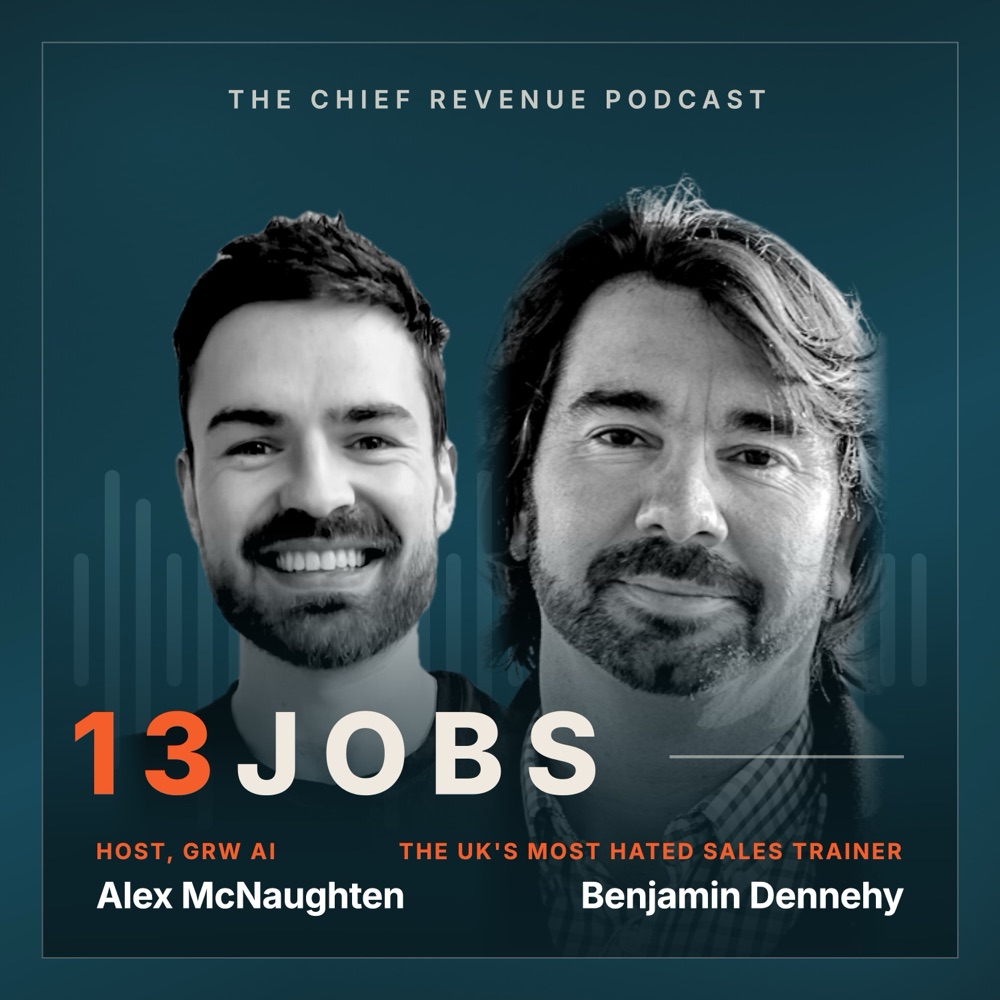
You don't have to like your surgeon
Benjamin gave himself the title of the UK's most hated sales trainer, on purpose. His argument is that being liked has nothing to do with whether anyone buys.
 Hosted by Alex McNaughten
Benjamin Dennehy · The UK's Most Hated Sales Trainer
Benjamin Dennehy trains salespeople under the title he made up for himself, the UK's Most Hated Sales Trainer. He picked it deliberately, on the grounds that nobody else can ever claim it, the same way nobody can follow Muhammad Ali by saying they are the greatest.
He is a New Zealander, qualified as a barrister, and fell into selling like almost everyone else does. He describes what he actually teaches as communication rather than sales.
In this episode, we discuss:
- How he became the UK's most hated sales trainer
- The distinction between a prospect and a customer
- You do not have to like your surgeon
- Why sucking up to people reads as desperation
- There is no loyalty in business
- What someone has to believe before they trust you
- You cannot actually like someone in five seconds
- People buy people is a misquote
- Four personalities, and talking to the one in front of you
- Their voicemail as a window into who they are
- The barrier to entry, and treating it as a profession
- The one thing: study it properly
Quote of the show
“Like is unnecessary in virtually every profession in the world.”
Key takeaways
- Liked and trusted are unrelated. You do not have to like your surgeon, your accountant or your lawyer to trust their work. Selling is the only profession that has convinced itself otherwise.
- Customers are different from prospects. Once someone buys, the relationship matters and over-delivering is the job. Before they buy, trying to be their friend is what makes you look like a salesperson.
- Sucking up is legible. Favours, flattery, working the gatekeeper. Prospects have seen it and it reads as desperation, which is the opposite of the credibility you were going for.
- People buy from people like them. The misquote is people buy people. Two people who share a manner do business easily, which is a fact about similarity, not about charm.
- Match the person, not the script. A managing director wants the point immediately. An accountant wants the detail. Their voicemail greeting tells you which one you are about to meet.
- There is no loyalty in business. Put your prices up thirty percent and find out. That is not cynicism, it is the reason the relationship has to be built on delivery rather than affection.
- Study it like a profession. Nobody becomes a surgeon by hoping. The barrier to entry in sales is a pulse, which is exactly why the people who actually study the psychology of buying pull away.
Transcript
Benjamin, thank you for joining me today. Really appreciate your time. How you doing?
I'm good. Yeah. Yeah. Nice to be in the land of the free and the unlocked.
Don't rub it in. Don't rub it in. We've had a little bit of freedom.
We were at the Christmas fair the weekend and everyone's out and about enjoying themselves and having parties. So yeah, unlike New Zealand.
Thank you for rubbing it in. Hey, look, I appreciate your time and thanks for jumping on today. Before we rip into it, the UK's most hated sales trainer. Tell us a little bit about how you got that title and maybe how you got ended up doing what you're doing today.
Right. Yeah. So everybody asks, how did I become the UK's most hated sales trainer? And the answer is surprisingly dull. And this, I made it up.
Okay.
I made it up, right? You know, so just like McDonald's has got I'm loving it or Nike's just doing it, these are phrases you make up to get attention. But the reason I created it, which is I think might roll on to what we're going to discuss in today's presentation or podcast, I should say, is when I went online to look at what people in my profession were calling themselves.
And what does anyone in sales that's good or thinks they're good at sales call themselves? They're a leader, they're a guru, they're number one, they're top influencer, they're the best, high performer. All these, look at me, love me, like me, I know, awesome. And I thought, well, no one wants to be hated.
Nobody wants to be hated, which means there's an entire space unoccupied. But if I take it, I own it. You can't own the love me space because everyone's competing for the love me space. No one wants to be hated. And it was Muhammad Ali. You know, if you ever say to somebody, I am the greatest, I am the greatest, who would you think of?
People go Muhammad Ali. You go, right, but he wasn't. All he did was kept saying it.
Mm-hmm.
Now no one else can come along as a boxer and say, I am the greatest. No, you aren't. Muhammad Ali was. So that was the strategy. Just create a space that no one can come along and take from you because no one's going to come along and say, no, I'm more hated. Well, I mean, they could, but it'd be bloody stupid, right?
So that was how I came up with it. And it sort of fitted well with my personality because I'm quite a direct, blunt person. I've learned the art of nurturing, which we can maybe get onto. But what it made me realize, it's not made me realize, what I knew is you don't need to be liked to sell anyway.
So to be able to label yourself as the most hated sales trainer in the UK, but also sell successfully to people despite the Trumpian style hat, the long hair, the utter unprofessional way in which I act and behave and be hated and still make money from what I do demonstrates that, yeah, anyone can sell if they know what they're doing and it's got nothing to do with your winning personality.
I think that's— well, I appreciate you sharing that story. It's super interesting and it does, it brings us onto our topic. And I saw a post of yours a little while ago, and this is why I really wanted to talk to you because you put a post up around this misconception that you need to build relationships with people, like, you know, like really build a strong relationship with someone to sell to them.
And I've been saying for a while now that that's bullsh*t. But I think you have been probably one of the most prominent voices in terms of really just getting rid of that whole misconception. So I'd like to unpack that a little bit with you today.
Sure. It's because it's basically, it is a lie. And I make the distinction between someone you've not sold to and someone who's a customer.
Okay.
You need relationships with customers. Let's not lie about that. So when someone buys from you, you have to deliver what you say you're going to deliver. The best thing is to overdeliver so that they're happy. And obviously you want to keep a rela— you now have a relationship because you're actually You've made that commitment to each other.
They've given you money, you're delivering. And in order to keep them happy and in order to keep them buying from you, yes, you need to have a symbiotic relationship that's cordial and pleasant and nice. But you don't need that for someone who you've never sold to. There are thousands, millions of people on this planet I have never sold to.
I don't need a relationship with them to give me money. I'll develop one once they've given me money. So most salespeople use the idea that in order to get in front of someone, in order to sell to them, you need to have a relationship and you don't. Okay, you just need them to trust you.
And I always go back—.
What's the difference? Sorry to cut you off, but what's the difference there? How do you make that distinction?
Do you have to like your lawyer to trust they'll do a good job?
Definitely not. I don't like my lawyer.
Do you have to like your surgeon to trust they'll do a good job?
No.
No. Do you have to like your accountant to trust they'll do a good job?
Definitely not.
In fact, it will go one step further, make it really hard. Do you actually have to like a politician to actually believe they can make a good decision?
No, I don't think so.
So like is unnecessary in virtually every profession in the world. You never meet your surgeon most of the time. You get 5 minutes before the surgery. They come in, they look you over, say, hi, I'm Dr. So-and-so and I'll be doing the operation today. Don't worry, everything will be fine. I've done this a million times.
See you on the other side.
Okay.
And you know, hold up, hold up, hold up. I don't know you. I need to get to know you. I need to have a friendship with you before I let you operate on me. No, you don't. So you don't need to be liked to sell. Salespeople tell them this to justify why people don't buy from them.
Right.
Yeah. And prospects tell you it because if you become— if I try and make you my friend, what do people who try to be friendly with someone do? Maybe you're at school, you want to get in with the cool crowd. What do you do?
You might do a favor for them.
Yeah, you suck up, you do favors. Prospects know this. Salesmen are desperate, needy losers, right? They're just desperate to hang out with the cool kids. So all I say is I just keep sweeping you along and you go, look, look, you couldn't just give me this, you couldn't just tell me this, you couldn't— and so they do that, and you're allowed to do that as a prospect.
So you don't need to be liked to sell. Most people don't like me when they first meet me. I created a character so that people don't have to like him. I still sell. I've had guys say to me, CEOs say, to be honest, Benjamin, I didn't like you when I first met you.
I said, why are you buying from me? Because I actually believe you could help me. There you go. It's got nothing to do with liking me. Yet they will eventually like me. Fine. I'll take that as a bonus.
Right.
But I don't need to be liked to sell. And it's destroying that myth. This is why they spend their time sending emails, sucking up to the gatekeeper. All of this crap is to justify the fact they don't have the guts or the ability to get past the gatekeeper.
Okay. So let's just unpack that a little bit there. And so the distinction you make is that you don't need to be liked to sell to someone. Once you sell to them though, then you should build a relationship with them to ensure that you keep the business, grow the business. And—.
You need to have a relationship. You don't— this is it. There is no loyalty in business. I try and point this out. Yeah. So I don't care how good a client you've got. If you were to phone them up and say, hey, look, We're really struggling. We've been hit hard. We're going to have to increase our prices by 20%.
How many are going to say, don't worry about it. We love you guys. You're the best. I would never, ever, ever, ever consider getting the same service elsewhere. You guys are awesome. I love you. That doesn't happen. Most will scratch your head and go, ah, okay. Oh, you're going to have to let us think about that.
We'll have to— yeah, yeah, I'm not sure we'd be able to continue if you do that. And you'll suddenly see people drop. You may get the odd one hang on, but most would say, I've got to make a business decision, and from business, I can't pay 20% more.
Yeah, it's a good distinction.
And so what they'll do is they'll say, I'm sorry, mate, unless it's family, unless you're selling to your family, your clients are your family, it's your brother-in-law's insurance company, Yeah, you're not going to. You're going to make the decision, I've got to go, I'm sorry, I've got to do what's best for my business, not for yours.
So there is no loyalty. And in fact, the entire capitalist system is based on there being no loyalty. You've got a product, I come along with one I say is better. Customer says, it is, I'm buying that. So this idea, this is, this is stuff salespeople tell themselves because they want to believe that it's them.
Most refuse to acknowledge that they're irrelevant in the sale. Yeah, people buy in spite of salespeople, not because of them.
I've definitely seen that as the case before.
Oh yeah, car dealers, right? Most people that sell cars are bloody annoying. I don't need a guy at a car yard to sell me a car. I can do it with a strategically shaved chimp roller skating around it just pointing at features.
So it raises the question. I think it's a really good point. You don't have to be liked to sell to someone. I agree with you. How then do you build the trust? Ah, okay, that's the magic question, I suppose.
How do you build trust? Yes. So in order for someone to trust you, what do they have to believe?
That you can follow through on what you say.
Yeah. And what else do they need to believe?
That you're saying the truth?
Right. So there's loads of things, but yeah, so they need to believe based on their experience with you that you know what the hell you're talking about and that you know more about them and their problem than they do. That's why you go to a doctor. You don't go to your mate when you're sick who's really good at Googling stuff.
Yeah. And he's great researcher. So you feel sick, you go to your mate, you don't go to him. Why? Well, he's not a doctor. He doesn't have the years of experience. You go to a doctor. I don't know anything about this doctor. I don't know where he went to school. I don't know, like, his past.
All I know is he's a GP in a surgery. Ergo, if he's in there, he must be good at what he does to a certain degree. So I rock in and I sit in front of a stranger, and for 10 minutes I tell him what's wrong with me. And then he asks me questions to figure out using his knowledge and skill set.
And he asks me questions that I'd never thought of before, I'd never considered, or I didn't realize that was important. And as he's doing this, I'm starting to think, all right, well, this guy clearly knows what he's talking about. So trust is getting someone to believe you know more about them and their problem than they do.
And the only way you can do that is by asking your prospect questions that they realize they should know the answer to but don't, or they realize that's a very good question and I've never been asked that before. I was talking to someone else who does what you do and they've never asked me that.
And then you realize, in order for you to be able to ask those questions, you've got to know a lot. And the moment— that's how you build trust. It's by getting a prospect to realize, I know more about you and your problem than you do. That's why you're coming to me. You're not coming to me because you like me.
I could be a complete asshole. It's irrelevant. Can I fix your problem? And do you trust I can do it? The only time I would say being liked ever plays a role is if you've got literally 2 products or services exactly identical on every single front. There's nothing distinctive. The only thing is the salesperson, and they say, ah, kind of like the other guy better.
That would pretty much be the only time it matters, and that rarely happens in the world of business where it's exactly identical.
To play devil's advocate a little bit here, Would— does being liked speed up that whole rapport building and building trust process, do you think? Or can it speed it up? If someone likes you, are they more likely to open up when you start asking them questions?
Well, let's, let's, let's unpack that. You meet someone for the first time. At what point do I start liking you in that first meeting?
It's probably, I would say from reading psychology, within the first 3 seconds someone has a view.
Uh, no, there's a difference. There's, um, not being pissed off or annoyed with you, but I can't like you. How can you— can you honestly say you just like someone within the first 5 seconds, 10 seconds? You can't like them. You can warm to them. You can maybe not be offended, but you can't— I don't know you, so I can't say I like him.
I said, well, He seemed pleasant enough. He seemed all right. I mean, I had nothing against the guy. Do you like him? I don't really— I don't know him. I'm not put off by him would be the most honest answer.
Right.
Yeah. Or I, I— and I know this has happened a lot because you get it, you could be sitting and you've probably done this, you sat in a meeting and you finished it and you said, so what do you think? You go, I think the guy's a bit of a prick. Yeah, I think he is too.
And then someone goes, but he does know his stuff. Yeah.
Well, look, I agree with you because I've been told by a client before, Alex, I, you know, I don't particularly like you, but you deliver. And I've had that experience, you know, it's only happened once, but I've had that experience where it was someone who, from a personality perspective, we were never going to be best friends, but we were able to have a really good business relationship because I was able to deliver on things.
So I agree with you.
Yeah. So this is where it gets interesting because what you get is you'll hear the phrase, you've either said it or you've heard other people say it and people say people buy people. You ever heard that expression?
I've definitely heard that expression. Yes. Yeah.
And that's what salespeople hold on for dear life, people buy people. So most salespeople only remember people that bought from them that seem to be cordial or pleasant with them, right? And the reason is, is that is a misquote. People buy people is a misquote. If people bought people, sales trainers wouldn't exist.
Why the hell do you need sales trainers if people buy people? You don't, right? It's a misquote. It's actually people buy people like them, like them. Now that's where personality comes in. So if you get a big fat loudmouth in a Hawaiian shirt and you stick them in front, of a thin stickweed accountant in a pinstripe suit.
What are the odds they'll do business together?
Well, purely on the surface, probably slim.
Yeah, exactly. They're so unalike that there'll be natural barriers that go on. But the big fat loudmouth meets other big fat loudmouth. What happens? They end up doing business because they're like each other. So people buy from people like them. They don't have to like you, but if you look, sound, and act like them, they're more likely to bond with you because they feel more comfortable around you.
So if you get in front of an accountant who's in a pinstripe suit and he looks like a Poindexter, trust me, you dress to look like them, you start to talk and sound like them, you give them the personality that makes them feel most comfortable with you. But most salespeople use their personal personality all the time, and most are like Tigger, bouncing off the wall, happy-go-lucky.
Hey, how are you today, sir? And what happens is, is they, they meet people like that, and people like that buy from them. And that's why they say, it's all about me, it's my personality, people just like me. Yeah, but what about the 8 in 10 that thought you were a tosser? Are you saying that they couldn't have bought from us?
Sorry.
So why didn't they?
So, and so, so kind of to sum that up, I think, I think what you're saying, correct me if I'm wrong, is that, you know, you need to speak the language of your prospect. You need to speak in the language that they care about. And if you're selling to accountants, then you need to make them feel confident and comfortable that you can speak their lingo, understand their world, um, and not just come in and think, oh, I'm a nice guy, so he's gonna buy off me because I'm nice.
Yes, uh, because Accountants, we all have personalities. There's loads of different personality profile systems and models out there. But one that's really popular is one called DISC. And this is 4 key personalities. Most people know it as the colors. It's the red, the yellow, the blue, and the green, right? And most people fall into, you know, it's not a science, but it's a good map, one would say.
It's not exact though. But if you get in front of a CEO or an MD, the odds are they're what you call a high D. That's a dominant type of personality. These people are fast-paced, short, sharp, and clipped. Come across as unemotional. They're not very detail-oriented. They're blue-sky thinkers and they're risk-takers. And the one thing they hate is losing authority, right?
Contrast that to their finance director. Their finance director will probably be not very loud. They'll be data, facts, and figure-oriented, very specific, isn't very emotional. He's the exact opposite.
Hmm.
So if you get in front of the MD and you talk like an accountant, you're going to bore him. I'm not interested in this detail, mate. Will it work? Can we get to where we need to go? But I'm not interested in all the— you get in front of the FD though, and if all you talk about is a blue sky vision, he's going to be, well, that's all well and good, but I need to see the figures.
I need to see how we get there. So you've got 2 different personalities. But so you can't— the rule is you can't be you on a sales meeting. Whatever your personality type is, it will only match up maybe 20% of the time with your prospects. The rest of the time you're meeting people that aren't like you.
And this is why most salesmen fall into the trap and say, it's my personality. No, you've just sold to people that you've met that are like you and you only remember them. The brain only remembers what it wants to remember.
Yeah, I think it's interesting.
And they don't see that and they don't.
So practically speaking, what should a rep do? You're going into a meeting, you've, you know, you don't know who you're going to meet, right? Let's say you've just cold meeting. If you've set it up, you do, you know, so you do a bit of research, you know a little bit about the person, but first time meeting, how do you approach it?
Well, again, let's roll back. If you're meeting a managing director, you can make a statistical chance he's going to be a dominant character, which means he's going to want you to cut to the chase quickly. He's going to want you to use 30 words instead of 300. He's going to finish your sentences.
Because he's going to get there before you do. So you need to realize, if I get in front of an MD, I'd better know my stuff, keep it brief, keep it simple, keep it clear. Talk about blue sky, talk about what's in it for him because he's very I-centered. He doesn't care about the team or the others.
What's in it for me? So then you style yourself on that. Yeah. I'll give you an idea. I'll help you out here. This is a simple little tip. You can spot a person's personality from their voicemail. So if you phone through to a dominant personality, you'll get something like this. It's Benjamin, leave me a message.
Right.
Straight to the point. No, nothing. Just, it's Benjamin, leave me a message. If you get a high I, which is known as an influencer, most people who go into sales have a high I personality. These are people that love meeting people. They love being the center of attention. What do you think their voice is?
Hi, it's Benjamin. Sorry, I can't take your call. Leave me a message, I promise I'll get back to you, have a nice day.
Mm-hmm.
What do they sound like? Then you've got what you call a steady relator. These are people that become teachers and nurses, they go into HR, they're always interested in other people and helping others, and they're always drawn to those. Their voice message will say, I'm unavailable to take your call right now, but if you do leave me a message, I will get back to you as soon as I can.
Very convivial, non-confrontational. And then you get to the high C, the accountant, the engineer, the solicitor, the detailed person, you get through and they haven't even bothered to change the automatic setting. It's mailbox 62 is full.
Yeah.
And so you actually spot this when you ask. So I always ask, can I go through their voicemail? Because their voicemail gives me a window into them as a person, right? If I'm going to meet a high D, I'm going to act like a high D. And most of my life, fortunately, is meeting high Ds and I'm a high D myself.
So I get on with high Ds, but you stick me in front of a C, it's bad because I'm not a details guy. They want to know all the facts and figures, you know, who have you worked with, what's the return on investment been like, and what's— what could measure, measure, measure, measure.
So I don't know this crap. I don't care for it, right? All I know is that they love the stuff and they say it works. That's enough for me.
So what are you doing there? So how do you do— what do you do in that situation then?
Well, again, this is the other thing. If you're a company and you're developing your prospecting list and you're figuring out who to target, one of the key things would be to identify the personalities of your salespeople and give them prospects that match their personality. So I know that CEOs and MDs buy my stuff, so I only target CEOs and MDs.
I can work with accountants or lawyers, but I choose not to. Too much work, too much effort, too much challenge for me to behave like them, so why sell to them? But you'll have people on your sales team, you're going to have a high I, you're going to have a high D, you're going to have a high C.
You go, hey you, the real geeky Poindexter sales guy, you should be the one phoning the FDs and the accountants because you're going to get on with them better. You know, the happy clappy guy, you should be phoning the sales directors. The, the person that cares about others, you should be phoning the HR directors.
Yeah, and the tough, unemotional, sort of gittish guy that people think is a bit of a wanker, you should be phoning the MDs. So you can structure your prospecting based on personality. A good salesman though learns how to mirror and how to adapt. But to make life easy for yourself, and the only reason anyone goes into sales is because they think they're going to have an easy life, right?
I don't think they've thought hard enough about it, but perhaps, yeah.
Nobody's in sales because this is what they wanted to be when they grew up. They're here out of default. This is the Last stop before unemployment. Yeah.
How did you get into sales?
I fell into it. I didn't want to be in sales.
What were you doing before?
I was meant to be a lawyer. I qualified as a barrister.
Okay.
Yeah. No, no, no. No one told lawyers they have to sell either. They're the most interesting people to meet at networking events. It's like, why the hell is a lawyer at a 7 AM breakfast meeting event? So why are you here? Oh, well, you know, it's just about getting out there and meeting people.
Yeah, but you're wasting your time. You've got no personality for this. You can't sell.
You hate the idea.
You never admit you sell. What are you doing here? Yeah.
So you fell into sales and I think that's super common. I'd say about 70% to 80% of people do.
I'd say 85% to 90% of people fall into sales. The other 10% want to be entrepreneurs and no one told an entrepreneur that you're actually a salesman.
So you fell into it and you've obviously built a great career in sales and now teaching others how to sell. What would you say to someone who's just starting out in sales or thinking about sales as a career?
Most people don't see sales as a career.
That's the problem.
So look at any lawyer or any surgeon or any accountant. How did they become that? Well, they went and studied for years at university. Salespeople don't do that. What do they do? The the the the barrier to entry for being a a salesperson is: Can you wear a suit and do you not dribble during the interview?
If you pass those two, you're qualified to enter the world of sales. And if you've got a nice personality, that's just an added bonus on top. Right? And then all they do is they pump your head with product knowledge. This is what we do. This is how we do it. Da da da da da.
Fill your head with this. Now go out and convince people they need it. That's it. You're in. You're a sales professional now. Whereas most lawyers, doctors, surgeons, accountants, or anyone that's really successful, even athletes, they spend years training, training, training, training, learning their craft. Salespeople don't do that because everyone said, well, there's no real skill to selling.
It's just the art of the gab. You know, if you've got a good product, it'll— if you've got a good product, it will sell itself. You're not in sales. You're an order taker. McDonald's doesn't sell anything, does it?
No.
No. You go into a McDonald's and you tap someone on the shoulder and say, what are you doing? They're not going to say, just browsing. They're in there to place an order. You go up to the counter, may I take your order? So, you know, order taking is different from selling. That's customer service.
So most people go into sales with the belief that it's going to be quite straightforward and easy and fall into it. Because, well, they go, I'm personable, I can string a sentence together, it can't be that hard. And what happens is they get in it and a lot gets stuck, because after doing it for 3 years, they suddenly realize, I've got no transferable skills.
What do I do now? Unless I go and retrain, and that's it. You've got to actually become a physiotherapist. You can't just go from sales, but you've got to retrain. How did you retrain to become a salesman? Oh, I didn't. I just turned up and didn't dribble.
So what's your advice? So what's your advice to the salesperson who's like serious and they want to do it?
Study the art of selling, actually invest in trying to figure out how does it work. There's human beings, figure out the psychology of how people buy. It's not that hard. It's all out there. You've just got to do it. Don't hope your employer is going to educate you. They're not. Most employers don't.
And it's not their job. We're not communists. It's your responsibility to educate yourself. So if you're starting out in sales, the first thing I did was I asked if I could sit next to the best salesperson. That was the first thing I did because I want to listen and hear what this guy's doing.
And then I started to research and study it. And I met a sales trainer who taught me a lot of psychology. And that's where I realized it's all about psychology. And then I realized selling isn't selling. All selling is is the art of communication. So you don't actually have to learn sales skills, you've got to learn communication skills.
And when you realize that, you realize, I'm crap at communicating. And once you realize you're crap at communicating, then you figure out, well, how do I get better at communicating? What do I have to do? What do I have to change? So don't read books on selling, read books on how to change how you communicate.
Things like Just Listen by a psychiatrist called Mark Goldston. How to Run Your Own Life, a book written by Jock Munger. Stuff that changes you internally.
Right.
Yeah. Sales books are pointless because they're like diet books. Everyone knows how to lose weight. Put the fork down and hit the treadmill, fatty. How is it that there's a billion-dollar industry telling people that? Because no one changes what's going on in between their ears. It doesn't matter how good the diet plan is.
If inside your head you're always telling yourself you're going to be fat or you can't do this or you need— you're never going to change. So all the technique in the world is useless unless you figure out why you're broken internally.
Right. I think that's quite good advice actually. It's— you're right. Most people jump into sales. They don't think about it. They haven't really thought— certainly when I jumped into sales, I hadn't thought about it and I just was blessed that I had people who taught me along the way very quickly into my journey.
But most— not everyone gets that. And it's through the focused improvement on learning people and learning how to ask questions and learning how to listen even and actually figuring out some of the basic stuff. Like, I actually like how you framed it. It's just personal. It's communication skills ultimately. Getting good at that will significantly put you ahead of Everyone else in sales because they won't all be doing that.
And if you're doing that, you'll be better than them in a bit of time.
I'm not a salesperson. All I do is teach people how to communicate. The art of selling is getting a prospect to feel comfortable. That's the first thing. So they don't have to like me to feel comfortable with me. Yeah, but I can make someone comfortable. How do you make someone comfortable with you?
It's in how you act and behave and sound when you're talking to them. And most salespeople don't realize that they ask questions that come across as rude, petulant, or abrasive, or they make people feel like they're being cross-examined. The moment you make a prospect feel uncomfortable, they will clam up. I'm very good at making people feel comfortable despite creating a character that comes across as a complete wanker.
In reality, people always say, you're so much nicer than I was expecting. And that's all part of the plan. And because I can make— and the art of a good salesman is making a prospect comfortable, because if they're comfortable, they'll open up and tell me the truth. Because I know that a prospect's gonna lie to me from the moment they meet me because they don't trust me.
It's not because they don't like me. They may say, I like Benjamin, I think he's a really nice guy, but I don't think he has a f*cking clue what he's talking about.
Yeah, it's how you ask the questions, right? That's what I always say.
How do you do it? How do you ask a question which you know could upset someone, but you've got to ask it, but you don't want to upset them? How do you do that? Well, you learn how to do that. So we just blurt it out.
What do you think of— what do you think of this kind of mindset? Like, something I've taught and I try and embody is ask a question confidently, believing that it's going to get an answer and an honest answer. And don't— because one of the things— so I'll use an example: budget. People often are uncomfortable asking what the budget is.
They're uncomfortable talking about money. And what I found is if you just ask the question thinking, and in a way genuinely believing it's the most normal, natural thing to do in the world, then people will typically give you a good answer. Whereas if you believe that it's a strange, uncomfortable question, that comes across in your voice and then people don't answer you in the right way.
So yeah, I agree with you, how you ask the question and you are, the more nonchalant you can be about money, the better. You have to act as if talking about money— but that's why we should go one step earlier. So the real question is, how can you possibly be in sales and think talking about money's bad?
How did you get here?
Yes.
I mean, it's like going to a surgeon who says, I don't like blood. So how the f*ck did you get through 7 years of medical school?
I agree with you.
And it's— and so, so that's the bigger problem. So you got to go to them. Hold up, hold up. Why do you not like talking about money? And then it goes back to their scripting because your mom and dad didn't let you talk about money. Mom and dad said money, only rich people have money and rich people have to stand on little people to get money.
And if you talk about money, it's rude. God forbid you ever ask somebody what they earn. Don't ask somebody what they earn because what they earn is the sum total of their entire human value.
Right. So you're actually saying you got to kind of unpick unpack, sorry, all the things that are the beliefs that you've got that might actually be limiting you in your job.
Yes. Why are you scared talking about money? Why? Why? Uh, well, because it's just not polite. Who told you that? Where did you get that? You thought that was mum. So why the hell are you at 36 taking your mum to work?
Yeah, yeah, yeah. Exactly.
Like I said, it's all up here. So Don't read sales books. They ain't gonna fix what's wrong in here. Read books on why you're f*cked up.
I think that's actually quite good advice. I like it.
It is the best advice. It's good advice. Once you unf*ck yourself, you'll be able to sell.
It's controversial advice and it's probably not something that most sales trainers I've heard put in that way. But I think it's good. And I think, you know, I've In terms of the success I've had in my career. And I think a lot of that has come down to internal beliefs as to being able to do something or feeling comfortable doing things.
And if you don't have them, it's actually then getting used to being uncomfortable in those situations, throwing yourself out there, getting— and then over time you get more comfortable with it.
Yeah.
Well, actually, you get braver is probably a better way of thinking about it.
You, you want to have Arnold Schwarzenegger's body in his heyday. In order to get Arnold Schwarzenegger's body in his heyday, what do you have to do? You first of all have to get into a routine and habit of going to the gym and eating right. So you've fundamentally got to change how you think and act about food and think and act about your lifestyle.
You've then got to go through all that pain because it hurts to look like that.
Hmm.
Hurts. Yeah, you don't just will yourself. You don't victimize. It's not fair. Why don't I look like You keep doing that enough and people patting on your back, you'll look like it. No, no, no, no, no, no, no, no, no, no, no. You got to get up every morning, you got to go to the gym, you got to follow your routine, you got to follow your diet, you got to push through the pain.
And when it hurts, you got to keep pushing through and you do it, you got to do it. Eventually you'll get there. And then once you get there, you've got to keep doing it to maintain it, because if you don't maintain it, it's just going to turn to fat. There is no easy ride here.
Salespeople don't want that. They're expecting— they just want to get a few good deals over the line and Hey, luck. It's motivated by luck. You can't replicate luck. You can replicate habit.
So it's like any skill in life. It takes repeated effort and discipline if you want to be good at it.
Yeah. The reason I'm good at what I do is if people followed me around, they'd realize how boring my life is because nothing changes. Every single meeting follows exactly the same structure, never changes. And I know what's happening. The prospect does it. To them, this is all new. To me, I know if I say this, they're going to say one of 4 things.
And then if they say one of 4 things, if I pick whichever one they pick, I give— I've got one or 2 answers to that. Then they're going to say one. It's like an entire mind map. It's like the whole—. We work and operate— we operate in a finite universe in the world of sales.
There is only so much a prospect can say or do. I've mapped it all out, so I'm literally just walking through it every day. It doesn't matter what they say or do, I know There's no surprises, just like a surgeon doesn't open up the body and go, oh my God, what the hell is this?
Hmm.
He knows every organ, every vein, he knows where it is, where it goes, he knows what it does, he knows that if he accidentally nicks this, he's got to do this. He's not bumbling through and, you know, well, it's my winning personality that gets me through these operations, yeah, the staff in the operating theater love me, I've got good patter.
You know, and you know, no, it's all because they know exactly what they're doing step by step, blow by blow, backwards, sideways, forwards. Ask the average salesman, why do people buy from you? Uh, uh, well, we got a really good product and, uh, uh, it was the right timing.
Um, you've left me a little bit at a loss of words sometimes, uh, Benjamin, but I, I, I love how direct you are with everything. You call— you say it how it is, and I haven't disagreed with anything you've said yet. So I just want to— I'm going to ask you one question.
It's something we ask everyone, and I want to ask you this one question.
Go for it.
You had it all over to do again, right? You're just getting into sales. It's your first day. What do you wish you— what do you wish, one thing, like what was like the one thing that you would do differently or you wish you'd known right at the start?
Oh, that— there are loads of things, but if I had to pick one, just one, the most important one would be this, and it's intertwined into 2 things. I'll mix it together. Understanding some very fundamental principles. And the first principle with this: you can't lose something you never had. Okay, salespeople constantly talk about how they lost a deal.
If anyone—.
If any of my clients say we lost a deal, my first question is, tell me when you had it. So you've lost nothing. So that's a terrible mindset. Salespeople constantly think they're losers when they're not. How can you be a loser? You never had anything to lose. So that's that. If I'd known that, life would have been easier.
And that's tied into the second point and they're interrelated. No attachment to the outcome.
Right. Yeah.
Salespeople, when you get into it, got to get a meeting, got to get an appointment, got to get a lead. I've got to get a sale, got to get a deal. You're attached to the outcome of what you're doing. And what I realized very early on— well, not very early, late in the process— what I discovered is true professionals don't care about outcomes because outcomes are the byproduct of doing something well.
If you get good on how you get to where you're going, the outcomes start to become predictable and consistent. It may not be the answer you want, but it'll probably be the right answer. And that's why I use surgeons and lawyers. They're not interested in what's going to happen on cut 62 when they're on cut 1.
They're not interested in what the jury's going to do in 2 weeks when they're sent out. What are they focused on? In the moment. They're focused on every cut. They're focused on every question. They're focused on doing right now. If I do everything competently right now, whatever happens at the end, even if I don't like it, probably right.
So actually focus on how you get somewhere, not whether or not you get there.
Brilliant advice.
Habit and behavior. So the two are interlinked. You can't lose something you never had and only worry about how you get to getting it rather than whether or not you get it.
Don't be tied to the outcome. Yeah. Brilliant advice.
And it's the Buddhists who came up with that. And I'll give this to you if anyone out there watching this is Buddhist. The Buddhist mantra is What is, what, what, what is the root of all misery? The root of all misery is attachment. If anything is making you miserable, it's because you're holding on to something.
I hate my job. Quit. No, but I need the money. Then shut up. My boyfriend doesn't love me. Then leave him. But I love him. Then shut up. Yeah, you let go of whatever's making you miserable and the misery goes with it. No attachment to the outcome.
I love that. We've covered, we bounced around and we've covered some cool stuff and I've really enjoyed this chat. It's been absolutely brilliant. We started with just one question. I feel like we've covered about 10 different topics in 30 minutes, which is fantastic.
Well, hopefully there's some salespeople crying into a sock right now. And I have succeeded.
Where can people find you if they want to connect with you? If they want to interact with more of your content, where can people find you?
LinkedIn. LinkedIn. Find me, just put a medium, or if you just type in uksmosthatedsalestrainer.com. I mean, it's easy, right? Everything's UK's Most Hated Sales Trainer. But LinkedIn is where you'll find me. Also, I've got a YouTube channel where I upload videos of me making calls and doing the stuff. So I'm not an academic teacher.
I don't teach theory. Everything I teach, I do, and everything I do, I teach. I think one of the greatest issues with a lot of sales trainers is they can't do half the stuff they pontificate about. And that's why people are quite drawn to what I do, is because it doesn't matter what your business is.
I could be in there for half a day and I can be on the phones in the afternoon selling it in. So how do you do that? Because selling doesn't change. It doesn't matter what your product or service is. Human beings buy the same way. Once you understand that, it doesn't matter what you sell.
And every company I've met says, we're niche, we're special, we're different. Turns out they're not.
It's just people at the end of the day.
It's just people at the end of the day and it's communication skill and learn to communicate. That's it.
Thank you so much for your time. This has been a really, really good conversation. There was some gold in there for those listening. Thanks again, and let's do this again sometime. I'd love to chat again.
No worries. It's, uh, it's been a pleasure, Alex. Thank you.
See you soon.