
Your competitor is picking up the phone
Rana teaches people who never chose sales how to sell. Her five steps start before the call, with what you believe about the thing you are selling.
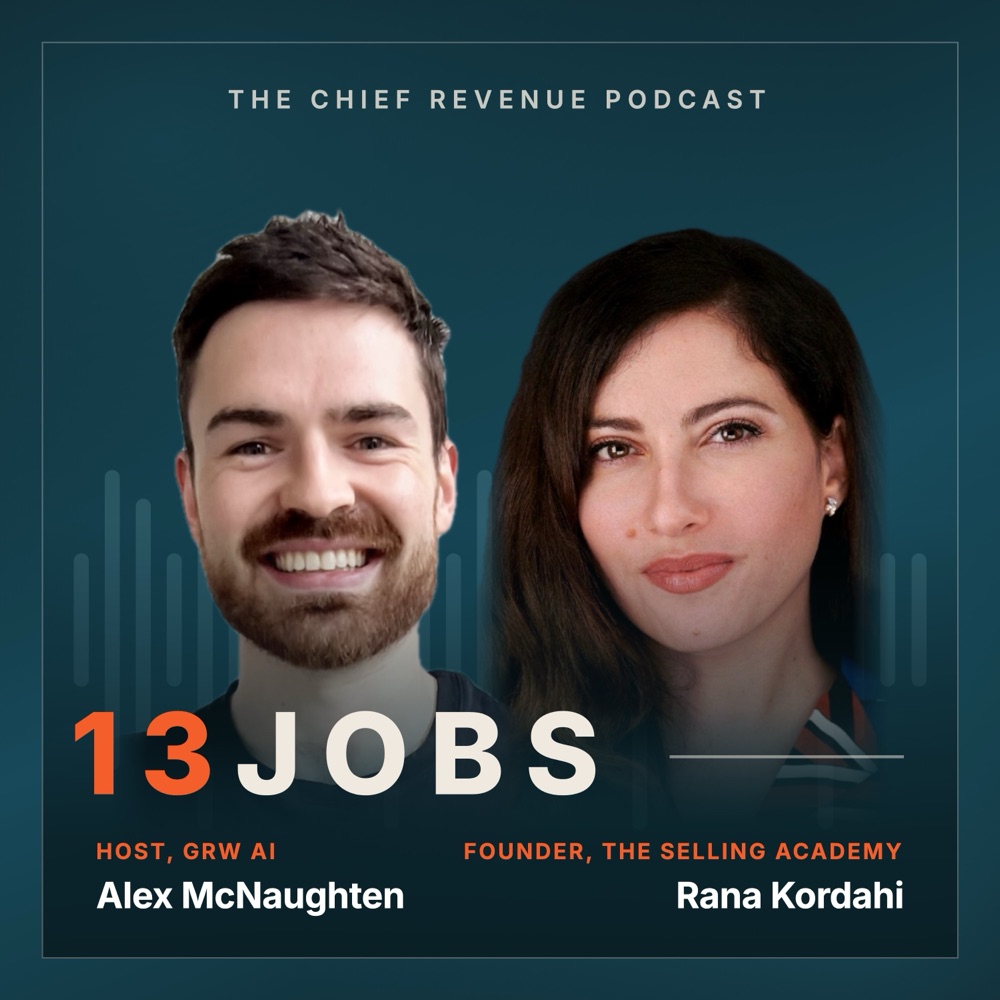
 Hosted by Alex McNaughten
Rana Kordahi · Founder, The Selling Academy
Rana Kordahi is the founder of The Selling Academy, which trains and coaches sales teams, and she specialises in teaching people who do not think of themselves as salespeople. She has around twenty years in sales and is a qualified NLP practitioner.
Much of that came from employment services, coaching consultants who were half recruiter and half counsellor to get on the phone and place job seekers, including people with disabilities, into work.
In this episode, we discuss:
- Twenty years, and falling into work with non-salespeople
- Teaching counsellors to sell people into work
- The first-impression mistakes
- A cold call is not a one-time event
- Introduce yourself, and what the call data shows
- Step two: the hook
- Three questions, not an interrogation
- Situational questions instead of intrusive ones
- Step four: a pitch built out of their own answers
- Objections, without trying to change anyone's mind
- Confidence beats technique
- Every minute you are not calling
Quote of the show
“If you're not picking up the phone, your competitor is picking up the phone.”
Key takeaways
- Say who you are first. Nervous callers skip straight to the hook and the person on the other end has no idea who is speaking or why. That alone breaks the rapport before the call has started.
- Three questions, no more. Enough to understand the situation, not so many that it feels like an interrogation from a stranger. The call is selling the next conversation, not the product.
- Situational, not intrusive. Tell me your biggest challenges is a question you would not answer from someone you have never met. How are you doing this at the moment is.
- The pitch is written on the call. Not the one prepared in advance. It is assembled from what they just told you, which is the only reason it is worth hearing.
- Ask why, even after a no. May I ask what would make you interested, just for my own feedback. Worst case you learn something; the alternative is hanging up with nothing.
- Confidence outperforms technique. Someone with the right attitude and no method beats someone with the method and no belief. That is why the mindset work comes first.
- Believe in the thing. If you cannot identify the impact of what you are selling, find something whose impact you can. The call is audibly different either way.
Transcript
Rana, good to have you on. How you doing?
I'm good, thanks, Alex. How are you?
I'm very, very well, thank you. So, Rana, you're the founder of the Selling Academy and you teach non-salespeople how to sell. So, people who don't have a sales background how to sell.
Exactly.
How did you get into that?
So, I've worked in sales for about 20 years and I also fell into roles working with non-salespeople.
Okay.
And the— some of, for example, I worked in an industry called employment services, if you've heard of it.
Yep.
And a lot of the employment consultants, they worked as recruiters, but they were also a little bit like counselors. And part of their job was to get on the phone and help sell their job seekers into work, specifically those with disabilities. And a lot of them had a lot of nerves. So they were really nervous.
So they've never had sales training. Also, I worked in consulting at like places like KPMG and PwC. And I also saw a lot of people that were tech savvy or engineers fall into roles where they became, you know, directors, managers, and partners. And they had to suddenly go out there and network and be able to save huge tenders or like close big deals.
And a lot of times, they also have the trouble with communication because they depended more on their credibility, but they didn't have the people skills or that intimacy to be able to move the deal further or save some of the engagements as well.
Where do you think— what are the biggest mistakes people make in terms of, you know, making good first impressions, whether it's in person or, you know, in a cold call?
I think it's possibly talking a lot about themselves, not really understanding the person, not putting themselves in the person's shoes, and just preaching or pitching too much. So coming across as too salesy because some of the best salespeople I've seen were the ones that didn't talk a lot. And if somebody didn't understand the art of sales and they were watching those people, they would think that they didn't do a good job because they didn't talk.
Or they didn't have that gift of the gab.
Yeah.
So the mistake is thinking that you need the gift of the gab to be able to push a sale through where it's really the other way around as well.
Right. So you're saying it's far more important to ask questions and listen to make a good first impression and make it about the person you're talking to rather than being there just talking and pitching?
Absolutely. I mean, yeah, absolutely. On a phone call, obviously, you need your little hook to hook them in. Because if you come across like, if I call you up and I'd go straight into asking questions, you're not going to— you're like, who are you? Why should I care? What's in it for me?
So on a call, it's important to have something that's compelling to them, but transition as fast as possible into asking questions. So the shorter your hook is, the shorter your intro is, the better for you. But in a face-to-face, of course, introduce yourself. You know, say something about yourself, that's fine. But always turn it back to that person and take a genuine interest in them.
Mm-hmm. Absolutely. And look, today we're going to talk a little bit about kind of cold calling and basically getting people into your sales funnel. So that kind of top of funnel outbound prospecting side of things. I guess the first question, because I think a lot of people think cold calling is dead. That's what I hear a lot from people who don't have a great understanding of sales.
You know, what do you say to people out there saying cold calling doesn't work anymore?
So for those people, they come at cold calling from a very, I don't wanna say wrong perspective, but from a perspective. So for example, they come into it as if it's a one-time event. Now, as you know, in B2B, a cold call is not a one-time event and it's one of the touchpoints.
So if I'm making a cold call to a business and I think that I'm going to close that deal on that first call, most of the time, you're not going to be able to because there's many decision makers. It's complex. So of course, it's not going to work the first time. You use that as part of your creating awareness strategy, part of your building awareness strategy, and part of your gathering information strategy.
And of course, then you need to try and sell the appointment on the phone. But sometimes, you might not be able to sell that appointment on the first call. You might be able to sell the appointment after several calls or doing many different touchpoints until that specific company or business knows, likes, and trusts you.
So as we know, it takes many touchpoints. However, if you have something compelling, you do your research, you know a little bit about them, you come, you approach it as if you're the expert in their industry, then you have a high probability of at least having them talk to you on the phone.
And then another higher probability of you getting that meeting with that person. As well.
So how do you do a cold call? How do you open it up?
How do you—.
Yeah, like there's a lot of cool— I see a lot of cool hesitancy, right?
Yeah.
And I ask people, you know, why are you hesitant about making the call? They say, I don't know what to say. They're unsure about how to open it up. They're unsure about how to guide the conversation to get the outcome they want. So what do you do?
Okay. So obviously, it depends who you're calling and there's no one script for one size fits all.
Sure.
So for example, if I'm, say I'm a recruiter and I'm calling. So for example, I just did a webinar yesterday and I was delivering to employment service providers. And I was teaching them how to get people with disabilities into work. And I taught them how to make the cold call. So number one, you introduce yourself.
Now the intro, we can argue and debate all we want about what is the first line we say. You could be like, is this a good time to talk? Or how are you? Or did I catch you at a bad time? Or whatever it is, right? We can debate. However, studies show that if you say the, you know, that pattern interrupt.
Yep.
Have you been? Hi, this is Rana from employment services. Hi, Rana. Hi, this is Rana Khudahi from employment services. Have you been, John? It scrambles their brain. And studies show on Gong.com, it showed that you have 6 times, you're 6 more times likely to keep that person on the phone a little bit longer than doing the old, is this a good time to talk?
However, it's debatable, right? Some people don't want you to— some people want you to ask them, is this a good time to talk? And some other people might— it might work better, how have you been? So that's the intro.
Cool.
You have to introduce yourself and where you're from.
Okay.
Okay. So a lot of people, they might just go straight into their hook without even introducing. Hey, this is Rana from whatever. How are you? They might just go because they're nervous. So that's step number 1. Step number 2 is you give them the— some people don't like the term hook. Like I know John Smybert, he's like, when I said the hook, he's like, no, no, no, no.
It's just true, you know. But it's whatever you want to call it. What is compelling and why are you going to help this person? What is so compelling that they should talk to you, right? So for example, say you were a recruiter helping people with disabilities. I've done my research and there's something in it for them.
For example, you know, hey, John. I might be talking to an HR manager. This is Rana from Disability Employment Services. How have you been? They might say good. Or they might say, who is this? And I'm like, okay, great. Look, the reason for my call, John, is I recently read that your CEO John Smith's letter to shareholders.
And one of your strategies was increasing your diversity inclusion by 3%. And as disability employment specialists, we do this helping businesses like yours. And that's all I say.
Right.
Okay. It's not a pitch. It's not telling them how great or how you're going to save their life. It's just giving them what is compelling about your products or service and why should they listen to you. So that's step number 2. However, in this, the hook, studies also show, and whatever I'm telling you, Alex, I know you know this because I've seen your work and you teach this stuff too.
But like this is for to get maybe a different perspective or—.
100%.
Yeah.
Cold calling is one of those areas that's hotly debated. Everyone has different views. So I'm always fascinated to hear about what's working for different people.
What's working for them. Yeah. Yeah. So I mean, and some 2 different people can say the same thing and one could work for one person and one might not work, right? And it depends who you're talking to. However, research also shows that if you start your hook with the reason for my call, you're also going to increase your chances of speaking to them because people need a reason for why you're calling.
Yeah.
So they need to have a— like I've had someone call me and several people and they just went straight into their hook without introducing themselves, without telling me the reason.
Yeah.
And I was like, who are you? I don't know why you're calling me. Like, and that kind of broke rapport. Now, in step number 2, which is your hook, it's important to go straight into your qualify or your asking questions. Step number 3. The faster you can go from hook to asking questions, the better.
Because as we know, people are more likely to want to Engage in the conversation if it's about them, and you're more likely to build rapport with these people if we get them talking. So it's not about you giving them the most amazing pitch. It's about you asking quality questions in order for them to engage with you and in order to find out, do they have this need?
Number one, do they have a pain point? Do they have a problem? Is what you have to offer relevant to them? Maybe yes, maybe no. You know, that's okay. They might say no or they might say yes. So on the qualify, I might be like, okay, John, look, how do you guys usually do your recruitment?
Or how do you usually fill those diversity inclusion quotas? And when it comes to hiring, what do you— what's your top 3 attributes that you look for? And on this qualify, you ask 3 questions maximum.
Right.
You might even ask, yeah, because what makes 3 the magic number? Because, okay, it could be 2, it could be 1, but if you're asking too many questions with somebody that doesn't know you, you're going to come across as interrogating.
Right.
And also a call is meant to be you're trying to sell the next meeting or you're trying to sell whatever information you want to send them.
Right.
If we— unless obviously, look, there's no hard rule. Like I've had cold calls where they were so open and They're open to what I have. And we ended up having that discovery meeting on that call, right?
Yeah.
But most of the time, you're going to come across people that they don't have a lot of time. They don't know who you are. So they're not going to be wanting to engage with you for a long time. So try not to ask too many questions. And even if you ask one question and they start talking and talking and talking, that's okay.
Like it's not like you have to ask 3 questions and that's it. I've coached those reps and I've done calls where I just asked one question and that person told me everything. It was like as if I asked them 10 questions.
Yeah.
They couldn't stop talking. So it's just a matter of listening to them and letting them express their problems, their pain points, their gaps, their needs. Also, it's important on that cold call not to ask intrusive questions.
Sure.
So if you go straight into, tell me your biggest challenges, To be honest, I used to teach this until somebody asked this to me because this is what I was taught. And I'm like, I'm gonna tell you the biggest challenges in my business? I don't know who you are.
Yeah, exactly.
Like, that's private, right? So try and get— try and ask situational questions. So tell me, how are you currently doing these things? How have you done things? So just more. And then you can start maybe on the 3rd question. If they're very open, you might ask, okay, how are you finding it? What are some of your challenges?
Yeah.
So I think you've raised a few really important things there just to kind of summarize. So introduce yourself firstly. I think you're right. So many people forget to do that and then they jump straight into their call and then it's like, wait, hold on, who are you? So super important, like introduce yourself.
Absolutely. I think then the second thing is that hook. I know John Smybert doesn't like the term hook.
Yeah. So you know that too.
Yeah. We can disagree on that, John, but You know, you've got to have your catchy statement that's going to grab someone's interest because otherwise, it's like, what's this call all about? And I think that's the importance of, you know, call it an elevator pitch, call it a reason for the call. If you've done a bit of homework on the kind of persona or type of customer you're trying to reach out to, you should be able to craft something relatively compelling there.
Yeah.
And then transition into questions. What about, do you get, do you, you know, what about the kind of more mindset and tonality of voice side of things? How important do you think those 2 are from a cold calling perspective?
So before I teach people how to make the cold call, I teach them about the confident part and the physiology part as well.
Okay.
So I'll tell you about that just when I finish the 2 other steps. So just people, if they were like, what's it? Because there's 5 steps to this.
Okay, cool.
We'll go into that. So the next step is your pitch. Whatever pitch that's right. So the pitch is not what you've already written beforehand. It's what— it's about the conversation you've had on step 3, the qualifying questions. And what they said to you is important to them. What are their problems and how do you solve that, right?
So it can— and then step number 5 is the next step. So how do you close there? Next step is minimum, you either give them— get an email address to send them more information if they're not interested, or set an appointment to go out and see them, or call them back at a better time in case they're like, look, I want to know more, but I don't have time for a meeting.
And try— studies also show setting 20 to 30-minute appointments work a lot better than setting hour meetings. Like, more people are more likely to accept your 30-minute 20 to 30-minute meetings. Most of the time, even 20-minute meetings go to 30 minutes or sometimes if it's going well, 40 minutes, right?
Yeah.
But it depends. Like sometimes if they're really interested and they're keen and they're like, yes, then set an hour meeting. If someone's a little bit hesitant, try get a 20-minute meeting and then, you know, then go from there. So those are the 5 steps. Introduce who you are, why you're calling, give them something compelling, your hook, Step number 3, get them engaged, ask questions.
Step number 4, give them the solution to the problem. Step number 5, have a next step like closing with through either selling an appointment or sending out more information.
That's cool. Yeah. I think step 4 is a good one because it has to be relevant to what they've just told you. So you actually have to be listening. I think some people get caught up in trying to remember what they're going to say and they forget to actually engage and listen into the conversation they're having right then and there.
Because the person on the other end is actually going to tell you what they care about and then you can articulate the value back to them in a way that's going to actually resonate with them. So I think that's super important. And I like what you— and it's interesting, the study you've mentioned, the facts that you've talked about, shorter meetings better than longer.
Absolutely. A quick 20 minutes always turns into 30, but it sounds better and it's more likely someone's going to buy into it than if you say, I want to come in and do an hour-long workshop with you.
Yeah. Oh yeah, I mean, their time is valuable too. Absolutely.
Yeah. Okay. That's simple. And that's pretty aligned to, I think, what I've taught people over the years as well. Very similar.
Oh, that's good. Good to know. I was like, okay, imagine he's teaching something different. I'm like giving some— No, I mean, we always learn as well. We always learn from different— I've spoken to people that have a very different approach as well. I'm like, okay, that's great. That could work for some people.
Yeah. Mine's very similar to yours. Quite simple, question-based, and just try and get a next step. And I think people often forget to get the next steps. But there's a few, there's a few then challenges sometimes people give you is, okay, what about if I get with someone who's objecting? What about if I get an objection?
What about if I get someone who, you know, says, oh, I'm not interested in that? And you feel like the call's over? How do you handle those?
So, I mean, then you go into an overcoming objections framework, which is another framework, but I'm not going to go into like the whole framework now. The overcoming objections framework is about not you changing someone's mind, but getting really curious, understanding why do they have this objection? What are their values? What are their perceptions?
And coming from a place of, okay, asking them, can I ask, What did you say the objection was?
Anything, you know, any reason. I didn't give any specific example.
Okay. So I'm not interested. May I ask? Okay. Just for my own feedback, may I ask what would make you interested or why are you not interested? Don't be afraid to ask that question because you want to get feedback. And that's okay. You're not— many times in objections, you can't really a lot of times turn someone's no into a yes, but you can walk away building more rapport and giving them another solution which suits them.
And they might say yes. However, if you don't listen to what is this objection and get really curious, you're not going to be able to turn that objection around as well.
No, no, exactly. Don't just give up there. At least find out some more information.
Yeah.
At worst, you might get some more information if you do get a bit curious. I like that. So back to my other question around the kind of mindset side of things.
Yeah.
You know, you mentioned mindset and physiology. You teach that before you teach someone like how to actually make the call.
Oh yeah, that's more important than making— like if you had the right attitude and the right amount of confidence and you don't know much about how to make a cold call, you would have better success than someone that knows how to make a cold call but does not have the confidence. So that is number 1.
And I mean, there's a few things I teach before I get people to go out, whether it's door knocking or on the phone. Number 1, it's important to identify the impact that you're making, how you're changing this person's life, and get really clear on why it's important for them to have whatever you're selling.
And if you don't believe in what you're selling, then don't bother selling it.
Right.
I know it's hard. Some people have a job and they, you know, they need But then try to find some other product that aligns with your values. So believe in what you're selling. Identify the impact. And not everyone's impact is the same as yours. Some people, you know, everyone has their own values.
Not everyone values what you value. I don't value first-class $10,000 flights, but someone else might. So if I came to sell a $10,000 flight, I need to identify the impact I'm making for their flight. Maybe this person has anxiety. And a 10-hour flight can cause them a panic attack, right? So maybe I don't have anxiety.
I can sit in economy. Or maybe this person likes to because they grew up poor and they like to feel like they finally made it in the world and that was their dream. So identify their impact, not your impact. Number 2, expect rejection. You're gonna get 90-something percent of people going to say no to you.
That's okay. Expect it and accept it. Number 3, change the story. So what is the story you're telling yourself before you get on the phone? Is it, oh, I'm wasting their time or they're going to say no or our products suck? Change our story and write counterarguments why this story is not true.
Number 4, change your physiology. So use your body. How would someone that's confident sit? How would they smile? How would they walk? Make sure you're breathing. Maybe do a little dance before you get on the phone. Smile and dial, as they say. And number 5, develop mastery. You're not going to get really good until you do these sales courses, you read the sales books, and you repeat all that information.
And you repeat it through your experience and through your failures as well. So that's my 5 little tips before getting on the phone as well. And yeah, there's, you know, speak slowly, don't rush your words, watch out for too many filler words. So if you're saying a lot of um, uh, you know, like, And you hear that, there's nothing— you need to say those a little bit because if you don't, you're going to sound too scripted.
But if you say it too much, you're going to come across as somebody that's nervous and you don't know what you're doing as well.
I wish someone had given me those 5 tips before I first started cold calling. My first job, I was given a list and said, go call these. No script, no nothing.
Same. Me too.
It was brutal.
Yeah. They're like, go and figure it out yourself.
I was calling like, what was it, like construction companies or something and getting told to f*ck— get f*cked about 3, 5 times an hour.
That was my first job to sell, like one of my first roles, construction companies. I was selling to them.
I was selling to builders, construction companies, tradies. It was horrible. I think I was like 20. But hey, after the The first kind of 50 rejections, you don't really feel it after that anymore.
Yeah, you get desensitised to those rejections.
Yeah, but I wish someone had given me those 5 tips first because that would have massively helped. That kind of like realignment of like the story you tell yourself. So, that's really important.
Yeah, same. I had to learn them. I had to learn them from people.
Yeah. Any kind of final, just to kind of wrap up? I think, by the way, this is awesome. I think it's really helpful for people who are scared of cold calling. And so one of the reasons I want to talk to you about it today is because I hear about this all the time.
And, you know, call hesitancy is such a thing. And, you know, even people who've been doing it and in sales for a while, I hear from some of my clients is that their BDM teams don't actually like doing calls. And I'm thinking, oh my God, what? What do you mean that BDM teams don't like calling?
So, you know, I hear all this all the time. It's one of the reasons I want to talk to you. Is there anything kind of, any kind of final tips, tricks, or just things you'd like people to leave people with in relation to cold calling that's important?
So what I want to say is, look, if you're not picking up the phone, your competitor is picking up the phone. Just think about that. So every minute you waste not picking up the phone, that can, whether you have a business or you work on a sales team, somebody else is picking up the phone as well.
Don't hide behind your computer. My biggest tip right now is a lot of people are using LinkedIn to do social selling and they're not picking up the phone anymore. So you might get famous, you'll get popular, you'll get those dopamine rush that you feel good. I've been there. But then what ends up happening is your competitors are going out, meeting people face-to-face, getting on Zoom, calling them up.
And I'm not saying for you not to use LinkedIn as part of your strategy, but use it, but don't make it the only strategy because you can get sucked into that feel-good momentum and then forget to pick up the phone. It doesn't matter how many rejections you get. Like, obviously, it's a cliché what I'm going to say, but it's a numbers game.
The more people you're going to talk to and that are going to say no to you, say thank you so much because you're getting me closer to that one person that needs what I'm offering as well.
So important that it's such a good reminder, I think, for people. Look, thank you so much for your time today. It's been awesome and really good to chat with you. Where can people find you and connect with you if they want to, you know, get more of your content or chat to you?
Well, thanks. I appreciate also you having me on your podcast. I feel it's an honour for me. So, LinkedIn. So, my name, Rana Kodahi. You can see it there, or you can go to thesellingacademy.net and you can find more info there. If you want to contact me, just go to contact, get the form, and then I'm more than happy to have a chat to anyone that wants to speak to me.
Awesome. Thank you so much, Rana.
Catch you again soon. Thank you.