
They already know they have a problem
More than half the decision is made before a buyer wants to speak to anyone. Rob's argument is that sellers have to move earlier, into work that used to belong to marketing.
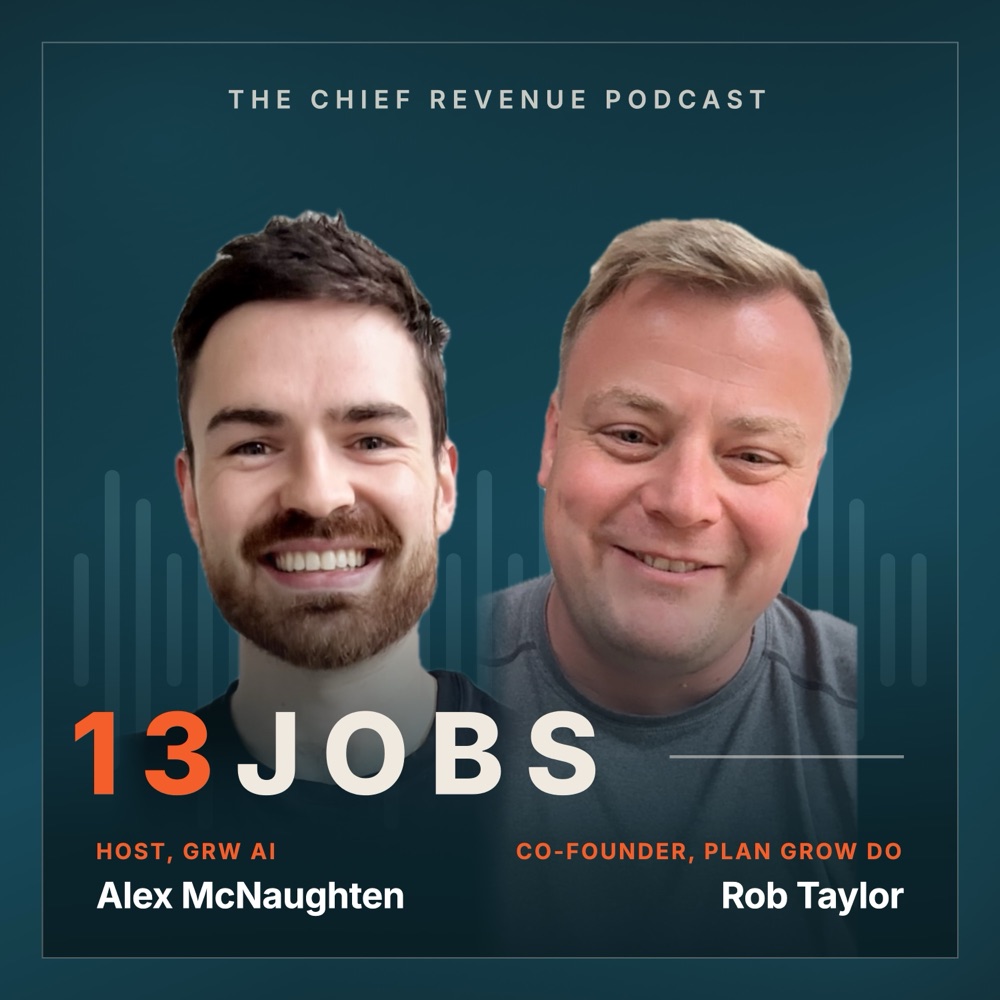
 Hosted by Alex McNaughten
Rob Taylor · Co-founder, Plan Grow Do
Rob Taylor is one half of Plan Grow Do, a B2B sales training business he runs with Steve Knapp. His own background is marketing, with more than a decade of it, and clients including Amazon, Google, Shell UK and Live Nation. Steve's is international sales leadership in a traditional B2B industry, at one point leading around four thousand people.
The pair wrote Modern Sales Leadership together. Their argument is that the tools and habits that used to sit in marketing now belong in a seller's hands, and that the buyer has moved on whether the sales team has or not.
In this episode, we discuss:
- Marketing and sales leadership, and the two halves of Plan Grow Do
- Every customer magically wants what you happen to sell
- Lockdown accelerated what was already under way
- A connection request is not a buying signal
- Ninety percent online, and fifty seven percent decided
- Hiding behind the corporate banner
- Willing to connect, against wanting to engage
- If it were a telephone you would use it all day
- Where the seller sits in ten years
- Teams told they are not allowed to use social
- Gen Z is value-led, and what that asks of an employer
- The one thing: genuinely put the customer first
Quote of the show
“I don't need you to identify my problem. I know I've got a problem already, help me fix it.”
Key takeaways
- Ask how you buy things. Most companies cannot describe their customer without describing their product. Working backwards from your own last considered purchase gets further than another persona workshop.
- Move earlier in the journey. Ninety percent of it starts online and over half the decision is made before anyone wants a meeting. Waiting at the consideration stage means arriving after the interesting part.
- Curiosity is not intent. Someone connecting, emailing or turning up at a conference is not ready to buy. They may be using you to educate themselves, which is fine if what you offer is insight rather than information.
- Behave like a provider, not a salesperson. Around six in ten will connect with someone who looks like a rep. Three quarters will engage with someone sharing insight, experience and a point of view.
- The channel is not the problem. Ask a room what social could give them and the list is long and correct. Hand them the same list about a telephone and they would be dialling. The hesitation is about the medium, not the value.
- Some teams are simply not allowed. No policy, no permission, no training, no budget. People can see what the channel offers and are told they cannot touch it, which is its own kind of development gap.
- Four generations, one workplace. New entrants get taught the old habits, then leave. Tenure is down to eleven months, and the top reason people give for going is a lack of professional development.
Transcript
Rob, good to have you on the podcast. Thanks for joining. How are you?
I'm very well, Alex. Thank you for— thanks for having me. It's great to meet you virtually like this. It's a wonder of modern tech, isn't it?
I know, I know. The funny thing is, you— when we— before we started recording, you actually hadn't even realised I was in New Zealand. You know, which is the funny thing. Well, it's the funny thing about doing this sort of doing business and, you know, building relationships remotely. And it's, you know, sometimes you don't even think to look.
So, Look, Rob, you and I, we got chatting on LinkedIn through a post I did not too long ago, um, and, you know, thought it'd be a cool idea to do a podcast together. Um, but tell us a little bit about yourself. So you're the co-founder of Plan Grow Do. Tell us a little bit about your journey in sales and what you, what you do today.
Yeah, nice one. Thanks, Alex. And, uh, yeah, just to, just to echo that again, it's a pleasure to be here. Thanks for, uh, thanks for inviting me along. It's— I'm looking forward to what we're gonna have a natter about. Um, well, yeah, my name is Rob Taylor. I am one half of Plan Grow Do.
We are a B2B sales training organization ultimately helping, uh, B2B business find the confidence through process and structure to sell in what most certainly is a changed world. Um, my background, uh, is predominantly what you traditionally call marketing, which might scare some people, but please come back to the screen. Uh, it's not something to run away from or shy away from anymore.
In fact, it's something that we think modern sales professionals need to embrace, um, about how they can directly impact through what might have been marketing tools and techniques before their own sales behaviors and their own sales successes. My business partner is highly experienced at international sales leadership level in a traditional B2B industry.
He's embraced the modern ways of doing things. We joined up, we teamed up, and now we're taking the best of tradition, hopefully the best of modern, uh, and really helping sales teams modernize, modernize that sales approach. So that's me in a nutshell.
Very cool, Rob. Thanks for that introduction. And today, you know, you touched on a couple of things we're going to touch on today, um, but, but I think one of the things we were talking about before we click record that I think is interesting, I'd love to get your take on, is this changing the idea of changing customer demands.
So I'd love you to elaborate on that. What did you mean by that? You know, what does changing customer demands mean to you? What do you think shifted?
Yeah, it's interesting, isn't it? The more and more businesses back in my journey when I first started working for myself, going from what was, I guess, traditionally business-to-consumer, B2C, into working for myself to help other businesses, so therefore B2B, understand their market. It was a real challenge for them then, and I find it still is now, to encourage companies to put their customer first.
You ask them, what, what does your customer want? And 9 times out of 10, until you probe a little further, every customer magically wants exactly what it is you've got to sell. Well, I, I don't think that's right. That's convenient, and if that's true, then happy days. But we don't— we can't build business from convenience.
And I think We have to really dig into how our customers have changed because some people might have profiled or looked at their customers 3 years ago. And if you— if we had a chat, uh, I don't know, in December 2019 around this topic, things might look wholly different now to what they did then.
Why? Well, the bleeding obvious has happened, hasn't it?
Yeah.
Things that we never thought would happen have happened. And we think that it was changing anyway. And I say it was changing, and I'll sort of touch on what it is. But we think lockdowns, pandemics, COVID-19 has accelerated what was happening anyway. And what we think was what was happening anyway is the changing face of customers and how they expect you to behave, how they expect you to show up, how they expect you to engage with them.
Because, you know, I'm sure like you on LinkedIn, how many times a day or a week do you get messages from strangers in faraway lands simply sending you a brochure of stuff or promising to fill your inbox with leads or get the phone ringing off the hook or 10x your business?
Too many to count, Rob. Too many to count.
Isn't it absolutely horrible? But this is how This is how we think that those people who don't even know who we are want to receive our information. We see platforms as spaces to just shout from. And I think if we can just pause and take a step back and think, well, what does my customer actually do?
How do they research? What are they looking for? And if you struggle to get into that as a, uh, from your business shoes, from your sales shoes, I understand because it might be a new concept. To you. Well, think about how you buy. Think about how you research what it is that you want to do.
If it's a considered purchase, what do you do? Probably like 90% of people, you'll go onto digital, you'll go to Google, you'll go to your existing networks through LinkedIn, for example. You'll look for information You look for content that helps you, the consumer, inform yourself.
Yeah, I think that's a really good point is sometimes we as sales professionals forget to put ourselves in our customer's shoes and actually empathize with how do they actually make purchase decisions. And, you know, one thing I've often noticed and, you know, particularly back when I was doing a lot of advisory work, is that the sales process that companies were using was not actually aligned to the buying journey of their customers.
So they were trying to fit a square peg in a round hole when they were selling. And, you know, and I think that comes from what you were just talking about there is that they actually never thought— or did any kind of homework in terms of how does my customer actually buy this service or this product?
You know, what are the buying decisions? You know, how do they make their buying decisions? What are the steps they take? Where do they do their homework? Where do they go for information? All those things you were talking about. And, you know, then companies wonder why their conversion rates suck. Well, it's because ultimately they're just doing like a spray and pray approach.
What are your thoughts on, you know, the idea that buyers or customers are far more educated than they used to be, as in they're a bit further along the buying journey by the time we speak to them? Do you agree with that?
I do, and it's interesting you mentioned that the organizations and companies you speak to don't join up their buying or their selling behavior with how their buyers buy. It's a key part of what we try and share is that joining up of buying and selling. And I think sometimes sales professionals, we can get, we can get excited, can't we?
If someone emails us or someone connects with us or someone phones us or we meet someone at a networking event or conference, we just assume that that person that's connected with us or messaged us is in an immediate buying frame of mind. They want my stuff. I've got to send them everything. And it doesn't mean necessarily that they're ready to buy from you at all.
They might just be curious about what it is you do. They might be seeing you as an asset who can help them better inform themselves and educate themselves, because that's what we do as consumers now. We're awash with information in the world. You can Google anything ever and you'll find the information. If we're still behaving in a way where as professionals we're just giving information to people, we're not adding anything to that person's experience.
And I think we have to become more active in the earlier stages of the buyer's journey, even before they perhaps know they've got a problem that you could want to or need to solve, but just be a part of their ecosystem, answer the questions that they're asking, offer insights rather than just benign information.
So really, are you talking about sort of sales professionals getting almost more involved in what you would traditionally consider as marketing's job, which is in that kind of consideration phase, or the— or the— or the even actually before then, in the completely unaware I've got a problem phase? Uh, are you talking about sales professionals actually, you know, using social platforms to, you know, just, you know, to do some of what, like, you know, I guess, like what I said, marketing's job.
Yeah, I think, and this is perhaps is why I find it easier to talk about because of my background in marketing, but I think it's where the tremendous opportunity is for B2B sales folk is to come further back in the buyer's journey. And when we consider some statistics around it, just to throw some stat attack at you, please.
Over 90% of a buyer's journey starts online. Makes sense.
Yeah.
57% at least of a final buyer's decision is made before they want to speak to you. People are self-serving now. They want to inform themselves. So when they come to you, they know they've got a problem. I don't need you to identify my problem. I know I've got a problem already, help me fix it.
Right.
And I think if, if we're hovering as a, as a sales pro in that consideration stage, we're missing out on so much opportunity before it. So if we can just become more active in positioning ourselves, becoming aware, you know, people that we speak to, and I'm sure it's the same in your, your space too, Alex, it'd be good to get your, your take on it as well.
People just hide behind corporate banners, so they'll, they'll share without any context or comment a corporate post on social media. So I don't care about that. I want to get to know you. It's social. I'd like to get to know what your thoughts are on that rather than the company. Do you, do you see that happening as well, where people hide from this opportunity to build their own position?
I do. And I think it's often— look, when I think— okay. So when I look at some of the young junior reps that we coach, you know, people who are just getting— it's their first ever role, right? And we're placing people in technology companies, SaaS companies predominantly, and coaching them as well. So when we see people just starting out in their career and they've never really used LinkedIn before, or this, you know, they maybe had a LinkedIn for 3 months, right?
Because like someone at uni told them it was a good idea. You know, for them, I try and get them just into the habit of doing a post. And I say, look, as you get going, absolutely, it's fine to share your company, reshare your company posts just to get into the habit of doing something.
But as you build that muscle, you should absolutely start to do your own content. And even if at just the start, it's rewording some of the company content, adding your flavor to it, You know, adding your thoughts around it. And then over time, you start to build, you know, your muscle at writing content and adding value and understanding your space.
And you start to be more in tune with your space. And then you can start to really go crazy and write your own content. And I'm a massive fan of this because, you know, that's how I built my advisory business. And it's where we get a lot of our business for, you know, from my company, Apprento now is through social.
And it's a phenomenally What kind of speak phenomenally untapped resource for most people in sales? You know, some I think three of the largest deals I've ever done in my career have come directly from LinkedIn content. You know, and other than the time it takes to write, it's effectively free. And and a lot of the top performing reps that we're coaching.
Are the ones who are starting to build their own personal brands on LinkedIn in their professional space. And it's really good to see because that's going to set them up and it compounds, right? You know, like the first year you get a few little results, year 2 you get more results, year 3, 4, 5, then the results really start.
So yeah, absolutely agree with everything you're saying. I think it's, it's, it's so important. And, you know, just resharing corporate stuff. Look, it's better than nothing, but it's not great because you're right, people want to connect with people they actually are interested more in what you have to say than what the company's marketing team wrote.
There's some, there's some insight that we share during our training that when we talk to organizations or business owners to try and break down that mindset of, you know, not seeing social. I know to talk solely about social, but it always crops up, doesn't it, because it's so prevalent. But it's, um, there's some research to suggest that I think 62% of your target market, generally speaking, are willing to connect with you if your behaviour is that of a salesperson.
So sharing, you know, contextless articles or just—.
Yeah.
Not updating your profile, looking like a salesperson. But if you can just start to behave and show up and look more like a potential provider to that person, i.e., you share insights, you, you get them, you understand common problems, you're sharing, uh, past experiences, case studies, your position within it, your thoughts within it— 3 quarters of your market want to engage with you.
And just that subtle but important difference from willing to connect is 60%, wanting to engage with you is 3 quarters. Your market's there. And I think we have to keep pushing that message to just start getting— like, I like that approach that you suggest, you know, was it flex the muscle or something, or build the muscle?
Yeah, flex the muscle.
It's an interesting perception just to get people started, because one of the things, a little exercise we've run, is we often ask the groups to define what social media can give you. Or what you think you can get from social media. And the list is so long, and every one of the points is bang on.
It's like you can get all that from that platform or from that medium, but why don't you do it, right? If we gave you this and said it was the phone, you'd make phone calls left, right, and center. Yeah, but because it's social or digital, you shy away from it.
Yeah. Why? I think it's fair, I think people don't know where to start, you know, I think you can you get into LinkedIn maybe for the first time and it's like, whoa, there's a lot going on. There's a lot of noise. You know, where do I start? What do I do? So I think there's a little bit of overwhelm.
And I think, you know, I think it is, it's like a muscle. You've got to train it. You get into the habit and, you know, start with a post a week, then get to 2, then get to 3, you know, then start commenting on other people's posts. Make sure you do that every day.
Start engaging with other people's content. Start connecting with people, you know, and then it just becomes a habit. And, you know, God, now I think of how I use LinkedIn and, you know, I have chats, you know, I'm having conversations on it all the time. You know, it's truly a social platform, which is quite cool.
And it's actually quite a fun place as well. So I want to go back to something you said because you said that so much of the— I can't remember the stat. I think you said 50-something percent, but I can't remember the exact stat. But the buying journey was kind of done before someone speaks to a salesperson.
Yes.
And I know that that's been trending more and more that way. My question to you is, and I don't expect you to necessarily know the answer, but I'm curious on your take in it, is like, where do you think sales professionals are going to be in 10 years, 15 years? Do you think there's still a place for them?
Do you think buyers still wanna engage with someone? And do you think— and the second part of that question is, do you think the role of the salesperson is going to change?
Oh, well, it's a really interesting question, isn't it? I think if companies and the people that work within the companies stand still, I think there'll be much more nimble competition, much more nimble new entrants to markets that will consume the one that's standing still. I think it's a very high risk to not at least try and embrace how the buyer has changed.
Because if you're just doing things that you've always done because it's how we've always done it, that might've got you to where you are now, and that's fantastic. We certainly don't knock the traditional side of things that work, have worked to this point, and will continue to work to a degree, but you've got to embrace forms of digital, and that surely has to challenge in an exciting way, not even in a worrying sort of way, but exciting opportunity to embrace digital and become more of a— I guess take more elements of marketing into what it is that you do, and don't just assume that your customers will flock to you.
I'm sure there's some research that suggests that— is it like over 40% of B2B buyers don't want to engage with a sales rep at all. They're trying to get you out of the way. They're trying to get people out. They want to self-serve. And look at how things are going. You can buy houses without speaking to people.
You can buy cars without speaking to people. It's going to happen at some point where the option at least will be available to buy pretty much anything without speaking to a person face-to-face. You know, I say it's 57% of a buyer decision is made before they invite you to meet. In his great book by Marcus Sheridan, They Ask, You Answer, you might've heard of that one, I'm sure he says it's over 70% of a decision is made before you speak to someone.
It's only going one way, it's not going back. We're not going to sack off Zoom, the internet, social, digital. As new buyers, younger buyers from what, I'm a millennial, I'm not even that young anymore, I'm 37, but Gen Z behind me, is it Gen Alpha behind them?
Yeah, yeah.
They grow up with on-demand tech, 24-hour instant response. This is what they're going to expect in a workplace as well. So if we stand still and think it's different in our industry, I think we're in for a bit of a fall, and we have to, have to think about how we can embrace different ideas.
Yeah, look, I think, I think you're right. I think my prediction, for what it's worth, is that the high-value business-to-business, like the threshold for what is considered high value for business-to-business selling, is going to increase. So, you know, you're going to be able to maybe make self-service decisions up to, let's say, $50K or $100K rather than only kind of $20K before you'd expect to expect to speak to someone.
I think there's going to be more and more of that where sales professionals are really far less relevant for lower value purchases. However, I think there's still a place for them because people still like to deal with people at some point in the journey. Now, the other thing that might change is where in the journey might shift.
You know, so it might shift a bit later in the sale. But yeah, I still think that there is a place for sales professionals. But I agree with you that they're going to have to adapt if they want to. You know, the top performers of 10 years ago, if they, you know, if they try to do the same thing now, would not necessarily be the top performers anymore.
And the top performers of today, if they don't adapt and evolve, won't be the top performers performers in 10 years from now. So I, you know, I absolutely agree with you. Just shifting tack a little bit because I wanted to ask you this as well. And before we run out of time is what are your thoughts on, you know, leading sales teams that have, you know, leading sales teams and what considerations do you think need to be made across generations?
Do you think there are any generational differences from a leadership perspective or do you think everyone can be kind of led in the same way?
It's— this whole leadership thing is really interesting, isn't it? I think, um, and my business partner, uh, Steve, he, he led a team, I think, of about 4,000 sales folk across, across the globe.
Wow.
He saw various cultures playing out. My age will suggest I've not led a team of 4,000 people around the globe, but through research and work that we do to help support our own studies and our own work with, with organizations who are developing their new leadership teams, we see a time where we've got 4 generations working in, or the potential of 4 generations working in one workplace.
Yeah.
That has to be exciting and challenging, but I think sometimes it can almost drown out the new entrants to that market because they'll be taught those old habits. And if those old habits aren't what's going to drive success for the future, there's a risk, isn't there, that these new entrants get frustrated? I think you said on one of your posts that the average tenure is now 12 months.
It's 11 months actually, is the latest data I've seen. It was 13 months 2 years ago, it's now down to 11.
And I think your research suggests it was professional development that is driving or giving people itchy feet to leave.
Yeah, so the survey we ran was that the number one reason why people are willing, you know, would consider or would leave a sales role is lack of professional development. And the second one was pay. They were the 2 top reasons, but professional development came out number one, which I thought was quite interesting.
And there was actually some research by Allegis Group, one of the largest, and they are the largest recruitment firm globally, was that millennials and Gen Z plan or, you know, would plan to stay in a role, you know, in a company, sorry, for 5 years or more if they were given ongoing professional development and mentorship.
The problem is that we're not doing that in general across organizations anymore. I think back in the day, you know, when I actually just started my career, it wasn't bad. It got worse in terms of that as my career went on. And, you know, from speaking to, you know, my bosses and mentors and folks who were around pre, you know, '90s, early 2000s, there used to be a lot more investment in people, but we've stopped that.
And, you know, I think part of that I think that's one of the key reasons why we've seen retention of staff just go off a cliff, um, to where it's now less than a year. Um, so—.
I think we see more pressures, don't we, Alex, where it's, you know, the, the top brass, the boss, the CEO might just say sell more, and the, and the sales exec manager is going to say how? Do more of what we've always done, which won't work, which creates a bigger gap, which no, no wonder creates that frustration of lack of professional development, leadership's not supporting necessarily or giving the tools for the people to do it.
Because one of the things we see that stops, um, individuals using social as a channel, as a means of communication, is the fact that they're not given permission from the organization. So they see these opportunities— I can do all this, but my company says no.
Are you actually seeing that? So you see companies saying you can't use social, then they're saying you can't use it as a you know, a means of—.
Yeah, this is actual feedback that we get from groups that we work with. Just last week we worked with a group of multi-businesses and we ran the exercise of what do you want out of digital, out of social networks, research, competition, sales, leads, this, this, this, this, this. Oh, that sounds fantastic. Why can't you do it?
We don't have permission. We don't have a policy. They won't put us on training. They don't see it as valuable. So there's an instant jarring and a detachment from what, what I know it can give me versus what I'm allowed to do.
Interesting.
And I think that plays into your research around professional development. They're not developing that space and allowing people to explore the opportunity. And the amount of times we hear that is, is incredibly common, uh, in the more traditional, uh, business-to-business industries.
Wow. Yeah, I hadn't heard that, but it doesn't surprise me in certain, in certain industries and companies. Um, so do you think we need to manage Gen Zs, for example, differently than we do Millennials and differently than we do Boomers? Or do you think that people are people and we should, you know, treat them all the same?
I think in a way, you know, I'm trying to dig back to some of my experiences. It was almost a Yeah, we don't do that around here. You come here, you're on work, you get to work, you have to come to the office to work, you have to work hard, you have to pull more hours than the other people.
If you do well, you get more pay. So the instant reward of work harder, get paid more, I don't think is as relevant in the millennials, but perhaps not the Gen Zs. Gen Zs, from what I know, or Zeds, however you say it, are they're more value-led. They want to work with an organization whose values align with their own.
Makes sense really, doesn't it, when you think about it? When there's so much going on in the world, why would I then go work for a company that could promote or accelerate the things that personally challenge me ethically and from a moral perspective? And I think that's going to play out more and more, but Which again plays into the digital side of things, the social side of things, that organizations and people within organizations, if they're not saying buy my stuff on social, which they really shouldn't be doing anyway, they should use these platforms to share their values, share what they stand for, share how they're, they're pushing for a changed and better world, a more integrated world, share how they support new employees.
In an element of hybrid working, in an element of flexi hours. Because do we really need a 9 to 5 anymore? Does work only happen 9 AM to 5 PM?
Certainly not for me, mate. I don't know about you, but—.
What time is it where you are now, Alex?
It is, uh, coming up to 7:20 PM here in New Zealand. Um, so yeah, look, I agree with you there, right? The idea of a 9 to 5, I think, is for better or worse, unrealistic for most roles these days, or certainly, certainly sales roles. I think the idea that you can do a pure 9 to 5, I think in sales has always been unrealistic.
You know, back even back when I was working in sales, if I had a client at 7 PM, 8 PM who's like, hey, send me a contract, you bet I was opening up my laptop and sending them a contract then and there to get a deal done, right? So Yeah, it's interesting. I think what you said there about the Gen Zs and millennials being more value-led, I think that's quite insightful.
I'd agree. And I think you're right is that social not only is a great sales channel, it's also a great recruitment and talent attraction channel. And it's a massive, you know, and as leaders in businesses, it's a really good opportunity to share some of your business, you know, your organizational values and personal values as well to a degree.
Because that can help you attract not only clients, but also future talent pipeline. So really, really good point you've made. Rob, I know, I know we're coming up to time. So I just want to ask you that one final question that we ask everyone who comes on the podcast. Knowing everything you know now, go back to your first day in sales.
What's the one thing you wish you knew then? What would you tell your younger self?
It's interesting, isn't it? It's been, it's been on my mind, in the back of my mind since we've been chatting. And I think for me, it has to come back to the customer, to, to understand that not every customer is the same. Not every customer needs to hear everything you've got to say.
And always be curious about how you can have better conversations with people to make their lives better, not from your own experiences. Own drivers, but what's going to help them. And always genuinely believe and put the customer first. That's what I'd tell myself. I think that would set everyone up for a better working environment.
I think, I think it's brilliant advice. And I think something that I've seen too many sales professionals forget is to put the customer first and put themselves in the customer's shoes actually, and empathize. So I think it's brilliant advice. And I think that would would have stood you in good stead day one of Rob's sales journey.
Rob, it's been a pleasure to have you on. I've really enjoyed it. It's been great to chat and it's been great to connect with, you know, someone who is doing awesome, awesome work in the sales space on the other side of the world, which is really cool. Tell me where people can go find you if they want to connect with you, if they want to learn more about you, connect with, engage with your content.
Where's the best place to find you?
Brilliant. Um, yeah, I mean, likewise, Alex, thanks again for, um, for inviting me on. It's, uh, it's always nice to chat to people in different time zones and continents but see so much commonality in what we see going on, uh, in the world. So thank you for, for having me on. Um, you can find me at plangrowdo.com, uh, where you'll see all about our insights that we've spoken about here.
You'll see, um, mention of our book Modern Sales Leadership, which helps companies understand a bit of the challenges that are coming down the line. You can find us on LinkedIn, of course, if you search for Plan Grow Do, or preferably search for me, Rob Taylor. You'll see my face. It's quite a common name, but hopefully you'll find me through the company page of Plan Grow Do.
That's right.
Yeah, let's connect.
We'll tag you in the LinkedIn post as well, so people just find you directly there too. So Rob, So Rob, absolute pleasure having you on. I really enjoyed the chat and we'll be in touch soon and chat again.
Good stuff. Thanks, Ollie.
Take care, mate. Bye-bye.