
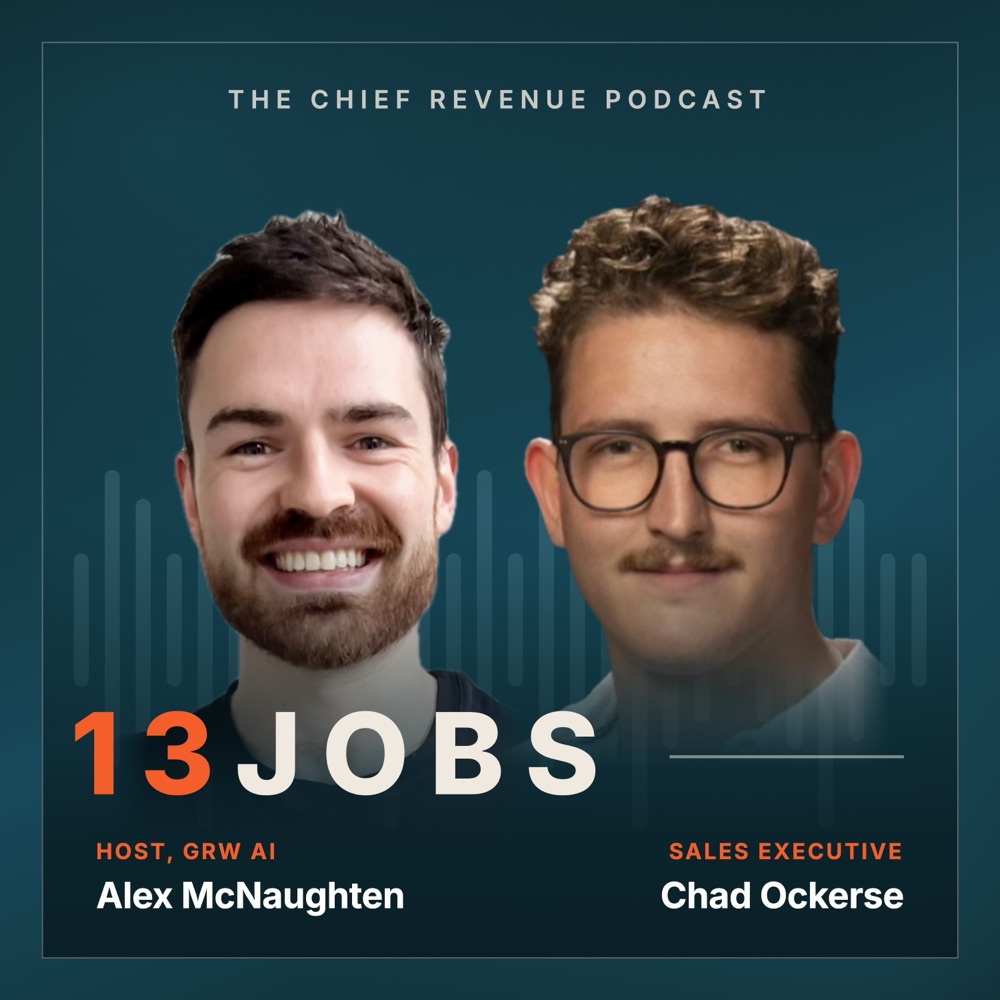
Rarely surprised on a call
Chad built a sheet of every objection by every role in a vet clinic before he needed it. He says almost nothing on a call catches him out now.
 Hosted by Alex McNaughten
Chad Ockerse · Sales Executive
Chad Ockerse was one of the first SDRs Apprento placed, in early 2021, at the veterinary software company ezyVet. He went on to break the company's SDR records and was promoted into a business development role in unusually short order.
He works New Zealand hours against the US market, which means a day that starts at 6am, or 4:30am when there are meetings in the diary.
In this episode, we discuss:
- From the first SDR intake to business development
- Mentality, organisation, and knowing the objections cold
- Why a no is a good outcome, not a loss
- A day that starts at six, with admin last on purpose
- Practising objections out loud with whoever is next to you
- An objection sheet, mapped by role inside the clinic
- The six Ps
- Mirroring tonality down a phone line
- Walking into clinics that were never going to buy
- Reading a gatekeeper from how they answer the phone
- Culture, and being able to put the headset down
- The one thing: build a calendar and hold yourself to it
Quote of the show
“The faster you get a no, the faster that conversation's done and you can go to the next one.”
Key takeaways
- Prepare until nothing is new. Objections written down, mapped to the person who raises them, practised out loud with a colleague. Answering quickly is what makes you sound like an expert, and people buy from experts.
- Different roles hear different value. What lands with a practice owner is not what lands with a practice manager. One sheet, one column per role, built in the first weeks on the job.
- A no ends the wrong conversation. It gives back the time, it usually teaches you something about the industry, and it moves you towards the yes rather than away from it.
- Reverse engineer the week. He took a quiet Monday and worked out how long everything had actually taken the week before, then put each task where his energy and the US clock allowed for it.
- Block the admin or it does not happen. Nobody enjoys it, and it feels safe in your head until six months later when the deal comes back and nothing was written down.
- Buy the exposure before you need it. He called local clinics that were not opportunities and asked to visit anyway. The industry knowledge that bought him has been worth more than the meetings would have been.
- Culture is a performance factor. Coming off a hard call and being able to laugh with the person next to you is what stops the last call bleeding into the next one.
Transcript
Chad, how are you, dude?
Yeah, not too bad. And you, Alex?
I'm really good, thanks. And really pleased to have you on the Apprento podcast. So for those of you who don't know Chad, Chad is, well, he was one of the very first SDRs we placed and we put him in a company called EasyVet. And since then he's been promoted and he's doing awesome things.
So Chad, tell us a little bit about yourself. Tell us what you've been doing.
Yeah, no, thanks for joining. Thanks for letting me hop on today, Alex. You know, great to have a chat with you. As you said, one of the first guys you placed at EasyVet. In total, uh, SDR work to start off with, and now I'm in that BDR, uh, business development executive role. Um, yeah, I've been loving it, enjoying sales.
Hopefully I can bring a bit of, a bit of information to your podcast.
But you definitely can because you've not only been doing SDR, doing an SDR role, you've been absolutely crushing it, uh, from all reports. So which kind of brings us on to the topic of today, which is wanted to really dive into what you did to be so successful, particularly in that SDR role, in the, in that outbound-focused SDR role, and really just wanted to dive into that.
So let's start high level, like what do you think made you successful?
Yeah, in the SDR role, obviously, as you probably know, outbound can be difficult if you do it for a long time. The biggest thing for me was mentality. Can't, can't do a job like that unless you can keep that good mentality, organization, and I guess just being able to take those rebuttals, learning your objections and learning how to throw back at them, you know.
Let's start with mentality because I think I'm glad that it's a good one you've called out. And what was your— what is or what was your mentality? And did it change at all during, you know, during your time as an SDR?
Yeah, no, it's definitely changed over the years. You know, when I first started off, it was not what it is now. It's become a lot more resilient over the time. When I say mentality, it's being able to have a goal, aim for that goal, and not let all the small things distract you from that goal.
Mm-hmm.
You know, being able to go in every day, deal with 100 nos just for that one yes. So, yeah, that's been my mentality at the moment. Things that have changed for me definitely have been, as I said, moving from chasing a yes to just accepting the nos and knowing that a yes will come.
Right.
And do you do, you know, like part of that resilience mindset that you talk about, is there anything that you do like day to day as like habits or routines that helps reinforce that or helps keep that, I guess, positive mindset that you have?
Yeah, definitely goals are a big one. So I have a wall in my room where I've got pictures of my goals up there. So it's nice visual representation of it. So every day I'm waking up and seeing that so I can kind of reset my goals. That's one way I have been keeping them.
Another one's through a few techniques, things like having a boat. Staying on that boat and having an island as your goal, or even going through and learning that nos are actually a good thing.
Expand on that a little bit. You talk about nos being a good thing. How is a no a good thing?
Well, it's— there's a couple of ways it's a good thing. One thing is it's no longer a waste of your time. You know, the faster you get a no, the faster that conversation's done and you can go to the next one. Quite often when someone says no, you learn a bit more about the industry, so you get to know more.
So it's kind of like no can be multiple things. And every no is a no closer to a yes, you know. So every time you get a no, you're getting closer to that yes.
I think it's a nice reframe. I think it's a nice reframe. I like what you said about it's, you know, you don't, you know, you don't need to spend time with that person anymore, right?
Yeah.
It's, you know, it's just disqualify, move on to someone who is potentially more receptive. Okay. So mentality is really important to you. The next one you mentioned there was like organization. Yeah. I think this is something that a lot of, not just SDRs, like sales reps in general, it really separates the best, you know, the cream from the rest.
How do you organize your week or your days? What do you do? Yeah.
So I work pretty weird hours for a New Zealand salesperson because we're working in the US a bunch. Start at 6 AM every day, quite often 4:30 AM if I have meetings in. So my whole morning is dedicated to meeting customers. I then split the afternoons into going through and reviewing what I've done throughout the day, and then at the end I go through and do all of my admin.
The admin does seem like I'm kind of leaving it for last, even though most salespeople, they hate admin. But it's, it's usually the only time I can kind of fit it in. But it's very important to actually block out those times to do admin and block out those times to go get some air or have lunch, you know, because otherwise you can just get so caught up in what you're doing that you miss them.
And it, for a lot of us, admin doesn't seem that important, you know, updating Salesforce and Pipedrive because it's in your head. But 6 months down the line, when you go back to that deal and try to bring things up again, if it's not written down, most of us aren't gonna remember it, you know.
So schedule your day out, have blocked out times to do your admin, to take your break, to do your revision throughout the day. Otherwise, I found I just don't do it.
How did you end up getting to— because it sounds like you block out your calendar in, you know, your days in your week. How did you figure out the right timings between like, this is admin time, this is calling time, this is me? Like, how did you figure that out?
Yeah, so all of it's tentative in my calendar. So if a customer is looking to book in through Calendly, they can still book over it.
Okay.
But it is a nice framing for me. The way I figured it out is I took a Monday because Monday's my quietest day as the US market's closed. And I just went through and I said, how long did it take me to do this stuff last week? How long did it— did I spend in these last week?
And then I went out and got general frame of what hours of the week I'm spending doing what stuff. And I prioritized it. What's most important in this time of the day? Like, what's most important in my US hours? Obviously meeting customers. What is a good break from meeting customers but is still really important?
It's reviewing what I've done throughout the day. And then what's something that I can just grind out in the afternoon after I've had my rest reviewing things? It's doing all the admin, you know? So that's how I figured out how I wanna set my day out.
Right. So you kind of like reverse engineered it basically from— did you take into account like the targets you like have to hit as well? Did you think about, okay, if I need to— I don't want to put words in your mouth, but like if I need to make X number of calls, I need to spend Y amount of time.
Like, did you kind of think of it through that way as well?
Yeah, definitely. We obviously do have productivity targets. So I had to take those into account, making sure I do have enough time to do the calls I need throughout the day. How long am I on average spending on a call? And then also using scheduler inside of— I use Pipedrive. So we have a scheduler there where you can set activities and what time and stuff.
So using that scheduler to prioritize in my calling times what I need to do first and what I need to do after.
Gotcha. Okay, cool.
Yeah.
Okay. So organization then. Sorry, what was the third point you mentioned that was really important? I think you talked about like practice and industry knowledge and that sort of thing.
Yeah, the big thing as well is objections, not just knowing what objections can be out there, regularly practicing them and being able to bounce them back. So when I was in the SDR role at EasyVet, it was as much as just talking between each other and someone saying the objective and you bouncing it back at them because you can have a scripted one.
Well, you always want a scripted reply and it doesn't mean you have to use that scripted reply, but it gives you something good to bounce back on. Because being able to respond to an objective quickly makes you look like an expert in your industry and people like to buy from experts. They don't want to buy from someone who's stumbling through an answer, you know.
Yeah, it's such a good point. People do like to buy from experts. You're absolutely right. So what are the common objections that you would get? Like, do you have an example of one that you'd be willing to share?
Yeah, our biggest objection is price. We are one of the more expensive in the industry, but that's also because we do provide some of the more I wouldn't say premium services, but some of the more advanced features.
Mm-hmm.
So the price definitely does play a big, big role in the objections we see, you know. So being able to go back straight away with the value, you know, that's like value for that clinic that will get out of the software. Because I'm in the vet space, very diverse range of clinics that are gonna benefit from different things.
So it's about learning what kind of clinic you're dealing with and then what they're gonna benefit with. And then also when I first started, I drew up a graph, an Excel sheet. I'll see if I can find it for you. But it's got each role in the clinic of who I'm talking to, and then the objections that I face next to it, and what's gonna be important for that role at the clinic.
Because what I, what I throw back at a practice manager is gonna be very different to what I throw back at an owner because they've got different priorities.
Right. So you actually built out like an effectively like an objection cheat sheet for the different types of objections you get and how to answer them for different people in the organization.
Yeah, because there's, there's not really any point me throwing back a, yeah, as an owner, you're gonna really, really improve from this, at someone who's just a manager at the clinic, you know? Yeah, because they're not gonna find that as a piece of value.
Yeah, that makes complete sense. And I think what I'm taking away from that is your level of preparedness is beyond, I think, what your average SDR is doing. And I think that's why you're so successful at it is not enough. Like, this is something we encourage a lot of SDRs to do, but I just mean broadly speaking in the market, not enough people have that level of thorough preparedness, which allows you to be prepared for pretty much any situation, right?
You're not surprised on a call.
No, very rarely surprised on a call. 'Cause I really either thought about it or heard it before. But yeah, it's, it's, to me, it comes down to the 6 Ps, you know, proper, proper preparedness prevents poor performance, you know. Say that one again.
What? The, the 6 Ps. I like that.
Yeah. So it's, it's got a swear word in it, but proper preparedness prevents piss poor performance. So, right. It's, it kind of sets the motto with how I prepare for things. Prepare for it properly and you're not gonna have a bad experience.
Yeah, that's awesome. So if I raised a price objection, say, imagine I'm a business owner, how would you address that if I'm just like, hey, Chad, that sounds really expensive?
Yeah, of course, we understand that we are a bit more expensive in the industry, but the reason that we are at that price level is because of the functionality that we provide. We're able to go through and actually combine multiple products into the same product. So if you go through, take your IT services, take through your current PIM system as well as your communication system, we may be more expensive than just the PIM system.
But when you add all 3 of those together, is the price comparable, or are we actually cheaper?
Right. And that's a good answer. You know what you're talking about. I think it comes back to the level of preparedness. I think the other thing I've noticed that you've done really well, and through coaching you and working with you over the last, you know, 18 months, maybe longer, it might be, might be even 2 years now, is you know a lot about your industry and you know all, you know, you, and you can understand and empathize with different people at different parts of the organization.
Have you got any tips? Because it can be quite overwhelming, I imagine, when you first joined EasyVet and you've got to learn this whole industry, right, that you've never really had any exposure to. How did you go about going from Chad day one, I know nothing, to very quickly being and sounding like a credible expert?
Do you have any tips or tricks on that? Yeah.
So, big thing that I was really lucky with is EasyVet's got a lot of vet staff that have actually transitioned out of the industry into the company. So, that allowed me to be exposed to the right people straight away. Something that I found is learn to mirror them on the phone, your tonality, the way you speak.
It doesn't seem like you can mirror properly over the phone, but if you're keeping your pace and your tonality right—.
As in mirror the person you're speaking to?
Yeah, of course. Okay. Most people say mirroring is, is a physical in-person thing, but being able to go and actually mirror their voice and their tonality makes them comfortable because it sounds like you're familiar already. Because they hear themselves every day, all day.
Yep.
Yep. Um, but yeah, definitely coming into such a large industry, it was a lot to learn. Um, being able to be exposed to those people who've been in the industry has been good. But then also I did a lot of, a lot of on-sites where I actually went into clinics, um, which I know isn't something that everybody can do.
Um, I know I am the only SDR at EasyVet that got to do it, but that's because I actually went and called local clinics and Even if they weren't interested, I was like, hey, can we just come in and have a chat? You never know what else is out there kind of thing.
Right.
So even though they weren't full sales opportunities, it still got me the exposure to the industry and the experience, which would be really beneficial to later sales opportunities. And it's about taking that bit of time at the start that isn't gonna be that beneficial straight away to create the experience that'll be beneficial later on.
Yeah, no, it completely makes sense. So you really kind of immersed yourself in the industry, um, asked a lot of great questions and got, you know, and, and really tried to understand your buyer.
Yeah, and it's also about putting yourself in them, in their shoes, you know, um, being able to actually take yourself out of the corporate world I'm in and move yourself into what they're actually experiencing in the clinic. And in your meetings, actually asking about that. It's, it's not just what's the monetary impact, what's the impact, it's like what's the personal impact on your life of having to deal with this, this, and this?
Um, because it creates an answer from them that you can then go and say, that is what I'm going to experience if I was in their, their position, right?
So you're talking about not just like the business impacts of what EasyVet can potentially solve, but also what does that mean for the individuals who work in that clinic you might be speaking to?
Yeah, well, a lot of people buy on emotion. I know the top execs never do. They're generally numbers and what efficiencies is this gonna do. But we do deal with a large number of small businesses, which quite often they're a family type of environment and they're gonna buy on emotion. So being able to emphasize with that emotion and show that you are similar to them in that way, It does create the, creates a lot more trust and rapport straight away kind of thing.
You can get her to laugh just a tiny bit at the start. It creates that comfortable situation for her where she's like, this conversation might be fun. Let's not be so closed off. And that's what I've found has worked. We've got people who I've seen just go straight by the script. Hey, this is blank from here looking to talk to blank.
Works well for them. I found this is what works for me.
That's cool. So injecting a little bit of humor into it. Kind of feeding on from your receptionist comment there, like, how do you handle navigating, you know, navigating gatekeepers like that? Yeah.
Yeah. So again, very, very dependent on what kind of gatekeeper it is. You got your ones who are really stoic and not going to give you the time of day. I'm very upfront with them. I'm like, hey, this is Chad with IDEXX, just looking to talk to blank. And you'll generally pick it up by how they answer the phone.
Mm-hmm.
If it's really pick up, really short, snappy, you know you're dealing with that kind of person. If it's someone who I'd say generally a bit younger or a bit more bubbly when they talk to you, I'll be a bit more of a, like, humor side. Because if they like you, they might think your boss, like, their boss will like you.
So I found that works as well. Another thing I've found is sending an email the day before saying, hey, I'll call tomorrow at 12 o'clock. Then when they say, oh, does he know you're calling, or she know you're calling, I'll be like, yeah, I sent her an email saying I'll call yesterday. And even if they didn't read that email, I still did send it through.
So.
Yep, yep, yep.
I think part of it with gatekeepers is just confidence a lot of the time. Like, if you sound like you know where you're going, then you could typically get through. Whereas if you're not sure, or you sound like— what's the word— if there's hesitation in your voice, especially with those, um, quite assertive type gatekeepers, you know, the ones who aren't as friendly, um, yeah, if there's any hesitation in your voice, they're going to shut you down quite quickly.
Has that been your experience?
Yeah, of course. Um, as I said, calling the US a lot, they deal with salesmen continuously. A lot of them take it as kind of like a goal to shut you down as soon as possible.
Yep.
Yeah, being confident and knowing exactly who you wanna talk to or exactly where you wanna go. Even if you're just saying, hey, I wanna talk to the person in charge of this. You don't have to know who you're asking for exactly. Just say, I wanna talk to the person in charge of your software.
Saying it in that confident fashion makes him sound, oh, maybe he has something to do with the person in charge of the software.
Yeah.
So it kind of makes them double guess instead of being like, hey, you know, can I talk to like, you know, whoever's in charge of the software? Because it creates— then they're just like, no, this person's nothing to do with the clinic. They're too busy to talk to them. Email us.
Yeah, totally. Is there anything else that you think that you've done particularly well that would be helpful for others who are maybe just getting started as an SDR?
Find a good culture. As I said, been in 3 sales companies now. The culture I found is most important.
Hmm.
Because you get— what I've found so far is you kind of get 2 main types of sales companies. You get ones that are there to have fun but also make money, and you get the ones that are like slave drivers. So you gotta be at a company where you can have fun, enjoy the people you're talking to, because if you come off a really difficult call, and you can talk to the person next to you and actually have a bit of a laugh before your next call, you're gonna be treating the same— the next call well.
You're not gonna have a, you know, you're not gonna be bringing your past call onto your next call.
Totally.
So finding a company that has a really good culture is really important to me anyway, because yeah, again, it puts you in that situation where you're surrounded by people you can enjoy and doesn't matter what happens on the phone, you can always just put the headset down and talk to people next to you and get out of that bad situation.
That's kind of what we see going forward with Apprento. It's like being that community for folks who maybe don't— not because not every company has the amazing culture that, you know, that you've been, you know, that you've experienced. You know, there's a variation like in anything in life. There's a variation in terms of culture, cultures of organizations out there, and we kind of see long term as Apprento's community being a place where like-minded reps and peers can kind of dip in and out and get that support that maybe they didn't get in their organization or they're not getting enough of.
But yeah, I think it's a really good point you've raised there. And from a, from a leader's perspective in these organizations, I think it's a real priority for them, or should be a real priority for them, is developing a really good sales culture and a collaborative sales culture, because the results are better.
Like the organizations we work with that have that kind of collaborative sales culture, they crush it, man, and their reps are happier and they stay longer. So I think it's a real priority. Should be.
And like, yeah, another thing is you can always have those star performers, but as you said, collaborative is important, being able to get them to collaborate with the team. It may distract them a bit from their star performing and slow them down a tiny bit, but overall it's gonna bring the whole team up.
And at the end of the day, if you have 15 reps and only one of them is destroying, like, one of them's exceeding quota, you've still only got— you're not gonna make as much as, say, 7 of those reps hitting quota.
Yeah.
So being able to have your senior guys open to at least teaching or mentoring or answering questions is what I've found has also been super valuable for me. We've got some really great senior guys at Easy Debt who've been extremely open to teaching and helping and collaborating on deals, which has been again super valuable for me.
And I suppose, have you been quite proactive in that? Like, have you gone looking for that help internally and like identified people in the organization that you want to learn from?
Yeah, of course. So we didn't have like a structured mentorship program or anything. It was just about going and finding the people to talk to. Asking them, hey, can you help me with this? And then being open and saying, yeah, of course.
Yeah. So I think that's— sorry, you carry on. There's a bit of delay on this.
That's okay. Yeah, it's, it's as I said about being able to not necessarily have a super structured mentorship program in place, but having your senior reps or your superstar reps being open to at least talking about that kind of stuff.
Something we encourage a lot of the juniors as they're coming through and they're just getting going is like actually identify people in the organization you can learn from and don't be afraid to go ask them because chances are they want to help. Like, that's the thing I found is like often senior people, they— if you approach them the right way, they're really open to helping.
And, you know, I think it's again something you've done very well is you found people in the organization. Like you said, there's no structure. There was no structured mentorship program. It was Find the people you want to learn from, ask them and, you know, ask to sit in with their calls or ask to pick their brain over a coffee or, you know, and one thing I often encourage reps to do is like go find someone in the organization you want to learn from and just buy them a coffee.
Say, hey, can I take you for coffee for 45 minutes? You know, it's a small investment. It's like $4 for a coffee, right? But it's amazing what you can get. You know, if you, you know, it's a nice way of reciprocity.
Yeah.
Chad, it's been really good. I really appreciate you sharing your knowledge and some of your experiences with us today. I think it's gonna be really helpful for, you know, other reps who are maybe just getting going or a little bit earlier in their career. So I just wanna ask you one final question before I let you go.
Knowing everything you know now, go back to day 1 as an SDR.
Okay.
Day 1 at EasyVet. What is the one thing you wish you knew then that you now know?
Learn to manage your time, because I only started scheduling my calendar after you told us to, which is what, 6 months after I started? Otherwise, you just, yeah, learn to build a calendar and learn to actually hold yourself to it. That's one thing I would want to know when I first started.
I think that's a really good bit of advice, and it's also one of the reasons why we brought that how to structure your week part of the Apprento learning curriculum way forward because it's so important. We brought that like right into the first few weeks now because it does, it makes such an impact.
So yeah, it's, it's, it's glad to hear you've got that down. Chad, phenomenal to have you on. Really appreciate your time. Where can people find you, connect with you? Where's the best place?
So they can always connect with me on LinkedIn. My LinkedIn's actually pretty simple. It's my— well, it's linkedin.com/chad-o. So surprised I got that. Oh wait, no, I changed it again. Sorry, it's /chadock/. So no dash or anything there, just Chad Ock.
Awesome. Awesome, Chad. You have a good one and we will catch you at the Apprentio Christmas party soon.
Yeah, well, thanks for having me on today, Alex, and yeah, we'll catch up at the Christmas party.