
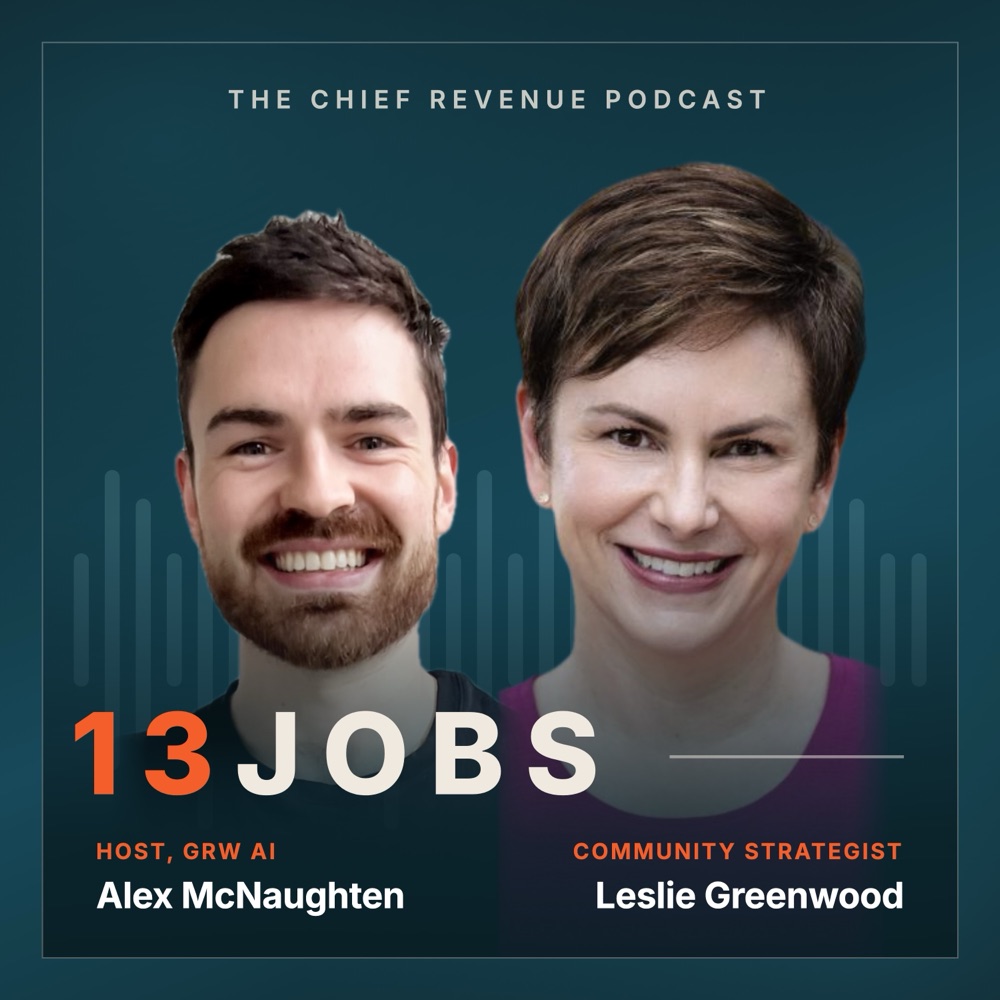
Don't forget the human behind the process
Leslie grew Pavilion from two thousand members to nine thousand. Her advice starts well before any of that: decide which single outcome the community is actually for.
 Hosted by Alex McNaughten
Leslie Greenwood · Community Strategist
Leslie Greenwood was VP of Member Success and the first executive hire at Pavilion, formerly Revenue Collective, the global community for go-to-market executives. She owned everything after enrolment, grew the team from one to sixteen, and the membership from around two thousand to nine thousand in two years.
She had just left to start Chief Evangelist Consulting when this was recorded, taking evangelist-led growth to SaaS startups. This conversation was recorded from a cafe, which she was gracious about.
In this episode, we discuss:
- Two thousand members to nine thousand, then going out on her own
- Know why you want a community before you start one
- Mission, vision, values, and what the room feels like
- Modelling the behaviour, then handing it to the people who get it
- Lurkers, and why they are often the best advocates
- Support, product, acquisition, contribution, customer success
- Pick one or two, not all five
- When a community needs actual headcount and budget
- The dinner in Austin that changed the relationship
- Engage, empower, amplify
- Processes are lovely, and there is still a human behind them
- The one thing: she did not know enablement existed
Quote of the show
“Processes are lovely as long as you don't forget the human behind the process.”
Key takeaways
- Decide what the community is for. Support, product, acquisition, contribution or customer success. Each has a different business outcome and a different measure. Pick one or two, because going wide makes the impact impossible to trace.
- Message the lurkers. No comments, no likes, logging in fifteen days a month. That is not disengagement, it is often imposter syndrome or shyness, and a single direct message is usually all it takes.
- Engage, empower, amplify. Watch what someone actually enjoys, then offer them the thing that matches it, then make sure everyone sees them doing it. The recognition is most of the compensation.
- Evangelists multiply. Model the behaviour yourself, find the people who already get it, and hand it over. Ten become a hundred, and it compounds from there.
- Engagement is not the business outcome. Track it early because you want the line going up, but the board question is deflected support cases, or influenced pipeline, or whatever the community was built for.
- It is planting, not harvesting. You do not go from spotting a lurker to them telling their friends inside a quarter. Consistent value over a long time is the whole method.
- Community needs a budget. Not at the very start, but the moment it becomes strategy it needs a person and money behind it, not an hour a week from someone who already has a job.
Transcript
Leslie, it is so good to have you on today. How are, how are you?
I am doing great. Thank you so much. What time is it your time?
It is 8:20 in the morning. Oh, nothing too unreasonable. Not too bad. No, I've had it. I had a few 3, 4, 5 in the morning calls over the last few months, but this one's a good— this is fine. And look, thanks so much for coming on. For those who don't know you, look, I think of you as the queen of community building, but, you know, tell people a little bit about who you are, what you've been up to, and what you're doing today as well.
Sure. Well, I just finished my tenure at Pavilion, formerly Revenue Collective, which is a global community that started out when I started about 2,000 members, grew to 9,000 members in my 2 years, and was in charge of everything post-enrollment. So if that was community interaction, whether it's programs, mentoring, etc., grew the team from 1 to 16 at some point.
And now I am going out on my own. So launching my own consulting business on November 2nd, which is very exciting, which will allow me to follow my passions and spend more time talking about community and evangelists and how you can use all those things to drive further growth.
It's a super interesting space and it's something that everyone's talking about. Everyone's wanting to build a community. Like we're building community, you know, but, but in general, it's something that, you know, every product company out there seems to also be building a community to support their, you know, support their product. What in your view makes an awesome community?
Like, let's start there.
Yeah. Yeah. I think you have to know why. Why do you want to build a community to begin with? Most people are like, yeah, this is awesome. Let's build a community. But they don't actually know why they want to build a community. So there's many different types of community you can build, whether it's a support community, whether it's a product community, engagement community, an acquisition community.
So even knowing the biggest overarching why is important, but then understanding then that the community is, is a community. It is a gathering of people. People want to get together. So you have to think about the softer side of community and what are you going to bring to that as a company? To get your community to be sticky.
And why, why do people want to come to you? They're not going to keep coming to you just for a support answer. It's really something deeper than that as you think about community.
So it's the why is crucial.
100%.
And I think it's actually a hard— it's how do you find your why? Like, as a community, like, how do you find your why? Because I think a lot of communities kind of start maybe with one goal in mind. Or no goal in mind. Sometimes that sort of just like our community, we just kind of happened and we're like, oh, that's interesting.
What do we do with it? Right. You know, so how do you find your why and make it purposeful and get people to buy into that?
Yeah, I think my, for me, the first thing that I'm going to talk about with any company or group is mission, vision, values.
Right.
You know, people, that's how people attach and people want to be part of something larger than themselves, even if it is a widget, etc. So you've got to define that. And a lot of the earlier stage companies, you know, they maybe haven't gotten quite there yet. So that's where a lot of my conversations are starting is mission, vision, values.
Yeah.
Right. So you got to start there. It's got to be true to who you are as a company. And as individuals, I imagine, within that company.
Well, it defines really what— it defines how you're going to treat your customer. You know, how are you going to treat them? Like, what is the experience? You know, when they walk into it— pavilion, we used to call— say you were— we were roaming the halls of Slack. When they walk into your community, what does it feel like?
There's that mission, vision, values kind of starts to transform that idea of You know, this community being more than just this, you know, place in internet land.
Yeah, for sure. And then I guess, you know, the second part of my question is, okay, like you figured out your why, how do you communicate that in the right way so that people in the community understand it and start to embody it as well?
Well, it should honestly, it should go in your your kind of mission statement of your, of your community. So you're here to talk about XYZ product, but also help other people do X to advance the field. So it's part of the entire value prop of your community to begin with. And then, you know, depending on the type of community, if you're having a community where you're interviewing people and you're talking to them before they join, that's kind of a different thing because you're going to instill that during the conversation.
If it is something where people are self-selecting, they're coming in, then you're going to model that. You're going to model that in how you're interacting with people. When they ask a technical question, are you going back and saying, oh, that's great. Now, why did you ask that? What else could I do to help you?
Is there a larger topic you'd like to talk about? And then you say, oh, you know, I know John Doe just actually asked me about the same topic. Would you— what if I made a connection? To you with them. So it's, it's, you're going to model it. And of course, you know, I'd love to talk about evangelists.
So you find your super users, your, your people that'll shout you from the rooftops, and you ask them to do the same for you. And you kind of use a grassroots or a bottom-up type of effort to model the behavior.
Right. So you actually want to identify the folks in your community who are, I guess, like your real they embodying what you want the community to look like. So you need to find them and you need to actually enable them to effectively build that community culture for you. Is that right?
100%. 100%. You'll do part of it as the community manager, the community leader, the leader of the company. And then you're going to find the people that naturally get it and then enable them. And, you know, once you enable them, then they can turn their group into 10, and then those 10 turn it into 10 more, and you'll see a multiplier effect over time.
And one thing we spoke— and I remember when we spoke about this not that long ago— is you talked about lurkers, and I hadn't heard the term before. And, you know, I've probably been guilty of being a lurker in a few communities myself. And, you know, an interesting thought I always have is like, okay, what could this community have done to get me more engaged?
You know, and I know we got lurkers in our community that consume the content, that watch, that listen, but they're not actively participating. Can you change that?
Yeah, I think you can. I mean, that's my belief that you can. You're— I mean, to go back, what is a lurker? It's like you said, it's someone that comes in. Maybe they come in every day, maybe they come in a couple of times a week. I personally, when I first joined Pavilion and now in another community I'm in, I'm 100% a lurker.
I'm not saying anything. I am reading. You know, when I joined Pavilion, I didn't even know what a CRO was. I'm looking at content, I'm seeing where there's conversations with 7, you know, 7 responses, so I can learn from that. I think a lot of people are like that. I mean, some people are like that because they have, you know, imposter syndrome and don't think they have anything they can add.
Some people, that's just, you You know, they're shyer. They're not going to be the person that's got their hand up and standing in the front of every forum answering everyone's questions. Those are amazing, by the way. So, you find those, I mean, in every— in most, I would say, community platforms or Slack, etc.
You can see who those people are.
Right.
They don't have any comments. They don't have any likes, but they're logging in 15 days a month. So, the first thing is, message them. Say, hey, you know, Alex, I saw you're in the community a lot, you know, and I saw, you know, reading content and everything. What's particularly interesting to you? And just start a conversation with them.
Make it easy for them. Invite them in. They're actually some of your, your best advocates because they're, they're there. They're just not the ones that are You know, answering every question.
So we should actually speak to them. So we should actually identify those folks and actually like call them up and be like—.
You should speak to them.
Okay, that's interesting. Well, you know, I think the easy thing to do is just dismiss them and just kind of think, oh well, they're there, they're consuming, we'll leave them be. But you're actually saying no, we need to— and this is another term, I'm borrowing some terms you used from our last chat.
Well, I really like the white glove treatment. You know, for those community members.
What's—.
So maybe we should have started this actually. What's the benefit of having a really active community? Like if you're a company that you don't have one today and you're thinking about going down this pathway, because it is, it's a bit of, you know, it can be a bit of a buzzword. It can be a little bit of a—.
Sure.
Oh, well, everyone's doing it, so we need to do it. What are some of the actual, like, tangible benefits to building an active community?
Sure. Well, one, it depends on what kind of community you want to build, kind of like we talked about the first time. So like, if you have a support community, so, you know, I'm sure Zendesk, for example, has an amazing support community, is probably buzzing all the time, and they're able to deflect, you know, hundreds of thousands of cases that don't come into Zendesk.
It's a one-to-many. Your community, when you actually have a community, which community means others helping others, they're answering the questions for you. So you're saving probably for them probably millions and millions of dollars in support costs. If you're a product community, so let's say you have an early stage product, you get your early adopters in there, you're letting them know about your releases, your product ideas, and you're inviting them into the conversation.
So, you know, letting them have a say. They're the ones consuming it every day. They're seeing how it works in their life and really hearing their voices. And so that can actually influence a lot of your, your product roadmap. I mean, at Pavilion, one of the things we did is we were always listening.
Almost everything we built was due to someone talking about it, asking for it, asking a lot for it. Ear to the ground. So whether it's one person saying that, or whether you're just, you have your ear to the ground and you're like, you've heard 5 people say it over the last couple months, you're like, ah, this might be something, you know, we need to think about.
If it's acquisition, then you have this great bustling community who buys into your mission, your values. They maybe have a PLG motion, they like your product, and you can actually track how many people enter your community before they enter your pipeline. And so you can have community-influenced leads. Let's see what else. Contributions.
So many of the, like, technology or developer kind of communities are contribution communities. So they're putting in thought leadership, they're answering each other's questions, you know, and then customer success. I mean, so you're in there and you've got your customers and you're talking to them and they feel a connection connection to you and you're making sure they're using the product and they can have access to you at all times, maybe that's a stickier customer.
So I think the first thing is deciding where do you want to put your— I guess, put which— where you want to put your eggs in which basket for your community. And usually they say 1 to 2, not all of them. You may do all of them at some point, but to begin with, you know, it's like 1 to 2.
Like focus.
Focus. Yeah, don't go, don't go so wide. It'll be harder to actually, you know, map business outcomes to the community if you've gone so wide.
As we're talking about this stuff, it sounds like this is a full-time job within an organization. This is not something you can just do an hour a week, or, you know, this is a— someone needs to wear this hat and own it. Is that right?
Yeah. Oh yeah, 100%. I mean, there are obviously big companies with community teams. Oftentimes, communities might include events, they might include content, and oftentimes those communities might roll up under marketing. The director or head of community at Gong was at a conference I was at. She reports to the chief customer officer. And so, yeah, so I mean, like, she, she's in there, then she has a staff.
But one of the things that, you know, I've heard people say, and some really you know, well-respected community builders is that, you know, having a full-time community manager at some point, you don't need it when you're first starting out, but like, if community is gonna be an actual strategy, you need an actual headcount, an actual budget to put into your, into your community.
The other side of it is like blending the physical and the virtual. You know, I think it's, Everything, you know, virtual is great and, you know, I'm a massive proponent of connections virtually. And, you know, that's how we met originally is through, you know, my whole trip around the States, you know, meeting folks who I had relationships with prior virtually.
But I think there is something to be said for in-person events, bringing people together.
Yeah.
What are your thoughts on that? Do you think it's important?
Oh, absolutely. I mean, if you can. I mean, obviously there are places that you can't. But for instance, larger companies that they actually have, even as a product community, they'll have groups. I think it's— goodness, it's one of the foreign language apps. They actually have 1,000 chapters of people around the world. I'm learning French.
I'm going to go meet with all all the French-speaking people that are taking French courses so we could practice, have coffee, things like that. So, you know, if it is possible, I'm a big fan of the, um, the in-person events. I mean, if I think about just, you know, our life cycle, we met on a random Zoom, probably in the middle of the night for one of us.
Um, we just chatted, you know, maybe we hit each other up on Slack a couple times, and all of a sudden you're there at a dinner in Austin, Texas. And it's like, okay, I think that for me, that's like, okay, yeah, I know Alex. And now I know Alex, you know, you're someone I'm going to come to and either ask for help, or would be more open to sharing something that I need help with, than if we were still only, you know, Zoom friends.
Hmm.
But yeah, if you can, it would be absolutely great to bring people together. In person.
And, and is that something you get your evangelists to do? Like, is that the whole purpose of getting the evangelists like enabled? Is you actually enable them? Because, you know, it, it's easy to run an event if you've got 50 or 100 people in the community and they're all in a similar location.
You can just say, hey, we're meeting here, right? Easy. If you've got 1,000, 2,000, 10,000 members desperately spread around the world, then it becomes a logistical nightmare if you're trying to tee up a monthly or quarterly catch-up. So yeah, is that something you then hand over that responsibility to the evangelist?
Yeah, you absolutely could. I mean, it depends on what the— I mean, the thing about the community and evangelists, it's all about giving them value. And so if that person finds value in hosting and being face-to-face with people, absolutely, you want to enable them do that. For instance, that's me. You know, I love getting together with people face to face.
You know, heck, I flew to Austin for the day just to get together with people face to face.
I was impressed by that. I was very impressed by that.
Thank goodness for Southwest points. Um, but, you know, I'll have a— I have a coffee with someone at least once a week, um, just to, to get together, to get it. And that's because it's worth more to me, even if I was you know, was or was not being paid for it, the value that I personally get from it outweighs that.
So even though it's my time, my money, the, the personal payment I get, which is what I consider a bonus, well outweighs any regular compensation I might get for it. And so for me, I'm an easy— I'm an easy sucker to be the evangelist to host events because I enjoy that.
So how do you enable these evangelists? You know, we've talked about finding them, like they kind of bubble up and you kind of, you know, you see them typically, but how do you then enable them so that their impact 10x's?
The next step is engage. You have to engage them, you know, watch them, listen to them. What is valuable to them? What are they talking about? Find out if they love doing in person, you know, just like watch and listen. So it's like you have to engage them, you know, start speaking to them saying, hey, you know, I see that you really are making some comments on XYZ, um, which I probably tried this on you once, Alex, actually.
You know, I see you're, you're talking a lot about X. You know, I'm thinking about running a webinar next month. I was wondering if you might be a panelist. Right. Um, I'm thinking about starting a small group. I was wondering if you might be the group moderator. You know, so as you're just type of, you know, engaging them, you know, find out what their, their wants and needs are.
And then the next step is empower them. So that's where you, you know, start giving them whether it's resources or it's, you know, a platform. You know, that's where you'd ask them about, you know, do you want to host this webinar, co-host, or be on the panel? Do you want to attend an event, etc.?
And then, then it goes to— Amplify. So now that you've got them and you've got them doing things, then you know how do you show your appreciation? How do you make them feel the gratitude that you have? Make their voices longer, larger, and stronger within your community and outside your community. You know, maybe that's a LinkedIn post naming them as a as a panelist or a host.
Maybe it's some amazing swag. Maybe it's an experience. Maybe it's just a shout out in the community.
Right.
Just saying, hey, I have— y'all, I have really no— Alex is killing it with all the questions. Thank you so much for, you know, just being a true champion of this community. Things like that. People are very much motivated to, you know, feel appreciated and to have themselves amplified within and outside the community.
And as you're saying this, it's just like, it's almost just basic sales, right? It's just asking someone a few questions and figuring out what are they into, what's going to motivate them, and then giving them that. Ultimately, it's, it's, and, and it's a bit of experimentation too. It's kind of like, hey, like, would this be a good idea over here?
Well, actually, no. Okay, cool. But what about this?
Right.
And then over time, does that sort of, do you then crystallize that into a you know, into more of a structured enablement process at some point? You know, once you've done that for a number of evangelists, let's say you've done that for 100, you know, do you— and you say, okay, well, you know, 3 quarters of them care about this.
So then do you make that part of a process or— yeah.
I think that'd be— sure, Alex, that sounds like a fabulous idea. You should make it part of a process.
Right. Okay.
Yeah, as long as you're, you know, I love Processes are lovely as long as you don't forget the human behind the process. Okay. So cool.
No, see, that's where my brain jumps to, is straight to process. But you're right, you can't forget the human in all of that. What else do you think makes that like a kick-ass community? We've talked about the why, we've talked about evangelists, we've talked about engaging work or identifying and engaging workers. What else?
I think it's delivery value. I mean, you have to deliver it just like when you make a sale, you know, you, they pay you X, your goal as a company is to have them return 10 times X, you know, that because that's easy. If you're returning 5 or 10 times X on your product, they're not going to quit.
They're going to renew, they're going to renew with more seats, they're going to, you know, you will expand your client base. So it's the same thing with With a community, it is about you delivering value and delivering consistent and ongoing value over time. And then you just have to know, because this is very similar to planting a seed that you're going to tend for some time and harvest over time, that you're— if you continue to do that, the harvest will come.
It's not something where like I go pick you out, you're a lurker, we talk, I get you on a webinar, now you're telling all of your friends. Like, it doesn't work like that. It's not something you're going to measure in a quarter or a month. It's a much longer-term project. So just like having a plan for how do you continue to deliver value over time, which may change, and that's okay.
Is this something like— what do you measure is actually an interesting one. Like, this is what I was thinking about the other day. It's like, what do you measure in your community? So yeah, is it, is it, is it hours logged in. Like, yeah, like, you know, are there key guiding light North Star metrics that every community should track, or does it vary depending on community to community?
It varies. So if you're a support community, it's like, you know, how many, you know, how many questions are being answered by the community compared to going to, you know, the support desk. Um, you know, if it's like I said, if it's an acquisition community, you might check community influence leads, you might track that.
Engagement, of course, is, is, you know, is a good outcome. You'll, at a certain point at the beginning, for sure, you're going to want to look, look at track engagement, you know, how many people are commenting, how many people are logging in, etc. And you'll want to see that, you know, go up over time.
But that's actually not the business outcome that the business is looking for. The business will have a business outcome based on the type of community that they're, they're building. So that is something as part of when you're first defining a community and what your community plan is, you really should have an idea of what your business outcome is, whether it's long-term or short-term.
It probably should be long-term. And that's what you should make sure that you have KPIs to measure. And if you have that, Then, you know, over time you'll measure the influence of community on those business outcomes.
Are there any kind of final thoughts or things we haven't spoken about that you think are really important to either someone who's got a community today or someone who's thinking of embarking on building one? Mm-hmm.
I think that my final thought is really going back to your process talk, is about remembering there are humans. Behind all of these. You know, they are members, they are users, but they're humans and they're actually taking time out of their day. This is why the— when you think about the value of a worker, if you're taking time out of your day to log into my community 10 times a month, it's a lot of value.
Like, I know, I know you and me, I don't have time to be randomly logging into communities that I don't find valuable. So So, and it's just like really keeping in mind the human aspect of it and the attachment, the engagement. For me, it's those intangibles that I'm probably never gonna be able to measure and put on any type of board slide that are some of the things that influence some of the biggest outcomes.
That's such a good point, right? 'Cause we do live in such a busy, saturated world of, there's so many things vying for our attention all the time. And, you know, yeah, you're bang on. If someone is actually taking time out of their day, logging in, contributing, even if they're just logging in and listening, like, that's still a time commitment.
Absolutely right.
You can't forget the human in all of that. This has been interesting. And this is, you know, super interesting for me because it's an area that, you know, selfishly, we're trying to school up on. So it's been awesome. To pick your brain on this.
It's been my pleasure. I love hearing about your journey in community building.
One thing we ask every guest when they come on our podcast is the one question that we ask everyone is, knowing everything you know today, imagine it's your first day on the job, first sales job ever. What's the one thing you wish you'd known? If you were to start it all over?
Yeah. You know, this is kind of a cheeky answer, but I've always worked in sales and startups, right? I wish I'd known that enablement was a thing. I have never actually had enablement in sales. And when someone told me what it was and what they did all day, I was like, you've got to be kidding.
You mean you don't just give your people a demo and tell them to watch it and and then pick up the phone in 3 days. So I wish that was a thing. I wish I'd known about that and that that was actually a thing in any of the roles that I'd taken previously.
Right. So like as an actual career path that you would have, that you didn't realize that enablement was actually a way you could go down.
Yeah. Or that, you know, as a seller or as a customer success person that I, you know, in, in like the perfect world, I would have access to that.
Yeah, it's a really good point. I think on both, both sides of that, because, you know, we often get asked as these youngsters come through, you know, come, come through our, you know, our program is, you know, where do they want to go? And the cool thing with sales is there are a lot of different paths and that, you know, you might start as an SDR or BD or, or move, work your way up to an AE.
And then you might actually think, you know what, I don't want to do the actual selling anymore. I'd rather enable the next gen of sellers. And that's cool too. And that's actually a really cool career path.
Yeah.
And then the other side of that, it's actually make the most of those resources. If you are in sales, make the most of those resources in your company if you're lucky enough to have them there. Like, really lean into them. And if you don't have them in your own company, I would always say like go find them because there's plenty of places you can go, low cost or even free communities out there that you can plug into to kind of make that up if you don't have it internally in your company.
Yeah, 100%.
It's been a pleasure having you on.
Oh, well, it's been a great conversation. Thanks for, you know, making this podcast not cringeworthy for me. I love it.
Not too cringeworthy anyway. Hopefully, hopefully the background music in this cafe that I'm currently recording in hasn't been too distracting.
Not at all.
Finally, where can people find you, connect with you if they want to just connect or if they want to actually, you know, get some help with building their own community?
Sure, sure. So you can find me on LinkedIn. So I'm just Leslie-Greene. Greenwood after all the normal LinkedIn stuff. You can also email me at leslie@chiefevangelistconsulting.com. That's the name of my new company, which is not yet live, but you can always email me there. Happy to speak more about all things community.
Amazing. Thank you so much. I look forward to chatting again soon.
Awesome. Thanks, Alex.