
Random acts of enablement
Alyssa splits enablement into three parts, and is blunt that only one of them is where a team makes a real difference.
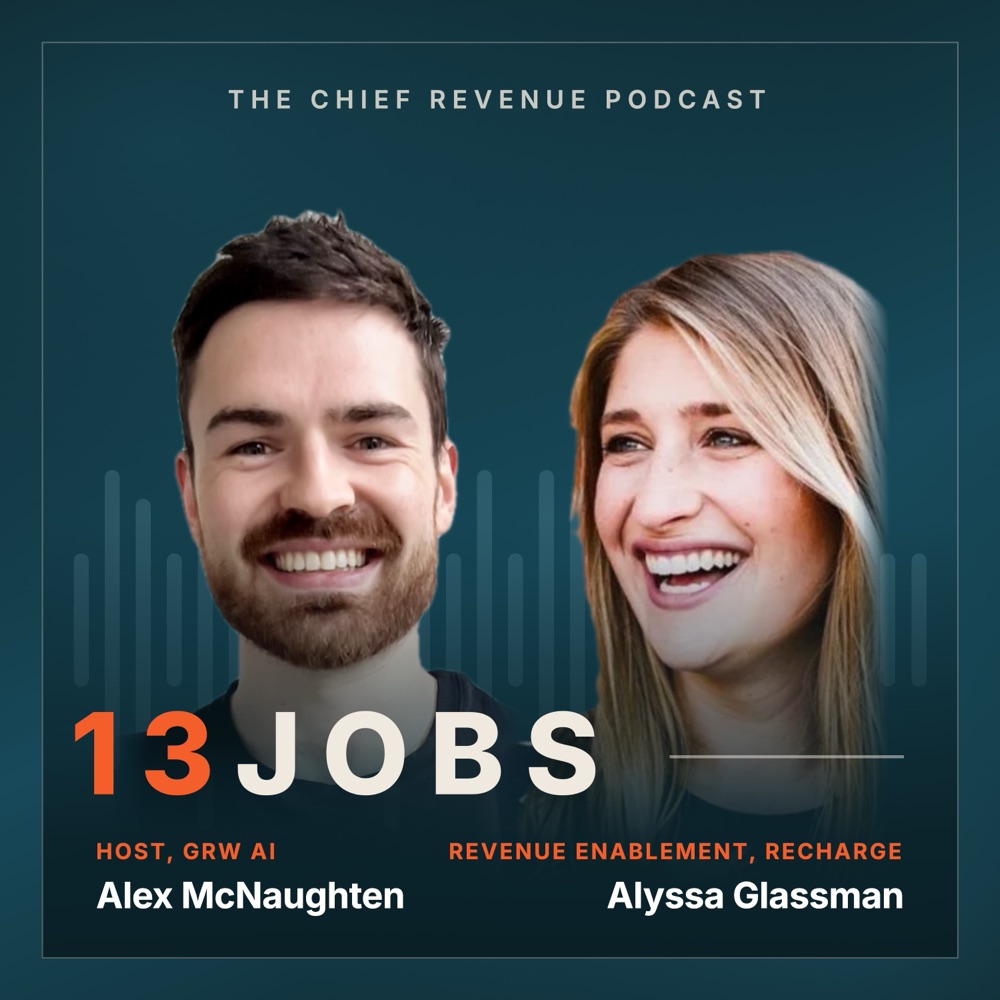
 Hosted by Alex McNaughten
Alyssa Glassman · Revenue Enablement, Recharge
Alyssa Glassman leads revenue enablement at Recharge, the subscription management platform behind more than 15,000 merchants and 50 million subscribers, supporting about 120 people in go-to-market seats.
She started on a support desk at Bloomberg, moved into sales and account management, founded a retirement planning business working with Bay Area tech companies, then joined Ripple, where she built a global executive education programme. When the pandemic closed that down she pitched her team on building an enablement function instead, and got the budget and the headcount approved in early 2020.
In this episode, we discuss:
- Bloomberg, a retirement planning company, and a nudge into crypto
- Pitching the function into existence in early 2020
- Three categories: role-based, product and market, tools and process
- Air traffic control across product marketing, legal, RevOps and PR
- Knowing when a piece of work is not yours
- Bring it in-house once there is product market fit
- Enablement as scalable behaviour change, learned in series
- Random acts of enablement, and one OKR a quarter
- Outcome-based enablement, and metrics the business cares about
- Market training is what makes a seller credible
- Activity against quota relief, and who is worth investing in
- Ten weeks of training then, and what a new seller gets now
Quote of the show
“They either say, I'm not getting enough enablement, or I'm getting too much enablement and I don't have time to do my job.”
Key takeaways
- Only one of the three is strategic. Product, market, tools and process are largely tactical, set by someone else's roadmap. Role-based training is where an enablement team decides what changes.
- Ladder every programme to one OKR. Random acts of enablement happen when every team is trying to train the sellers at once. One high-priority outcome a quarter, run in small cohorts, with the managers in the room.
- Buy-in comes from the top or not at all. If the CRO does not invest in it and say where they have opinions, programmes get repurposed. Tying the work to the numbers the leadership is measured on is what stops that.
- Nobody ever reports the right amount. It is either too little or too much and there is no third answer, so do not read the survey as the verdict. Track the seller whose average deal size doubled instead.
- Bring it in when you have product market fit. It is a scale function. Before the messaging settles, a strategy that turns over every six months gives it nothing to scale.
- Plot activity against quota relief. The people doing the work without the output are the ones worth the investment. The quadrant tells you who they are before the quarter does.
- Learning happens over time, not in a week. Ten weeks of training at Bloomberg is not what a new seller gets now. Multi-part programmes, mixed modalities, and enough repetitions for it to become a habit.
Transcript
Alyssa, really good to have you on. How you doing?
Doing well, thanks. How are you?
I'm really good. It's good to see you. Well, virtually this time after meeting you in San Francisco earlier earlier in the year. Um, tell us a little bit about yourself. So you've been in this like sales enablement world and working at some awesome tech companies, um, in sales enablement, but tell us a little bit about your story and, and what you're doing today.
Yeah, I did a whole lot of things on the way to sales enablement, and I think that's something that you will find is pretty common. Uh, this industry is pretty young, I think, uh, probably like 5 years in name. And so a lot of us have a lot of different backgrounds. I started out at Bloomberg on a support desk, moved into a sales role, never had a BDR, which I really missed out on.
I think would have been awesome. Had to go hunt and kill. But it was, it was really good having that experience and also doing some account management along with it. I tried to break into more traditional tech from there, and I honestly had a hard time crossing over. It was hard to speak the language.
The vernacular at Bloomberg didn't translate necessarily. We had our own CRM system. Everybody wanted Salesforce information. And I took a different path. I ended up founding my own company. It was a retirement planning business. I care a lot about personal finance and thought that that was a great place to do it. Worked with some really great tech companies in the Bay Area, leading their investment committees and helping them to offer differentiated benefits to their employees at the time.
But I definitely was impacted by, by the scale of just how much you had to put in the business and found that being a founder is really tough. You often have to do a whole bunch of things that are not in your wheelhouse, whether it's standing up a website, running payroll, researching taxes for the business.
And I wanted to really just grow as a professional. Um, I actually had a client from Bloomberg who, uh, had suggested that I look into crypto at the time, and he's like, Alyssa, you're in San Francisco, you need to go work for a crypto company. Like, this is the future.
Yeah.
Took a job with Ripple. I actually built out their executive education program, which was a global program. Um, and in the pandemic, I just saw everything kind of like closing closing up. And I was like, oh shoot, we're not gonna be able to run this program. It's gonna look really different. But I know there's still a lot of value here.
I was running sales training at the time. And I was like, I think there's this broader umbrella of sales enablement. And so I pitched my team on building a function, getting a budget, hiring a team to support that, and was able to get that approved in early 2020, which was great. And so that's where my official, like, sales enablement career kicks off.
So about 2 and a half years in name, but I was able to hire out a team of 3 there, run a budget, everything from sales kickoffs to day-to-day training, and we can break down what that is. And now I'm working for a company called Recharge Payments in the e-commerce space and supporting a team of about 120 folks who are in go-to-market seats.
Yeah, it's awesome. It's a cool journey you've had. And, you know, even though in years of tenure your sales enablement doesn't sound like long, but in sales enablement, that's really long because it's this new function effectively.
Yes. So I've heard something that's like, if like a lot of people who like get into different functions, like their experience doesn't make sense until they get there. But I often find myself pulling on my executive briefing education. I pull my— find myself pulling on my sales knowledge and like managing a territory and like these different pieces of my career to really round out and build functional education for the teams that I support.
So let's just— we're gonna talk about sales enablement today, and I wanna start with like, what is it? Because I still feel like there are a lot of companies out there who don't really understand Yeah, that's, that's a great question.
I like to break it down into 3 main categories. So sales enablement is role-based training, product and market training, and tools and process training. And in my world and a lot of other folks in sales enablement, we support more than just sellers today. So that role-based training really extends. Yeah, I think that's a great point.
So we have AE training, we have BDR or SDR training, we train sales engineers, and then you have account management training, partner management, or some sort of business development.
Mm-hmm.
And as well as your solutions team, so your implementations folks. So a lot of different roles to cover. I like to always say like I'm a subject matter expert when it comes to facilitation, when it comes to adult learning, when it comes to content and packaging, you are the subject matter expert in your role.
And so I really lean on my sales managers, my account management, management team to be able to really share what their teams need in order to develop that training.
Mm-hmm.
Because we really look at it end to end. We look at training our teams, we look at the content that they need to be successful, and then any sort of tools and process behind that. So, um, we just did a bit of a facelift to one of our pricing packages. And so we needed to not only train the teams, but we had to make sure they had all the externally facing content.
And so that consisted of interviewing different folks along the value chain who were providing value Making sure that we could package up what they were doing, training our teams to use that, and then backing into all the tools and process that need to be updated behind it.
So it sounds like there's a lot there. Like, that's a, that's a lot of stuff for a team to own.
We're like Jacks and Janes of all trades. I like often say I'm an air traffic controller. I think if someone's interested in getting into sales enablement, one of the best things that you could do is just get really curious. About the, um, the teams that you work with and the teams that you support, because you really interface with every team at the company.
Um, I interface with product marketing on a very consistent basis because they're providing me with the source content I need.
Yeah.
I interface with legal on a regular basis when they have a rollout to make sure it gets into my order forms. I interview and, and I, uh, work with RevOps. To make sure that if we have any sort of like pricing, packaging changes, anything like that, it ends up in our CRM. Work with PR if we need to put a logo in a deck to make sure that they have approval.
Mm-hmm.
So you oftentimes become a bit of an air traffic controller, but I also think it's important to step back and be like, when is this not mine? And product marketing is a great example where my product marketing team really owns the source content. They are responsible for that like source piece of content, and then we can take it there, we can package it, we can deliver it.
But we— they're sort of the owners of that information.
At what point does it make sense for an organization to start bringing sales enablement in-house, do you think? Because, you know, like what you've described is fairly resource and people intensive. So like at what stage of a business should they, in your view, like when do you think a company should start thinking about sales enablement and, you know, how do they go about it?
I think there's 2 schools of thought. I think people who have been practitioners will often say like, get it in as early as possible, build it into your DNA, build it into the functionality. I've also worked in very nascent industries, blockchain and crypto. Constantly evolving. I saw, you know, our strategy change every 6 months as a result of just differentiation in terms of product market fit.
So I think it's very dependent on what your industry is at. But I think when you get product market fit, and when you start to scale those, those functions, like, at the end of the day, like, we are a scale function. So I could go into a 50-person company and be an effective air traffic controller.
But if you want me to act in my capacity as a scale function, do it when you have product market fit. That's my best, right, best piece of advice.
Right. So once you have product market fit, that's when you pour fuel on the fire and invest in sales enablement. What are your thoughts on, you know, using external partners versus doing everything in-house? And does that change at different stages in you know, in an organization as well?
I think a lot of the times what— when I say scale function, I really mean like scalable behavioral change. So when you're continuing to evolve your messaging, when you're testing different messages in the market, you're still trying to find fit with your messaging. And I say you bring it in-house when you're trying to create scalable behavioral changes.
I think that's, that's the most important. And having that function, it can sit a lot of places in the organization, but as close to the teams that you support as possible, the more you're going to have the trust and the buy-in to try different things. Because a lot of times folks get really ingrained, whether you're, you know, a new seller or you're a more experienced seller, you probably have your way of setting up your calendar, setting up your week.
You might not want to try A different way to set up your calendar, schedule your time, have exit criteria. And I've often found that in order to do that, you need to learn in series. You need to have multi-part trainings where you not only get delivery of information, but you actually get to try something out, put your hands on it, see what works, and also like be able to voice like, hey, this is like not really working for me.
Like you know, doing 30 calls a day is really challenging because I have this many customer meetings. What's the expectation here?
Yeah, it's an interesting point, right? And into— and I like how you split it out into those 3 areas, and you specifically called out role-based, role-based versus like product and, and I guess mark— and market. Um, because I feel like a lot of organizations, certainly in this part of the world in particular, don't take into account the role-based side of things, which is how do you actually apply your product and market knowledge in a sales situation?
Um, yeah, do you want to just expand on that a bit?
Yeah, I would, I would say in terms of those 3 areas, the one that you want to be the most strategic in is your role-based training. I would actually say that your product and market training and your tools and process training tend to be more tactical unless like your enablement team is introducing new tools.
But typically like we have to rely on a product roadmap in order to roll that out. We can make requests for how things go to market, like say that we have all of our features or functionality launch once a month, for example, and we train on that. But in principle, like we're actually like quite tactical when it comes to that.
When it comes to the role-based training, that's where you can really make an impact. I really like to work with my— I call them enablement captains, but I have a manager from each team who represents each role. I meet with them on a biweekly basis, and my team meets with them as well.
And we focus on one high-priority OKR for the quarter. Because I think a lot of times you can get tasked to do this and that. And there's a term like random acts of enablement. Like everybody is trying to like train your team at once, and you're like— They can't absorb this much information.
Yeah.
Like, I need you to, like, like, back it up a little bit. And so I think when you can really be thoughtful about that role-based training and ladder up to a high priority OKR, that's how you get more effective. So for example, my sales team for the last 2 quarters, for the account executives and for the sales engineers, we focused on Moneyball stats.
So we focused on like what is actually gonna like drive quarterly for the business. And so we've run training in small cohorts around pipeline generation, time to close, and deal growth.
Interesting.
Increasing average deal size. And we work with our team, small cohorts, the sales managers are working alongside of them. And that is a strategy that we are using to drive our top line number.
How do you get sales leader buy-in? Because sometimes sales managers, you'll get, they'll push back and say exactly what you said. It's like everyone's coming at my team trying to teach them stuff. They don't have enough time. Or sometimes just the sales leaders themselves think they're doing enough. You know, how do you get sales leadership buy-in for role-based development?
It definitely has to come from the top, like 100%, full stop. Like, if you are a CRO, a VP of Sales, Head of Revenue Solutions, I cannot tell you how important it is to invest in, you know, your enablement team and really let that drive the decision-making and also like let us know where you have opinions.
I think that's, that's incredibly important there. And at the same time, I think when you're laddering up to those high priority OKRs that are actually hitting their metrics and their numbers, that's how you make sure things don't slide or get repurposed.
So as long as you tie what you're doing into an OKR or a number of OKRs, then, you know, that's how you can keep getting the buy-in to keep reinvesting in this area. That makes total sense. Exactly.
The holy grail is— I'm sorry to cut you off there.
No, you got it.
The holy grail, the head of Salesforce, her name is Jodi. I forget her last name, but she talks about outcome-based enablement, and they are actually tracking who goes through their programs and what the impact is on their metrics. That is the holy grail. Most of us do not have the data to be able to do that and track that, but we do want to track metrics that matter for the business.
Want to be as tied to revenue as possible. You want— at the end of the day, the business is not going to care about your CSAT scores, your NPS. Like, yes, it's important. I will absolutely say the role-based training is really important for retention. When folks in go-to-market seats feel like they're getting developed as sellers, as account managers, that's where you really build loyalty and retention.
But it's not gonna come out on your surveys.
Mm-hmm.
I will tell you, it always goes like one of 2 ways. They either say, I'm not getting enough enablement, or I'm getting too much enablement and I don't have time to do my job. There's never like, I'm getting the perfect amount of enablement and training. Like, that's not how our world works. So don't be deterred by that.
When you are able to track outcomes, when When I can see that one of my sellers who took my deal growth development path doubled their average deal size, like I have something that is like quantifiable and they have something that's quantifiable and they can really say, I am getting developed as a seller and that's what matters at the end of the day.
Yeah, you're right. And I remember a sales leader telling me one time, he's like, look, as long as my— as long as I can help my team make outrageous amounts of money, they're gonna be pretty happy. And like in sales, it's not all about— it's not just coin-driven, but like if you take someone who's doing okay and you help them crush quota the next quarter, chances are they're going to appreciate the help they've been given.
And it's interesting you saying that this has to come from the top. I think that's definitely something we've noticed from companies we've worked with is the ones who are, who really get this and it filters down from that, whether it's a C-level person or even a founder sometimes, you know, that's where the team really gets behind it because they see that that person up top values it and values them and their development.
Whereas the companies that are more on the fence about it, it just filters down in the culture, unfortunately. And that's where you see people just not taking it as seriously.
Um, 100%. You need that, that balance of like, I want to make you a lot of money and I want to make you a fundamentally better seller. Um, and they're super critical.
The retention piece is interesting. I'm glad you mentioned that because there was— it was, it was Allegis did some research on this, the world's largest recruiter, and they said that they found this particularly with millennials and Gen Z is that I think, I think I always met my other stat, but I think it's 67% of them.
It was either 63 or 67% of them said that they would stay in a role for 5 years or more if given regular professional development and mentorship. And then, you know, if that's not reason enough for companies to invest in this stuff right now, I don't know what is, especially in this like crazy talent-tight market with retention being such an issue.
Now, I know there's been some changes in the market a little bit, but it's still pretty tight. You know, there's still not that much talent out there. So super important. You mentioned market training, um, and I think that's often underappreciated. I often see companies over-index in product and not enough in market. Do you want to talk a little bit about that?
Yeah, I think that where that really comes in is helping your team to act as better thought leaders. And a lot of times you can really source that from internally, um, whether it's your product marketing team, your account managers are sitting with customers day in and day out. They have a ton of thought leadership to share.
And so packaging that up, not just in terms of the product or the competitive landscape, but helping them to really understand industry trends. We do a State of Subscription Commerce report each year where we look at different verticals, different sizes of merchants. And by doing that research, our sellers, our account managers, they can be more credible when talking to our customers and our prospects and help them to learn more about the key KPIs that could drive their business, especially if they are a newer merchant in the space.
I think it's just even just part of just being able to relate to your buyer. Like if you can speak their language and you can use the words that they use in their space and understand what's going on in their world, you can have far more of a credible authority-based conversation with them rather than just flogging product, which I think sometimes when sales enablement is done poorly, it's too product-centric and it misses that, that, that, you know, it misses the role-based piece or it misses the market-based piece or both.
Yeah, I would, I would absolutely agree with that. I think we are— we have a hard task. We're trying to build trust and gain commitment in a virtual environment. So there's naturally a barrier here, and that's really challenging. And so the more that you can speak the language, the more that you can help to reduce those barriers to entry.
Yeah, exactly. Let's bring on to the last area, which is tools, you know, tools and process. What are the key tools that you're using in your stack right now? Like, what are the— and we don't have to go into specific vendors, but I mean, like, what are the key tool, you know, the buckets that you use?
Yeah, so we, it's really interesting. I was at an enablement conference and someone put up a stat that there's over 700 sales enablement vendors in the space and I feel it in my inbox. So like, I apologize if I haven't gotten back to you, but there are a lot of tools right now.
I think we will see a lot of vertical integration, especially with some of the larger players. But as a whole, like, you absolutely need to have a CRM. That is so mission critical, and a CRM that connects— can connect data with your product, with other tools, is extremely critical. We're actually going through the switch now, and it definitely takes a lot of work.
Having like a call or an email vendor is really important, making sure that you can easily connect to your customers. That's critical. And I know it's kind of different all over the world in terms of who has the best sources for emails and phone numbers and all of that. And one, certainly a tool for like doing all of your outreach, all your prospecting emails in bulk, personalization at scale.
Scale is really important these days, and so that's a critical piece. Another tool that I hadn't used previously, but I cannot do my job without now, is a sales quadrant. It's sort of sort of showing your like will versus skill, but it's not something that I had had in the past. Being able to look at my team on a whole and say on the x-axis how many activities are you doing based on where we think you should be, and this is a combination.
Of calls, emails, SAOs, whatever we think is really relevant to create a cumulative score. And then as well, plotting that against on the y-axis, your quota relief. And so that gives us really good information, like, are you able to hit your quota without putting in the activities? Is there a reason for that?
Are you just really efficient and good at it, or is this a leading indicator for a future quarter? Are you putting in the activities and you're not getting the output? Those are the people that I really want to invest in. If you are putting in your activities and you're not getting the output, I want to help you be able to move up and get that quota relief.
So it helps me to really see who we need to help. When I build my trainings, I rely on a lot of the data from our CRM. I am looking at win rates, I'm looking at launch rates, I'm looking at call-to-connect rates, I'm looking at how we transition throughout the funnel. And I want to build to really have scalable behavioral changes based on that information.
Mm-hmm.
So those are some of like the key tools that I use and that our tool— our teams just like also need to function on a day-to-day basis. The other one that I didn't bring up, having like an LMS and a CMS is really important as well for enablement. I've seen this in a lot of different flavors.
I haven't seen a single LMS that I think is worth it. It's so like, I wish it just looked like a TikTok feed that I could scroll on and search through. But lots of LMS, learning management systems out there, and then having a content management system as well. Like, if you're early days, you can absolutely get by in Google Drive.
I definitely recommend having like a shared space in Google Drive. I've seen like both versions where like everybody has their own files versus like a company-wide directory. You can absolutely get through in early days, but once you get to a larger level and you want to be able to track like, let's say, pitching content or stats behind how much the content's being used, that's where having a content management system or a CMS is really valuable.
Yeah, that's a good point. And it's funny you say that about LMSs because you're right, they haven't changed.
They haven't changed.
Because I've been in— I was in— I used to sell like talent and learning solutions and yeah, like it just has not moved forward. It's the same exact thing that I was selling 7 years ago or 6, 7 years ago. And it's crazy to me. You're right. Like with TikTok and Instagram and all these tools, you'd think they'd look at that and the behaviour of how people consume content.
And create a learning experience there.
That's our competition, 100%. Like, they can easily just like pop on their phone. Like, that, that is our competition. And I have seen some good solutions coming out around just-in-time learning where they actually like layer it onto the web page so that you can do your training inside of Salesforce or inside of Tableau or something like that.
Which I think is, is really interesting. So I'm hoping there's some evolution, but it's something that I think about frequently.
Yeah, it's an interesting one. Alyssa, there's been a really interesting conversation. I love how you've broken it down and made it really simple for people to understand on enablement. We've got one last question that I ask absolutely everyone who comes on the show. Um, which is going back to your first day in sales when you were an act— when you were a rep, um, and knowing everything you know today, what's the one thing you wish you knew that would have changed the game for you?
It's a really good question. I wish that I had really learned how to use data quicker and, um, and really leveraged it. Like, at the end of the day, like, being a seller, like, your numbers, your output is the biggest piece. And so there's always gonna be a lot coming at you. But if you can really understand your data and know how to territory plan, figure out like just those basic pieces of like territory plan, account map, have a strategy to stick to with your schedule, like those those pieces are really invaluable for getting started.
And I feel for people coming into the industry. I think there is less and less training. Like when I joined Bloomberg, I got 10 weeks of training.
Yeah. Yeah.
In the markets. Like it was incredibly generous. I don't see programs like that as frequently now. And so if there are people who are willing to invest in your development, mentor you, take advantage. I think that learning on the job is really critical as well.
Yeah, it's so interesting you say that because, you know, it wasn't that long ago that I got into sales. You know, it was about a decade ago, and the investment and the level of training and development you got was, I would say, 5x what people are getting today. Like, it's significant. And it's actually not, not to plug, but it's actually like why we developed our learning program the way we did, as in it's this like ongoing continuous professional development approach.
Because I think we've, you know, we've kind of devolved almost learning when it's being done poorly into this like quick dip day course or quick dip, here's a training for a week, now you're good to go. And it's like, well, that's not enough, especially in a role that has so much— and roles in sales that have so much nuance.
You know, effectively we're teaching people how to people, you know, how do you interact with people?
Yeah.
And that is not a simple subject. And then there's all the supporting things around that, you know, that you spoke about today, like market, product, the specific role-specific stuff. And then you've got to learn how to speak to people and connect with people. Like, it's a lot. Yeah, you can't do that in a week.
You cannot do that in a week. I think learning over time is one of the best strategies and having it available in lots of different learning styles. So on-demand, in person, um, mixing all those modalities is, is going to be really important because you need to— I think you have to, to do something like 16 times before it becomes a habit.
Um, and so like learning over time is so incredibly important.
Absolutely. Alyssa, it's been a pleasure having you on. Really appreciate it. Where can people find you if they want to connect with pick your brain on some of this stuff?
Awesome. LinkedIn is the best place. Alyssa Taylor. I work for Recharge Payments. Shouldn't be too, too difficult to find.
Thanks so much, Alyssa. Speak to you soon.
Awesome. Thanks, Alex.