
Never ask for anything but help
Jared pulled a member aside who was about to pitch the community and told him to ask for help instead. Same goal, opposite reception.
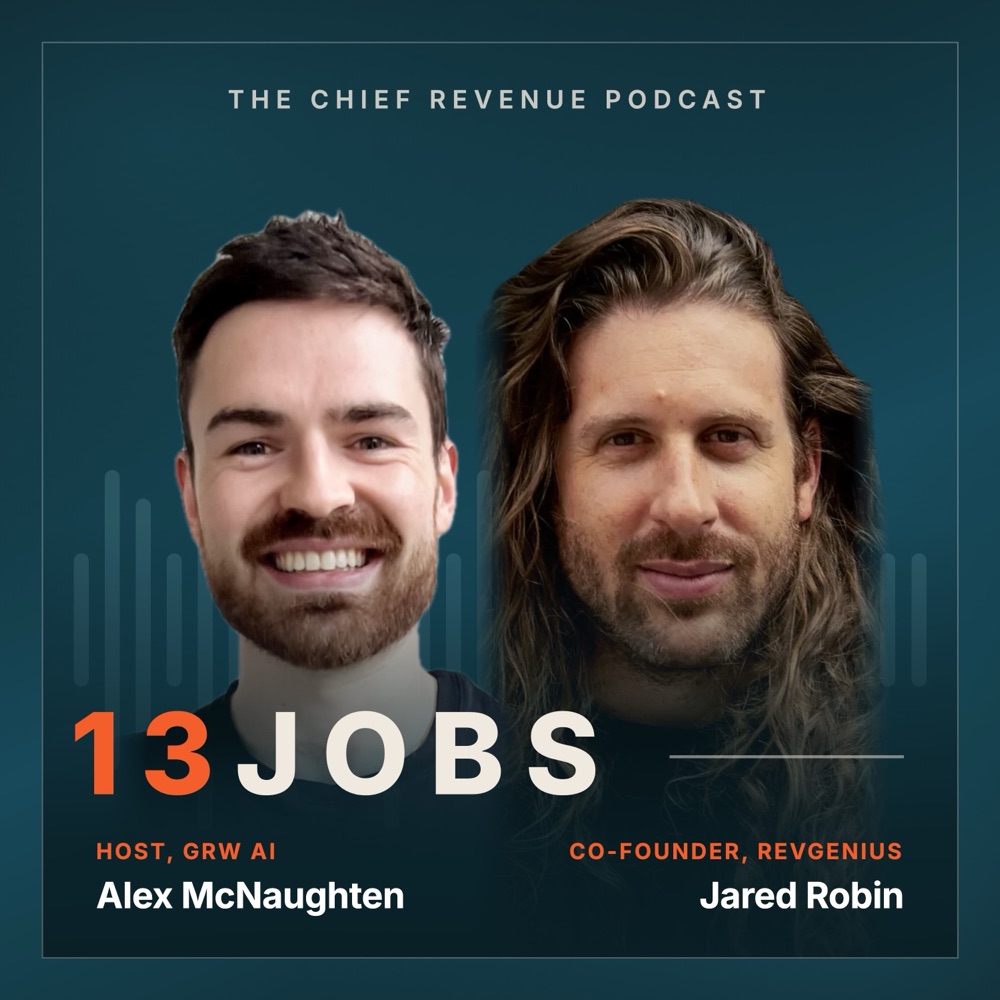
 Hosted by Alex McNaughten
Jared Robin · Co-founder, RevGenius
Jared Robin is the co-founder of RevGenius, the revenue community he started with Galem Girmay at the beginning of COVID because the existing spaces felt neither organised nor inclusive. He is the son of a salesperson, fell into the profession like most people do, and spent seven years at FedEx before moving into technology.
He describes what RevGenius is building as a revenue empowerment community: guided by rules against outbound selling, and held together by people asking each other for help rather than pitching.
In this episode, we discuss:
- Christchurch, Queenstown, and a skydive
- Starting RevGenius, and the gap they saw in the existing communities
- From company-centric content to something worth reading
- Ask for help instead of pitching, and watch what happens
- Only helping the people who actually ask
- Giving means giving away from your business model
- The thing no large platform manages to scale
- Three months under number and you are gone
- Clubhouse, and any platform that can scale realness
- An argument you would never get in a comment section
- Which other profession asks whether something is appropriate
- Joining one: lean in. Starting one: find a need you have felt
Quote of the show
“Vulnerability is magnetic, right? Because it's real.”
Key takeaways
- Ask for help, not for the sale. Announcing your product gets a small yes, a large shrug and a few people actively put off. Asking how to position it gets goodwill, advice, and occasionally the buyer you were looking for anyway.
- Giving means giving away from your business model. An SEO agency publishing an SEO white paper is a best practice, not generosity. Helping someone with something you do not sell is what actually earns the room.
- Vulnerability changes what people do. He watched it inside one call: a confident plan got polite interest, and admitting he did not know what he was doing got offers of introductions.
- Empathy is the thing that does not scale. LinkedIn, Facebook and Clubhouse cannot do it. A community of ten thousand can, and whether it survives a hundred thousand is the open question.
- The revenue world has no human element by design. Three months under number and it does not matter who you are. A community is worth building precisely because it holds people the way their job does not.
- Realness is the format, not the platform. Audio, unrecorded and unsaved, gets people talking as themselves. What makes it work is that the conversation is not only about business.
- Start with a need you have felt. Not a thirtieth version of something that exists. Get a small group talking, check the hypothesis holds, then add people. Minimum viable audience.
Transcript
Jared, how's it going, man? Thanks for having you on.
It's going well, it's going well. And, you know, little, little-known story, I studied at Sydney Uni for a minute, so I have been to the South Island. Just thought I'd throw that out there.
Oh, cool.
Catch you off guard.
So you have been to the Southern Hemisphere. Awesome.
Christchurch, etc.
Very cool, man. Okay. You remember the spots too. So Jared—.
I skydived in Queenstown. But anyway, go on. Wow.
I love Queenstown. That's probably my favorite part of New Zealand. So Jared, you're doing some cool stuff. So you set up and founded this awesome community, Rev Genius. And before that, you're in various kinds of sales and sales leadership roles. So tell us a little bit about yourself.
Hey, thanks. Yeah, along with Galen Gourmay, we co-founded Rev Genius and we did it because we saw a need. We saw other communities and clubs out there and we're talking a year ago, but at the beginning of COVID there was just so much content hitting you and so many people active and so little organization.
And sure, there were quote unquote other communities, but we still saw this gap in like inclusivity and really having this open and inclusive vibe as well. But my history starts, my professional history starts about 15 years ago. Went to school, super entrepreneurial, but as many of us do in the sales profession, we fell into it, whether it's intentional or not intentional.
Very few people come up like that. And I'm the son of a salesperson, so I knew that that was potential in my, you know, my vision. And I knew if I met— if I majored in marketing, I would just go into sales because we're thinking 15 years ago before like digital marketing was as like great and growth hacks, etc., as it is today.
It was like a little more old school best practices type stuff. So long story short, I'm here today. I had various sales roles. I was outside of technology working for FedEx for about 7 years, learned a ton, had short hair at the time, as you can imagine, suit and tie at the time, as you can imagine.
If you ask me kindly after the recording, I'll show you a picture, but lots of good stuff there. And then transitioned to technology where I've spent the last 7, 8 years. Went from Fortune 100 to early stage, trial by fire, failed before I succeeded, and I'm here today.
That's awesome.
So a few different roles.
That's awesome. That's a cool journey. Very. And I can definitely relate to falling into sales. That's, I think, the common story from speaking to probably a fair few hundred people in the sales profession now. And look, today, so we're going to talk a little bit about community today and I guess how that relates to revenue.
So kick us off. You know, we spoke a little bit about this before we started recording. What does community mean to you and how have you gone about building community?
Yeah, awesome questions. And community is everything to me. And I think I started really like diving in a few years ago in my career where I was looking at like double-sided marketplaces without realizing it. Because you had like a buyer and a seller, whether it was art on the blockchain, which I did, or helping photo shoot productions.
It was connecting to humans, and sure, companies were behind them, at least in the the photo shoot space, you know, where I was working with Foot Locker, etc. But the artists and and humans weren't, and and super interesting, right? Like I I went away from the SaaS. Space because I saw, or I'm sorry, directly selling SaaS for a little bit, and I got back into it.
But because I saw that interactions amongst people were the future, like like it's it's so funny interactions hearing myself say that now it seems like second nature. But way back when it's the people representing a company that would buy things, and now. It's very much individuals and more individual. So, you know, fast forward to now, we're definitely in, in how we view community and what leads me to community.
We saw social media has, you know, since I graduated college, been a central part to our lives. And that's 2005. And that's, that's Facebook, right? And along the way, it became professional to ask people for, for business on these networks. And as soon as I got onto LinkedIn 10, 15 years ago, I must have been one of the older ones there.
I'd reach out to people and prospect and do all that. And then, and then in the last handful of years, putting content out became a thing. So people would put content out about their companies, and this is the evolution to where we're at today, right? Um, and, and the content would be very company-centric.
The selling would be very company-centric. Hey, do you know FedEx? We get you— we get the products there faster. We do this amazing thing, that amazing thing, and this. And it would resonate sometimes, but then there'd be a lot more people that came into the space and you had to change the content you put out, change your sales process, etc., to asking questions.
What do you need? Gaps do you have, etc.? And then it moved to putting content out of value, like where you're just giving. And that was really the impetus of community as we see today, right? So you have LinkedIn, and now I've put today like the 4 tips to help you do better in communities.
1, lean in. 2, all this. Like, it's literally there today. Now, how we branched and the gap we saw with LinkedIn was it's very business-focused and people aren't really fully getting it all the way top to bottom. And the connections are kind of not as deep as away from LinkedIn, you know, like, hey, can you introduce me to this person or that?
It's not, how are your kids? How could I help you? Honestly, sorry to hear about this or that. So bring the same people into a micro-community. And micro-communities is what folks call it now, but, you know, we're building a category called revenue empowerment community where the people really are the central focus and understanding that if you have a job, your job is your professional goal, like to probably do better there, make more money there, et cetera, but create this culture where it's guided by guidelines like no outbound selling, no, none of that, and create this vibe, create this energy.
And one example of that, and so how can you, without outbound selling, still have sales as a focus, right? Like, and still be revenue generated. So one, you can learn, right, how to do this outside of here. That's big and that'll get that. But even within the community, there are deals happening behind the scenes.
How? And the one answer that comes to mind, this awesome solopreneur, newer entrepreneur, I should say, he's building out a team, a smaller team. It looked like he was about to sell in the community. I pulled him aside in a private Slack channel and I said, it feels like this is what's about to happen.
My suggestion, don't do it. And my suggestion is, if you don't Clearly you want to get business. If you don't know how, or you need a better idea or game plan or process, ask. You'll get more love saying, hey, I'm having a hard time finding who I should sell to, or how to sell, or how to sell my product, than Just saying, hey, this is what my product is, and and that's human nature, right?
So if I'm selling Rev Genius, let's say, and I go into another community and I say, hey everybody, it's great. Rev Genius is the best. This or that. People, maybe a small percentage will be into it.
Yeah.
A big percentage will be whatever, and a small percentage will be super turned off by it, right? But if I went in and I'm like, hey y'all, I just started this micro community. This is what we're doing. Would love your help on how to position it to people just like you or people like your friends or your brothers or your mothers or your sisters.
Does anybody have a few minutes? Like, I might be able to help in another way to repay or something. You're going to get so much goodwill and somebody might raise their hand. Nobody's going to be turned off in general, right? Like, you'll still get a good percentage of neutral people, but you're going to get people that help.
And you're gonna get people that might even buy. Like, wait, what do you do again? I'm actually in the market for that. Can we talk about it? Yeah, that's simple positioning. So thanks for allowing, uh, my, my evolution discussion. But where we're at today is lean in, um, be vulnerable. No one will say anything against that.
And vulnerable Vulnerability is magnetic, right? Because it's real.
Yeah. And I think you touched on something like super important there is this people's kind of innate need to help others. It's just there. Like it's part of human nature is you want to help people. Well, I think a lot of people have this in them.
I agree.
And rather than going out there and just trying to self-promote, is leading with a bit of vulnerability and actually having some trust that you're just not going to get beaten down and that you're going to actually maybe be lifted up by someone is a far better approach. And I've seen it in small ways and I think that like in one-on-one interactions and I think it absolutely translates into community.
I mean, before this call, I went from having a strict idea of what I wanted to do in the VC world to being like, I don't know what I'm doing, right? Like, and, uh, and you felt probably a different, uh, magnetic pull or push both times, right? Like, it's just the way it works.
I didn't do it intentionally, but, but, right? Like, 2 totally different things. Like, okay, let's let him be, to, oh yeah, I, I might have somebody.
That's right, that's right, exactly. So, um, what's, what's the expression? Never ask for investment, ask for help.
Yeah, I mean, you could use that literally never ask for anything but help. And, and, you know, without getting too spiritual or, you know, you know, out there, I'll say one thing, you know, one thing I'm trying to— and to your point, a lot of people want to help, right? And there is no fault in that.
There's no fault. But one thing I'm trying to do is I'm trying to get to a point where I only help people that ask. Because sometimes, like, you get anxious, right? We're all on our own journey. And if somebody asks help— and that's a whole bigger thing into, like, the actual revenue world, right?
Like, that's fine and dandy when you're asking about help with your children or not. But, like, when it comes to money, is it different? Frankly, it's the same principles, Matt. It's just that people aren't used to it.
So you also brought up a couple of other good, cool things though when you talked about building community and the evolution of how that's gone from, I guess, a content perspective, which is, I suppose, a part of it, which is this idea of value add and giving first without— before you even ask for anything.
Maybe just unpack that a little bit more and talk about building community and some of the key pillars that you need to focus on as you build a community.
Yeah, awesome question. And with giving, how I define it is giving away from your business model.
Okay.
Right? Anybody could give a white paper that shows how people use SEO to increase their search.
Right?
Oh, and by the way, I'm an SEO agency, right? Like, it's almost become a cliché. Everybody that's good does that best practice, right? But can that SEO agency help somebody, a salesperson, get a SaaS sales job way away from that, or help somebody even further away, right? That's the giving that ignites the whole universe.
And I just wrote, good on you. Like, like, our mission is to educate, empower, and inspire. We did our job. And, you know, be consistent with that. And, and no community— I don't know how many communities are out there that, that are able to scale empathy, so to speak. But it very much is a secret sauce that LinkedIn, Facebook, heck, even Clubhouse which I love so dearly, we'll never even— we'll never be able to do at scale.
And frankly, we have 10,000 people. If we had 100,000, are we able to do that at scale? I hope so. I hope so.
That's pretty cool. And I think you bring quite a— you've tried to really bring a very human element to community building, which I like and I think is a little bit different. And I think it kind of—.
Yeah, there's no community. There's no human element in so many sales jobs. Yeah, if you don't hit your number 3 months in a row, you're out. I don't care what your name is, what you look like, how many lunches we had together, meeting your parents, right? Like, 80%, you're gone. Okay, maybe 20% stays, but you get the idea.
Like, let's—.
So why not support you the way that the rest of this revenue world doesn't. And it's not wrong not to, but maybe it is a little wrong. Maybe there is a formula that is not VC-driven, right? That can work with the same results.
Talk to me a little bit about something you're obviously quite excited about, is Clubhouse. And I think just to set some context for people who are watching this in New Zealand, is because there's very few people on Clubhouse in New Zealand right now. And that's actually how we connected, funnily enough. I was messing around with it.
I just got an invite and was messing around with it. Talk to me around, I guess, how you're using that and what you see the potential for Clubhouse is.
Yeah. What excites— we spoke about what excites the most in like the community space, right? And this led to this. And I'm like, it's not other micro-communities, Sales 123, ABC, or whatever. Those are great. And I'm so happy salespeople have spaces. They're needed. But it's platforms like Clubhouse, Patreon to a lesser extent as well, but Clubhouse in particular, because any platform that could scale realness let's, let's break it down a little.
That could scale realness, good, bad, or otherwise. And I told you about my conversation. I said, everybody's in there saying, you know, try to get a job in 6 weeks, update your LinkedIn and do this and that. I said, those are great ideas, but, but if that's all you do, you're not getting a job.
Right.
And like gave like anecdote after anecdote. Any platform that could scale realness, and I've seen Clubhouse doing it As much, if not more, than others. I think part of it is because it's audio, so you don't have to see somebody. And, and for that, you know, it's, it's potentially more inclusive, uh, because you're not necessarily seeing what somebody looks like.
Uh, and it's also not saved and there's not records of it, so you're a little more free-flowing and free-falling with that. And that's super, super interesting to me. They're about to raise at a billion-dollar valuation. Most people that listened, if they're, they're on top of it, got on a month ago or less, right?
Yeah.
Like, I got on like 6 months ago or whatever, but like, we're always looking for the new thing. I started getting it a month ago when everybody was on because I'm, I'm on and I'm— and now I see it and, uh, and I'm excited. Like, people are talking, they have Zoom fatigue. I think the whole nature of being on your cell phone early and being able to do other things and not have to look pretty or proper for Zoom is major.
Mm-hmm.
And then, yeah, it's super interesting. It's super interesting. And there's not a ton of links, so you're not going to be promoting any of your websites. You could have your LinkedIn— I'm sorry, you could have your Twitter and Instagram. I wouldn't be surprised if one of those parent companies bought them. And, um, and that's it.
And it's, it's fascinating. It's working. You have a lot of celebrities on there in a good way talking about— like, I, I heard, um, and the conversations are real. So perfect example of the conversations are real outside of the business world, right? Because I don't necessarily think the conversations are real yet in the business world.
This is what excites me about this. Like, it's 14 ways to grow LinkedIn. Oh, how to ABM, how to— come on. Like, like, let's, let's talk about you. This is what we're scaling at Rev Genius, right? Clubhouse is doing this too. Example, 21 Savage. Do you know the rapper, the hip-hop artist?
Yes. Yeah.
His manager is in a room crying foul on the Grammys. Okay, crying foul. And and he's edgy about it, right? Like why da da da? Two people that work for the Grammys came on, and they're like, "This is da da da da." This is why LA as a city, not 21 Savage. Like 21 Savage is part of Atlanta.
Your home network's in Atlanta. You have less people in Atlanta than LA. This is how it broke it down in front of a couple hundred people. And then you had other people coming on like George Clinton and like all these other people, and it was fascinating scaling realness. Where are you gonna get that?
You're not getting that in a LinkedIn comment section. You're not getting that in Facebook, which is becoming increasingly partisan and political, and it's weird. Instagram is just pictures and da da da da, and the comments are the most surface level. TikTok is flash in a pan. You're not getting that realness. You can in micro communities if done right.
But I think part of the glory and the gold here is that it's not just business. I think, I think part of the struggle and, and what Rev Genius is so great at and what I love, and we're getting better, is that this business world is impenetrable. Or is it, right? Sexist, racist, all this is happening and people are cool with it without realizing they are because that's just the way it is.
And people aren't cool with it. White men don't realize it. We have privilege, right? Like, for me to say that, you know, let's take a step back. But that's the way it is. And it's not cool to speak about things that aren't business.
Hmm.
That's the way it is. People will say, is this appropriate for LinkedIn? Is this appropriate for this network? What other job do they say that? Like, what other, like, sales, marketing— like, they say that, like, hip-hop agents say that, like, is this appropriate for Facebook or whatever? They say that, um, basketball players say that, like, on whatever networks they're on, Twitter, all this.
They say, is this appropriate? Where else are they saying that? Hmm. Outside of this Fortune 100, 500, aspiring-to-be area.
Right. So I see your point. So you're saying, just so I've understood you correctly, you're saying that there's this kind of standard in—.
It's like bubble.
And it's kind of, it's quite fake and you're seeing platforms like Clubhouse and real community and communities like the one you've built where people are actually relating to the person they're speaking with. Not the corporate image that that person is kind of putting out on other platforms. Is that right?
Yeah, I believe so. And I think part of the reason on Clubhouse, to go full circle, is that because you have these other highly cultured communities there and not just business, it's like intertwining a bit more and making people realize that there's not 2 cultures, there's one culture. You know, racism, sexism, which is implicit in a lot of business, not only is not right, um, ethically, morally, or for your business, like, it just shouldn't be, you know?
Like, does that make sense? Like—.
It does, it does.
And I know we're going off on a tangent, but like, it's bringing it all back. This is why, you know, having this vibe that Clubhouse has, uh, has got, like, literally was influenced for us, the vibe, not Clubhouse coming through. I looked at the streetwear magazines I don't know if you know Highsnobiety, Hypebeast, like all of these, they have millions of, you know, the Nike Jordans and all this as a big inspiration.
The business publications that are out there have a few hundred thousand, you know, visitors every month. These have millions. Virgil Abloh, like the culture. Clubhouse was able to get the culture. Rev Genius is getting there and it's exciting. And, and that's why I foster Clubhouse and, and vice versa. I have people texting me on Clubhouse, as I told you, that are running rooms telling me to get on there because, because they trust me.
Like, in that—.
That's pretty cool, man.
They, they're texting me to— for me to come on and plug myself. So like, think about that. Not me going on and plug myself. I have people texting me telling me now is the time to plug me. That don't work for me, that have no interest in me. Now we got that community full circle, right?
I get it.
That's community. So like, I don't want to. He's like, I'm gonna do it myself. And I'm like, all right, I'll do it. He's like, I thought it would come from you better. I'm like, thank you. Sweet.
And that's pretty cool. I think that's the power of community right there, is when people who you're not— yeah, you have no real professional connection with who are doing things for you. Because they respect you as a person and respect the value you can bring.
So just because they know I'm not doing anything to try to take, but to try to give. Yeah.
So let's try and like wrap it all up here. So I guess in terms of, I guess, like some practical stuff, you know, for people who maybe are building little communities in their own space or trying to develop community, you know, for their business or in their kind of sales role or whatever that might look like is what's like 1 or 2 little tips that they can quickly take away and kind of deploy to help with their journey?
So if you're looking to join a community and you're in like a revenue profession, one, lean in. Show up every day, lean in. What does lean in mean? If somebody asks a question, you know the answer, give the answer. If somebody asks to hop on a call and you think you could actually help them and you have time, take the call.
Okay, and, and that'll all come around. You see a comment you like, like it. Cool. Super easy stuff if you're going in. Now, if you're starting your own, understand what you're starting. I'm a big fan of not being a meat too, in the sense that like 30 people created this community, me too, like let me come in and do one as well.
Find a need, find a need ideally that you felt personally. And I've had people try to ask me to help advise them when they're seeing it from afar, and it's a whole different feel when you empathize, like you honestly empathize. If you empathize, you see something that's not being addressed. Get a group of people together and start talking about it and then see if they agree and then build it around them.
Start with a small group, talk regularly, validate your hypothesis, and then add people to the mix.
That's awesome.
Minimum viable audience, Seth Godin.
Exactly. I love that. So Jared, final thing is where can people find you?
Revgenius.com, R-E-V-G-E-N-I-U-S dot com, or LinkedIn forward slash in forward slash Jared Robin, J-A-R-E-D R-O-B-I-N, scrunched down in front of the DeLorean, long hair waving. That's nice.
We didn't even talk about that, actually. What's up with the DeLorean? Is there a story?
It's not mine. It was at an art exhibit. I think I told you a long this path that, uh, I was in blockchain art.
Yeah.
And I went to the exhibit, I saw the DeLorean, I said, cool. I scrunched down in front of it. My CEO at the time took the picture, and I'm looking at it. He sent me the picture. I'm like, is it appropriate for LinkedIn? I said, I'm in art now. Not anymore, right? And my CEO took the picture.
Check, check, we're good. And, and I, I just kept it.
It's a pretty cool picture. It's a good talking point.
Thank you.
Well, look, thanks, Jared. This has been a good chat. I've enjoyed this and I look forward to doing another one with you.
I really want to. Thank you.