
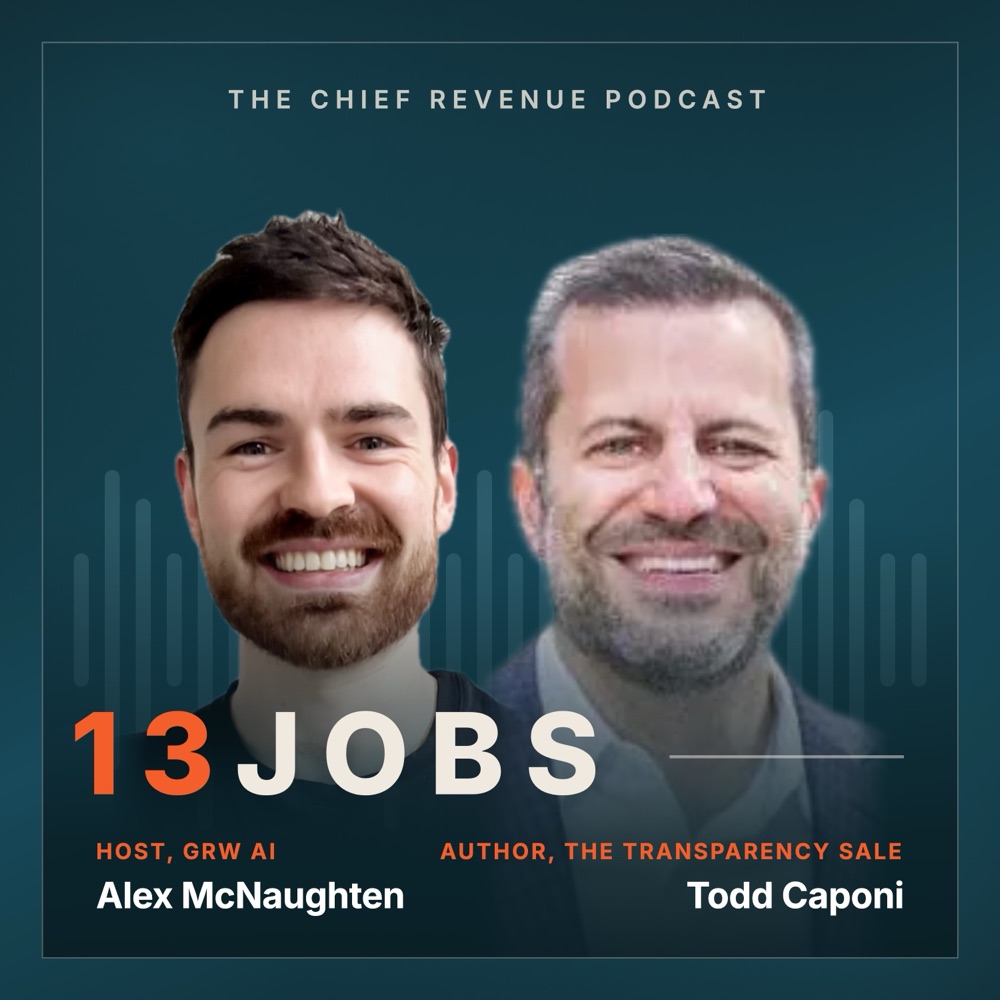
Transparency sells better than perfection
A product rated 4.2 outsells one rated 5. Todd took that out of the review data and into a sales meeting, and turned a six month cycle into ten days.
 Hosted by Alex McNaughten
Todd Caponi · Author, The Transparency Sale
Todd Caponi is the author of The Transparency Sale, a speaker and a sales trainer, and a long-standing student of behavioural and decision science. He was hired out of the US to run sales operations for the Auckland company Right Hemisphere, was promoted to VP of sales, and helped turn the business around before it was sold to SAP. He won Worldwide VP of Sales of the Year for that work in 2009.
He went on to lead sales organisations in the US, most recently as chief revenue officer of Power Reviews in Chicago, where a research study with Northwestern University changed the direction of his career. This episode is a throwback: a replay of a webinar he ran for the show's audience, complete with the live questions at the end.
In this episode, we discuss:
- Auckland, Right Hemisphere, and the study that changed his career
- Lost in the woods, and the brain that decides it is a bear
- The three things every buyer does when things get uncertain
- Messaging written in an up market fails in a down one
- Imperfection outsells perfection in the review data
- The IKEA proposition: what you give up to be great at your core
- Calvin Klein, and opening with what a competitor does better
- Ten days instead of six months, and the sixty one percent you never see
- Stop being all things to all people, and why logic polarises
- Present like a makeover show, not a pitch
- A to B: start with their current state, put yourself last
- Why the profession has been distrusted since the 1930s
Quote of the show
“Transparency sells better than perfection. A four-two sells better than a perfect five.”
Key takeaways
- In a downturn every buyer thinks the same three things. Cut discretionary spend, extend runway and reduce cost on essentials, reduce risk against the worst case. Messaging that promises growth is aimed at a nice-to-have.
- Imperfection converts better. Products averaging 4.2 to 4.5 stars sell at a higher rate than perfect fives, and 82% of people go to the negative reviews first. The buying brain is looking for the flaw either way.
- Lead with the flaw and the cycle collapses. Todd opened a meeting by explaining what a competitor did better. The buyer threw out the RFP and closed in ten days instead of six months, and the competitor's later pitch landed on ground already covered.
- Sixty one percent of the purchase happens without you. Reviews, analysts, peers, Glassdoor. Anything you leave out, they go and find. Doing that homework for them is where the time comes out of the cycle.
- Name what you are not. IKEA tells you plainly that you will find it, carry it and build it yourself, and wins anyway. Nobody does everything for everybody, so decide what you are giving up and say it first.
- Logic gets used against you. The logo slide reads as impressive to the half already on your side, and as proof you are too big, or too generalist, to the half who are not. Decisions are made emotionally and justified afterwards.
- Reorder the deck, A to B. Their current state, then the couple of problems they had not named, then why the current state cannot hold, and only then you. It is the choreography of every makeover show, and it is why the audience is bought in by the end.
Transcript
So welcome everyone, and thank you Todd for joining us here this morning. Um, so Todd, why don't you tell us a little bit about yourself and your connection to New Zealand, because there's an interesting connection here.
Yeah, it's funny. I don't know if anybody on remembers a company named Right Hemisphere, but they were around, you know, 2004 to 2010, founded by a guy named Mark Thomas, who I think is now the president of NextSpace there in Auckland. But Part of the way in, I got hired here out of the US to run sales ops for Right Hemisphere, and then shortly into my tenure, I was boosted up to VP of Sales, and we turned around the company, grew it, and eventually sold it to SAP.
I was actually in the news in Auckland in, I think it was 2009, for winning the Worldwide VP of Sales of the Year Award. For the work at Right Hemisphere. I went on to be the head of sales for a company called Authorit there. I was only there for about 11 months. And then since then, I've been, you know, run sales organizations big and small.
And the last one, I was the chief revenue officer of a company called Power Reviews. And I'm gonna tell you a little bit about that story because we did a research study. The results literally changed my whole life, which is the craziest thing ever. But that will be— we'll go into that a little bit.
But New Zealand is near and dear to my heart. Used to go out there every 3 to 6 months. I was on the advisory board for the New Zealand Trade and Enterprise Group here in the US that was helping to help New Zealand-based companies establish a foothold here in the US. So a lot of history there.
Awesome. Thanks for sharing that, Todd. And look, just for everyone else on the stream, if you want to ask questions, feel free to, feel free to put them in the question and questions on Zoom, and we'll get to them, get to them towards the second half of the call.
All right. And yeah, Alex, as we go through this, if there's a question, I'm going to keep the Q&A box open. I mean, we've got a small enough group here that if you want to ask questions, if something's relevant that I can hit on, I'll try. But to Alex's point, we'll kind of hammer on that at the end if we can too.
So this doesn't have to be just me yapping, we can have a little fun with it.
Awesome.
So if you're ready, I am.
Let's do it, let's go.
All right, cool. Well, thank you everybody for having me here. This is seriously New Zealand, I like that, my favorite place in anywhere, like even better than where I am. So I'm so excited to be hanging out with all of you again. So hopefully you can see my screen now. My background probably just changed to brick.
So Alex, give me a thumbs up if we're seeing everything good.
Yeah.
All right, cool.
Good as gold.
All right, cool. So what we're going to talk about today is, you know, given everything that's going on, and I know like we here in the States all the time, I'm based out of Chicago. About how New Zealand did such a fantastic job dealing with the last few months. So, so bravo. But I know it's had a real impact on business, on the economy, on the ability to travel in and out, and that's impacted all of our businesses.
So today what I want to talk you through is selling in an uncertain market. This idea that you can literally read minds right now, like if you could read the mind of a buyer, wouldn't that be helpful? Well, I want to teach you how to do it, but it's, it's not as creepy as it sounds.
It's kind of cool. And so that's what we're going to talk about, how transparency and empathy can be your superpower in times of uncertainty. So if you guys are ready, let's— I'm gonna, I'm gonna get a little creepy here. We're going to start off by— I'm going to take you into the woods.
All right, so imagine you're hanging out with some friends, you're leaving a party or whatever you're doing. You're walking home and all of a sudden you're like, where the heck am I? I'm lost. Like, it's dark. I'm not exactly sure where we are. So what starts to happen? Well, subconsciously, like, you don't have to think about it, your heart rate probably starts to speed up a little bit.
Your hands probably get a little sweaty, right? And all of a sudden you hear something in the distance crackling in the woods, right? Just like some branches snapping. What do you do? You freak out, right? Your brain jumps to worst-case scenario, meaning that's a bear and it is there to kill me. Now, it could be just a bunny rabbit, right?
Or it could be the wind knocked a branch over and is making all this stuff crackle. But our brains were literally wired to jump to worst-case scenario when we're scared, when we're in times of uncertainty. Which certainly being in the woods is a time of uncertainty when you're lost and our brain starts to do stuff without our control.
Well, that's absolutely applicable to the world that we're living in when we think about uncertainty. I mean, this survival mechanism is what's kept us alive as a species for billions of years, right? And that's what's happening right now. So when we think about our ability to kind of jump into the brain of our buyers, we can literally read their minds.
And I hope you're— I'm a huge Simpsons fan, so in a lot of my talks you'll see references to that. But the point is, if you could read the minds of a salesperson or of a potential buyer, wouldn't that be helpful? Well, today you can. So what I want to do with that in mind, with our survival mechanism being to jump to this kind of uncertain, scared subconscious world, where our heart starts racing and we go, that's a bear.
Let's think about in your own situation for a second. When you face a personal downturn, meaning you can see off into the future that, gosh, I don't know if my job is going to be stable, I don't know if I'm going to sell as much, I don't know if I'm going to have as much money, what do you, what do you do?
Right. Well, I'm guessing there's probably 3 things you do because it's certainly what I do. And turns out most of us are the same way. The first thing you probably did or do is you reduce your discretionary spending, right? So you look at the nice-to-have things and you say, first thing I got to do is make sure that I'm not spending stuff on— spending money on stuff I really don't need.
So that could be a personal trainer. It could be that new furniture you had your eye on, you know, maybe a new car, whatever that is. It is likely the first thing you did is said, let's pause that, like hit the pause button on that one, right? So that's number one. Number 2, and Alex, you'll be impressed, this is actually from a Pack 'n Save right outside of Auckland.
So I customized presentation on the fly for you. But the second thing—.
I'll pull in one of those, Keith.
There you go, exactly. So that's exactly what happened, right? So in March, you know, February, March, As the first cases started hitting Auckland, what did everybody do? They ran to the grocery stores and the stores to not only extend their runway on the things you did need, which I'm guessing if Auckland was anything like Chicago, all the toilet paper disappeared.
Everybody grabbed all the toilet paper and all the hand sanitizer. I don't know what we're going to do with all that toilet paper, but sure we did. That second thing is we We extend our runway, so I want to make sure I have got enough of everything in case things get really bad, and we try to reduce our costs on the essentials.
We do not need the high-end gallon of milk, like I can just go buy a regular gallon of milk. I will drive a little bit further to save a few pennies on a gallon of gas. I do not need a really expensive— I do not need to be the convenient thing, I got to save some money.
That is the second thing we did, look at the essentials, reduce costs. Extend runway. And then the third thing that we do is we look at what worst-case scenario is. So let's say this is worst-case scenario. We do everything we can to make sure we don't hit worst-case scenario, right? That's what all 3 of us do.
We— they're all 3 things that we do, all of us do. We reduce our discretionary spending. We look at our essentials and not only reduce costs but extend our runway. And we look to reduce risk against worst-case scenario. Well, if that is what you did, that is what I did, that is what all of our buyers are doing, and as it turns out, your targets are human beings, too.
They are doing the exact same thing, and it is exactly what every company has been doing over the last 3 months. Every company that you talk to has been doing these things, and for the most part, the thing that is interesting is when you think about the last real economic downturn, Most of the people you're talking to weren't in their positions back then, and some of them weren't even in the workforce back then.
So with that, we all fall back onto that subconscious, that's a bear and it's gonna kill me, right? And we start doing the things that we do to protect ourselves against that, right? So before we really dive in, I want to jump in and tell you the 3 things that we're going to tackle on this call.
All right, so in today's environment, what we want to do is first of all, I want to teach you how to message like a mind reader. So how do we take that? How do we take that feeling that we know what every buyer is thinking? We all share a brain, right? Our DNA is the same across 99.6% of us.
How do we message like a mind reader? The second thing we're going to do is obviously I wrote a book called The Transparency Sale if you didn't get that, but We're going to talk about how positioning transparently, especially in today's environment, is super important and what that really means. And then the third thing we're going to talk about is to present, like how you present, how do you message, how do you take your message to market.
And we're going to do it like a reality TV show. And not The Real Housewives of Auckland, by the way. I'm going to get that out of the way right now. I, Alex, I could not believe when I looked that there is a show called The Real Housewives of Auckland. Like, that's sad.
We're actually going to talk like reality makeover TV shows, not just crazy reality TV shows. So, I don't know if any of you guys watch that, but that's what we're gonna do. All right? So, if we're cool, let's keep going. I don't see any open questions, but I haven't really talked much yet, so let's keep going.
So first, let's talk about messaging like a mind reader. So again, when we take that step back and think about what we're all thinking about, reduce discretionary spend, look at your essentials and either extend your runway on those or reduce your costs on those. And number 3 is to reduce your risk against worst-case scenario.
Here's the thing that— and I actually posted about this today because we're 3 and a half months in and I still see people getting this wrong— is messaging created during an up market will fail in a down market. And what that means is when all of this stuff started happening, did you change your messaging?
And it's not just the words coming out of your mouth, but looking at your website, looking at all of your supporting materials. And in my opinion, but the data and the research backs this up, is that you should consider taking your messaging from pre-February, throw it out, I know that sounds crazy, so select all, delete, and then go get in a room and go, who are we as a company, as an organization right now, and why should we care?
And align it to the things that your buyers care about. So I'm going to give you an example here. This is one of my clients. It's a company called Envoy in San Francisco, California. Envoy, what they do is often office check-in systems. So when you go to an office, and I think they've made their way down to Auckland, and if not, there's other companies that are like it.
But let's say you're going to go to an office, there's a little iPad, and then you check in, you say, I'm here and I'm here to see Alex. It'll take your picture, it'll print out a little guest pass, and then it'll let Alex know that you're there. Guess what? When all the offices shut down, so did Envoy.
Like, who needed office equipment and office technology in such a down market? So Envoy, that was on fire, they were growing at a crazy rate, they had just tripled the size of their sales team, immediately started laying people off, right? Because that's what was going on, their pipeline just disappeared. However, in conversations with them, they took a step back and said, all right, what do our customers care about today?
Well, first of all, they're gonna care about going back to an office eventually. Like, we're not gonna be virtual forever. At least I hope. I'm staring at the little green light on my laptop only like it's gonna burn my retinas. But what are companies going to care about when they come back? Envoy, you've got the technology to help with that.
Let's change the message around reduced discretionary, extend runway in the essentials, reduce risk. And so this is their website in February. This is their website today. You'll notice even in the cartoon at the bottom here, That the cartoon— let's see, it's this way— the people have masks now, right? They didn't have masks in the old one, but it says Envoy makes workplaces safe no matter what, right?
They took their messaging and they threw it out and rewrote it for today's environment. And guess what? They're back to 80% of where they were before, and they see the path to go grow on top of it. So my advice to each one of you is to look at your value proposition right now And go, all right, was this developed in an upmarket?
If it was, throw it out and start over. I'll like start over in today's world and go, who are we today and why should anybody care about it more right now than ever? That, that's— I think that's so important. I literally, I just went through an exercise. I'm doing a keynote next week and I was given an advanced list of who's registered.
And I was looking at the company names on that. And I started looking, and I was going to their websites and finding that there was a lot of discretionary language still on their websites. Revenue growth, revenue growth. I know this sounds very counterintuitive. Revenue growth is a nice-to-have right now. Most companies, if they get revenue growth, they're like, wow, that's cool.
Like, we're one of the lucky ones. The must-haves are reducing costs, extending runway, and reducing risk, right? So when you look at your website, are there fluffy things on there about experiences or engagement or like, oh, we're going to help you 3x your company? Like, oh, okay, cool. But that's not what I'm thinking about right now.
So take a look at your messaging and make sure that it hits those points. All right. So that's number one. You can read minds. When things are good, your buyers could be thinking about 100 things. When things are bad or uncertain, Their brains all snap together to the same 3 things, right? And that's part of our survival mechanism.
So hone your message on that. All right, let's do number 2. So number 2 thing that you could be thinking about right now is something— obviously it's positioned transparently, but let me tell you a little bit of a story about why that matters. And so, Alex, I kind of joked at the beginning about As a CRO, we did this research study and it changed my life.
Well, I'll tell you the story here. I was the chief revenue officer of a company in Chicago called Power Reviews. And if the name doesn't give it away, what Power Reviews does is they help retailers and brands collect and display ratings and reviews on their websites. So you're buying a pair of shoes, you look at the shoes, you look underneath it, there's reviews.
That was us helping to collect and display for that organization, right? So that was what our technology did. Here's the thing. We did a study with a local university here in Chicago. It's Northwestern University. And it looked at what do buyers and consumers do when they're evaluating something when a website is acting as the salesperson.
And here's the— first of all, the first data point which doesn't surprise anybody, and I would assume everybody listening in here feels the same way, is that today, in today's environment, we all look at reviews. 96% of us look at reviews before we buy something of medium to high consideration, so not like a pack of gum, but medium to high consideration that we haven't bought before.
96% of us look at reviews, so no surprise there. But here's the thing that literally I looked at it and thought, Wait a second, could this apply to human-to-human selling? And I'll give you the punchline now. It does. Is first of all, 82% of us go right to the negative reviews first, right?
So when you're reading reviews, you skip the 5s and go right to the 4s, 3s, 2s, and 1s. And when a product has an average review score out of 5 of a 4.2 to a 4.5, and that's across all product lines, so some skew higher, some skew lower. When a product has an average review score between a 4.2 and a 4.5, those products actually sell at a higher conversion rate than any other review score, including a 5.
So to play that back for you, number one, we're wired to go to the negative first. 82% of us do that. But number two is imperfection Sells better than perfection. Transparency sells better than perfection. A four-two sells better than a perfect five. Now that like seemed totally crazy to me, right? So I started doing the research around it because I'm a behavioral science nerd, and so I started reading and trying to do the research about hey if this happens in the B to the B to C world, meaning when a website is acting as the salesperson.
Would the same thing happen if it was a human selling, right, in a B2B environment? Turns out it absolutely is. And so, to give you a little feel for what this means and how you should start thinking about this, and Alex, remind me, you guys have IKEA in New Zealand, right?
It's on the way.
Oh, it's on the way. All right, okay, so I'm going to give you some forewarning. IKEA is the largest furniture retailer in the world. 10 years in a row, number one furniture retailer in the world. And I'm going to warn you, if you've never been to one, the experience sucks. It's horrible, yet it's packed all the time every weekend, and I'm going to tell you why.
So in terms of the experience, what you're going to find is you go in and it is like there's people everywhere. There's— it's not intuitive as to where you find things. So you're looking for bedroom furniture, you wind through like curvy winding hallways, you finally find what you're looking for. There's no salespeople on the floor, nobody to help you.
But there's a little tag next to the piece of furniture. So you have to write down the code or take a picture of it with your phone because you're going down to the warehouse yourself to pull the boxes off the shelf so that the little code will have the slat number. So It's like aisle 2, slat 21, and you grab those boxes.
There's a little cart you'll put it on. The cart doesn't have brakes, by the way. That's a fun one when you're pulling a 200-pound box onto a cart that doesn't have brakes. You'll enjoy that experience. You wind the thing out into the parking lot. They don't let you take the cart all the way to your car.
They have parking areas right by the door because they want— They don't want people pushing 200-pound carts out into the parking lot. So you have to back in and then try by yourself, nobody to help you, get these boxes into the back of your car Tetris style. And I know from my last experience in Auckland, a lot of you have hatchbacks and the smaller cars, so good luck with that.
You'll have a blast. You drive home with an injury or two as a souvenir, and then you open the box and the instructions are all diagrams. There's no words on the instructions. And typically there's 150 parts that aren't labeled. So you've got to take it and line the 2 up. You F-bomb your way through the assembly of this furniture.
And when you're done, you'll look at it and go, you'll get an endorphin rush and you're like, wow, that looks pretty good. We should have bought the end tables with it. Let's go back. Right? It's crazy. That the experience can be so difficult. But here's IKEA's value proposition: they tell the world, "Hey, listen, we're going to give those things up.
You're going to find it. You're going to pick it. You're going to jam it into your car. You're going to assemble it yourself. But we're giving those things up so we can give you modern Scandinavian design furniture that's pretty cheap, like you didn't pay much for it, right? And that's why they keep winning." When you think about your organization, what are you giving up to be great at your core?
We all are. Nobody does all things for all people. And you lead with it. What you're going to find at IKEA is when you walk in, if you find somebody that works there that's nice— good luck with that— you know, say, hey, listen, I need a salesperson to show me the bedroom furniture.
I'm going to need it delivered assembled to my house and feng shui'd in a way that looks great. They're gonna go, perfect, that's not us, go down the street. There's 3 other furniture stores that will do that for you, that's not what we do. And there's a real opportunity for you to do that in your own work environment.
Now, let's take that to the B2B world. The first time I tried this, magic happened. And so here's an idea for how you could potentially think about doing it. This was a few years ago, right after I'd stumbled upon all this research. I was in New York. I had an afternoon open, and my afternoon had just canceled, so I was trying to figure out what to do with myself.
My VP of sales, who reported up through me, sent me a text message saying, Todd, we just got a great lead for a big apparel retailer brand in New York. It's Calvin Klein. So we're all friends. So Calvin Klein sends an inbound lead. I'm like, Calvin Klein, that's a great one for us.
I'd like— we should go after that. So I called my VP of sales. I'm like, right, talk me through what's the process? What are they going to do? And he said, well, they're going to issue a request for proposal, an RFP, so we're going to have to fill that out. And then if we make the cut, they're going to fly us up to— we're going to fly up to New York on our own dime, of course, and we're going to do a full presentation there.
And I was like, New York? I'm in New York right now. Hey, could you reach out to their head of e-commerce and see if the guy might be available for coffee right now? I've got an afternoon open. Like, I know it's a 1 in 50 shot, so no pressure, but go ahead and ask him.
So the rep did, asked him. I don't know how the rep positioned it because I— it all worked out. I went to the office. If any of you have ever been in Manhattan, the offices are very small and in the summer very hot. But we go in, I meet the guy, we go into his office.
Again, I'm under the impression that we're going to go have coffee. First thing he does is he points— he's got a monitor, there's a monitor arm sticking out of the wall, and he's like, you could plug your laptop into there for your presentation. And I'm like, presentation? I thought we were having coffee.
Like, what are you talking about? I look to my right and people are wheeling chairs into the office. 7 of them. So we're in this tiny office, it's hot, there's 9 of us jammed into this office, and they think that I'm there to give a presentation. So I had just stumbled on all of this research.
This dude, this head of e-commerce, was New York in the best way possible, right? There was no small talk, it was just get right to business. So he starts the conversation with this, he's like, Todd, we had your competitor in here, we've got you in here, how How are you better? And he kind of sat back.
The other people in the room kind of geared up like, here comes the sales pitch. And so I flipped the script and did the opposite. I mean, partially because if this didn't work, I was there all by myself, so no one could tell, right? Like, I wouldn't get in trouble. It was perfect.
But anyway, I just started by saying, hey, before we get too far down the path, because I know you're going to— you've got a bunch of people in here, you're investing a lot of time. That competitor that was in here just released something new that they probably told you about, but if they didn't, it's not— it's something that's not on our roadmap.
It's not even something we've contemplated. So if that's gonna be important, can we start there with something they're better than us at? They all looked at me like I was insane, but they're like, yeah, yeah, tell us about— like, they didn't tell us about that thing. Like, oh, okay, cool. Well, we do ratings and reviews.
This is a plugin that does this thing called ad retargeting, and I kind of got nerdy about what it does. But their first customer was also in the apparel space, and basically I sold as though I was the competitor, which is insane, I know. But they were just— they were looking like, yeah, that's not— we're looking for ratings and review software.
Like, why would we go to a ratings and review software for ad retargeting? I'm like, Why are you asking me? I don't know. Like, that's why it's not on our roadmap. We—they were laughing. They were joking about it, and after about ten minutes, they said, "Yeah, not something we care about. Like, not on our requirements list, and it won't be." Like, all right, cool.
Well, let's talk about where we're good. All right, and like why we win. So I went into that for literally five minutes, and it was not a presentation. I was just talking. The fifteen-minute point that head of e-commerce kicks everybody out of his office. Except me and him. He pulls out a folder from his credenza, the same one that had the monitor arm sticking out, opens it up.
It's got his e-commerce budget for the year on it. 5Th line item down is ratings and reviews software and a dollar amount. He says, can you hit that? Now I'm telling you, in my career of selling, I'd never had anybody show me their actual budget, and it was literally the first time I tried leading with a flaw, leading with transparency.
We ended up talking through the pricing. 10 days later, he called me to tell me that they've decided to throw out the RFP process, throw out the need to fly into New York and do a full presentation, and that they were going with us. So in what would have been a 6-month sales cycle, we got the, the answer in 10 days, and then we had a few weeks of terms and conditions we had to negotiate.
But the point is, when I led with a flaw, when I led with transparency, It disarms the buying brain's resistance to being influenced, and you've done all the homework for the buyer because typically we present as though we're perfect, right? We present as though we're a perfect 5.0. As it turns out, we're wired to get to the negative first.
A 4.2 to a 4.5 sells better than a 5. I positioned ourselves as a 4.2, and guess what? Magic happened, right? Win rate or sales cycle shrank, win rate went up. We won a deal that we should win. If it turned out that ad retargeting was going to be super important to them, I'd rather lose now versus have my team fill out a big RFP, fly up to New York, and find out, hey, you guys don't have ad retargeting.
So like, well, that would have sucked. Now my team could have spent time on deals that we should win. And then the punchline on all this is that when he called me to tell me that he had selected us, That was when the competitor went into hard sale mode for their ad retargeting technology.
And he stopped them and it was like, whoa, whoa, whoa, Power Reviews' chief revenue officer has already tried to sell us on that. We're not interested. We don't need it. And so that was really funny. So you make it really, really hard on your competitors when you lead with your flaws too. And so the point here is that I want you to consider what your buyers spend time on when they're evaluating your stuff.
Right, as it turns out, and this is a study done by Gartner, it used to be CEB, but it looked at where buyers spend their time. And as it turns out, buyers only spend 39% of their time in a purchase process, or the 22 plus the 17, talking to you, talking to your competitors, or talking to their internal buying groups.
61% of their time is basically back-channeling you, getting at the information that you don't give them. Right, because we tend to talk as though we're perfect. Well, our buying brain needs to get to the negatives. So what do we do? Well, we look for the references, we check with analysts, we talk to our peers.
Who else has experience in this stuff? They look at review sites, they'll Google, hey, what is it like to work with X company? There's, in the technology space especially here, there's companies like G2.com and TrustRadius. There's Glassdoor for current and former employees to leave reviews about what it's like to work in your company.
Essentially, culture matters when people are buying, right? They're not just buying your products and services, they're buying you. So Glassdoor is an important one too. So the point there being that 61% is not a foregone conclusion. When we lead with our flaws and embrace transparency, we do the homework for the buyer and they don't have to go do all this homework.
And that 61% is where your cycle— your cycle lengths shrink. So lead with your flaws, lead with transparency, but I would also go through all of these things and find out what would a buyer find on their own when they were doing their homework, 'cause you know they're gonna do their homework. The proliferation of reviews and feedback means that we have to embrace transparency now anyway.
And then put your messaging together and buckle up, 'cause this is a big one. It's the, It's a term that was coined by a supermodel, Tyra Banks, and it's crazy that Tyra Banks' knowledge and her wisdom is going to impact the way you sell, but she coined the term flawsome. And what FLOSSOM means is to embrace your flaws, but know that you're still awesome, right?
Tyra Banks has created— she's like a media mogul, having created a whole business venture around this idea. But the same goes true for your businesses. And what you sell. As it turns out, nothing that we sell is perfect. Our buying— the buying brain is wired to know that. And my advice for you here, when I think FLOSSOM, is I'm not advising any of you to go into your next sales environment and say, hey, this is why we suck, right?
Like, that's taking it too far. FLOSSOM means that we're awesome, otherwise we wouldn't be in business, but here's what we're not good at. Here's what we're giving up to be great at our core. So think like IKEA, right? And there's a number of other companies that have done a really good job of giving up certain things to be great at their core.
Your company has got the same thing, maybe not to that extent, but stop trying to be all things to all people. Embrace your flaws, lead with them, and you'll find that sales cycles speed up, win rates go up, and you'll be working the deals that you should be working. All right, so that was number 2, one left.
Let's talk about this third one, which is to present like a reality TV show. And that sounds crazy, right? Like, what does that mean? Well, and I know in my time in Auckland 10 years ago, I— we all as entrepreneurs, as leaders, we want to talk about ourselves, right? We want to talk about how great we are.
Well, it turns out there's one really important concept I want you all to think about. So Number one here is our brains are actually wired to make all of their decisions in the feeling and emotional center of our brain, right? So when we use logic, we use logic to justify a feeling and emotional decision.
So when you lead with ROI, when you lead with stats and data, you're actually polarizing the buying brain. And so That runs counter to a lot of the ways that we typically present. But what I want to do, I want to take you into a study here that'll maybe solidify this a little bit.
And this, this study blew my mind. I think it's super cool. But it was done by a researcher, Martin Lindstrom. Martin Lindstrom, in a lab in California, brought 2,080 smokers into the lab. So these are 2,080 people that smoke. Habitually, right? What they did is they, when they first came in, they showed them a cigarette warning label, you know, just like this one.
All right. Although actually, it was not just like this one. It was more like the ones that are closer to you guys, kind of the gross ones, the ones that like, it's not just a cigarettes will kill you, but it'll have a picture of somebody's like lung falling out of their— all right, I've gone too far.
But like the gross pictures that go associated with it. They showed these people the cigarette warning labels, and in every case— and then they said, what does this cigarette warning label make you think? And in every case, these people looked at it and they're like, oh gosh, I gotta quit smoking. Like, yeah, this is killing me.
I need to stop. Very logical, right? But then what do they do? They took them into what's called an fMRI machine, which is a functional magnetic resonance imaging machine, which is basically sensors that they can put all over the head. That literally can see where— what areas of the brain are lighting up at different times.
And we've now gotten to the point where we can pinpoint what's going on in the brain and what kinds of triggers are happening. So he puts them in the fMRI machine. So they're laying down, shows them another cigarette warning label. What do you think happened? Well, in every case, their craving center would go off when they saw the cigarette warning labels.
Their brain subconsciously was telling them, Gosh, I haven't had a cigarette for a while. A cigarette would be really good right now, right? So the cigarette warning labels are literally telling the smoker's brain to go have a cigarette. They're doing the opposite of what you think they will do. Now, what does this have to do with sales?
Well, surprisingly, it's got a lot to do with sales, and I'll give you an example, and it's probably your logo slide, or what we call the NASCAR slide. You know, NASCAR here, and I'm sure it's called NASCAR there too, but like a NASCAR is a stock car that's covered in logos, so that's why we call it the NASCAR slide.
I want you to imagine, and I'm wondering if you guys use NASCAR slides in your presentations. Well, here's what's happening to the buying brain when they see your NASCAR slide at the beginning of a presentation. Imagine that you're presenting this slide as your NASCAR slide to 10 people, 5 of them are for you.
So when they walk in, they're like, you know what, I'm leaning towards going towards Alex here, I'm in. 5 of them are kind of on the fence, like they're not sure, they might be leaning towards a competitor or maybe they wanna not do anything at all. So let's look at the first 5 that are in your camp, they're for you, and you put together this slide 'cause you are so proud of the companies you work with.
What happens to their brand? Those 5 are going to look at this and go, wow, that's really impressive. If, if they're good enough for these companies, they're good enough for us. I'm going to take this, I'm going to file it in my brain as something I can use to justify why I'm going with Alex.
But what about the other 5? This same slide that you are so proud of will be used against you in the purchase. And here's how. There's 3 people, or just 2, 2 of the other 5 are looking at this going, Wow, these are big companies. Holy crap. Like, you know, Commonwealth Bank Australia.
Gosh, Air New Zealand. Whoa, IKEA, Facebook. These are big companies, man. We're gonna get lost filing this same piece of logic to be used against you when it comes to justification time. There's 2 more people that are looking at this going, wow, I see financial services. I see lodging. I see CPG. I see a motorcycle company.
Wow, these guys are generalists. They don't know our industry, right? I mean, they're working all over the place. I want somebody who is more of an expert in my industry. So again, they're using the slide you were so proud of, taking this and filing it as a reason not to do business with you.
And then of course there's one weirdo that's like, oh, they work with Shake Weight? That's weird but cool. So I don't know if any of you know what Shake Weight is, but, uh, you should look it up. It's hilarious. Um, so The point being here is that when you lead with logic, I want you to understand that your logic can be taken and held against you.
You're so proud of this. Most presentations that I see start with logic. They start with ROI. They start with our purpose or our mission. They've got a map of, hey, we've got offices in these places. I know you don't, but we think it's cool. There was one company I worked with that had a slide that had all their awards on it.
And they were in the antivirus technology category. They had a slide that had that they were the 2018 Antivirus Technology of the Year award winner, and they were so proud of this, so proud. And then, so I'm working with them on it, they show it to me, and I'm like, that's cool, congratulations, that's awesome.
Um, who won it in 2019? Because it looks like you didn't, somebody else did. Give me their name so I can go look them up. Right. So again, you've got to think through the fact that your logic will polarize people. You hear it politically. When you hear logic, our brains are actually wired to take our current feeling or belief and, and use whatever logic it is to either support or will create a counter against it and also continue to support our prevailing belief.
So stop with the logic. What's better is leading with reality makeover TV shows. And like I said, not the Real Housewives of Auckland. That's not what I mean. I mean reality makeover TV shows. And I don't know how many of these do you guys have over there, but on Netflix there's a show called Queer Eye.
There's also great reality makeover TV shows like— and Alex, this is a show that you guys have and watch.
Um, I don't actually know. I don't know where I am. I've heard of the show.
Okay, and then there's, uh, do you guys have Restaurant Impossible?
We, we do have it. Someone just commented in the chat saying we do have this show.
Oh, you do? Okay, cool. All right, there's Restaurant Impossible, there's The Biggest Loser, there's a ton of reality makeover TV shows. And I know this sounds crazy, but there's an opportunity to use the choreography they use Because it not only tells a great story, but it compels the heroes, the audience, to action.
And that's what you want, right? So I'll tell you, um, so, uh, thank you for telling me that you haven't. Queer Eye is a show that there's these 5 guys that are experts in different categories, and they basically make over a disheveled human being. I'll just leave it at that. So like episode 1 of season 1, There's a guy named Tom Jackson.
Tom is— he's overweight. He's got rosacea, like his skin is all kind of red. He lives in somebody's basement, like basically rents out the basement. It's got a walkout porch. He sits at the picnic table outside of that. He can see the TV. And so at the end of the day, he sits at the picnic table, watches TV from outside, has a cigarette, and drinks what he calls a redneck margarita.
Which is tequila and Mountain Dew combo, which just sounds like the grossest thing of all time. Well, these 5 guys, you know, he actually raised his hand. He's like, I want to be on the show. And that's similar to what happens in your sales pursuits. It's not like you're barging into conference rooms going, you suck.
Like, I'm here to help you, right? Well, that's— this guy raised his hand. These 5 guys go in and they first align around, hey, Why are we here? And he's just like, well, I've been divorced 3 times. I'm still in love with my second ex-wife, but I know I'm a mess and I could use some help.
And they're like, all right. The next thing they do is these 5 guys are really flamboyant. They go rummaging through his house. They're trying on his clothes. They're like, they're being themselves. They're being authentic. But the next thing that they do is they challenge Tom in terms of teaching him things he didn't realize were problems.
So when they walked in and aligned and they said, well, I've got, you know, I'm divorced multiple times, I know that I'm a mess. These guys start looking at like, first the long-haired guy Jonathan looks at Tom and looks at his medicine cabinet, was like, like, what are you using on that rosacea?
He's like, nothing. Well, like, that's going to get worse. The one guy Tan, who's on the far end, who looks at his clothes, sees that all of his clothes are red. He's like, gosh, when you put those on, it makes your skin redder. And then Jonathan with the long hair looks at his toenails and his toenails are super long.
And he's like, gosh, you could climb a tree with those things. And like each one of these guys picks at something that he did not mention as issues to just illuminate and teach. So teach, teach, teach, teach, teach. Then when Tom realizes like, wow, gosh, I didn't realize I had all of these problems, then they go into Here's how we would address fixing those.
And over the next 3 days, that's what we're gonna do. We're gonna get you a new wardrobe. We're gonna teach you skincare. We're gonna get you a haircut. We're gonna clean this house up. We're gonna teach you, you know, a better drink than a redneck margarita. And at the end of 3 days, you're gonna feel fantastic.
And, you know, hopefully your second wife will be interested in you again, like that kind of thing. Well, that's exactly how we could present in— and basically what happens is Tom is then all in. And will run through a brick wall for these guys and at the end of the episode, they're all sitting there crying together at the successes they've had together, which is exactly what you want to happen.
So when we take that in the world of sales, we need to stop leading with we, we, we, right? Nobody wants to hear your we, we. These guys, imagine if the beginning of every reality makeover TV shows was these 5 guys talking about how great they are. Like, we fixed these people and look at these different cities we've done it in and we've won these awards.
You'd just be like, This is the most boring show ever. Like, who cares? Instead, they come in and they make it all about Tom, all about the hero. Here's what you said the issues are. Here's a couple you didn't say. Here's how we would address those. And here's the path forward, right? They moved themselves to the end.
So if you remember nothing from what I just talked about, just remember A to B. And this is just taking your slides and reordering them. In a way that not only tells a great story but compels the audience to action. Instead of starting with you, you start with your customer and their current state.
Get aligned around, hey, why are we here? What the issues are that, that you've thought were worthy of spending time even talking to us. If B is their future state, in the middle is how A is no longer sustainable. So if you follow this path in your slide choreography, you're going to tell a great story, but it's going to be so compelling to the audience.
Start with their current state. Hey, you mentioned that we're here for this problem and this problem, but knowing companies like yours, there's a couple of things you didn't mention. Like, is this an issue? Is this an issue? Oh yeah? Well, we can see the data behind that. And once you kind of pick at that enough, you go, all right, based on the things that really resonated, here's how we would handle it.
You move you from the beginning to the end and it becomes compelling, you build credibility as a counselor, as a resource, as a partner to them, and they will wanna run through a brick wall. There's an opportunity even in a commodity space to differentiate yourself in the way that you sell. Now we use this in all of our presentations in each of my last few companies, and then I teach this as a concept as well.
But there was one deal we won at Power Reviews that we had no business winning, and I swear it was because we came in with this approach. So start with their current state, tell them, teach them about how that current state is no longer sustainable, and then lead to you instead of starting with you, and you're gonna be a huge winner in that.
All right, so to wrap up, in today's environment, we talked about messaging like a mind reader, right? You know that your buyers are thinking about 3 things. Eliminating discretionary, or at least putting it off, looking at their essentials and both extending your runway and reducing costs, and reducing risk against worst-case scenario. Make sure your message hits on those 3.
Get the discretionary language out of your messaging and focus on those, and I swear it will resonate much more effectively. Number 2 is remember FLOSSOM, right? When we position and lead with flaws, transparency, sells better than perfection, both from a behavioral science perspective around the data that I shared, but also due to the proliferation of reviews and feedback.
You can no longer hide your flaws and expect to get away with it anyway. So now is the time to embrace it. And when you lead with it, you're going to find that your sales cycles speed up, your win rates go up. You will be working the deals that you should be working and stop working the deals that you're going to lose anyway.
Again, Lose fast if you're going to lose, right? And last but not least, think about your presentations and present like a reality makeover TV show, right? Start with the client instead of you. You don't need to talk about how great you are. Talk about how great they can be. When you add— when you layer it in, in that choreography, you're going to bring them in because our brains don't want to listen to you talk about yourself, and you're going to find that they're in and they're ready to take that journey with you.
All right, so with that, Alex, I don't know if we've got any questions so far, but I'm yours through at least the top of the hour and I've got no place to be. But, you know, for everybody else, I'm online on LinkedIn. You can follow me on Twitter @TCapone. And then the book is anywhere books are sold.
Fishpond has got it. Mighty Apes got it for a little cheaper than Fishpond. And then of course it's on Amazon or anywhere else that you buy books. And happy to be a resource for you too. So, Alex, what do we have as far as questions go?
Awesome. We just got a question from Jared Doolin here. Todd, where does a cold call pitch to implement your selling approach— due diligence will be key, i.e., you need some sense of the inside issues to solve beyond public info. It can be challenging to access those key issues.
Yeah, I think I understand what the question or the comment is there. Here's the thing. So you work with lots of companies, right? Like, if you— like, I know the companies I work for, what I find is our tech— not like when selling technology, for example— our technology solves 5 key issues pretty consistently, right?
And so what we did, the first thing we did, because we can't read minds in terms of what issues they're facing, And so we know what the 5 issues are that we continually hit on that vertical. So you've got to almost lay it out by vertical. When we walk into these presentations or when we do a little pre-call qualification and the customer says, I have this issue and this issue, like, okay, cool, let's talk a little bit and understand what that means.
Hey, companies like yours also tend to have this as an issue too. Is that something that that you have? They either say yes or no. And what about this one? Typically, and I lay out in the book the choreography, it's normally you bring in 2 to 3 ideas for them that other companies like them are— theirs are sharing or having.
And you'll find that you are able to quickly diagnose that. For example, the other reality makeover TV show that I often talk about is Restaurant Impossible. So Restaurant Impossible, it's this guy Robert Irvine is the chef. He's a big dude. But it turns out that what he does is he goes into struggling restaurants that have volunteered to be on the show and help turn them around in 48 hours.
And almost every time he walks in and they align around, they do the alignment, and the person's like, well, there's the economy in this neighborhood is not real good. And there's another restaurant, Italian restaurant. We're Italian. They're Italian down the street that's been taking away our business. He's like, okay, cool. He looks around a little bit and like he rubs his fingers across the buffet and a bunch of dirt falls down and he's just like, yeah, it doesn't really cost you anything to clean.
Like, this place isn't clean. And then he walks along the floor and finds like a soft spot. The floor lifts up the carpet and there's a hole. And he's like, wow, this place is in disrepair too. Like, you didn't mention those things, right? He does it in an aggressive way. I'm not saying that you should.
But the point is, when you hear what they have to say, you know more than those customers. Your role as a salesperson is to be their guide, be their Sherpa, but help them see outside of the bubble that they're in. So introduce those ideas. They don't all have to resonate, but I bet you one or two will if you know your current customers and what that customer is likely facing before you get in.
Hmm, such a good point, Todd. And I think further to that is it's okay to be slightly off. Like you don't have to get it 100% right, but just ask your prospect as you're going, as you're talking to them about these things, like, hey, look, does that sound about right to you? Are you seeing those kind of situations yourself?
And figure it out together, but at least you've got a starting point.
That's exactly right.
So we've got a few other comments coming in saying, loved it, looking forward to reading the book. Oh, I've got a question from Scott here. It's, how is the sales profession seen in the US? It's not that revered here in New Zealand?
Yeah, it's a great question because I'm a nerd for behavioral and decision science, but I'm also a super nerd for sales history. Like, I have a book from 1947 on sales that I've read twice, but then I followed the references back and now I'm reading a book from 1919 on sales. And I've been doing a bunch of research into before that, and so I've got articles from the 1890s Here's the thing.
Back in the 1800s, sales profession was seen as the slimiest of all professions, right? Like snake oil sales is an actual thing, and I could talk to you about that. It's— the stories are hilarious. Um, back in the 1910s, um, sales became a revered— like it was well thought of, um, in the professional circles, right?
That, um, salespeople were the success or failure of businesses. And they were well respected. Well, something happened in the 1930s that turned it negative and it became slimy forever. And a lot of it has to do with, you know, lighting, you're lying, the hiding of flaws. Gallup, the Gallup organization here in the US does a survey every year of the most to least trusted professions.
And out of the bottom 4, 2 of them are sales. And then 2 of them are political. So they're members of Congress and senators here. So that's the bottom 4. So Scott, yes, it is still considered a slimy profession here. And that was part of the reason that I was like, I got to write the book.
Now, there was— I thought to myself, there's a 50/50 chance that this book will suck, like literally, because I've never written a book before, that I write the book because I just wanted to get the ideas out there because I care about this profession and I want to see it improve. And it turns out the book has been on fire and like it's my career now.
But the point being, I think that transparency is vital now, not only because reviews are proliferating everywhere, but because it actually sells better. And it's actually unique. Not everybody's doing it. And I think there's an opportunity for sales to get moving back up again. But yeah, it's still kind of scraping the bottom.
Yeah. And I think it's definitely Definitely the same here, if not worse, unfortunately. And it's something that we're conscious of trying to address as much as we can. And I think transparency is one of the key ways you do that.
Yeah.
Jason here's got a point around— he says he loves the idea of transparency in ratings. Wonder if there is merit in individual ratings as a salesperson. You know, around trustworthiness and helping engagement?
Yeah. So, you know, I think the concept of ratings and reviews, it's basically, you know, the point of the book and the point of the Transparent talk is about the fact that you can take the learnings of how buyers act when a website is acting as a salesperson and apply that to human-to-human selling.
So when I talk about human-to-human selling, I'm not talking about ratings and reviews specifically. I'm just talking about the fact that wired to go to the— like, we want to know the negative because we're wired to try to predict what our experience is going to be. And that negative, like, the negative actually helps.
Now, that question is really interesting because it's kind of a side topic around when do we get into a world where ratings happen against human beings? Like, when do we start rating? I think they do some of that in China, which is really freaky. But there are real estate firms that are doing this now, where realtors, like, you know, you're going to go buy a house, you can look at 5 realtors and then see the reviews.
I, you know, I think that there's some merit there, but I think we can all read a review and know whether this applies to us and whether we believe it or not. And that needs to happen. Like, if you read a review site, you can see that all the reviews are written by friends of that person, like you can sense it, you know it, and then you stop believing those.
I think for ratings to start applying to human beings is a scary proposition. It wouldn't surprise me if somebody tries it, but I don't really see it working very well would be my knee-jerk reaction to that.
Got a question come through here from Mark, is how has COVID impacted the opportunity for NZ companies to push into the USA? Do you think it's easier or harder, and how should NZ companies differentiate themselves?
You know, if you look across history of the most successful companies in the world, many of them— as a matter of fact, out of the, you know, in the US they call it the Fortune 500, so it's the 500 biggest companies— 60% of them were founded during economic downturns. So like, if you just go back through time, like Procter Gamble, Home Depot, Twitter, Facebook, Uber, like they all were founded during economic downturns.
And the reason that I bring that up is because if you, you know, doesn't matter if it's New Zealand or anywhere, if you've got a product or service that will apply to the things that we're all caring about and focused on right now, especially in what is now just opened up as a completely virtual world where no one's going face-to-face, we're doing this call like you're down the street in Chicago, right?
There's no difference. I don't see why there would be any pushback around a New Zealand-based organization being able to successfully establish a beachhead in the United States, as long as they've got a product or service that has an opportunity to address something that all people are caring about right now. I think the— I think it's actually gotten easier than it was 10 years ago.
Yeah, I'd agree with you there, Todd. I think this whole selling remotely piece has really been a level playing field because whether you're Microsoft or whether you're a startup, the buying experience is almost identical. It's over Zoom. So there's an opportunity there in a lot of respects. There was one more question here that— there was one more question that I was asked by someone to ask you on this who couldn't make the webinar was around what about if you're selling to really high-growth companies in the current environment?
Because there are still some companies who are chasing revenue growth. How do you position to them? Do you use the same framework around aligning around cost and risk, or do you have to have a bit of intelligence and treat that one slightly differently?
Yeah, I think you have to treat that one slightly differently. Absolutely. I think that, you know, for the most part, all of our buyers are thinking about the same things. Now we're doing this call on Zoom. Zoom is on fire, right? Like they're, you know, experiencing incredible growth. So I mean, that's just one of those things where you've got to think about if I'm going to sell to Zoom, how do I want to alter my message a little bit to be able to take advantage of the things that maybe they're thinking about?
Like Do a Google search and look at the news. You're selling to a high-growth company. They probably have news. What does Zoom care about right now? Security, right? Like, security is everything. They've got a bad reputation. I'm doing a meeting with a humongous financial services company, and we were talking about it because I wanted to use this technology for it, and they're like, well, no, no, no, no, we don't use Zoom.
What, are you crazy? Right? And like that, so that's what Zoom cares about. If you've got a message that you can take to Zoom around helping them with their reputation around security, Because I think there's some— they've fixed their problems. It's just like every organization that you go into, there's— if there's an opportunity to custom that message for them.
Now, when we think about reading minds, though, you know, I'm thinking about just in terms of your overall outreach. One of the things, like I said, I found today was I was researching and there's one company in particular that I was looking at their website and it's very fluffy language on their website.
There's a site called archive.org. I don't know if you're familiar with it, but you can go and punch in the website name and it'll give you a calendar where you can click and see what their website looked like on that date. And so I just, I looked at 8 companies and I punched up their website now, and then I went on there and looked at their website in February.
And what I found on 6 of the 8 was that they hadn't changed one word on their website. It was still exactly the same language as it is now. And gosh, the selling environment was completely different. I think we all need to recognize that and go, you know what, we need to think about who we are today and change that.
So your messaging, your broad messaging, use the mind-reading approach, or for anybody you know is kind of struggling. For everybody else, just, yeah, do a little homework and make sure that you're targeting the right companies with the right message.
And I think a lot of this, Todd, just comes down to actually putting yourself in your buyer's frame of mind, right? It's actually empathizing with them and thinking, what do they care about right now? What are they thinking? Which is, I think, probably where a lot of us go wrong sometimes is starting with us and what we're good at and all our value that we think we bring rather than starting with actually who we're trying to speak to.
Exactly, that goes back to reality makeover TVs, buddy.
Exactly, exactly. See, I was paying attention.
There you go.
So look, that, that, that's time there, Todd. I just want to give you a massive thank you. This is— this has been great. We've got some good feedback in the comments from people as well. Really appreciate your time, your expertise and wisdom there. And this will be a lot of help for a lot of people.
So thank you very much.
Awesome. And if anybody has questions as they're watching the recordings or whatever, connect with me on LinkedIn and I'll— I'm always happy to answer your questions. So pop me those through there. And happy to be a help. I love, you know, I want to be there in Auckland again sometime soon, so I would love to make that happen at some point as well.
Absolutely, we'll get you out here soon. Awesome, Todd, and thanks everyone for joining.
Yeah, thank you.