
It teaches you how to be a good person
Kyle hires against three things and none of them is sales experience. He is blunt that past performance guarantees nothing.
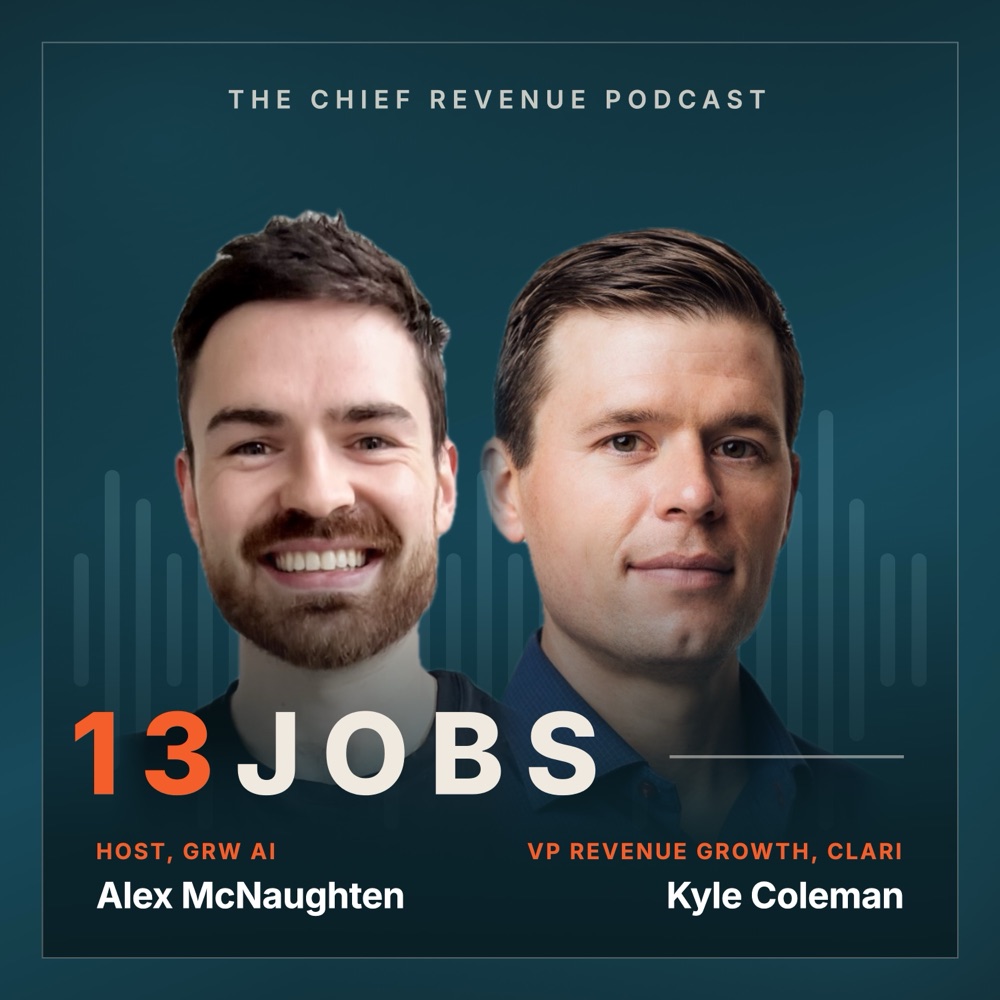
 Hosted by Alex McNaughten
Kyle Coleman · VP Revenue Growth, Clari
Kyle Coleman was the sixth employee at Looker, where he built the SDR function from himself to around sixty five people while the company went from roughly $100,000 in ARR to $100 million, about 800 staff, and an acquisition by Google in 2019.
At the time of recording he was VP of Revenue Growth at Clari, running growth marketing, sales development and enablement. He has been selling something in some form his entire life and is unusually happy about it.
In this episode, we discuss:
- From a six-person company to a Google acquisition
- What the job at Clari actually involves
- Why the word still carries a bad reputation
- What the career actually teaches you
- The perception is costing the profession people
- Introverts, and who is really at the top of the leaderboard
- The other trend showing up at the top
- Executive presence, across functions and seniorities
- One: curiosity, and the party test
- Two: tenacity, and failing seven times in ten
- Three: passion, and the question he stopped asking
- The one thing: enjoy it more while it is happening
Quote of the show
“It's teaching you not just how to sell a product or a service or an offering or whatever it may be. It's teaching you how to be a good person.”
Key takeaways
- Three traits, none of them experience. Curiosity, tenacity and passion, evidenced anywhere in someone's life rather than only in a sales job. Character is the thing; past performance guarantees nothing.
- The party test for curiosity. Someone who talks about themselves all night is forgettable. Someone who asks questions leaves you thinking they were great, having said almost nothing.
- Ask about maximum effort, not a lost deal. Tell me about a deal you lost invites a flippant answer. Tell me about a time you tried as hard as you possibly could forces a real story.
- The top of the leaderboard has changed. Better listeners and better communicators, more introverts, and more women. The extroverted archetype is not what the numbers show.
- The caricature costs the profession. The smarmy car salesman stops high potential people even considering the job, which is a recruiting problem the industry inflicted on itself.
- Do not tell people exactly how to work. He is not doing the job fifty hours a week; they are. Set the outcome, then trust the people closest to it to find the route.
- Enjoy it while it is happening. His one regret. The days are hard and the weeks are long, and the impact only becomes visible if you stop long enough to notice it.
Transcript
Kyle, thanks for joining me today. How are you doing?
I'm living the dream, Alex. How are you?
Living the dream. Now that's, that's a good introduction. Living the dream. I'm very well, thanks.
Good. Brooming with positivity. Always, always.
That's awesome. So Kyle, for those of those who don't know you, you're the VP of Revenue Growth at Clari. Why don't you tell us a little bit about yourself, how you ended up there, and you know, a little bit about your career in sales.
Yeah, sure thing. Do you want the 30-second version or the 30-minute version or somewhere in between?
Somewhere in between, somewhere in between, maybe not quite 30 minutes.
So, um, I did a lot of things after graduating college. I, all these things that were kind of sales, kind of marketing, a little in between. And I ultimately ended up working at a 6-person company, SaaS company, business intelligence company back in 2013. as the first individual contributor on the sales side.
Right.
And, and marketing side for that matter. Now, at a company this size, you're doing a little bit of everything from writing website copy to manning the trade show booth, to following up with leads and all of that. And I ended up gravitating down the sales path and more specifically down the SDR path because I just really liked it.
I liked its intersection between sales and marketing because that is, that had been what my experience kind of was collectively. And it ended up being a really good fit for what I liked doing. So was the first SDR at this 6-person company, ended up growing the team of SDRs from a team of me to a team of about 65 people globally.
Wow.
The company went from about $100,000 in revenue ARR when I joined to about $100 million in ARR when I joined, or when I left rather. And the company was about 800 people, ultimately got acquired by Google in the summer of 2019 for $2.6 billion. So that one went pretty well. Then I jumped over to Clari, which is where I am now leading sales development, growth marketing, sales enablement, value engineering, the teams that are responsible, Alex, for creating and accelerating pipeline.
Okay.
That is my main charge, creating, you know, penetrating accounts, the right accounts at the right time, getting in front of the right people, and then creating the programs and processes that help mature that pipeline. For our sales team to close. And that's my role.
That's very cool. And it sounds like sales has been a pretty good career for you so far. It's been going pretty— it's been going okay.
I have been selling things in some form or fashion my entire life, my entire life. And I am so thrilled to do it full-time because I love it. I absolutely love it. And I love impacting other people and training and enabling other people to do it well because I care about it. I really truly care about it.
So yes, It's been a passion of mine, sort of unrealized until I graduated college. I was like, what do I want to do with my life? And then explored a few things and ultimately found that this is the right path for me.
That's very cool. And it's cool that you found it quite early on by the sounds of it as well. And it kind of brings us on to our topic of today, which is sales is still a dirty word. No, 100%. Why? I'd love to get your take on it, but sales is this dirty word.
And as a result, I feel like we're missing out on getting a bunch of awesome people into the profession. So I want to explore that with you. I want to kind of unpack why it's a dirty word. And then also, let's talk about all the good stuff about sales and like why it's an awesome career and where it can lead.
Yeah. Yeah, it's— you're totally right, Alex. And this is true universally, both in your neck of the woods and in mine, that sales still gets a bad reputation from time to time. And I think the reason is just it's such an easy thing to it's an easy thing to make fun of. It's, it's an easy profession to draw a caricature of that's just completely inaccurate because people know what it's like to deal with a pushy, coercive salesperson who is only looking out for themselves, only trying to make money.
And that's been unfortunately the caricature, the persona that's gained popularity, even though it is the overwhelming minority of salespeople out there. So put another way, every single person is in sales in some form or fashion. You think about what you are doing day to day, no matter who you are, you have some component of sales in your life, personal life, professional life.
Mm-hmm.
And this is what I like most about it as a career choice is that it's teaching you not just how to sell a product or a service or an offering or whatever it may be. It's teaching you how to be a good person. It's teaching you how to interact. It's teaching you how to communicate.
And these things that I get to do professionally, that other salespeople get to do professionally, and that they take pride in, these are things that matter to just being a good person. So that, that is what I want. And I hope a lot of people will realize is that everybody in some form or fashion is in sales.
And it is something to take pride in because it matters in your life. It matters at work and it matters at home. And if you think about what makes a good salesperson and And I'm sure you've worked with salespeople or you've been sold to in an effective way. You'd agree that the experience was a good one and that you liked the person that you were working with, that they helped you solve a problem that maybe you didn't even know you had.
It's a cool opportunity to be able to do that professionally.
I think you summed up a bunch of stuff really well there. And I think just gonna unpack the caricature of what a bad salesperson looks like. I think everyone can relate to that. You know, whether it's been in, you know, a car sale or retail or a property transaction, like everyone can relate in some way, shape, or form to what being sold to badly feels like.
And unfortunately, I think that resonates more strongly than the good experiences of sales because we sort of just forget those. We're like, oh, we bought it, but we actually forget of the good journey that we went on. When we were being sold to in an effective way. How do we change this perspective though?
Like, how do we, you know, like voices like yours are awesome and I think you evangelize the sales profession really well, but like on a broader scale, how do we get people more excited about selling in your view?
It is an interesting question, Alex, because the issue with the perception is that it stops high potential salespeople From pursuing sales, and I think the tides are changing though. And then one one data point of this is I can't remember who the person was or what college they graduated from, so forgive me on the details.
But they were the valedictorian of their class in 2020, and in their they made a LinkedIn post about this, and they said, "Valedictorian of my class, super proud of the work I put in. I'm starting as an SDR at Adobe in August of 2020," and I was like. This is incredible. I've never seen, I've never seen this before where like literally the number one person at a very solid school is proud of the fact that they're going into sales.
They're starting as an SDR, sales development rep. And that, that for me was a cool turning point. The congratulations that they got about having made this choice was affirming. You know, I was looking through the comments and I didn't see anybody that was like, waste of talent, or why are you doing that?
That's a bad career choice. Everybody was super supportive and very excited For this person, and so what we're realizing, and and what I think is a broader realization is kind of what I talked about earlier, which is sales takes many forms, and you get to inject your personality. You get to inject your style.
You get to inject a lot of positivity into how you pursue the role. You get to make your own schedule in a lot of ways. You get to control your own destiny in a lot of ways. You get sort of the Somewhat intimidating, but somewhat motivating number to work against to evaluate your performance.
And so for people who have that mindset, who are competitive with themselves and work well on a team, that's what sales is becoming now is this kind of really interesting combination of people who can balance ambition and humility, admit that they're wrong when they need to, but hold themselves to a really high standard to constantly be improving.
And that's the opportunity that sales is providing to people. It's that type of person who's now being more and more attracted to sales. And that's opening and expanding the aperture, expanding the universe of potential candidates for this world that we're living in, because the definition of what makes a good salesperson is becoming more and more diverse.
And that, that's the opportunity that is in front of us right now. That's the wave that I see happening. And that's why I'm so excited to continue to hire into this role. And then to work with the people that are kind of on the forefront of the change.
I think you're bang on about the skills you learn in a sales career are so applicable to all parts of life. You know, whether you're arguing with your partner about something or, you know, or actually, you know, often if you're buying something, you can use sales skills to get a better deal or just in general.
I think human-to-human connection, conversation, it makes you a better person. I fully agree with all of that. You said something interesting about sales, and I'm summarising it, being kind of opened up to like a more diverse group of people. Could you mind just expanding on that? Like, what do you mean there?
Yeah. So, part of the caricature, if we're thinking back to the smarmy used car salesman who has a monthly or daily number they have to hit and they'll just tell you whatever lie they need— you need to hear to sell a car, like that's the caricature. That is a person who is pushy, who's aggressive, who's extroverted, who's loud, all these things.
Okay, that is just so far from the truth of what is successful in sales, first of all. But more people are realizing this. And in fact, there have been more and more studies recently where 2 things, 2 trends are emerging. One, introverts are becoming more successful than extroverts in sales.
Okay.
Very interesting. And why is this? They're better listeners. They're better communicators. I'm painting with a broad brush. But they are able to find success in a different way than the more extroverted, more energetic, you know, more effervescent type of person. And so there's multiple pathways to success. So that's one thing is that introverts have a role in sales that's additive and different, usefully different than the way that an extrovert approaches a sale.
So that's one major trend. And both can be successful. So I don't mean to— say that one is more or less successful than the other, but more introverts are becoming more successful. That's just what recent studies have shown. And then the second important trend, you think about the caricature that I'm drawing, I'm intentionally using the pronoun he, because it's a male-dominated caricature.
Yes.
That is so far from what's happening now from a trend standpoint in especially in technology sales, but more and more women are entering the sales force. And more often than not, they are the top performing people on the team. And these 2 trends in combination, and I don't know what the overlap is, but more and more introverts finding success, more and more women finding success in sales.
These are such good things to, again, expand the profile, expand the aperture of what a successful salesperson looks like and can produce. So that, those are the major trends that we're seeing. And it goes from, you know, this really narrow net of extroverted, pushy, energetic, male-dominated to all walks of life can find success in this role.
Here's the mindset that's successful. Here are some of the characteristics that are successful. Go and allow these to manifest inside of yourself, bring out the best parts of yourself and go and figure out how to do this job the way you want to do this job and you can find success. So that, those are, I point out the trends because I think they illustrate the shift that we're seeing in the industry.
But the broader answer is that it's not about, you know, any— it's not about being pushy. It's about caring about your work and manifesting your personality throughout your work in whatever way you can to find success. So multiple pathways to success and expanding, ever expanding. And that's the short answer to your question.
Yeah, I think it's— I think those are both really good trends. And I think, I think that the introvert one's really interesting because I think I'd love to get your feedback on this. But from my experience, I've coached a lot of sales reps. The ones that I see typically performing consistently at the highest degree are not the most extroverted, loudest, biggest character in the room.
They are usually actually a little bit quieter, maybe introvert or ambivert in terms of their personality type. Exceptional listeners, very organized and quite detail-oriented. That's usually what I see in terms of like the reps who are taking home the half a million, million-dollar commission checks. What about you? Would you agree with that or would you see something different?
I think generally when I think about the top of the leaderboard, Alex, that's who I see at the top of the leaderboard. It's not to say that I haven't seen extroverts be successful because certainly we both have. But I think you hit on the right points. Really, truly excellent listeners. Really, really organized, ruthless with their time.
They don't allow for distractions as much as some extroverted people may. Um, but I think if I had to distill the difference into a kind of a simple framework, I would say that the people who are most successful are the people who respond instead of react. So they respond thoughtfully as opposed to reacting emotionally.
And that's— it just makes such a difference in a sales role. And typically, just, you know, again, from a stereotype standpoint, an introvert is going to be more likely to listen, think, then respond, as opposed to listen and then react as quick as they can to overcome an objection or give a counterproposal or whatever it may be.
And that's a huge advantage. It's a huge advantage. The thoughtful salespeople are the ones who are the most successful.
One of the other key traits that we've seen using a piece of software as part of our software sales DNA assessment process, one of the key traits we've seen in high potential new business focused roles is this idea of handling authority, which is how best way to describe it is being able to speak to someone who's hierarchically significantly more senior than you, but speak to them on a level.
That's been one of the highest predictors of sales success, both from aggregated data from lots of companies internationally, but then also from our New Zealand pool of data in terms of people we've been placing in organizations. Is that something you have ever proactively looked for or noticed or— Yeah, what are your thoughts on that?
No question. And then I think the way that we think about it or maybe that it's popularly understood is executive presence. Does this person have the presence to either command a room or command attention or understand pain points at different levels up and down? The chain of command or chain of seniority. And absolutely super important.
And the reason it's becoming more and more important is because there are more and more people involved in a buying decision. You know, it used to be 1 or 2 or a handful of people. Now, on average, at a 500-person company, you're having to deal with 11 different people in a buying group.
Yep.
And that is all different functions. So kind of horizontally, but also all different levels of seniority vertically. And the people have to be able— I don't mean to say like a chameleon, but you have to be able to understand pain points at different functions and different levels of seniority and be able to speak to the value that your product or service solution, whatever, provides at all those different intersections of role and seniority.
And that's really, really hard. It's probably most important when you're in those higher levels of seniority, when you're talking to the executive level people, VP level people, because more often than not, they are ultimately decision makers, economic buyers, whatever it is. And so yes, I would say that executive presence, a, an ability to speak confidently, speak in a way that is convincing, in a way that can influence an executive, is very high on the list for predictive of sales success.
What else do you personally look for when you're building out your sales teams?
Yeah, I personally look for 3 main things that need to exist in somebody's professional life, in their career, and/or their personal life. And this is this is this will make more sense in a moment. I hope if it doesn't, then we got problems. So I look for three things. Number one, by a landslide for me, is curiosity.
Yeah.
How are you unendingly curious about the things that are interesting to you? Like, talk to me, and this would be an interview question that I'll ask somebody, is just talk to me about how you, you go and find out about something. How do you go and explore something? And they can give a personal or a professional example from a problem they solve at work, or they can give a personal example for something that matters to them at home.
Either way is equally useful to me, equally telling to me about their capacity to be curious. And then my job is just to excite them about their work here at Clary. And if I can do that, and I'm confident in their, in their sort of ability to be curious, to be self-starting, to go and ask questions and find answers, I know that they're going to apply it at work.
And that, that kind of thing is very hard to train. And so I'm looking for that innate mindset around curiosity. That's number one. I'll pause there and see if you have any reaction to that.
I agree. It's my short reaction. Curiosity is one of those really key traits. Being curious and being able to listen, I'd say, like some of the most important things for sales roles, particularly in more complex sales roles where, like you said, you're dealing with lots of different buyers. Or even if you're just selling something that's a little bit more of a complicated sell and you actually have to really understand someone's problems to be able to position it to them in the right way.
So yeah, curiosity is a massive one. And I think To be honest, I would say it actually transitions, extends outside of sales roles. I think curiosity in general is one of the best human qualities.
Exactly. So the example I give, Alex, is if you're at a party and you're meeting somebody for the first time and all they do is talk about themselves, are you ever gonna, you ever gonna want to talk to that person again?
Probably not.
On the flip side, On the flip side, you have an interaction and they're just asking you questions and they're trying to understand what matters to you. And you end up talking about yourself for 25 minutes.
Perfect. Are you ever gonna want—.
Perfect.
Exactly.
People love that. Wow. It's so funny because there's studies on this where, where this exact thing happens and the sort of subject in this experiment comes back and we're like, they were great. I loved them. They were awesome. They told me everything. It's like, they didn't say a single word about themselves. They were just asking about you.
And it's people who are genuinely curious to learn about other people, about problems, about solutions, but also curious to be introspective and learn about themselves, their processes, the things that they're doing well, the things they're not doing well. If they're honest enough and curious enough to understand that they have areas of improvement, these are people that are constantly learning and constantly improving.
And that is what makes for a good salesperson. The salesperson who's doing their job the same way today that they were a year ago, not set up for success. So curiosity unlocks all that. Exactly.
Can you teach curiosity?
I think that you can show examples of people who do it well, and you can kind of give an archetype for, you know, how to do it. But I think it's, it's largely an individual motivator, Alex. Like, people have to be excited about the work they're doing. They have to understand their contribution.
To the team, the department, the company. And if you can get them excited and get that motivator, kind of that fire burning in their belly, that typically can unlock or turn on some capacity to be curious, capacity to put some energy behind this. But ultimately, it's up to an individual person to decide whether or not they want to do this.
And so I think the tools can, can be there, but you can't force somebody to operate this way. It's impossible. You can motivate them, you can inspire them, you can give them that, like I said, the archetypes, the people to emulate. Ultimately, they're the ones that gotta execute.
Okay. So that's the first one.
That's the first one. So that one's the largest or the hardest one to unpack. These next 2 are more sales, more sales focused. I would say number 2 is tenacity. So the ability to overcome inevitable failure, like inevitable, and I say inevitable, you will fail in sales. Way more than you succeed. Like, a salesperson with a 20 to 30% win rate is like off the charts.
Yeah, yeah.
Which, put another way, means they're failing 7 to 8 times out of 10. That is really hard, really hard. Um, so I almost, almost swore, but I realized this is a family-friendly podcast, so I'm glad I didn't.
You can swear if you like, it's okay.
So the ability to overcome failure, to learn from failure, to pick yourself back up And to go at it again the next minute, the next hour, the next day, whatever it is, it's really, really hard.
Mm-hmm.
Um, this is where the team component of sales becomes really important. I mentioned, um, a little bit ago that people need to be individually competitive, competitive with themselves, but really good team players. It's a really hard thing to do. And the failure is where both of these components come into play. You need to be competitive with yourself enough to know that you can overcome this.
You can do better. You can improve, but you also need to share your failures with the team and get some support, get some guidance, learn from people who may have failed the same way from you, help other people avoid the way that you just failed. And if you can combine these 2 things, and again, I package this as tenacity, I think that it's a really, really useful way to improve and think about how to approach this job, which is Quite a roller coaster.
Can be quite a roller coaster.
Yeah, for sure. It's, it can be tough at times. I think any kind of sales role, because you're right, you're failing, mathematically speaking anyway, far more than you're succeeding.
Way more.
And yet, like you said, if you're good and you're doing 30% of your deals, wow, like you are crushing it, but you're still failing a lot. Now, tenacity is one of those ones, or, you know, resilience. It's not the easiest necessarily to pick up in an interview just from questioning someone. So like, what are you looking for when you're trying to figure out, is this person actually tenacious or are they just saying they're tenacious?
Yeah, it's hard. It's really hard.
I—.
So a version of the question I ask people is I want to hear about a time where they tried as hard as they could possibly try on something. And again, I'm typically interviewing people for sales development roles. So many times this is their first tech job, or maybe they're fresh out of college or something like that.
So I don't necessarily couch it through the lens of, you know, a deal that you won or lost, but rather a time in your life. You put forth maximum effort. You tried as hard as you can on something and it didn't work. Like failure, abject failure did not go well. What happened? What did you do?
What did you learn from it? And that kind of story and hearing how people think about, first of all, what do they consider a failure? So that's an interesting sort of outcome of this question. What do they consider a true failure here? But more importantly, how did they address it? And how did they overcome it?
And sort of the subtext here is, how has it influenced the way that they operate today? What tangible and lasting takeaways planted in their brains then that are still animating the way that they go about their job. And it's just such a useful and revealing question to think about and try and, well, have a conversation around, frankly, their tenacity, which goes way beyond, you know, tell me about a time you lost a deal and you win the customer back.
Like, it's not what this is about. It's about mindset. And trying to unpack that mindset is really interesting. And I think really revealing.
Yeah, I think I like that question because it goes— it forces someone to tell a story and it forces them to actually think in a bit more detail and unpack it, which is, I think, the problem with the tell me about a deal you lost.
Right.
Because that just— you can give a flippant answer to that. You don't really learn much about the person. So, I like how you've couched that question. It's similar to one we use and almost identical, actually. And it's a really, really good one. So, yeah. It's— I've sat quietly through advisory work I've done in terms of interviews, sometimes quietly, sometimes not quietly because I can't help myself, listening to how sales leaders interview potential sales hires.
And I'm often struck by the surface-level questioning that really you leave that an interview and you just don't really feel like you've learned much about the person. What are your thoughts on this? And do you try and go— but seemingly you try and go a little bit deeper with your questioning.
It is entirely about character. This role, sales, is entirely about character. And past performance is a useful indicator, but past performance doesn't guarantee future results in any industry. So why would that be the case in sales? It is way more about Hiring smart, strategic, thoughtful people with brains who you trust to operate autonomously and to use their brains at their job.
Like the goal that I have as a hiring manager, as a sales leader, is not to hire a team of lookalike people that are interchangeable, who I can, you know, give a phone book and a phone and I can say, go dial. Like, that's not the goal here. I want to hire people who will take the process framework we have and improve it.
And be confident enough to try new things, to experiment, to fail, and then come to leadership and say, this didn't work. We need to change this, this, and this. My job as a leader is to hire people who can really figure out the how. I haven't been in an individual SDR role for many years.
Sales leaders out there haven't been in an individual sales role for many years.
Mm-hmm.
They may have a sense. I have a sense of what works and what doesn't. But I'm not doing the job 40, 50, 60 hours a week like some of these people are. So who am I to tell them exactly how they need to go about the day-to-day? I want to find the right people who can— I can communicate what needs to happen and why it needs to happen.
And if I communicate and cascade that context, my expectation from the individuals on the team is they're the ones figuring out the how. And then they communicate back up to me to change the what and the why. And it's this virtuous cycle that continues between us. So you can't do that by hiring automatons.
You can't do that by hiring robots. You can't do that by hiring people that aren't thoughtful, that aren't strategic, that aren't creative, that don't care. And that's, that's what we hire for. And I think that's what a lot of sales teams are starting to hire more and more for. And that's why people are starting to have so much more fun in sales orgs.
And that's why the role and processes and all these things are changing. As rapidly as they are is because we're injecting a whole new element of thoughtfulness, of strategy, of personality that's bottoms up. And that is a really, really exciting sort of change for me across the industry.
Now, was tenacity— and was that one point or—.
Yeah, that was one.
So we've got one more to come. Okay.
This is officially the longest answer to any question you've ever asked.
No, it's a good— it's a brilliant answer though. Quite.
Personality trait number 3 is passion.
Passion.
And passion is a tough one. And the way that I explore this is, well, actually, let me take you back in time. I used to ask a version of the question, you know, pitch me my product, sell me my product, give me the elevator pitch. And what I realized, Alex, after asking however many hundreds of people to do this, it's like, I learned nothing from this.
Like, all I learned was their ability to go on clary.com and read my website. Like, what am I doing here? This is a complete waste of each other's time. So stop doing that. And instead, the question that I ask is something to the extent of, what is the thing at work or at home, your personal life, whatever it is, that your friends, your family, your coworkers— what is the thing that they know you for?
Like, what is the thing that you just won't shut up about, that you talk people's ear off about, that genuinely excites you in your life? What is that thing and why? And sell me on it. Why should I care? And when they pitch this passion to me, I get such— I see they light up and I get to see what it'll be like for them to sell something that they care about, something that excites them, that they know is helping other people.
And again, my job then becomes to convince them that my product does this. And if I can show them that Clary does this, and they have shown that they have this kind of internal intrinsic capability of showing and communicating with passion, with, you know, with through a smile, laughing, bringing positivity, convincing somebody that something that they care about matters, that translates.
So passion in, in some form or fashion in your life and extending that into your work life. And if you can do that, you're going to be successful?
I think I have an idea about the answer to this question, but what's your answer to that question?
I have a few different answers to this question.
Okay.
So on the personal side, I love running.
I love running.
And this is a useful one for me, especially from like an objection handling standpoint, because so many people hate running.
Oh yeah. God, I absolutely hate it. I need to do more of it. I play football and my fitness has just steadily decreased over the last 10 years and need to get back into running. So if you could share some of that passion with me, that would be awesome.
What other activities in your life can you truly disconnect from technology? Can you really get away from a screen? Can you really commune with whatever environment that you're in? You know, for some people this is something like skiing or hiking or something like that, but running allows you to do that just by stepping out the door.
You don't need to bring headphones. You don't need to bring any sort of form of entertainment. Just go outside and just move. Walking does the same thing. Walking is just as useful. Walking is probably the best exercise you can do. But for me, efficiency becomes an important part of this. And running fits into my work schedule really well, cuz I only need 20, 30 minutes to go and get in a really solid run and then come back, reenergize, recharge, ready to rock and roll.
Like I am a different person, different person the mornings that I can get out and run versus the mornings where I don't. So I really, it's cathartic for me. It unlocks a lot in my life and I just really like it. It's an opportunity for me to be away from screens, away from technology, and just kind of alone with thoughts.
Some of my best ideas will come to me when I'm out pounding the pavement. And it's a cool, it's a really cool experience to just like submit to that freedom of thought. It's meditative for me. So it's a lot of different things baked into one. So that would be on the personal side.
On the professional side, it's for me, it's all about developing people. Like I absolutely, it's so funny, Alex. I am like, I'm like the world's worst sales leader in this capacity. I care so much more about getting people off of my team than getting our number. Like I mentioned, I lead sales development teams, oftentimes the feeder team into not just sales, but the rest of the organization.
And I take No more pride than in what I take when people move, when people graduate from SDR into operations, into sales, into marketing, into whatever career path is challenging and fulfilling to them. And the opportunity to do this, to mentor at this point, it's been 126. And I know the number, 126 people that I've hired as SDRs and have moved into something else just at the companies that I, that I've worked at.
And now the opportunity to do this sort of at scale, you know, with, with the platform on LinkedIn is a— it's really, really fulfilling to me. And that is what I'm most passionate about is ensuring that people know that the sales development role matters, that sales matters, that it's something to take pride in, that it's creating this lasting skillset that you can leverage in whatever you want to end up doing.
And then to do that more pointedly from an individual mentorship standpoint is That's what's most— that's what I'm most passionate about. So again, sorry for the long answer, but—.
No, it's a brilliant answer. I can feel the passion, you know, resonating from you and you talk about both those things, which is really cool. I think, look, finding passions in life, you know, I feel like not everyone does. I feel like some people never really truly find a passion and then others find it really young.
And I've always tried to, you know, I wonder what your thoughts on this. I'm always trying to figure out, is it luck or is it— or is there some, you know, concerted effort in terms of finding a passion? And is it more that if you find something that gives meaning, that that is a passion in itself?
Like you find something meaningful and that adds value to, I don't know, your community or some people around you, like that in itself, that meaning becomes a passion.
Yeah, I think it is hard. It is not by accident that people stumble into this. I think there's the psychology major in me would call this openness to experience.
Yeah.
If you have this openness, if you have this energy, and this is why I think it's a, it's an important mindset sort of characteristic that translates nicely into sales, because if you're talking to a candidate, if you're talking to somebody who hasn't found this in their life, who's content to just kind of like, you know, go through the motions.
They're probably not the person that you want to do all the things that we just talked about, having expectations for somebody to deliver on our team. So yeah, I think that people avoid it because it's not— or not avoid it, but people don't just stumble into it. I think it takes intent. I think it takes commitment.
And I think it is not something that everybody has a capacity for, unfortunately.
I think that's a good answer. I think the intent piece is important, like being open. You have to intentionally be open to experience.
Very true.
So, I have 2 final questions for you. And the first one you've kind of semi-answered, but I'd like you to sum it up. So, imagine I'm a uni grad or maybe not, maybe I'm a high school student and I'm thinking about what I want to do. Sell me a sales career.
Uh, I, okay.
And you've already pretty much done it. I know, but bring it home.
I have a version of this conversation with university grads frequently, like I mentioned in recruiting when, when they don't know what to do or they're torn between roles. And what I would say to you, Alex, taking you back however many years to high school, college, um, is sales gives you the opportunity to truly control your own destiny in ways that many other roles don't.
You control the things that matter most, which is your output, your energy. If you enjoy the work you're doing, you control a lot about what happens to you, not just today and tomorrow, but your whole career. And you can't say that for very many other roles. So if you want to bet on yourself, sales is a good path for you.
And if you can exhibit the curiosity, the tenacity, the passion that it takes to be successful here, You'll be successful. It's completely within your control. And on top of that, young Alex, the economic— the economics are nothing to shake a fist at here. You can do very well for yourself financially, and it is totally fine for that to be a motivator.
In fact, it's a good thing for that to be a motivator. High-performing reps are motivated by the money they can make, and you're gonna— you have the ability to control in many respects, your income in ways and accelerate your income in ways that you're not going to get in most other roles. So a combination of those 2 things, you controlling your destiny, you manifesting the right sort of mindset, you building an enduring skillset that'll help you do whatever you want to do in your career while you make pretty good money doing it.
Tough to compete with.
It's a great answer. And I think the second part of that answer is interesting because I feel like, and I don't know if this is a cultural thing in New Zealand. I'm from England originally and lived in New Zealand for half my life. We don't like talking about money in this country. It's like, oh, we don't want to.
But it's a really, really undersold part of sales is if you do well, damn, you can earn well. Like I bought a property when I was like 23 years old and had like a brand new Merc AMG whilst my mates who went into like Big 4 accounting were like, working 100-hour weeks for slave labor, you know.
And I'm not saying that that's a bad career. It's an awesome career choice. And I'm not trying to put one against the other, but we don't sell how good sales is very well a lot of the time.
I agree.
So, you know, absolutely write your own destiny. Very few roles you can do that truly and truly set up your day and manage your time and effort and then equally get rewarded for how much you put in. It's pretty cool.
I don't know if there are— I don't know how many other careers match the financial outcome with the energy input.
No.
And that's a, that's a really, really interesting way to think about it, like investment banking or consulting or something like that. The early days of those roles are brutal. And they pay off long term.
Sure.
But you can put in the same amount of hours and get way more impact way earlier in your career in sales. And so again, like Kudos to both roles. But yeah, the financial output for the energy input, unparalleled in sales careers.
Yeah. And I think one of the other final really good— final, there's lots, but one other really good selling feature is it's one of the quickest pathways. Actually, it is the quickest pathway to C-level. Yeah. Whether it's CEO, CRO, You know, I— it is, as far as I'm aware from the reading I've done, it is still the quickest pathway to get to those kinds of roles, which again is pretty cool.
So if you want to progress and if that's what motivates you, you actually want to progress up the ladder, that's a pretty good motivator.
And especially in technology. And some people may say, why is this? Well, because as a salesperson, you are learning marketing, you're learning product, you're learning sales, you're learning finance, you're learning all of the things things, biz dev, you're learning all the things that you need to know to be an effective C-suite member.
So, and often we'll think about salespeople as being, quote unquote, the CEO of their territory. And that really is true. Like, if you are working regionally, if you're working in selling into an industry, whatever it is, you probably have a better sense of what message is resonating than your marketing team does. Because again, you are in that little niche part that maybe the broader global marketing message isn't resonating with.
And so CEO of your territory, product, product roadmap, the features that your patch needs, the messaging that they need, the terms that are going to be viable in contract negotiations, like you are learning all of these things. So yes, the mindset of a CEO of your territory is really a powerful one. And it does indeed accelerate your path to some level of seniority.
And I think you're right, spot on, that CEOs, certainly CROs, mostly born out of sales roles.
So I have one final question for you. This has been a brilliant chat and I've got one final question for you. Knowing everything you know now today and you go back to Kyle day one sales job, what do you wish you knew? What's the one thing you wish you knew that would have changed the game for you?
I would say There's so much out there.
I know, it's hard to distill down to one thing.
So I would say, um, maybe, maybe a regret that I have, and, and so I think this would be useful from, from a change standpoint, would be to, to really enjoy it more. Like, okay, really enjoy it, because the days are hard, the weeks are hard, they can seem really long, and you can just get beaten down, but the months and the years fly by.
And I would say one of my biggest regrets is not, not kind of taking a step back and being like, wow, this is pretty, this is pretty cool. Like, I'm getting exposure, I'm getting experience of things that I frankly shouldn't be getting. Like what we just talked about, the CEO of your territory.
Step back, look at the work you're doing, appreciate yourself, appreciate your opportunity, appreciate the role you're in, show some gratitude, maybe write some stuff down about what you're learning. Like, if I took all this advice, I'd be really, really happy for it, because I'd have a nice little doctrine to go back to.
But that would be my advice is slow down for a minute every now and again, and just take it in and really, really choose to enjoy it. Because it flies, flies by. And I think it'll just make you a a more thoughtful person, will make you a better salesperson. And I know it's something I've injected into my own sort of cadence now, but I lost 8 years.
So I wish I had those 8 years back.
It's good advice. I think sometimes we just get caught in the doing and the doing and the doing and we forget to take a minute and think, oh wow, we've actually had quite an impact here. Across people, companies, you know, relationships. And I think it's important sometimes to wake up and smell the coffee, so to speak, and actually just pause and appreciate all and how far you've come and what you've done.
So, really good advice. Kyle, this has been awesome. And I could probably talk to you for another 3 hours, but this has been awesome. I'm sure you've got plenty of other things to do rather than chit-chat with me for much longer. Where can people find you if they want to connect with you, if they want to, you know, have a chat to you, if they want to, you know, consume your content?
Where's the best place to find you?
LinkedIn is the place where I try and post 4 or 5 times a week on things, topics like we just discussed— mindset, tactics, processes, etc. So Kyle Coleman on LinkedIn. I think you'll have an easy enough time finding me.
Awesome. Thank you so much, Kyle. This has been brilliant and I'd love to do this again sometime.
It's been an absolute pleasure. Thank you.