All episodes
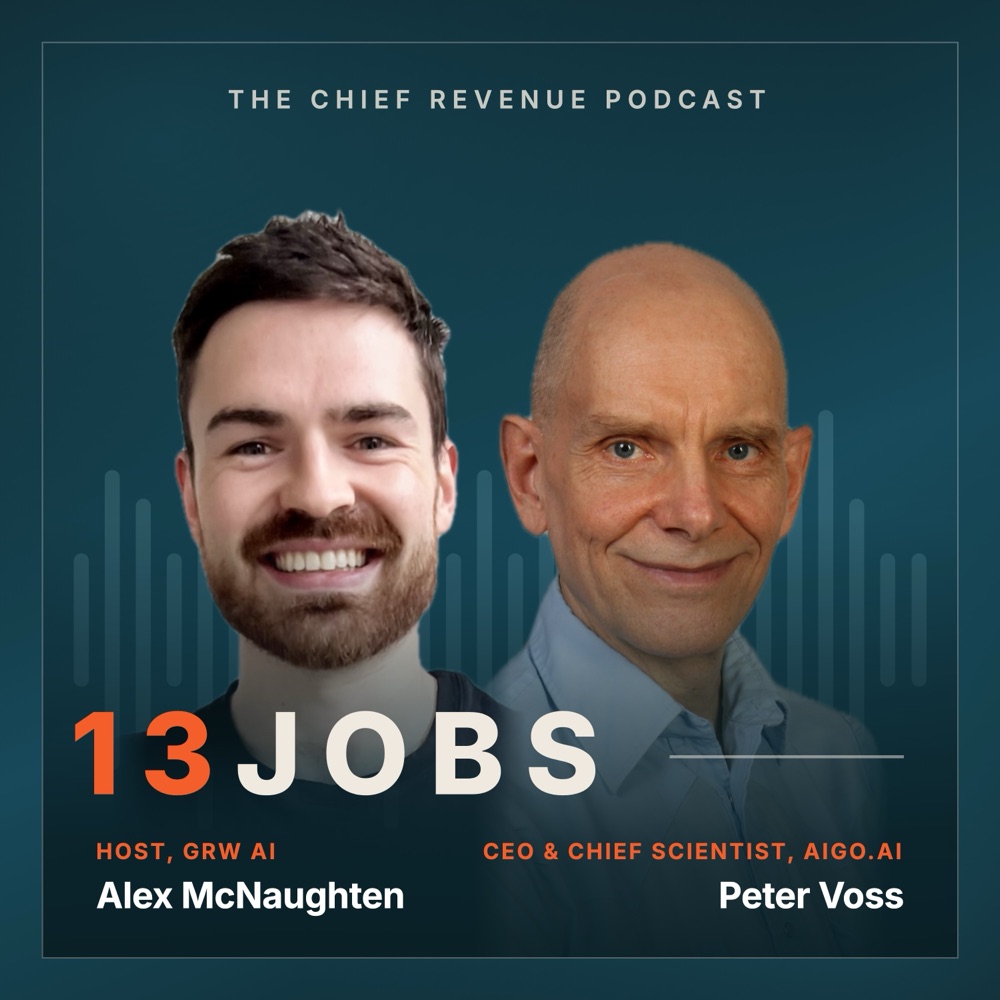
Why today's AI is not intelligence with Peter Voss
Episode 049 · Jan 4, 2024
Why today's AI is
not intelligence
0:0029:10

Why today's AI is not intelligence

Peter helped coin the term artificial general intelligence in 2002. His read on the current wave is that it is eloquent, genuinely useful, and not what it appears to be.

Hosted by Alex McNaughten
Share

Peter Voss · CEO & Chief Scientist, Aigo.ai

Peter Voss is the CEO and chief scientist of Aigo.ai, which builds what he calls a chatbot with a brain: a cognitive engine that uses context and reasoning rather than intent matching and flowcharts. Its customers include the 1-800-Flowers group of companies.

He started as an electronics engineer, turned his own company into an ERP software business that went from a garage to 400 people and an IPO, then spent the two decades after that exit on cognitive AI. He was one of the people who coined the term artificial general intelligence in 2002.

In this episode, we discuss:

  • From an electronics garage to a 400-person IPO, and what came after the exit
  • Selling the first company, and building the second generation
  • What generative AI does brilliantly, and where it stops
  • Why most chatbots run on thirty-year-old technology
  • Context and reasoning instead of intent matching and flowcharts
  • Twenty million customers, remembered as individuals rather than demographics
  • Six weeks of average tenure, and what that says about call centre work
  • Why eloquence gets mistaken for intelligence
  • Why legal and QA will not sign off on an unsupervised statistical system
  • High-value B2B selling as one of the last things to be automated
  • The nearer prize: a system that preps the rep and updates the CRM for them
  • What actually excites him about human-level AI

Quote of the show

G is generative. It makes up stuff.
Peter Voss, CEO and chief scientist, Aigo.ai

Key takeaways

  • Generative means it makes things up. That is the design rather than a defect. Trillions of pieces of information, good and bad, blended into output that sounds right whether or not it is.
  • There is no real-time learning. Today's models do not fold new information into an evolving picture between one conversation and the next. A person does that without noticing.
  • Most chatbots are thirty-year-old technology. Intent detection plus a flowchart. Tell one you never want Uber again and it will still cheerfully open Uber for you.
  • Context is the whole difference. What was said earlier, what was said in previous conversations, what is already known about this customer. That is what lets a system interpret rather than pattern match.
  • Statistical AI needs a human in the loop. It cannot own an entire customer conversation, because legal, QA and marketing will not sign off on something that makes confident, occasional blunders.
  • Call centre work is already failing on its own terms. Average tenure of around six weeks. Automating it is a service argument as much as a cost one.
  • High-value B2B selling is among the last things to automate. Trust, complexity and novelty all work against it. The nearer prize is a system that briefs the rep beforehand and writes the CRM update afterwards.

Transcript

Alex McNaughten

So for those who don't know Peter, Peter is on a mission to bring human-level AI to the world. Peter, tell us a little bit about your journey, your mission, and what you're up to.

Peter Voss

Yes, certainly. I started out as an electronics engineer and started my own electronics company, then fell in love with software and my company turned into a software company. So that ended up being quite successful. It was an ERP ERP software company catering to small to medium-sized businesses. And we went from the garage to 400 people, did an IPO.

So that was super exciting. Love to do that again. But that also exiting the company gave me the freedom to think about what project I wanted to, the big project I wanted to tackle. And it really occurred to me that software needs more intelligence, you know, that if the programmer doesn't think of something, the software will just crash or do something that isn't really very sensical.

So how can we build intelligent software? And that put me on a journey where for 5 years I actually just studied intelligence, starting with philosophy, epistemology, theory of knowledge. How do we know anything? You know, what is reality? So really the core fundamentals. And then how do children learn? How does our intelligence differ from animals?

What do IQ tests measure? So I really want to deeply understand cognition and intelligence. And over that period, I then came up with a design for a thinking machine or cognitive engine. And in 2001, I then launched an AI company. And for about 5 years, we just did R&D. We developed some core technology framework and so on.

And we then commercialized this in the call center space to automate calls intelligently. And that company is now still about 80 people or so and, you know, has good technology, much better than what most people are used to when they just want to press 0 to get to an operator.

Alex McNaughten

Yeah.

Peter Voss

But I ended up not really having the ideal investors in the company. They didn't really want to aggressively pursue improving the technology to get closer to human-level intelligence. So we sold the company and then I went back to another round of R&D basically to develop the second generation of the technology. And we now commercialized this about 3 years ago.

In the current company called Aigo.ai. And we basically have a chatbot with a brain. And we, our company really has 2 divisions. The one is the commercial division where we focus on scalability, reliability, security, and, you know, all of the things that are obviously important for enterprise. And then the other division is to continually improve the the technology.

And in fact, we just launched a major, major initiative to now get to human-level intelligence as soon as we possibly can.

Alex McNaughten

It's a fascinating journey you've been on. Obviously, AI has been a hot topic really probably since the launch of ChatGPT end of last year. What's different between how they're approaching it and how you're approaching the problem? Because, you know, their mission, one of their stated missions, is to find artificial general intelligence.

Peter Voss

Yes, certainly. The current surge in statistical approaches and generative AI in particular has just been amazing to watch. I mean, what this technology can do, you know, starting with ChatGPT, is really mind-blowing. I mean, the amount of knowledge that is embodied in this model and the kinds of conversations it can have are really quite phenomenal.

But there are some inherent limitations, and these are actually quite severe when you want to get to the kind of intelligence that humans have. The limitations can actually be described almost quite well in GPT, ChatGPT. GPT— G is generative. It makes up stuff. It has this massive amount of information, trillions of pieces of information, good, bad, and ugly, and it can pick from randomly, statistically, it can pick good information or ugly information.

Actually, this morning I just asked who's on the board of OpenAI and it told me that Woody Harrelson was one of the directors, environmentalist and actor. So yeah, it can make up stuff. That's the G part of generative. The P is pre-trained, and this is the big problem that you need this massive, massive amount of information, and the training for ChatGPT cost over $100 million and took weeks to do.

And that's the nature of the beast. Now, humans aren't like that. We don't, you know, we can learn incrementally. You can show a child a picture, a single photograph of an elephant, and they'll be able to recognize an elephant. They don't need hundreds or thousands of examples of that. So the pre-trained part, that it's basically trained at the factory, and then it's a read-only model essentially.

Now, there are some tweaks, some caveats, but essentially it's pre-trained. So it can't learn interactively in real time. It can't integrate this information and update its model. You can only sort of add on the outside. And then the T is that the core technology used for it is transformer technology that really nails down these limitations because transformers are inherently backpropagation trained.

So it will always require massive amounts of data and massive amounts of training. So that's the approach that has been very, very successful for many applications. But there's actually a pretty strong consensus now that this alone will not get us to human-level intelligence. So the approach that we've been pursuing for the last 20 years is not generative AI.

It's not statistical AI, but cognitive AI. So we start off with saying, what does intelligence require? And some of the really important aspects of that is that it can learn with small amounts of data in real time incrementally and form concepts and to conceptualize, which also ultimately gives humans the ability of metacognition, of thinking about thinking, which is really important to deal with the sort of, you know, confabulation and making up stuff that you can say, hey, what am I about to say?

Or what did I just say? It doesn't make sense, you know. Um, so our approach is basically small data focusing on what cognition requires. Uh, DARPA actually calls this the 3rd wave of AI as opposed to statistical, which they call the 2nd wave.

Alex McNaughten

Right. Interesting. And you're currently, you've got, like you mentioned, you've got a commercial arm to this. You know, to your business. There's a research focus, but you've also got this commercial arm. How's it being used right now? How's this approach to AI being used?

Peter Voss

Yeah, as I say, you know, we call it a chatbot with a brain and there are thousands of companies providing chatbots, but pretty much everybody's using actually what is essentially 30-year-old technology. You have some way of identifying the intent of what does a customer want, you know. So you might say blah blah blah weather.

Okay, we'll trigger the weather, you know, app or whatever function. But then, you know, if they say I hate Uber, don't ever give me Uber again, they'll probably still trigger the Uber app. And then it goes through some little flowcharty type program.

Alex McNaughten

Yes.

Peter Voss

Where do you want to go? How many people are going? And do you want UberX? So you have to follow this flowchart thing. This is really what pretty much everybody's doing with, you know, some level of sophistication when you use these new modern tools for developing these flowcharts. But it's, you know, there's no real intelligence, there's no real understanding there.

So with our approach, we have this cognitive engine that has deep understanding, contextual understanding. So we use context. What is, was, what was said earlier in the conversation, even what was said in prior conversations. What else do I know about the customer? And we use reasoning and context to deeply understand and interpret everything that's being said.

So you can jump around in the conversation and it will, it has a much, much better chance of actually being able to stay on track and do what—.

Alex McNaughten

Right.

Peter Voss

What needs to be done. So that's a technology we have. And a good example of an application is one of our big customers is 1-800-Flowers group of companies. That's Harry David as well, Popcorn Factory, and, you know, a dozen other companies. And they use this to provide a hyper-personalized service to their 20 million customers so that it remembers you as an individual.

You're not a demographic, you're not a number, you're not a statistic. You're an individual with a particular history of who you buy things, gifts for, on what occasions and what kind of gifts they prefer. And on top of that, of course, it has all of the information of current product information availability in different areas.

You know, if there's a storm in your area and there's a delay, all of that kind of information can be utilized to really provide a very, very good experience for a customer. In fact, better in many cases or most cases than what a human can offer. And you can imagine, especially during Valentine's Day and Mother's Day, you obviously have a wait time, you know, when you're suddenly going, you know, 20x on your call volume or 30x on your call volume.

Alex McNaughten

Yeah.

Peter Voss

Whereas with Aigo, with our technology, there's no wait time. It can provide this service instantaneously. And we also all know how hard it is nowadays to run call centers, how hard it is to find people who even want to work there, then to train them and to retain them. I heard the latest statistic is that the average time that people stay on the job is 6 weeks.

Now, obviously, that includes a lot of people who after the first day say, whoa, I'm out of here.

Alex McNaughten

Yeah.

Peter Voss

But it's really, really hard for them. So the quality that you can provide with humans and then, you know, the delays and limited information with the right kind of technology, you can actually end up not just pleasing your CFO and saving a lot of money, but also providing better service to your customers.

Alex McNaughten

And it begs a good question, I suppose, which is where does this all leave us? You know, so, you know, you know, let's say you work in a call center and it sounds like people don't want to work in call centers. So maybe it's not a very good example. But, you know, how is this technology gonna change the work, the working experience or the buying experience across more and more products over time?

Like, where do you see this going?

Peter Voss

Yeah, that's a very interesting question. And of course, there's a big difference between the level of intelligence we have have now, you know, across the state of the art, I mean, whether it's statistical systems or our approach, it's still quite a long way from human-level understanding. I mean, things like ChatGPT sort of give the impression that it's, you know, human-level, but that's just because it's so eloquent and so, you know, but I mean, you scratch under the surface and people who use it consistently will actually see very quickly, will know that— No, it's still a long way from human-level intelligence.

So it depends—.

Alex McNaughten

Confidently wrong a lot of the time, like very confidently wrong.

Peter Voss

Yes, and that's what makes it sound so impressive, you know. So it depends on whether we're talking about incremental improvements on the current technology, and that will just, you know, chip away. And as far as statistical approaches are concerned, their strength is really as tools. You know, the human always needs to be in the loop because they can make such terrible mistakes.

You can't put them in a call center type scenario where they handle the whole conversation by themselves. You know, your legal team isn't gonna sign up on it, off on it, and, and your QA and marketing team because it can just, you know, make big blunders. But as long as there's a human in the loop to use it as a tool for humans, the statistical systems, generative AI, are actually very, very powerful and they will continue to shine in those areas.

Now, our approach is predictable. It's not a black box. So you can really do a full audit on it and you can be certain of what it says when and that it does follow all the business rules. But it doesn't have this massive amount of knowledge about, you know, everything in the world.

So that's going to improve as we develop our technology. So, you know, see really on the one hand, a very mundane type of tasks like in call centers. People who want to make this their career really don't want to handle the very mundane tasks, just to take a routine order or to tell somebody where their order is or to make a simple change.

So if they can sort of go up the food chain, sort of level 2, level 3 kind of customer support. I think it makes their lives more interesting and makes them more valuable to the company. So where the human element is involved, and I think that's kind of across the board, that it enables people to become more competent, but also to utilize their unique human strengths.

Now we can talk about the longer term, but I think the dynamic that changes and it's kind of a different, different, almost a different topic.

Alex McNaughten

Yeah, no, that makes sense. So, you know, in the kind of short to medium term, it's sort of helping people, freeing them up from the mundane, freeing them up from the maybe the repetitive or the lower, the lower value parts of what they do and allowing them to focus a layer or 2 higher, a level or 2 higher, you know, and I think call center is a good example, level 1, level 2, level 3.

Yeah, yeah, that makes a lot of sense. What about, you know, in terms of a B2B context and B2B sales, do you think that this kind of technology will have similarly transformative impacts on the B2B buying experience, even on really high-value B2B buying?

Peter Voss

I don't know. It's hard to see. How that will play out. I mean, certainly at the moment, there's a lot of setup required, a lot of setup to really capture the right business rules, the APIs, make sure that the APIs are appropriate. There's quite a lot of setup. So you really do need quite a bit of the same kind of transaction, the same kind of, you know, volume.

So B2B, as far as routine stuff is concerned, You know, where companies are buying and buying, buying from each other. I mean, that, that has been automated. And I think this technology, our technology and statistical technology, can continue to automate these processes more. So I think that that's a good thing in terms of high-value selling.

I really see, you know, where our technology could help is to, again, to improve the performance of the individual salesperson. But we know that high-value sales, the human element is such a big thing, you know, that building that rapport with your customer and, you know, you share the sports team or the experience or where you've lived or where you, you know, your kids' experience or whatever it might be.

I mean, ultimately, it's, you know, the customer often makes a decision for better or for worse, based on how much they trust the person.

Alex McNaughten

Yeah.

Peter Voss

And, you know, building that trust, I think the way AI can help is it can help the individual salesperson to be better equipped, to be better prepared to give good answers. But it's hard for me to see that these high-value items, I think those are gonna be one of the last things to be automated.

Alex McNaughten

I think I tend to agree with you because there's so much complexity and also unpredictability in those kind of buying journeys. Like, they're not very standardized in the same way that a call center interaction, as an example, is a lot more standardized and could go in, you know, one of a few number of ways.

It's also, you're right, is so much of particularly larger spend is on trust and it's people not trusting themselves to make the decision and then trusting a salesperson or a team of salespeople to, you know, help them make that buying decision. I also think there's a level of novelty as in we're always developing and inventing new products and services to sell.

And I think that for the novel, for the new, I think that's kind of still where people will probably have to be involved to various degrees. It is interesting though, and it's, it's this last year in particular has been fascinating to see how a, you know, kind of AI has been, been and also not been utilized by sales teams and how it's impacting performance.

I think one thing we were talking about before we started recording was this idea of automating CRM updating, for example, or, you know, making sales hygiene a lot easier. And I think stuff like that could be very attractive to salespeople and make their life easier and allow them to actually spend more time selling.

Peter Voss

Yes, absolutely. I mean, we'd love to see our system implemented in this way where, you know, it's an assistant to the salesperson where it can— they don't have to update Salesforce anymore, but they can just ask it, tell me about my next appointment. And it can tell you about, you know, what hobbies the person have or what products they were talking about or if they have kids or whatever.

It can give you that rundown. And then after the call, you could just say to Aigo, you know, remind me next Tuesday to follow up, send them brochure X and let my boss know what's going on. You know, that kind of thing. But I think there's, there's, there's a lot of resistance for salespeople, you know, just the resistance for change, or they may feel that they're being controlled more.

So it's not, it's not that easy to persuade people to implement new systems like that, even though they can improve productivity and even the quality of their interactions substantially.

Alex McNaughten

Yeah, look, I think it's not just salespeople. I think in general, people are averse to change or what they perceive as a big change, even if the benefit is there. Peter, what excites you the most about this kind of future where we're, you know, working towards and, you know, folks like yourself, you know, are working towards?

Yeah. What excites you the most?

Peter Voss

Yeah. So I've spent the last 3 years focusing on really building up our current commercial company, you know, that we need the scalability and robustness and security and all of that. But a few months ago, I actually— we now have that working very well. We have a strong team in place and all that.

So my focus has shifted back to development. And that's ultimately what's been driving me is to really achieve human-level AI. And that's my mission, my dream to achieve that. And what excites me is like, I could sort of put that into 3 buckets. And, you know, the one is the most obvious one is that it can massively reduce the cost of goods and services through automation and, you know, create really so much wealth across the world by simply reducing cost of goods and services.

The second area that I find extremely exciting is imagine you have just even one AI that you train up to be a cancer PhD-level cancer researcher. Once you're at human level, you could do that and then you can now make a million copies of that. Now you have a million PhD-level cancer researchers chipping away at this problem.

We're obviously going to make much more rapid progress on cancer, other diseases, battery technology, pollution, whatever problem is facing humanity or whatever we can improve the human condition with. As far as research is concerned, we'll have these millions and millions of focused PhD-level researchers chipping away at these problems and we'll make so much progress.

So that's the second bucket and that's super exciting. The third bucket is what we call a personal personal assistant or really personal personal personal assistant. And the reason I put 3 personals in there is there are 3 elements to this. The first personal is that you own it. It's yours. It serves your agenda, not some mega corporation's agenda.

So that's the ownership. The second personal is that it's hyper-personalized to you. Again, you're not a statistic, you're not a number. You are the individual with your own history, your hopes, your dreams, your relationships, and so on. So it'll learn really to be your companion and advisor, very hyper-personalized to you. And the third personal is the one of privacy, that you decide what you want to share with whom.

Certain things you share with your spouse, others with your coworkers, and, you know, some things you're happy to share with Amazon. So having that personal, personal, assistant. It's on the one hand, it'll be like having an angel on your shoulder that can help you think things through. Do I really want to get into this business relationship or do I really want to break off this relationship?

Do I, should I be buying this? Should I be moving? And, you know, it can help you think things through. Um, and that, I think it'll make us, make us better people and really help, help us flourish. So I see this personal, personal assistant is very, very exciting for, you know, everyone in the world to have that as, you know, help us think things through and get stuff done.

Of course, you know, it'll be then my assistant talking to your assistant if it's just a transactional thing, you know.

Alex McNaughten

Peter, I appreciate you sharing that. I think it's a cool vision. It's a cool vision that you've got there. For those of, you know, for those who want to reach out to you, connect with you, consume your content, etc., where's the best place to find you?

Peter Voss

Aigo.ai. I mean, I'm also on LinkedIn, Twitter, and it's easy to find me there. I have a lot of articles on medium.com. Um, but if you have any particular specific interest, uh, you can also just email me, peter@aigo.ai. Um, yes, our website has, has a lot of things. Also recently published 2 white papers, um, of why don't we have AGI yet?

AGI, artificial general intelligence, uh, which is basically human, full human-level AI. And the second paper is about how we can get there more rapidly, which is sort of really related to our development project that we, we have now.

Alex McNaughten

Very cool. Peter, this has been a fascinating conversation. I love this topic. It's something that I'm very interested in. So I appreciate you coming on the show and sharing your wisdom.

Peter Voss

Yes, thank you. And, you know, anyone obviously interested in our chatbot with a brain, any enterprise people, please contact us. We can make your CFO happy and your end users happy. And anybody interested in helping on our vision of achieving human-level AI, we are currently looking for to hire additional people and for additional investors.

Alex McNaughten

Awesome, thanks a lot, Peter.