
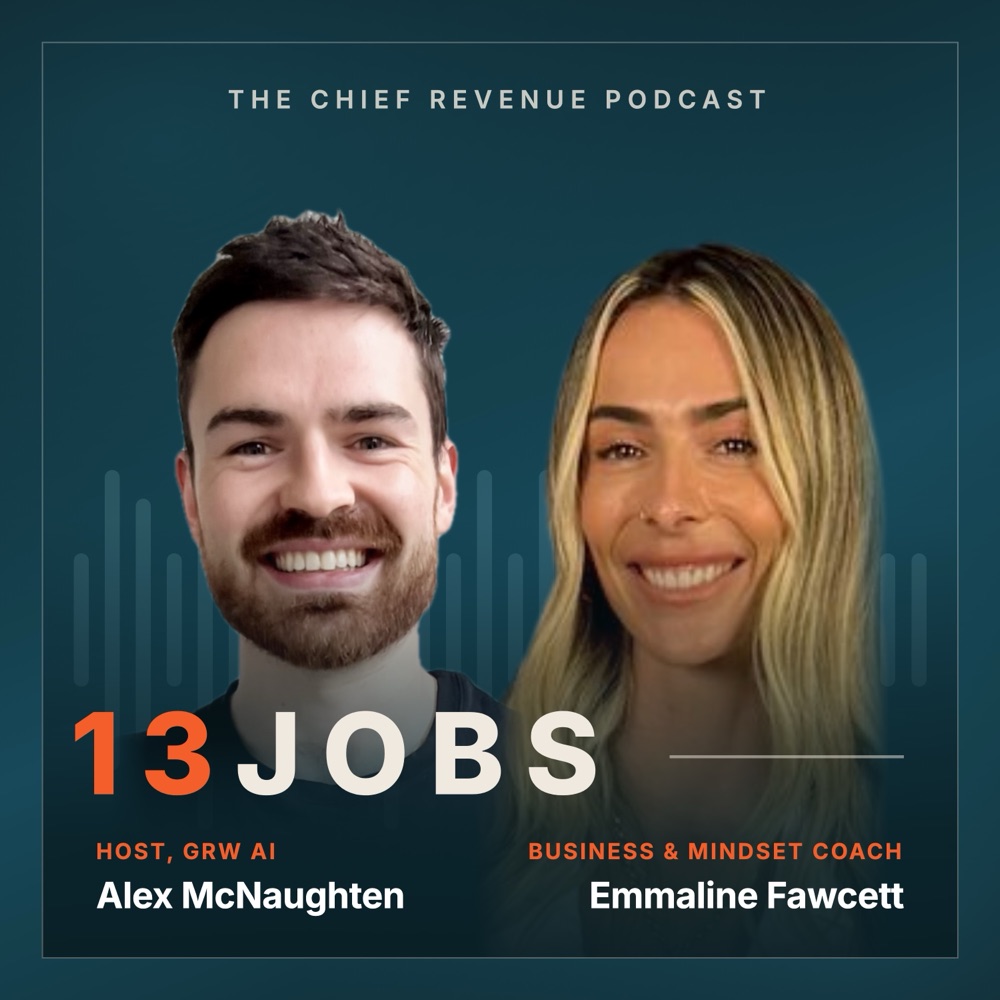
You are not the offer
Emmaline knocked on up to 300 doors a day in Queensland humidity. The mindset shift that made it survivable is one sentence long.
 Hosted by Alex McNaughten
Emmaline Fawcett · Business & Mindset Coach
Emmaline Fawcett is a business and mindset coach based in New Zealand. She works with women taking their businesses online, having taken her own fitness and nutrition coaching business through the same move.
She came to it from clinical nutrition and personal training, years of face-to-face work and running her own companies, then an NLP qualification that pulled her toward mindset work. Somewhere in the middle of that she spent nine months knocking on doors in Queensland, which is where most of her views on rejection come from.
In this episode, we discuss:
- From clinical nutrition and personal training into mindset coaching
- Sales as providing a solution to people it was already right for
- Nine months knocking on doors in Queensland humidity
- What a day of a hundred and fifty doors actually returns
- The shift that makes rejection survivable
- You are not the offer, and why detaching is not the same as not caring
- Why she pays her sales team a retainer
- Commission breath, and wanting the sale too much
- The morning routine, and discharging excess energy before the first call
- Resilience, and what happens to people who have not built it
- The core wounds sitting underneath a fear of rejection
- Hard work beats talent, and being outskilled by someone hungrier
Quote of the show
“They're not saying no to you. They're saying no to the product.”
Key takeaways
- They are rejecting the product, not you. One sentence, and it is the difference between a hundred and fifty doors being survivable or not.
- You are not the offer. Detaching from the outcome is not the same as not caring. It is knowing the thing you sell was never going to be right for everyone.
- Commission breath is audible. Wanting the sale too badly is felt by the person across from you. The best runs tend to come when you are not chasing the deal.
- A retainer takes the desperation out. Keep the commission, but pay a base as well. It removes the weight sitting on every individual conversation.
- Discharge the energy before the day starts. Sales carries a low-level anxiety in the body. Training in the morning burns it off so the first conversation starts from neutral.
- Resilience is built, not issued. Without it, anything that feels like pressure makes people crack, and no amount of product knowledge compensates.
- Hard work beats talent every time. A naturally gifted seller who stops learning gets outskilled by someone hungrier who never stopped.
Transcript
How you doing?
Hello, I'm good, thank you. I'm so pleased to be here. How are you going?
I am great. It's a Friday. The sun is sort of shining here in Auckland, so life's good. So for those who don't know Em, Em is a business and mindset coach. But tell us about yourself. Tell us a little bit about your journey.
Sure thing. So I come from a history of being clinical nutritionist, personal trainer, did a lot of face-to-face work for a long time, obviously running my own businesses for a long time. Then got into mindset coaching. So got my NLP qualification about 3, nearly 4 years ago now. Um, absolutely loved that, kind of wanted to dive further into that.
Um, pivoted my business into the online space, my fitness coaching and nutrition coaching. That went pretty well. And now I coach other women through bringing their businesses from the PT floor or the clinical nutrition space into online. So it's been quite a wild journey, but absolutely loving it.
That's awesome. And we came across each other because I saw you do a post the other day about sales, and it was like an impassioned post about how useful, valuable, and important sales is. Um, and that's what I thought we'd talk about today— sales as a superpower. Um, so starting things off, I was like, what, what is selling?
Like, how do you even describe selling?
Sure. So It all depends on your environment and I think who you're selling to. I believe sales is so much simpler than what it probably is thought of in society and from our conditioned minds. I believe that sales is simply just a solution. It is when you're speaking to the right people, that is, right?
So if the needs, desires, and solutions of the people you're speaking to align with the product, all you're doing is providing a solution. You're actually there to be deeply in service of those human beings, of those people when you've got the right audience. Now, we're not talking about cold calling or door knocking because not everyone's going to be your desired client or customer.
But I think, you know, especially in the online space, um, and when we talk about warm lead generation, I just believe sales is so much simpler than what we all think it is. Um, understanding a bit of human psychology is an absolute necessity, but I think more than anything, a high level of emotional intelligence and just knowing that you're providing a solution.
So I think we've overcomplicated it a lot, you know, and with the likes of all the movies that you see, Wolf of Wall Street, and we, you know, all the different films that we watch, we, it's made out to really be demonized. And I hate that about, you know, the way we think of sales.
I think it's truly an act of service and you being in service of other people's needs.
Yeah, I think that's it, right? And it's a shame that most people have this perception of sales as this sort of dirty, sleazy, underhanded, like, bag of tricks. And yeah, you know, it's— yeah, when it's done well and when it's done properly and ethically, it is, as you just described, an act of service.
And I think, um, when you start framing it that way, it becomes a lot easier. Um, but tell us, you had an interesting journey. So you, you, you've done the whole door knocking sales, like you've done like the— Probably the hardest sales experience you can have. So tell it, tell us about kind of your journey into starting and now kind of with this approach of service.
Like, what was your journey?
So I think, you know, I started obviously on the gym floor. I started, you know, as a clinical nutritionist working face to face, and I took a little bit of time off because I wanted to get some travel in. And I did end up doing a super random job door knocking, um, when I was in Queensland.
And boy, that was an experience. I think that was the first time that I had ever been completely thrown out of, into such an unusual environment. And, you know, as you know, when you're doing cold sales face-to-face, it probably, I actually think it's harder than doing cold sales over the phone.
Yes.
And I've done a bit of that in my own business. So it's interesting though, because I actually think people respond to you better face-to-face. So the face-to-face door sales was really interesting. I did that for about 9 months. You know, you're knocking on anywhere from, 150 up to 300 doors a day. It was in Queensland.
So very, very muggy, humid climate. So we've got these weather conditions which are just not palatable. You're turning up to the door like a freaking drowned rat. And of course, trying to take money and you're conducting the sale at the door. So that's a whole thing on its own is the trust piece with credit cards and payments and your legitimacy.
So that was all kind of tied into the way that we pitched. But I honestly think that that experience probably set me up to be so incredibly resilient, but also I realized how much face-to-face you're more deeply connected with the other person that you're selling to versus say over the phone or in a DM, right?
There's that real lack of connection. There's that real inability to read the other person. So, I mean, aside from tonality and voice and everything that you can kind of gauge over the phone, but I think face-to-face, believe it or not, although it sounds really scary, it was probably one of the most incredible experiences I could have now as a business owner.
You know, and, you know, with the intention of building out my sales team and going through that process now and into 2024, I think that process alone has really showed me what you need to be successful in sales for sure.
How many times do you get rejected?
I would say from 150 to, say it was a slower day and you sort of only got a 25 or 30% Um, show rate to the door, you could make anywhere between 7 to maybe 15 sales in a day. A slow day would be 4 sales, but obviously it's all dependent on getting the housewives at home or, you know, getting the hubby on the phone at the door.
So it really depends on who's home and during the day that can look very, very different. Yeah.
I guess where I'm going with this question is like, how do you— how did you learn to deal with rejection? Because this is something that I think a lot of folks who are newer to sales struggle with is They do. You know, like rejection never feels good. And I think a lot of the time it's quite jarring for someone if they've just started a sales role.
It's like, oh wow, that doesn't feel good. And now I don't wanna do that again. And now I've gotta do it 150 more times today. So yeah, tell me a little bit about how you deal with the rejection side of selling.
It's a really simple mindset shift. It's just a shift of perspective. They're not saying no to you. They're saying no to the product.
Right. And that was it.
It's literally that simple.
Just detach immediately.
Yeah, because we as humans, we, when we're, when we're not solid in our concept of self and our identity of who we are, we personalize a lot of things. You know, you walk into the office and someone's having a bad day that morning and they kind of groan at you and people go and create an internal dialogue around it being very personal.
People personalize too much. And it's not about becoming detached and not caring. But it's understanding that when somebody says no to what you're selling, they're not actually saying no to you. They're just saying no to the product or the service at the time. So, you know, rather than making it so personalized and feeling like you're being rejected, the rejection is to the offer.
It's not to you. So I think it's that simple.
But you're giving the offer.
Absolutely. But I am not the offer. And this is where we we need to learn to detach a little bit from the objective outcome. Yes, you're selling the offer. Absolutely. But you are not the offer. You're not selling yourself. You're selling a product, a service, a package, you know, whatever. And at the end of the day, your product, your service, your offer isn't going to be for everyone.
And I think when you are going into sales, say, you know, you're thinking about going into a sales role, you have to start with the expectation that you won't will be rejected in a sense, or you will face rejection. I don't think it's you being rejected. You will face rejection.
Yeah.
You will get nos. You will get people that are having a bad day and that will, you know, project that onto you. But you'll also have the opposite. You'll make some beautiful connections. You'll meet incredible people. You'll have wild conversations you could have never have imagined. So it's all about perspective when you go into it.
I think definitely setting your sales team up or your salespeople up to expect rejection in a sense, Is, is important for sure, but it's not actually you that's being rejected. Remember, not everyone needs what you're offering.
You said 2 really interesting things there. You said like connection, and I think actually that's one of the best things about being in any kind of customer-facing role is just the kind of like little random connections you make along the way. And it can be like the shortest of conversations, but it's actually, it's one thing that I find really good.
And, you know, like, I'm still doing 90% of the selling across, you know, my business today. And it's, it's like the little conversations and it's kind of irrespective of whether they become a customer or not. It's just the connections you're like, my, my, my approach has always been just like going to every interaction kind of like open-minded looking to understand the other person.
And if I can help them in some way, shape or form, like awesome. And if I can't, that's okay too. And help doesn't necessarily just mean I have to sell something to them. It could just mean I'm gonna connect them with someone I know because I think actually that would be useful.
Absolutely.
And I guess it kind of came back to your like service mindset. So I think that really struck out is that you've zeroed in on the word connection. And I think that's something that a lot of people forget about is it is just a human-to-human connection and that is kind of more important than I've gotta sell you this specific thing.
I think just on that, I think, you know, when there is a huge pressure and let's just talk money for a second because let's be real, a lot of people go into sales, you know, with the premise of financial returns and that's kind of like that actually, it places a lot of pressure on every individual sale.
And so, you know, with my sales team, for example, I will be putting them on a retainer and the reason being is, you know, they will still be somewhat commission-based, but having that retainer is just— it takes away from that desperation in the selling process. When you're on commission only, like I was, when you're door-to-door, there's a level of desperation whether you know it or not.
Other people can unconsciously feel that from you. And I think once you can take out that real ultimate survival desperation from it and it actually just gets to be a conversation, I think that changes the whole dynamic because you're not stinking of desperation. You're not stinking of, I need the sale, or, you know, I'm not gonna have food to put on my table.
So I think, I think that's another really important point too. You know, when you're in sales solely just to make money and you don't have a connection to the products or the offers or the services that you're selling, it actually makes it harder to sell. It's really easy to sell something that, one, you know, gets results, and two, that you feel is doing good.
Unconsciously, if you're selling a secondhand car, if you're selling a secondhand car and you know it's overpriced, and, you know, you know this person's not getting a good deal, that is going to be felt on the other end, right? People can smell bullshit whether we know it consciously or unconsciously, and you can too.
And that's going to impact how you sell, how you show up in the sales conversation, how you show up in the transaction. So I think where I think the word integrity comes to mind, where it's like it's easy to sell something you are connected to and that, you know, that works and, you know, holds value.
That doesn't mean it's not a high-ticket item. That doesn't mean it's not a big contract. That doesn't mean it's not a big sale. But you know that it holds value and you see its value, then it's really easy to sell. Yeah.
Okay. So it's, I think that's a really good point is, and I often say this to folks if they're looking for a role is be careful about what company you go work for or like what you're like what you're selling because if you struggle to get behind it or you don't believe in it, other people will feel that too.
And, um, the other thing around this, and we like, it's commonly like known as commission breath, is like when someone wants the sale too much and it's just really off-putting. Everyone can feel that. And like you articulated perfectly, it's like, it's that like desperation of like, you know, and, and on in, it's kind of almost like a begging.
And you see it sometimes from folks when they like really, really want the sale and they're like, please, I need this sale. And it's like, it's so off-putting. It puts everyone off. They don't wanna buy from you anymore.
Yeah.
And, um, the most successful I've ever been in my career has always been just when I'm like, have integrity. I know what I'm selling, like the solution I'm offering is valuable and I'm just there to help. And it's actually when I'm not looking for deals, that's when things, that's when the numbers actually come.
And I think that's something, it's like counterintuitive, it's like, but it makes a big difference. In terms of mindset, and obviously, you know, you're a mindset coach, trained mindset coach, and I'm curious, like, what other aspects of, what other things have you learned, or like, what other aspects of mindset have been really important for your success and for folks you've worked with?
Sure, sure. That's a good question. There's a lot, I think, and this is going to sound really basic and it's not necessarily anything crazy, but morning routine has been a big one for me. Okay. I feel like when I go to the gym and I train and I exercise, I discharge any of that kind of excess energy and I get to come into work and come into sales conversations, whether it's DMs, over the phone, etc., in a very, very neutral manner.
I've discharged any excess energy. I'm feeling really good. My endorphins are up, my serotonin's up, my you know, in general, how I'm coming into work in that state, it's of high self-esteem and you're, you know, you feel really elevated after exercise. So while that's not necessarily mindset, I think that alters your perception of self and your perception of the day.
So I think that's sort of the first thing. Morning movement—.
Can we just pause there for one second?
Yeah. Yeah.
Because you mentioned something, I'm curious what you mean by it. When you say like discharge excess energy, What does that mean? Like, like, why, why, why? Like, what makes you need to do that?
Or it's not recognized. There is pressure and a low-level anxiety that comes with sales, and so I'm a believer that we need to discharge some of that excess anxiety and energy that gets built up in the body. So it's a biological thing, it's a physiological thing, it's also an energetic thing. We're discharging any excess anxiety at the start of the day to come in clear-headed, very focused, and, you know, in a space of resilience.
Because that's, that's really what all of those beautiful hormones that exercise creates does. They make you feel more resilient. You have better self-esteem. You have a better attitude. You're positive. And you're going to be coming in, I think, in a more neutral manner as opposed to waking up, you know, knocking down 3 coffees, coming to work.
A bit flustered and they're maybe anxious and like, oh, I've got to make 3 sales today. You know, it's just, it's a very different, it's a very different feel. How you come across is gonna be very different.
Right. Gotcha. Oh, look, I intuitively massively agree because the days I get up at 6 and have a workout before I, then a cold shower and then start my day compared to the days where I don't, massive difference in how I'm feeling in those first few hours of the workday. Massive difference. So yeah, that's—.
I think also on that, I want to touch on a bit more mindset stuff. So you guys are really getting the juice out of me. But I think there also has to be a sense of resilience developed. Do you know what I mean? Because when you don't have a resilient mindset, any perceived stress or any perceived struggle or anything that feels like it's bubbling up inside of you, it makes people crack.
And so I actually think, and you probably know this after years of doing, you know, sales recruitment and whatnot, is that you can't hire people that don't have a good sense of self, like their identity and just that a good level of confidence or personal power or esteem. Sales will literally break you if you have poor self-worth.
So developing that resilience muscle, and I think it's actually something for a lot of people, you're either born with it or you're not, or you develop it over time as a skill set. So a lot of this has got to do with your childhood conditioning and I think, you know, your concept of self.
But It's a skill that can be developed over time. Resilience really is key. And the other thing to that, I would say, you touched on rejection before. I would say you have to be able to enter a lot of curiosity because curiosity is the antidote to shame. And how do people perceive rejection?
Well, they feel shamed, don't they? They feel rejected, they feel wronged. So having a lot of curiosity, I think, is really important.
Yeah, let's touch on that one in a second 'cause curiosity, I think, is the biggest superpower anyone can have in sales. In terms of what do you say to folks who just don't exercise and just don't believe in that kind of part of high performance? Because like my personal belief is if you look after yourself, you're gonna perform better in other areas of your life.
So if you look after your body, your mind's gonna be sharper and you're gonna be able to show up better at work. And that's not to say that everyone needs to you know, work out 20 times a week and be a competitive athlete. But I do think that moving the body in some way, you just perform better.
What do you say to the folks who are just like, nah, no, I, I'm, I, I don't, I'm gonna sit on the couch and I don't work out and I never have and never will?
Um, honestly, I would say that they probably have a low level of self-worth or low level of at least self-esteem, because when you have a high level of self-esteem, you care for yourself. And I mean, we all know that movement is a part of that and nourishing your body and eating well and not slumping on the couch.
So I would say they're likely probably not going to be successful at sales. But I would say that there are just those human beings that are like, they could sell the shirt off their back. There are those rare human beings who are just born salesmen. It's very organic. They're very intuitive. They read other people.
They love to just have a chat and, you know, they build that rapport really well. Are those people. I would say the couch slumpers more often than not probably wouldn't be that successful at sales unless it's something, unless that's all that they know, right? And then they're gonna master that skill over time.
But I think it's gonna alter, it alters your chemistry. We already know that from a physiological standpoint. It's not possible for you to feel good about yourself sitting on the couch all day and eating junk food. So, Internally, however anyone wants to frame it, exercise is going to make you a better salesperson, no doubt.
I will not disagree with you there. Curiosity, you mentioned that. What's important about that in a sales context, in a life context?
Sure. I think a lot of society, this is gonna go really deep, but I think a lot of us hold, you know, many different core wounds as humans. We hold the same core wounds really. You know, it's fear of rejection, it's abandonment, it's unworthiness. Those are kind of like the 3 core wounds that human beings hold that underpin, you know, who they are and how they feel about themselves.
And so I think, you know, curiosity is important in sales because what other role are you likely gonna be hearing no? And, you know, numerous up to hundreds of times a day. Sales is really the only role where you're going to have to be engaging people and especially if it's cold you know, whether it's door-to-door, it's over the phone or it's DMing, that is going to be the most probably abrupt transactions that you're gonna have.
So in any business, it's always gonna be sales. And so I think the curiosity comes in because it enables us to continue learning. It enables us to not take everything so personal. When you get curious, you're very adaptive in your mentality. You get to look for other reasons, solutions, justifications, opportunities. Curiosity is the antidote to shame, but it's also the doorway to growth.
Because if you're not curious, you can't learn, right? When we have that fixed mindset. So I think curiosity is huge for everything, but I think more than anything, it's the cure to shame and it enables us to continue learning and evolving.
It's a good response. I agree. I think It's, it's crucial in a sales context, but also in a life context because you're right, it's kind of like that fixed versus growth mindset. And I think the folks who I've seen do really well, not just in sales and like in general, are just the folks that like, they're always reading, they're always learning, they're always developing, they're always trying to be better.
And I think, you know, for— I think that's particularly in a, in, in a, in a profession like sales, or, you know, if you've got a business and, you know, you're having to sell, I think it's one of the things you can never be too good at. You can always get better at it, and you can never be too good.
Um, and my God, I've been teaching people how to sell for since 2019. What's that, 4 years? And then before that, like, I had teams as well. And even the best like highest earning sales folks who are doing like million dollar years, multimillion dollar years, they've been in it forever, they're still learning.
And that's what I've always noticed from coaching some of those people. Like they're still learning, they're still open to learning. And I think that's a difference. Last question.
You know that saying?
Oh yeah, go, go, please jump in, jump in.
I was just gonna say, you know, hard work beats talent every time. You can be a very talented salesperson, but if you're not willing to continue learning and having that student mentality and really want to evolve Evolve your, the way that you sell and really who you are, then eventually you will be outskilled.
Someone will come in that's more eager, more willing to learn than you. And yeah, that's just it. So I'm such a believer in that, you know, hard work beats talent every time.
I agree. Last question for you. This is the question I ask every guest when they come on the show. Knowing everything you know now, go back first day on the job in, you know, or for like right at the start of your career, what's the one thing, like the one piece of advice you'd give your younger self?
Um, I think more self-compassion. I definitely think more self-compassion. I was— I had a lot of perfectionist traits when I was, when I was really young. And so, you know, the, the expectation that I would put on myself was really high. And while it's great to be eager, it's great to be passionate, it's great to be motivated, that has to be met with a little bit of compassion at the same time.
Whereas I think when I was younger, I really, I beat myself up a lot. Whereas now I'm, you know, so much more compassionate. And I think it's that fine balance, right? And I don't even like the word balance. I don't necessarily believe in the word balance in anything in life. But I believe that, you know, you really have to manage essentially how you evolve.
And over time, I know that I've developed, you know, the ability to be much kinder to myself. So it's that balance between real hard work and ambition, but also compassion. So I definitely would have preferred, if I could go back and talk to my younger self, it would be that I would be kinder to myself, I think, for sure.
I think that's good advice. This has been great. I've enjoyed this conversation. We've covered a bunch of stuff. I think there's a bunch of value for the listeners. Where can people connect with you, find you if they want to follow you, consume your content, get in touch? Where's the best place?
Sure thing. So jump over to Instagram. We've got a Facebook page as well, but we're really only present on Instagram. It's Emmeline Fawcett. You can email me if you want to get in touch, team@emmelinefawcett.com. I also have a podcast. Jump over and have a listen to that. You'll find that all on my Instagram page and of course website, but yeah, we'll just go for social media for now.
Perfect. Awesome. I'll make sure those links are in the post as well so folks can just click and click and find you. And thanks for coming on. It's been great. I've enjoyed the convo.
Thank you so much for having me. It's been amazing. So good to connect with you. What you're doing is just incredible.