
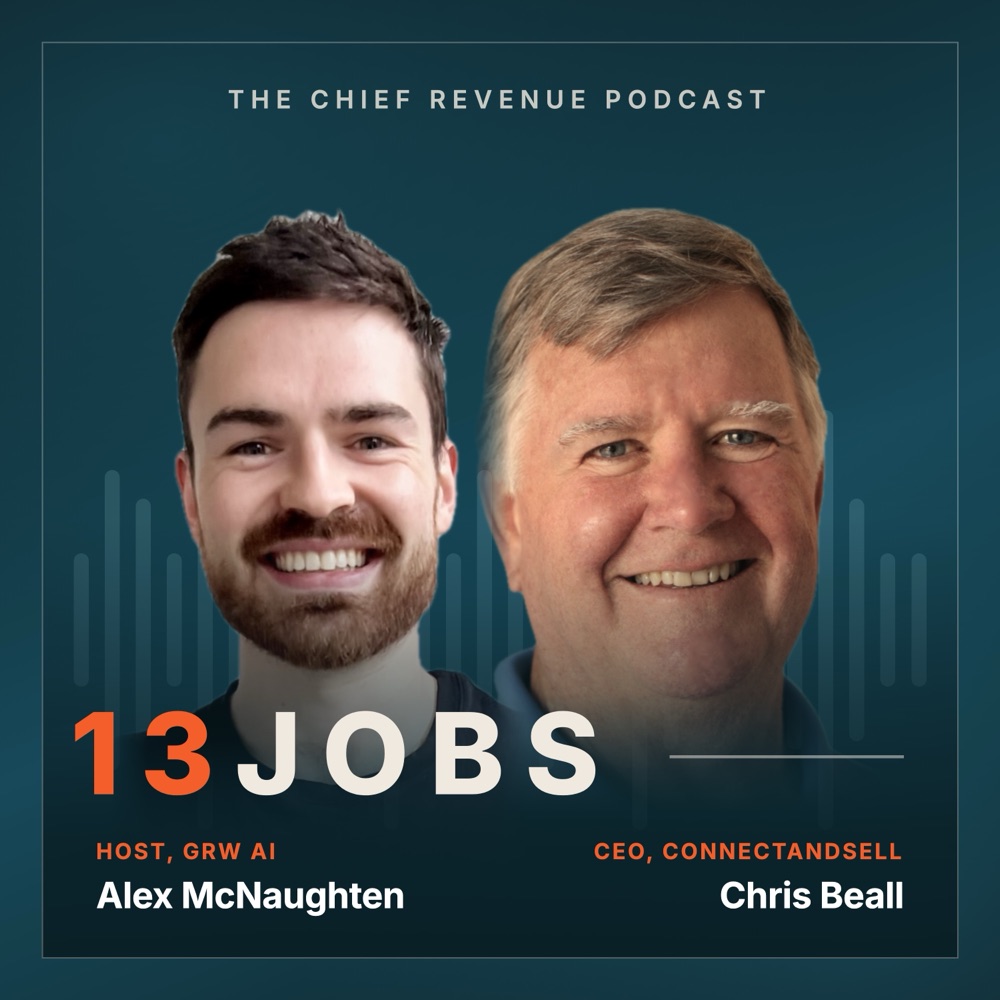
They're protecting their career, not their money
A bad B2B purchase does not really cost the buyer money, it costs them standing. Chris on why that makes trust the actual product, and the voice the only way to build it.
 Hosted by Alex McNaughten
Chris Beall · CEO, ConnectAndSell
Chris Beall is the CEO of ConnectAndSell, which he joined in 2011 by informing the founder he was working for him whether or not there was a job going. The product dials a list on a rep's behalf and hands them a live human conversation, which he describes as raising the flow rate of the only thing in business that creates value.
He has spent decades building and leading software startups, starting his first venture in 1983, and is an avowed disciple of Geoffrey Moore of Crossing the Chasm. He also hosts the Market Dominance Guys podcast, which passed 200 episodes.
In this episode, we discuss:
- Growing up in the desert, raised by animals and books
- Hiring himself into ConnectAndSell, uninvited
- The pitch that made him join on the spot
- Crossing the Chasm, the book everyone reads and nobody follows
- Why tech enthusiasts are not your market
- The visionary customer who pays a fortune and never references you
- Why a B2B purchase is a career risk rather than a money risk
- Trusting a seller more than yourself, the way you trust a surgeon
- Why the trust part cannot be automated, ethically or otherwise
- Seven seconds, and the two things you have to do inside them
- Naming yourself as the interruption, then asking for 27 seconds
- What a door-to-door job taught him about being an expert
Quote of the show
“They're not protecting their money, they're protecting their career.”
Key takeaways
- B2B buyers protect their career, not their budget. A bad purchase costs standing, reputation and possibly the job. That asymmetry sits underneath almost every stalled deal you have ever seen.
- They have to trust you more than they trust themselves. The buyer cannot be the expert, they are busy running their business. It is the same trust you extend to a surgeon, and for the same reason: too much is on the line.
- The trust part cannot be automated. A bot has to declare itself, and one that does not gets found out eventually. Going to market with tricks does not survive the market noticing.
- Tech enthusiasts are not a market. They try things because they enjoy technology. Reading that as product-market fit is lighting a fire with borrowed lighter fluid and planning to cook dinner on it.
- The visionary customer will never reference you. They bought to beat their competitors, and their competitors are exactly who you need to sell to next. Price the deal knowing that.
- Seven seconds decides a cold call. Show them you see it from their side, then show you can solve something. Naming yourself as the interruption does the first half in one line.
- Expertise is asymmetry, not mastery. Selling brushes door to door he knew nothing about the products. He had access to information the person at the door did not, and offering to go and find it was enough.
Transcript
How you doing today?
Alex, unbelievable to be here. Wonderful.
That's good. Glad to hear it. So for those of you who don't know, Chris is the CEO of Connect and Sell. So Chris, tell us a little bit about yourself, how you came to be where you are today and tell us a little bit about Connect and Sell as well.
Sure. I'm a kid who grew up way out in the desert north of Scottsdale, Arizona. I was raised by animals and books. I suppose my parents might have tried to have a hand in it, but we had a lot of animals and we had a lot of books and they seemed to have the upper hand.
And, you know, grew up kind of thinking that the world was the world described in books because my dad had collected all the best of what had been written and thought over all time. So I was kind of in this curated, you know, I didn't know any better, right? So, and I read everything.
So that's how I grew up, very interested in math and science and just learning stuff. And one thing led to another and eventually because, you can't really get a job in physics that's worth anything. I ended up getting a job in the software industry and then I realized that the whole thing about the software industry was nobody knew how to sell.
So I found myself as the engineer who sold all the deals.
Right.
And so, you know, you kind of put that together after a while and go, well, I may as well start companies because if you can build it and you can sell it, you can kind of get anything going. And so I started startup companies. My first one I did with a guy in Boulder, Colorado in 1983, I think it was after 4 years of being in some large companies and doing interesting things there.
But it was more interesting to start our own venture financed with Kleiner Perkins of all things out of California, which was quite unusual. Who I didn't know that was important back then, but it was cool. And so I've been kind of, you know, poking along doing these software startup companies for a long time and some of them in some unusual areas, did electronic cataloging for about 10 years, the whole world of B2B catalogs.
And I hold a bunch of patents. It looks like, I don't know, somebody told me 17, 18 of them.
Right.
And so then I fell into Connect and Sell. I ran into this guy Sean McLaren and he was, I was introduced to him back in 2011. I joined the company on the spot. Literally, he was not— I don't think he was recruiting. Maybe he was.
Right.
I wasn't looking for a job, but I heard what Connectasol was doing out of his mouth and I just said, hey, I'm working for you now. And he said, what if I'm not hiring? I said, you know, Sean, I checked on the way over here to this meeting this morning. It was a very early morning meeting.
I said, this is still America. It's a free country. I can do whatever I want. I can work for whoever. I'm working for you.
What did he say?
Would you like some advice? He says, what kind? I said, free. He goes, oh, free advice. I'll take that. What is it? I said, well, I advise that you pay me actually because I've heard it stabilizes the employer-employee relationship and you are gonna want this to be stable. So that's how I got into this gig.
And then some time into it, no good deed goes unpunished. They made me CEO. I think because they couldn't spell janitor or fit it on the business card.
Chris, I'm curious, what did he say that made you want to join the team? When you said he described what they did in his own words, what were those words that made you want to join the team?
You know, I don't remember the words exactly, but here's what I played back to him. I said, okay, timeout. You're telling me you've reinvented the business telephone. To call multiple folks on a list at the same time. And the mathematical consequence is a 10 times increase in the flow rate of the only thing that creates value in business, a conversation between somebody who has a potential solution to a problem and somebody who might have that problem.
Is that so? Is that what you have? And he said, yes. And I asked, is it real? And he said, yes. I said, is it sold for money? He said yes. And I said, is it at scale? And he said, not so sure. But then he told me they were doing 7 million fully navigated dials a year and that sounded like something.
So I said, I'm in. Wow.
And maybe you can or maybe you can't share this, but how big was the company then? And, you know, where are you at now as a business?
Yeah, let's see then. I'm trying to remember what it was back then. It was probably doing 8 million, 7, 8 million, something like that. We're doing about 24 now. Well, we were venture financed a little bit, but then we came to a parting of the ways with our VCs back in 2014, which is kind of how I became CEO.
Right.
And I had an interesting week one week where we didn't know if I was an employee or if I was running the company. But, you know, you just get up in the morning and you do what you do, right? So yeah, it's an interesting company. It's not like the other Silicon Valley companies in a few ways.
One is it's not pure software, but it's a lot of software. It's actually the most complex system I've ever been involved with. And kind of my claim to fame is building big, complex, global kinds of systems. This is a global Mechanical Turk. It's got right now about 275 people in it who navigate phone calls.
And they work alongside a whole bunch of AI. So it's basically either people or AI prosthetically enabled people with a bunch of tech that's helping them, you know, each one in their own Iron Man suit navigating phone calls. And they just, they're a big pool of them and they do this thing. Of course, the pure AI ones, we don't have to pay very much.
And the human ones, we need a lot because you have to talk to gatekeepers and do stuff like that.
Yeah.
And they just offload all of the work that's required to get somebody on the phone. So you load a list into our product, you push a button, pet your cat, you drink your coffee, you stare off into space and dream your dreamy dreams. And then at some point, somebody who's on your list answers the phone and you get a little bloop in your ear, bloop, and it pops on the screen, shows you who you're talking with, what you're talking with them about.
Now you gotta speak at that point. Some people don't, they do the deer in the headlights thing.
Panic.
But as my wife said, you get the undivided attention. Of another human being who might mean something in your business and you might mean something in theirs. And she also said it's the world's greatest weight loss program when she tried it because her heart rate was about 160.
That's awesome. Well, and it brings us quite nicely onto our topic and something we were talking about before we started recording. And you used this phrase, you know, it's possible to dominate markets using the human voice at pace and at scale. And I wanna unpack that a little bit over the course of, you know, the next few minutes is like, what does that mean to you?
What's that all about?
Well, the first part of it that I think is really interesting is the idea of a market. And I'm a disciple of Geoffrey Moore, the guy who wrote Crossing the Chasm, a book that everybody reads and nobody follows. And everybody thinks they're an exception. They read Crossing the Chasm and they go, yeah, that's great.
But my product is so marvelous, so wonderful, so incredible that it's already across the chasm. Even in my mind, it was across the chasm, which is why—.
That rule doesn't apply to me, right? That's the typical thinking.
Yeah. So the chasm is full of the dried, you know, desiccated bones of companies that were run by people who said that. And I'm a big believer in it. I think that folks don't like technology. They don't want to risk their career buying technology. And the fact that you like it and you made it and you think it's cool doesn't make it great to them.
It makes it even scarier to them. And you've got to figure out how to get across the chasm into something that's called, that Jeff Moore would call a market, which is a set of companies that are inter-referencable where if you get one of them as a customer, and you do well with them, you reduce the cost and risk of doing business with every other one in that set.
And that's the definition of a market. So it's an operational or mathematical definition, which I prefer, given my background, I like stuff like that. And so the first question is, well, why bother to dominate a market? And the answer is because everything else is unsafe. If you don't, someone else will because it's a runaway train.
Once you are the referenceable solution, Jeff wrote a book called The Gorilla Game about technologies. Once you're the gorilla, no one else is allowed to survive in that market. They exist only because it amuses you to have them exist if you're the gorilla. And if you're not the gorilla, you're toast, you know, you're serving that master.
So it's either dominate a market which could be small or could be big, or it's wait around until somebody else dominates that market and starts telling you how your business is gonna be run. So it's the only safe place in business is market dominance. And so it's important. And then the question is, well, can it be consistently achieved?
So talking about the market thing, because I think this is something that a lot of companies struggle with when they're trying to find product market fit or when they're kind of earlier on in their journey in particular is, you know, who do I serve? Any ideas or thoughts on like, how do you maybe accelerate the process of finding your market or what are the steps you should take to finding your market?
Yeah, I think the acceleration is actually just a matter of not doing things that take you in the wrong direction because that's gonna eat up your time and eat up your energy. So first of all, you gotta just admit, it's like, you know, the 7 stages of grief or whatever, you gotta go through all the steps.
So step one is you actually do have to sell to tech enthusiasts who try your stuff because they like technology.
Yeah.
It's just really smart not to treat them as your market. So getting sucked into that and going, ooh, people love my thing, they're using my thing, therefore I found product market fit is kind of like saying, you know, I managed to start a fire here with a little lighter fluid that I found over here in somebody's lighter and therefore I'm gonna stay warm all night and be able to cook my dinner.
It doesn't work like that. There's not enough fuel in the tech enthusiasts to take you all the way to covering your company's overhead and providing you with additional gross profit so you can grow. But you need them anyway because they're going to give you ideas and they're gonna use your stuff and beat it up a little bit, but they'll keep trying, right?
Then sadly, you probably have got to find yourself a visionary customer, somebody who sees competitive advantage in your product and do a single deal with them that nobody will let you do. If you have VCs, they won't let you do this deal because it lets you skip like 2 rounds of financing that they would rather do with you.
And that is you take an immense amount of money from some larger organization that if they had control over your technology in their world against their competitors, it would be special for them and you do a deal with them. A big deal. Like, you know, I did one once with a company in the MRO space where we had almost no money when I joined this company, but we had a technology that we could cobble together pretty quickly.
We already had the tech enthusiasts behind us and this particular company was desperate because they were gonna have to compete with the open internet, which was really dangerous back then. This is in 1990.
'08.
And they paid us for some technology that had been around for 6 weeks, $10 million for a license fee. And they paid us $2 million a year to provide them with non-recurring engineering in order to make it fit their business. And we gave them exclusivity against 3 named competitors. Each year they would pay for the exclusivity.
And we licensed our patents to them and cross-licensed any future IP that they developed.
Wow.
It's a 5-part program that you can run and it pretty much guarantees that you will at least have somebody beat the living daylights out of your technology and make it work. And then you gotta actually package it as a product and go find somebody with a broken mission-critical business process who will pay you for that product holding their nose because they don't like new technology, but they really need to fix this thing.
And then you gotta work with them, make them referenceable, And then it's reference, reference, reference, reference, reference until you get to the edge of that market. That's kind of it. Yeah, it's a fail-safe program, but most folks won't do it.
So I like how you've broken that down. So, so I'm just gonna recap it. So I've understood correctly, start with the early adopters, start with your tech enthusiasts and get some runs on the board, get some feedback, help shape, shape things, then go find yourself and you describe them as a visionary. As in a larger organization that has a very serious problem that they're willing to pay for, that they can't solve themselves.
And they probably appreciate that your thing isn't perfect, but they'll work with you and work with you to make it, you know, to solve their problem. Is that a fair description?
That's it. Yeah. And they'll pay you an awful lot of money and they won't ever be referenceable. So you have to take an awful lot of money from them.
And they won't ever be referenceable. When you, okay, so talk a little bit about that. Why won't they ever be referenceable?
Well, when you look at the reason that they're doing business with you, it's to squash their competition or to keep from getting killed by their competition.
Right.
So the last thing they wanna do is be a reference customer for you as you sell to their competition. But the natural folks to sell to are their competition.
I'm with you. So they're, so I'm with you now. Okay. So you are basically making a deal with them to not go sell to their competition and give them an unfair advantage. I'm you. And then once you've done that, then it's go sell to anyone with a problem basically that you can serve.
And even if they're not the tech adopters, their problem is so great that they will pay you to solve it.
Right. And they're not seeking competitive advantage. They're seeking a solution to a broken mission critical business process, probably because they're stuck on something old. Time has gone by, things are changing, whatever, right? Their business doesn't work quite right anymore. And you can identify these people, the individual people who are the change agents around this, they go out looking for solutions.
If you ever go to a trade show and you walk around, you used to be able to do this pre-COVID, you'll see them in packs of 3. They'll have a leader and 2 wingmen or women and they'll be going to every booth. And you just have to look for a group of 3 people going to every booth and, you know, That's somebody with a broken mission-critical business process and they've been sent out to find a solution.
And those are the only people worth talking to at trade shows.
Right. Gotcha. So that's sort of the market side of it. Now let's talk a little bit about the human voice element because we're living in this world of automation, AI personalization in quotation marks at scale, etc., etc. But you talk about the human voice. Yeah, unpack that for me.
You can say now, what up?
No, well, I'm curious because you were very specific about that phrasing, the human voice. So talk to me about that.
Well, Here's the problem with B2B. The big problem with B2B sales, and this is generally in B2B, in all B2B situations, is compared to B2C, it's a very risky buy. If you're the buyer or the recommender of a B2B product, you're risking your career. If you, I'll give you a comparison. So say I go buy for myself a Tesla.
Yes.
So I buy an automobile that costs a lot of money and is different and I drive it home and I think, wow, that's fantastic, or it drives me home, whatever. One does with a Tesla. I don't have one. And, uh, but the next day I noticed, you know, I actually have kind of a— I have sort of an itch where I sit.
Hmm.
I drive my Tesla again and I'm itching even more. So I go to the doctor and the doctor says, Chris, you're allergic to electricity. You got to get rid of that Tesla. It's like allergic to electricity? That's not possible. He goes, yeah, that's a problem, right? So I dumped the Tesla on the market and I'm out 10 grand.
So I have to make that 10 grand back up at some point in my life, right? Now take the same $72,000 and spend it on something that makes my company worse and I'm the person who brought it in. And the average B2B purchase makes your company worse at random products that are, you know, that are brought to you by vendors.
When you try to use them, you'll find out they don't quite work like you think. They don't integrate like you think. Your business processes don't fit with them and the schedule for getting it all to happen was a rosy fantasy. And who gets blamed? You do. So you, the decision maker, sounds like such a great role, right?
You get blamed for the bad purchase and almost all purchases are bad purchases.
Right.
Therefore, B2B buyers are extremely cautious because they're protecting their career. They're not protecting their money, they're protecting their career, their kids' college education. Their retirement, their reputation. So now you've got a problem. It's like, well, I can't be an expert as a buyer. I'm busy running my business or doing what I do.
Someone else has to be the expert. I suppose that role is taken by one of the sellers. All the sellers will claim to be experts, but I need an expert. I have to believe one of them is an expert and that person is on my side. I have to trust them more than I trust myself.
I actually said this once to Anthony Iannarino and he made it the opening quote of his book, Elite Sales Strategies. I had no idea he was gonna quote me, by the way. He signed the book for me, handed it to me and didn't tell me, by the way, here's a quote from you that opens the introduction.
It's like, thanks, Anthony. He is a very funny person. So the quote is this though, and I do remember saying it to him. I said to him a couple of years ago, I said, Anthony, People buy from people they trust to make a decision they don't trust themselves to make. In B2B, people buy from people they trust to make a decision they don't trust themselves to make.
And that's the essence of all B2B sales, is the buyer has to trust one of you sellers more than they trust themselves. It's very explicit. It's not like they have to trust one of you more than they trust the other.
Folks.
They have to trust you more than they trust themselves to make this decision. It's like going into, you know, you have an issue and you need to go see a surgeon, right? Well, you have to trust the surgeon to operate on you more than you trust yourself.
Of course. Yeah, absolutely.
And why is that true? Not because surgery is hard, but because there's so much on the line. In B2B sales, as the buyer, there's so much on the line that you're in the same position of somebody who's putting themselves under the knife. There's gonna be blood, but that's not the issue. The issue is trust.
And is that where you see, is that the bit you think that can't be automated? You can't automate that trust building process.
You can't ethically do so and you can't unethically do so. So you can't ethically do so because if you do it with a bot, the bot's got to say I'm a bot, otherwise it's unethical.
Yeah.
And if you do it, if you do it with a bot unethically, then the market eventually finds out that you're a liar. And how can you trust somebody who not only lies but puts their lies into automation in order to spare themselves some effort? So it's fundamentally problematic to go to market with tricks.
And I mean, in any market, sincerity pays off big time because it's needed. How do you trust an insincere person? And actual expertise pays off. And that takes some time too. You can't have your bot pretend to be an expert. That doesn't work. So you're kind of stuck. But now you're also stuck in another way, which is, and Chris Voss taught me this.
So I had the good fortune one evening of being at a holiday dinner thing with somebody who really knows this stuff, Chris Voss, FBI hostage negotiator, brilliant guy. And he's, you know, they've tested this stuff, Harvard Business School and the FBI tested all these sorts of things. And I got to ask him after dinner a simple question.
I said, Chris, I gotta know, how long do we have to get trust in a cold call? And he says, 7 seconds. And I said, really? Because our research says 8 seconds. And he says, your research is wrong. It's 7 seconds. And I said, well, what do you do if you can't get trust in 7 seconds?
He says, we replace the negotiator. That's all the time you have. So now you have the formula for market dominance. You have 7-second conversations in which you generate trust with somebody by ambushing them. And then having generated that trust, you don't blow it. How would you blow it? Well, try to sell them stuff.
You know, first you actually have got to engage with them in a way that lets them come to the conclusion that you're an expert who's on their side. You get a little bit of trust and within that little bit of wiggle room, you can spend that trust, so to speak, without destroying it.
In order to get somebody curious enough to actually have a meeting with you, for instance. And during that meeting, you can let them know what it is you're an expert at and why it's okay to trust you. Not that you say stupid things like trust me, that's a dumb thing to say. So there's a process that you can run repeatedly using the human voice that allows you to consistently generate trust in a relationship that didn't exist, where the relationship literally didn't exist a few seconds ago, and you must do so within 7 seconds.
And that begs the question, what do you do in that 7 seconds?
Exactly. So I asked him, I said, well, what do you do in those 7 seconds? It did beg that question. Thank goodness I actually asked that question. Yeah. So what do you do? And he says, oh, it's simple. It's easy. I said, great, tell me what's easy. And he said, all we have to do is show the other person, the other party that we see the world through their eyes.
We call it tactical empathy.
Right.
And then we need to demonstrate to them that we're competent to solve a problem they have right now. And I said, well, isn't the problem they have right now me? I'm the problem. I just ambushed them. And he said, bingo, that's why you're always in control and can never fail. He said, that's why cold calling is the only completely reliable thing you can do in business because you set up a situation where if you do these 2 things and you're always in charge of the problem that is you, you're good.
So I get that intellectually. Explain what that actually looks like.
There's probably 10,000 ways to do it, but you only need to one of them, right?
Sure.
There's a lot of ways to hold a violin, but there is one that works pretty well. So may as well hold it that way. So you can say something like this in order to demonstrate to the, to the person that you see the world through their eyes, throw yourself under the bus and you do it with your voice.
So you say something like, Alex, I know I'm an interruption. You hammer the word know. You know, I'm an interruption. I know I'm an interruption. I'm a bad thing. Okay. So I see the world through your eyes. I'm bad. Then you change your voice so that it's a come along with me voice.
In the FBI, they call it a playful, curious voice. And this is the hard part. None of this stuff is easy.
No, no.
But, you know, nor is ice skating, right? People learn to do that too. So you change your voice, you flip it really fast and very sincerely to a playful, curious voice, and you just ask a question, which is, can I have 27 seconds to tell you why I called? And when you ask that question, what you're doing is you're saying, I'm capable of solving your problem.
I can go away in 27 seconds. And the path of least resistance is to say, Sure, go ahead. But the side effect, and everybody calls this permission-based, which I think is mistaking the obvious, the zeroth order effect, they let you continue for the real effect, which is now they trust you. It's not they let you continue.
It's not permission. They trust you to continue now involuntarily. It's not a conscious process. They're not in there, you know, with a checklist categorizing various things you did. The way that human beings are constructed, if you do these 2 things, you get a little smidgen of trust. And during those 27 seconds, you can see whether you can turn that trust into curiosity.
And if you can, curiosity is the emotion that allows somebody to do something novel.
Yeah.
That they didn't plan on doing. Well, something novel they didn't plan on doing is scheduling a meeting with you. And that's the whole game. And if you do it consistently across lots and lots of people who comprise a potential market and have those meetings, well, you're first to converse. You've established yourself as reliable, trustworthy expert.
You're paving the market with trust, but only 1/11th of your— 1/12th of your market's in market right now. 11/12Ths you're out of the quarter in which they're gonna be considering a solution like yours because solutions like everybody's take about 3 years to cycle through for any company. So now you've got a way of paving the entire market by not being so particular like, oh, I won't talk to you unless you're in market right now.
Where's your band? Where's your medic? Where's your this? Where's your that? It's like, where's a human being who, if they trust you and you talk to them once a quarter when they're ready to buy, they'll buy from you. That's market dominance.
You use the word expert. How do you, how do you show expertise? Because I think that's something that particularly folks newer to selling perhaps intimidated by because they feel like, you know, your first day on the job or first couple of weeks on the job, you don't feel like you're an expert in anything at that point.
And then, you know, you're calling people up and you know, gotta get them to trust me, have a little bit of curiosity, and then I need to convince them I'm an expert somehow. And I think that's probably the most daunting bit.
It is. And so I have an example. I was once a Fuller Brush man. So I needed to make some money really fast. My first wife had had a miscarriage. It's a long, long time ago back, like there were probably dinosaurs roaming other parts of the earth, but I was living in Phoenix and it was too dry for dinosaurs.
So we just had like lizards. And I got this job in one day selling door to door. So I wasn't an expert on Fuller Brush's products.
No.
But I intuited or reasoned or something that I shouldn't do things that don't work. Everything they taught me, I knew wasn't gonna work. So I didn't do any of that crap, but I would knock on a door and here's how I established myself as an expert. First, here's how I got trust. Knock on door, nice lady opens door, Air conditioning is piling out into the 110-degree Fahrenheit day at a rate of about $15 an hour.
And she says, yes. And I say, hi, I'm Chris Beale. I'm your new Fuller Brush man. You probably don't know what Fuller Brush is. I sure don't. Okay, so take that opener, put it in the context of, of what I'd said before about getting trust. Now, I'm— I didn't know this back then.
I was just intuitively got kind of lucky, right? And she would always say, well, how can I help you? Because obviously I needed help.
Yeah.
And so then here's how I established myself as an expert. I said, well, it's my understanding and I have no idea if this is true that my company carries some products that are good around the house that you can't buy in stores. And if I were to go do some research and find 1 or 2 of these that I really think could make a difference in your life, Can I come back and share those with you for 5 minutes?
Everybody said yes.
Yeah. Okay.
So what was I an expert at? Where was the asymmetry? I had access to the products and the information and she didn't. So I could go do the research, right? So I could become an expert on 1 or 2 items and then I could come back and describe how that worked. Oh, So I found this little— I noticed you wear glasses.
I wear glasses too, and I've always had a problem in Arizona walking into air conditioning and having my glasses fog over. And this is the only thing I've ever found that cleans glasses and they don't fog over when you walk into the air conditioning. And I tried it myself, and it's fabulous. And it's also so inexpensive.
I figured maybe, you know, if you only wanted to buy one little thing from me, this would be it. It's like $2. They would always buy it. Now we had a commercial relationship.
Yeah.
I had 14 products, 2 for 7 demographics, 14 products, 1 lead product like that and 1 you would buy a lot if I was going away. So I became kind of a sort of a top full of brush man pretty quick. But the expertise establishing there was just recognize the asymmetry. You're working for a company that actually has solutions.
You don't need to know about the solutions to know that there are solutions and that you could offer to help take somebody's problem and match it up with those solutions in a way that helps them understand their problem better. And maybe even you move forward commercially. That's the asymmetry that makes you an expert.
Yeah. Okay. I'm with you. So in other words, like just knowing the problems is probably enough to get you going. And then having access to other people in the organization who know all the solutions and can solve them.
Exactly. You've got all sorts of content. You've got, I mean, your company is in business. It does something useful.
Yeah. Yeah.
And you don't need to ask these like super probing questions. In fact, the way I conduct discovery is quite bizarre. People just laugh at me.
Okay.
But my close rates are pretty high. And so the way I do it is this, look, here's the problem, it's always emotional, always emotional.
Yeah.
It's never factual. So what's the emotional issue with a discovery meeting? It's pretty simple. This person is coming to the meeting, whether it's in person or Zoom or whatever, apprehensive that you're gonna sell to them. And then they have got to put some defenses up against you selling to them because they know you have this advantage, you have information they don't have.
And somehow it's all relevant to their world and they're apprehensive. Well, that's a bad emotion to have just hang around. So your number one job is what do you do about the apprehension that the other person feels? Well, you can only replace one emotion with another emotion. You can't make emotions go away.
That's all that drives people to act anyway. So I choose to ask this question. I would just ask this as we got on a Zoom or something. I did it today actually with somebody that It wasn't even a sales call. It was just like I asked this question. So Alex, it really helps me to know when I'm talking to somebody actually kind of where they are physically.
Where are you right now on the face of our blue whirling planet?
Hmm.
Now, why would I ask that question? Because I want you to be free to move from the emotion of apprehension to the emotion of pride, pride of place, because everybody's proud of where they are. It's hyper reliable. So then you tell me about where you are. Okay, we've made step 1 on an emotional journey that's useful for both of us.
We're now closer to be able to having an honest interchange about something else. So then I kind of bring up the something else and I ask, so I research everybody I talk to, I research their website, I look them up on LinkedIn. I always think I know what's going on in their business and I'm wrong 100% of the time.
I've never been right. So tell me, when everything works out in your business, perfect customer, perfect timing, perfect budget, product market fit, whatever it is that you love, when it all works out, how does your product change that other person's life? Well, then I get pride of mission. They're actually gonna tell me why they do what they do, which they probably have forgotten, but now they're reminded, oh, we're together on planet Earth.
It's a blue whirling planet. That's good. And I'm proud of what I do because everybody's proud of what they do. And now they're gonna tell me about what they do and why they do it and how it's good for somebody else. Well, their business problem is something that keeps them from being able to accomplish that mission.
It's friction in the mission. All business problems are friction in the mission. There are no other business problems known to mankind. So now we've gotten down to really the core of discovery, which is, is there any friction in the mission? I have not ever met anybody in business who doesn't experience frustration about being able to do their job as well as they would like to.
I have never met that person. Satya Nadella is frustrated at not being able to do his job as well as he would like to. We all are. So now we have something to talk about.
That's brilliant, Chris. I could see why you've been very successful in sales and This is genuinely one of the best conversations I think I've had all year. So thank you. You've put things in such a simple way. But it's been highly insightful. So yeah, it's brilliant. I just wanna say that. I think the most insightful thing here is sometimes we try and over-intellectualize selling, but you're right, it is emotional.
And We have frameworks and plans of what to say and, you know, et cetera, et cetera. But emotion is what drives action. And I think that's often what's missing from the sales process is we're trying to be too, perhaps too structured about it. So I really like how you've broken that down. And I think my favorite quote from you today has been, all business problems are friction in the mission.
We're nearly at time, but I wanna ask you one more question before we wrap up. Knowing everything you know today, go back to your first day on the job. What's the one thing you wish you could take back with you or the one bit of advice you'd give yourself back then?
Which job? This one or the first one I ever had?
The first job you ever had, like as in first professional job, you know, maybe first sales job or something like that.
Yeah. You know, the thing I still have to remind myself of it all the time is that everything that we do, and I've learned this over and over and then I keep failing to learn it, is about that same sort of emotional journey that somebody else needs to have room to go on and encouragement and support to go on in order for them to do anything different from what they're doing today.
And everything about business, everything about success in business is about doing something different from what you're doing today. And so leadership is all about supporting folks in a way that allows them to make those emotional journeys to where they will do something new. And I used to try to force people to do some stuff, stuff that is obvious to me should be obvious to them.
Well, that's ridiculous. But, you know, if I could have taken that particular, you know, bone out of my body earlier, that would have been good.
That's great, Chris. I really enjoyed this conversation. It's been brilliant. I could probably keep going for another few hours, but For those of you, for those who want to connect with you, who want to consume some of your content, you know, you mentioned you had a podcast. Where's the best place to go find you?
I like the podcast. First of all, there's a lot of it. So if somebody, you know, doesn't like part, they can go to another part. So we just dropped episode 200 of Market Dominance Guys just last week. I'm recording another episode actually right after we speak. And it's an exploration, it's a cookbook really for how to dominate markets with the human voice at pace and scale.
And it takes you through the math, it addresses the theory of constraints issues that are dominant in business. And we have some guests eventually and some of them are quite something. I highly recommend anybody who does cold calling listen to Cheryl Turner's episode, the secret of her success. Which is that she loves no-shows.
And that's, it's that kind of thing. There are some real surprises in there. So you can also come to Connect and Sell if you want to try the voice thing out. Of course, you need to talk to people and that's what we do is we let you push a button and talk to people on your list.
At first, it's scary as all get out, but it is pretty remarkable. You know, it's kind of like if somebody said, well, here's a forest, let's build a house out of logs. This is handing you a chainsaw so you have a chance. You still need to know a lot about logs and building houses, but you got a chance and you didn't have much of a chance with the hand axe that you've been handed.
So if you wanna give it a try, it's a, it's a one, we do a one-day thing. We don't do demos. We, we just let you use it for a day. And it's a whole team. We've had a team at one point, 108 people in a single test drive. Which was a riot.
That's a good—.
It was really fun. And so, you know, sometimes people make a bunch of money on their test drives. We've had folks say they've made tens of millions of dollars of pipeline during a test drive. And sometimes you just talk to a bunch of people and realize, you know, maybe we need to get a little bit better.
It's been a great conversation, Chris. Thank you. I really appreciate your time and thanks for coming on the show. Look forward to speaking to Hey, thanks, Alex.
You're very kind. Thanks.