
Welcome the no
Jason's framework has three parts, and the objection half rests on treating a no as feedback rather than a fight.
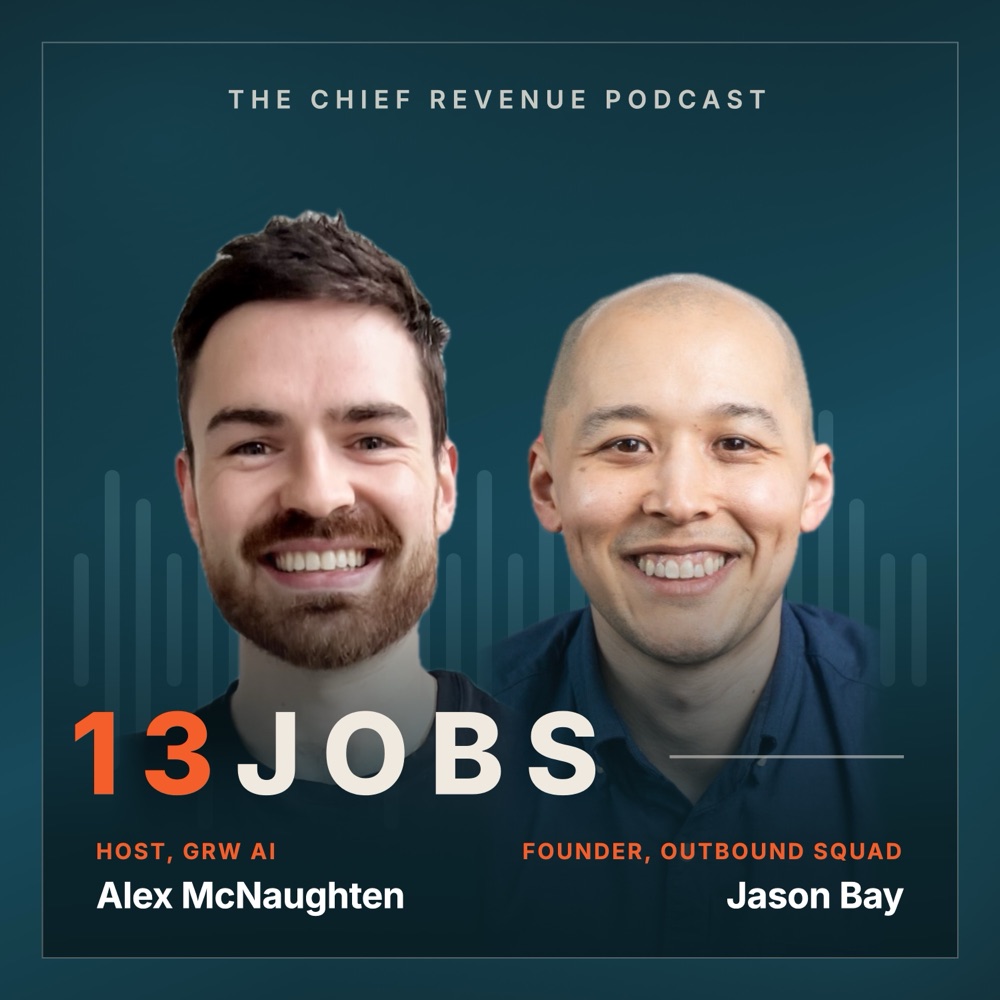
 Hosted by Alex McNaughten
Jason Bay · Founder, Outbound Squad
Jason Bay coaches outbound sales teams, through Blissful Prospecting and later Outbound Squad, for companies including Gong, Zoom and Monday.com. He was the extremely shy five year old who covered his eyes at soccer practice, and at 19 was running a six figure house painting business while at Oregon State.
He works on three things: identifying the right accounts, engaging them in language they recognise, and handling the objections that follow.
In this episode, we discuss:
- The shy five year old, and door-knocking for painting work
- Identify, engage, and the third bucket
- One product, three verticals, three different messages
- What can you teach them in exchange for their time
- Starting with the buyer's journey, not the product
- How the iPhone was introduced, and why it applies here
- The study where brainwaves sync up
- Mining case studies and job ads for their world
- Empathise, validate, and the third step
- Listening for what they are not saying
- Two thirds of reps never try to handle it at all
- The one thing: stop copying and sound like yourself
Quote of the show
“What can you teach prospects in exchange for their time?”
Key takeaways
- Teach something in exchange for the time. Nobody wants an hour-long demo. They want to know what companies like theirs are doing about the problem. Offer that and the meeting is worth taking.
- Start where they already understand. The iPhone was introduced as a phone, an iPod and an internet device, not as a touchscreen. Lead with the buyer's priorities, then locate your product inside them.
- Same product, different messages. A pharmaceutical company and a medical device company buy the same solution for different reasons. Verticalised messaging is not a nice-to-have.
- Do not take an objection at face value. Not interested usually means something more specific. World-class listening is hearing what someone is thinking but has not said.
- Empathise and validate before you ask anything. Sounds like you have a process that works. Then ask how they are doing it today. Nobody defends a position they were not made to defend.
- Never make them feel stupid for being honest. Telling someone their current solution is rubbish costs you the candour you needed. Thank them for the objection and the conversation continues.
- Two thirds never even try. Most reps let the prospect off at the first no. Welcoming it, and asking one curious question, is most of the gap between average and good.
Transcript
Jason, how you doing, buddy?
I'm good. I'm glad. This is the second time we've talked in 2 weeks, dude. It's good. I have fun jamming with you, man.
I know. I had fun last time, so I had to have you. I had to do this, the reciprocal thing, and have you on my podcast as well. Thanks for your time. And, you know, today we're going to talk about outbound prospecting, outbound selling in general. And you're an outbound sales guru. That's your jam.
Tell us a little bit about yourself, how you ended up doing what you're doing today and so good at outbound.
Yeah, what's always fascinated me about outbound of any kind, whether that be B2C, B2B, is that you're like, how cool is it to take a complete stranger and turn them into a paying client? In B2C, it could be in a couple— in a day, it could be the same day. In large B2B, it could be months or whatever it is.
But I don't know, that's, that's always kind of fascinated me because in my personal life, I've always kind of— we talked about this last time we spoke— I've always been pretty introverted.
Yeah.
I was the kid that my parents signed me up for soccer. You guys might call it football. I don't know what you guys call it, but soccer where you kick the ball. And I remember when I was 5, I was so shy walking up to practice to meet my coach. I had my hands over my eyes like this.
I was just so shy. Did not like talking to strangers. You know, and even as an adolescent, young— well, I guess it's still a teenager in high school, just that was very hard for me. And when I got in my first sales role, this was about 13, 14 years ago, it was, you know, going door to door selling house painting services.
But it was— it felt different to me because now there's a very clear, tangible incentive to being able to talk really well to strangers because I can make money.
Yes.
And with painting services in the US, it's, you know, $4,000 to $6,000 is the average, you know, kind of paint job for a home that's kind of small. And I would make like 25% profit off of that in the business. So I sold like $100,000 worth of paint jobs, made, you know, $25,000, $30,000 for school over the summer.
And I was like immediately hooked on this outbound thing or the sales thing, excuse me. And the way I got into outbound and what I'm doing now is I worked with that company as a sales manager, as a marketing director. I started call centers for them. And then 2013, 2014, I was like, you know, I want to help other businesses build an inside sales team like this.
And I gravitated more towards the B2B businesses because, as you know, in B2B, what's, what's great is, you know, there isn't really like a do not call registry for, for B2B, which I think 70% of America is on a do not call list. So it's getting really hard to do that. But you can research people, you can get their emails, their phone numbers, you can learn more about them before you reach out to them and outbound is a totally different game where it doesn't have to be so cold.
And I think the thing that's going out of style right now is doing outbound in the way you would with B2C in a B2B fashion is just, it's just going out of style, just picking up the phone and randomly calling your personas with no research, nothing to share, just pitching them. I think that's going out of style pretty quickly for most businesses.
But yeah, that's what I've been doing. I work with SaaS companies, professional services companies, and and help their SDR, BDR teams and their AEs, you know, start conversations with strangers. You know, how do we, how do we do that?
It's a very cool journey from the extremely introverted kid who's running around covering his eyes through to door knocking and, you know, selling a pretty substantial amount of painting through to now helping all these other companies do outbound properly. And it kind of, you know, last time when we spoke, we touched on this idea.
You don't have to be an extrovert to be good at selling. And I think your proof is in the pudding that you really don't. So it's interesting what you just said there about certain types of outbound kind of going out of fashion. I just want to dive into that a little bit more.
Like what would you say people are doing wrong? Or what would you say is like the wrong way to do it?
Yeah, so I look at the outbound motion in 3 kind of buckets. Okay, if you're good at these sort of areas, your life gets a lot easier when you're doing outbound. One of them is identify. So it's a 3-part framework. It's identify, engage, create. Identify is your ability to really figure out, am I talking to the right people at the right companies that really match our ideal client profiles and the personas that we want to be selling to.
The mistake that people tend to make and the shift that you need to make in the approach is, if you're looking for ways to mass blast people, whether that be through— I mean, to me, even using a solution that like auto dials and you pick up the phone and you just know the person's name, that's, that's mass blasting people.
Okay.
You know, and I think the thing right now is you got to figure out a good balance of how do we use automation effectively? You know, so what's that balance between mass blast and what I call quality first? Because you can't just customize every single word of every email that you send to someone.
There's no need to do that. Right? There's no need to say something new to every single person when you cold call them. But what is the people and the patterns? And how do we segment? And I'll give you a practical example. If your ICP is, oh, we're industry agnostic, we can work with with any company.
Well, it's gonna feel like that when people receive the message, they're gonna feel like you could work with any company, they're not going to feel like you specialize in them.
Hmm.
So if you're selling something, you know, one of the companies I'm working with right now, they sell an electronic— it's called EDCs— they sell an electronic document capture solution. And they verticalized it and said, hey, folks that are running clinical trials, So let's say you're creating a supplement, Alex, and you're like, you know what, I want to get a clinical trial, because if I can prove science that this works, it's going to sell like hotcakes.
Well, they haven't just said anyone that runs clinical trials is a good fit. They say, hey, specifically medical devices companies, they're going to receive our message very differently from a pharmaceutical company.
Right.
From a therapeutics company, same solution, it does the same thing for every one of them, that the messaging is very different because a pharmaceutical or a therapeutics company, excuse me, that's much more of a B2C consumer-facing business where they're looking to use this as a way to get more customers signing up for their services through their websites.
A medical device company is thinking, I just need to be able to get this thing to market. And for the people that are going to be selling this medical device, I want them to be able to talk about the fact that it's proven through science. This is going to help us get our product into more places.
Those are 2 very different things. Same solution though. So the segmentation I think is extremely important. On the engage side, that middle piece, it's once we know who we're going after, how do we start conversations with them? So that's your emails, your talk tracks, you know, your sequencing strategy. And the thing that we want to really make sure to do there, the big mistake is everyone's using super me-centric messaging.
So I could say something like, hey, Alex, we have an EDC, it's going to help you electronically capture this data, it's going to save you a bunch of time. So you don't have to worry about doing this process manually, it's going to make the data extractable at the end. So you can, you know, make it really actionable, all this other stuff.
That's just talking all about me. Yeah, versus you-centric is, hey, Alex, I don't know if you're like most clinical operations executives that we talked to, but one thing they're really focused on is shortening the startup timelines for starting a clinical trial. It normally takes on industry average 12 weeks, and people are looking to figure out how to get it done in a month or two so they can get their product to market faster.
Right.
Is that something you're working on? That's a very use-centric message where I can weave in my solution and how it decreases the startup timeline without talking about all of its features. So that's another big shift. And the third shift With that create bucket, that's sort of how we objection handle and get the conversation into a meeting.
And I think where people need to really move away from is this always be closing mindset to I just need to close for the meeting, ask for the meeting, ask for the business, to teach, don't take.
Right.
So what can you teach prospects in exchange for their time? No one wants to come and hop on a 1-hour demo. What I want to do as a prospect is I want to learn what are other medical device companies right now doing to shorten their startup timelines? What are they doing to make their products more marketable?
What are they doing to better train their team and staff so that during the actual clinical trial, they're not getting really bogged down with things that could push the timeline back?
Mm-hmm.
That's what I wanna learn. I don't just wanna do a demo of your product. I know that I'm gonna get that, but what are we gonna give them? What value are we gonna give them in exchange for their time? So those are the 3, you know, kind of shifts and mistakes that I see people typically make with outbound.
Right. I would agree with all of that from what I've seen. And I like how you split into those 3 areas. I think that makes a lot of sense. Let's start with this first one, this, this idea of making sure that we're segmenting right, because I agree with you. A lot of poorly done outbound is like a scattergun approach and it's just, hey, here's 1,000 people, here's 1,000 names, let's send them something.
And You know, you're right, it feels very much— and I've been on the receiving end, I'm sure you have— it feels very generic. It doesn't feel like—. God, I've got heaps just this week, actually. I don't know what's going on. Apparently Christmas is a time to mass blast emails out. Yeah, it doesn't feel like they actually know you, care about you, or even understand any of the problems you might be having.
Is this a fundamental mindset shift where people need to put themselves in the customer's shoes? Or like, how do you get people to have— make that shift typically?
Yeah, usually where I start is talking about the buyer's journey.
Okay.
So when I train a company, the very first thing I'll say is, you know, share my little iPad screen, I'll say, hey, let's talk about the buyer's journey. What, what journey do your buyers go through when they buy your product? And what most people say is, oh, you know, they need to know about how it can help them.
Like, that's not the first stage in a buyer's journey. You know, the first stage is usually problem unaware.
It's—.
There's a bunch of people in this bucket that don't know they have a problem or that there's a better way of doing things.
Okay.
So if we use company that I'm working with as an example, there's a lot of people doing their running their studies just using paper. They don't know that there's software because they've always done it through paper, right? Or maybe there's people using software that doesn't allow them to do the things that their solution does, my client, but they don't know that that exists.
They don't know that there's a better way of doing things.
Right, right.
So what I start to talk about is like, are you talking about them and to them in a way that they're going to understand. Because when you explain things— another example I like to use is, I don't know, do you remember the Steve Jobs keynote for the iPhone when it first came out?
The general kind of message?
Oh, pitched it kind of, but refresh my memory.
And for those who may be iconic— Yeah, so depending how old the person is listening to this, maybe that dates me a little bit. I'm only 32. I'm not that old, you know. But it was 2007, I believe, is when the first iPhone iPhone came out and the way that Steve Jobs talked about the iPhone and explained it, because he's a really good presenter and people kind of had a hunch it was a phone, but he said, hey, so the iPod had been around that time.
He said, it's a way that you can have 1,000 songs in your pocket, a way that you can surf the web, and a way that you can talk to people. And he just went through those 3 things. He started with the context of something that people would already understand. People already knew about MP3 players.
Mm-hmm.
They already knew that surfing the web is a thing because we have computers, and they already knew that phones were a thing. He didn't start explaining the iPhone by talking about the fact that it's the first touchscreen phone. That's not the thing that people are going to gravitate towards. People are going to gravitate towards, wait, I can look at the internet, I can talk to people on the phone and listen to music with— on the same device?
That's pretty cool. So the way that we give context to people when we're reaching out to them is we actually have to start with them.
Yeah.
And I have to actually start with your priorities and your results and what you're trying to accomplish, because that's the context in which you understand. You understand what people like you are working on and the results that you're trying to achieve on a daily basis. I have to start with that. Exactly.
Yeah.
So I always recommend starting with priorities and problems. That's the first part, the identify and engage. The thing that bridges those 2 things together is priorities and problems. That's why I like a cold call that starts out with, you know, hey Alex, Jason here with Blissful Prospecting. You got a minute for me to tell you why I'm calling?
You can let me know if you want to keep chatting. So permission-based opener, prospect will usually say yes. Now at that point, instead of doing elevator pitch on your product, you do, hey Alex, I'm talking to a lot of folks in clinical operations right now, and I hear them focused on one of two things.
One is they're either about to start a study. And their biggest focus is making sure that they get it started as quickly as possible so they can get the thing launched, get the product into market, etc. The second thing I hear is that folks are working on a study right now and things keep coming up that slow the study down.
So participants are dropping out, parts of the study need to change, and whatever process you have in place makes that take way longer than it should. Which one of those 2 situations are you in right now? I'm talking about your world first, and then I can get on the same page. Not to sidetrack too much, but there's this really good book called You're Not Listening, and they reference a Princeton study.
And what they did is they studied the brainwaves of people that are talking like you and I are.
Yep.
And they looked at the brainwaves, and what they found is that when people are talking in conversation and people are actually listening and engaging, their brainwaves sync up.
Right.
Pretty cool, right? And that's— if you think of a cold call like that, what you're trying to do is sync up with that person as quickly as possible. You know what helps you sync up to people really quickly is to talk about them.
That's right.
Relate to them based on something that they know about. Yeah, because if they've never heard of my solution or any of that kind of stuff, which they probably haven't unless you're reaching out and you're calling from Zoom or Amazon or Google or whatever, they probably haven't heard of you before. If we're being honest, for most people listening to this.
So if I can talk about you first, we're starting to sync up a little bit. And then that buys me some time for them to actually want to listen to me and be interested in what I have to say because I've shown them I know their world.
I think—.
That's usually how I explain that.
I think it's a really nice way of thinking about it and syncing up with someone. I like that. That's a really interesting study actually. I need to check that out. Um, One of the things that we see with companies who are struggling with this is they just don't have their ICP figured out at all, their ideal customer profile.
They just haven't defined that well enough. And that's probably almost where the challenge starts for them is they don't actually know who they're trying to sell to. And I think the only way you can do what you just described well, which is where you start talking about you know, a problem or goals that a potential prospect, that a prospect or potential customer has is if you actually understand that ICP and what's going on in their world.
Because, you know, and I was chatting to the UK's most hated sales trainer is how he describes himself. I was speaking to him recently and he made this point. You don't need to be liked to sell to people. You just need to demonstrate that you know more than they do about their world and about their problems.
Yeah.
And that you can demonstrate and prove that you can solve them. But you can only do that if you actually understand their business. So what would your advice be for sort of maybe a rep who's just starting out and who's trying to, you know, who's green as anything and doesn't know anything about their ICP?
Like, how do you get that level of confidence and knowledge quickly so you can actually demonstrate that in a call?
Yeah. Okay. I wanna quickly comment on what, uh, Benjamin shared. I don't disagree with him, but I think in sales right now, there's a lot of, like, there's a lot of polarization and people like to take extremes.
Sure.
I just don't want anybody to mistake that for you don't have to be likable because being likable is kind of like being really physically attractive. Like it's gonna allow you to get past the first 10 or 15 seconds if you approach someone and talk to them randomly. Like if you look like Brad Pitt, That's going to be a lot easier time for you than if you, you know, look like whoever else you want to throw that vote at me.
Sure. You know what I mean?
So I think likability is a factor. Just don't bank on just your likability. Obviously the stuff we're talking about is the most important, but if you can also be likable, it helps a lot. Um, so your question was, how do we, if we're a rookie rep, how do we, how do we kind of know this stuff?
It's a great question. Um, so there's a couple of things that I would recommend. One, you're going to get this information. The best place to get it from is existing clients. Okay, so there's a couple different ways that you could get that. So if you're an SDR, BDR, let's say, or even an AE, hopefully your company has recorded sales calls with your ideal prospects.
I'm going to listen to— this is what I do when I start working with a company for the first time, by the way, to listen to three or four of those with the prospects that you're selling to, and really listen for. During the discovery process, when they were asked, hey, why are we meeting today?
What are you looking to accomplish with this? What are your goals over the next 12 months? I want to pay really, really close attention to that. I'm literally going to write that down and transcribe it word for word. And I'm going to use the sales motion to inform the outbound motion. I'm going to use what we learned in sales about our prospects to inform how we talk to them when we're doing outbound.
So sales calls is a really good one. I find that most studies have kill— or most clients, uh, sorry, most sales teams have great case studies.
Okay.
So look at those case studies. The case studies, if done well, will pretty elaborately talk about, and it will feature a person with a quote and say, we had this problem. Here's what we did to solve it. Here are the results. That's language right there that you can use. Another thing that I find pretty helpful too, I'll just rattle off a couple of the more, the lesser common ones.
Another one is if you look at job descriptions.
Yes.
For open jobs that are the same job title as the one that you're prospecting to, oftentimes you'll find a really good job description that talks about what this person's responsibilities are, why they're hiring them. That's great. Another one that I like, at least here for the United States, is 10-Ks and Seekingalpha.com is a really cool tool where you can actually look at quarterly reports of publicly traded companies.
I could literally listen to a transcribed call. I could listen to a CMO at a Fortune 1000 or publicly traded company talk about what they're working on right now. That's going to help me even if I'm reaching out to companies that are not publicly traded, just to know what marketers care about right now, what marketing executives in that industry care about.
So, um, there's that. You could interview customers if you want to. I mean, there's just dozens and dozens of things like you have to just, just do some research, you know, on this and with your company, look at those recordings, the stuff you have internally, talk to reps that are really successful at outbound.
See if you can pick the brain of the top 2 or 3 AEs on the team or SDRs, BDRs, whatever it might be. And, and I'm really trying to figure out the people reaching out to you. What do they care about?
Mm-hmm.
What are they prioritizing right now? What do they want to accomplish and what gets in the way of that?
It's really good advice. And the interesting thing, you've— that all of that focus was not about what we're selling. All of that focus is on who we're selling to and what they care about. And I think sometimes when a new rep starts, and this is actually sometimes— it's sometimes not even the fault of the rep, sometimes it's the fault of the leader too, is that their whole onboarding program is around their product.
Yeah.
And they miss one of the most important things, which is The customer or different types of customers that they have, and arming that that new rep with you know the right kind of insight into the customer's world and the customer's mind. So I think that's really really good advice. And there are you're right there are so many different ways you can go about doing that.
I think you've listed some really useful ones there. So another thing I wanted to ask you about is. Objection handling. So, you know, not every cold call is smooth and not everyone wants to talk to you straight away. And one of the fears often for reps who are just starting out in outbound is, oh my God, I'm going to be told to fuck off, you know, every million times a week and it's going to be, it's going to be hard.
And yeah, and there is some of that. Hopefully not too many. Expletives, but, um, what, how do you handle objections as you're doing this?
Yeah. So I think the problem with objections is, you know, people like to say no.
Okay.
That's just what people like to do. Right. So people like to say no. Um, I think the other thing too, and, and not only that, people are kind of conditioned to say no to salespeople too. Think about all the interactions you have with salespeople in your life, and most of the time it's saying no to them.
Yep, multiple times, right? So people kind of are coming in, your prospects are coming in with that. The other thing that's really hard on a cold call is you— there's a feeling that there's like an hourglass going and the time is running out. And when someone gives you an objection, you feel like, oh God, I have a split second to respond to it, you know.
So the opportunity, I think, though, is to— if you actually shift your mindset And I'll, I have a framework for this too, but if you actually shift your mindset into one of welcoming objections and being glad that they're sharing stuff, you're gonna have a lot better time. So welcome the no, welcome the not interested, the we already have a solution.
That means we're talking, we're having, we're about to have some real talk. That's what I want. Um, I think the second thing is if you can think about when you're prospecting, think about your prospects like they're already clients. And think about how would I talk differently to a prospect if they were already a paying client?
Because if you had a paying client, let's say, Alex, you're a sales leader, we've already done some training before, and I'm trying to upsell you on doing another training with me. Yeah. Usually, we're gonna have a very candid conversation. If you're not interested in doing it, I'd be like, well, hey, what's going on?
Like, it went really well the first time. Is it just not in the budget? Was there something you didn't like about— like, we actually have a conversation about it. It's not this weird thing that I take really personally. You're a customer. I want to do what's best for you. I want to help you.
Right?
So if you could put this lens on of, I'm looking at prospects like they're customers and I want to help them if I can, and I'm going to welcome them being honest with me.
Hmm.
That's going to be really good if they're honest with me. So if you take this kind of frame, a frame of mind going into the objection, we're going to do 3 things. So the framework is EVO. It's empathize, validate, offer. The mistake that most reps make when a prospect gives them an objection is they go straight into a rebuttal.
So when someone says not interested, a lot of where people go is they're thinking, well, how could you be not interested when I haven't told you about the product?
Yes. And they take it personally, almost.
Personally, they get a little defensive. It comes out in their tone, et cetera. So what I want you to think about is like step number 1 is really just getting better at listening.
Okay.
So what do you do is like really think about, you know, world-class listening is not about just hearing the words that the person's saying. It's about what is this person thinking that they're not sharing? So let me ask you actually, so what do you think a prospect, if they said not interested to you on a cold call, what are they really thinking that they're not sharing with you?
Um, well, I'm sure that like if If someone says to me, not interested, my first response is, okay, what's making you not interested? You know, like, I want to find out where that's come from. I don't know if that's the answer you're looking for, but that's always been my approach.
What are you thinking? If you said not interested to me, what would you be thinking behind that?
I don't want to give you my money or, you know, Yeah, it's probably the first thought.
Yeah. Or I don't want to talk to you, or I'm busy. Or like, the point there is that when someone says something to you, don't take it at face value, right? You don't even know this person, you have no relationship with them. So when someone says not interested, you can infer that that probably means, hey, I— you caught me in the middle of something, I thought you were someone else, I'm really not interested because I already have a solution, or I don't like talking to salespeople, or whatever it might be.
So if we can really get to what is actually going on, what are they thinking? What are they feeling that they're not saying?
Right.
What is the unspoken part about this? So when someone says, oh, you know, Alex, actually we already have a solution that does that, we're good. Well, what I'm thinking is, okay, yeah, they actually might be good and already have something, but really what they're probably thinking is, You know what? We have something, and it's actually a lot of work for me to bring in a new solution, and I'm gonna have to sell a bunch of people internally, and I have to train my team on it.
That just sounds like way too much work. I'm fine. Like it's getting the job done. If it's not broke, don't fix it. There's so many things I can infer just from that. So when I'm an objection handling that E that empathize, I have to say that. So if someone says not interested, I don't want to question them saying not interested.
That's gonna make—that's gonna do the opposite of disarming them. I'm gonna tell them that it's okay. So if someone says not interested, like Alex sounds like I caught you in the middle of something, and you know what? I'm totally calling you out of the blue. If that's the case, totally okay. That's the validate part.
I'm gonna let them know that it's okay to feel the way that they're feeling. And a lot of times there's like a sense of relief for the prospect. And then the offer is. Well, hey, this might be a long shot, Alex, but the reason I was reaching out to you is you're a lot like this other medical devices company that we're working with, that I noticed you guys have a trial coming up.
And what they were really focused on is how do we get a trial taking 12 weeks? How do we shorten that down to 4 to 6 weeks? And that's something that we're helping them do. I thought you might want to hear about that. Am I totally off in reaching out and thinking that that might be relevant for you?
Hmm.
So everything about the tonality is I don't want to argue with you. I actually want to agree with you. So if someone's like, hey, we have a solution already, empathize. Hey, sounds like you have a process and solution in place that like you're pretty happy with. And I noticed you've been doing this for 10 years.
So you've probably put a lot of thought into it. Like, think about it. Like if someone said, you know, if you're like, hey, we're good, we're taken care of. And someone said that to you, you'd be like, weird. I wasn't used to that. I thought that I would have to defend that answer.
Yeah.
Don't make the prospect defend the answer. You know, I think it's different in a sales context, by the way, where you can challenge a little bit more.
Yes.
But then I would just go into, hey, if you don't mind me asking, because sometimes I hear people are doing this by paper, or they have some sort of EDC, or maybe they outsource it. How are you guys getting it done right now? Oh, we're using paper. Well, hey, again, this might be kind of a long shot, but I was reaching out to you because you're a lot like this other medical devices company that was using paper.
And one of the things they kept complaining about is that everyone had to do double entry of data. So they'd capture the data on paper, 80% of it was accurate, 20% was inaccurate, and then they had to key it all manually into a database and then they'd lose data there too. What's your experience been?
Right.
It's a completely different way to handle it than like, oh, what solution are you using? Oh, well, the reason why we're better than that competitor is we do this. And it's like, no one wants to be told that the way they're doing things is wrong.
I think that's bang on. And one of the things I've always told people is anytime you get an objection, like, actually just thank them. Be like, hey, thanks for bringing that up. I can see where you're coming from. And just kind of validate where their perspective rather than jumping in and trying to convince them.
Because you're right, if that person's been in the job for 10 years, they've probably thought a little bit about what they're doing. Just a little bit. They probably know enough. You know, and if that's the part of the business they own, then they're probably kind of proud about it. And they probably— there's a sense of pride and, you know, ownership and all the rest of it that goes along with that.
So if you come in and say, hey, that's rubbish, but this solution's way better, do you really think that person's going to want to hear that and want to buy from you? So yeah, I like that approach. I agree with you very much that that's a far better way to objection handle. I like how you put it.
I think just quick thing to add there, if I could, is I think about if you were selling personal training is the analogy I use a lot. Okay. So if you walked into the gym, and I'd noticed that, hey, you're a member there, you come in a lot, I said, hey, you look like you could use some personal training.
You'd be like, dude, I'm good to go, man. You know, versus, um, hey, I noticed you come in a lot. It looks like you're really consistent in the gym. I don't know if you've ever looked into personal training before, but one of the things that I hear a lot is that there's people that are really consistent in the gym that have a harder time being consistent with their diet.
Are you open to looking at like a custom meal plan or anything like that that might help with the goals that you have in the gym? That's a completely different way to approach that conversation than, hey, you look like you could use a personal trainer. Yet that's what salespeople do.
Yeah.
Oh, you're using that solution? That's garbage. Like, you make the person feel like an idiot for being honest with you. Like, we actually want to— that's why I love you said thank you. You want to invite any candor you get from a prospect. Thank them. You want them to be more candid with you.
Yes.
The more candid they are with you, the more real the conversation is. You can actually get somewhere. This is not just prospecting, the sales motion too. The more honest I can get them to be and comfortable and really reward them for that. Thank them for being honest. I can have a real dialogue with those people.
And if we carry on with just that PT, personal training example, even if you were wrong in that assumption and even if my diet was super clean, that's still a better approach because at least now we can have— because my natural human instinct is going to probably be to correct you. So, at least now we're in a conversation.
I'm probably going to actually, you know what, Jason, my diet's actually pretty good, but I'm struggling in these areas. Yeah. And maybe now we're in a—.
It's unassumptive too. Yes. Where I'm not saying I can help you. I don't know if I can help you if I don't know you. I know nothing about you. I'm particularly really— I get triggered. I don't get angry. But like when someone tries to sell to me, and they're assuming that they know what I need help with, it bothers me, man.
Because all you got to do is ask. All you got to do is ask.
Is this something you find is a big mindset shift for reps when they're first starting out? Or maybe they've never worked with you before and they're not used to doing things this way. Do you find that it's quite a hard thing for them to change in their own head before they can even do, like, act this stuff out?
And if so, how do you go about— what's the word? Remodeling someone's, you know, wiring in their brain.
Yeah. So let's be real. You and I have been doing this for a while. How many reps do you think actually try to handle the objection? Let's just go with that part first. How many, how many just give up when someone says not interested? They'd be like, oh, thank you for your time.
Is it okay if I send you an email? How many reps do that?
Probably about a third at least.
I think it might be two-thirds of reps, honestly. Yeah. You don't even try to handle the objection.
You're probably right. I'm probably being very—.
But I've listened to enough calls where reps just let the prospect off super easy.
Yep.
You know, so for me, it's if you can wrap your head around welcoming the no, and when I hear no, take it as feedback and really lean in and be curious. So Alex, after this podcast recording, if you said, hey Jason, there's some things I have some feedback for you on that I think could, could have made this gone better.
I could take that one of two ways. I could take it really personally and be like, what the fuck? Yep. Or I could lean in and be like, oh shit, I care a lot about being a good guest on someone else's show. Let me be curious here. Right? So if you welcome the objection and just frame your mindset around this is just a person giving you feedback, don't take it personally.
So that it's not about handling the objection. It's just more about being curious about where it's coming from. And then the second thing is just being bold enough to have some candor with the prospect and to be blunt with them. And I think that people think about that like arguing, like it's a confrontation.
No, it's not a confrontation at all. Being blunt, you can do that in a really nice way with a smile on your face like I am right now.
Yes.
So when someone says, send me an email, it's like, hey, I'm totally happy to do that, Alex, but I'm just curious. And it's totally okay. Either one of these is totally okay. But usually when people say send me an email, they're really not interested and they just don't want to talk to me anymore.
Again, which is totally okay. Is it that or do you, do you really want to spend some time researching this? And, and, uh, cause I don't mind putting together an email for you, which, which one of it is for you. Feel free to be totally candid with me. That's being really blunt, but not being an asshole about it.
Yes. Yeah.
You can be very, you can have some candor with a prospect. So I think if you can wrap your head around that, that it's, I'm not, it's not a confrontation. Let me just take this as feedback, constructive feedback, and try to do something with it. And instead of trying to change the person's mind, what if I just give them some alternatives and let them choose?
Mm-hmm.
It's not about me. All I can do is let you know that we've helped people like you before, and I just thought you might benefit from how we've helped them. They have the choice, yes or no, whether or not they want to do that. I just want to make it Instead of making it easy to say yes, what I like to say is making it hard to say no.
And making it hard to say no just by being unassumptive and friendly. And this is the likability thing that I talked about earlier. I think if you can be likable and assertive and friendly and not be afraid to ask for what you want, you're very hard to say no to. I don't mean being hard to say no to by being really pushy.
I don't mean it like that.
No.
I mean, just like being a good genuine dude or dudette that really cares about helping the other person and just making sure that they know that, you know, be hard to say no to.
And one of the words you used there was curiosity. And I think that's a mindset that underpins doing a lot of what you've said well is required. Yeah. Is because not being unassumptive and actually genuinely being curious about the other person on the end of the call, on the end of the Zoom.
Yeah.
That's, I think, one of the fundamental mindsets that I see in good reps who get this stuff quickly and run with it is they're actually curious. And when they get an objection or they get, you know, or they feel that their prospect's not fully bought in, they actually take the time to figure out, okay, why is that?
You know, like, where have I lost you? Whereas a less curious rep will just plow on and just think, okay, cool, I've got an email out. So this has been fascinating and I've learned a couple of things from how you think about it and what's the word, frame up outbound. I like your method.
What's— if you were to do it all over again, like you're going to jump back into sales, it's day 1. Okay, and you're back in sales. What's that one piece of advice or one thing that you would, that you wish you'd known that would've really moved the needle for you?
I think for me is, I think style, adopting my own sales style. So the very first book I read about sales was The Little Red Book of Selling by Jeffrey Gitomer. Okay. And I felt like for the first 3 or 4 years of selling, I tried, I wanted to be Jeffrey Gitomer.
Right.
And I didn't make the decision early enough to be like, you know what, people are buying me. The more I can be myself, the more unique I look compared to everyone else selling the same thing, because I can only be me. Okay, right. So for me, it's that content creation, especially same kind of thing.
You know, I create a lot of content now, you create content, we're doing it right now. Just being myself. You know, So that's the advice I would give to my 19-year-old self going door to door selling house painting services is be you when you do this, man. Like adopt your style, use the frameworks, words, scripts, whatever people are saying, but make it your own.
Be you.
That's the advice I would give myself. I think it's really good advice because when you're comfortable with yourself, people feel that. And if you're trying to be something else and trying to fake it, I think people feel that. What's the word? It's like a disingenuous— it's disingenuous almost. Like people will feel that, feel that you're not really there, you're not really you.
So, I think that's really good advice. And it took me a long time to figure that out, too, actually. It took me a long time to just have fun with sales and just enjoy the whole thing, the whole experience, every conversation, just like generally be present in them.
Yeah.
And I think part of that is actually getting unattached from the outcome.
Yeah, dude, what's your closing rate on deals when in the first sales call you're busting up laughing with a prospect? Oh, it's like the closing rate's extremely high when you get to that point with a prospect, and it's like a lot of that is just being yourself. Yeah, you know, some of the biggest deals—.
Oh, I totally— some of the biggest deals I've won were We were just genuinely having a good time and we're just sitting in a boardroom or on a group Zoom or whatever, and we're just having fun and I'm smiling, they're smiling. You inject your personality into the conversation a little bit as well.
And I'm not saying my personality sells, but it's being at ease in the conversation, I think, puts others more at ease. And you're more likely then to have a real connection and a real conversation and they're more likely to open up and all the rest of it. So, yeah, I fully agree with you.
Jason, this has been real. We got to do this again. I love talking to you.
Yeah.
For those who, and I'm sure most of them have, but for those who are listening and haven't come across your work and haven't come across you before or seen your content, where should people go to connect with you and find you and learn more from you?
Yeah, so if you listen today and you're like, oh, it'd be kind of cool to check out some more, we have a ton of free stuff. So that's the first stuff I would check out, blissfulprospecting.com. That's a hub for our podcasts that we release 1 to 2 times per week, usually. I'm writing LinkedIn posts every single day.
I'll typically do webinars 2 to 4 times a month. All of that's a great hub to kind of get the free stuff. And then we also work with reps and companies on how to implement the process I walked through today. So if you're a rep, We have Outbound Squad. That's kind of a place where you can get coaching, community coursework, all that kind of stuff.
It's pretty badass what we got going on there. It's application only. And then we also work with companies. So if you have a sales development team or a group of sales reps that you're like, I'd like them to do outbound like this, definitely reach out. Blissfulprospecting.com.
Awesome. Thank you so much, Jason. This has been a great conversation and look forward to the next one. See you again soon. Yeah, you bet, man.
Yeah, this is fun.