
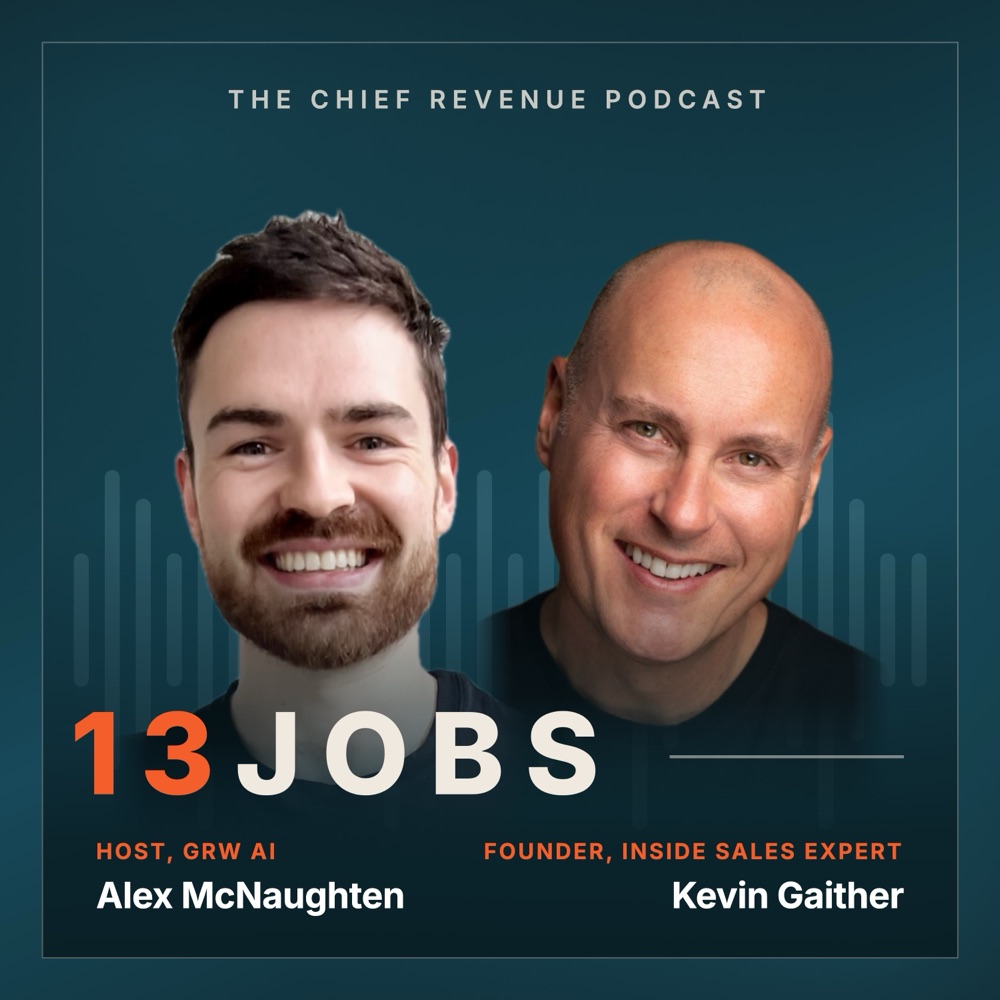
Selling your way into your next sales role
Salespeople run the worst campaign of their careers when the product is themselves. Kevin on what the ten percent who do it properly actually do.
 Hosted by Alex McNaughten
Kevin Gaither · Founder, Inside Sales Expert
Kevin Gaither, known to most people as KG, is the founder of Inside Sales Expert, where he helps leaders at early stage tech companies avoid the mistakes he made building, fixing and growing sales teams.
He has spent more than 25 years in the profession since falling into it in 1994, most of it in sales leadership, including eight years at ZipRecruiter. He has reviewed tens of thousands of resumes and interviewed well over a thousand salespeople, which is the vantage point this episode comes from.
In this episode, we discuss:
- Why people overvalue the resume, and what actually belongs on it
- Seconds, not minutes, of a recruiter's attention
- How the applicant tracking system scores you before a human reads a word
- The fifty, forty, ten split, and where the effort really goes
- What is wrong with saying you are looking for anything in sales
- Writing a mission statement specific enough for someone to act on
- Job boards as a one in a hundred shot
- The litmus test for who belongs on your list of thirty
- Why a referral goes straight to the top of the pile
- Turning the job description into a preparation document
- The interview is the best you will ever see of someone
- Imposter syndrome, thirty years in
Quote of the show
“I don't care what you did. I want to know what you accomplished.”
Key takeaways
- Nobody reads your resume. They scan it. Seconds, not minutes. Bullets, numbers, dollar signs, rankings, quota attainment, awards. It has to work at a glance because a glance is what it gets.
- What you accomplished, not what you were responsible for. "Responsible for making fifty calls a day" is the line that puts a resume in the bin. Sales is quantifiable, so quantify it.
- The tracking system reads it before a person does. Keywords lifted from the job description decide your fit score and your place in the queue. That is why tailoring per application is not optional.
- Effort is the entire moat. Half send a generic resume, forty percent tweak it, ten percent hyper-customise and go find the hiring manager directly. That last group is barely competing with anyone.
- "Anything in sales" makes you impossible to help. Stage, location, motion, role, what you want to be paid. A specific mission gives your network something they can actually act on.
- Job boards are a one in a hundred shot. Your network is the real channel. Build a list of thirty or forty people using one test: if they asked you for help, would you give it?
- A referral skips the queue by design. Recruiters move referred candidates to the top so the referring employee stops chasing them. Knowing why the mechanism works tells you how to use it.
Transcript
Kevin, thank you for joining us on the show today. It's great to have you here. For those of you who don't know KG, as he likes to be called, Kevin helps sales leaders at early-stage tech startups avoid the mistakes he made when growing their sales teams. And he loves sharing his experience and expertise that he's amassed over 25 years in the profession.
And today we're gonna be talking about job seeking in sales. But Kevin, thanks for coming on. Tell us a little bit about yourself.
Thanks for having me on the show. Happy to help and happy to give back. You know, the irony of this, Alex, and I know you know this already, is that growing up, nobody ever said that I should be in sales. In fact, sales scared the living daylights out of me and it was not something that I looked forward to, you know, when I was You know, fundraising for the baseball team.
You know, anytime I had to ask somebody for money, it freaked me out. It really, really bothered me. So as a result, I happened to be good at math. I went to school at UC Davis with a degree in aerospace engineering, of all things, but ultimately ended up graduating with a degree of architecture.
Again, nothing to do with sales. However, when I took my first job out of school, Alex, I was getting paid $10 an hour, and and and I I. figured out pretty darn quick that like at a 3% raise every single year, I wasn't going to be making money for a long, long time.
So, what could I do? And I thought, well, maybe I start my own company or I can get into sales, but I didn't have the guts or an idea or the money to start my own company. And I thought, you know what? Let's try sales. And I'd always had a competitive and sports background with a high work ethic.
And I was like, You know what? That's the job where I can control my destiny. The harder I work, the more money that I, you know, that I make. And so remember, I was getting paid $10 an hour in a customer service job, which is $20,000 a year. 3 months into my first sales job, I got my very first commission check.
It was $19,000.
At that point, you're hooked.
I was hooked. I had made in one commission check, I made nearly as much money as I had made made in the entire previous year getting paid $10 an hour. And I was like, you know what, there's no turning back. And since then, you know, that was 1994. Since then, Alex, I've been on a quest, a quest to improve my salesmanship.
But also, I transitioned after about 5, 7 years, transitioned into sales leadership and become, you know, a true student of the game that always can get better in sales leadership and sales management. And that's where I've spent the vast majority of my career in building, fixing, and growing sales teams and making a ton of mistakes and learning along the way.
It's very cool. And I can definitely relate to the falling into the profession. I know we've had this conversation before, but it seems the common thing with everyone in sales is none of us choose it, which I don't know if that's sad or not, but it is interesting if nothing else. But you've been, you know, super successful in the profession.
You've, you know, built and led massive teams. And, you know, these days helping startups avoid those mistakes. You know, I think quite a topical area right now is job seeking for a lot of folks in the sales profession. It has been a tougher market after years of, you know, super high employment and effectively the talent having all the power in, you know, in in the job seeking environment, it's kind of started to flip and probably really flip the other way now.
So I think this idea of job seeking is timely and it's a really important topic to cover. So let's just break it down. Let's go through, let's go through like, how do you get a job in sales? Like, how would you do it? So over to you. Yeah.
Now remember, Alex, you know, when you're a hammer, everything looks like a nail. So I don't know anything about like job searching for product roles or engineering or any of that kind of stuff there. But there's definitely a problem here. Most of the things that I focus on is helping leaders at early-stage startups avoid mistakes when they're building, fixing, and growing their sales teams.
However, given the fact that I'm in that space and I'm publishing regularly about sales and sales leadership topics, I'm telling you, 2, 3 times a day, somebody is reaching out to me and asking me for help on how to get the sales job or the sales management job or the VP of sales job.
And the reality is, Alex, is that first of all, very few students learn in either high school or university, they, very few learn how to look for a job. Yeah. Very few learn how to look for a job. Okay. And then there's, because there's no courses and, you know, maybe there's the career center, but the career center, You know, what I've experienced through talking to the, you know, people that are reaching out to me that still have the problem, even though they have access to career centers, is that they just don't know what they're doing at every stage of the process.
And, and I think just jumping right, right into it, um, the first topic we should discuss is the resume. Okay?
Yep. Yeah.
I'm a firm— now you have to understand, I've reviewed probably tens of thousands of resumes. I have interviewed over 1,000+ salespeople. I don't even know how many, but probably more than that actually that I've actually interviewed in my entire career. So, I know what good looks like.
Yeah.
I know what a good resume looks like. But I'm gonna start by saying that people overvalue the resume. They think that when they get a great resume, that's gonna be the thing that's gonna get them in. I'm not saying it's not. I'm saying that people overvalue it. Now, Let's just talk about the resume.
Here's what, if you're in sales, which is a quantifiable job, you better chalk your resume filled with numbers.
Yeah.
Rankings, client names, unless you're, you know, unless that's, you know, confidential information, dollar signs, growth numbers, quota attainment, accolades and awards. Hey, Jamaica President's Club, you better put it on your resume. And this is what I want your listeners to remember. Like, this is the tattoo you put on your arm. I don't care what you did.
I want to know what you accomplished.
Yep. Yeah. Okay.
If you find yourself writing responsible for making 50 calls a day, you've wasted my time. That resume is going out. Do you know Do you know the average amount of time that a recruiter spends looking at a resume, Alex? Take a guess.
Well, um, I can speak from experience having built and run a recruitment company. It's not very long. It's seconds.
Like seconds. That's right. Like, like 30 seconds, certainly less than a minute. Okay, so people go to all this trouble of evaluating a resume, and the recruiter is going to spend Seconds, seconds, mere seconds. So you'd better catch their attention with bullets, numbers, dollars, accomplishments. Like, it better just pop off the page.
Your resume is a marketing vehicle, okay? It's a marketing vehicle. You'd better learn how to brag. But most people—.
Keep it short as well.
And like, as short as possible. Short, succinct bullets, easy to read. If you're doing 5-paragraph essays, boom, done. Now, Another thing. Now, I was at ZipRecruiter for 8 years. And so, a little bit of inside baseball, I understand how the process works. I ran my own recruiting business too. But being at ZipRecruiter, I was able to see, like, you know, pull back the layers of the onion to understand most companies are using applicant tracking systems.
Yes.
And the applicant tracking system, as you know, Alex, consumes the resume. Parses out keywords, matches it to the job description, and then oftentimes it applies a fit score— 90% fit, 70% fit, 30% fit.
Yeah.
And it allows the recruiter who goes into the applicant tracking system to go through hundreds of resumes and sort it by fit. So what does that mean? If your resume isn't chock-full of the keywords that are in the job description, It doesn't matter what you got in the resume. Okay. Now, okay, we can keep going on and on and on about the resume and I can do— I am so passionate about the fact that people like overvalue their resume.
You should value it. You should take time to make it right. No typos, make it look professional, make the keywords match the job description. But frankly, The resume isn't going to get you the job. The resume isn't gonna get the job. And unless you wanna ask me more questions about resumes and things like that, I'd love to move on to the next piece.
I've got one really quick question.
Bring it.
Given the keyword matching software of a lot of these ATSs, should people be tweaking their CV 4 different jobs. And I know that seems like, cool, that was the answer.
Yes, the answer is yes. But, you know, Alex, here's the reality, okay? If you're looking at, you know, 100 people that are gonna, you know, apply for the same job, okay? 50 of those 100 are just gonna see the job, click and apply, and just send their regular resume.
In there. Yeah.
Okay. Maybe another 40% of the, you know, 40 out of the other, you know, of the 100, they're gonna do some customization, you know, to their CV or resume. But then there's like that 10%. That 10%, like, they're gonna go above and beyond. They're gonna do hyper-customization of their resume. They're gonna move it around.
They're also then gonna find hiring managers that they can maybe send the resume to directly. And this is literally just like everything in life. 90% of people aren't going to put forth the effort. The 10% are. And if they— and if in this market, if you want to stand apart, you've got to do different.
You've got to go the extra mile. Customizing the resume is definitely going the extra mile. And 50 out of 100 applicants are not going to customize their CV.
Why?
Because they're too effing lazy. Period. End of story.
Yeah.
So, if you're willing to do it, You should, and it will give you a leg up, but it's so hard. Great. Then don't whine about you not getting a job.
Yeah.
All right.
Exactly. Cool.
Cool.
The next topic.
Yeah. So this is a huge pet peeve of mine, and I've actually written blog posts years ago about this exact topic. Alex, if I come to you and I, you know, you know, I'm looking for a job and then you say to me, well, what are you looking for? And I respond with, I'm just anything in sales.
What's the problem with that, Alex? What's the problem with I'm just looking for anything in sales? What's wrong with that?
Well, there's a few things that centered around me instead of what the company's looking for. But it's kind of part of it. I think the second part of it is it's so nonspecific that it's What do I do with that information if the hiring manager— Ex—.
What do you— and forget being a hiring manager for just a second. Let's just say it's just 2 people, 2 friends, you and me having a conversation, and I'm looking for a job and I'm asking you for help, and you ask me what I'm looking for, and you— and, and, and I respond with, well, you know, anything in sales.
Be like, okay, well, uh, do you want Remote? Do you want in person? Do you want outside sales? Do you want inside sales? Do you want lead development? Do you want enterprise selling? Do you want to work for a tech company? Do you want to work for a consumer packaged goods company? Do you want to work for a large company?
Do you want to work for a small company? Do you want to work for a company that has a career path? No career path? Well, it's nonspecific. And so, what usually ends up happening In that scenario, Alex, and again, given your expertise and experience, you know this to be true. The usual response from a friend sounds like this.
Okay, you're looking for anything in sales. I'll keep my ear to the ground. I'll let you know if anything crosses my path. Delete, done, forgotten about.
Yeah.
Instead, I counsel, and this is literally just like a sales strategy. A sales strategy needs to be specific. I need to know who I can help. I need to know what my targets are. So instead of saying anything in sales, I'm saying things like, my mission is to find a fun, fast-growing company in the Los Angeles area that's a pre-IPO company, tech company, where I can build, fix, and grow a sales team as the leader of that sales team and get paid well in the process in terms of current compensation as well as stock options.
By the way, that's literally what my mission statement was when I was, you know, an, you know, active job seeker and looking for jobs there. Every word was well thought out. I'm looking for a fun, fast-growing, uh, pre-IPO tech company in Los Angeles. Let me just start with that. Few people even get that clear on what, what you're looking, what you're looking for.
Fun, fast-growing, pre-IPO tech company in Los Angeles. Great. What kind of role they're after? Where I can where I can build, fix, and grow that sales team as the sales leader. And notice how I said the sales leader, not VP of Sales, CRO. I'm not necessarily tied up. I'm not tied up in a title.
If you are, write the title. You know, I want as a sales director where I can get paid well in terms of current compensation as well as stock options. And people might want to add on to say that has 401 and health benefits and all that kind of stuff there. And the strange thing is the universe has an unbelievable memory.
The more specific you get, Alex, the more the universe goes, oh, that's the thing you're looking for? Boom, here you go. But the mission statement is just one piece and most people don't even start there. And that's when I'm talking to sales leaders that come to me and say, hey, KG, I'm looking for an opportunity.
Great. Well, you gotta get specific just like a sales strategy. If you, if you know, you can't, you can't help everybody, you know, you can't sell to everybody. You have to be able to go like, okay, what is my niche? What's my high probability type of opportunity that's gonna be best for my business?
And when I say that to sales leaders, they go, oh my God, it's so intuitive. I should get specific. Any questions about the mission statement there?
No, I agree with you. Like the difference between, you know, the first I'm looking for a sales job and then your second very specific one. It means like actually I could help you then because I can say, well, actually, you know what, that sounds like this company and this company. I can introduce you to my friend versus, oh, I know I have 10,000 people in my network, most of them in sales.
Like what am I supposed to do? Do a post? Like I'm not gonna, you know, it's not helpful. So And I think it's really interesting. It's kind of a lot of folks in sales forget this when they're selling. I did a post about this recently, is they forget what makes them successful in sales will also make them successful at getting a sales job.
Yeah, they forget that completely.
Yes, yes, yes. You're 100% right. And in fact, this leads me to the next point actually, like, God, I can't think of the name of that. Anthony Natoli was hiring for SDRs one time, and he wrote something that was, you know, very, very similar. Like, for God's sakes, like, why aren't you using your sales skills in your job search?
You know, so totally, totally agree. Okay. So now, now we talk about applying to jobs. You have to remember, I came from ZipRecruiter.
Okay.
Like, nearly a billion-dollar company, you know, where employers post jobs, job seekers apply to those jobs. And, you know, there's Indeed and Glassdoor and all these companies there where you're— it makes it easy for you to apply to jobs. So, let me just give you the stats. It's not complicated to understand this.
And if you've ever been through a job search, you know this to be true. Your probability of success in finding a job through job boards is probably 1 out of 100, maybe 1 out of 200. Okay? And the advent of, you know, the easy apply buttons makes it even worse because now you're dealing with, you know, 200 other people, 800 other people, 1,000 other people that have applied to the same job that you have.
I'm not saying that you shouldn't use these job boards to find the jobs. I'm not saying that if you see a job that you shouldn't, you know, submit your resume because, hey, you know what? If you, you know, if you don't play the game, you can't win. Okay. So, but, but that is not a high probability activity.
That's not your high probability activity. Your high probability activity has 2 forms to it. First thing, you're going to come up with a list of like 30, 40 people that you used to work with in the past or have, you know, relationships with in the past. And what you need to be thinking of of is serendipity.
Okay, Alex, you don't know who's in my network, and I don't know who's in your network. And even if you're looking for a musician job and you think KG, you don't think musician, but you don't know that I know the bassist, the former bassist for Ratt.
Mm-hmm.
You don't know that, you know. Uh, but if, and if you don't ask, you're just never gonna find that out. So the first aspect of your, of like finding jobs to apply to is Through your own network. And the older you get, by the way, the better this is going to be as you've built out network.
People know who you are. But even still, when you're younger in your 20s and you know people that you've worked with, former professors, part-time jobs you've had, there's parents, friends that you should reach out to. Make a list of 30 to 40 people. People have a hard time asking for help.
Yeah.
And here's the litmus test. If any one of these people reached out to you to ask for help, would you blow them off or would you say, absolutely, I'd be happy to help you out? And if that person reached out to you and you would be happy to help, put them on the list.
Yeah.
Put them on the list because I guarantee you that they'd be just as happy to help you out to the best of their ability. Okay? And then when you've got that list, you take your handy-dandy mission statement that you've written out. I'm looking for a fun, fast-growing pre-IPO tech company in Los Angeles.
You know, you take your little 28-second mission statement or elevator pitch and you present it to them and you can send it via Snap on a video or text message or LinkedIn with the video or audio. Doesn't matter. So they hear you, they see you, and you're asking for help. Do you happen to know of— here's my mission statement.
Do you happen to know of 1 or 2 people that I should talk to? That's, that's number 1. And again, you'd be shocked at what you don't know behind the scenes of those people's networks. The 2nd piece to this, which is very similar to the first but far more cold, make a list of— you already have your mission statement.
Great. Now go look for companies that you think meet your mission statement. And it does not matter if you see a job there or not.
Yeah.
That's not the prerequisite. You are looking for the company. And when you find the company, now go find the CEO, the CRO, the VP of sales, sales managers, directors, and you get those names of those people at the companies that you think might be a good fit. And you take your handy-dandy mission statement once again and you reach out to them on LinkedIn, or whatever, you know, wherever you find these people and LinkedIn is gonna be the most common tool and give them your mission statement.
I'm using my mobile phone here, of course, like give them your mission statement with the video so that they see you, they hear you, and you've customized it for them. You know, hey, you know, I'm Alex. I'm looking for this fun, fast-growing, you know, I was hoping for perhaps an informational, you know, interview or to get to know you and your company better just in case down the line there is an opportunity.
Believe me, that's the above and beyond type of stuff that other people are not going to do. And if you do those 2 things, okay, you got— you activate your own personal network and then start creating this network of people at companies that fit your mission statement, you're improving your probabilities of success because now you'll have an inside track to those, to those jobs.
Here's a before we move on to like sales interview preparation, by the way. I knew an interviewer. Sorry, interviewer. I knew a recruiter at Discord, right? And and I asked her about the job application process, and she tells me she was like, oh yeah, I get eight hundred resumes for one job, and I just sit there while I'm in meetings going through resumes.
She's in meetings. Going through resumes. So, in other words, she's given like 50% attention to your resume. And she's just looking for basic stuff, mere seconds, mere seconds to go through each one of the 800 interviews. And I said, but what happens when an employee refers somebody in? She goes, oh, top of the pile.
Yeah.
What do you mean top of the pile?
What?
Like, she's like, without even looking at the resume, I put it top of the pile. Why the hell would you do that? Because I know that if I don't, the employee is going to be all over me asking me what's going on with their referral. And so I just put it to the top and they automatically get an interview.
Are you kidding me? Like, talk about inside information there. So to the extent that you have somebody that's on the inside of these companies or a friend that knows somebody that's inside of these companies, boom, your resume goes to the top of the pile. And it doesn't matter what your resume looked like.
It doesn't matter if the keywords are there. It doesn't matter if the applicant tracking system has sucked it down in the proper way. You've got an inside track. So, that is a major piece that people forget to do, especially salespeople. Like, we're cold calling, we're building opportunities, and then we just sit there and go click, click, click, click, click, apply to jobs.
It's totally antithetical to the job that we actually do.
So, um, obviously, no, no, I hear you. And, and I, I think also it's, it's probably worth pointing out that this applies not just to sales roles, like this applies to jobs in general. Like you could use this exact same approach to get just about any job you wanted. Um, it's just, I just think so.
It's just particularly funny that we don't do it in sales when it's the whole— why do you think? You know, before we move on, I just like, why do so many sales professionals not act professionally when they're trying to get a job? I've never understood it.
I, you know, I believe firmly that when you're selling a widget or a software or a service or something like that to a buyer, it's, it's, um, It's a— it's less personal. It's less personal. And so, and when it's personal, it's like, well, you know, ask it. Well, asking for help can be hard, especially for guys, especially for guys asking.
Yeah.
You know, you know, we're men, you know, we don't ask for help. We know what we're doing. Like, it's stupid. But, but yet it's hard to ask for help, you know, because like, I don't, you know, I don't want to bother my friend, you know, I don't want to bother my friend. But that's the point.
If this person reached out to you and asked for help, would you blow them off and be like, oh, no way am I gonna help you out. You're on your own, sucker. No, you're going to do so that when it becomes personal and like really truly about us, I think people get hung up and like, well, I don't, I don't want to be a bother, you know.
Mm-hmm.
And it, it, so it takes, and that's why that litmus test is so important to keep in mind, you know, like, sh*t, Alex, excuse my language, but like if you reached out to me, I don't really know you that well. We've met a couple of times and we're referred by Richard Harris. You know, if you reached out to me and said, KG, I need your help.
Can you connect me with so and so? I'll be like, sure, absolutely. What do you need? You know, and I don't even know you that well. Imagine somebody. Imagine somebody who was like, you know, we had known each other for ten years or something like that. It's like, of course, of course we'd help each other out.
You know, I just so I think when it when it's personal, people have a hard time. Asking for help. And so they sort of just forget, like, use my sales skills to get the, to get the, to get the job.
I think the other interesting dynamic that sometimes comes into play is like when the person asking for help feels like the person they're asking for help is so much more ahead of them and they don't have anything to offer in return. So, you know, like you're in your 20s and you're asking, you know, one of your parents' friends for help or something like that as an example, right?
And they're super far along. Yeah, they're CEO of some big company and you're You know, a uni grad, let's say, and you feel like, well, I don't have anything to offer in return. And I remember a mentor of mine gave me this feedback once. We were talking about this, and she was like, well, actually, sometimes the act of helping is so fulfilling in and of itself that that is what you're giving me.
It's like, actually, I feel good helping you, so you don't need to give me something in return. I've already actually got something. So it's really interesting that people don't like they. Don't recognize that initially.
Dude, that is so right on. I feel it when people say that to me. They're like, KG, hopefully, you know, can you take a look at my resume and that type of stuff there? And then they go, you know, is there anything I could do to help you? My only response is like, pay it forward, you know, pay it forward, help somebody else out, you know.
So I think you're right. Like oftentimes that's fulfillment in and of itself is the helping Okay. So once you've got the in, you know, you got a toehold, you know, you're in, you've got, you've activated your network, you're going for that first interview. I think this is again where people fail. They fail tremendously.
And again, all I know is salespeople, you know, this, the best people, the people that interview best for the jobs are the ones that are gonna get the jobs. And I know that sounds obvious, but just because you're a high performer doesn't necessarily mean you're a good interviewer. So how are you going to do a better job of like preparing for the interview?
Yeah.
And here's— there's so many different things that we can do, and I'll give you just 2. First things first, the simple cheat code is to look at the job description. And you look at the job description and look at the things that they are requiring The nice to haves, the need to haves, and and you literally put it into like a like a Google Doc.
Okay, so imagine all the bullets of the job description down the left-hand side, and then the the next column right next to it would be sample questions that I might be asked, and then the third column is. Sample answer if I get that question. Okay, and so now it's I'm just going to make stuff up.
Must use Salesforce.com. Must have experience using Salesforce.com. Perfect. What's the question that you're probably going to be asked? Tell me about the CRM systems that you've used in the in the past. Then the third column is your sample answer. I've used Salesforce.com at this particular level. I've done reports and dashboards, and now you've literally got this cheat code.
Of like, well, they're probably gonna ask me how I've used Salesforce in the past. They're probably gonna ask me my enterprise, you know, experience. Must have prior prior success or you know whatever consistent success. Great. Tell me about some of your successes in sales. I've made President's Club three years in a row.
I was the number one salesperson at this company. And so now when you do when you bust that out and you like write all these as you're preparing. You've got notes about all these like facts, figures, all in the safety and comfort of your own home. Because when the interview starts, you're nervous, your hands are clammy, and they're asking you questions and you're like, now I have to be like, think on my feet.
Yeah.
You can, you can aid yourself by preparing and trying to anticipate the questions you can ask. And here's another fun one. I love ChatGPT. Go to ChatGPT, pump in the job description, and then say, give me a sample of 10 behavioral interview questions that I might be asked based on this, on this job description, and what sample answers might be stellar answers to that.
And ChatGPT does this so very well. I've helped people do it and I've, I've done it myself.
Yeah.
It works so well. And like I said, this is just like that distribution curve of like things you're going to do. 50% of the people, they're just not going to do any preparation whatsoever. 40% of the people are going to look at the jobs, you know, the website itself and go, okay, I did my research.
And then there's like that sliver of 10% of the applications or the interviewees. They're going to go the extra mile and, you know, create the document in advance and do all that kind of preparation there. And then the final piece, I know our time is getting short here. So, and I know that the final piece to this, Alex, that always frustrates me is then, you know, nailing the interview itself.
Okay. So you've done the preparation, you've done your preparation, you've done, you know, done your research on the company. Now you gotta nail the interview and you don't know what they're gonna ask, but you gotta, you know, You know, by preparing, you'll help yourself. If people would only remember this acronym of STAR, STAR, and you've probably heard this one in the past yourself.
S-T-A-R, situation, task, action, and result. So situation, I, I had a quota, I quoted a hit, and I had, I was 90% to quota with 5 days left, but nothing in the pipeline. Okay, the task was to develop enough pipeline to generate a deal in 5 business days. The actions I took were creating this list, making 80, 90 calls a day, you know, whatever.
The result was I closed a deal on the last day of the month and got to 101% to goal or something like that. And if you can focus your concise storytelling in that format, situation, task, action, result. You're going to crush 90% of the other applicants because most of the other applicants are going to give a blanket answer of like, well, you always have to be working hard in sales, or you always have to be competitive.
But if you focus on like a real story about when you use Salesforce or how you crushed your quota or how you made it to President's Club or whatever that might be— situation, task, action, result. And you start telling real believable stories, the interviewer goes, that person is for real because you've told a real story about your accomplishments.
Once again, it kind of goes back to that, you know, that preparation there. And then, and you're gonna get questions that you didn't anticipate, but all the prep work that you did in advance with that document, that I described to you is you'll be able to like, oh, that they didn't really ask that question, but I could use these, you know, this situation, the results from, from that example there to help answer, answer that question.
And then it's the questions, the questions that you ask. I believe firmly that the questions that a candidate asks is one of the most— the sales candidate asks is one of the most important things Out of the interview for me, I like to carve off like ten minutes for the salesperson, the candidate to ask me questions.
Why? Because our jobs, Alex, as salespeople is all about asking questions. So if you go and ask me the galactically ridiculous question of where do you see yourself in five years, or what do you like about being at XYZ company, or what are the work hours, or what's vacation schedule? If like you go and ask dumbass questions like that.
You've just, you've just told me exactly the kind of person you are. And I know that sounds brutal, but when I've got choices of candidates to go for and I've got a candidate that prepares and asks good questions and another one that really just wants to know what the work hours are, sorry, you know, I'm gonna ask better, you know, I'm gonna go for the person that asks better questions.
Here's the other thing to tattoo on your, on your other arm now. During interviews, candidates are acting on their best behavior. Think about that.
Mm-hmm.
This is the peak. This is like, this is the best you're ever going to see from them. And I know that sounds kind of fatalistic, but the, you know, this is the best representation of themselves. So if you see sort of half-assed level performance Like the questions that they ask, the answers that they give are just sort of like mid.
That's exactly what you're gonna get. In fact, you're probably gonna get worse than that because mid is the best you're ever going to see in, you know, in, in the interview. And, and the people that nail the interview, you know, kind of almost the last piece of the, of the total process there, they're the ones that are gonna be concise in their answers.
They're gonna be prepared. They're gonna use the STAR method and then they're gonna ask stellar questions just like a great salesperson is going to ask questions when they're qualifying prospects.
It's, um, this has been fantastic. Next time someone asks me, I'm struggling to find my next job, I'm just gonna say, well, listen to this podcast because it's literally the blueprint. It's the blueprint to getting it. Like if you do all those things, you increase your odds of success. Many, many multiples above what most people are currently doing.
So fantastic. It really, I love how you've broken it down. I'm conscious of time, but I've got one last question for you.
Right.
And it's a quick one, which is go back to your very first day on the job in sales. Okay. What is the one thing that you wish you knew or the one thing you could take back with you to that first day?
Boy, let me just talk out loud for a second, Alex. Man, I was— remember, no one ever said that I was in sales, should be in sales, and I was hired with 2 other people that had, you know, quote unquote experience. I would say probably don't be so intimidated. You know, I was You know, I have developed a nasty, nasty case of imposter syndrome over the period of the last 30 years where it's like, you know, the success that I have, it's not earned and, you know, one-trick pony and, you know, all this kind of stuff there.
And like, you know, I don't deserve to belong where I am at right now. But going back then, I was like, you know, oh my God, like fish out of water. I don't belong here, you know, and I feel like I would have, I would have seen, I saw success fairly quickly, but I probably would have felt better about myself.
I would have had better mental health if I was, if I didn't, if I believed that I belonged in, in this profession and didn't need to continually like prove myself, although that drove me to like take extra steps and because I never wanted to be, but, but it It really affected me. It really affected me that I was so intimidated by these other people that I was hired with.
And I was just like, everything I'm going to do is going to prove that I belong in this particular role. There's some positives to that, but the mental anguish of like, I could be fired tomorrow for no other reason than like, 2 other people just have more experience. Like, that was mentally taxing on me and I probably should have, and actually now that I'm saying this, I probably should have been going to therapy straight out of the gate.
You know, they're like, you take a sales job and you just have therapy that goes right along with it. I say that with a smile on my face, but I think that The profession of sales has a unique level of stress and continual, you know, pressure for performance that I believe that I wish I would have leaned into therapy back then as much as I lean into it now.
I, you know, I've only been going to therapy for 3 years. I probably should have been going for 33 years.
Yeah, interesting. I think it's a good reminder that the mental health side of sales is crucial. Because it really can impact your performance and well-being more importantly if you don't get it right.
No question.
It's been a great conversation. I've thoroughly enjoyed it and we've really made the most of the time that we had. Where can people find you if they want to connect with you, consume your content, etc., etc.? Where's the best place?
Yeah, thank you. So you could just find me on LinkedIn. You know, Kevin Gaither would be my username. Uh, so that's where you could find me publishing, you know, every single day, daily at 5:30 and sometimes more. Um, or you can go to insidesalesexpert.com. That's insidesalesexpert, singular, uh,.com. And I've got 10 different, uh, sales leadership guides that, uh, you know, if you're a leader at a, you know, pre-IPO tech company, there's likely some free guide there for you to, you know, to download.
So LinkedIn, Kevin Gaither or insidesalesexpert.com and you can find me either of those, those places.
Awesome. Kevin, this has been fantastic. Thanks for coming on the show and we will no doubt speak again very soon.
Thanks for having me. Good seeing you again, Alex.