All episodes
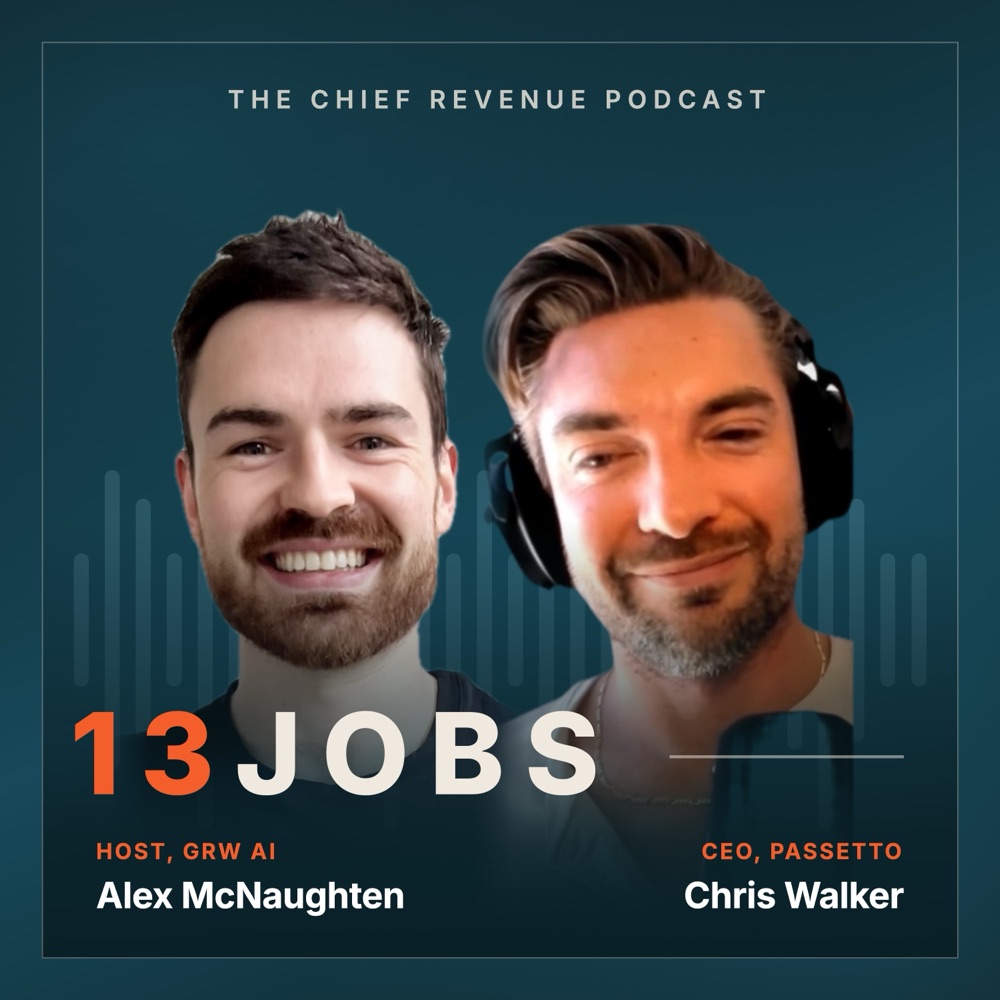
The go-to-market data model is broken with Chris Walker
Episode 050 · Jan 17, 2024
The go-to-market data
model is broken
0:0035:13

The go-to-market data model is broken

Twenty-eight companies, nine of them in the Cloud 100, and almost none had their data structured well enough to make a go-to-market decision with it.

Hosted by Alex McNaughten
Share

Chris Walker · CEO, Passetto

Chris Walker is the CEO of Passetto and executive chairman of Refine Labs, the B2B demand generation company he built over five years and more than 250 client engagements before handing the CEO role to Megan Bowen.

Passetto grew out of the pattern he kept finding: a unified go-to-market data model that combines marketing, sales and SDR spend retroactively, so leaders can see where the money actually goes and what it returns. He spent seven years inside B2B companies across supply chain, product management, operations and marketing before starting any of it.

In this episode, we discuss:

  • Seven years inside B2B companies, and what stopped working after 2012
  • Why another Friday pipeline meeting will not fix misalignment
  • Looking at the whole go-to-market spend instead of the departments
  • Proving ROI against collecting the data to decide with
  • Nine of the Cloud 100, and almost nobody with usable data
  • The years when companies did not care about tracking the spend
  • Touchpoint attribution, and how the data can tell any story you like
  • Where a buyer converts predicts win rate, velocity and acquisition cost
  • HIRO, and standardising what pipeline actually means
  • Pipeline inflation, and what four times coverage really is
  • When to start, and the debt you build by waiting
  • Sunk cost, and quitting engineering three months in

Quote of the show

There's a huge difference between trying to prove the ROI of what you're doing versus to collect the right data to make a strategic decision.
Chris Walker, CEO, Passetto

Key takeaways

  • Proving ROI and deciding are different jobs. One biases you toward finding evidence your channel worked. The other needs data honest enough to tell you it did not. Most attribution tooling was built for the first.
  • Almost nobody has the data structured to decide. Across 28 companies, including nine of the Cloud 100, some were spending ten million a year on Google Ads without being able to track it to a keyword or campaign.
  • Misalignment is not a meeting problem. Not another Friday pipeline call, not putting sales and marketing under one CRO. It lives in how the money is allocated and how the result is measured.
  • Look at the whole go-to-market number. Sales, SDRs, marketing, ops and tech as one figure. The only useful question is which chunks move to get more customers for less money.
  • Where a buyer converts predicts nearly everything downstream. Velocity, win rate, deal size, acquisition cost. Blending inbound, outbound, events and partner into one pipeline number hides all of it.
  • Coverage lies. Four times coverage made mostly of SDR-sourced pipeline converting at six percent is not coverage. Pipeline inflation is measurable and almost universally ignored.
  • Start at about five quota-carrying reps. Leave it and you accumulate debt in workflows and data. Untangling it later means disrupting how a lot of people already do their jobs.

Transcript

Verbatim · strong language masked
Chris Walker

Yeah, Alex, really good to, to be introduced to you and be doing this. My name is Chris Walker. For the past 5 years, I built a company called Refine Labs, which I think you probably heard of before.

Alex McNaughten

Yeah.

Chris Walker

Focused on B2B digital marketing and demand generation for high-growth B2B companies. During that 5-year period, we've worked with more than 250 companies. As of, as of actually yesterday, we made the, we made the change. We made the announcement last week that Megan Bowen will be taking over as CEO. So she's been promoted to CEO of the company.

I'll move into the role of executive chairman. And then thinking about what's next for me is something that I've been planning for a while and would be releasing some announcements later today. So I'll just share them here as well. I'm planning to start to build like a portfolio, an ecosystem of go-to-market services and technology companies that includes my company, Refine Labs, another company that I'm starting calling— called Pacetto, which is go-to-market strategy and analytics consultancy.

And then I've made investments in one company that's confirmed. I'm looking to make another one, and that would have a portfolio of 4 total companies that would operate with complementary services to the— in the B2B go-to-market space. And see, as I've moved out of the role of CEO and into the role of executive chairman at Refine Labs, I've been able to see the market at a whole different altitude.

You sort of zoom out and you see, and these ability to have an ecosystem of like complementary companies that are able to— one's doing marketing and revenue operations, which then provides the data and the infrastructure to then like measure and optimize your digital marketing and your outbound strategy and your partnerships. And then having a consultancy that can look and say, here's how we spent $25 million on go-to-market last year.

What major adjustments should we make to the budget allocation heading into next year? And then a company called Hatch, which I'll be announcing soon, which is a dark social content production agency. So they produce all the content for our podcast and for our events, but also the LinkedIn videos that you see, the stuff that I post on TikTok and things like that.

And so have just— yeah, I think together as a group of companies, we have a lot of opportunity to be like complementary offerings to B2B companies who want to execute go-to-market differently. A lot of that has been in the marketing space, but we're moving into analyzing the investments of outbound partnerships, sales effectiveness.

And so it'll become a whole go-to-market portfolio.

Alex McNaughten

That's really exciting. And congrats on, I guess, this next phase of the business moving, stepping away from CEO into the chair role. I'm curious what made you years ago want to start this business?

Chris Walker

Yeah, so I worked in B2B companies for about 7 years as an employee before I started my company in supply chain, product management, operations, marketing. Just spent a lot of time in different parts of the of a B2B business, and through that experience, what I saw is that over time from 2012 to 2019, companies continued to struggle with generating new business revenue, and what they saw is that increased investment in sales was.

Like was not yielding the associated return that they had gotten when they were an executive in the early 2000s or the mid-2000s running a company. And then when you go out and start and talk to customers and understand how are these people buying, and then I was talking to ophthalmologists, respiratory therapists, wastewater treatment specialists, consultants and engineers, like a bunch of a broad set of different personas.

And there's patterns in how they buy, there's patterns in how they get information, there's patterns in who they trust. And where they go to make, you know, complex, expensive purchasing decisions in a B2B setting. And I identified very clearly the misalignment between what customers want and how customers behave against how the traditional B2B go-to-market playbook is run and how B2B companies deploy investments to try and get a return in new business.

And so that was the— and seeing the pattern, I think I worked at 6 or 7 different companies, 6, 5 of them were for consulting, 2 of them were full-time roles. So 7 companies. I saw that pattern over and over, over a 7-year period of time. I built the trade show booths in 2012 and 2013.

I went and I looked at the budget and saw how much we were spending there. And I was in the booth having the conversations with prospects and following up and sending the lead list to sales and watching none of those deals close, or at least not enough to justify the investment. Sure, you get a deal here and there and just saw these— the continuous misalignment between how the world was changing and how buyers were changing versus how companies were operating and deploying their investments.

So that was the premise for me to start my, the first company, Refine Labs. And that was in 2019.

Alex McNaughten

Interesting. And, you know, I suppose my background originally was sales and then moved into go-to-market and sales-focused consulting and worked across about 140 or so companies in a 5-year period, which was probably too many if I'm honest. I probably burned out, burnt myself out of touch. But One of the things I really noticed was a complete lack of alignment between sales and marketing.

Like there was this, and I know there's the kind of age-old cliché of sales versus marketing, you know, the classic, oh, there's not enough leads. Well, you're not converting the leads you've got and that kind of classic tension between the two. And I'm really curious on your take on this. It's like, how do you get marketing and sales aligned?

Chris Walker

Yeah, go-to-market team misalignment is still— was present in 2012, 2017, and is still present today. If you look at the root cause behind it, I've studied this for a long time. I've advised and consulted tons of different executives. I've spent a lot of time studying this, and my core belief is that it's not going to be another pipeline meeting on Fridays that's going to solve this.

It's not going to be Putting your chief revenue officer in charge of sales and marketing to try and like align the teams. Unfortunately, it hasn't been revenue operations up to this point, although I think there is promise in the future for that function to solve some of these things. My belief is that the root cause issue is that the operating model and the data model that companies use and the KPIs that come out of that about how they optimize and run their go-to-market and monitor the performance are fundamentally flawed.

Here's why. The first part of the operating data model that companies use that is a core issue is that it operates in an assembly line like it did in 2012. Marketing gets a lead, SDRs then either call the lead or get a lead out of ZoomInfo to go outbound to call someone that didn't ask to talk to us to try to get a meeting for our sales team.

Then we get the meeting and we pass the baton again to sales, and then sales has to just take whatever meetings they get and try and hit their, hit their quota. Typically having meetings mostly with people that are not interested in buying right now. And so we have this assembly and then the, the, the, you know, intermediate metrics of an MQL or an MQA and an SQL or a meeting booked and the compensation structures around those are all not aligned to the overall outcome, which is to drive business revenue growth, net new revenue at an appropriate ROI.

So one of that is the assembly line. The second, the second part of it is that it's sort of a function of the assembly line, is that marketing impacts all parts of a customer lifecycle. It impacts the demand creation process, the capturing of that demand into actual revenue, or the capturing of that demand into pipeline, the conversion of the pipeline into revenue, and the expansion of accounts to drive up NRR.

And marketing investments can be deployed against all those different lifecycles. Yet companies like investment analytics and models assume that marketing is just supposed to be for the top of the funnel. And so the way they scrutinize, the way they scrutinize the investments and the way they set it up don't allow the teams to be operating as an all-bound integrated revenue team.

Companies want to move there. They're adopting account-based marketing. They're talking about all-bound, but don't have the underlying infrastructure to then go out and do all-bound and say, okay, well, how do we know what's working and what's not across the entire go-to-market? Not siloing out and saying what's working in marketing and using attribution and then siloing it out to SDRs and saying what's working inside of SDRs.

Alex McNaughten

Mm-hmm.

Chris Walker

But looking at the entire go-to-market view and saying, we spend $50 million on go-to-market between sales, SDRs, marketing, ops, tech, stuff like that. We spend $50 million. How are the big chunks of budget being allocated? Where are the big chunks and how could that money be moved to improve, dramatically improve ROI, which means get more customers for less money?

And so that's part of the problem and part of the stuff that we're tackling with my company, Pacetto. How do you— we have built a unified go-to-market data model that retroactively can go back and combine marketing, sales, and SDR data and budget investment data and look at performance and budget across the entire go-to-market.

And then moving forward, actually an infrastructure inside of Salesforce that would then allow you to look at that data in a consistent way and be able to use those analytics moving forward. I mean, I think that's one of the core things that we need in go-to-market. We still, we still use the Salesforce lead contact opportunity object.

We stamp campaign stuff on side of a contact and then it's attached to an opportunity. And then we look at all the contacts on the opportunity. The reporting is really challenging. CMOs and executives aren't getting the insights that they need to make big macro strategy decisions. Sure, you can make a tactical optimization and say, we're gonna change this keyword or this bidding type.

You can make micro changes, but we need the view as executives to be able to make macro investment and strategy changes. That's what I'm after in this next phase.

Alex McNaughten

Yeah, that's really exciting to hear because one of the things I've noticed is like there's often like this obsession with, and I think you've described them as vanity metrics in like previous podcasts and posts around you know, SQLs, MQLs, clicks, leads, and there's an over-obsession with that and then not enough zooming out and thinking, okay, you know, we've spent a million bucks, what have we got for it?

And then, yeah.

Chris Walker

Yeah, it's because there's a huge difference no matter what go-to-market function you're in, there's a huge difference between trying to prove the ROI of what you're doing versus to collect the right data to make a strategic decision. They're almost competing objectives. When you're trying to prove the ROI, you're going out and doing anything you can to say that your display ad influenced that account.

You're biased to try and prove that it's working.

Alex McNaughten

Yes.

Chris Walker

And when you have an analytics system that is objective, it's almost the exact opposite. The goal is not to prove ROI. The goal is to have the right data to make a strategic decision. And I think that a lot of the vendors that have been, that have come out with technology around marketing attribution were centered around solving the problem of marketing, proving the ROI, not centered around the problem of how do we make a smart go-to-market decision as a go-to-market team and set of leaders.

And so I think there's just a competing objective there and you need both. You need to be able to do both. You need to have the tools and capabilities to do both. But I think companies just don't have that like objective analytics engine to actually make a decision.

Alex McNaughten

So you think it's a data problem? Like you think that's where this stems from is people haven't had the data they need, or do you think it's something deeper than that in terms of like how we're training marketers and how we're training go-to-market folks?

Chris Walker

Part of it is certainly the data for sure. I, as I've been working on this project in stealth mode for about 9 months over that time, I've worked with 28 B2B companies and 9 out of the Cloud Forbes 100, Cloud 100. So 9 out of the 100 best private SaaS companies in the world and then another set of 19 other companies.

And the consistent pattern is that almost no company has the right data collected in the right structure to be able to make smart go-to-market decisions. Some companies in the Cloud 100 that spend $10 million a year on Google Ads and can't track it down to the keyword or the campaign level. And so they spend $50,000, I don't know what the math is in my head, but it's like $30,000, $50,000 a day on ads and don't spend $30,000 or $50,000 one time to be able to track it properly.

And so you see examples of that. It's not like small companies have bad data and big companies have good data. I actually don't see, Sure, you get more mature and things like that, but I don't see a pure correlation between bigger companies being able to measure more effectively. And so data ends up being a really big issue.

And what we do is we're able to take all the data that they already have, then be able to restructure it and combine the sales, marketing, and SDR data together and then show them a story of here's your exact same data looked at in a different way and here's what it's showing us.

And what do we get back? Oh, that makes perfect sense. We always thought the content syndication wasn't working. We always thought that our agency running this lead gen stuff on LinkedIn wasn't working. We always thought that we were spending too much on Google Ads and not enough on a podcast or something like that.

And the response is usually that this data makes tons of sense. And then the question is, well, why didn't you look at this data, you know, 24 months ago? Why didn't you— why don't you prioritize looking at this data every single quarter? Why don't you look at changing the way that you report on a quarterly basis to the marketing team, the executive team, and the board?

Around the progress that we're making inside of marketing as well as a whole go-to-market team. And so I think those are some of the evolutions that I'm hoping to drive in the conversations that we're trying to have here. But just to close out, data is absolutely part of the issue.

Alex McNaughten

Do you think that, I suppose, a lack of focus on this over the last, let's say, 5 years or so, Has been like broadly speaking in the market. Do you think it's been a bit of a case of money's been really cheap and you know just keep spending it and if we're seeing something back you know that's okay and it's sort of just been a bit of a laissez-faire approach to things because money's been so cheap and easy to come by and now that interest rates have risen and sort of the macro has changed that people I suppose are really zeroing in on efficiency.

Chris Walker

Yeah, I think there was a period of time and it was probably very extended. The economy was doing very well from like 2012 all the way to 2022. But there was a real period inside of the COVID boom where I was in the work, I was working with the companies. I saw it where companies would spend $500,000 a month and say, we don't care about tracking it.

You'd literally have conversations like that where it's like we would forcefully say this is not a good idea to increase your budget from $30K a month to $500K a month in one month. And they say, we don't care, we need to spend the money. Those days are over.

Alex McNaughten

Right.

Chris Walker

But those are examples of what it was like. It's definitely not like that now, but a lot of companies have to pick up the pieces from that time, which takes a really long time to resolve. Budgets get inflated, Not checking really against ROI or results. Results start going down. You have pressure on ROI.

Now you have to decrease your budget. But how do you do it? What? Which? You don't have any tracking. How do you decide where to where to cut $5 million? So you're just guessing that you're taking a blanket. You're taking a blanket cut across everything. What I will say though is that if you look back five years, the amount of data and the quality of the data that B2B companies collected in 2019 or 2018 compared to now now is.

Significantly more sophisticated, significantly better. The rise of revenue operations and the focus on this has driven a lot of positive momentum in this direction. In 2018, you had to convince your rep to put sh*t into Salesforce.

Alex McNaughten

Yes.

Chris Walker

It really was like, it really was like that. That most, that if it happens in some companies, but usually doesn't fly anymore. And so I don't want to discredit the progress that has been made, but when you look at the gap between where we are today And where we need to be for our companies to make smart decisions around the tens of millions or hundreds of millions of dollars we're deploying on sales and marketing investments every year, there's just a there's a long way to go.

And what I'm trying to communicate to people is that the path is actually very simple. It doesn't take a long time. It's not very expensive. Rela and relative to the entire go-to-market budget to fix this thing, we're talking. A 10th of a percent of a company's annual marketing and sales budget to properly have all of the analytics to be able to make these decisions.

It's not. And companies always try and solve it with a technology product. Sure, technology helps. But what I found is that the actual value that's provided is, okay, what data do we look at? Why are we looking at it? When we see something, how do we recognize it? And then what do we do about it?

And the what— how do we see it and what do we do about it is actually the place where there's the gap.

Alex McNaughten

Right.

Chris Walker

Elaborate on that a little bit more. So the first, the first kind of angle is like, depending on how you look at the data and what data you look at, you'll be able to tell whatever story that you, that you could tell any story. And so right now, the way that data is viewed is typically in one main way, which is touch, like campaign touchpoint attribution against an opportunity.

And so there's an opportunity created with an account. This is the ABM and the Gartner type of philosophy. Let's create an opportunity with an account, let's put all these contacts onto the account, and then let's have marketing try and influence the progress of this account by having trackable touchpoints on the opportunity. And then based on those touchpoints, we'll be able to say how much influenced revenue each of the investments had so that we'll be able to know what's working and what's not in marketing.

Alex McNaughten

Yeah.

Chris Walker

That's the common way. The, the previous way that companies still use, uh, some companies still use is using a sourced model. If it came from the web, if we, the lead came from a website or an event or some other type of marketing program, we're gonna say that marketing drove it. And if it was an outbound call or the AE met them somewhere, we're gonna say that SDRs had it or sales did it.

And you get this departmental-level credit about who sourced the opportunity, which is not a good— it's not a good solution either. But the insight is that actually we should be looking at both of them and using them for specific purposes. One is critically important, the sourced model, what we call a tipping point or a conversion.

What was the thing that the buyer did that triggered your sales team to take action? And what was the outcome of that action in terms of a meeting, an opportunity, and closed won revenue? And inside of a go-to-market engine, a large developed company, you'll, you'll have a million times when that happens every year where you, there's a signal that happens and a salesperson or an SDR takes action.

And then if you collect those, and then they're gonna have a disposition of a meeting, qualified opportunity and so forth. And then in a year you could then look back and say, okay, out of these million touchpoints and the signal or the thing that drove the action off of it, what are the action— what are the signals that leads to our sales team closing deals?

What are they? And it, like, in a very simple way, you could track that. So it's not about which department is going to get credit, which is the whole reason that companies started to move away from it. It's not about that. It's about what is the signal that's driving our sales team to take action that leads to high sales productivity and results?

And what are the things— what are the things that buyers do that triggers our sales team to take action that doesn't lead to good results? And maybe we should just stop triggering our sales team to take action based on those things. That's— this is like 2019 when I started to recognize this. Companies would run a page like a LinkedIn lead gen or some other form of content syndication, and they would collect 5,000, 50,000, somewhere in that range of leads in one year, and they would measure it on the cost per lead.

And then when you looked and you saw, okay, we got 50,000 leads and we won 4 deals, which means that we're talking to 10,000 people to win one deal. So yeah, there's the advertised, the $50 cost per lead, but there's all the cost of our sales team talking to so many people that don't buy in a mature go-to-market engine.

That's the problem. It means that your headcount is way higher than it needs to be to close the same amount of revenue. It's just a bunch of waste.

Alex McNaughten

Yes.

Chris Walker

And so we need to have that view. And then alternatively, basically every CMO is coming to me right now and saying, How do we measure the top of the funnel, quote unquote? And the reality is that at this point in technology, my belief is that the best way to really understand how that's working is to get direct customer insights.

So if you think about it, and then we have to think about the difference between attribution, how do we analyze investments to try and determine whether those investments are paying off or not and how we should do versus KPIs? What are the core metrics inside of our machine that we're monitoring to know whether we're on or off track?

And when we think about the quote unquote top of the funnel, I think that companies are, will move away from the idea of an MQL and move into the idea of an engaged account at the like highest level. And so is it to just have an account engaged on your website, not necessarily that you're driving an outbound activity off of it, but to just know that the right people at the right accounts are on your website, I think is more valuable.

Than having somebody download your ebook when they almost never read it. And it is trying to— like the whole goal of KPIs is to try and incentivize the right behaviors across a broad set of the team that are trying to do something. You're trying to incentivize the right behaviors and align the teams.

I think that the shift from moving from a lead to trying to engage an account, I think is a good, a good move overall. And then on the— on what I'm calling investment analytics now, not attribution. Attribution is one way to determine whether your investments are paying off or what the impact of those investments are.

But there are a variety of other ways, and we should be using as many ways as feasible that are, that are cost-effective and deliver data in a shorter period of time. We should be looking at data from a bunch of different angles to make decisions about how to deploy millions of dollars. We should not have one tool that has incredible known limitations and use that tool to decide how we deploy all our investments in marketing, and other forms of go-to-market.

Alex McNaughten

Yeah, look, I think that makes total sense. And it's often like, it sounds really simple when you say it. But you know that this probably, it's probably not that simple. Maybe it is and people just haven't gotten onto it for this long and it just takes someone like you saying this stuff out loud.

But one thing I wanna touch on is you and it sort of brings us onto it, is you talked about HYRO recently on a podcast and you were talking about, let's first define it and then let's talk about what it drives and the results you drove because I found this really interesting.

Chris Walker

Yep. So here's the insight and then we'll talk about the definition. Here's the insight that depending on where your buyer converts, pre-opportunity creation, How the buyer engage, how how your sales team engages with that buyer to start a sales process has a dramatic determination and predictor of sales velocity, win rates, average deal size, sales productivity, customer acquisition cost.

And so if you just look at pipeline overall and you blend all your pipeline together that's coming from outbound and partner and website and events, and you blend and all the different. Programs and lead gen channels inside of that, you blend it all together, you miss the huge details of what are the highest sources quality of pipeline that we should be optimizing for.

And so example, like I learned this in 2018, we had, we looked at the win rates and ACVs and sales cycles of 2 different sources inside of our company. We had an outbound meeting that was set by an SDR. The win rates of those deals were 6%. And the sales cycles were 222 days.

This is in 2019. And then we looked at buyers that said, hey, I want a demo that came through the website. And those buyers, the meetings won at 40% with a sales cycle of 79 days. And if you are just as an executive looking and saying pipeline, then what it would drive you to do is say, forget the website, let's invest more in outbound.

It's driving way more pipeline.

Alex McNaughten

Yeah.

Chris Walker

But the pipeline wins like 20% of what the website wins and it takes way longer. And so the purpose of HERO, which is a high-intent revenue opportunity, is to standardize the definition of pipeline across these different pipeline sources or buyer intent signals that allow a company to see, hey, we should, for our outbound qualified pipeline, in our case, based on our historical win rates, should really be stage 3.

But our website opportunities from just meeting booked to close are winning at 30%. So our qualified pipeline stage or our hero stage for our website is going to be stage 1. And then what you have is you have a normalized measurement of how much pipeline you're actually creating in your business based on actual performance metrics.

What the issue that it solves is there's a lot of pipeline that gets put into stage 1 or stage 2 that companies call qualified pipeline. That is total garbage, that there are clear patterns and trends that the win rates are very low and there is no quality control or no data to support or even start the conversation of should we even be putting this into pipeline anymore?

And so that's, that's the whole point, recognizing that in an all-bound system that you have multiple go-to-market motions running, that you're going to have a variance in terms of the performance of those different go-to-market motions from a demand capture and demand conversion standpoint. And just use, like, being able to look at that data to be able to make better decisions on how you plan and forecast, how you invest and allocate, how you opt, how you have sub-teams or sub-functions optimized against KPIs.

I think there's just a lot of, a lot of benefits to taking the idea of qualified pipeline to the next level and just using, using more data to support the definition of qualified rather than just an arbitrary deal stage.

Alex McNaughten

Yeah, well, it makes total sense, right? Because you can, you can look at maybe you've got 3 times pipeline conversion and that can sort of lull like a sales leader into some sort of false sense of security that that's, that they're good, right? They got 3 to 5 times coverage, happy days. But if in reality, like you said, when you dive into it, 70% of that pipeline is actually SDR generated and we know they convert at 6%, then maybe that's not such a good position to be in.

Chris Walker

We do this, we do this in every one of the 28 projects that we've been running and we compare basically our automatically calculated definition of pipeline by every single individual opportunity and stage move versus their like arbitrary stage 1 or stage 2. And just to show them the differences in pipeline, which lead to a phenomenon that we call pipeline inflation, which is critically important for a sales leader or all go-to-market leaders, which is basically like we'll ask the company what type of pipeline coverage are you planning for?

They'll tell us we're trying to get to 4x we're really hovering about 3 right now. And we say, well, based on the pipeline and the quality of the pipeline at stage 2 and the win rates broken down by pipeline source, you need 8x coverage. And it's a huge flag when you think about long-term macro planning to have that type of insight, because then you can go back to the drawing board and say, okay, what are we going to do about it?

We only need 8x coverage because there's a lot of sh*tty pipeline in here. If we start to cut that out, we can get back to a normal, normal range. Like back in the day, it was basically like qualified was you're going to win it at 25% or greater. So all we're doing is that's what a rep would like take to the bank when they call it qualified.

Alex McNaughten

Yeah.

Chris Walker

And so all we're doing is applying that logic in an automatic and objective way inside of Salesforce. And you can have both of— it's not like you have to kill your qualified pipeline and adopt this. I actually think that HERO might end up sitting and being a backend analytics metric for companies just monitor the quality of their pipeline and make decisions.

And it doesn't have to change any of the core. I don't believe it should change any of the core sales workflows, the qualification processes. Sure, if you want to go and improve those, sure. But it's— those are not requirements in order to adopt this definition. It's truly really more of like an executive analytics and/or RevOps type of analytics method to then go out and problem solve and optimize your go-to-market.

Alex McNaughten

Oh, 2 final questions for you, Chris. Like, at what stage should a company start thinking like this? Is it as early as possible, or is there a certain stage where it makes sense to get this sophisticated?

Chris Walker

So the challenge with not doing it is that you build up a ton of debt and problems that become really challenging to untangle over time. And oftentimes when you untangle them, you have to disrupt broken or inefficient or improper workflows that have been created that impact a lot of humans in the way that they do their job in order to do it the right way.

So my core belief is like the best time to plant a tree was 10 years ago. The next best time is today. It's the same thing. Like if you're a company, the time that you should be thinking about this is when you have 5 reps, probably 5 quota-carrying reps. Is the time where you probably have the resources to support getting the operations in place and supporting it.

And you might have one sales ops, rev ops, marketing ops type of person in your company. That's the time to solve this. And the way to solve it is not to rely on the senior manager that you have in ops. It's to go out and find a firm and pay $50,000 and get the sh*t done so that you have it forever.

And it's not a recurring SaaS subscription. You don't pay $50,000 a year. You build it, the tracking is in place, you work with it and you go. I really do think that's the best way to do it. But larger companies are like, most of the companies that are doing these projects right now, not for me, but just broadly trying to fix all of the tracking are companies that are $100 million.

That's the segment of companies that are trying to fix it because they need to figure out how to have a billion, to be a billion-dollar revenue company.

Alex McNaughten

Yeah.

Chris Walker

'Cause they're all, have taken on a lot of VC funding. And so, And to get from— you're not going to get from $100 million to a billion doing the same sh*t that got you from $50 to $100.

Alex McNaughten

Yeah.

Chris Walker

Um, and so I think, yeah, I think, uh, that's the, the main segment that is investing in solving this problem that I find is companies that are, you know, above $50 million, maybe because they have more resources to fix it, maybe because the problem is so much more dramatic. Prob— the real reason is probably because the problem is so much more dramatic and expensive.

As you get bigger, you spend an outsized amount more in go-to-market expenditures, and the cost to solve it doesn't scale at the same rate. And so it's about the same cost to solve it for a big company as it would a small company. But generally, I would say fix it as early— put the pieces in place as early as you can to have the data to make good decisions.

Alex McNaughten

Final question, Chris, and this is one we ask everyone who comes on the show, is Go back to your first day on the job. What's the one thing, you know, one piece of advice or one thing you wish you knew when you were starting your career?

Chris Walker

First day of the actual first day? Like right out of college?

Alex McNaughten

Yeah, like first day on the job. You come out of college, first day on the job.

Chris Walker

I would say if something doesn't feel right, Don't be afraid to make a change, even if you— even based on what other people will think about the change or what you did. I studied engineering for 4 years. I invested a f*ckload of money in an engineering degree, and on day 1, I was doing software engineering.

And within 3 months, I realized that I hated it and I didn't want to do it. And I could have the sunk cost, the sunk cost fallacy of, oh, I invested so much in my education. But I have to be an engineer for the rest of my life now. I guess I just got to suck it up.

But within 3 months I was like, I'm going to pivot. I want to be like— and the company gave me an opportunity in product management, which then led me to like business cases and thinking a lot more about margins and business. And, and my career went from there. And so I just— and a lot of people wouldn't make that move because of how their parents would think about them or what their friends would think about them.

Or that just the sunk cost of what they've already invested. I just think that it, you don't really understand how it works until you get into the real world. Up until college, it's kind of just like, it's kind of just like fake life.

Alex McNaughten

I think that's a pretty good description of college. Yeah.

Chris Walker

And then, and then you get outta college and you're in real life and you re— and you realize that, oh, like there's no guided track for me anymore. It's not like I just go from sophomore year to junior year to senior year and these are the credits that I need to get and everything's laid out for me.

It's the exact opposite. You have the open field. And so recognizing that you don't have some set track anymore and that you own your own decisions in your career, I just think it's such an empowering move. And the earlier that you can like learn and adopt it, I think the more happy that you'll be.

Alex McNaughten

I think that's a great place to finish, Chris. Thank you. Where can people find you if they want to connect with you, engage with your content? Where's the best place?

Chris Walker

Yeah, so feel free to connect with me on LinkedIn. I post a lot of content on LinkedIn. They're typically like the shorter form, like the key messages of some of the podcast episodes that I publish. For those of you that are looking to increase your content production or increase the results you're getting out of content, you could also just watch what I'm doing and try and model it after your own company and target market.

I think I really have a good cadence for how I operate that channel, and there's some new things that we're going to be trying out that you can see how they work and then have some ideas. And then I also publish long-form content on the B2B Revenue Vitals podcast on Spotify or Apple, as well as on YouTube under Chris Walker.

So feel free to check me out on any of those places or anywhere else you can find me. Thanks for having me on the show. Really thought it was a great conversation and look forward to catching up again soon.

Alex McNaughten

Thanks a lot, Chris.