
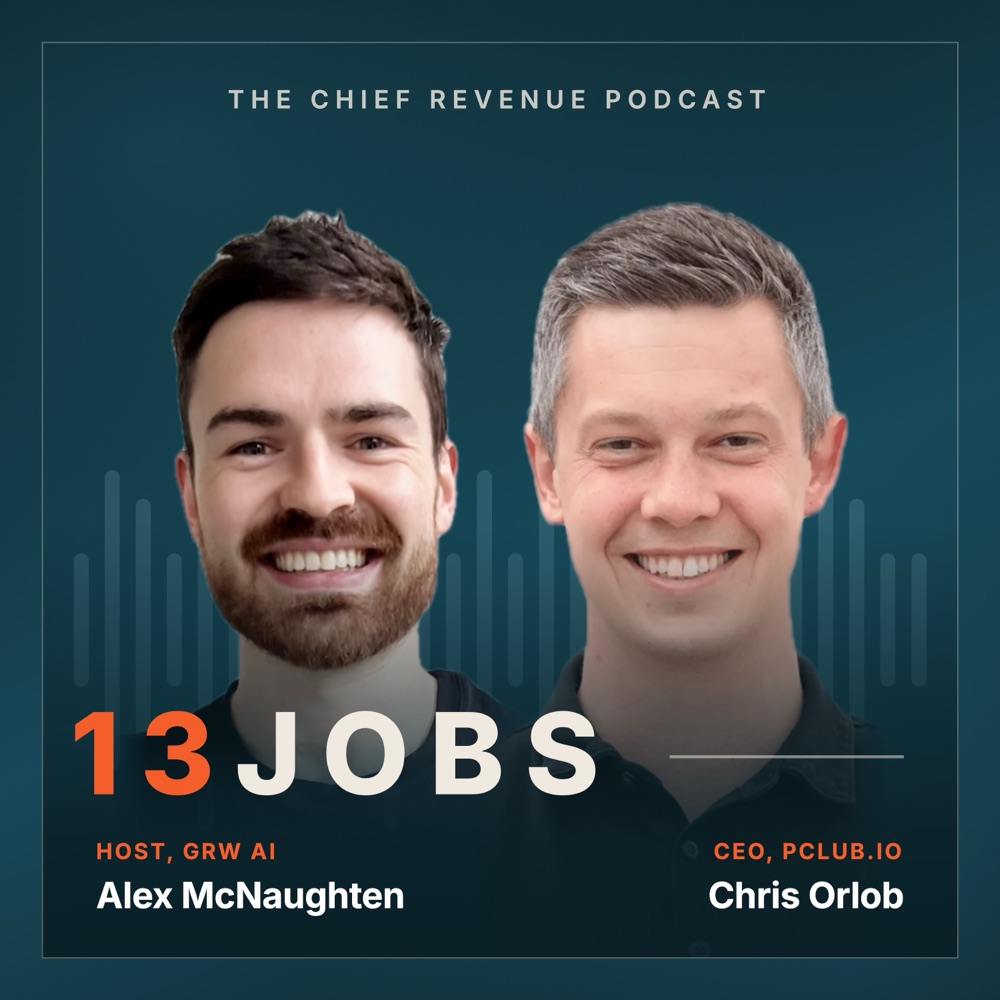
Sales training tells you what to do, not how
Chris wanted to be a professional drummer, then helped take Gong from under $200k to over $200m. His verdict on sales training is that it teaches process and calls it skill.
 Hosted by Alex McNaughten
Chris Orlob · CEO, pclub.io
Chris Orlob is the CEO of pclub.io and QuotaSignal. pclub is a course platform for B2B sellers, built around the idea that selling is a set of separable component skills rather than one broad discipline, and it has trained more than 10,000 SaaS and tech salespeople.
Before that he spent five and a half years at Gong, joining when it was under $200,000 in annual revenue and leaving when it had passed $200 million and a $7.2 billion valuation. He had previously founded Conversature, a company that set out to be roughly what Gong became.
In this episode, we discuss:
- Five and a half years taking Gong from under $200k to over $200m
- The tendonitis that ended the drumming
- The startup that was meant to be Gong, and the offer that came after it
- The amusement park queue where pclub started
- Basketball is not a skill, and neither is selling
- What to do against how to do it, and where MEDDPICC stops
- Why most people cannot teach the thing they are good at
- Training against coaching, and doing the rep's job for them
- The real gap: frontline managers who never get coached themselves
- Manage the people, manage the selling, manage the business
- Reinventing yourself at every inflection point of hypergrowth
- Start building an audience earlier than feels comfortable
Quote of the show
“Basketball is not a skill. Dribbling with your right hand is a skill.”
Key takeaways
- Selling is not one skill. Basketball is not a skill either. Dribbling left-handed is. Most training bundles everything into "how to sell to enterprise" and teaches none of the parts properly.
- Process is not skill. MEDDPICC tells you that you need an economic buyer. It does not tell you what to say to reach one. That gap is where most sales training quietly fails.
- Most experts cannot teach what they know. Of roughly 120 candidate instructors, about 20 made it to a published course. Knowing something and being able to break it into teachable parts are different abilities.
- Coaching is not telling. Training imparts the skill. Coaching either reinforces it or draws it out. A manager who whiteboards the answer is doing the rep's job rather than building their capacity.
- Nobody coaches the frontline manager. They get promoted for being a top rep, then are expected to hire, interview, coach and run performance management having been taught none of it.
- The manager's job is three jobs. Manage the people, manage the selling, manage the business. Add up an honest time split and it comes to more than one hundred percent, which is most of the answer to why coaching never happens.
- In hypergrowth, learning is survival. Join a fast-scaling company at director level and you become underqualified for your own job unless you are learning constantly. The business outgrows you otherwise.
Transcript
Chris, thank you for coming on the show. I really appreciate having you on today. How's it going?
Yeah, it's going amazing. I'm happy to be here, Alex.
And for those of you who don't know Chris, Chris is the founder of P Club. But Chris, tell us a little bit about yourself and your journey in sales because it has been a pretty fascinating one.
Yeah, I think the bulk of it is this 5.5-year journey I had helping grow a company called Gong from a little less than $200,000 in annual revenue to a little over $200 million by the time I left and had a lot of fun doing it and was fortunate to, you know, be mentored by some of the best sales leaders in the world, at least, you know, in my humble opinion, they're some of the best in the world, like Ryan Longfield, who was the previous CRO of Gong and Jameson Young and some of these other like just superstar sales leaders.
I've been a sales technologist almost my entire career before Gong. Worked at a company called insidesales.com for a while. Then I started a company that intended to be Gong-like. This was before I knew about Gong and that's how I wound up with Gong. And P Club is doing the same thing, right? We're an online education and skill transformation platform for typically SaaS and technology sales professionals and we sell to businesses as well as individuals and we have a lot of fun doing that too.
That's awesome. Yeah, it's a pretty fantastic journey you've been on. I'd love to know, how did you get into sales originally?
So my dad was in sales and he always just like had, he had like kind of odd sales jobs, like he worked in like call centers and stuff. So not like tech sales, but he indirectly imprinted on me like the value of being able to sell, even though like when I was a teenager, I had no aspirations of like being in sales in a career at that time.
I wanted to be a professional drummer.
Very different. Yeah.
But at the time, like I found this list of goals I wrote for myself when I was like 16 and most of them were like drumming oriented, but a few of them were like learn marketing, learn sales, be an entrepreneur. And I didn't, I don't even remember really having those aspirations back then.
So it was always kind of there, right? Like I did like sales-oriented things growing up. I sold golf balls to golfers because we lived on a golf course. And then when I got into college, that's how I paid my way for, you know, through a bunch of stuff is like selling home security over the phone.
I did door-to-door selling like coupon books and then finally I transitioned into SaaS. After I left school, and that's how it started. Um, actually, what I should have led with in this answer is my dreams for being a drummer died because I used to practice so much that I got tendonitis here and in both of my knees.
This was like death metal drumming, so you have like the double bass.
Yeah.
And I got tendonitis that still has not gone away. Like, I have scar tissue, and that, that'll kill your dream of being a drummer, right? Because you have scar tissue and you can't practice for more than an hour a day.
Oh my God.
Yeah, and if that's all, you know, you can't be the best drummer in the world if you can only practice an hour a day. And this was like my early 20s. And so at some point, like in this depression of, um, I just decided I wanted to make a lot of money and that was like my new life goal.
And I didn't know how I was going to do it, but eventually it led to me learning how to sell because all of these books on how to get rich, all of them say different things, but they all say you know, they all have one commonality, which is learn how to sell and learn how to market.
The big money is made in the world.
That's interesting. So from drummer to sales and talk a little bit and look, we don't have that long, but, you know, talk to me a little bit about your journey with Gong, you know, so you mentioned you were founding a company that you sort of in that space and then that's how you became part of Gong.
And then there was a pretty incredible journey you went on from, you know, $200K to, did you say $200 million in annual recurring revenue? There's quite a few different sort of, I suppose, stages of growth there. But yeah, just talk me through it and like kind of talk through, I guess, like that 0 to 1, 1 to 10.
You know, joining Gong, like when I finally got the offer, is probably like one of the best feelings I've ever had professionally. Like still to this day, like I remember the day I just like felt so good. Because before that, I started a company called Conversature, which intended to be Gong. And this was an 18-month slog.
Like, I didn't raise any money. I watched my net worth drop to like months of runway left and I had like little kids at the time. And so eventually me and my co-founder like threw in the towel and I had like this month or two where I didn't know what I was gonna do next.
And it was actually kind of nice, right? Like, I didn't have like responsibilities or goals or anything like that. But Gong reached out to me, the CEO Amit Bendov reached out to me about wanting to work with them. And so we talked for like a month and I finally accepted an offer. And I remember the night, I don't drink anymore, but at the time I made myself a Sazerac and just, and I think I had a cigar too.
And I just felt like on top of the world because it was like after 18 months of not getting paid, Yeah. No paycheck for 18 months. We generated maybe $30,000 in revenue during that entire 18-month period. I finally had like a good role where I was making money and I was excited about the space and it was still a startup so I could like fulfill my entrepreneurial inclinations.
And then it was just up into the right from there. Like, I hate to say it, but like, yes, there were very challenging times at Gong, but like there were none of these like horror stories that like you read about, right? Like that book, The Hard Thing About Hard Things. I don't know if you've ever read that.
But it's the founder. Yeah, it's the founder of Andreessen Horowitz. And the stories that guy had building Opsware, his company, were nightmarical. And I'm reading this and I'm like, this isn't what Gong was like at all. Like there were, there were definitely, I think a lot of us were, don't realize how fortunate we were to be on that journey.
Not, I'm not saying it was easy, but it was not like there was no existential threat to the business during that journey.
So what do you put, I suppose, you know, paraphrasing a little bit, you know, a smoother ride perhaps than other startups? Like what do you put that to?
I think there's a few things. The number one is just like how rock solid the leadership team was, right? Because like a lot of startups are helmed by first-time CEOs or young CEOs, me included. Like that's, you know, me running P Club right now. And when I joined Gong, it was Amit Bendov as CEO who's been a CEO before and a CMO before, like very seasoned.
And he hired Udi Ledergaard who he had worked with before as VP of marketing and eventually CMO and just Aran Aloni who was the VP of products, Alon, the other co-founder who's CTO. So just like super seasoned leadership team and then you combine that with we had a really hungry market to sell to.
And when you sell to a market that's hungry, they will pull you to success whether you want to be there or not. So I think those are the 2 things, right? Like when I think about, all right, if I want to grow P Club to $500 million in revenue, what has to be true?
And to me, it's probably like a 2 to 3 line checklist. One, are you in the right market? Check. 2, do you have the right people on your team? And then 3, do you have the right offer for that market and is it scalable and profitable? And if you get those 3 things right, then you probably have the raw material for a big successful company.
Let's talk about P Club a minute. Actually, I'm bouncing around slightly, but what made you want to launch P Club? What was the moment that was like, okay, the world needs this?
That happened probably 10 years ago or 12 years ago, maybe even more. I was at an amusement park with my current co-founder and we've been best friends all this time. We were at this amusement park with our girlfriends who are both now our wives. And I told him like, I was like waiting in line for a ride and I told him how I wanted to make a bunch of money.
And he goes, if you wanna do well economically for yourself, then you should learn how to sell and master And so that inspired me to start learning, right? And acquiring skills. And I became obsessed with skill acquisition and I still am. And I attribute skill acquisition to how I've been able to rise to the station in life that I am right now.
Of course, I've been fortunate, but like the skill acquisition is what helped unlock those opportunities. And PD Club is now just a manifestation of that passion and helping other people achieve the same. Because the mission of P Club is help people acquire economically valuable skills that raise prosperity. And the way I define economically valuable skills is revenue generating.
And so there's a lot of, you know, I don't want to overemphasize mission of a business like I'm some like, you know, noble philanthropist who's starting a company out of just the goodness of my heart. Sure, some of that's there, but like there is a lot of like self-interest when it comes to starting a company.
But the mission is also there, right? I get out of bed early because it's meaningful to me beyond just enriching myself to help others acquire skills that they can use to achieve whatever it is that they want to achieve.
Gotcha. And I think that's a fantastic mission in terms of, I guess, the landscape, right? Like the skill landscape or training landscape, however you want to define it. What was the, I suppose, the gap that you identified? Yeah.
I think there's a few of them. One is how we think about the component parts of selling skills, right? Most, in my opinion, sales training is too broad, right? It's like how to sell to enterprise and they're teaching all of these skills in one. But the way I think about sales skills is kind of how I think about basketball skills, right?
Basketball is not a skill. Dribbling with your right hand is a skill. Dribbling with your left hand is a skill. Layups are a skill. Free throws and field goals and, and dunking and rebounding. All of these are component skills that make up the skill of basketball. And I think of sales in the same way where sales isn't a skill.
But business discovery is, and multithreading is, and champion developing or development is, and business acumen is, and accessing power is, and writing cold emails. There's all these dozens and dozens of component skills, and we have a separate dedicated online course for every one of them in a way that helps people rapidly acquire skill or skills faster than if it was too broad.
So that's one of them. The second gap is all of those skills are taught by subject matter experts that are operating that skill at the highest level, right? A lot of salespeople have, whether it's fair or not, they don't always see like many sales trainers as credible, right? The common story is like some guy who sold Xerox 30 years ago and hasn't closed a deal since then has been training people.
Versus like learning from Kristen Connor, who's, you know, an expert at multithreading and selling every day and teaching you how to multithread and all of the, you know, very specialized subject matter experts for any of these given skills. And we have found that that value proposition has cut through the market like a hot butter cutting into— I just got that backwards, a hot knife cutting into butter.
Yeah. Yeah.
You can use that. You don't have to cut that out.
No, I like that. Well, you know, it makes total sense, right? Because like in any, in dev, like in any profession, you've got everything from great to rubbish and everything in between with the sales training landscape. So, you know, I, you know, having folks who are doing it and the best in their field actually teaching the class, like, Yeah.
Makes, makes total sense. Yeah. Anything else, Chris, that, that when you were setting up Peak Club that you identified as, you know, like was missing from the sales training landscape? This is something I'm really interested in because, you know, I've sort of wondered, I've looked at the landscape in terms of, and sales performance as a whole, right?
And maybe you can resonate with this, is that sales performance is, you know, give or take 40% quota attainment is kind of like the norm and we accept that and we sort of accept that 1 in 4 new sales hires are gonna flunk out in their first year. And like there's a lot of things we sort of just accept.
And I've always wondered why that is. And I was wondering if any of that influenced you in terms of this.
You know, I don't think I understood the gap in the market when we were first selling it. I started to better understand it as we were in the market and as we evolved. But there were a couple of things that I learned early on. One is, in addition to the gaps I already pointed out, there's a big what to do versus how to do it question in sales.
And most sales training tells you what to do without telling you how to do it, without giving you like actionable tactics and telling you exactly what to say and do. MedPic is a good example. And I'm not picking on MedPic because it's not supposed to be skills. It's a deal qualification methodology.
Yes.
Right. But it tells you what to do, not how to do it. It tells you that you need a metric and an economic buyer and a decision maker and decision process and identifying pain and all those things. That's a process and that's what to do. There's a big gap that we found, which is how to do it.
And that's the difference between process and skills. Now the gap there, first of all, that's a gap by itself, but how skills are being fulfilled, nobody's like really dominated that space. And so that's what, you know, P Club intends to do in partnership with all of our partners. So that was like the first thing.
The second thing is just when we started, we didn't really even intend to create P Club. I just created an online course because I had taught this course internally at Gong for years and people loved it. And I taught it externally live a couple of times and refined it. It was like applicable to all SaaS categories.
And so I created this course and it just took off like within 3 months was doing like well over 6 figures a month in revenue. And so it was like, all right, I think we're, you know, onto something and we should triple down on this opportunity and build a business around it.
That's very cool. And what, why do you think there are some of these challenges in sales more broadly? Like, what's going on in sales? Like, what's wrong?
I can tell you exactly what it is, at least through our lens. It is that people struggle imminently to teach what they know. And so proof of that is, right, at the time of this recording, we probably have like 20 course authors and course instructors at P Club. And we've had to work with maybe 100 or 120 just to land on those 20 who actually made it out the other side and delivered their course.
Right.
You know, even people who've like written books on this, you know, it becomes obvious that many of them maybe have like had their books ghostwritten for them because you get into a meeting with them and you try to break down the outline for the course they want to teach. And this isn't like me criticizing them, but most people cannot do that well.
And I think that's why a lot of sales training is very high level and kind of generic and does not get down to the brass tacks of like what to do and what to say, because we at P Club won't publish a course unless we're satisfied that we're getting tactical enough. And, you know, we like to, this isn't true, this is kind of a joke, but like we like to say it's easier to get into MIT than it is to become a a P-Club instructor.
And, uh, again, I don't even know what the data is for MIT, and I'm sure MIT's stingier than we are, but like, there is an element of truth to that. It's a— it is a hard skill, and it's a rare person that is both very good at what they do and can teach it to others in a very prescriptive way.
Yeah, I think that makes sense. And how do you see the role of coaching Fitting in alongside training? Like, where does coaching come into it?
Coaching to me is— so training is imparting knowledge and like, you know, imparting the initial skill. Coaching is either reinforcing that or extracting what other already exists within a person. So you've trained them, they know the knowledge, but they're having trouble implementing it. And so coaching is a lot less telling people what to do and a lot less whiteboarding and a lot less teaching and a lot more challenging them and asking questions and facilitating their own self-discovery so that they can think, right?
Because if all you do as a manager is when you coach people, you tell them what to do, all you're doing is making people dependent on you because you told them what to do and they're like, perfect, that was the answer I needed. They go execute it. And as soon as they run into an obstacle, Instead of them being able to solve it themselves, now they call you.
And if you have 9 people doing that, you'll never go on vacation. You'll never be able to.
And the team won't get better either.
No, you're not building skill capacity. You're just doing their job for them.
Do you think, you know, is that something that you've noticed as a gap? Like, is that, is that because obviously there's the skill acquisition piece that's, you know, we've talked about and that's broadly speaking, has been a challenge in the past. It's like consistently really good people who can pass on skills in a way that someone will actually be able to then take on themselves.
And I think that's a massive gap. I think one of the other things I've really observed over working across a lot of organizations over the years is the lack of ongoing coaching and reinforcement And it's like, it's typically the manager who's supposed to do that, or that's where that falls. But from what I'm seeing, it's not happening.
And we've done some, you know, we've done some analysis on this and we've seen that it's maybe sort of less than 20% of people are getting regular, at least weekly coaching. Um, small sample size, but, you know, it's not much.
Um, yeah.
How important do you think that is to, I guess, consistent performance and consistent performance improvement?
I mean, I think it's critical and I agree that like it's a rare sales organization that I come to work with that I see doing this well. Most managers are not doing skill coaching. They're either doing deal management or deal coaching and there's, those things have their place, but they're different than skill coaching.
And so I actually think the biggest gap is the fact that frontline managers themselves don't get coached. Right? Because their boss is like a second-line leader. They're either an executive or borderline executive.
Yeah.
And their job is to run a business, not just be a sales leader. And so I think the biggest gap in coaching is frontline managers don't get coaching typically almost ever. And they're not really educated on how to be a frontline manager. You know, you get promoted because you're a top performer as a rep and now you're a manager and you don't know how to hire or interview or coach people or run performance management or any of these things.
And so I think that's where it starts is just the fact that most managers don't have the skills they need to be a manager. They don't get coached. And frankly, a lot of managers don't even understand the role of sales management. Like if I asked the typical manager, like deconstruct your job into its core component parts, I think they would give me very like perfunctory answers.
Right? Like, help my reps hit their number. That's what most of them would say.
Well, the stat is 95% of sales managers get no sales leadership training. That's the stat I was able to find. It's not a good picture. And I think, you know, I tend to agree with you that frontline management, there's a serious gap there. What do you think the role of, you know, the sales manager is?
You know, like, What is it?
I break it down into like 3 super categories. There is manage the people, manage the selling, and manage the business. And under each of those 3 categories, there's even more finely defined component parts. So like manage the people, well, that obviously has to do with interviewing and hiring, with coaching, with performance management, with people leadership.
Inspiring your people, running team meetings, etc. So that's like one bucket and there's like 6 or 7 things that go underneath it. Manage the selling. Now we're talking about pipeline management, deal strategy and deal coaching, setting up metrics and KPIs and managing your team to those metrics and KPIs. So now you're managing the selling activity and the pipeline.
And then finally, there's manage the business. Which is cross-functional partnerships, managing up, forecasting your numbers so that the business can resource themselves appropriately and kind of acting as the CEO of your team or your team's territory. So all of that could be simplified into manage the people, manage the selling and manage the business.
That's how I think of it.
One of the best descriptions I've ever heard, like one of the cleanest. The thing I noticed is it's a lot of things. Oh yeah. Oh yeah.
It's a lot of things. Well, there's this guy named David Brock. I think that's his name. He wrote a book called The Sales Manager's Survival Guide. And he kind of—.
Yes, I've read it. Yeah.
He has this chapter where it's like a joke, but not a joke where he's talking about how sales managers should spend their time. And it's like 50% on this, X amount on this, and the total amount ends to 150%.
Yes. Yes.
And he's like, exactly, this is not a typo. Like, sales management is not a 40-hour-a-week job. It's, it's a minimum 50, usually closer to 60-hour-a-week job, especially frontline management. I was more busy as a frontline manager than I was as a second-line leader because as a frontline, as a frontline manager, I had like 8 or 9 people reporting to me.
As a second-line leader, I had 4 managers So it's fewer people, they have to go manage all the reps. I'm managing managers now. It's not to say it's an easier job, but it's not always as time consuming as frontline management.
Gotcha. Yeah, look, I think that that's probably fair. And David Brock, we had him on the podcast, fantastic book he's written, like it's brilliant. And I remember him saying exactly that around, you know, doing this addition of all the things that a sales, you know, a poor sales manager has to do. What made you successful, Chris?
Like, you know, obviously you've been very successful. What made you successful? And I guess to caveat that question is particularly going through the phases of, you know, a growing company and then also you taking on responsibility, growing responsibility through that journey.
I struggled a lot in that journey. Like, I had to reinvent myself and my skills at several inflection points. In fact, that's one thing people don't tell you. Like when you go on this hypergrowth journey from almost zero to a very big company, you will deal with like some very intense insecurities as the business grows and you question yourself, like, is this business gonna scale around me and without me?
And am I gonna be able to level up to keep up with it? And so I think one of the things that helped me is I'm just an insane learning machine. Like I'm always learning, spend about an hour a day consuming content. So that's one thing that helped. 2 is I think I have a strong ability to develop other people, right?
That was probably my strength as a sales leader. There are other sales leaders that put me to shame when it comes to like their operational rigor and like building the machine. And being able to operate the machine. I wouldn't consider that a strength point of mine. I think I'm like maybe a B+, but I'm very good at developing people and both training and coaching them.
And I think that went a pretty long way.
That makes sense given your interest, I guess, in skill development, I suppose. And it's interesting you mentioned that as the first thing that led to your success was consistent learning. I don't think that's talked about enough, like broadly speaking. Like I think it's—.
You have to, like if you're, if you're not learning as if you're like a drowning person grasping for air and you work at a hyper, hypergrowth company, you're not gonna become significant at that company. That's not to say like you're gonna get fired, although that could happen. But like if you start at a small company at like a director level job, And you have aspirations of being like a VP or C-level 4 or 5 years at that point, the odds are stacked against you unless you're learning an incredible amount, right?
If you don't learn, you become underqualified even for the director-level job as the business starts to grow.
You talk about, about an hour a day of content consumption. Where do you go for your learning?
I like books. I take a lot of courses too. They're all on P Club, but I usually take those like because I'm doing quality control for the company, right? Like I need to make sure these are great and I just so happen to learn a bunch of sh*t as a result of like QAing those courses.
But like aside from that, most of my learning is like reading physical books. I don't know what it is, but I love— like, this entire bookshelf is like a 2-layer bookshelf. I've read all of those, and I've got a bunch of books scattered over here that you can't see. I have a— I read this quote the other day that made me feel better about all this, because like I buy so many books and I'm way behind.
And it was like, the purchasing of more books than you can read is just the soul reaching for infinity. And I like it. Made me feel better about myself.
That's a great quote. I love that. Chris, I've enjoyed this conversation. I've got one last question for you before we wrap up, which is knowing everything you know today, go back to your first sales job. What's the one thing if you could take it back with you? Like, what's the one piece of information you take back with you?
Man, I want to give an answer that's not tactical and something bigger, right? Because like the first thing that came to mind was money follows pain, right? Like when you can uncover pain, that's like how deals get done at the most fundamental level. But that's tactical. I would have figured that out eventually.
If I get, if I was just giving any advice to like my younger self, I would have probably told me to start creating an online presence earlier than I did. And I don't recommend that for, I don't recommend that for everybody, but for P Club, that's how we grew so fast is like I spent, you know, 7 years building a LinkedIn audience and then we were ready to start selling P Club and there was an audience already there willing to buy.
And I can only imagine where we would be if I started doing that even 5 years earlier and had double the size of my audience. So I don't recommend that for everybody. There's always this debate about like, should salespeople, you know, spending all the— should they spend a bunch of time creating LinkedIn content?
I actually don't think most of them should. It depends on like their personal aspirations and goals. But that's what I would tell myself.
Chris, this has been fantastic. I've really enjoyed this conversation. Where can people find you if they wanna connect, consume your content, learn more about P Club or anything else you're involved in?
Yeah, reach out to me on LinkedIn. I try to get to most requests, but sometimes I fall behind. So you can do that. And if you're interested in exploring P Club, the website is pclub.io, right? Short for President's Club, pclub.io. So you can go check that out and see if anything catches your interest.
Chris, thanks a lot for coming on. Look forward to chatting again.
It was fun.