
Consistency is an outcome, not an input
Chet timed how long editing a podcast actually took him, then bought the hours back. Five hours a week turned into an extra deal a month.
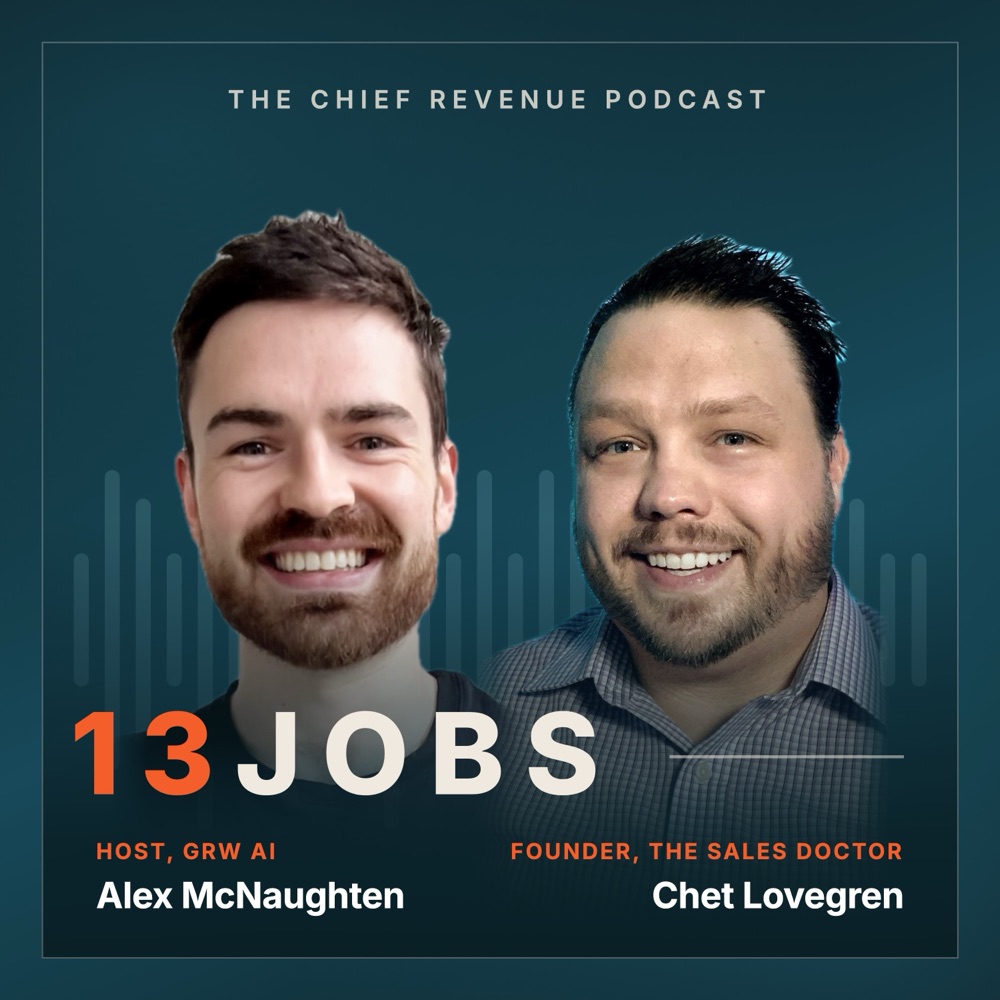
 Hosted by Alex McNaughten
Chet Lovegren · Founder, The Sales Doctor
Chet Lovegren is the founder of The Sales Doctor, which he started in 2020 as a prescriptive way to diagnose and fix problems in a company's go-to-market. He has more than eleven years selling and leading, and has helped build the sales processes and teams behind companies that went on to raise over $100 million.
He hosts two shows, the Sales Rx Podcast and the Founder's Formula Podcast. The Sales Doctor was a side hustle until the start of 2023, when the demand made it the only one.
In this episode, we discuss:
- Two podcasts, and a side hustle that became the only hustle
- Sixty hours of work in thirty, and the three things people lack
- Hours as currency: five of editing traded for a deal a month
- How a thirty second call eats twenty minutes
- Four hour blocks: himself, business, break, business, family
- Multitasking is a lie; adaptability is the thing people mean
- Faked dials, and what they are usually about
- The five five five wrap-up, done the night before
- Five hours of calls in a forty hour week, and what fills the rest
- Matching the task to the energy the last one left you with
- They have no idea you are messing it up
- Eat the fish, spit out the bones
Quote of the show
“Consistency is an outcome of discipline. Discipline is the input.”
Key takeaways
- Put a timer on the work before you judge it. He clocked the editing, the repurposing and the scheduling, and only then knew what buying those hours back was worth. Five hours a week at three hundred dollars a month paid for itself on one extra client.
- Focus on the multiple, not the number. One deal a month becoming two is a bigger idea than two deals a month, and it changes what you do with the time.
- The cost of a call is not the call. Thirty seconds on the phone, then the CRM, then the research, then Slack, then LinkedIn. Disposition, next call, and do the wrap-up in one block at the end.
- Discipline is the input. A small fire every day beats a large one on Monday and nothing by Thursday. Consistency is what comes out the other side, which is why aiming at it directly does not work.
- Five, five, five, the night before. Five minutes on what got missed, five on the plan for tomorrow, five journalling how the day actually felt. The plan exists before the morning starts.
- Schedule against your own energy. Content on the day he films, outreach on the day the demos leave him talking about the product, warm reconnects on the day discovery has worn him out.
- Nobody on the other end knows you are getting it wrong. The prospect has not seen your training and is not your manager. Fear of failing at it is the thing costing new reps the most.
Transcript
Chet, good to have you on the podcast, man. How are you?
Doing well, Alex. Thanks for having me.
No, it's an absolute pleasure. We connected over LinkedIn. I was loving your content and, um, yeah, I thought it would be great to have you on. Um, so for those of you who don't know, uh, you're the founder and head of sales at The Sales Doctor. You've also got podcast, uh, Experienced Sales Guy, But give us the overview, the elevator pitch of who you are and what you're about.
Yeah, the title always trips people up because I used to just— so we call my community and my listeners in my podcast SalesRxers, playing on the doctor theme. So for a long time, I went by Head SalesRxer because I was trying to be cute. You know, you like, you see people that want to be very creative with their title, Chief Prospecting Officer, Chief Excitement Officer, all that kind of stuff.
Didn't want to be another one of these people that's just like, I'm founder and CEO. Like, I've typed that enough with my Founders Podcast. And I was like, no, but I had to put the founder in there because I don't think people really understood it. And I wanted to keep the head SalesRxer thing.
So I know it always trips people up, but it's just another fancy way of saying I'm the person in charge kind of running the things and speaking to the community. But yeah, I got 2 podcasts, SalesRx Podcast and the Founders Formula Podcast. Both are awesome. It's super fun. It's just an absolute blast to be able to learn and interview go-to-market leaders and really talented and skilled go-to-market professionals from anything from video prospecting to, you know, product-led growth to marketing and sales alignment.
And then the Founders Podcast is really awesome because as someone who is a founder, it's great to learn from other people and to hear those stories of the fact that somebody was just as scared as you were once or even continues to be scared about certain things or is approaching things or needs education in certain areas.
And I'm just a firm believer that learning and development is— it's done in togetherness, right? You don't do it alone. And that doesn't mean that somebody needs to teach you, but even just hearing, you know, that somebody else went through something, it gives you the confidence that you can do it. It's what I do in my sales outreach and what I always preach is action by association.
You know, other titles work with us because we do XYZ. Now I'm thinking, oh, I don't want to miss out because other people like me are doing it, but also other people like me are doing it, so I should do it or I should consider it or I should look at it. And learning and development really, really goes the same way.
I mean, especially creating content. I look at content of people's and I'm like, I like that style. I like how they did that. I like how they cut that or they edited that or they formatted that. Now let me go figure out how to do it in my voice. And I think it's so important.
I think it's so important with learning too, you know, eat the fish, spit out the bones. You're gonna learn a lot, you're gonna hear a lot, you're gonna see a lot, but you gotta also do what works for you because not everything is tailored to you as the person or even you as the company owner or the go-to-market leader.
But yeah, man, Sales Doctor's been rocking since the beginning of this year. It was something that was once a side hustle, now became enough demand to be my full hustle, my only hustle. And it's been scary and exciting and rewarding and miserable and awesome all at the same time. As a co-founder, you know what I'm talking about.
You're like, yep, yep, I get it. I know I've experienced all of those things. But it's— I found a roller coaster.
The founder roller coaster. Um, and look, today we're going to talk about an area of sales that I think it's super important, and it's not just sales, right? It's, it's life. Um, but, but we're gonna obviously take it from a sales lean today, but productivity, um, maximizing the usage of your time. Where do we want to start?
Because it's a big topic. Well, you know, when— how do you think about it?
Well, all right. So it's a buzzword, right? Productivity. You could say it and it could mean a million different things. I think what it really boils down to is, and I'd released a newsletter article about this a few weeks ago, but it's how can you take a 60-hour work week and put it into 30 hours?
You know, I have a wife, I have 3 kids. I still want to spend time with them. I still want to go to the gym. I still want to go see the occasional Marvel movie in a theater. But I also, at one point, you know, I had 2 podcasts. I was working a W-2 job.
I had a side hustle. I have rental properties I have to manage. I have content creation that I do on TikTok and YouTube and all this stuff. Where do you find the time? And the reality is most people have the time to do absolutely everything they want and then some, but they lack 3 different things.
One, They lack prioritization, and we can dig deep into each of these, but they lack prioritization. Number 2, they lack understanding of their time spend. We'll talk a little bit more about that as well. And then 3, they lack discipline and they can't stay consistent. So not only do you have to understand your time spend, prioritize your time, but then stay disciplined to that.
But you have to just stay on top of things. And so when we talk about understanding your time spend, A great example is editing video content. We were talking about this a little bit beforehand. You were like, you know, oh, for all your podcasts and your content, you're doing your own editing. I was up to a certain point.
One, when the, when the business demanded that I, I could, you know, spread a little bit of my profit margin to go hire someone. But 2, when I started actually pulling up a Google timer, when I would go to edit an episode and seeing how long it would take me, seeing how long it would take me to cut 2 clips together, seeing how long it would take me to repurpose that content into a blog, into a newsletter, into a LinkedIn carousel, into a Twitter thread.
And then even loading all that stuff up into my scheduling tools on Buffer and LinkedIn and TikTok and all those things. Once I started looking at that amount of time, I went, okay, yeah, I definitely wanna get this 5 hours per podcast back a week. And the amount of money that I spend when I think about that, if I had 5 hours extra a week to go prospect, even if I just win one client every 2 months, I'm already 10x-ing my ROI.
Mm-hmm.
But I, but if you don't think about your time as a currency to some effect, you won't get there. You don't look at that and go, what else could I do with 5 hours a week? If I spend 5 hours, it's 1 hour a day doing extra prospecting, I can add 10 more prospects to my sequence.
Okay? If I add 50 prospects to a sequence a week, I know 2 of those people are gonna turn into a discovery call. And I know at least one of those people is probably gonna move to a demo. Well, over 4 weeks, that's 4 demos complete. You have a 25% win rate after demo.
That's 1 extra deal a month. 1 extra deal means $2,000 for you. So go pay an editor, you know, $300 a month to go cut these things together for you. You're already maximizing your money. And so I always tell people, don't focus on the total number, especially like individual contributors. Don't focus on 100 calls a day.
Don't focus as an AE on, you know, 2 customers a month to close 1 deal. Focus on the multiplication of the number. If you're closing 1 deal a month right now, focus on doubling that because focusing on doubling that is a lot bigger than focusing on 2, and it's a lot more impactful when you think of it that way.
So I always tell people, focus on the multiplication of the number. Yeah, I might not have, you know, increased my income by 10 grand a month by hiring an editor to edit my 2 podcasts. But what I did do was I 10x'd my income because of the time spend. I got rid of the time spend.
I had to pay for that time spend, but then the amount of time that I got back, I could fulfill doing other things. It meant that I wasn't missing the gym every day because I wasn't burnt out from editing, and I could go in the middle of the day if I wanted to because I know I didn't have to get this podcast episode edited.
Right. And that's, that's invaluable. You can't even measure that because that's your health, right? It's pretty hard to measure, but you replace the time with currency. And then measure the amount of time you get back and what you can do in its place with that currency and kind of to your skill set, right?
Like I can edit great videos, but I know someone else for, you know, it'll take me 5 hours to do something someone else can do for 2 hours and charge me for it. It looks 5 times better and then I'm making more money back because I have more time to do other things.
So that's the first one is understand your time spent. You look like you have a question on that one.
Yeah, I do. You know, it brings up the question around like individual contributors in sales. Where are they misprioritizing their time or misspending their time? Do you think from your experience, what are some of the low-level activities that maybe they're doing too much of or the higher value ones they're not doing enough of?
So that's a tough one because I don't know what the catch-all would be because if you work in certain, like here's a straight fact, if you sell to tech salespeople, cold calling is not dead. But there's a lot of other things you can do if you're— because a lot of tech salespeople are on LinkedIn.
There's a lot more stuff you could be doing by social selling than pounding a bunch of calls, right?
Mm-hmm.
I had reps before that were like, well, I made 85 calls today. Yeah, but you didn't connect to a single person. You go and you send 5 LinkedIn video messages, you get 1 response. I'm not saying you shouldn't cold call, but maybe let's put some more effort on other things. Let's spread our portfolio a little bit.
You don't put all your eggs in one basket. Somebody doesn't just go, Hey, Facebook stock, let's do it, right? Like, let's just dump all of our money into Facebook stock because as it ebbs and flows, like being a founder, it ebbs and flows. But I can take the ebbs because I have other things that my money is in as well, right?
I have rental income. I have other agreements with other companies, other things I do. I don't just do like one specific thing. I have the podcast sponsorships, all that kind of stuff. So I'm supplementing that income. I don't put all my eggs in one basket. Same thing. You don't put all your eggs in one basket.
You have to be, you have to diversify your portfolio work. So I think that's the first thing is like people will just like make a bunch of cold calls one day or go send a bunch of emails, or I'm just gonna do LinkedIn prospecting today. You have to block your time appropriately and make sure that you're really spending the time where you need to be spending.
Where people get tripped up is the fact that, and we'll talk about this a little bit, is people will literally like, great example, I'm making cold calls, right? I talk to Alex. Alex goes, hey, hey, mate, like, I'm sorry, but I'm not the decision maker. I'm a frontline guy. You gotta go call this person.
This is my boss. They're gonna have to give me any kind of go ahead for you to evaluate our SDR team for your product or whatever, yada, yada, yada. Most reps will go and they'll write all those notes down. We're off the call. I'm gonna go into my CRM. Now I'm spending 10 minutes.
Alex is not the decision maker. Let's go find, let's go find Dave. Okay, here's Dave's info. Here's his LinkedIn. Okay, I'm doing a little research on Dave. Okay, I'm setting him up in the sequence. Okay, I'm messaging him. All right, my 30-minute call block. I just spent 10 minutes on one phone call.
Even though I only spent 30 seconds on that call, I just spent 10 minutes. And then all of a sudden, oh, ding, ding, ding. My manager's asking something on Slack. Okay, da da da da da. And my LinkedIn never closed. So now what happens? Now I see three LinkedIn notifications because I made a heartfelt post about appreciation post about my wife this morning.
Okay, now I'm on LinkedIn. Okay, three minutes goes by. Now that one call just cost you 15 minutes. You're halfway through your one, your 30-minute outreach block. Oh, and then you just got an email. Somebody accepted a meeting. Okay, perfect. Let me get them the whole checklist of dumb crap that my sales director wants me to send every time someone books a meeting, even though I'm an SDR and it's really unimportant for me to send all this crap.
It's really something the AE should be doing in prep, but my sales leader doesn't know what they're doing, so I gotta go do this. Oh my God, I'm 20 minutes in on one phone call. So it's about— so what successful reps do, Alex is not decision maker. Talk to Dave, CRO has to give the go ahead.
And then I go back, end the call, make my disposition, and then I go to the next call. And then at the end of that block, I take 10 minutes to do my wrap up.
Yeah.
I have 3 notes from 3 conversations I had. Now I'm gonna go enter that in and I spend 10 minutes entering in all that information. Than spending 20 minutes on one call. So when you talk about like prioritizing your time, that kind of filters into the prioritization piece, which is prioritize what you're doing and when.
On the personal development side, when I think about prioritization of time, I can't take credit for this, but I also can't give credit to who said it because I watched so much crap on TikTok that I can't remember who said it. But he was a, he was a British guy. Apparently he's very successful.
Has a lot of nice things, a lot of businesses, rental income, stuff like that. But he was on a stage speaking and he said basically to the extent of, I have my wife, my dog, my house, my businesses, my mom, my cars, my money, but I make sure that before anything, I take care of myself first thing in the day.
And that's the gym, that's meditation, that's personal grooming, that's eating right. Because if I can have— I cannot have my businesses and my money and still have my wife, my mom, my dog. I cannot have my cars and my money, but maybe have my businesses. But if I'm not around for any of that, then I don't have anything.
And so the first thing I prioritize is the main block of what I need, which is my health and my wealth, right? Me, me being alive. If I'm not alive, I don't have anything. My mom might not be alive, but I'll have my wife and my dog and my cars. So, it's just like this thing where it's like I put all these— we tend to put all of our energies into these other things.
I got to pay my house payment. I got to spend time with my kids. I got to spend time with my spouse. Oh, I got to do this. I got to do that. I got to go return this. I got to go return this or take the stuff back to the dry cleaner.
I don't know, whatever people are doing these days. I'm in the house most of the time because I'm building a business and I work from home. So, I don't get out a lot to the gym and the occasional outing with the kids and stuff like that. But whatever kind of errands and things you're trying to do.
And we put all this time into that. And then at the end of the day, it's like, wow, I ate fast food. I didn't go to the gym. I didn't take time to think about my own life or journal or put any of my thoughts down. So, we don't prioritize. So, that's on like the personal side, how I'm thinking about life now.
So, I literally have like me blocks, a business block, a break, a business block, and then a family block. I do these 4-hour like sprints essentially in my day, but I stay so hyperfocused that the amount of time at the end of the day I get to spend with my family for 4 hours straight from 4:00 PM to 8:00 PM.
I'm actually getting in way more time with my family because my phone is off. I mean, it's on, but it's not— I don't get Slack notifications for business. I don't get business emails. I'm not checking LinkedIn. My phone is off. And so, I'm actually front and center with my kids. So, me being able to literally sit across the table from my kids and eat dinner for 45 minutes and have a conversation with them is more than the person who is constantly checking their phone or they missed dinner because they were still working.
And so, they're eating dinner while their kids are doing something else.
Yeah.
Like, the amount of time that I get to spend doing those things because because I'm hyperfocused on exactly what I'm doing, I feel like I can get more work done than a normal person. And so the amount of, the amount of in the morning, the 4-hour block I have in the morning for myself, the amount of exercise, mindfulness, that's also a time that I take to like read up on financial things.
The amount of stuff I can put into my own life there is way more than someone who takes 10 to 12 minutes every day for a week. Right? I get way more done in one day's worth of a 4-hour block than one person can get done for their entire week by just staying hyper-focused to that.
And so it's all about that prioritization. And then you take that into your operator, like an individual contributor role or even a manager. It's like I used to love setting up my one-on-ones on certain days. Tuesdays, Wednesdays, and Thursdays. Middle of the week is when I'll do one-on-ones. Don't do them on Fridays.
Don't do them on Mondays. As a founder, I don't take meetings on Mondays. Mondays are strictly for what I'm gonna work on that day, which is typically content, a lot of content on Mondays, filming, strategizing, all that stuff, content, and then like marketing stuff. That's typically what I fill my Mondays with in addition to the admin stuff and the financials and operational stuff that I have do for my business.
But I won't film a podcast on a Monday or a Friday, either for me or with someone else. I don't do that because that's not in my prioritization. That's not in my blocks. That's not my calendar blocking. And so that's like a big thing is like when you're doing something, you need to stay specific to that task and that task alone.
You can't go back and forth because we can't multitask. We're less effective when we try to multitask. We drop like 20, I think it's like 20 to 28 IQ points. I can't remember the exact number, but we're 40% less efficient and we drop nearly 28 IQ points when we try to multitask. And so it's like, why would you want to do that?
So when you're doing cold outreach via phone, that's all you're doing for 30 minutes. When you're doing, when you're on a one-on-one with your rep, you're not on Slack because they can see it. You know what I mean? You are strictly looking at that rep, looking at their numbers. I almost make it a point to try to show my hands on one-on-one so people don't think I'm down here like, yeah, Because you can see, you can see my arms are twisted inward a little bit.
My eyes will drift. You can tell. So I make sure that it's like my hands are here or I'll sit like this or I'll sit like this because I want that person to know they have my attention. When you're doing what you're doing, stay on that task. Multitasking is such a lie. And what people really mean is be adaptable and flexible.
Be able to make 30 minutes worth of cold calls, do 10 minutes of wrap-up on those cold calls, 10 minutes worth of admin tasks. Go do something else for 20 minutes. That's relative. Maybe you're doing like email follow-up and outreach, and then go take 5 minutes to yourself to recollect, and then go do video outreach for 30 minutes.
You need to be adaptable in that sense. You need to be able to move from task to task. But when you're in the task, stay in the task and don't do other things. You have to be able to prioritize.
I think that's that one bit of advice there is something that a lot of reps struggle with, and they haven't— they don't think of it that way. Because I've, you know, I've seen reps and they do exactly what you just described. They do a call, do the wrap-up, send the email, get distracted.
Oh no, 30 minutes is gone and I only made one of the calls and I was supposed to make, you know, 10 in this block, right? Or 5 in this block.
Or what's worse, not to cut you off, but what's worse is then they go, crap, I just spent 45 minutes cold calling. I only made 4 calls. Then they go enter in 6 dummy dials so it looks like they did something and they're not only lying To themselves, but they're lying to their boss.
They're decreasing the trust that hurts their career development because if you're a decent manager, you can find out when people are faking dials. It's really not that hard. Software makes it really hard to not be able to effectively accomplish that. And so you end up hurting yourself. And sometimes people do it because they just have generally malicious behavior and they're lazy.
But most of the time people are just like, oh my gosh, I'm going to get yelled at like a kid. Like they're conditioned like a child. To to to fear the bad behavior instead of just being transparent because they haven't been able to build that up with their managers. So sometimes people do it because they're lazy; they're gonna do it anyway.
But sometimes people just generally do it because they're like, "I can't let an hour go by and show my boss I only made five calls." So let me go tick tick tick tick tick tick tick tick real quick, and now I have made fifteen calls. It looks a little bit better.
Do you have a process for sort of? We talk about it with reps and with our own teams. It's like reverse engineering your. Your week or reverse engineering your day, you know, so starting with here's the outcome I'm trying to achieve, how do, you know, what are the things I need to do to get there?
Do you have a process around that or any thoughts on this idea of like how do you actually prioritize what to do and when?
I do. And this is, this man, you're like living inside of my brain because this segues into the third piece, which is the discipline. And so for context, when I'm talking about discipline, It's the idea of— I saw this really cool meme the other day and it was like how average performers work, how top performers work.
So for those of you listening, I'm doing one on the top, one on the bottom. The average performer, it had Sunday, Monday, Tuesday, Wednesday, Thursday, Friday, Saturday, and it had a fire emoji. And on Monday, the fire emoji took up a big portion of the little image. And then Tuesday was smaller, Wednesday was smaller.
Thursday, Friday, Saturday, Sunday was nonexistent. And then on the bottom, it was how top performers look at things. And the fire emoji was on Monday was much smaller than the Monday from the average performers. It was just, just a little fire emoji, but there was a fire emoji on every single day. And that's discipline, which leads you to consistency.
People would say, oh, well, that's consistency. No, consistency is an outcome of discipline. Discipline is the input. Consistency is the outcome. People too often think consistency is an input. It's not. That's an outcome of being disciplined. And so when you're talking about how do I reverse engineer that, there's a system that I do every single day.
At the end of every day, I call it the 5-5-5 rule. And what that means is I take my journal and I spend 5 minutes doing wrap-up. What did I forget to do today that I need to do tomorrow? Okay, got that. The next 5 minutes, what is it that I need to do tomorrow to end up where I need to be at the end of my week?
And so part of what I'm getting is from what I forgot to do today, all that stuff. And then I'm kind of building my plan for tomorrow in that next 5 minutes. So, okay, I forgot to— I forgot, man, I forgot to send Alex that proposal email and I really should get that out.
You know what? I'm gonna take it a step further. I'm gonna do a video proposal email through Vidyard and I'm gonna send that to Alex. So I'm really gonna add that extra level of effort. That's gonna be the first thing I'm doing tomorrow. So I'm doing that in my next 5 minutes. So 5 minutes wrapping up, what did I do today?
What did I forget to do? Next 5 minutes is creating your plan for tomorrow, what you need to get done, how you need to get it done, blocking out any little areas on your calendar for like those specific tasks so you also don't forget about them in the moment. And then the last 5 minutes is journaling.
How do I feel about today went? Scale of 1 to 5, what's my happiness score? How do I feel like, you know, am I, am I sad about today? Am I feeling okay? Am I kind of blah? Am I excited? Do I feel like I was productive today? Where's my head at? How am I thinking generally?
This is typically how I go into my daily planning is I'm not doing it in the morning, I'm doing it the night before. I'm doing this wrap-up. Now, if I was looking at how do I look at a week and know what I need to do at the end of the week, that's tough because numbers, I mean, speaking specific to numbers, that could be different.
If you're an AE and, you know, your 90-day pipeline's looking pretty low and it doesn't look like the SDR forecast is looking great for opportunity and you're noticing a drop in MQLs and you only have 3 discovery calls, 1 demo, and 1 pricing and proposal call. Well, 3 discos, that's an hour and a half.
A demo might be an hour and a pricing proposal call is maybe 15, 20 minutes.
Wow.
Looks like in a 40-hour work week, you got quite a bit of time. What average performers will do will go, well, I guess I'm gonna see what happens this week and see if I get any new opportunities and forget that, like, no, you need to look at your time spent and realize that you're employed for 40 hours a week and you have 5 hours worth of work in front of you.
What are you gonna do with the other 35 hours? Give or take, you know, our weekly sales meeting, our all-hands meeting, 30 minutes, maybe an hour one-on-one. And that's where you can build your plan. Okay, well, shoot, I have all 3 of my discoveries are on Tuesday, my demos on Wednesday, and my pricing calls on Thursday.
Well, when I'm on a demo on Wednesday, I mean, typically after demos, I'm so jazzed up from showing the product that like I wanna talk about my product and I wanna talk about how I help people. Great. Then on Wednesday, I'm gonna create some sales content for LinkedIn. I'm gonna do some LinkedIn social selling.
I'm gonna do some video outreach on Wednesday because I know that frame of mind and where I'm gonna be at. That's why on Mondays for me as a founder, I like to do social media strategy on the same day that I'm creating content because I create all this content and then I have this vision for where I want it to go and how I want it to look and how I want it to intertwine with your business, my business.
So that's why then the second half of the day I'm working on strategy and marketing and then I'm creating the marketing materials for it. So I created the piece. I'm like, oh, this is gonna, this is gonna be great. This is a, You know, it's a leadership guidebook on XYZ topic. Okay, I'm gonna post it here and then I'm gonna do it here and then I'm gonna do this with it and then I'm gonna do a webinar that's gonna then feed into this.
Okay, now I'm gonna go create the collateral for it and then I do like the marketing stuff for it.
Mm-hmm.
Then on Fridays is typically when I shoot my content because I give it some time to marinate. But like, that's why I do it that way because I know what I'm going through and what I'm feeling and the tasks I like to do. Man, I'm really worn out after discovery calls. That's a lot.
It's a lot to take on a discovery call. It's a lot to do the wrap-up. We have a huge discovery call checklist. Man, those are tough days. Great. Then on Tuesday, I'm probably not gonna do as much outreach because that's exhausting, mentally draining and physical work. I'm not gonna do as much cold outreach even though I need to build my pipeline.
Maybe what I'm gonna do is I'm gonna go through my closed loss pipeline from the last 3 months and I'm gonna look at who I can reengage with the conversation and do some light reconnecting instead of cold outreach because cold outreach is exhausting and tough. I'm gonna reach out to people I already have relationships relationships with.
So I say in order to, you know, in order to get consistency, you have to be disciplined, but you also have to think about how can I build off the momentum that I'm already experiencing after certain tasks that I have on my docket. Now that's the AE life. SDR life, fortunately, y'all don't want to hear this probably, but it's pretty routine, pretty mundane.
So you're kind of like doing the same things and there are certain times when you want to do stuff, especially like Oh, I only call in my region. Okay, well, don't call in your region between 12 and 1:30 because people are probably doing other things in the middle of their day. Call early and then call late in the afternoon so you can schedule your call blocks accordingly.
So there's not as much variation for SDRs, unfortunately. But again, people, people aren't typically career SDRs. So, you know, that, that, that future of moving into that AE role is really where you're gonna make or break yourself as a salesperson because there is so much more opportunity because you're juggling so many more different things.
Yeah. Yeah. Chet, I'm conscious of time, but this has been really interesting. I've taken a couple of key learnings away from this conversation. I wanna ask you the one question we ask everyone we get on the RevUp podcast, which is knowing everything you know today, go back to day one of your sales career, first day on the job.
What's the one thing you wish you knew that would've changed the game for you?
Hmm. I would probably say it's just, there's just a really big thing around fear for me when I first got into sales. Like, even if you're an SDR making a cold call, the person you're cold calling doesn't know what you've been trained on how to cold call. They're not gonna know if you mess up.
So just make the frickin cold call, you know what I mean? Like, they're not your boss. They don't know if you're messing up on the cold call. Stop being afraid of failure and Stop being afraid of not performing correctly because guess what? That's also why you're in SDR because you're not great at what you're doing.
You're learning, you're developing. Same thing with AEs. You're not a manager yet. Take the time to learn now and fail, fail fast and fail quick so that you can build your foundation. It's almost as important to know what not to do than what to do because if you know the key things, there are a million ways to do something, right?
They say there's like 9 ways to skin a cat or whatever. That's the old saying, right? But there's, when you, especially when it comes to like sales and leadership, there's really only like a few things that you really shouldn't do. People learn different ways. You can communicate with people different ways as a leader.
There are a couple of things that leaders should never do, right? They're like tried and true, black and white, do not do these things. So it's important to almost know those because then everything else is on the table for you to choose from. And it's like anything with learning, eat the fish, spit out the bones.
I mean, Alex has been a great, great host and I've probably given these long-winded, incredibly detailed answers. Hopefully he'll get some good short-form clips out of it.
I like to deliver as much as as possible.
But if you listen to the whole episode, 90% of what I say probably flew over your head. But there might be 5 to 10% that you pick out and you go, ah, that stuck with me. And that's how it is for everybody. And there might be stuff that I say where you go, I don't agree with that.
That's not my personality. Great. But there's probably most likely something in there that you did. And that's the whole point of eating the fish and spitting out the bones. Use what works for you. My sales process has been built across reading Gap Sale, the gap selling and the challenger sale and spin selling and, you know, transparency sale.
And my methodology has been built across— leadership has been built across great people like Brené Brown and Bill Campbell and all these learnings I've had and then making them work for me and making them work for where we're at in the world. And so you got to do that. You got to eat the fish and spit out the bones, take in all the information and do what works well for you.
So, but don't be afraid of that. Don't have that fear of failure is a big one.
I think that's awesome. I appreciate you sharing that. Chet, it's been great having you on the podcast. Where can people find you, connect with you, engage with your content?
Yeah, got a website, www.thesalesdocrx.com, or you can just simply go to LinkedIn, Chet Lovgren, aka The Sales Doctor. And I have a little stethoscope emoji in there because I'm a fan of the emojis. They're great pattern interrupts and they also just look really cool on LinkedIn. And I have all my resources on LinkedIn.
You can shoot me a DM. Um, unless you're trying to sell me something, I appreciate it if you just tell me it's a pitch slap in advance and then we can decide if it's relevant.
Awesome, dude. Hey, look, pleasure to have you on. Awesome to connect, and I'll chat to you soon.
Appreciate it, Alex. Thank you so much.