
Coaching the thing that actually moves deals
Most teams coach whichever skill somebody decided was important. Dave on what the data says once you check whether it correlates with winning at all.
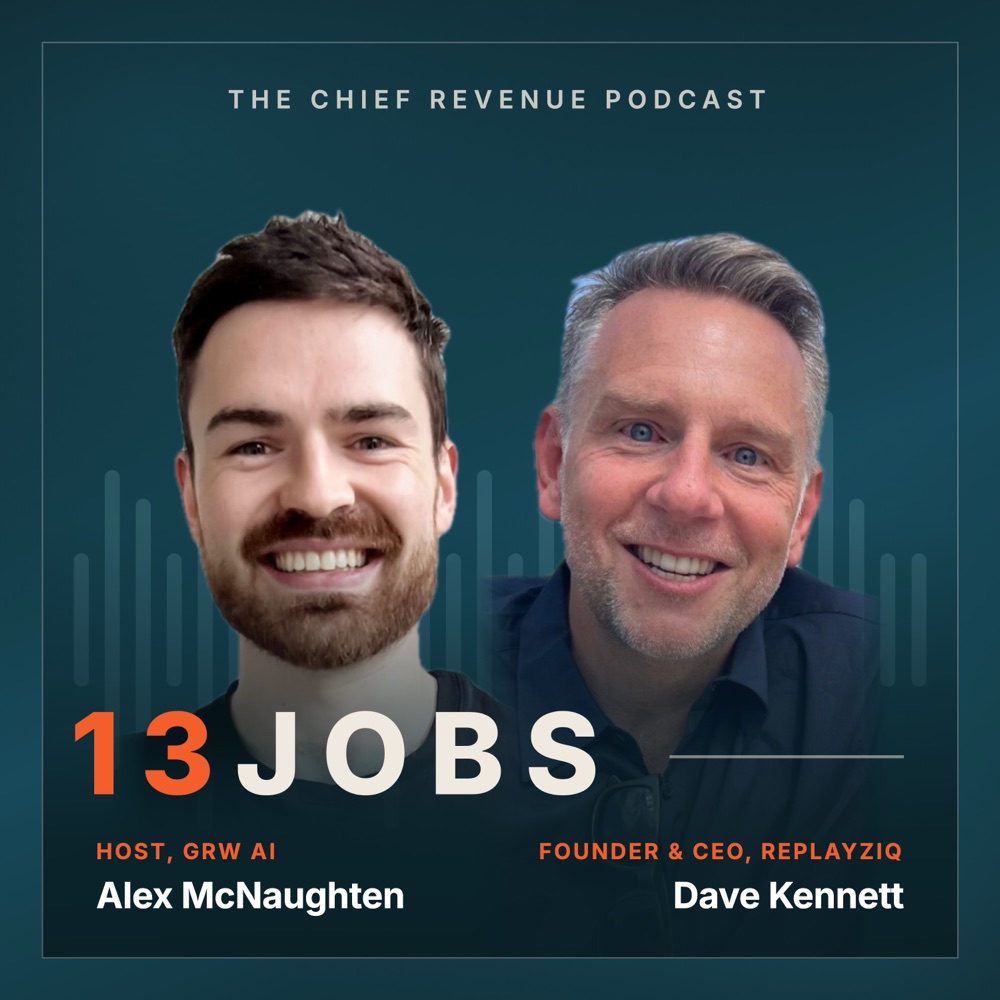
 Hosted by Alex McNaughten
Dave Kennett · Founder & CEO, ReplayzIQ
Dave Kennett is the founder and CEO of ReplayzIQ, call intelligence software that scores sales calls automatically and tells leaders where each rep needs to improve.
He spent much of his career in SaaS sales leadership before starting the company five years ago. It began as a human coaching business with a bench of coaches reviewing calls for software companies, then became a platform trained on that labelled data so the same review could run at scale.
In this episode, we discuss:
- The Friday feeling of all the calls nobody listened to
- What coaching is, and when straight talk beats another question
- The real problem: feedback conversations barely happen at all
- Not making the time, or genuinely not having it
- One coached call per rep per week, and what is actually realistic
- The air fryer analogy, and platforms quietly collecting dust
- The unofficial pact you make with every rep you hire
- Coaching the thing you assumed was the important thing
- Asking whether those five or six skills correlate with anything
- The one behaviour that lifted a win rate, which no human had spotted
- When doing something well correlates with the deal not moving
- Learn the objections, learn the product, then go and do it badly
Quote of the show
“They just don't make the time is one way to put it. The other way to put it is they just don't have the time.”
Key takeaways
- Space beats technique. Most leaders believe in coaching and still do not do it. Whatever gets said in a session you actually hold beats the perfect session you never book.
- Not making time and not having time are different problems. One is a priority question, the other is a workload question. Leaders tend to describe the first and mean the second, and the fixes are not the same.
- One coached call per rep per week is the target, and almost nobody hits it. The realistic version is team coaching: everyone together on a Friday, working through one rep's call at a time.
- A platform nobody opens is not an investment. Call recording only pays back where an enablement team or a leader has the hours to mine it. Otherwise it is an expensive archive.
- Check that the skill you are coaching correlates with something. Teams pick a focus for the month from instinct or a post they read, then coach it for a quarter without ever testing it against deal progression.
- Some good behaviours correlate with losing. Across fifty SDRs, a skill they scored well on turned out to stall deals. They were selling the product when the job on that call was selling the meeting.
- Make coached calls a number you track. How many calls each manager coaches per week is a KPI a CRO can actually hold someone to, unlike a belief in coaching.
Transcript
Dave, thanks for coming on the show. How you doing today?
Great. Thanks, Alex. Great to be here.
Really good to have you. So for those of you listeners who don't know Dave, Dave is the founder of Replays. But Dave, tell us a little bit about yourself.
Yeah, for sure. Well, I'm first and foremost been passionate about sales my whole career and spent a good chunk of that career in sales leadership. And specifically in SaaS. And we started this company 5 years ago with a mission to support companies, support sales leaders and sales reps in streamlining coaching as well as just helping people take the art and the science of sales more seriously.
I think everyone wants to do that, but it's like, how do you do that? How do you do it effectively? And how do you do it in a scalable way? And I think that's what ReplaysIQ has been working really hard to bring to market.
That's really cool. And Dave, for the listeners who haven't come across Replays before, just tell us a little bit about what Replays does and I suppose the core problem you're solving.
Yeah, for sure. Well, probably helps to talk about what, you know, why and how we started, you know, as a sales leader myself, we would be using, you know, Gong and there'd just be hours and hours of calls that went unlistened to from our sales reps. And for any of the sales leaders listening, I know there's lots of sales leaders listening to this that probably can identify with that guilty feeling that I used to have, which is it'd be Friday, end of day and I was like, oh man, we were gonna review a bunch more calls than we actually did this week.
And you kind of feel like you're letting your team down a little because of the way that you're pulled in a million different directions. And so our solution to that was originally 5 years ago standing up a team of coaches that would just dive into Gong and Chorus instances for, you know, top software companies, whether it be IBM or Outreach or Vidyard, longstanding great customers of ours.
And we would help them improve their sales process, their discovery, their demo, as well as for SDRs and BDRs with their cold calls. And What we found was patterns and with those patterns, we turn them into best practices and we call them the Replays Best Practices, like 100. And I really do not want this to be a plug for Replays.
I'm just kind of, you asked about the origin story. So there's a certain amount of that in there.
Yeah.
But like we found that there were definitely common patterns to success as you would imagine. So we created this online library of replays, best practices that we would coach to. And then about a year and a half ago, we're like, yeah, there's gotta be a more scalable option to this. And that's when we're like, you know, there really is like, why can't you just push a button in any part of your tech stack and have it just review sales calls at scale and tell you exactly how everyone did on their sales calls that day, where they need to improve, creating auto snippets of, you know, the highlights of the best skills.
When you roll out a new sales methodology or new initiative, we all know that feeling of like, okay, we just spent a ton of money on this and we're gonna try and reinforce it, but is it really being adopted by the team? And so we set out to build a B2B, a platform for B2B sales organizations that does just that.
And that's what we created. It's called ReplaysIQ.
It's super cool. And Dave, I think I and many other sales leaders who will be listening to this will definitely resonate with that problem of I'd love to listen to all these calls, but it's now a Friday and I haven't got anywhere near through them. So totally get it. And that was one of the reasons I really wanted to talk to you today because I love what you're doing.
But the topic we're gonna actually riff on today is coaching. And I think there's a fair amount of misunderstanding around coaching. I think in general, well, the data would suggest that it's not being done anywhere near enough with 70% of salespeople not getting sales training or regular sales training. But yeah, maybe let's start with like, what is coaching to you?
And sort of start unpacking it from there. Sure.
I think that's, you know, of course, there's the textbook definition of coaching where you're, and I'm not sure that this is the way I always think about it, quite frankly. But, you know, where you're in any context, whether it's sales or whether, you know, how there's life coaches out there and mentors and stuff, it's helping the person arrive at the answer, you know, by being a good thinking partner, a good coach.
But not telling them the answer. So to me, as a sales leader, you don't always have the space for those nice, neat, tidy coaching conversations where it's like, okay, let's just hypothesize for half an hour together and see if we can arrive at where you need to be. That would be great and that would be perfect.
But to me, when I think of the best sales coaches that I've worked with, They definitely do some of that, but they also give straight talk. They also give feedback. They also create space for, hey, let's listen to where this went well. Let's listen to where it could be improved. Let's get your take on why you think it can be improved and if you agree, disagree.
And then let's talk about what great looks like. And then now let's talk about how we get you there. Is it in the form of role plays and homework and all this other stuff? So it's a broad Term coaching to try and define, but those are some of the ways I think about it.
Yeah, I like that. And I think where you started there around this like reflexive idea of coaching, which is not immediately jumping straight to the answer. I think there are times, like you said, where straight talk is needed, but a lot of coaching is actually helping someone think through something for themselves and kind of get to that, yeah, help them get there without just spoon-feeding them.
I think that's sometimes where, sometimes that's, I'd say that's the biggest bit that's missing from a lot of like observing how a lot of sales leaders and salespeople are getting coached. Do you agree with that? And if so, why do you think that is?
Well, I think, I actually think the biggest problem is there just isn't, there aren't feedback conversations that are happening enough in general in sales organizations. I don't think I think the intentions there by the sales leader, and by the way, like including myself in this, right? As I have been sales leader at various organizations, I would never give myself an A+ for carving out enough time to do that.
So first and foremost, I think for the folks who are listening, who like are listening to us discuss how to coach, I think just create space to coach and whatever you say there is probably more than likely anyway, gonna be better than not having created that space to just give feedback. So to me, the biggest problem in coaching in SaaS sales right now is it just doesn't happen.
And it's a broad—.
Why do you think that is, Dave? Sorry to cut you off, but why do you think that is? Because I think I agree with that premise, but what's stopping sales leaders from coaching right now?
Well, that's the irony is that many of the leaders I, we work with who I have a lot of respect for are deep believers in coaching and they just don't make the time is one way to put it. The other way to put it is they just don't have the time. And, you know, we've, you've been there, I've been there.
It's tough, right? When you're getting pulled a million different directions to be on calls and I think also being on calls and And then coaching afterwards or letting your team see you in action sometimes, not going in to save the deal all the time necessarily, but certainly having your team build that level of respect because they've seen you do it.
That's in my opinion very important as well. But I think it's just from management meetings to getting reports out to being on sales calls to just the stuff that's involved in your day-to-day As a sales leader, it's just tough to create the space.
So how, how I'm a busy sales leader, how much time should I be dedicated to coaching? And how would you like, what advice would you have for me to help start to create that space? Like, what have you seen work?
Well, we've seen that, let's start with what would be ideal. I think what we've seen work the best is one coaching conversation per rep per call per week at a minimum. And I would venture to guess that happens in less than 5% of sales organizations. And guess what? I didn't ever achieve that when I was a sales leader.
So if we're gonna sit here and say what's ideal, we can't really have that conversation without saying what's realistic. And I think what's realistic, you know, we see a lot of team coaching going on, which I think is really good, where on a Friday everyone will get together and each week they'll choose a call from a different rep and everyone will, you know, team coach.
And I think that's, you know, important or asking the sales rep to dive in there themselves, pick a call per week, do some self-coaching and then send it along to their leader. But I think we also can't ignore the importance of technology. And I think there's, I think a company, you know, I see this all the time where leaders will quote unquote buy Gong or Chorus or what have you and they'll be like, okay, we're now a coaching company and this is gonna be great.
But then 90% of the actual functionality of that platform, it gets dusty, it gets cobwebs, it never gets used. And so the question that we spend a lot of time thinking about before we built ReplaysIQ is why isn't the current tech stack that's available to sales leaders being maximized? Because it was billed as this big time saver.
And by the way, Yeah. Deep respect for the companies I've just talked about, huge respect for them. And but why is it that, you know, actually, I'll give you an example. We got this air fryer about a year ago in our kitchen and actually a year and a half ago. And first week I used it a ton and then really didn't use it after that.
And we were so excited about like, oh, we're gonna make fries and all this other stuff. And then about a couple months ago, my son said, hey, why don't you get a Ninja air fryer? Because I see our grandparents have that and they use it all the time. Like, why would a Ninja air fryer make a difference?
We have an air fryer already we don't use. He's like, just trust me.
Yeah.
We use it all. So anyway, for his birthday, it's a funny thing to get for your kid, but I got him an air fryer. It's a Ninja air fryer. We gave away our other one and we use this thing for like 2 meals a day. So they're both air fryers.
What's different?
And the analogy—.
Okay.
It's just more usable. It's more functional. Whoever created the Ninja air fryer had a lot of busy families in mind because they're like, you just put the thing in, it tells you when it's done and it's done. Whereas a lot of air fryers do not work that way, even for cleaning and all that other stuff.
And I would really draw that analogy to, and sorry, probably not my best analogy. I just thought of it as we're talking, but like, you know, to the established conversational intelligence platforms out there that unfortunately people are paying $125 per user per month for and a large license fee and they're collecting dust, not in all cases, but in a lot of cases.
So ReplaysIQ was a solution to that. You click a button, you get calls scored. You click a button, you see highlight reels. You click a button, it tells you why you win deals at your company. And again, this is not meant to be an ad for what we're doing, but you asked me like, what do I think the solution is?
And I know it's a long answer, but I think it's part human and I think it's part tech. And I think it's the kind of tech you use that is gonna be really important.
Yeah, I think what you've just said there really lands with me because I've seen that same behavior where organizations invest heavily in some of the, I guess, more established, longer-standing players. And, and they're great platforms. Like, I agree, like, they're fantastic platforms. I think one of the limitations though is that unless you have— something I've noticed is unless you have an enablement team who's like poring over the calls and able to like invest the man hours, or you've got sales leaders who can find and create the time to do it.
You're right, it does sort of— they're not being maximized. That investment in that platform is not being maximized. And, you know, and I think it, you know, I agree with the second part of what you said there where the solution is part human, part tech. And, you know, I think that's the beauty of the, you know, the, I suppose, you know, AI revolution, whatever you wanna call it we're going through now, is that there will There's all this time compression going on and that's happening all across the running of a sales function, running and output of a sales function.
And that's really exciting. And I think that can create the space for more coaching, which is exciting for me because I've always felt that salespeople get a pretty raw deal where there's no pathway. You're kind of thrown in, here's a phone, good luck, sink or swim. And I know not every organization is like that, but that's certainly my experience and a lot of people's experience coming up in sales.
So yeah, it gets me quite excited that I think coaching is getting easier.
Yeah, absolutely. Because I, you know, we do have this unofficial pact that when a sales leader brings a sales rep onto the team that, hey, gonna help you get not only better at your current job, but help position you for that next position, whether it's junior AE to senior AE or AE to team lead or what have you.
And we're not all born with the playbook on how to coach well either, which is a challenge. I was not. There's a lot of hard knocks I've had over the years for sure in terms of, man, I could have done that better, could have handled that situation better. And I've been that person who's hired the person and said, here's your phone and here's your computer and away you go.
And, you know, I learned from those things. I feel bad about those things. But those are the realities we deal with when we're in a high-scale situation or when the macro is what it is right now and companies are really struggling and you've got, you know, rep to leader ratio of, you know, 10 to 15 to 1.
it's very challenging in that scenario as well. So yeah, I think it's good to have tech to help out, but I think it's also important to define what great looks like. And, you know, that's challenge number one because if you're gonna coach to something, what are you coaching to? And, you know, I think that's a challenge in any organization.
And I think the next thing is Yeah, we all know things. There are certain universal truths in sales and that's why you take the Venn diagram of all the different sales methodologies and we all, you know, I think kind of agree that they're all kind of doing the same thing, right? But the, you know, discovery extremely important.
If you don't do that well, you're probably not gonna win a lot of the time versus the person. But then I think it's about, all right, what are the actual things at your company for your buyer in their buyer journey and given their persona that are super important in the sales process that are bespoke to actually your methodology and how it's applied at your company versus 10 other companies out there.
And so I think that's another nuance that is really important to contemplate as you're preparing your your roadmap to success? What does our playbook, ideal playbook look like?
For sure. And I think that playbooks need to be thought through carefully and updated regularly. It should be a living document, not just like a once in time, oh, here's our playbook from 7 years ago. Like it should be continually improved and iterated. Something we spoke about a little bit before the— before we clicked recording, and it was surprises that the data has shown.
You know, the data you've been collecting on this. Let's talk a little bit about that. What are some of the surprising things that you've seen and learned from the data?
It's been fascinating, you know, to have the gift of being able to be a sales leader who's, you know, co-created this product for sales leaders, we get to see it in action and have certain like surprises that come up and there's been a few. So, you know, one is the thing that you think is important in your organization to coach on.
And by the way, like this applies to me as well for sure. So I'm not pointing like, you know, I definitely in the past have assumed, okay, this month we're gonna focus on uncovering pain and second-level pain because that's the most important thing. Well, why is that the most important thing? Is it because that's what a thought leader on LinkedIn said that week?
Is it because, well, yeah, we all know that's a universal truth? Or is it because that's the thing in our buyer journey that our sales reps empirically we've found have to do to really win that deal over. And so to make this more, I think, tangible, it's when we review, you look at the certification programs, right?
Which I think is amazing. We talk to leaders all the time who are like, oh, we're trying to put this, you know, certification program together where it's these 10 skills the sales reps have to be great at. And it's for the first half of this year and we're gonna have them do role plays by the end of it or review their calls and that's how they get certified.
And my question to them, my first question all the time is, how did you— I'm fascinated by this. How did you arrive at those 10 skills? I mean, there's hundreds of skills. There's over 150 skills Replays IQ measures and that happen in even just a 30-minute sales call. So how did you land on 10?
Is it because of a book you read? Is it because you were a sales rep before? Hopefully you were. And this is the thing you think is the most important. And so what we found happened, I had a really interesting conversation recently with someone I've grown to do well. I talked to them first about 6 months ago.
When I say recently, I've grown to really respect where they're coming from. They're a sales enablement leader. They had over 100 reps in their sales organization. And this person listened to sales calls for half of their time for a whole year. Imagine like half of your available hours in a week listening to sales calls and the goal was to score all of those calls and then come up with the list of things that the team needs to certify on and establish what great looks like and all that.
That sounds like a very logical process. It sounds like also that I would feel that maybe that's too much time reviewing calls, but still.
Sure.
I really respect it. It's like, good on you. You're gonna have some really good data. I said, okay, well, what did you learn? And they said, well, we learned that our team was good at these 5 things, but that these 6 things they're not good at. I said, okay, so what? And they're like, well, the so what is that's what we're coaching on in the next few months is these like 5 or 6 things.
Like, okay, but how do you know those 5 or 6 things are the most important things? Like if it's, you know, having a really good upfront contract and agenda, do you really know that there's a correlation and causation between deal stage progression and a sales rep that you're not very well? They're like, well, no, I don't know that.
And they're like, how am I supposed to know that? I'm like, exactly, none of us can know that. There's no tech out there that does that for you. If you had a data scientist next to you and you reviewed calls all day, every day and you scored them perfectly, then maybe you'd have that data.
And so that also was very confirming about what we built because what I'm excited to share with you and folks listening right now is just what the insights that we were able to glean when you have machines. We have machines that score calls at an error rate that's 5 to 7 times better than humans.
So first of all, we're scoring 150 things per call. We then customize those things based on your company. So We train our machines for 3 to 6 weeks first to learn about your methodology. But then we look at a ReplaceIQ, looks at a cohort of calls that move forward to the next stage and a cohort of calls that did not move forward and weren't successful and then scores all of those and it analyzes through this algorithm we built called the Crucial Skills Algorithm.
It extracts what are the key things at your company that leads to deal stage progression. You know what we found? Is that the top reps didn't always do the obvious things. So we had a couple of the top reps that by leaderboard, our customer would say, yeah, we expect, you know, Jane to be the top rep for sure and top scored rep.
And we assign sort of a 360-degree scorecard and training plan, enablement plan to support that rep. Like, turns out reps really like this because they're competitive and they want to know how to get better. And what we found is that their top rep in this instance, and we've seen this multiple times since then, scored, I don't know, let's call it a 60 out of 100 on their general sales IQ when you average out 150 things.
But what we, what ReplaysIQ found when we actually did the deep analysis of why is this person winning deals, why are their top reps winning deals, that person had to be a 3.5 out of 4 when presenting pricing. The rest of their team was not. But it's that one skill at that one company in that one sales stage that was analyzed where you can kind of mail it in for the rest of the call.
But if you don't, if you do that part right, delivering pricing, a 3.5 out of 4, and there's, you know, 3 or 4 ways we define that, etc., then you're gonna crush it. And so guess what? They trained their team not on the 15 things that the team scored the lowest on because those are head fakes, right?
Yeah.
They trained their team on that one thing that ReplaysIQ picked up, which, you know, I could sit there and view 1,000 calls and never have picked that up. And sure enough, their win rate improved dramatically. And so I think the meta point here is for us not to make assumptions that that thing that the sales thought leader on LinkedIn said is the thing I should be focusing on for the next 30 days.
Yeah.
Try and deeply understand what is the thing that matters. This is what we see. And don't get me wrong, you don't need— I'm not suggesting everyone run out there and get sales tech to do this. If you're very intentional and very thoughtful about what you're looking for, then there's ways to triangulate this on your own.
But I would encourage the folks listening to think deeply about that.
That's fascinating. And, and I suppose like intuitively it makes a lot of sense because some of the best salespeople I've had the pleasure to work with did not follow the rules per se. Like they, they, and, and if you were kind of casually observing, you'd think they were just getting by on maybe like charisma or something.
But then you're, you know, what you've just explained there is that actually they were probably just doing one one thing or a couple of things really well that was increasing their success rates so much more. And that it's easy to miss those things unless you're actually deliberately looking for like, what behaviors is this person consistently doing?
And because you can get caught up in the noise of, oh, they didn't send upfront contract, that's weird. Like, I'd have thought that was important. Or, oh, they didn't ask the discovery questions. About that thing or whatever it might be. So yeah, that's fascinating, Dave. That's a really interesting insight.
Yeah, absolutely. And would you believe we've had instances where when a rep does something very well, it has a correlation to the deal not moving forward? And when we unearth that, we're like, okay, wait, is there something wrong with our system? Like, what's going on here? And we have a team of PhDs, so we threw them on it.
They're like, no, it's correct. And sure enough, when We took some sales leaders on our team and threw them on it. They're like, oh, this makes sense. It was, and you'll probably, I'm sure this will make a ton of sense to you right when you hear it. It was an SDR team and there's 50 SDRs we were scoring and, you know, there's a handful of them that would, our system said when you do a really good job at differentiating your product relative to others, you're less likely to get a past lead.
And then when we dug into it, we're like, oh wait, these are the sales reps that are over popping the popcorn. I heard that term recently and I love it. They're the SDRs who are also trying to do the AE job, right? They're not just generating curiosity and then passing the lead. And instead of, you know, saying to the person who's asking about the differentiators, that's an excellent question.
I've got someone lined up to talk to you who's way better positioned to talk about this than I am. Can I schedule a time with you guys sometime this week? They'd be like, oh, let me walk you through it. And then the person would make a, like the prospect would just be like, oh yeah, not for me.
And the SDR hasn't been trained on how to actually overcome that objection and because it's not there, right? So it's interesting how we found examples both ways.
Yeah, that's fascinating as well. But again, intuitively makes sense. Sell the meeting, not the thing on the first touchpoint. Um, Dave, is there anything else, anything else you want to share? This has been a fascinating conversation and I could probably pick your brain on this stuff just out of professional curiosity for the next hour.
But is there anything else that you really want the, the audience to, to know or that you want to share with them?
I mean, I don't think so. I think if, um, you know, we all struggle every single day to try and get, um, those key priorities taken care of. And I think as an industry, as a sales collective, we're all trying to do a better job on the coaching side. And I think for vice presidents and CROs, it's like, hey, you know, just make sure that that is a KPI you're tracking, which is how many calls are being coached by sales managers per week.
Sales manager, you know, how are you doing at that unofficial pact that you're making with your sales rep? On really helping them get to that next step. And then from a, you know, I think it's just about building space and doing the work. And ultimately, role plays are also just a fantastic way to get that done.
And there are any listeners who are leading a sales organization and you haven't installed role plays into the fabric of your organization, I would highly recommend checking that out because That, that's, this just comes with having worked very closely with many top-tier SaaS organizations on their enablement plans and those that do that work get it done.
So yeah, those would be my closing thoughts.
Yeah, look, role plays are sort of universally hated, I would say, and initially there's sort of this aversion to them, but they're one of the most effective ways, I would say, and quite an easy thing to roll out into across the team to drive improvement. Dave, I've got one last question for you, which is knowing everything you know today, go back to your first day on the job in sales.
What's the kind of the one tip or one thing you could bring back with you that would have changed the game?
I think it's 2 things. It's learn all the key objections. There's 3 things. Learn all the key objections and just exercised those muscles in the form of talking in front of a mirror or role playing with your buddies in the sales pit or remotely via Zoom. And also the product, you lose credibility very quickly if you can't have a basic level of knowledge of the product paired with customer stories.
That makes up— customer stories makes up for a lot, a lot, a lot of being green in a new industry or what have you. So Having some really good customer stories to share. And then I think also not being afraid to just go out and do it. Your first 10 to 15 calls are gonna suck anyway.
So just get them over with.
Get them done. I love it, Dave. This has been a fascinating conversation. I'm really glad we were able to make this happen. Where can listeners find you, connect with you? Where are the best places?
Oh, please, you know, hit me up on LinkedIn. I'd love to hear from you and certainly on our website, replaysiq.com.
Brilliant, Dave. Thank you. Thanks for your time and we'll speak to you again soon.
Awesome. Thank you, Alex. Enjoy the chat.