
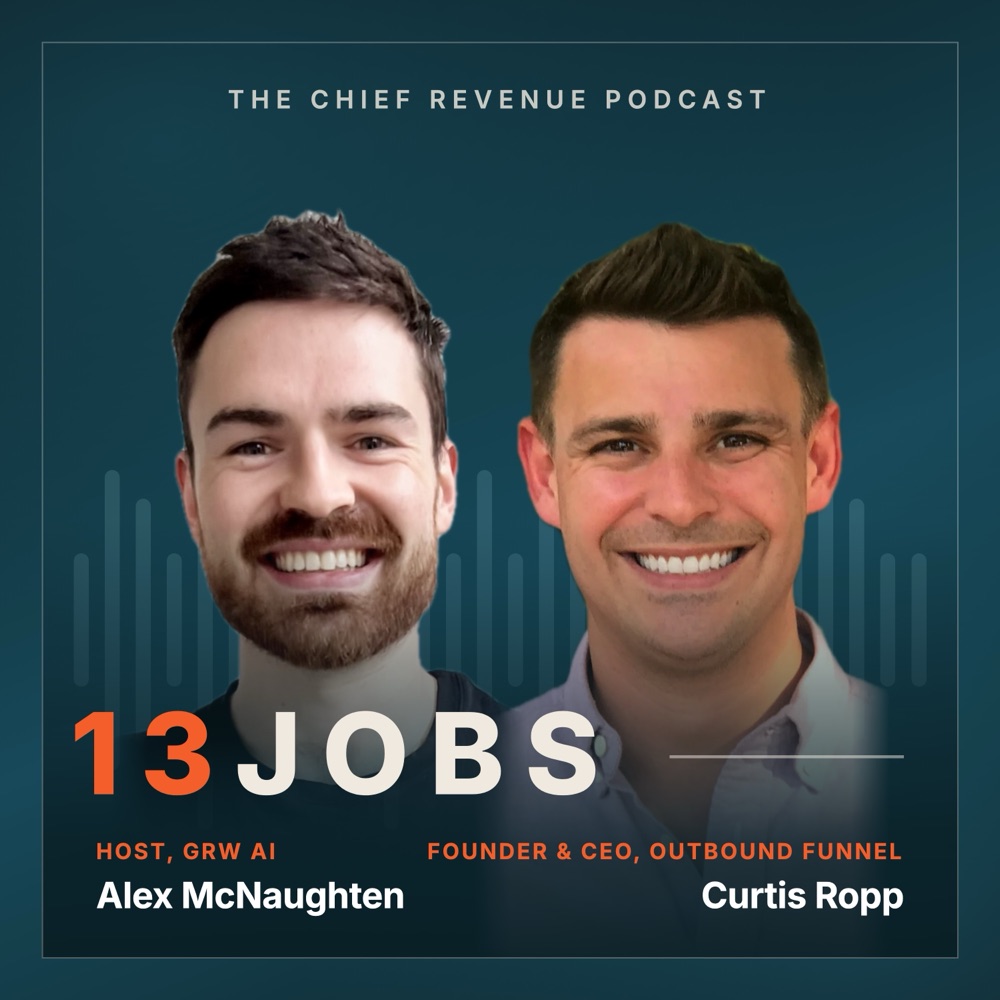
Your tech stack should be a circle, not a stack
Volume used to cover for bad outbound. Curtis on what stopped working, and what a revenue stack that feeds itself actually looks like.
 Hosted by Alex McNaughten
Curtis Ropp · Founder & CEO, Outbound Funnel
Curtis Ropp is the founder and CEO of Outbound Funnel, a RevOps consultancy that builds and implements revenue tech stacks across the ecosystem, from Intercom at the front through Outreach, Salesloft, Gong and Drift to Gainsight at the back.
Outbound Funnel is a top implementation and professional services partner for several of those platforms, with a team of military veterans and multi-platform certified consultants.
He describes falling into sales through failure rather than ambition, and says the only reason he ended up leading anything is that he was unemployable.
In this episode, we discuss:
- What Outbound Funnel does, and where it sits in the RevOps ecosystem
- Falling into sales through failure, and being unemployable
- Maturity and consolidation, and why the 2015 playbook stopped working
- When bad behaviour was still rewarded, and the jump from college to pro
- Budget moving, and CMOs stepping into seats sales used to own
- The line between a platform and a feature
- Whoever owns the first and last hour of a rep's day wins
- The stack as a closed circle that feeds itself
- Designing the whole thing back from the customer's experience
- What generative AI is actually changing about content
- Where AI earns its keep: patterns across ten thousand campaigns
- Hold on to your curiosity
Quote of the show
“Wherever that person goes to start their day and finish their day is the winning software.”
Key takeaways
- The bar moved, and the tools did not move it. Knowing your customer, being relevant, getting the timing right: those always worked. What changed is that volume no longer covers for doing them badly.
- College to pro, not a different sport. Same game, better equipment, far better execution. You can still compete, but you cannot loft one in and hope it lands.
- Platform beats feature. Companies built on a single feature are being absorbed. Whoever owns where the rep starts and ends their day is the one winning the category.
- The budget moved before the buyer did. Sales budget is earmarked for headcount, not foundational tooling. That is why CMOs and CROs are now sitting in seats a VP of Sales used to own.
- Build a circle, not a stack. Intent data triggers outreach, outreach triggers a call, the call feeds onboarding, onboarding feeds renewal, renewal feeds back in. If it does not close on itself it is not a system.
- Design each step from the customer's side. Ask what every step actually does for them. Where a step is deliberately unhelpful, know why, because that is usually a decision nobody made on purpose.
- AI earns its keep on patterns, not prose. Generating content is the obvious use and the least interesting one. The value is reading ten thousand campaigns and surfacing the common thread.
Transcript
Curtis, good to have you on the show. Thanks for joining me.
Thanks for having me. This is great, Alex.
So for those who don't know Curtis, you are the Chief Executive Officer at Outbound Funnel, but please tell me what's Outbound Funnel all about and tell me how you came to be.
Yeah, so I'm the CEO and founder of Outbound Funnel. We are a RevOps consultancy. We work with partners like Outreach, Gong, Salesloft, Drift, Intercom, and a couple of others that will help you kind of get a little bit more of a full competency rev stack. So think we're gonna start with Intercom and we're gonna end at that customer success with Gainsight.
We play right in that ecosystem. Gotcha.
Really cool. And how did you fall into the world of sales? And I use the term fall because I feel like most people don't choose it. We kind of just blink and we're here.
Fall is a good word. And I like it because I think it really, I got here through failure. So like it really was fall. So I didn't really know what to do in life and it was a path that kept finding me and openings were really the only things that were available there.
I laugh with people when they say, why are you an entrepreneur? Like, oh, you must have had this you know, drive inside. And really the simple answer was I was unemployable. So leadership found me. It was the only door that was open was this one, and there was nothing behind it. I had to figure out how to build, um, you know, what my vision was from after opening that door.
But that's, that's the simple answer of how I fell into it.
That's awesome.
I love it.
Unemployable. Um, and today we are going to talk about And I liked how you phrased this, reevaluating the vision of your revenue tech stack. So let's maybe just unpack that. Like, what do you mean by that?
Yeah, I think, you know, the rev stack now has gotten pretty large and you're starting to see some maturity on platforms. There's adding functionality, there's some consolidation. You saw Drift that just got acquired by Salesloft. So what, knowing what we know now, the past 6, 8 years of how these kind of tools work and how they've been refined in the marketplace, what are we trying to do with them today?
And I think it's different. You know, what was working in 2015 and 2016 is not the same thing. I know that these sales enablement platforms wish that was the case.
Mm-hmm.
But that's, that's not how it works. And the insights and available knowledge and things like sixth sense that bring to the table weren't really in the mature model. And you still have new things like AI that's coming into the play and how is that going to be leveraged. And one of the biggest drivers for, you know, an SEP would be content.
And with ChatGPT and being able to have AI-generated content and have bots that can scrub for, you know, recent news articles and things like that, we have a customer right now that's leveraging some of those tools where it scans for certain news that's pertinent to their business. And there's a part in their sequence that allows for this bot to basically curate something that's happened within the last 5 days.
Let's say it's a hack in the UnitedHealthcare, you know, security system. Well, that's really important for this security software. That's relevant, it's curated, it's already done, it's presented to the rep so that way they can actually do a final human scan, but it's preloaded. So now knowing what we have available, how are we recreating that vision of what these tools do?
And, you know, what does that mean for the future?
Really interesting. What do you think is the big thing that's changed? Like if you had to summarize like what's changed outside, outside, I think the obvious, which is there's been some technological advancement and, you know, AI has has been a big one. But like, yeah, how would you describe the change of like what's working, what was working in 2015, 2016 versus what's working today?
I think that's easier to answer what's not working than worked because what's working then is like the good stuff always works, right? Knowing your customer, making sure that you're relevant, your timing, All of that kind of stuff always works.
Yeah.
What we got away with, I think, with this new technology and the reach that these technologies were allowing us to have was bad behavior was still reported. So whether that was throwing really poor campaigns or claiming personalization when it just wasn't, the volume was so high and your hits rates were so high that you could be bad at it.
And still be rewarded. That doesn't work today. You have to be good at what it is. You know, I played college athletics, and the difference between going from college to the pros is a fairly sizable delta. And that's what we're kind of going into, in my opinion, is you're gonna look at it and go, oh, now, now we're professionalizing this.
Mm-hmm.
This isn't someone that's running a side campaign and trying to have you know, new content that's written off, you know, off, I guess, base. Let's just say that. Um, and it's being pushed to anybody and everybody that we've curated these lists or curated. That's not gonna work anymore. You have to have intention.
You have to have intent on what's going down with your, you know, sequences and with your actions. And you have to look at these things full picture. It's not just getting them in the door, but how do you leverage these tools to do renewals? How do you look at expansions? How are you looking at these?
I think originally, at least where we played, a lot of this was, I think, earmarked or heavily focused on the early side, the SDR side. But the reality is these tools aren't SDR tools, they're relationship management tools, right? You've got Salesforce, you've got HubSpots and things like that. That's, that's your index. That's, that's where everything needs to live.
That's, that's your truth. These tools aren't a tool like that. They're a system of action. So everyone in every department needs a system of action, whatever you want to call. This is a revenue-focused system of action, but from SDR to AE to customer success to customer renewals, you have to have a vision of how you leverage the tool, or quite frankly, there's not enough budget in people's budgets today for a lot of these things.
So, you know, that's, that's where I see what's not working has to change. And what has worked in the past, people that are doing this already from the beginning, they're just crushing it still because the tools just got better, right?
Yes.
It's really, it's more an improvement. Same thing with my experience from an athletic standpoint. The pros, they have better equipment, they have better nutrition. They've, they're just better at it. They're doing it so much better. It's amazing to watch. They see things that are real time to us slowly, and that's not going to go away anytime soon.
But you can leverage the tool— the tools to get better and maybe be a little bit more competitive at that range. You just can't— you can't just throw it in there and loft it and think, hey, it's gonna hit.
Yeah, I think that's a good way of explaining it, is like the bar has just been raised in terms of what is not acceptable. Like we could get away with pretty bad behavior in 2016, 2017, even right the way through to like 2020. There was still some pretty— like, we just look at outreach, for example, there was some pretty bad behavior.
There was bad behavior going on that was still being rewarded. But then now you can't get away with it like you used to be able to. You talked about sales enablement as well. When— what do you think's changed in that sense? Like, I, I'm might have been when we were first, before we started recording actually.
What do you think is changing in that world and with the technology stack there? Like what are you seeing in that part of the business?
I think there's a lot of consolidation. We touched on Salesloft and Drift. I think you're gonna start to see that the functionality of those tools cross departments, right? Where a lot of an Outreach buyer, a Salesloft buyer would have been maybe a sales leader. You're starting to see more CMOs be in those seats and looking at it from like, oh, maybe it's actually a CRO position because they are touching multiple departments.
One of the biggest things we saw over the last 6 months, 9 months was really budget and whose budget it was gonna come out of as they reallocated it. Sales generally have a pretty sizable budget, but it's earmarked for other things.
Yeah.
For the tooling or the services necessary to build out those larger, more automated, more robust foundational tech stacks. That's not what the sales budget's for.
No.
So a CMO coming in and stepping into that ownership seat and them demanding more value out of those tools, that's why I think you see Drift and Salesloft being a really good pairing because it was a CMO owner that was in that Drift kind of ownership. It is a natural progression, especially with forecast and a couple of other tools that they're introducing.
So that's what we're seeing right now in Salesman is kind of cross-function, cross-budget.
Right. Interesting. So we're seeing this kind of divide of like marketing tech and sales tech kind of finally coming down aligned to actually how a lot of these orgs are run with revenue ownership of the whole thing. That seems to me intuitively to be a good thing and not having this, you know, kind of wall between marketing and sales.
What other, in terms of consolidation, like what else are you seeing? What other kind of themes on the consolidation front are you seeing right now?
Well, I think we're starting to see the difference between a platform and a feature.
Okay.
And the companies that have stood on a feature are being absorbed by platform-focused companies, right? The ones that are winning are who's owning that person in seat's time the most. So whether that's a sales rep or, you know, a sales engineer, whoever's whoever's got that seat, if they're actually spending the most time in the platform, that company's winning.
So, you know, we have other things that may be plugging into it. Maybe you're bouncing from one platform to the other, but wherever that person goes to start their day and finish their day is the winning software.
Gotcha. Who do you think is doing a really good job with that right now?
Ooh, I think Outreach does a great job at it.
Right.
I think Gong does an incredible job at it. I think that maybe are using it differently. I think historically Gong, you might be going there for coaching. Maybe you're going there from like a retroactive standpoint, whereas outreach, you're spending a lot of time there as a productive standpoint. I'm trying to outreach. I'm trying to go out for things.
I'm looking for net new. Here's my activities that I have to be in. I think a lot of people are spending more time in that space there.
Yeah, what you said around the platform, sorry, the companies that were more of a feature like, hey, we can help you write a better email or we can help you do this one very specific thing, is they're losing out right now because I think, you know, sales tech stacks were potentially perhaps getting a little bit bloated.
And now, now some of these leaders are looking, well, look, I can do most of that in like 1 or 2 platforms rather than needing 5 or 6. Going back to like where we started, like reevaluating the vision of your revenue tech stack, what does a good vision look like? Do you think, you know, 2024 and beyond, like what's the vision for a great sales tech stack or revenue tech stack, I should say?
Yeah, I mean, I think the vision has to be a closed circle, right?
Okay.
So I'm looking at it, whatever I build as a tech stack, instead of it, you know, being truly a stack, it needs to be a circle. It needs to be feeding itself. So whether that's marketing intelligence or intent data that's coming in that then triggers some kind of automated outreach that then triggers some kind of sequence that then, you know, funnels them to a call that then funnels them to success that then funnels them to an onboarding that then funnels like that all has to feed back from a renewal standpoint.
And I think that that's going to be what the best companies have at Vision is as soon as we target you as a prospect, we know what your full journey and your lifecycle looks like at us, right? There's that lifetime value metric that we really all love to talk about, like what is their experience during that lifetime?
What are those steps? Where are the places where they can fall off and starting to leverage those software that we do have access to To bolster that.
I'm imagining you talk to a lot of revenue leaders. How many, like what kind of percentage of them are thinking about things in that sense versus maybe aren't quite there yet?
I'd say again, I'm probably privileged to a certain select group.
Sure.
These conversations, right, that maybe they're underwater, but they're at least able to breathe enough to even talk. Because a lot of revenue leaders over the last 6 months have not. The ones that I'm talking to, I would say there's a pretty high percentage of it. That's good. And that's really mostly due to because there are new positions.
We at least talk to a lot of new revenue leaders.
Interesting.
And so when they're coming in, it seems to be part of the conversation, whether that's with the board or with their executive team. Of what does that full revenue vision look like. And it's explained and at least worked on through that hiring process. So when we get them, they're extremely excited. They're looking for these things.
So, you know, there's a bit of privilege in that because we see people that come to us that are looking for solutions. They're already eager to learn.
Yeah, look, that makes sense. I think depending on someone's experience probably over the last 12 months also determines whether they actually have the bandwidth to be thinking that way, or like you said, they're just kind of treading water right now, or maybe not even. What else, like, in terms of this idea of, like, reevaluating the vision?
So I like this idea of, like, closed loop thinking about the whole customer journey as a collective and focus on, like, that lifetime value piece. What else do you think is in this like vision for a revenue tech stack going forward?
I think the vision has to be focused back on the customer's experience. You know, we're getting smarter as a buyer, we have better access as a buyer. And, you know, the tools should empower us to be able to do more. That was always what intrigued me about sales technology over sales. You know, realistically, I was probably a lazy salesperson because I would try to figure out what they were doing.
And then if I did it once, then I should never have to do it again. That's always been my mindset. Now that when I came on the scene, we didn't have sales automation. So I just like write little steps and checklists and I would just go through those things. But once you get the technology to help you, you can service more people.
And sales and revenue and all this kind of stuff, whatever label you wanna put on it, at the end of the day, from a company standpoint, people trade money for you to solve a problem for them.
Hmm.
You are of service, whether it's a physical service, like we're a physical services businesses. We don't have necessarily a technology that's attached to it. We do the physical build or a technology platform. You're solving something, you're of service. And we try to figure out how to make that part of every single motion.
So if you're gonna look at it from a vision standpoint, how does each step service that customer? It should always be positive. And if it's not positive, why is it intentionally not positive? Because you don't want that behavior, right? Because that happens too. Oh, well, we don't want a self-service model because what we found is that once they get on there, their onboarding experience isn't great.
Mm-hmm.
But if you keep pulling at that thread, you'll find tools that may be able to automate that onboarding experience. And maybe you do need to have a more self-service model so people can try those things out. But the true visionaries that are looking ahead that far ahead are having those kinds of discussions.
What about AI? What's generative AI doing in this whole revenue tech stack space? Like, how's that changing it? Is it changing it?
Oh, it's definitely changing. Yeah, it's for sure changing. It's changing how content is created, how content is distributed. How content is consumed. You know, we, we think of AI as it's always learning, but it's consuming content at a crazy rate.
Yeah.
Which changes how sometimes people write content because we know there's learning generated by AIs out there and you want to maybe influence it in a certain way. So all of those things are definitely coming and are here. From my standpoint, I embrace it. There are certain things that I think are really, really good.
But you should be able to leverage it to take out where human error exists or where we're not great at. Personally, can't spell anything. Spell check, great. Being able to have some kind of AI in content creation from my standpoint, absolutely amazing. But from a storyteller, I don't need AI to help me with storytelling.
I just need to be enabled to be able to get the story out. And I think that's the same thing from services. If you can look at what you're providing, of value and being of service to that customer and leverage AI to get that to the customer and deliver that at a better rate, you're gonna be pretty successful with it.
Is it just in the kind of content creation and distribution, etc., like analysis, like you said, is that, is that the primary use case that revenue leaders are thinking about right now? Or are they, or are they looking at other applications?
Oh, I think they're looking at everything. I think that's a really easy one to pick from.
Yeah.
It's a little bit more public, but I mean, we're using things from, you know, a much broader scale of how people interact with you, being able to see that across all your customers and have AI go in there and say, like, you know, from a content standpoint, don't worry about the actual words on it, but can you analyze 1,000 to 10,000 campaigns, figure out what that common thread is?
That's where AI is really helping. It's not content generation. It's really looking at a much larger data set and being able to pull out some kind of learnings or at least patterns and then stimulating conversation around that.
Yeah, I'm interested to see how it transforms how revenue, how the revenue function operates in the next few years. I think it's happening pretty quickly. I think there's a lot of experimentation right now. But it's gonna be interesting to see like what what really sticks and, and how it changes the shape of the function going forward.
Curtis, I've enjoyed this chat. I've got one more question for you today. Knowing everything you know, go back to your first day on the job. What's the one piece of advice you'd give your younger self or one thing you wish you could take back?
So full disclosure, you did give me this question before, so I had a chance to think about it. And what I started with, I think I've actually come to change. So, okay. I would say looking back, the thing that I would tell my younger self or anyone that's coming in this position was to really make sure you, you hold on to your curiosity.
And where I would make my most missteps is when I found myself the least curious about the next thing and the curiosity of like, well, why does it do this? And then if it does that, could it do this? And then to this, it kept leading me down a path. And I didn't necessarily have an understanding of that.
That was work. My curiosity was forcing me to do work that others may find, you know, not fun. But because it was done in that more childish, more like, this is an adventure, let me consume this passion that came from that curiosity. It was what got me through most of the tough times.
It's awesome.
Appreciate you sharing that. Where can people find you if they want to consume your content, get in touch? Where's the best place to find you?
I'm somewhat active on LinkedIn. I'm pretty terrible on social, to be totally honest, but you can find me, my team at outboundfunnel.com. And, you know, we try to make ourselves somewhat present on the social scene where we can.
Awesome, Curtis. I've enjoyed this conversation. Thank you for coming on the show. And sharing your wisdom with us and look forward to staying in touch.
Thanks, Alex. Appreciate it.