
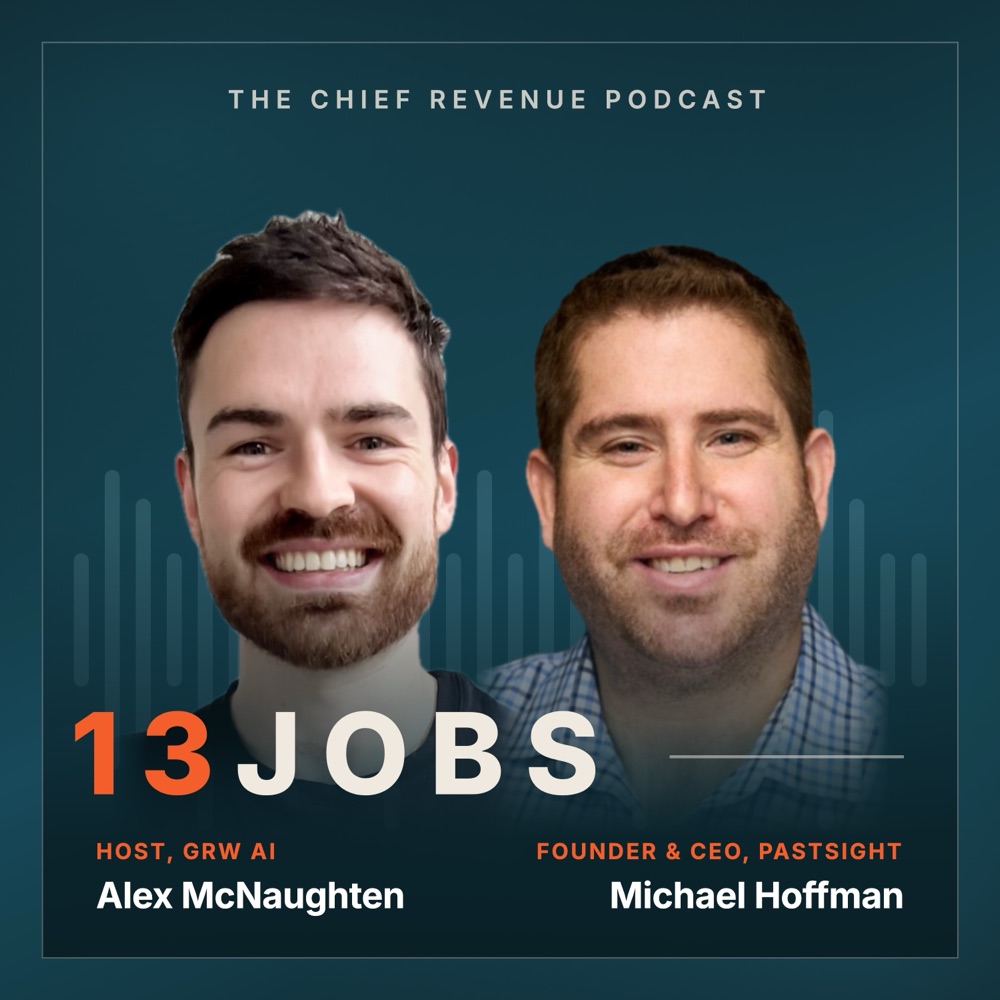
Most win-loss analysis is bullshit
Every company runs win-loss in some form. Michael's argument is that almost all of it rests on data the reps had every reason not to be honest in.
 Hosted by Alex McNaughten
Michael Hoffman · Founder & CEO, PastSight
Michael Hoffman is the founder and CEO of PastSight, a revenue-driven win-loss analysis platform for SaaS companies.
He spent more than twelve years as a revenue leader across various tech companies, running sales, account management and customer success. The problem that followed him through all of it was not knowing why teams lost deals or why customers churned, and knowing some of it was preventable. He started the company around that question.
In this episode, we discuss:
- The win-loss evolution, and where most companies stop
- Picking the loss reason that will not raise eyebrows
- The CEO who grilled reps, and what stopped appearing in the CRM afterwards
- What the deal review still misses, even with call recording
- Why running it internally has never worked, across a thousand companies
- Why it lands on junior people, and why product is the wrong owner
- Pipeline is dearer than ever, so close rates matter more than coverage
- The revenue-driven approach, and the two things leaders actually want
- Roughly a quarter of lost deals are winnable back
- How to re-engage a lost opportunity from scratch
- What good win-loss changes: messaging, enablement, pricing
- Stop competing with your peers and start learning from them
Quote of the show
“You're usually not losing deals because of product, that's just what people tell you to avoid confrontation.”
Key takeaways
- Every company already does win-loss. Most do the version that cannot work. A dropdown in the CRM and a deal review with the rep. One-sided, and that one side has every reason to keep it vague.
- Loss reasons are political, not factual. When a CEO grills reps for losing to a named competitor, that competitor stops appearing in the CRM. The data ends up describing the culture rather than the market.
- Product is rarely why you lost. It is what buyers say to avoid confrontation. Which is also why handing the analysis to product marketing tends to confirm the wrong answer.
- This is not a junior task. Revenue is the lifeblood of the business and why you lose it is a senior question. It gets pushed down because people assume the work is light.
- Ask the programme for pipeline, not just insight. A win-loss effort should return deals as well as findings. Most approaches stop at a report nobody acts on.
- About a quarter of losses are winnable inside a year. Roughly one in ten can come back straight away. The rest need the real reason and an actual nurture plan, not silence.
- Good win-loss data travels further than sales. Top of funnel messaging, enablement, how reps handle competitors and the status quo, and pricing all rest on knowing why buyers really chose.
Transcript
Hoffman, good to have you on the RevUp podcast. How are you doing today?
I'm doing great, Alex. Excited to be here.
Yeah, thank you for coming on. So for those who don't know Michael, CEO and founder of PastSight, but tell us a little bit about your journey and what you're doing now.
Yeah, absolutely. So I've been a revenue leader for the last 12+ years at various tech companies. And the pain point I've always had running sales and account management and customer success teams is I don't know why my teams are losing deals. I don't know why customers are churning, and I know there's things that can be prevented.
So I'm losing sleep at night knowing like, okay, like what else can we be doing to win more? And, um, I started a company around that. Because I believe that getting the voice of the customer is the number one most valuable way to answer those questions. And I believe there's a massive opportunity.
And so that's what I'm doing now is building Passsite.
Very cool. And that sort of brings us on to the topic of today, which is a lovely quote I pulled from your LinkedIn. Which is most win-loss analysis is bullshit. And I'd like to unpack that with you over the course of this podcast. So maybe at a really high level, because I've noticed that a lot of companies don't even bother with win-loss analysis at all.
And I'd like to understand why you think that is.
Yeah, absolutely. So it's funny, every company is doing win-loss in some capacity. So we look at win-loss as like an evolution.
Okay.
And so right now, like the, like way most companies do it is one-sided. And what we mean by that is, um, it's really like looking at CRM data or having a deal review with, uh, an account executive or a CSM. And so that's just from the view of the, um, AE or CSM, but like companies are doing something.
They just think that's all that's out there. And there's like people have kind of accepted that, hey, like we know our CRM data is not 100% accurate, but we believe it's directionally good enough and it's really the number one way we can get this information. So like that's where it started and that information is bullshit.
And so I think there really is an opportunity to do a lot better so I can get into the evolution, but Companies are doing win-loss analysis today. They just might not know it.
Right. So they're sort of doing it in a low-resolution way that's not very meaningful in terms of the outcomes they're gonna get from it. And I think the interesting one you called out there is like CRM data. And I remember, you know, back when I was a rep and, you know, often there was a selection of win-loss reasons and you often just pick the one that seemed closest or the one that wouldn't raise too many eyebrows.
So you— so a lot of the time you just put price. You say, no, it was a price objection, right? And that sort of behavior when it's scaled out, I suppose, is part of the reason that you can't trust that.
100%. I mean, I was at a company and I won't share which one, but one of my previous employers where If the reps lost a deal to a certain competitor, the CEO would get triggered that and start grilling the rep on why'd you lose to that competitor. So the account executive is like, okay, I'm just not gonna put in that I lost to that competitor.
So like, I'm not saying that's existing at every company, but reps want to focus on closing deals. They are gonna do whatever the minimal effort is to put things into the CRM and the required fields to focus on closing the next deal. So reps aren't even incentivized to put in the right information.
Even if they were, they wouldn't know the right questions to ask. And even if they did, prospects aren't going to tell the truth. So there is so much going against what's in the CRM data. And it's wild how much companies are depending on that.
Yeah. Exactly. And what about the deal review? What's wrong with, you know, the classic, you know, manager sits down with their seller and asks them, hey, why did we lose this? Like, what's missing from that?
Yeah. Well, the deal review has also evolved in a great way, but it's still incomplete. So it used to be exactly what you said. And by the way, the loss reasons you're talking about, the dropdowns, when you were A rap that hasn't changed since.
No.
So it's still the same thing. But it used to be managers being like, why do you think you lost this deal? Blah, blah, blah. Now at least there's Gong and things like that, all these other tools. But they don't get to the crux of the issue. If a prospect isn't gonna buy, they are not gonna be so honest on a call if they don't like you.
People generally wanna avoid confrontation. So you can listen to gone calls all day long, and that is much better than the rep's opinion. You can at least listen to talk time or how they answered questions or essentially try to guess what the prospect's thinking. But the real future is getting what customers think at scale.
And so that's what we're trying to unlock. But deal reviews today are just so ineffective at doing that, especially when it's just the rep opinion, but also even with The call recordings today.
Gotcha. Okay, so let's go along this evolution a little bit. So we've got kind of CRM dropdowns, we've got dealer review, like talk a little bit more about how this evolution shifts towards better.
Yep. So then what will happen is companies will be like, okay, we need some real customer feedback to understand why we're winning and losing. We're in all these meetings debating the CRM data, making big decisions on it. So that's when they're gonna go to 2-sided, um, like really talking to the customer, which is great.
But the way they do it never works. I've talked to over 1,000 companies at this point and nobody has nailed this internally. And so they'll try to do it internally. It will usually be a junior person. They will not get good responses because they don't know, A, the right messaging to reach out.
Um, B, it's internal. People don't want to be sold to. So even if it's a different department, If they didn't buy your product, they don't want to talk to you about having them, uh, having you sell them. So companies trying this internally, it's project-based. It always goes by the waistline. Some companies think they got enough.
Oh yeah, we did 10 interviews. We got some good data, that kind of thing, but they don't know what good data looks like. So that's the next step in the evolution is let's try this internally and it doesn't work. So I could keep going down the path, but I'll pause there.
Yeah, I've definitely seen that sort of behavior. And one of the first questions I have is, why are we putting such junior people on this? Because it seems really important, you know, like, I'm the CEO of that company, I'm the CRO of that company. I wanna find out why we're winning or losing, right?
Like, it seems a pretty crucial thing to understand. And yeah, I have always questioned why it's often some poor junior SDR or something who's been tasked with this job. Any commentary, thoughts on that?
Yeah. Or it's oftentimes in product marketing or product.
Yes.
When like you're usually not losing deals because of product, that's just what people tell you to avoid confrontation. But it's somebody junior because people think it's a junior like lift to get it. And like senior people think they're too busy doing other things. I, I again don't think this can be done effectively internally no matter what, but this needs to be a higher level initiative.
Like you said, why you're losing deals is critical. That is like revenue is the lifeblood of your business. Every dollar that you lose or every dollar that you— that's churned, don't you want to know why? Like that should be priority number one for every company.
Yeah, absolutely. Well, like, you know, if you need a 4 or 5 times pipeline coverage to hit your number, that means you're losing, you know, 3 or 4 deals for every deal you win. And that, that's a pretty big delta. Let's figure out why. Um, so, okay, talk to me. Okay, so what's next?
So like, where, where does this evolution go then?
Yeah, and the 3 to 4x thing real quick is really interesting because That's how it has been. But getting pipeline is also harder than it's ever been and more expensive than it's ever been. So we're working with companies. If you can improve close rates, you don't need the 3 to 4x pipeline that you used to have.
But so the evolution, so then companies will be like, okay, we tried this internally, didn't work. Let's hire a consulting firm to do this. And we call this insights-driven. And that will be a one-off project. You hire a consultant, hopefully they're good. The good ones will get responses, give you some sort of insights.
It's usually still driven by product or marketing and not sales, meaning that the insights are coming from marketing. I've worked with companies where I'm talking to the CRO and they're like, yeah, marketing's doing some insights. There, but I don't even know what the insights are. So you hire somebody to do a one-off project, 50/50 if they do it well, but there are some firms that do it well.
And if they do, those insights never really get to sales, which is what matters at the end of the day. So I think that's where— that's why I saw such an opportunity, is that's where it stops. And what we're taking is a revenue-driven approach where I can talk to you, but like, that's the next stage of evolution of like Doing it internally, basically through deal reviews, not working.
Then we're gonna try it internally, not working. Now we're gonna hire a firm that didn't really get us anywhere.
Yeah, gotcha. And I suppose firms that end up being potentially quite cost prohibitive, anytime you use the word consultant, you know, it sort of implies potentially a high, high cost. And I know, I guess that's how it's traditionally been done. And like you said, like in anything, you've got the good ones and the not so good ones.
What other thing coming at it from a more product perspective a lot of the time, what else are they doing wrong from a, you know, from the consulting lens?
Yeah. So one, yes, they're overpriced. They're probably charging by number of interviews, and they're not taking a revenue-driven approach. That's where we believe PassSight comes in. And I'm not even just trying to make this a whole sales pitch. I'm thinking about like what the approach is of like, what do revenue leaders want?
They want 2 things. They want insights that they actually take action on and they want pipeline. They want to close deals. They want to win deals back. And so like, that's what a win-loss program should do. And so the revenue-driven approach is unlimited interviews. So you don't charge by interview. It's continuous. It's the missing part of your go-to-market motion.
After a deal is lost, you reach out right away. You gather all these insights so that you can understand for each deal, can I win it back? When can I win it back? How should I prioritize winning it back? And B, what are the trends happening across all of the deals we're losing or different segments?
So I know what changes I need to make. But then most importantly, it's continuous so that when you're making changes, you can actually see if it's working and you have new hypotheses you want to test. So like, that's what we mean by revenue-driven of like real actionable insights, continuous, and gets pipeline.
Yeah. Interesting how you've added the gets pipeline because that's often missing. From anyone's approach to win-loss analysis is that, you know, you've identified a clear objective of actually we want to win some of these back. We don't just want to learn from them. Like, actually we want to win some of these as well.
Like, we want to figure out, can we win them in 6 months? Can we win them in a year, etc.? So that's really interesting, and I haven't heard that spoken about in that way before. Um, now without, you know, and, and I'm interested in this, so, you know, normally you wouldn't go so, so into a product, but talk a little bit about the product and how it works.
I'm very in this and I think it's gonna be useful to hear.
Yeah, it's funny because it's like we hear that all the time. Oh, I never thought about this as a way to generate pipeline and a way to like win deals back and it's like, why not? Like, what's the whole like point of this? So sometimes like the most obvious things come when you just like create this from scratch.
So none of the other companies that we indirectly compete against, like, come from the revenue lens. So I just think about, like, what does a revenue leader want to see? So to your question, we have a methodology of everybody we interview of what is the win-back score. And so that is based off of their intent to buy again.
So yes, I would definitely evaluate the solution again. And then also the lift it would take. I would buy again, but they would need to cut their prices 50%. Okay, that's a high lift. They're probably not gonna do that. I would buy again, but I really want a sales rep that, like, doesn't frustrate me when I'm communicating with them.
Seems like a pretty low lift. So based on that, there'll be a score. And then that is also in addition to the date that you should reach back out. So maybe they would get in 6 months. So we would have a high pipeline score for that date. And that's all part of the solution that we have of everybody we interview.
We have a pipeline score and this can even be deals in funnel and it can be on the customer success side of like companies that are gonna renew or not renew. So what we're thinking about each opportunity as revenue for the company or each interview as revenue for the company.
And on this win-back side of things, like what are some of the results you're seeing? Like how, what kind of percentages are we talking about that actually companies are able to win back when they're doing, when they're taking a revenue approach to win-loss analysis?
Yeah, it depends on the company. So it's, there's a lot of factors we could get into on that. But from my level, it's around 25% of the deals you can win back.
And like, so 1 in 4?
Yes, 1 in 4. Now it's more 1 in 10 that you can win back right away. Like, so 10% of your deals you can win back right away, but 1 in 4, you lost it and you're not doing the right things to nurture it and win it back in the future. Um, so that 25% is like within a year, if you do the right things, it's yours to lose.
Interesting.
And then how should an organization reengage a lost opportunity? Like, because so many companies don't touch them, like they lose the deal and then it's dead to them, you know, like what is the right way to reengage a lost opportunity in your view?
Yeah. So if you're doing this internally, so let's say you don't have the, like the past site context, because if you work with us, then we'll like give you all the recommendations. You can reach out and say, hey, I know you spoke to them, uh, and blah blah blah. But let's say you're just doing this from scratch.
A, you always want to get on the phone and have a— the A, you should have a last, um, conversation on why the deal wasn't won.
Yeah.
Um, and if you position it the right way and you did good enough selling, you should build enough of a relationship to, to have a call And get them to open up somewhat. They're usually still not gonna tell the full truth. But good reps can get a lot of the truth. And hopefully there's some enablement guidance or some standardization across the company of what you want to collect.
From there, you should have a nurture strategy based off of that and have a follow-up down the road, even if it's 9 months down the road of of winning it back. So it's like, okay, find out the real reasons why you lost, to have a strategy to nurture and stay top of mind and have a follow-up.
It's not rocket science, but companies just aren't doing it.
Yeah, yeah, it's not rocket science. You're right. And it's, it's, it's just not done. I agree with you. What are some of the other outcomes of getting this stuff right? So outside of being able to win back lost opportunities, what are some of the other outcomes you're seeing when companies like fully embrace win-loss analysis?
Yeah, so a couple things. One, you're now making decisions based on the right data set. So if you have win-loss analysis with accurate data rather than CRM, it should impact every part of your go-to-market strategy. So your top-of-funnel messaging, if you know the real pain points of your buyers, if you know how they truly evaluate your solution, it should impact the top of the funnel, your enablement strategy of how you're training reps, how they're talking about competition, including the status quo and that kind of thing, all the way up to your pricing strategy.
So a good win-loss is where the win-backs are almost like the gravy because you are now taking action based off of what the customer wants and it's improving close rates. And ultimately impacting the way the company does business. Like, that's what good looks like. And when companies know what good looks like, they get hooked on it.
But very few companies know what good looks like.
When is there a point that's too early to start doing this? Like, if you're a bootstrapped, you know, team of founders, can, you know, like, what can they do? Is that something they should be doing? Or is this more for later stage companies? How do you think about staging this in terms of organizational Yeah, stage.
Yeah. So like founder-led sales, which is primarily what PassSite is doing today. I'm involved, um, or my co-founder is involved in, uh, most of the deals. If I lose a deal, my co-founder will reach out and vice versa so that it's somewhat third party. Uh, people will be more honest. Like, I've— I actually did one of my own today, uh, For unique reason, and like it's a little awkward to be like, well, like did I resonate with you?
And that kind of thing. But even that is a lot better than normal, than nothing. So should like a founder-led salesperson hire a pass site? Maybe not because you're so close to the the buyers. But you should be having when a deal is lost a full win-loss interview. So it is never too early to do it.
Gotcha. That's— I think that, that's a good message, is that just start on this journey as soon as you can. Michael, I want to ask you a question that we ask every guest who comes on the show. It's been a really interesting conversation, and you've made a very, very good case to do win-loss analysis, which is why I was keen to bring you on the show, because I just have seen it done so poorly.
Throughout my career with companies I've worked with who are much more on the starting end of that evolution that you described. But a question we ask every guest is, knowing everything you know today, if you go back to your first day on the job in sales, what's the one thing you wish you could take back with you, or the one piece of advice you'd give your younger self?
Good question. Great question. So I'll just give my like gut reaction to the question. When I started in sales, I was so competitive with other people and I like just cared about being number one. When I feel like that prohibited me from learning as much from other people. So like, you know, those all— I've made every sales mistake in the world of like you know, scheduling, all the sales 101 stuff, but that you learn along the way.
I would say, like, I would tell myself, like, hey, think long term, get better at your craft, don't be so competitive with others, is something that took me a lot longer to learn.
Yeah, interesting. I'd say I was similar as not collaborative enough when I was young and probably missed out quite a lot on the shared learnings from my peers who I worked with. I think that's fairly common with salespeople. Great advice. I love it. Michael, where can people find you if they wanna connect with you, engage with your content, learn more about PastSight?
Where are the best places to find you?
Yeah, the best thing to do is email me, mike@pastsite.com. And then you can also connect with me on LinkedIn and feel free to message me on LinkedIn. I'm sometimes a little bit slower on LinkedIn, but our website's passsight.com. Connect with me on LinkedIn and then just email me at mike@passsight.com.
Thank you so much for coming on the show. I've really enjoyed this conversation. It's been educational and I think the audience is gonna love it. Thanks again and we'll speak soon.
Yeah, absolutely. I enjoyed this a lot.