
Breaking through the mid-level muck
Most sellers stall at director level because they decided they were not worthy of the room. Mike on the two routes up, and the one move you cannot come back from.
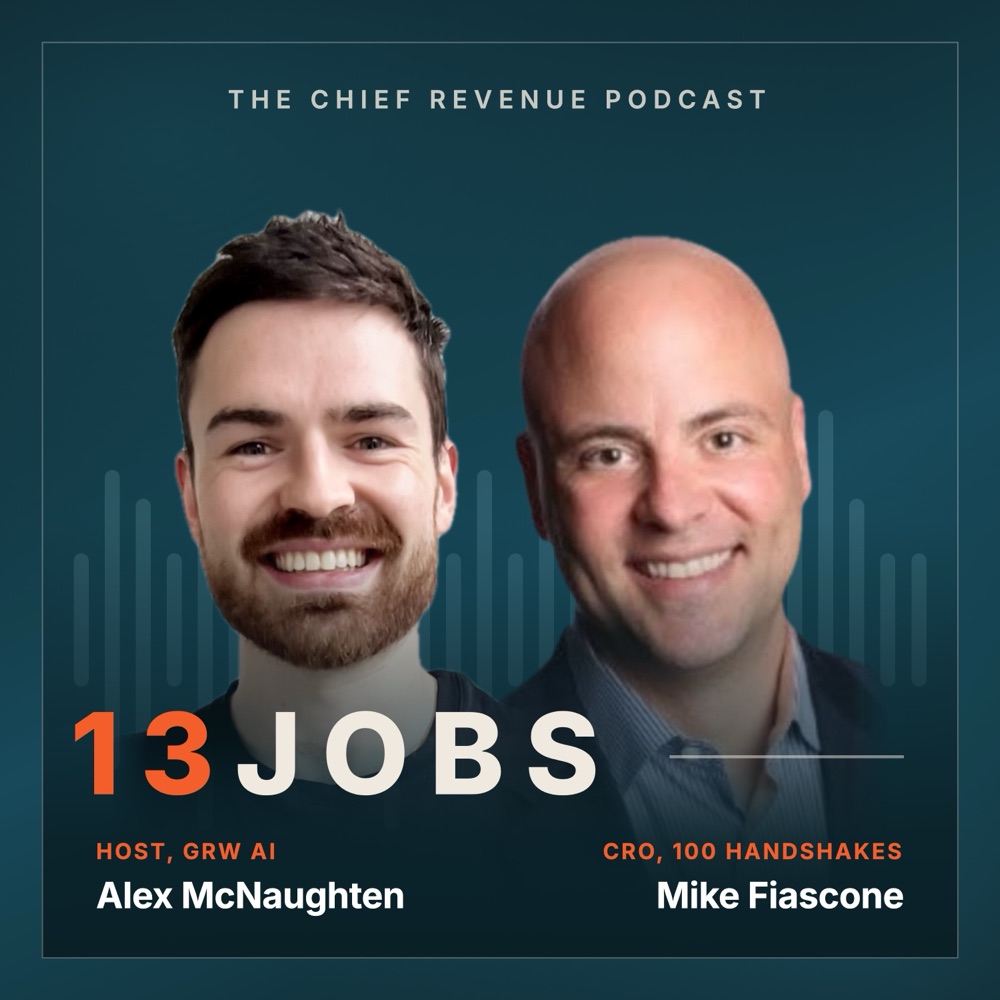
 Hosted by Alex McNaughten
Mike Fiascone · CRO, 100 Handshakes
Mike Fiascone is the Chief Revenue Officer of 100 Handshakes, which builds relationship mapping software for B2B sellers.
He has spent 25 years in strategic enterprise sales, including five years at Oracle and ten at DocuSign, where he led the big deal team, Strategic Engagements, covering the executive advisory board and executive engagement. That work produced the DocuSign Way selling methodology for strategic sales, which he trained hundreds of reps on.
In this episode, we discuss:
- The ceiling sellers invent for themselves, somewhere around director and VP
- Putting executives on pedestals, and why it is really a confidence problem
- How not to do it: cold email, gifting, and going over someone's head
- Bureaucracy trail, and positioning the executive meeting early and often
- The helicopter: trusted relationships and circles of influence
- Time kills deals, and why top down and bottom up have to run together
- Why five hundred employees now feels like an enterprise motion
- Profiling your own executive network before you need it
- The hamster wheel, and the bicycle gear nobody is using
- The three things that separate the people who do this well
- Where the executive assistant fits, and when to bring them in
- Stop trying to please, and what he would tell young Mike
Quote of the show
“Inform people, but don't ask for permission. You're the executive of the account. Treat it that way.”
Key takeaways
- The ceiling is invented. Most sellers stop at director or VP because they decided that was as high as they go. Nobody imposed it on them, and the executives are not the ones enforcing it.
- Going over someone's head unannounced is the unrecoverable move. Position the executive meeting from the very first conversation, then keep repeating it. By the time it happens it should be expected, never a surprise.
- Two routes up, and you want both running. Bureaucracy trail is slow and it works. The helicopter is a trusted relationship the executive already has. Running both at once is what compresses the deal.
- The mid-market now behaves like enterprise. Over roughly five hundred employees you hit the same stakeholder problem, and every purchase funnels to a CFO who was never in your process.
- Profile your executive network before you need it. Board, investors and execs in a sheet: work history, industries, who they can reach and why. That turns "can anyone introduce me" into a named shortlist.
- Busy is not strategy. Low gear, pedalling hard, flat road. The faster path is fewer motions done deeper: the research, the narrative, the connections, the copy.
- Bring the assistant in as a teammate, not a target. Never the first point of contact. Get the name from someone you already work with, introduce yourself early, and keep them warm so the meeting actually gets booked.
Transcript
Mike, good to have you on the show. Thanks for jumping on. Good to see you today.
Good to see you. Thanks for having me.
For those of you who don't know Mike Fiasconi, he is the Chief Revenue Officer of 100 Handshakes and has been in the sales game for a long time. But Mike, tell us a little bit about yourself and how you came to be doing what you're doing today.
Yeah, my background is 25 years of strategic enterprise sales at large companies, small companies, 5 years at Oracle, 10 years at DocuSign, top performer. I led the big deal team called Strategic Engagements at DocuSign, which included our executive advisor board and exec engagement. And our mission was to help close the largest deals around the world.
And that led to creating the DocuSign Way selling methodology for strategic sales. And I rolled and trained hundreds of reps on that program. And now I started my own company to help sellers develop these relationship maps so that they can navigate these large organizations more effectively.
That's fantastic. And we are going to be talking about a topic I've never spoken to anyone about on the podcast actually, which is breaking through the mid-level muck or Or in other words, exec management navigating accounts. So Mike, where to start on this topic? Like, yeah, like maybe let's just start with like, how do you think about this?
How do you think about executive engagement? And let's go from there.
Majority of sellers, and I was this way too, tend to hit some level ceiling inside of their account. It's this fictitious barrier that they create in their mind where they think I'm as high as I'm gonna get. It's up to the customer to carry the flag forward at this point. Everybody's definition of that bar changes, but in general, it seems to be around that director VP level.
And so that's where we start is so many sellers that I have coached over the years. And again, I felt this way too. It was like, I can't go above. There's no way I can meet with a C-level. I'm too small of a company. I'm too young in my career. I don't wanna piss off the person I'm working with.
There's a variety of reasons, but they're all limiting beliefs and it's fear. Ultimately, it's fear is what's holding people back.
Interesting. So, you know, why do you think that's there? Is that just kind of natural human emotion that, you know, you're looking at this, you know, executive, maybe you're talking to a big account, you're looking at them thinking, what can I offer them? Like, is that kind of the feeling? Why is that?
People put these executives on pedestals. They look at them as these superior lords almost when they're not worthy of, you know, serving and supporting these, you know, wealthy, powerful people. And so ultimately what it comes down to is lack of self-confidence in the seller's mind because when it doesn't matter what your title is, we're just humans.
When you look at everyone as a human being solving problems and you feel that you're a consultant and you know a lot about a very specific area, then you are worthy and deserving of having that conversation with the C-suite. So I think there's just this tremendous imposter syndrome, put people on a pedestal.
I'm not worthy or deserving of that level of conversation. And God forbid I do get it, then what? I don't wanna blow it. I don't wanna get fired. I don't wanna upset, you know, every— anybody. And so that keeps people in a chrysalis. I call it this chrysalis. It's a crusty formation that creates a holding pattern.
And you're not able to break through. And so when you do break through, you realize executive meetings are fun, they're normal conversations, they're not scary. In fact, they're refreshing, they're great. And when you do that enough, you actually don't wanna go back to the director and VP level because you tasted the sweet nectar of that, you know, of that C-suite executive conversation and it's— It's transparent, truthful, and real, and they'll tell you hell yes or hell no.
And that's what you wanna know.
Well, I think that's a really good point is once you get to the exec level, you start having those conversations. I remember when I first started having them is I was a little taken aback at how transparent the conversation was. And they, you know, like often it would just be, they just lay it all out, you know, like, yep, here's the situation, here's where I'm struggling and like warts and all, they just tell you.
And God, it makes the sales process a hell of a lot easier when you're coming from that kind of radically transparent place. And it's interesting that we started this conversation actually, which I wasn't expecting, but it makes a lot of sense with this kind of like emotional inadequacy, fear, feelings as to why people actually aren't up at the exec level in terms of when they're trying to have their sales conversations.
Yeah.
So I suppose that begs the question then, if I think it's pretty clear why we wanna be at the exec level and like why we wanna be selling there. I think that's fairly clear and fairly obvious. I guess the more interesting question is how do we get there?
Well, that is an interesting question because everybody wants to—.
That's the million-dollar question.
To get to the top of that pyramid. Even though those are fearful and afraid, there's a part of them that wants to break through.
Yes.
Everybody. It's a universal desire for a seller to want access to the most powerful person in the room because they have the power to clear that budget schedule, to prioritize. So how do you do it? Here's how you don't do it.
Okay, that's good. Start there.
A cold email. From the sales rep.
Okay.
A cold email is not the way to do it. I know some people are using these gifting kind of things where they'll send a gift. I think they're gimmicky personally, if you're trying to do a cold outreach. The other thing you don't do is you send an email and you don't inform who you're working with.
You go over their head unannounced.
Right.
That's a surprise attack and that will put you in jail. So how do you do it? There's multiple routes to the top. One route is to go bottoms up. And if you think of your— you need to climb a mountain, I call this bureaucracy trail. This is where you have to put your hiking boots on.
And you got to pack a lunch and a dinner and a tent and a sleeping bag.
Yeah.
Because bureaucracy trail will take you up to the top, but it's going to be a while. And as you climb, you may fall off a cliff. The weather could be a little scary and it's quite a journey, but you have to do that because what are you going to do? And the way you handle that is positioning this executive meeting early and often.
So there's no surprises from the very first conversation. You're constantly reminding everyone you're talking to because they're not gonna be in a defensive position early on when you say, hey, at some point when the timing is right, we need to get our executives connected. Oh yeah. Okay, we'll do that. When there's a technical and business fit, we're gonna have to involve our executives.
Now, why? It's just the best practice. It's good for the partnership. I find that when we get our executives aligned, you have access to our best people, our best products, and our best price. And it makes your job and my job much easier. So at some point, and you keep saying that, you're like, you know what, it feels like based on the plan that we set up, the mutual activity plan that we talked about, feels like we're now getting at that stage.
Where we need to get our execs aligned. And we're also missing these other people that we haven't talked to. So you're gonna have to determine the person that you're working with. This is their truth point. This is the fork in the road. Are they really a champion? Can they really get it done?
Or are you gonna have to find somebody else to get you to, um, that executive meeting? But you've positioned it all along. That's bureaucracy trail. You can do some, you could do some prospecting into adjacencies, similar kind of title and role adjacencies. You can get, if you can get 3 or 4 people in operations and IT, maybe someone find, if you get a few people, now you've got multiple Sherpas that can help guide you up the mountain.
Yeah.
But you have to position with it always. And then they're gonna help you or they're not. And that's, you know, that's the longer path. The quicker path to get to the top of the mountain is to take a helicopter, you know, to go heli skiing.
Okay.
And that helicopter is a trusted relationship, a relationship that executive already has a trusted, some level of trust. What does it mean? It means they know them. It means that they knew, used to work with them at a previous employer, that they know through a common investor, that they're on a common board somewhere, that they went to the same school, their kids play football together in the same, you know, rivalry.
There's actually quite a bit of commonalities when you are trained in the skills and the science of searching and looking for circles of influence, you can find trusted advisors. It's not just your senior leadership team. It's your board of directors, your investors, your customers, and your partners. There are executives in all of those categories.
And if you do enough LinkedIn searching with Sales Navigator to do previous work history, current history, work history, universities, you can start to narrow your search into a sphere of maybe 10 people that have a likely, a high propensity to know that person. That's the ideal. That's the helicopter. That's the helicopters. They already have a relationship.
If they don't, if you can't find that, then you use your executive in your own company that has a similar title. And just for the sheer fact that it's coming from an executive to an executive, there is some level of trust there. That'd be the secondary option. The first option, I spend hours of research to find a hit list of potential warm intros and focus more on networking and less on prospecting to find.
And I've done it enough times that I'm always surprised at how fast You can find somebody that knows somebody. It just takes work. It's a different kind of work.
And like, obviously the helicopter path is a lot shorter and quicker and, you know, arguably better. I think, how does that translate into win rates depending on which path you take? You know, do you find that if you go up bureaucracy, mountain that you have a slower, you know, you have a worse win rate or a longer deal cycle, etc.?
Like, how does that play into it?
What I do know is time kills all deals and the more time introduces more risk. So you're looking for deal compression. In order for you to do a deal, you need the top, the middle, and the low all in alignment. You can't like skip that step. You have to get the top, the middle, and the low in alignment.
It's slower to go bottom, middle, up. It's slower to get alignment that way. So if you can do both at the same time where you're coming from the top and you're working from the bottom, you're going to then compress the time. We found at DocuSign for our largest customers, it took 7.5 years from going from land to expand to enterprise-wide, 7.5 years.
And so when my team got engaged, we cut it down to 4 years and then to 2 years. And we did a few deals within the same year where we did our land. But because we had gotten to the top, because we were all on the same page of what an enterprise would look like from a value and a cost, when we did our land, it teed up the ELA much more quickly.
So I also saw that Gong produced a an analysis, a survey that said your win rate goes down 322% if you don't have a decision maker directly engaged. Yeah, this is for enterprise deals.
How are we classifying an enterprise deal here? Because that was gonna be my next question is like what sort of ACV or characteristics of the deal have to be true?
Larger deals. But in this day and age, even the mid-market and major size accounts feel like an enterprise sale motion.
Yeah.
They just have to go up to a higher level and there's more stakeholders involved. So in the old days, it'd be $1 billion in revenue or higher or $500 million in revenue or maybe 5,000 employees or higher depending on what your metric is. But I find in today's selling economy that if you get over 500 employees, you're still stuck in the mid-level muck and you're still in that same predicament.
And I think, you know, particularly over the last 18 months, even smaller deals have started to feel like more stakeholders are getting involved and you're having to do more of, you know, more of this, what you would typically would have considered an enterprise sales motion. Like even for, I'm seeing like organizations with much smaller sales cycles going through going through, you know, either helicoptering in or doing a bureaucracy mountain even for very small ACV deals at the moment.
And I'm wondering if you're seeing the same.
Every purchase is being scrutinized and the CFO has to approve so many purchases now. These small ones that used to be able to just easily get a director level to approve on their discretionary budget. Now everything has to funnel up to the CFO in this economy and everything's being scrutinized. So there's what I hear consistently around sales leaders is that we've had slippage of deals.
Yeah.
Our deals are pushing, our win rate's going down. We, there's this CFO that gets involved at the last stage and just kills our deal. We're too low level. We're single-threaded and our deals keep slipping. That's a consistent thing I've always heard, but now it's really loud. It's a really loud cry for help from the sales leaders that I speak to.
And they're like, you know what, we just can't rest on our laurels. It's not a transactional sale anymore. We have to be proactive and make a run to the top.
How do you make it easy? For your, you know, how do you make it easy to get helicoptered in? And what I mean by that is like, how do you make it easy for the, you know, the exec, not the exec sponsor within the company, but, you know, the other exec who's going to, you know, warm intro you in, for example?
Like, how do you make that a, how do you make it easy for them?
How do you make it easy for them? Well, there's a number of different strategies. First off, It starts with profiling your executives. As a strategic seller, I would like to, I'd like to do that myself. I look at my board, I look at my investors, I look at their LinkedIn and I build a Google Sheet and I have different columns where it says, here's a link to their profile, here's the company they're at, here's their previous work history.
Here are the industries that they're knowledgeable and have experience in, whether it's FinServ, healthcare, whatever. Here's why they're helpful or potentially helpful. Here's the school that they graduate from, a lot of Harvard, a lot of Stanford. Those are like very inner circle networking kind of clubs. So I like to have that mapped out now.
Right.
I also have seen chief of staff play the role to put that together. Executive assistant will often have a hand. On at least building an internal profile on a Google Sheet of your executive network. So that makes it easier for the sellers to say, oh, I have this deal, I see their background, oh, I see their work history.
Based on that, here are the 3 people that might have a connection. So that's on the profiling side. Once you do the meeting, you have to have a standard agenda, a link to the LinkedIn profiles of the people that you're targeting. You do these 30-minute kind of powwow sessions. You have an email follow-up.
Thank you so much for your time. Here's what we discussed. Here are the people I'm gonna follow up with. And then you make it simple. Here's an email draft that you can send to your contact. So you draft it for them. You put the email address of who they sent it. You, you mock up the email to— here's the email carbon copy.
Carbon copy these people's subject. Here's the subject of the email. Yeah, here's the body of the email. Feel free to edit it as you want. But that's what you could use to make the intro and use my email that I'm gonna send you. I'm gonna send you an email and you're gonna take my email and you're gonna forward it.
But I'm gonna give you the template that you could start from.
Yeah, I think that, you know, what I'm hearing there is like the level of preparation and detail here. Is so far beyond what your average seller is doing. Like, and they're wondering why they're getting stuck in the, you know, mid-level muck as you beautifully described it before we started recording is they're not doing that, Prem.
They're not doing that.
They're on the hamster wheel. They're on the hamster wheel and they're busy. They're busy. Their schedules are full. But they're not doing strategy work. And the image in my mind that I always see is on, if you think about like a bicycle, let's use a road, a road bike. Some people are in that lower gear and they're pedaling really fast.
Yeah.
And the bike is just kind of moving along.
Yeah.
But the road's flat.
Yeah.
Or maybe there's a decline and there's some people that put it in the higher gear and are barely pedaling and they're just flying by. You're in a higher gear when you're doing, you're spending, you're spending time, but you're spending it in different areas. And it's actually the fastest path to doing a bigger deal.
It's actually much shorter. It's a, it compresses the time of the deal by doing more time on the details of the email, the copy, the narrative, the point of view, the research, the connections, networking. It's the fastest path is to slow down and go deeper. And those that do it are magic. That's, you don't do it with all your deals, but you always do it with your A accounts, your A opportunity.
Everybody has a sliver that's strategic in their patch. That's the one that I'm talking about. You must, this is your quota killer. This is your quota busters. These are your mega deal candidates, right? I mean, That's the one.
These are the deals that make your year, right? Like you get one of these deals, there's your quota. Yeah, you know, absolutely. Anything else on this topic, Mike? Look, we could go into this all day, but, you know, conscious of time. Anything else on this topic of, you know, executive engagement that you think that you're seeing like just people missing?
Like, What else are people just doing wrong here?
Well, there's 3. I interviewed a bunch of people on this topic and it always came down to 3 things. There were 3 key keys to doing this right. One was the belief. They believed they had something worthwhile and valuable. It was their mission to bring this message to the right executive. They were almost obsessed as the executive of the account.
To meet with the executives. So that was one common thread was mindset. The second common thread was a deep level of research like we talked about with the people and the companies. They all did a really good job of that. And then the third was leverage. They leveraged relationships, they leveraged the executive network and the helicopters and they leveraged their champion relationships.
But one relationship that seems to be missed a lot is the executive assistants of the customer. They are incredibly powerful and no one ever searches for them on LinkedIn. No one bothers to connect with them. No one bothers to set up a call and get to know them. And I can tell you from experience that it is a game changer when you have a person whose job description is to schedule meetings with executives, to navigate the org within an account, to understand the political dynamics and the relationship dynamics, to care, to understand what they care about and what their top priorities are.
The EA knows that more than anybody and they will schedule meetings for you because that's what they do every day. So I proactively reach out to EAs and get to know them and then I have a process of saying, hey, do you manage Brian's schedule? My executive would like to connect with him.
When is Brian gonna be available in the next couple of weeks? If I send you a draft agenda with the goals. Would you then put this on the calendar or run this by them? It's amazing. So that'd be one area I would recommend sellers do more of is connect with the EAs.
How on that topic, Mike, do you, you know, because obviously the EA is thinking kind of broadly across, you know, that executive's How do you capture their attention? You know, like, you know, if you're selling sales technology and you're trying to get in, you know, get access to the CRO, for example, how do you get the EA to pay attention to, you know, your problem?
So it wouldn't be my first, wouldn't be my first point of entry in the EA. Usually I'm having some discussions with somebody over there. And I'll say, hey, who's the executive assistant to Brian? Is it Mary? And they'll say, no, it's not Mary, it's so-and-so. Oh, okay. Then I say, uh, to the EA, let's say it's Jane.
Hey Jane, I got your name from Pete over here. We're in the process, we're working on some things. I understand you manage the schedule for Brian. Is that true? Great. I'd like to just reach out, introduce myself, keep you aware of the people we're working with. And also my executive would like to meet with your executive at some point.
Do you handle his schedule?
I see. So we're not talking about proactively prospecting first point of contact. Okay. I'm glad you clarified just so for the listeners.
Right. At some point, fold them in the mix and use them as part of your team. They play a really important role because even when an executive wants to meet with you, they end up Not scheduling it anyway. So just develop a relationship with the person scheduling meetings earlier in the process. Remember how I said position it early in the process?
At some point we're gonna need to. Well, I'm also warming up the EA so that they, we're all ready to go. That way we can get this on the books.
Mike, it's a fascinating conversation. I've learned quite a few things actually during the convo. I wanna ask you one final question, which we ask everyone who comes on the show, you know, reflecting back over your 25+ years in sales, you know, if you go back to your first day on the job, what's the one thing that you wish you knew day one?
Mike's just picking up the phone, you know, like first job. What's the one thing you wish you knew?
I worried too much about what other people thought early in my career. I wanted to be a pleaser and I thought I was really good at being a pleaser and saying the right thing that they wanted to hear so that I could convince them. And boy, if I could go back early in my career, I would tell the young Mike Fiasconi, be authentic, just have genuine conversations.
It's not about what you can do or what you can get. Don't worry, just Do what's right for the customer, have good intentions and no apologies. Just be transparent and truthful and do what you need to do, what you think is right. And yeah, people may be upset along the way and that may happen.
What I found is it doesn't happen as often as we think. And when it does happen, it's their problem. It's not my problem. It's their problem.
Yeah.
They're taking this in a negative way. I'm sorry, that they are there, but they are because I've got something valuable. So that mindset of I really don't give a sh*t what you think. Yeah, that gravitas, you know, that F you money, even if you don't have it, it's that attitude with the right heart and the right intention.
Yes, I think that's a really good point. A really, really good point because I think a lot of folks, like, They do, they fall into this like customer pleasing mindset all the time. Sometimes to help the customer, actually, you have to maybe risk the relationship or, you know, risk upsetting them in the moment to point something out because, and as long as it's coming from a good place, like you're actually, you're genuinely trying to help them, but maybe they're not gonna like what you're gonna say in that moment.
I'll say, what concerns do you have? I'm sensing some hesitation because what I find is this is the best thing. And I'm rooting for you. So I'm sensing some concerns. What are those? Like, let's just get it on the table.
Yeah.
Let's hit it. Let's just hit it right on and move forward. You know, be bold, be brave, stay focused and do what's right for the partnership. Inform people, but don't ask for permission. You're the executive of the account. Treat it that way.
Mike, brilliant conversation. Really enjoyed it. Where can people find you, connect with you if they wanna either learn more about your company or—.
Follow me on LinkedIn. I post on there daily and then 100hs.org is 100 Handshakes relationship mapping software for B2B sellers. And so you could sign up for a free account, give it a go and you could also set up a meeting with me. So That's the best place to find me.
Mike, thank you so much for coming on the show. I've enjoyed the conversation. I'll see you soon.
All right. Thanks, Alex. Appreciate it.