
Sell the how, not the who
Andy knew he had won a deal in Hong Kong six months before the order landed, because the customer had started describing the solution as his product.
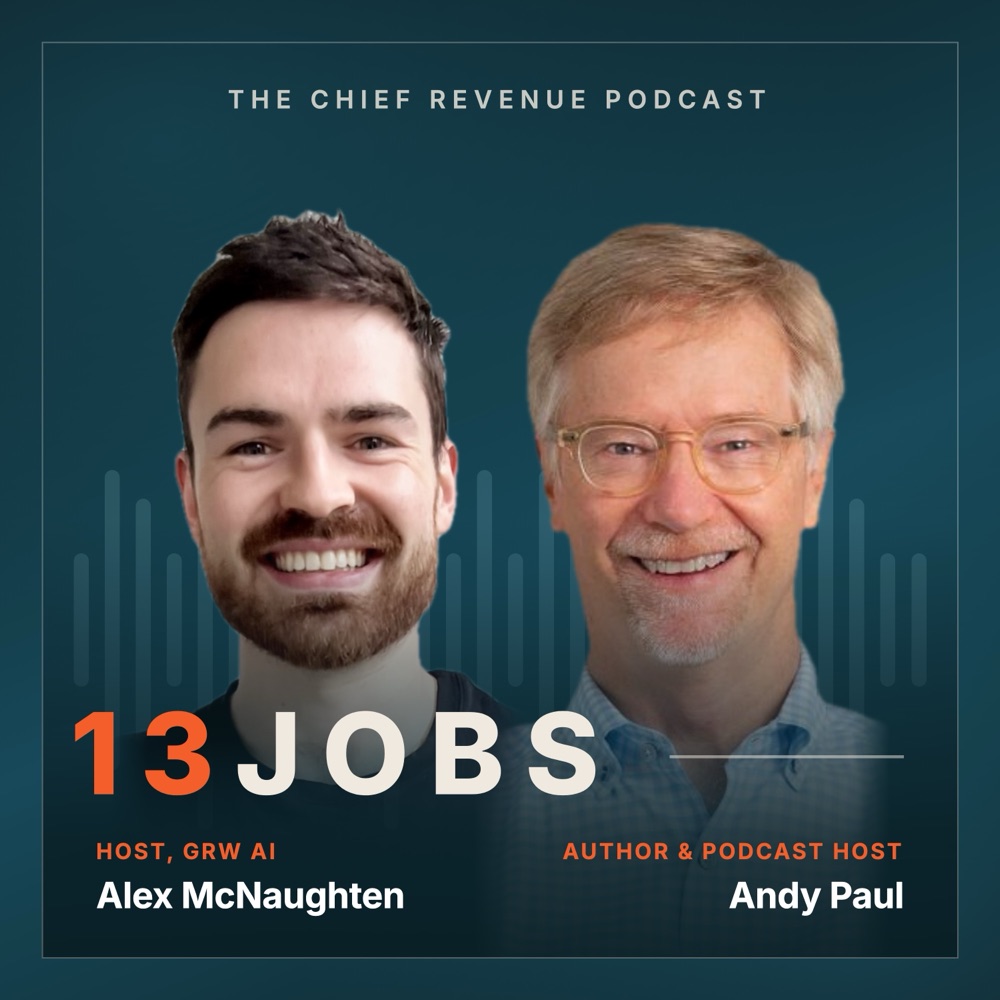
 Hosted by Alex McNaughten
Andy Paul · Author & Podcast Host
Andy Paul has been selling for more than forty years, much of it at the leading edge of whatever wave was breaking: mainframes, Apple in the early eighties when it was a $125 million company, the first battery-powered notebook, then satellite networks across Europe and Asia. He spent fifteen years selling multi-million dollar systems for startups against the world's largest tech companies and defence contractors, and winning.
He has written two award-winning books, Zero-Time Selling and Amp Up Your Sales, and hosts one of the longest-running shows in the category, with close to nine hundred episodes at the time of recording.
In this episode, we discuss:
- Forty three years, from mainframes through Apple to satellites
- Nine hundred episodes, and the selfish reason he keeps going
- Persuasion reactance, and the twenty billion dollar irony
- Persuasion changes minds; influence helps people make them up
- Winning the how, six months before the order came
- Satisficing, and why buyers never move in lockstep
- The biggest thing you can give a buyer is feeling understood
- Discovery is not a stage, and qualification is not done once
- Tell me more, three or four times over
- The one thing hiding in a three hundred item compliance matrix
- Two lenses: is this good for the company, is it good for me
- Flip the training budget towards the managers
Quote of the show
“We're spending billions every year to train salespeople in the one behavior that customers universally hate.”
Key takeaways
- Buyers make two decisions, in order. How are we going to solve this, and then who with. Sellers are trained to sell the who. Win the how and the second question mostly answers itself.
- Persuasion is the behaviour buyers dislike. Everyone resists being persuaded, and the training industry spends billions teaching exactly that. Influence, helping someone make up their own mind, is a different act.
- Making someone feel understood is the value. Ten questions with ten answers is a superficial understanding. The follow-up is what gets you to the point where the buyer thinks this person gets it, and that is the differentiator.
- Discovery is not a stage on a board. It happens on every interaction, and so does qualification. A buyer who learns during their own process may be more qualified than they were, or less.
- Find the one thing. Three hundred requirements were not equally important. A flight to Asia established that the chief executive cared about the real-time take from the onboard casinos, the proposal was rebuilt around that link, and they won.
- Every stakeholder is two stakeholders. Good for the company and good for me. The person blocking consensus usually has a disconnect on one of those, not an attitude problem.
- The leverage is in the managers. Of the training money spent in the US, roughly a tenth goes to managers. Effective coaching has the largest predictable uplift on individual performance, and managers are being asked for something nobody trained them to give.
Transcript
Hey Andy, how you doing, man?
Great, Alex. Thanks for having me on the show.
Thanks for giving up your time. Really appreciate it. So Andy, you're a bit of a sales expert. You've written books. You've got a— you've just told me you've done—.
A bit of— I like that. That's a good way to put it, actually.
I know. That's a bit of a small joke there to start. You've done— you just told me over 900 episodes on your podcast.
Close to, yes.
On everything sales. So yeah, tell us a little bit about yourself and how, I guess, how you ended up here. Doing that?
The end of a very long road. So I've been in sales for 43 years, be 44 years this year, and really been fortunate to be sort of at the leading edge of a lot of the tech revolution waves that have come over the years, selling mainframe computers and sell— I worked for Apple in the early days, back in the early '80s with Apple.
I mean, Apple was $125 million a year company when I first joined them. I think, what, were they close to $100 billion now? So slightly different scale. Sold for a company that made the first battery-powered notebook computer. I was in the satellite communications industry for a number of years selling the first of their kind satellite networks in countries throughout Europe and Asia.
So I've just been Yeah, now working in the SaaS business, I've just been very fortunate to sort of always sort of be at that leading edge in a way that forced me to evolve and change and understand what was going on. And so I started my own company about 20 years ago to really help the smaller companies of the world learn how to go out and compete with the big guys.
So that's sort of been what I'd done for 15 15 years prior to that, worked for startups where we're selling these large multimillion-dollar satellite communication systems, competing against some of the world's biggest tech companies at the time and defense contractors and so on. And we did very, very well. And it's sort of, yeah, small company, no brand name.
We were venture funded. We didn't have a lot of money yet. We won big deals repeatedly. And so A lot of times small companies, you know, they want to make this really smooth, gradual transition to selling big deals. They think we have to get their feet wet on the smaller ones. Yeah, we just did the opposite.
We said we want to sell to big companies, so let's go sell to big companies. You know, let's learn how to do it. And so I took that and said, okay, I can teach other companies how to do that. Had my own company as I was doing that for A better part of 15 years.
And then, um, yeah, I got published my first book, published second book, started doing more public speaking around this, sort of a little less consulting. Started my podcast about 5 and a half years ago. And yeah, no idea 5 and a half years later I'd still be doing it because, yeah, the average number of episodes that somebody produces of a podcast before they quit is 7.
According to one of the leading podcast hosting companies. That's why there's, yeah, a couple million podcasts out there because it's easy enough to start one, it's hard to keep it going.
That's right.
So, yeah, it just sort of evolved and, you know, evolved a nice audience and a lot of demand from guests that want to be on the show. So, that makes that part of it a little bit easier. In terms of recruiting guests to be on. We're never really lacking for content in that regard.
And for me, I tell people, it's just been one of the most selfish things I've done. Because, yeah, where else do you get to talk to all these smart people and continue to learn stuff day after day after day, which for me has just been— as somebody who's really curious and always been an avid learner and reader, this has just been fantastic.
Just not just to meet people, get to know people, but also, you know, absorb some of their knowledge and wisdom.
That's awesome, Andy. And I can definitely relate to the love of talking to smart people who— and learning from them. It's awesome. It's, you know, I think that's one of the best parts about doing it is I've, you know, I've chatted to people all around the world about sales, which is something I'm passionate about.
And I guess You know, you've been doing that for a little bit longer than I have. And, you know, it's very rewarding, and you learn a lot too.
Well, yeah, and I think you never— for me, it's one of the lessons I'm trying to impart to people is that, hey, yeah, I'm much closer to the end of my career than the beginning of it. And I'm still learning. Oftentimes I feel like, because I've got a couple of books in the work that I'm writing, and that Yeah, I feel like I'm pushing the envelope more than people substantially younger who should be pushing the envelope and in terms of what sales can be and what we need sellers to be.
And yeah, a lot of that got stimulated by some of the conversations I've had with people and just maybe more than I could have if I wasn't doing the podcast, I was really having my finger on the pulse of what's happening in sales.
Very cool. Very cool. And let's talk about that and talk about what sales is and should be. You know, one of the challenges we have down here in New Zealand is that sales is still a bit of a dirty word. And I would say it's probably not exclusive to New Zealand. That's probably common to— Yeah, certainly not exclusive.
Yeah, that's common to a lot of markets, but particularly here, there's this almost aversion to selling. Particularly in the startup community, everything's very product-focused, product-led. In your view, why do you think that is? What do you think causes this sales aversion?
Well, actually, it's aversion of a different sort, which is that— so there's a very interesting book written, published in 2020 called The Catalyst: How to Change People's Minds, written by professor at the Wharton School of Business in Pennsylvania named Jonah Berger. And it's really, it's about persuasion. And yeah, actually he and I sort of differ on some aspects of this, but one of the key points he makes is that basically everybody in the world resists being persuaded.
He calls it persuasion reactance. And what I find ironic is that almost every sales training course that exists out there is training people how to become persuasive. And so, you know, this becomes the irony is that we're spending billions in the US alone. It's $20 billion a year on sales training. We're spending billions every year to train salespeople in the one behavior that customers universally hate.
So you wonder why people react badly to salespeople. That's how we set them up. We said, go do this thing to that person. And oh, by the way, 100% of the people in the world dislike that behavior. So it's like, hmm, maybe there's a different way we should be doing this.
Okay.
And so yeah, my contention is, is that persuasion's a hammer, right? We use persuasion to get somebody to do something, right? As, yeah, buy my product. And I think that we need to look at influence as a different path to take. And unfortunately, persuasion and influence are conflated oftentimes. And they're distinct. Behaviors.
And so, you know, persuasion is about getting people to change their minds, influence about getting people to make up their minds. And the literature even says that, right? So, and this is one of the differences I had with Jonah Berger. I said, you know, in sales, I don't approach sales from trying to change a buyer's mind.
I approach it from trying to help them make up their mind. So, I'm trying to influence the choices and decisions they make, the trade-offs they make, about not only their understanding what the problem is they're trying to solve, but how they're going to solve it. And if you look in the literature of decision-making, you know, there is this idea that's been researched.
One person in particular, a professor named Paul Nutt in the United States, who said, look, we studied corporate decision-making and decision-making in general, and there's other people written about this. He said, look, when we make decisions, we basically go through 2 steps. First is, how are we gonna solve our problem? And then who are we gonna solve it with?
Right? So if you look at your buyer in a business-to-business environment, they go through those 2 motions, they're distinct motions. And really almost 2 distinct decisions. The first decision is, how are we gonna solve this problem? So that involves helping them understand what the problem is, what the scope of the problem is, what the scope of the potential outcomes could be.
Help them make trade-offs in terms of, you know, this versus that, this versus that, and help them arrive at that place where they make the— place where they make the choices. Yeah, this is how we're gonna solve it. And then the next step is, okay, well, who are we gonna solve it with?
But if they've largely based their choice of how they're gonna solve it on your solution, if not entirely, then your odds of winning the deal are pretty high. But we train sellers, sell your product, sell the who, when they need to be selling the how. And this is, this is the, this is a fundamental difference in approach that I think is what really holds a lot of sellers back.
They think their job is to get somebody to buy their product, where their job is really to make a connection with somebody, help them understand the problem, help them choose the best solution. Or what could potentially be the best solution, and then who they're going to solve it with. And so I, before I'd read any of this stuff about the research and so on, I discovered this in my own career, is very distinctly I was working on this big deal in Hong Kong and this moment hit where it's like, oh.
Oh, I'm gonna win this deal, right? And this was— I knew it was 6 months before I got the order, but I knew at that point that I won because basically the customers started talking about the solution to the problem in terms of my product, right? So I had won the how.
Yeah.
At that point in time, I called it winning the sale before winning the order, but I was really— I won the how. And so it completely shifted my mindset about how I approached my customers and said, I didn't want to— I wasn't focused on the endpoint decision. I wanted to win that choice about how they're going to solve their problem.
And so for me, that meant being hugely responsive, deep discovery as early as possible, and to front-load as much of the value I could bring to them as possible. Because then I knew that I was increasing my odds of winning the deal because there's this belief that's completely wrong on the part of sellers that buyers, if they have 3 competitors on a deal, that buyers move through the deal in lockstep at the same stages with each of the sellers, which they don't.
And again, there's Nobel Prize-winning economists from the United States. Herbert Simon has done this research years ago, back in the '50s and '60s, where he said, huh, actually, when people go through a process of making a decision, for the most part, they just don't make the good enough decision, right? They're gonna— he called it satisficing.
So it's the conjunction of satisfy and suffice, right? This satisfies my requirements and suffices to enable us to achieve our business desired business goals with the decision. So what Simon found is that, again, in the vast majority of cases, people said, look, wow, we found the solution. That met our requirements, we don't need to spend any more time, right, talking about anybody else.
This is— this satisfies, satisfies our requirements and sufficient to achieve our business goals. Boom, let's do it. And again, that was something I saw happening before I had sort of the intellectual framework around it to understand exactly what's happening. But once I did, it all made sense. It's like, yeah, I want to reach that satisfying point.
As quickly as possible, because if I do that, I've taken that prospect off the street. That's, that's my business to win at that point in time. It doesn't matter what's a small deal or big deal. It works that way.
Yeah, I think there's a lot there and there's a lot of gold in everything you just said there. What a lot of— and it's not often their fault, but what a lot of reps do is they They show up and throw up. They show up and just talk about the product and it's, here's all the great features, are you in?
It's kind of the attitude.
Yeah.
And it doesn't work very well. Yes, they might get some deals, but it doesn't work very well. And what you've talked about there about winning the how is so much more powerful. But that can only be done with that discovery, right? You can only do that well if you go in with this mindset of I want to understand the customer.
I want to understand their business. I want to understand their challenges and I'll try and help them if I can. But if I can't, that's okay too. Sure.
But you said a critical word there, which is understand, right?
Yes.
So there's understanding, then there's understanding. And oftentimes sellers these days, they have sort of a list of questions they typically go through. It could be scripted. It could be just their own script they came up with. And they get the answers and they say, oh, okay, great, right? I got 10 questions, I got 10 answers.
Whereas what you should be saying is, all right, they give an answer, but what's the follow-up to that? How are you digging deeper? How are you making sure you really understand? And, and that's, you know, this is a big gap for a lot of sellers. And so they have sort of superficial understanding where you really need in-depth understanding.
And it's not till you have that understanding that you can really provide any source of value to the buyer in terms of the choices and decisions they're making. Otherwise, you just start talking through your hat. And again, this is a big gap. And so I tell people that sellers, I said, so what's one of the biggest sources of value you can provide to a prospect?
And the answer is to make them feel understood. That's incredibly powerful. So if you think about, you know, the connection you're building with a buyer that, you know, grow— hopefully grows over time and your credibility and your trustworthiness grows. Yeah, helping the buyer feel, yeah, this person understands me. That's huge. That's a huge differentiator right there.
Most sellers stop short of that point. And again, to your point earlier, it's not like you will never win a deal if you don't do that. But if you want to win a higher fraction of your deals, you'll reach that level of understanding. And, you know, you can— there's ways to confirm it with the buyer and so on, but it requires, yeah, great discovery and understanding what you're trying to achieve with discovery.
Yeah, oftentimes, and I would say in the overall majority of cases, you know, sales teams have these sales processes neatly laid out stage by stage by stage, and they say, oh, we got a discovery stage. Well, the fact is discovery happens every single call or interaction you have with the buyer. There's not one stage, right?
You're continually discovering. And so if you put it in this box and say, oh yeah, we did that, you're suddenly at a disadvantage if you're gonna run up against somebody like me because I'm gonna find out more about them. I'm gonna make sure I have a deeper understanding. You're gonna lose because I've taken it to that next level.
So you can't— this is where our sales processes are sort of just so messed up is we put everything in a box and it's like, yeah, they're not one-and-done type affairs. Qualification is not a one-and-done thing.
No.
Because yeah, as your buyer goes through a buying process, they get educated about the possibilities for what they could potentially achieve with making the decision to make a change in their business, to invest in a new solution of some dimension. Yes, they get smarter. You want to— they may no longer be qualified, or they may even be more qualified for what you're selling than they were before, but you got to stay on top of it.
So yeah, anyway.
Yeah, no. Just that point of understanding, super important. People in general want to feel understood, whether you're selling to them or whether you're just having conversations. That's just an innate human need.
Yeah.
And it's always struck me as strange that we don't actually use that more in sales, that that's not one of the very first things you're taught. I didn't learn it until years later. Until I'd actually left professional selling as a career and moved into training and started reading up more on psychology. But this idea of that, it's like an aha moment when your customer feels understood by you.
And that's often when the deal accelerates.
Absolutely.
But it's an area that people often struggle with to reach those aha moments. Understood moments. And I think, in terms of those sort of follow-up questions and how do you ask the questions, when to ask them, when doing discovery, do you have any kind of tips around that?
Sure.
Around how to get— how to do it in a way that isn't playing 20 questions?
Yeah. Well, I mean, how much time do you have? So yeah, I could go on forever about discovery. Because it is so important, right? So there's, you know, simple— and I hate to call it a technique, it's just a question you use, a follow-up question, which you can use a lot and without overdoing it.
You ask a question of somebody, something you truly want to understand, and that's a simple follow-up question. Oh, that's interesting. So what else can you tell me about that? Or the variant of that, well, that's interesting, tell me more about that. Right? More of a command versus a question, but it's still a question.
But the thing is, people love it when others are interested in them.
Right?
It's such a basic thing as the way to make yourself interesting to someone else is to be interested in them in a sincere way. And follow-up questions, just take it down a level deeper. And people who have expertise wanna share it. And your customers are experts in something they wanna be able to share with you.
So that's a very simple one, right? Just, well, and what else can you tell me about that? And you could say that 3 or 4 times in a row, right? It's just, let's take it down another level and people will suddenly start giving you insights about their perspective of their problem that you hadn't got before.
Another interesting approach is, I find, is that in every situation, there's always one thing that's more important than all the others. And if you have this perspective as a seller, say, look, my job is really to discover what the one thing is. There's one thing that somebody involved either a stakeholder or a senior decision maker feels is more important than all the others.
If you find that and you orient your selling efforts around that, huge advantage for you. Because again, you understand them in a way that you didn't before. I'll give an example, selling a system to satellite communications to a large cruise line in Asia. At the time, I think it's one of the largest cruise lines in Asia, if not the largest.
And it's gonna be the first system to have broadband communications to the staterooms and voice over IP to the staterooms and so on. It was a big deal. I mean, this is— today's dollars, probably worth about $20 million. And so, um, we were competing against all these major tech worldwide tech companies. We were a startup at that time.
I think we were doing about $50 million a year in sales. And we'd been through this deal and they had hired these outside consultants, as these companies always did, to put together their RFP. Because we'd survived sort of the cutdown, they got to the final 2 vendors, and there were 3 vendors, I think, in this case, and they put out an RFP.
And you got to the RFP section where there was a compliance matrix, right? If you're not familiar with compliance matrices, but basically a listing of every critical feature they thought they needed And this thing ran over 300 items, right? Multiple pages. And I looked to the salesperson, I said, you know, these aren't all equally important, right?
What's the one thing here? And he didn't know at that time. I said, well, let's find out. And he had a pretty good relationship with the CEO of this company. And he ended up actually getting on a plane, traveling to Asia, met with the guy. And found the one thing. What the one thing was, is that this guy really didn't care about the internet browsing.
He didn't care about the voice over IP. What he cared about was getting the real-time take from the onboard casinos. So he knew by the minute how much money was coming in off that. That's what he cared about. And that actually was meant to be a separate, its own satellite link. It wasn't going over with the rest of it.
So we basically flipped our, our proposal to focus almost exclusively on that. Yeah, we're gonna do the other stuff, but it's this one thing. So we made sure that link never went down, didn't matter, you know, hot standby, all these things, because that's what this guy cared about. And we won. So we knew the one thing.
And I could give you chapter and verse of other examples of companies. You find that one thing and you put yourself in the driver's seat. So that's 2 tips about discovery. I'll give you one, throw in one more just so— yeah, because I'm passionate about this part of things. Because yeah, if you get this right, you set yourself apart from everybody else.
Is that, you know, as humans, we, especially in a business environment, we look at every situation, every opportunity through 2 lenses. Is this good for the company? Is this good for me? And so when you're doing discovery and you're talking to people, you have to understand how they look at both of those, right?
Is, yeah, is this— what's the impact this could be on the company? Is this a good decision for the company? Is this a good decision for me? So if you have like 5 stakeholders, key stakeholders in a decision, it's like having 10 stakeholders. You need to understand the dual perspective on each one of those, because if part of your job is say, look, I need to develop a consensus among these stakeholders and someone's holding out and you can't get them in line, Well, it could be because on either the business or the personal side, there's a real disconnect and you need to be able to address it.
But if you're unmindful of it, you're just gonna think this guy's just being a jerk and stalling the decision and, you know, we need to work around him as opposed to how can I help him feel more understood, right? And if you do that, suddenly they become your big advocate.
Yeah, yeah, it's, it seems so simple when you say it out loud. You know, understand the environment you're selling in, understand the buyer, understand the individuals, make them feel understood, and then try and help them with the thing that they need some help with.
Yeah.
It seems obvious and it should be, you know, it seems like something you could put in one page and give to every sales rep on the planet and that would probably dramatically improve how sales is perceived.
It could. I mean, I think that the problem we have is maybe a minority view on this, but I think the problem really rests with the sales leadership and that everybody has this perception about how sales are supposed to be. And increasingly this has become complex with the use because we're putting all these tools into sales now, this you know, some great technological tools like RingDNA, the company that owns my podcast.
But tools notwithstanding, it's still a human business, right? It's a person selling to a person. And so rather than having the tools drive the process, the tools should be supporting the individual in getting their job done. And that doesn't mean supporting them in getting 100, making 100 calls versus 50, but supporting them in terms of at those moments when they're interacting with another human being, that they're their best possible self at that time.
And, and there's a big gap that way. And I, and again, I, you know, I believe the blame rests with sales managers more often than not, and not necessarily their fault, but you know, companies have historically underinvested in training management-level people in some of the basics— how to become a more effective coach, how to, how to coach performance improvement, right?
We're asking things of, of our managers that they're just not equipped to give. And so I think this is one of the things that, that needs to change in a serious way. And I would contend, again, I use the example for the statistic of like roughly $20 billion a year spent in the US on sales training, of which I would hazard to say that at most 10% of that is spent on training sales managers.
I believe so. That's $2 billion for sales managers, $18 billion for sellers. I contend that if we flip that and spent $18 billion training sales managers, only $2 billion on training sellers, we'd be much further ahead. Because it's really, it's really the sales manager that plays such an outsized role in helping sellers get better.
And yeah, you ask most people, how'd you learn how to sell? From my manager originally, from my manager, or for me, it was customers first and foremost, and then managers. And the customers taught me how to sell. I was very fortunate. I asked good questions and customers told me how to sell to them.
And it's like, oh, I should do this more often. So, but it's one of those two. And setting aside customers, there's been research to show that one thing you can do that has the biggest predictable uplift in individual sales performance is effective coaching. And we give a lot of lip service to the importance of sales managers coaching, but we don't provide them the training, the understanding.
And, you know, there are tools out there to help them coach, but it's like, nah, this is like, you wanna do the same thing with your sellers that you do with your prospects is you wanna help them feel understood.
That's right. And I think there's probably a whole nother podcast just on that topic as well, to be honest. Andy, this has been Fantastic. I think we just sort of scratched the surface on some of these areas, but there was a lot of gold and some practical stuff in there for people to go away and use.
Any kind of final thoughts? And also, where can people find you if they haven't already come across you before?
Yeah, well, they can find me on LinkedIn personally. Please connect with me on LinkedIn. So it's the usual preamble and I'm real Andy Paul. And yeah, then catch my podcast on iTunes, Spotify, wherever it's Sales Enablement with Andy Paul. Some people may remember the previous name, which was Accelerate, but podcast was acquired just a year ago and we changed the name.
We may change it again before too long. But yeah, check those out. We've got Yeah, 870-some episodes as of today, and, and a lot of, a lot of great content. Even a lot of the old ones are still great episodes that people are still listening to today.
That's awesome, Andy. Um, really appreciate your time today and look forward to talking to you again. Thank you, it's been a pleasure.
Let's do it again.
Absolutely. Chat to you soon.
Bye.