
Stand out by being simpler
Will sold his car to keep the company alive, and lost his only data provider two weeks after raising. He counts both as ordinary.
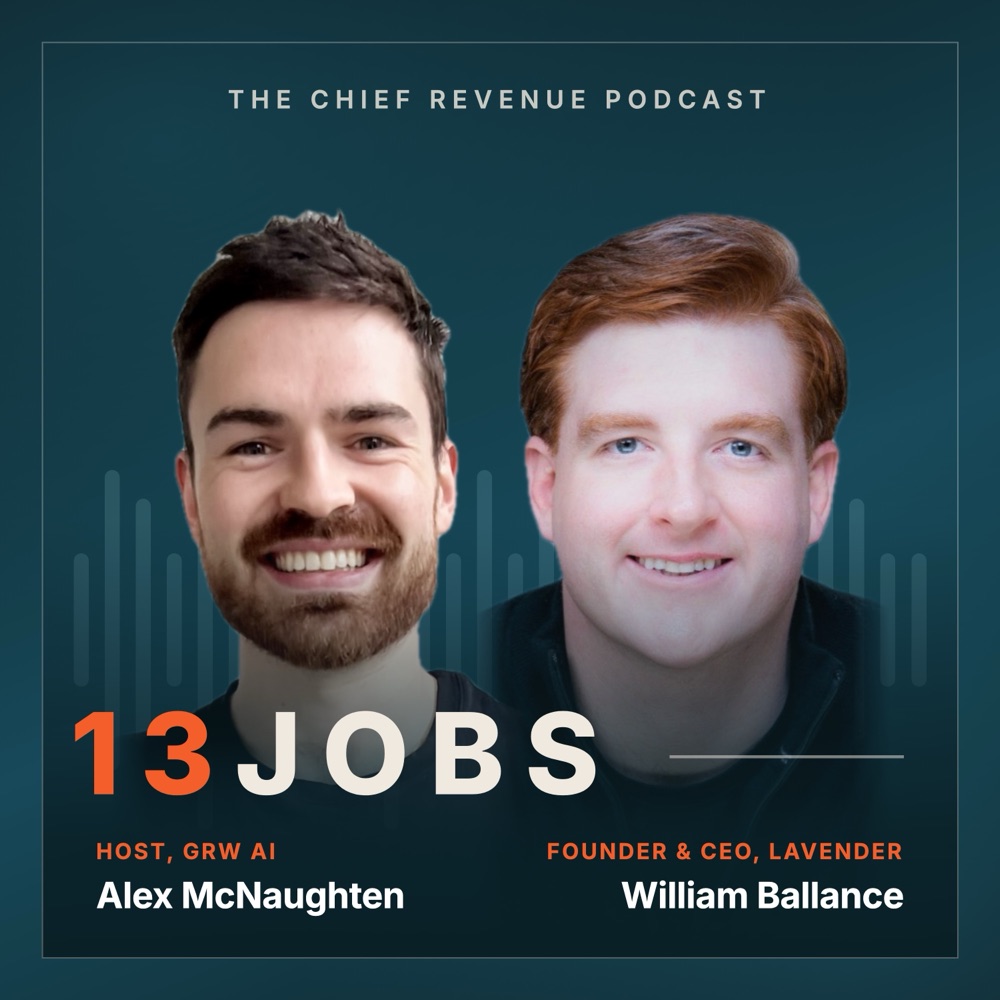
 Hosted by Alex McNaughten
William Ballance · Founder & CEO, Lavender
William Ballance is the co-founder and chief executive of Lavender, the sales email assistant that sits wherever a rep already works, in Gmail, Outlook, Outreach or Salesloft. He started in sales as the second hire at a daily deals startup in Atlanta, which went from $30,000 in sales to a couple of million while he was there.
He has been on his own for more than six years, two and a half of them on Lavender. Before it there was an alumni fundraising app, a Snapchat filter business that paid the rent, and a marketing tech product that COVID killed a few weeks before launch.
In this episode, we discuss:
- Undercutting the mixtape business in seventh grade
- Second hire at a daily deals startup, and what it taught him
- Ten days from payroll, and selling the car
- The Snapchat filter business that funded the alumni app
- Almost dying often enough to stop finding it frightening
- The user stories that actually keep them going
- Banned from handing out the swag, so they threw a rave
- Meeting his co-founder at a hackathon he nearly skipped
- Forty five days of runway, and the pivot into Lavender
- Give first, and why they refuse to paywall the content
- The email to Mark Cuban that took two hours
- Eleven seconds of attention, down from forty five
Quote of the show
“We thought we were gonna die and then we just didn't die.”
Key takeaways
- Resilience is repetition, not temperament. A cut-off data provider, a missed payroll, a plan collapsing the week of a conference. Each one felt fatal, none was, and the next one lands differently because of it.
- Constraints force better ideas. Told they could not hand out swag at SaaStr, they threw a party instead and got more attention than the company that spent three hundred thousand dollars on a booth.
- Give first, in public. Content other people paywall, given away. Half-hour email coaching sessions for people who were not customers. The goodwill is the top of funnel.
- Volume stopped being an advantage. Anyone can send a thousand emails now. If a rep will not spend five minutes writing to a buyer, the buyer will not spend forty five minutes on the demo.
- Eleven seconds. That is how long a cold email now gets, down from around forty five when Lavender started. Most reps still write emails that take forty five seconds to read, which is three follow-ups' worth of material in one message.
- Financial success follows the impact, not the reverse. The reply-rate numbers are good. The messages from users with dyslexia or OCD, or who were on a performance plan and are now hitting quota, are what he counts.
- It takes longer than you think. The thing he would tell himself alongside how to write a cold email: have more patience. Nothing takes hold as fast as it looks like it will.
Transcript
William, good to have you on the podcast. How are you?
Yeah, man, good to meet you and happy to be here. I'm doing well.
So for those of you who don't know William, he is the co-founder of an awesome email AI-based email platform called Lavender. But tell us a little bit about that and tell us your journey.
Yes, Lavender is a sales email assistant. It really exists wherever a sales rep is— Gmail, Outlook, Outreach, Salesloft, etc.— to help them write a better email in less time. And there's lots of ways it does that, but at the end of the day, it just helps them get more replies and save time on their email by writing Effectively.
Awesome. And I came across you as a Lavender customer, so I started using it and I was like, oh, this is pretty cool. And I just reached out to you and here we are. And, you know, for today's topic of conversation, we're going to talk a little bit about the entrepreneurship journey. And, you know, I'm curious to learn about a little bit more about your journey and I guess how you, you know, you started in sales and then you, you know, you're building a tech company now and Yeah, just really want to unpack that.
So yeah, start at the beginning. Um, first day in sales, what happened? How'd you end up in sales?
So in 7th grade, um, someone in my class was selling mixed CDs for $5, and I started selling mixed CDs for $3 and put her out of business. And I think that was my first, my first experience in sales and entrepreneurship. And, you know, through, through like my younger years, I got interested in like websites and software development, even at a pretty young age alongside like general stuff like playing sports and going to college and all that.
I was not gonna be an engineer, although when I was younger I had some experience like building different types of apps and stuff, like for my homework, just taking classes in high school. But I went to school to be a lawyer, realized I didn't really wanna be a lawyer anymore. It's like a lot of reading.
It was kind of boring. So I got into entrepreneurship when I was in college and had some side businesses and whatnot. And Ended up wanting to work at a startup and went and worked at an early-stage e-commerce startup in Atlanta, Georgia in the US, which was— I saw it seemed like a top 5 fast-growing city for startups.
I moved there and worked at this early-stage daily deal company, kind of like a Groupon or a LivingSocial. It would sell discounted deals. This was around 2011. And it was a regional version of that just for like that area. And I was the second hire and came on as a, just what you would call an SDR these days.
At the time, just like a sales rep trying to build the business.
Mm-hmm.
They had $30,000 in total sales and we grew it to like a few million, a couple million over the next couple years. And, um, just like cold calling, really cold calling, cold email, traditional outbound sales. But because I was so early, I got to work really closely with the, the founders. And once I proved that I could make them money, that gave me a lot more flexibility where I could do other stuff.
They started teaching me the the marketing, the customer success. I started managing salespeople. And granted, I'm a year out of college at this point, but I got a lot of experience with a lot of different parts of the business because I was so early in that company. The Daily Deal bubble burst and the company kind of folded after a while when people stopped doing daily deals.
The economy rebounded, a lot of consolidation in that space. And from there, I went and worked in tech sales and that got me interested more in like the software side. Going back to like what I had learned when I was a kid in school and just got into tech sales and went from there.
But I started off out of college just doing traditional sales, SDR.
And do you think that, you know, the skills and— yeah, the skills that you learned along the way in tech sales prepared you well for the entrepreneurship path? Like, do you think some of that translated across?
100%. I think about this pretty often. I'm asked about it pretty often too. So I think that first experience in school when they, I randomly got put into a web design class and I got introduced to like development, even though I wasn't an engineer, like understanding how do you build a website or how to build a simple software app at a young age.
Like I think that was really key to like framing my mind around product development. And then my first job at the e-commerce startup, while it definitely gave me that sales skillset, also we were building a consumer brand. And Lavender really appeals to the end user right now as an, as a consumer. But then in my first tech sales job, it was a data-driven marketing automation platform.
So I kind of learned how does like really deep data, how can you use that to create better engagement? So I think these 3 things came together to create Lavender, this interest in product development, this interest in sales, especially the consumer side of building the brand. And then how does data play into optimizing your communication, which is what Lavender's doing today.
So. All those experiences really set me up for what we're building with Lavender.
Very cool. But it's not all been easy, right? Like, it sounds very, you know, like this perfect story, this perfect, but, you know, I imagine there's been a few speed bumps along the way.
We've almost died probably 100 times, if not more. We were 10 days away from missing payroll and we got the last angel investment we needed to get the profitability. I sold my car to get us started. Um, barely made groceries and rent several times. It's been more, more struggle than, than, um, than ease, I would say, along the way.
Although now we've got a stable company, thousands of users all over the world, massive brands using our product to increase their reply rates. But it wasn't like that. Um, I've been on my own as an entrepreneur for over 6 years now, of which Lavender is 2 years, 2 and a half years of that journey.
I first quit my job in tech sales to do a startup for alumni fundraising for schools. I was working in tech sales at this e-commerce automation company, and there was a college in Virginia that was a school that was close to where I'd gone to school. And it was a college for women, it was an all-women's college, and they announced they were closing in 2015.
Since I had tons of friends there and I kind of understood community building and marketing, I created an online community of alumni from my school to support their school. And we raised some fund— some money for them, did some fundraisers. I got some press for that. And ultimately the school was saved. I was a very, very, very small part of that.
Their alumni saved the school. But while I was there, I saw this inefficiency in alumni fundraising and I did what anyone else would do. I started building a mobile app. I had a developer building it, not myself building it, cuz I had forgotten all the code by this point.
Mm-hmm.
But I had a developer that I had met on Reddit, actually a freelancer, start building this MVP of like a social chat and fundraising app for schools called Alum. Eventually the entrepreneurship bug just started eating at me more and more and I quit my sales job.
Hmm.
And that was in like the last day of July of 2016, I think. And went out to go full-time on this alumni app. And what I quickly learned, I'd been used to selling to marketers and entrepreneurs, pretty short sales cycle. So I quit my job, And it's like the first day of August.
I'm like, I'm gonna go start selling my alumni app to schools thinking it was gonna be pretty easy. First of all, I learned alumni or the, the schools go on vacation in August because it's in between summer break and fall semester. Second, they definitely are not buying your early stage MVP, minimally viable product that you built as a solo founder with a freelance developer.
They require all sorts of integrations and like lots of bureaucracy. Education sales cycle is quite long.
Mm-hmm.
And These are all like learning moments really on really early on for me. So to pay the bills, I had a Snapchat filter business. So around the same time, Snapchat launched the ability to create custom overlays and filters on your images.
Yeah.
And I had made one for my cousin for her wedding, cuz I just quit my job. I couldn't really afford a nice gift for her and she loved it. Her friends loved it. And I thought other people will love this too. So I had come from daily deals. I put up a Shopify website for custom e-commerce, or I'm sorry, custom Snapchat filters, submitted it to Groupon and LivingSocial, which are the 2 big daily deal platforms.
And I was the only provider of custom Snapchat filters on both platforms for like 6 months. And this gave me the income that I needed to keep iterating and building on the alumni app and also got my first customer and first school for the alumni app. I thought, I thought this was gonna be a huge success, but I realized that the, the school that bought the early product, the early alumni product, they were kind of the outlier.
Most schools needed tons of proof points. They wanted testimonials, wanted other schools, they wanted all this information to make their buying decision. And just this one person said, I'm buying your product because I want to be the first person to have it.
Yeah.
So I thought, well, how do I find more people like that person? And had an idea for a software that would look at my CRM of target accounts and figure out based on their data, their personality traits, who are the ones that need the proof points and who are the ones that are more pioneering.
And there was an idea I had just to like segment my CRM or sort my CRM by personality type to optimize my outbound. But I had no idea how to actually build that. But I'm gonna pause because this is like a next chapter in the story after that.
Yeah.
Yeah. So I'm gonna pause. Any questions like up to now?
Definitely. Definitely. I'm listening, absolutely fascinated by this journey you're on. I just want to stop one thing because you said something, you nearly died 100 times, right? Like it wasn't, you know, it wasn't easy. How do you handle the stress and the rejection? You know, because this is something that in sales, I think a lot of youngsters, they come into the profession or on an entrepreneurship path, but, you know, people come in and they don't necessarily anticipate, you know, how many times you're gonna get knocked down, how many times they're gonna hear the word no, you know.
So yeah, how do you handle that stress and rejection through your journey?
Yeah, it's really interesting. A lot of people now reach out to us, they're like, oh, you guys are growing so quickly. We're, I'd say, probably the top sales email assistant that's being used by people right now. And people think there was like this really quick success, even just our brand on LinkedIn. Like, oh, you guys are so big on LinkedIn.
They don't recognize that we've been posting on LinkedIn every day for over 2 years, and now we're a big brand on LinkedIn. But a lot of that posting was in silence and obscurity. A lot of the building was in silence and obscurity. Most of the time, most people telling us no, your product's too early, um, even investors, etc.
The majority of the time was kind of getting knocked down and being told no. And I think after you're told no and knocked down and you almost die enough times, but then somehow you don't die, you start to realize that I'm— this is just another part of that journey. So my co-founder Will and I, in the very beginning, those moments of we're almost gonna miss payroll or, um, so this investor or customer or whoever's telling us no, in the very beginning, there's a data provider that we absolutely needed to have and they cut off our API access and we thought it's gonna kill the business.
And then we went out and figured out how to build it on our own. Like, these are all moments that we thought we were gonna die and then we just didn't die. Something happened. We just put our heads together and figured out how do we solve this? And once you've done that enough times, you start to become kind of immune to the bad things happening because you almost die and then you don't die.
Then, you know, like the next time I'm gonna figure out something and somehow it always works out. Not, not by luck or like just not doing anything and it's working out automatically. It's us like figuring out a way to solve the problem. But again, like repetition, once you've done it enough times, you figured out how resilient you are, keep going.
And that's always been the key. We just made a decision that we're just not going to quit. And we've seen, we've seen companies and founders come along after us and before us with millions of dollars more funding than us. And they're not in business anymore, not just in our space, but in general.
And we've always been undercapitalized, always kind of the underdog. And all of a sudden, like now we're not, but it took a lot of getting knocked down to get to that point.
Do you think that you naturally have a high stress tolerance, or do you think it's something you can develop? Is it like a muscle? Because you talk about, you talk about, you know, you get knocked down a few times and you figure out how to, you know, you figure it out, and then the next time it's easier, you know.
Yeah. Do you think it's born or, or developed?
It's a combination. Um, you know, I think I've definitely experienced like periods of really high stress and Probably maybe still do, but I think it's how— I think you build the muscle on how to handle it. So how does it affect you? So even if we feel like we're under immense pressure or stress, I think we've gotten better at internalizing it and just not letting it affect us.
And I think that part of it was built over repetition.
Right.
In the very beginning, it always felt like we were gonna die, but I think for us, at least for me and probably for Will as well, I've wanted to be an entrepreneur for a really long time. And I decided in college it's what I was going to be. And that was like my North Star.
And I've always thought of it as like, no matter how hard things get, that is like what I have to go through to get to the end goal that I want. And I'm going to regret it way more if I quit too soon than if I keep going and ultimately don't achieve that goal.
Because it's my singular goal professionally is to be a successful entrepreneur. So I think just having that North Star has helped me get through these periods of stress where other people that are kind of like in and out on entrepreneurship maybe would give up a little bit earlier and go to a more traditional high-paying corporate job, which was not something that I was ever interested in.
You say, you know, your North Star is to be success, you know, be a successful entrepreneur. What does that actually mean to you? Because everyone's idea of success is different. Like, what, how do you define that?
Yeah, it's not necessarily financial.
Okay.
I actually got asked this yesterday in a meeting, like, what drives you to do this? Because a lot of times, you know, being an entrepreneur, it's super lonely. A lot of your friends aren't gonna get it. When I was getting started, you know, my friends were in late 20s, mid-20s, they were traveling, all these different things, and I couldn't do all that, all those things with them.
So it's a lonely experience. People don't really get it. A lot of hours. There's a lot of sacrifices that you have to make. So like, what keeps you going through that? And I think for me, it's just like this desire to create something.
Mm-hmm.
And I'm channeling— some people channel that through music or art or what have you. And for me, I channel it through entrepreneurship. And I think financial success is a byproduct of creating something meaningful and of value. So that's the thing that I define as success. Do I create something that people really want to use and that positively impact their life?
I could, I could be an entrepreneur and go create like my Snapchat filter business like that. That helped people, but it wasn't like I was changing their lives. I gave them a, a simple filter for their wedding or their birthday party. It made them happy in a moment, but it didn't really change their lives.
Where with Lavender, outside of the product helping people increase their reply rate, make better sales, get more demos, just increase their revenue, we have users writing in like, I have, I have OCD and I used to spend an hour writing my emails and Lavender has literally changed my life because I can actually get my job accomplished now.
Or users who write in and say they have dyslexia and Lavender has saved them from making major mistakes. Or people that have written in and said they were on performance improvement plans about to lose their job and they found Lavender and now they're hitting their quota. So these are the sorts of things like this real impact that we're hearing from our users that are like the main drivers of us right now.
These are the big morale boosters when we hear things like that. Hearing a company 2x their reply rate or increase their pipeline, those are great economic outcomes. But it's really those individual user stories that we, we feel are really making impact on people. And I think that's what's important to us. The financial benefit of that as a founder, as a company will come if you prioritize making your users lives better.
The rest comes after that.
Yeah, it's such a good point, right? You know, I've talked about this a little bit before as well. It's the financial results of, okay, we've eliminated new high failure rates or hard RAM times. They're cool and they're great for the company. But I think the thing that really motivates Scott, my co-founder, and I is, you know, the stories of young people's careers we've started and how they're now, you know, in a financial situation they never would have dreamed of 6 months or 12 months before, or, you know, they've been promoted a couple of times, and like those kind of stories, like that's way more rewarding than, you know, just the sheer numbers.
Just back onto this like stress tolerance one, because I think it's really interesting. I know a lot of folks struggle with it. Are there any practical things that you do, you know, I don't know whether it's exercise, yoga, meditation. Like, is there anything that you practically do around this, or is it really as simple as you just get on with it?
Yeah, I think it's that.
Okay.
Um, no, like nothing else I do is like— I'm not targeting stress tolerance. It's not like something that I actively like— I'm meditating or, or something like that. Maybe I, maybe I should, but like it's not something that I'm thinking too much about. I'll give you an example. We were recently at a conference called SaaStr, and we were not a sponsor of SaaStr, but they're a client of ours.
So we're like, we're close with them. And we had planned on distributing all of this company's swag at the conference. And one of our employees posted a picture on LinkedIn of her, of her packing it up into these suitcases to bring. And someone from the company They called us like, hey, you're not allowed to hand those things out because you're not a sponsor.
And we had just invested a ton of resources in getting tons and tons of swag made. And for a brief moment in time, that was a, a massive stress spike. It's like, we made a large investment, we can't afford a booth, this is our marketing initiative for this conference. Everything that we're doing there comes back to a— we built like a basically an entire fashion line, if you will, for this conference.
Yeah.
And, uh, had tons and tons of this swag. So for like 10 minutes, Will and I are just like high stress level. And then we just take a step back, like, okay, well, this is a problem we have to now solve. We have all this swag. How do we distribute it if we can't do it at the conference?
And then the whole mission shifted from getting pe— instead of going to the conference to distribute the swag, how do we get the conference to our event to distribute the swag? Ended up throwing a happy hour with another company, and we also threw a late night rave, which we gave out most of the swag at the rave.
And we had like 300 people from the conference come to this, this late night party. It was the talk of the conference, and we put it together in like 48 hours. And, you know, we had companies that are like multi-billion dollar companies. One of the co-founders told me, we spent $300,000 on our booth and everyone's talking about your party.
So what actually happened was this high period of stress of our plan getting derailed at the last minute made us— it was a forcing factor for us to come up with a new solution, which actually resulted in us getting way more word of mouth and just way more promotion for this new idea as a way to solve that problem.
And we've been through that, like similar experiences like that where something's gone wrong and then we have to figure out a new way of doing it so many times. I think that's how we handle the stress. Another example was early on, we were building this marketing tech product, and that maybe I'll get back to that part of the story.
But we had a data provider that we were using in our, in our first MVP. And then I guess they figured out what we were doing and they thought it might be somewhat competitive. So they cut off our access to their data and they're the only people that had this data. It was how to predict personality off of like online, online data.
So we thought this was going to kill our business. This is before Lavender, and that was a really stressful time. We had just raised our first angel investment and we had sold this vision of being able to make this, this database prediction. And then we got cut off by the only provider that had the data.
So what we did, we thought about it for a while and we said, there's people in at University of Cambridge who are originating research around this topic. We cold emailed them and got them to come help us build our own models and not need to have the data provider anymore. But that was a really stressful moment as well.
I think that's the common thing is like once the stressful thing happens, you have to have a good co-founder ideally to sit down and figure out the solution and just go forward.
Do you think life's easier with a co-founder as an entrepreneur? Like, do you think it makes the journey Yeah, better, easier. And how did you find yours?
That brings us right back into the story after the alumni app. So, um, I think to answer your question, yes, because I was on my own for about 2 years before I met Will, trying to build this alumni fundraising app and just largely trying to stay alive. Like, I did like marketing consulting, just random things to bring in income, and not have to get a job.
That was like North Star right then, was student— whatever you can do to not have to go get a job and stay on your own and try to figure things out was like of the highest importance. Um, luckily I had a good community around me at a coworking space in Atlanta called the Atlanta Tech Village.
So there's like other entrepreneurs, early stage people there that were in kind of a similar boat, some further along, et cetera. But having that around me was really helpful. So But not having the co-founder, like that was really a hard time. There's so much work that needs to be done. There's so much like ups and downs, like having the co-founder there really helps.
So how'd I meet my co-founder? I was building this alumni app and I had this epiphany of these, of these schools where some were pioneers and some needed proof points to make their decision.
Yeah.
Just like your audiences. Some people want a testimonial, some want a case study, some just wanna buy it right now. Like this all ties back into something known as the Herman Brain Dominance Instrument. People think through decisions in 4 quadrants: action, vision, people, and data. And you go into all 4 of these quadrants when making a decision.
But based on who you are, you have a dominant quadrant you go into first. So some people really data-driven, some people really about the people involved and who it's going to impact. Some just want to get started. I could talk about that separately. But the idea for— I had an idea for my own business, my alumni app, of segmenting my CRM to figure out who are the vision-oriented people that are gonna be pioneers.
I had no idea how to build that, which is how we had this data provider that ultimately cut us, cut us off our API access. But randomly I got introduced to this hackathon that was happening. Techstars was putting on a hackathon.
Yeah.
And I just thought the people that are gonna self-select into going to a hackathon over the weekend and then pay like $100 to go to it, they're gonna, the kind of people I, I need to meet. And I was actually at the end of the line. I was gonna probably get a job the next week.
But I decided to go to this hackathon. And one of the rules of the hackathon was that you cannot pitch an idea you've been actively working on. So I could not pitch my alumni app. So I pitched this idea for a CRM segmentation tool based on personality type. And I met Will there.
He was sitting in front of me. I pitched my idea. He joined my team. We built an early version of this, this audience segmentation tool. We won the competition. Will quit his job the next day. He was working in consulting.
Yeah.
Got some early interest from angel investors that heard about us winning, but it actually took us 2 months to get our first angel investment. In the meantime, I sold my car to keep it going and not have to get a job. Then we raised our first angel capital. 2 weeks later, that company told us they're not gonna give us API access anymore.
We had to go find the, the academics to help us. And, you know, the journey continues from there, but that's how I met Will. And we just realized the very first night that we worked together at the hackathon that we really got along well. We had similar work ethics, we had complementary skill sets, and we looked at the problem in different ways.
We did actually did our, did our own, uh, test for that Hermann Brain Dominance Instrument thing I mentioned to you. And we have it online at officialpersonalitytest.com. It's a domain that we have that has a test on there to, to figure out how your dominant thinking patterns are, but we did ours and we just had very complementary ways of looking at problems.
Um, they're like opposite but also connect really well. And we started building from there. I've been working together for 4 and a half years.
Wow. That's awesome. And, um, where to next? Like, you know, what's, what's, what's the next few years look like for you?
Growth. Um, so we were building this marketing tech product and then COVID happened and everyone stopped investing in experimental marketing budgets around the same time we were about to launch. And we just saw that people were going remote first and we thought they're gonna send more one-to-one emails. We have technology we've been building to analyze marketing copy.
So Facebook campaigns and newsletters for one-to-many communication.
Hmm.
And no one wanted to buy our product. We lost our top customers. We didn't have very many. We were still like just coming outta beta. And because of lockdown, like no one was investing in marketing spend. So we didn't have a lot of money in the bank, like 45 days of runway maybe.
And we just thought, gotta, gotta make a big bet here. We think people are gonna send more emails because they're not in the office. And we just pivoted. We took what we've been building for marketers, repackaged it, rebranded it, worked on the model a little bit for about 2 months. And then we launched what is now Lavender, an email assistant for sales teams.
Originally it was not for salespeople exclusively. It was being used by lots of different types of use cases, but over time we started building the feature set around specifically solving problems for SDRs and AEs around the world. And as we move forward, we're just doubling down on that. We've got a lot of growth, a lot of great brands that are coming and working with us now.
We're showing real results. People are pretty regularly doubling their reply rates, if not more, and a lot of exciting things coming in the product. Over the next 12 months to make that experience so much better, especially for teams. Although generally SDRs and AEs will find the product on their own and then expand to the teams.
But yeah, that's the biggest thing for us right now, just making the product more seamless, more effective, more efficient for both the SDRs, the AEs, and then also the teams.
Fascinating journey, dude. Fascinating journey. What's the number one thing you've learned across the way that, that you think has led to you, yeah, being able to, you know, navigate, navigate the, the path of entrepreneurship you've been on and then also be successful?
Give first. So everything we've done, um, even when I had the decision to help the school, to building the alumni app, to everything is related back just wanting to help people first and like expecting If you're expecting some, some reward for that, typically things will backfire. But if you lead with giving first, then good things follow from that.
Even with our, our top of funnel acquisition, we give away so much content for free that other like influencers, if you will, will paywall. They want you to do a course or they'll want you to buy their ebook or whatever it is. And we just make that same content, but give it away for free.
We like, Will, Will, my co-founder, when we first got started, would sit down with SDRs for half an hour, hour-long email coaching sessions, even if they weren't a user or a customer of our product. And I built so much goodwill in the community, just leading with that give-first mentality has helped us so much.
And now whenever we need something, our audience, our community is just there for us. And we've built a really close relationship with them because of giving first. I think that's by far number one. And then resilience is really important. If you wanna be an entrepreneur, you have to really want it because there are a lot of ups and downs in this and you have to be able to go through whatever it takes really to get to the other side.
It's awesome. And thanks for sharing all of that. I've got one final question that we ask everyone who jumps on this podcast. It is a sales-focused podcast. So I've gotta ask this question for you is, Knowing everything you know now today, go back to your first day on the job in sales. What's, what's the thing you wish you knew that would have helped change the game for you?
How to write a cold email. Like, I, like most other SDRs, do not know what a good cold email is, or I do now, but at the time I did not. You're taught to write a certain way in school, very formal, really long. You're probably trying to increase your word count to hit some minimum for your professor or something.
And you carry that into the job and then you have probably 1% reply rate at best. And I experienced this. I was writing an email to Mark Cuban. I spent 2 hours writing this email and it was like long, every, all the things our company did. Here's why it's gonna help you. Like, I was like, that was great.
My sales manager read it. It's like, that's good. Like, got the— he did not respond. I wasted so much time. I should have made cold calls or sent 50 more emails or something in that time period, and I didn't. But that's kind of like the thing that Labender is solving. SDRs don't know what a good cold email is.
Most sales managers, if they were in sales pre-COVID, do not know what a good cold email is. What worked pre-COVID and now is different. So if I had known what a good cold email is, I would've been much more effective. The other thing as it relates to entrepreneurship, um, and, and going from a sales rep to an entrepreneur, I thought it was gonna be a lot faster than it was.
I think looking back, if I had known, have more patience, that would've been great. You expect things to take hold a lot faster than they actually do a lot of times, at least in my journey. So I think 2 things for me would write a cold email and just have more patience. Things will take longer than expected.
So I know we're really nearly outta time, but I just wanna quickly, very quickly, is how do you write a good cold email right now? You said post-COVID it's changed. Use Lavender. Yep, definitely. I'm already using it. Give me some tips.
Yeah, well, first thing you do is download Lavender for free. If you're a student, job seeker, or bootstrap founder, it's free until you get a steady income. But outside of that, one thing I would do is make sure the email is personalized. Too often people want to fire off a template, and tools like, like Cadencing tools make it so easy, and it used to be that volume was a competitive advantage in sales.
But now anyone can send a thousand emails at a push of a button, and if you're the buyer and you're getting automated emails, and a sales rep won't spend five minutes to write an email to me, why should I spend thirty minutes to see your demo or forty-five minutes to see your demo?
So getting in the mind of the buyer, what's happening to them? They're busy separately. Even if you're writing to a really intelligent person. Or an executive and you wanna sound smart, or you wanna say all the things your product does or use all the buzzwords, they're getting 50 of those emails a day.
They have meetings, they're managing a team. Be mindful of their time. When we started Lavender in 2020, the optimal reading time for a cold email was like 45 seconds to a minute. People would read your email at 45 seconds. Since we started the company, more cold emails have been, are being sent. And now people spend on average 11 seconds scanning your email.
Wow.
Yeah. So most, most sales reps write, still write emails that take 45 seconds or longer to read. So you're better off taking that long email and breaking it up into like 3 separate emails as follow-ups versus sending that first long email. There's so many things in the data outside of just length. Um, and Lavender looks for all of them, but that is like one of the simplest ways to improve your outcome.
It's just know your buyer is busy and they're probably reading your email on their phone in that 1 or 2 minutes they have between their next Zoom meeting. And they're not gonna be able to read your novel of an email.
It's such a simple but great piece of advice because you're absolutely bang on. It's too many people when they're inexperienced is they're writing essays and they're wondering why people don't read it. And then you ask them, well, would you read it? If someone sent you that and they're like, probably not. There we go.
Um, it's really important to be, to, to have empathy for your buyer and kind of get in their mindset and their shoes. The other day I had, last Friday, I had literal back-to-back meetings all day. And what, what period do I have to, do I have 15 minutes to talk to you about your product?
And buyers are getting, we're a small company and I get tons of these already. You're getting lots of the same emails from SDRs that sound relatively the same. They all have the same format. They're all asking for 15 minutes. You cannot give every SDR 15 minutes of your time. So ultimately, they end up giving zero SDRs 15 minutes of their time.
So stand out by being simpler.
Great advice. Thanks so much for coming on and talking about your journey today. It's been fascinating. I really appreciate it. Where can people find you, connect with you? And obviously, download Lavender as well?
Yeah, we're big on LinkedIn, so LinkedIn's where we are from a social standpoint the most. Um, you can just search me on LinkedIn or search Lavender on LinkedIn, and then for using the product, just go to lavender.ai and it's free to get started.
Awesome. Hey, thank you so much, and I will chat to you again soon.
Yeah, thank you.