
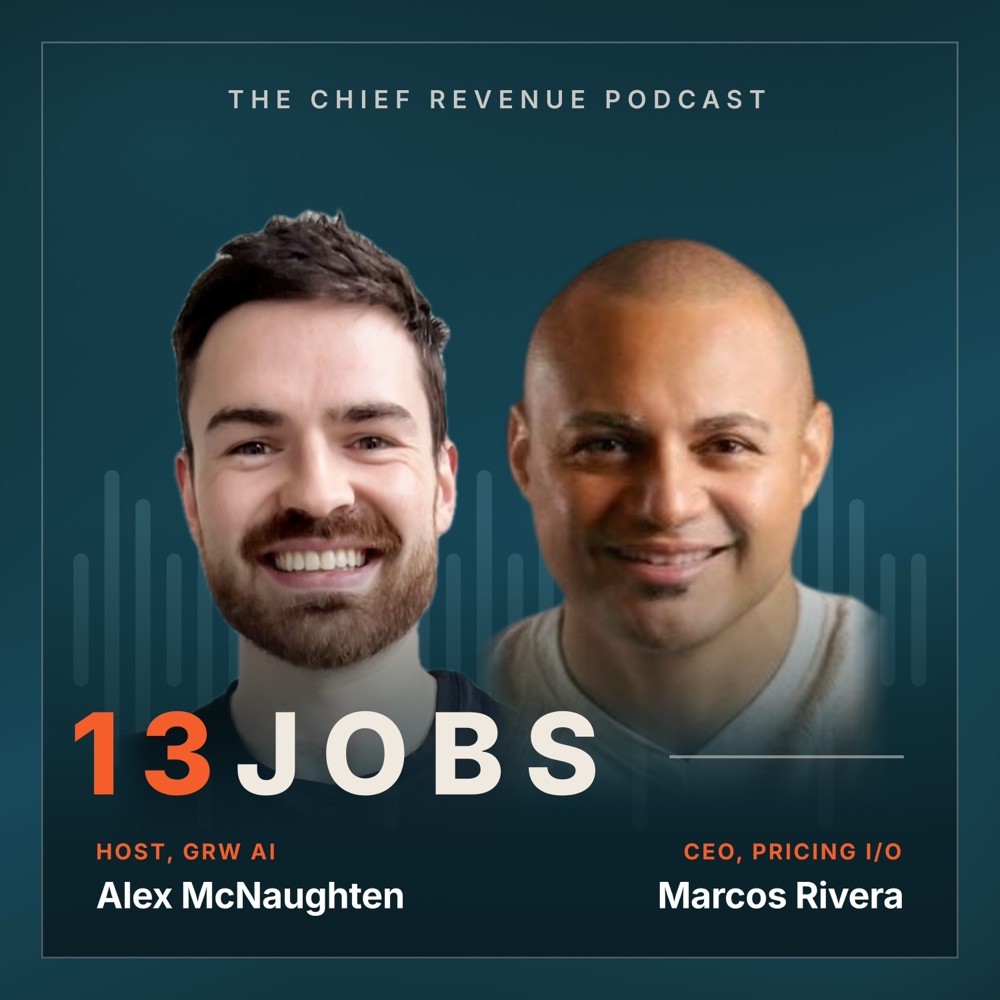
How to price your product
Early on you are not pricing for profit, you are pricing for perception, and Marcos is blunt about what guessing your way through it costs you at every renewal after.
 Hosted by Alex McNaughten
Marcos Rivera · CEO, Pricing I/O
Marcos Rivera is the founder and chief executive of Pricing I/O. He was head of pricing at Vista Equity Partners from 2016 to 2019, building the practice from the ground up across the firm's funds and portfolio, then went out on his own as COVID hit.
A product manager by trade, he decided that how a product is priced and packaged is more impactful than the product work itself. He has since helped price more than 400 SaaS products and coached over 100 CEOs across a twenty-year career. He wrote Street Pricing: A Pricing Playlist for Hip Leaders in B2B SaaS, and hosts the Street Pricing podcast.
In this episode, we discuss:
- The founder who sets the price once and then defends it in every deal
- Early on you are pricing for perception, not for profit
- Premium, speed or service: pick a lane and make the model agree with it
- The $30 a user mistake, and the sales rep who called it
- Changing the metric from per user to per claim, and $300K to $30 million
- Creating your own anchor when you have no data to price off
- The REAL framework, and why the lift gets subtracted
- How much of the value you can actually capture, and why AI changes the range
- Two plans from day one, and the premium for the price of the standard
- PLG: do not put up the paywall before the habit has formed
- AI costs eating the margin, fair usage policies and forgiving overages
- How you know it is working, and what the variance in your prices is telling you
Quote of the show
“If everyone's buying your price and nobody's pushing back, you probably need to raise your price.”
Key takeaways
- Price for perception before you price for profit. Early on you have no data and little leverage, but you do control the story. A simple structure that signals what the product is worth beats a number picked out of the air, and it is far easier to move up from later.
- Pick a lane, then make the pricing agree with it. Premium, speed or service. Quoting a premium price and then taking 75 percent off it tells the buyer the premium claim was never true in the first place.
- Change the metric, not just the number. Marcos moved a product off $30 a user onto roughly $3 a claim, because the better it worked the fewer people you needed. That product went from a little over $300K to $30 million in two and a half years.
- Build the anchor before you name a price. Where there is no direct competitor, the enemy is the old way. Add up the hours and the errors it costs into a number that is uncomfortable, then price against that number.
- Give the premium plan for the price of the standard. Two plans from day one. Anchor high, let the early customer feel they got a deal, and take feedback and a defined window in exchange. Nobody says no to that.
- Do not paywall before the habit forms. Changing a working habit takes six to eight weeks. A two-week trial that ends in a credit limit interrupts the very change it was meant to cause, so give the higher tier, set milestones, and let people extend.
- Read the variance, not the average. If people pay wildly different prices for the same thing you have a problem, and if they pay the same price for wildly different usage you have a different one. If nobody pushes back at all, you are too cheap.
Transcript
Marcos, thank you so much for joining the show. How are you today?
Yeah, I'm doing terrific, Alex, man. Thanks for having me.
Thanks for coming on. Well, for those who don't know, Marcos, you are a pricing expert. You are an author of Street Pricing. But yeah, tell us a little bit about yourself. Give us like your quick background, and then we're gonna jump into the show.
I was the head of pricing for Vista Equity Partners. Did that over, you know, 3 years, did it across all their funds, across their portfolio, and built a practice from the ground up. So after leaving that position. So I was doing it from 2016 to 2019, then I started on my own, and then COVID hit, right?
And so my firm Pricing I/O was kind of born from COVID but just decided to really take on this problem that I saw across all and each, big or small, new or old, like these companies had a really big issue with pricing, packaging, how do they exchange value, right? And so Sales teams were confused, they relied on discounting, you had really awkward renewal conversations in many cases, some of them were downsell.
Yeah.
Lots of stuff that just were symptoms of just not really having a good solid strategy and pricing model behind the scenes. So that's where I said, you know what, I'm gonna focus on this head on, this is what I'm gonna do. I'm actually a product manager by trade, but decided that I think the pricing and packaging of the products is actually more impactful.
So there you have it.
Awesome. And like what you just described there is pretty much exactly what I want to talk to you about today, is particularly in like early-stage companies, you know, one person kind of sets the price. And then, you know, in a seed-stage company, they're the one defending it in every deal as well, because they're often the ones still selling.
And then even as they start building out the team, it's not like they have someone who's really thinking about this all the time, day to day. And like a lot of those symptoms you just described, which is heavy discounting is happening, you know, renewals, they're not happening smoothly. So, you know, if you're a founder of an earlier stage company and you're trying to avoid all of that, you know, and you're trying to get this right, particularly in this new kind of AI world with consumption models kind of now kind of picking steam as well, How do you think about pricing?
Like, where do you even start?
Man, I— so I'll tell you where not to start. How's this? And then I'm gonna break it down real quick because I keynote on this subject all the time, right? I talk to a lot of folks at different stages, founders all the way to multi-hundred million dollar companies. But here's the thing. The number one thing I get from folks that are in their early stage— when I say early stage, I mean, you're like, you know, you haven't even hit $10 million ARR yet.
You're probably at $5 or less or even or even less. And they say, well, Marcos, I don't really need to think about pricing yet, right? Because I'm sort of early in this whole journey.
Hmm.
That's where you're wrong. You gotta be super careful, right? You don't need to do some, you know, 7-figure pricing study with all this data with McKinsey or Bain or anything like that. But you have to sort of set the stage. And in the beginning, you're not pricing for profit necessarily. You're pricing for perception.
The perception of value around the product, right? You're a founder. No one can tell the story better than you. You typically have the passion behind it. Maybe you felt the pain for many years. Maybe you were once your customer, right?
Mm-hmm.
You need to take that and you need to use it. And the pricing and packaging behind it is not to be overly complicated. You don't need 7 tiers and 15 add-ons and all this crazy stuff. It can still be very simple. But the idea behind it is you have to have some structure in order to help communicate the value over, because the moment you give someone a compelling idea and a reason to buy you, that exchange equation is already starting in their head.
And if you just throw it to the wind, like, I don't know, just $25K, here, go, then I think you're really doing yourself a disservice at the founder level. So that's one thing I would avoid is not just to just guess my way through it. I'm early.
I don't know.
I think you should still have some basic structure. Yes, you're not gonna have a ton of data or rigor, I get it, but some basic in place to start the right perception building is what you're doing. Does that make sense, Alex?
Yeah, I think it makes complete sense. And, you know, actually now thinking back to like what we did with our pricing when we first launched, we made that exact mistake. We didn't think about it. We were just like, eh, you know, finger in the wind, like we'll worry about pricing later. And I wish we had taken, like, I wish we had been more thoughtful early on in creating that perception that you described.
How do you figure out what perception you want, perception you need to give? You know, 'cause I feel like that was immediately where my mind went, is like, how do you even know what perception you should be giving early on?
Yeah, that's a tough one because it really depends on where you see the company going and actually the reason behind you doing this in the first place, right? For founders that are, you know, doing it to get rich quick, you're probably not gonna get as far, right? But I think when you're really trying to solve a real problem and you're, you know, that your solution is superior to the alternative or whatever they're doing, it's gonna force you to articulate that piece that's better.
We have this data that they don't. We have this integration that they don't, this process that they don't, this distribution that they don't, whatever that may be. And because of that, you care, Mr. or Mrs. Customer, because this is going to get you this percentage more growth or this much more likelihood of this outcome, like whatever that is.
You have to really sit down and stare in the mirror and actually say, here's the outcome of what we're doing and why it matters so much. And that fuels the perception you're trying to build. And I'll say this, right? You don't always have to be the premium product, although most people like to think of themselves as.
Premium product, right? You could be the fastest product. You could have the best service layer wrapped around it, the human-in-the-loop piece. You could have, you could be the one that is low frills, quickest to get stood up and running. And that's, that's okay, right? But sort of, but you have to own that, like—.
Right.
You have to own that. This is where we are. This is where we play. And the perception building has to align to all that. So when you give out a price point, and if you say you're going on a premium bend and you say, hey, look, we have more curated, I don't know, information or proprietary things that no one else has, and therefore we can get you results no one else can get you.
Here, let me give you a price. Oh, it's $25K. How about I give you a 75% discount off of that? Like, that doesn't quite match with like the perception building and the signal, right? And so from my perspective, if you're going to go premium, if you're going to go speed, if you're going to go service, right, the standard 3 stools that everybody knows from business schools, right?
Then you have to own that piece and then the pricing model behind it has to align, meaning no big fat discounts for the premium side. You could give them step-ups, you could give them bundles, things like that. For the speed side, you almost want less than 2 variables in the metrics. What I mean by that is you don't wanna have to count 15 different things on the speed side because the moment they get to value, they're gonna want something else.
Make that upsell easy, okay? And then when it comes to the services side, Oftentimes what you want to do is make sure that you don't over— how can I put this— overallocate and create the services to be too heavy. You have to give them the right amount of service to get to that next milestone and then the next and then the next and make sure that the perception around the service is a— that experience allows them to trust the product even more.
Remember, trust the product, not the person. The services can get very muddy. In those pieces. The idea behind it is the services is really there to unlock the value of the product. So you gotta be careful there. Those are my big 3 when you think about your positioning and perception and when you start to build your pricing model.
Does it make sense?
It makes total sense. Before we go into like how to do this, or like, I know you've kind of started, before we go into this, into like practically like how you do this if you're thinking this through for the first time, I'm curious, tell me about a time when you got this wrong, like when you priced something wrong and like, what did you do?
What did it cost? And how did you figure it out?
Yeah, when I was, you know, a wide-eyed, skinny product manager back in the day, right? I really thought that, I really thought for when it comes to pricing and packaging, I actually thought that thou shalt never discount. Right? In the enterprise world, or in any even midsize these days, it's not about not discounting.
It's about leveraging strategically at a discount, right? The old scalpel versus the sledgehammer kind of thing, right? And so in my early days, I remember this too, because his name was Scott. I just took over a product as a product manager and redid the pricing. I was proud of it, thought it was really cool.
And I said, here's the price, Scott. It's going to be $30 a user. I'll tell you more here in a second. $30. He goes, okay, cool. What's the real price to the customer? I said, what do you mean? He's like, well, they're not going to pay $30 a user. The competitors are at $15.
I said, yeah, but my product's better. He goes, yeah, but that's not going to work in the sales cycle. And so what I ended up doing was arguing back and forth of not discounting versus building up the value to the sales rep. So a couple of big mistakes. Number one is I didn't have a discounting framework in place.
Yeah.
I didn't have the right value buildup to show how we're different from the other alternative. And number 3, honestly, I just wasn't— I was a little naive. You have to win over sales when you're doing pricing and packaging, and you have to get them to buy in on your product. And if you're the founder, that's you.
But when you hire your first sales rep, they have to believe in your pricing and your value prop as well.
Right.
And I made those big 3 mistakes, and it was a big fat dud. I have my net prices. They, they discounted anyway, by the way.
They didn't care. Yeah. Yeah.
And so I had to do 2 things. One is I had to reestablish credibility and pull out the value. But then I changed the value metric. I stopped charging per user and decided, you know what, everyone else charges per user in the industry. But why? It actually, it's counterintuitive. The better my product works, it was like a dispatching, you know, you dispatch field adjusters and things like that.
The better the product worked, the less you actually needed people. So why in the world— this is back in the mid-early 2000s, right? Why would this even work if I am getting paid less for actually doing, you know, delivering on the value, for doing good? So I changed the metric to per claim.
What I said is, instead of charging $30 a user, I'm going to charge you— it was like just under like $2.99 a claim, $3 a claim.
Okay.
And completely took off from a product perspective. And I had the discounting thresholds. I had the whole thing like and that had measures. Did you know that using our product actually allows your adjuster to solve your claim 40% faster, and that 40% faster actually leads to 12 points in customer satisfaction lift, which leads to more upsell in your policies and higher renewal?
Like, I linked everything, and that perception change was, was, was the ticket. Kept it simple. They understood the language of claims. They, they tracked it by it. They knew it. They could tie it all the way through in their own cost structure. Sales understood it. I gave them volume discounts based on number of claims and let them, uh, discount it with high volume.
And I gave them bundle discounts. We had another like compliance engine. So if you combine these 2 things, I'll give you a discount. I did all that stuff. So my second round, this card, uh, I kid you not, this product I took it over was a little over $300K in annual revenue. By the time we were done, it had hit $30 million, and that was in 2 and a half years.
It's a pretty nice turnaround story.
It just— complete turnaround. But that's, again, the perception, the pricing model that supported it, all that. I just approached it so wrong from the beginning. I was naive.
Was that the moment that you kind of started to figure this out when you got it wrong at the start? That was like, oh, okay, this is really important.
It was. I've always priced my products. Any product I've ever built, I priced. I did lots of complex integrations. Financial services, insurance services, really tough industries to sell into, if you know what I mean.
Mm-hmm.
And so, but that was one of the storylines that really allowed me to pull the levers the right way and everything took up after that. And so then my peers started giving me their products and saying, hey, can you price my product? And can you price my product? I just started collecting these products in a portfolio, moved up the ranks in product and management.
I did some M&A too and did all this pricing. And that's how I started getting good at it. And then Vista came and brought me in, and then I got super good at it by doing it across 100 companies, right? So it's that pattern recognition that once you get going, just really, really fuels the skill.
That's really cool. So kind of like making this real, like, let's put like, you know, I'm a founder. I initially picked the price off 2 competitors, a hypothetical situation. I picked my price off 2 competitors on a bit of a gut feel. I think I want more of like an affordable perception in the market.
What next? Like where to from there?
So there are a couple of things here. I always like to do a couple of things when it comes to pricing, especially early stages where you don't have a lot of data to go off of.
Right.
And so the first thing I like to do, this is in my book, there's a whole chapter on this one in my book about early days pricing. Like how do you figure something out without having a ton of data? Historical data, things like that. And the idea behind it is, well, you have to create your own anchor.
And what I mean by that is, when you tell someone about your great solution and how much it's going to help you and all this, they're trying to find some kind of reference point in their head for how to think about how much this thing is worth.
Right.
We all do it. I can give you a slice of pizza and you're already thinking about how much this thing is worth, right? So it's just a natural thing. So you have to control that anchor. It's not about the price just yet. It's the anchor. And so for me, the first thing I do is, all right, competitor.
You just mentioned a couple of competitive points. That's a great anchor because if the competitor is either well-known or the incumbent you're trying to boot out, now you know what they charge for their value and you can position against that. And I'll talk about how to do that in a minute. The second one is if there is no real direct competitor, say you're doing something new, well, now you have the extra task of educating that end buyer on why your new thing is better.
But then the enemy isn't necessarily a competitor. The enemy is doing it the old way. And that old way could be, you know, number of hours stitching together information from multiple systems, number of errors that you, you know, in doing it the old way. And so you have to sort of accumulate and add those up into a scary number.
Like, you know, you realize you probably spend 11 hours a month doing this in PowerPoint, and I actually can take that 11 hours down to 1. What do you think?
Right? Mm-hmm.
Now you're creating the anchor and then you create, then you're showing the value from the anchor and that starts to reset how much they're willing to pay for your product out of the gate. So number one is you focus on the anchor. You don't focus on the price yet. Number two—.
Just on that, Marcos, I think I know what you'll say, but I'm curious anyway. Like with a lot of like new AI products, often it's you're not competing with one direct product. You're kind of competing with like this part of that product, this part of that product, this human process over here. So you're saying actually like map all of that out and then like This is the total cost.
You should, you should map it out. There's 4 big areas that you want to map out. The first, I call it my REAL framework, R-E-A-L. Okay, real quick, I'm not gonna spend a lot of time on this one, but REAL. So R stands for the revenue impact, right? So this is growing revenue, keeping revenue, or expanding what you already have, right?
The E is the expense part. That's where we naturally go first, right? How many hours you spend on something, how much your licenses you're spending on all this other stuff. It's really more about the competitive advantage you get by saving the money more so than the money itself. A is avoidance. This is avoidance of risk, compliance, penalties, new spend, things like that as a result of your product in here.
I don't have to hire 5 people anymore. I can use this thing. That's great. And then the L, this is the tricky one because I'm subtracting the L. The L is the lift required to get the value.
Yep.
How much work gonna take me? Can I get this done in a week, in a day, in an hour? How much is gonna work? And so the faster you can get to value, the more of it you can capture. Okay, let me say that again.
Okay.
The faster you get there, the more you can capture. If it's a long journey of training and configuring and services, then the less of it you can capture. Okay, and how much you can capture generally depends on the industry, but you can capture anywhere from 10 to 30% of your value with AI these days because AI is just doing more of the work.
And so if you give $100 worth of value, the natural thing to try to capture is $10 of that $100 of value, but it can range from 5% to 25, 30% depending on competitive intensity and what you're really doing. But that's just a general, like, little return range, right?
Yes.
Nobody wants to buy something that's gonna break even. They wanna make some returns there. So that's a natural place to start. If you want to get more aggressive and like, hey, I want to capture more market share, then you can go lower in exchange and give them a little bit nicer return on that.
But that's a general rule of thumb. Okay?
Helpful.
So you have your anchor, you have your percentage share there I just mentioned a second ago. I can give you in the show notes a spreadsheet on this one. I have a whole thing around it.
Okay, great.
And then the third thing you want to do is structure. So the idea here is, Hey, I'm going to save you thousands of dollars or hours or whatever this is, or I'm going to make you so much more money. Your conversion rates are going to double, whatever that is. And the idea behind it is, and I'm only going to do this for X amount of dollars, look at the return you're getting.
This thing pays for itself. This is what I love. This thing pays for itself with one deal. This thing pays for itself with your next transaction. This thing pays for itself very, very quickly, and that reduces the anxiety. And the point here is that when people are trying something new, they're excited about the benefits.
They just don't want to be, you know, they don't— no one wants to be a sucker, right? They want to make sure it works. And so the way you structure it is a couple of things. One is you always want to have 2 plans and not one. What do I mean by that?
So you always want to have like a standard and a premium or base and a pro or whatever the hell you want to call it. That's fine. But the idea here is you want to, even if your product is new, you have these 2 because what you're going to do is you're going to say, hey, I'll tell you what.
I know, thank you for stepping up and being an early adopter or for taking this on or whatnot. I'll tell you what I'm going to do. I'm going to give you this premium plan for the price of the standard. Right.
Right.
So I'm just, I'm anchoring them high. They feel great now because they're like, oh, I'm actually paying you know, less for something and I feel good about that. They're giving me the high-end plan. The standard plan could just be a stripped-down version of what you have, right? But you want to give them the premium for the price of the standard.
No one's going to say no. Okay, who's going to say no to that? You give them the premium for the standard, or you can even add some other embellishments there. And you say, hey, in exchange, I really just want your feedback. And is it okay if we set up these meetings for the feedback?
Yeah, absolutely.
And if that's cool with you, and then at the end, I know it expires in 6 months or whatever it is, 3 months, But I would love to see how you really enjoy the product and then we can definitely make something work really great for you, right, and then take it from there.
So what you're doing is just reducing the anxiety, right, anchoring, right, you give them the good value exchange and why this matters, you give them the structure that makes them feel like they're getting a deal. Do you see what I'm doing here? I haven't even talked about the actual prices and all that stuff yet, this is all about managing the structure of the deal and getting it in there nice and easy and from the early stages of your company, as a founder or as someone, you know, ready to bring on some sales, you have to make sure that that is a very clean and consistent storyline and narrative across everyone.
Because in the early days, you're changing quite a bit, right? You're like, oh sh*t, I should be building this and not that and all this stuff. And that's okay, but the narrative has to stay clean and crisp because for new reps, especially when they come in, they're going to learn it, they're going to get it wrong, they're going to need coaching, they're going to have, you know, of that ramp-up time.
And if you're wishy-washy and changing your story narrative a lot, it makes it a lot tougher to get those guys.
That makes a lot of sense. And you're so right, you know, it takes 2 to 3 months to ramp up a rep to being productive as it is. And if you're changing things on them every other week or every other month, like, you're just, you know, setting them back a little bit further every time.
They don't have that confidence when they're actually having these conversations. I'm curious, like, how did would change if you're more PLG or like sales-assisted PLG and you've got your pricing like smack bang on? Even some, even some like straight B2B companies have their pricing on the website too. So does that mean you have to kind of tell that story through your digital channels?
Is that, is that, you know, the difference here?
Yes, with a bit of a nuance here. So you do have to tell it through the digital channels, make sure that there's clarity. You want to show that there's also some additional things you can do in framing on the page when you're PLG motion more. Typically speaking, the product is doing more of the talking than the sales rep.
And so what you're giving them access to, again, and that whole get the premium for the price of the basic works really well in PLG motion as well.
Yes.
But what you're doing is you're trying to nudge them to that next milestone to be able to convert them over afterwards, right? And so the idea is a lot of companies give them what I call just, just, you know, open exploratory access, but no real focus on getting to the milestone. So for me, and this is just my, my, my product mind coming out more than my pricing mind, is I actually like to give customers a path, right?
Here's what I want you to accomplish. Yeah, you can explore these other things, but I got to get them to send their first email. I got to get them to, you know, dispatch that first job. I got to get them to upload a file. I got to get them to do— I got to get them to do something.
Very, very specific that kind of drives— I think some people call it the magic moment. I don't know, it feels kind of gimmicky to me, but the point is, is trying to get them to do something that they get that sensation and aha. And here's the key, this is the one where a lot of PLGs go wrong, is that they try to introduce the paywall or the pay factor too soon.
Human beings need a little bit more time to build that habit. If I'm getting hit with, your credits are out, or you can't do this, or sorry, you're gonna have to pay, too early before I start to change my habit, which can take a month or two.
Yes.
And I get turned off and I just want to leave and I don't do anything right. So most from a psycho— you can read the psychology papers on this. Most humans can take about 6 to 8 weeks to change that habit. So you're talking about 2 months. So going on the higher end and a PLG motion, give them that, give them that higher tier access for the price of low, give them paths to milestones that get them meaningfully deeper in the product and give them about 2 months to change their habits.
Because then after about that, look back and you're like, I don't want to do it the old way anymore. I don't want to do it in Excel anymore. Like, and so that, that is one of the keys for the POC. So that's the nuance I would call out.
That makes a lot of sense. And like, you know, one data point is like what we've seen from our free trial motion is it does take longer than you think. Like, you think people are just going to go in there and suddenly just like change all their behaviors. But actually, you know, we found we had it in our head like, oh, 2 weeks will be a good like free trial length.
Like, that'll be enough time. In actual fact, like most, like the successful ones mostly turned into like 3 to 4 weeks, even like one crept into 5 weeks because people needed more time to actually, it was like actually just like explore the product and figure it out. And like, I'm sure we can make some improvements in terms of like guiding them better in that experience.
But I think even then, maybe 2 weeks has always been like overambitious in terms of a product that's like touching them and their team members to like change a whole habit.
I don't know about you, man, but 2 weeks just flies by these days. Yeah, no, you're right. I blink and I'm like, oh crap, I'm at the end of the month already, right? So I think you do want to give them— so I would not just say, hey, your trial is 2 months.
You could even say your trial is 3 weeks or 4 weeks or whatever, and then let them extend. And that's usually a really good signal. If you say, hey, I see you're getting some value here, would you like a little more time to check us out? And they usually say yes, and then you kind of move them along because you— well, there is a natural group of procrastinators that will always sign up for your product, right?
They'll sign up in the moment and then they won't come back to it for a while until you're like a day or two before the trial ends, right? But that's, you know, you don't want to optimize for those necessarily, right? You want to optimize for those that are actually, you know, you're nudging and moving and you're tracking that, okay, they've taken, they're on step 4 of 6, let's keep nudging them over to step 6, right?
And those are the key ones there. For me, 2 weeks flies by these days, but that used to be the standard, right? 7 days, 14 days. I get it, right? I get it. But I think especially with AI, the adoption curve is a little different because we are all kind of learning and the conditioning is changing with AI.
I'll tell you this, like right now versus 5 months ago, it's different.
It's totally different. I know. Yes. It's like a different world. Like we're actually in a different world. And, you know, from the start of this year to today, it's a different world. Last couple of things I wanted to ask you about is, you know, AI seems to be changing how people are thinking about pricing.
And I think like one of the challenges that a lot of, you know, companies including ours are seeing is you've got an AI, you've got an agentic product, you're leveraging LLM providers kind of under the hood, various LLM providers, and then suddenly your product usage is going like this because, you know, it's sticky and it's working.
But what does that mean? It means your costs are also going up quite high. And like what you thought was gonna be like a 90% growth margin company is now looking like 60% or 50% even. And like I've heard a lot of stories like from other founders who are going through the same thing.
So I'm curious, like how do you think about that like mid-flight when, you know, things seem to be working actually from like a product perspective and like, typical PMF signals for an early-stage company, but then you're like, oh crap, how do we make this mathematically work now?
That's right. I mean, we're living in a world now where that incremental user, that extra usage actually counts, right? It actually hurts the overall margins and costs money. And by the way, nothing insignificant either. So 2 things, right? One thing that I noticed is that as you're as you're gaining traction across, right, you may release something that is on one of the frontier models that is adding a lot of value, and then you get a bit of a spike in usage.
Oftentimes that spike comes down, by the way. So when you see usage behavior, the spike does level out. However, it does give you a bit of a crunch on the LLM, on the margin side with LLM cost spiking and things like that. So there are a couple of things. One is a fair usage policy always protects you from those like power users, like the weird midnight million calls a minute type of thing.
And so a fair usage policy out of the gate will help you sort of, you know, throttle back or put some boundaries and guards. And this isn't new. This is something that APIs have been doing for years, right? It's just like, hey, watch for those crazy use cases. But you can also create what's called allocations or entitlements over time.
So the idea here is you give them access to it, say, hey, we are you know, we are giving you open access or, you know, trial access or whatever it is so people can get it. That gives you a little bit of an opening a few months later to say, okay, great, these are the, you know, plans or whether you're doing credits or usage limits, whatever you're doing in your system, but this is what it's going to cost you from there.
So my point is, is don't give it to them for free with the expectation that it will always be free and there's no other— there's no like boundary out of there, right? If you have a— as a product manager, this is— I talk to a lot of product managers too. If you're developing a feature that is a little more inference intensive or things like that, then you want to make sure that you release it with a caveat that you can use it up to, up to, up to say like 100 usages or 1,000 credits or whatever that is, but for a limited time we're going to forgive any overages.
All right.
I see.
So what you're setting up is you're taking away the fear of using it by forgiving the overages over the period of time, and you get the real usage. And then you say, okay, great, thanks. Now we're gonna— and you use that data, by the way, to set the thresholds, right, at the same time.
And then you say, here's where, you know, here's where we're gonna ask you to now to continue. You give them some like allotment already included so they don't feel like you're just snatching it away out of their hands, right?
Mm-hmm.
But say, hey, look, this is based on your usage, this is what we're gonna allot you. And then if you need more, here's what it looks like to get more. Lovable has been really great about top-ups, right? Use it up to here. Oh, you need a little bit more? Just top it up.
You don't need to like upgrade, double your pay, right? So give them little avenues like that. What I found in my recent AI buyer study is that buyers want soft caps with flexibility on how to deal with overage. That's the number one requested control mechanism.
Right.
They don't want hard caps. They don't want to be like, you know, stop, you can't do this anymore. They actually don't want to prepay for a ton either and draw it down. I was a little surprised on that one. They prefer, just give me a cap that's soft and let me deal with the overages as they come.
And that was the number one answer from all of the AI buyers.
That's really interesting. And that makes a lot of sense. Marcos, this has been a great conversation. I could probably pick your brain on this topic because it's something I'm really interested in and curious about at the moment. I could pick your brain on this probably for for many hours, but last question for today, which is, you get this right, like what happens?
6 months from like nailing this, dialing this in, like how do you know you've dialed it in? Like what should you be looking for?
You should be looking for a couple things. One is, and I'll split it up between like sales-led and PLG 'cause they have some slight differences here. So on the PLG side, you want those conversion rates to continue to climb up, right? We all know, like, a free trial conversion to paid is usually not that high anyway.
It usually could be 10%, 15%. If you start seeing that thing climb up even higher, you're nailing something. People are saying, okay, I'm willing to give you some money. But what happens after that? That's the key. What happens, what I call early expansion. So the best expansion windows most commonly are between 3 months and 9 months.
Right.
If you start seeing expansion windows happen earlier, then you actually might be a little bit cheap. And you actually may want to think about re-architecting some of your values to get folks even deeper. But it's a good sign if people want more and they're asking for more. So you look for that from a PLG perspective.
And from an SLG perspective, look at those, look at the variability in close rates and in final price points. And so if you see your price levels ranging anywhere from $10K to $45K, that's a bit of a problem. That's like a 4.5x difference. You want to keep your ranges Like your ranges should be 30%, 40% at most.
And this is because you're sort of training and you're sort of evaluating different TAMs that you feel like are worth attacking and others that are not. And over time, that 30% to 40% becomes more like 15%, 20% variances, and you keep that tighter. So look for variances. If everyone is— by the way, if everyone's buying your price and nobody's pushing back, you probably need to raise your price, right?
Yeah.
And so look for that as well. So what happens at the point of sale? And then again, what happens on the expansion levers? For newer companies, you won't see as much product expansion as you would usage expansion. And so if you're not— if you're seeing, by the way, let me just make it super simple.
If you're seeing folks paying wildly different prices for the same thing, you have a problem. And if you have folks paying the same price for wildly different usage, you've got a problem. Okay.
Yes.
And so look for those 2 imbalances when you're selling to see if your pricing is working.
That's awesome. That makes it really concrete and simple at the end there. Marcos, great conversation. Thank you for coming on the show. Where can people find you, connect with you? Like you mentioned some resources as well. Yeah, just—.
Yeah, I'll give you that real framework here for folks if they want it in the notes. I am easy to find on LinkedIn. You can just go Marcos Rivera and I'll pop up there with my bald head and, you know, my smile and all that, my cheesy smile. And at pricingio.com, you can always find— I put a lot of free stuff there as well.
Awesome. Marcos, thank you so much. Appreciate it.
Thanks for having me, man. A lot of fun.