
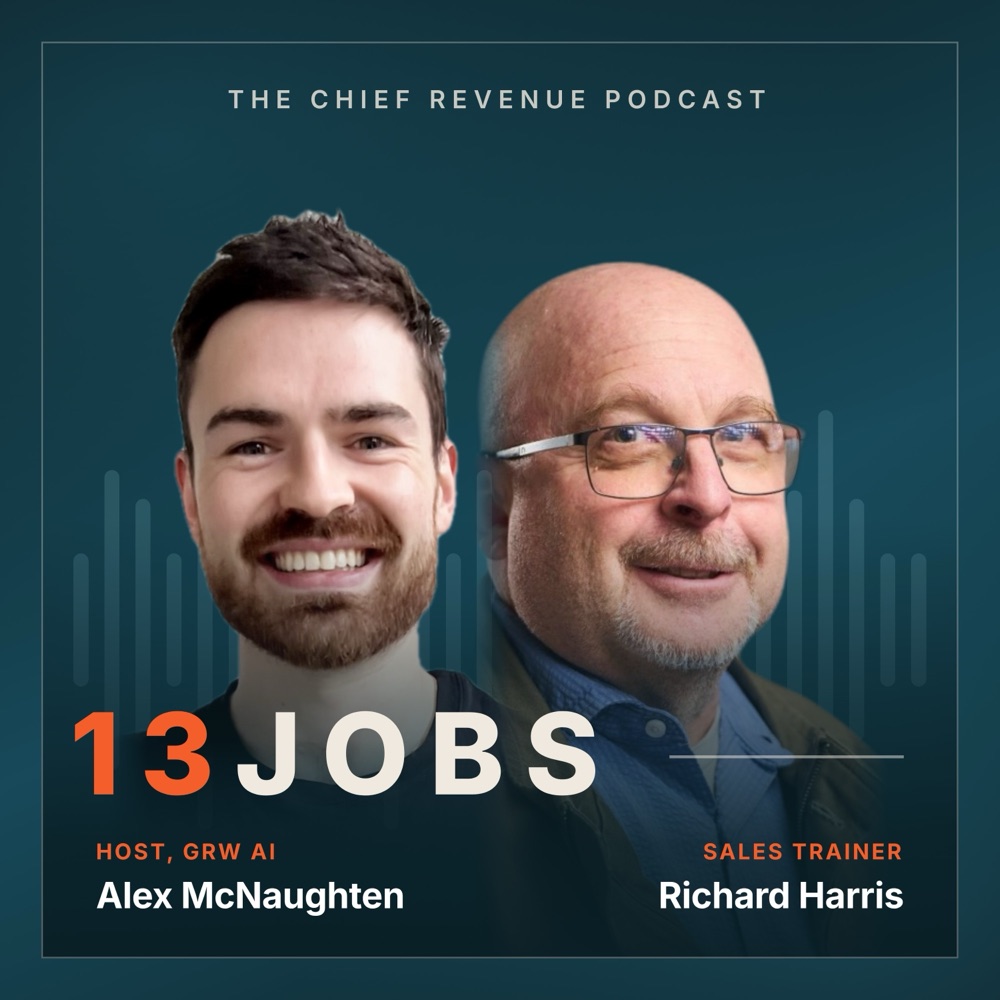
What everyone gets wrong about prospecting
You did not miss the number because you prospected too little. Richard's argument is that the leak sits further down the funnel, and nobody wants to own it.
 Hosted by Alex McNaughten
Richard Harris · Sales Trainer
Richard Harris is a sales trainer and go-to-market consultant, and the author of The Seller's Journey. He teaches revenue teams how to earn the right to ask questions, which questions to ask, and when.
He is a 4x Salesforce Sales Leader and 5x AAiSP Top Sales Leader, and co-founder of Surf and Sales. His first sales job was selling jeans and t-shirts at The Gap.
In this episode, we discuss:
- Everyone piling into top of funnel, and the noise that follows
- Sixteen touches for a first meeting, and where that number is heading
- You did not miss the number because you failed to prospect enough
- Why top of funnel is the easiest place to lay the blame
- 84% of leaders think they coach, under a third of reps agree
- Throwing bodies at the problem, and now throwing AI at it
- The three things to fix at once, and getting the company to agree
- What a year spent on conversion would have bought you
- What a VP should be doing before asking for budget
- Recording your own call and handing it to the team to critique
- No ramp period for managers, and the conversations nobody teaches you
- Check your ego, and the promotion he assumed was his
Quote of the show
“All AI is doing right now is accelerating the suck.”
Key takeaways
- The prospecting problem is usually a conversion problem. Missing the number is rarely about volume at the top. It is discovery, closing and discounting further down, and both ends can be worked at once.
- Top of funnel is the easiest place to point. The people accountable for it are early in their careers and cannot push back. No VP of sales volunteers that their own conversion rate is the problem.
- AI accelerates whatever you were already doing. The quality of an individual message may improve. Volume rises faster, and the noise you are trying to break through is the noise everyone else is now adding.
- Coaching that people can feel is rarer than leaders think. 84% of leaders believe they coach their team. Under a third of reps agree. The gap is reinforcement after the training day ends.
- Do all three at once. Prospecting, conversational skill, and working out what AI does to your motion. Funding one and ignoring it for two years is the pattern that keeps repeating.
- Lead from the front before asking for budget. Get on the phone with the reps. Record one of your own calls and hand it to the team for critique. Then go and ask for the money.
- Nobody gets a ramp period for management. Reps get one. New managers get a title and are left to work out the genuinely hard conversations on their own.
Transcript
How you doing, Alex? It's great. I'm great, man. It's so good to see you again. So I like, we were talking offline. I like how your beard's a little cleaner now as opposed to my scruffiness.
So yeah, I've tidied myself up.
You're quite handsome.
For those who don't know Richard, you are, well, you're a sales expert for starters, you go-to-market strategist and you are the author of a new book called The Seller's Journey. But tell us a little bit about yourself, Richard.
Gosh, I hate this question. Go-to-market strategist, founder-led sales, sales strategist teaching reps how to earn the right to ask questions, which questions to ask and when. That's what I specialize in. I am, you know, a husband and father of 2 great teenage boys and Puppies and, you know, love the surf, obviously from Surf and Sales, and love reading.
And, you know, that's the basics. My first sales job was, you know, selling at The Gap, literally last century, selling jeans and t-shirts. So how about we leave it at that?
You've been selling for a long time. Well, brings us on to our topic today, and I think it's an interesting one. And it's definitely one that folks are always wrestling with. I think it's always a topic of conversation really, which is what's everyone getting wrong about prospecting?
Yeah. And I don't know that we're ever gonna get it all right, by the way.
No.
Like, let's be honest, right? Like, that's a good point. You know, like there's always something we can do better. So note that, you know, the answer comes with a certain jaded bias perspective of what's happening and it's, you know, it's April 2024. Everybody in 2024 is really focusing on prospecting top of the funnel, which you always have to do.
Like, we get it. Like, you gotta fill the funnel. The challenge I'm seeing, there's a couple of them. One is that everybody's wanting to do it, which means it's gonna get even noisier than it has been, right? It's gonna be even harder to get through.
And it's already hard to get through, right? Like it's not easy today. Yeah.
I mean, you know, the last data set I saw was like 16 touches, you know, to get a first meeting. And granted, a touch can be something like a social media, you know, a like on LinkedIn or a comment. Like it doesn't mean 16 emails and phone calls, right? Like we know that, but I can only assume it's gonna get harder.
And I don't know if the answer then is more traditional marketing, not outbound marketing, but just like pay-per-click. Is that gonna increase the pay-per-click? Because, you know, that's what we think. And so anyway, so this, this whole outbound motion I think is getting really, really tough. Part of the people are also overlooking in this prospecting.
Everybody wants more prospecting. Everybody's wanting to go outbound. Everybody wants to do this. Are the buyers, are the buyers really ready to buy? Like, I don't know. Like last year in 2023, nobody was willing to spend on lots of things. But what are they willing to spend on now? And granted, I'm gated, right?
Like I talk to clients who want sales training or prospecting training or go-to-markets, you know, founder-led sales support and stuff like that. But I just don't know, is the market ready to open up and buy? And again, I just don't, I don't have that magic ball. So that's the mistake. Those are the first 2 mistakes.
One is this, it's gonna get noisier. And the other is, do we even know if our market's ready to buy? Right? So I do wonder, you know, I haven't even said this to clients, I probably should, is how many customers have you talked to that says they're willing to start purchasing again. Like the founder, that founder, even if you're a big company, you should still be talking to people to see if they wanna buy because that I think is a big measurement.
But, um, well, I, so I suppose my immediate question to that is if we're not doing, if we're not prospecting, how do we even find that answer though? It's a bit of a catch-22, no?
Totally, totally right. Exactly. So I'm not saying you don't, Right? It's not a zero-sum game. I'm just saying that be mindful about what you're asking for.
Right.
The flip side of that is you didn't hit goals last year because you didn't prospect enough. I can assure you that was not the challenge. The challenge is that your sales team doesn't know how to do good discovery and they don't know how to close and they don't know how to you know, stop overly discounting.
That's the challenge that I see. And it doesn't mean that you can only choose one of those paths. You can choose both. And in fact, you should choose both. So that's just what I say is like, it's like, why aren't you focusing on converting what does go into the funnel? Like, wouldn't that have a better, a faster lift?
That's interesting, right? What do you think? Because I've definitely noticed the same thing too, is folks are very focused on top of funnel, top of funnel, top of funnel, but then they're converting at terrible, terrible conversion rates in their funnel. And then they're also not looking at the data in terms of deal source to conversion rate as well.
Yes.
So yeah, expand on that. Like, why? Why are people just focused on top of funnel and not thinking about actually converting what's in the funnel?
Because you can whip the horse a whole lot easier at the top of the funnel, right? It's easy to fill. Like, I can visualize that and nobody— and it's easy to lay the blame at a prospecting level, probably because most of the people in charge of that are earlier in their career and don't know how to play the game yet, right?
Right? Like they're, they're, they're like, oh, well, okay, I guess if that's what you say, as opposed to sales leaders. There's not a VP of sales who wants to say, yeah, my conversion sucks on my team. Yeah. Because it also shows, highlights their incapacity or inability or desire to even try and train or teach their team, or that they don't even know how to do it.
Right.
Right. Right. Because nobody wants to point the blame at themselves. That's ultimately it. And it's easier to blame BDRs and SDRs like it's easier to blame marketing.
Right. So it's actually a shift of blame when actually a lot of the problem, you know, correct me if I'm mishearing you, but actually a lot of the problem here is we've got sales leaders who are not being accountable for low conversion in their They never have been, right?
Like they never have been good at that, you know, particularly in the world that you and I swim in, you know, you and I swim a lot in the startup world and the SaaS space and stuff like that. And, you know, the advantage of, you know, going to that startup world is you can get in somewhere earlier in your career, you have an opportunity to make yourself, you know, better and learn some things, but you don't know what you don't know.
And there's often no mentorship there.
Mm-hmm.
So again, The ecosystem isn't necessarily designed for the sales leader who can't figure it out on their own, right? And often because it is startup and funding and egos and all that stuff, they think that, you know, their press release is gonna get 'em a bunch of customers. It's really not. So, and you're right.
And to your point, like there's this lack of accountability and I don't know if that's because they haven't been taught it. Or because they're afraid to admit it or a combination.
Yeah, I saw an interesting stat recently was that I think the— I might get the numbers slightly wrong, but it was circa 84% of sales leaders think that they're coaching their people.
Oh yeah.
But less than one-third of their people actually think they're getting coached.
Absolutely. 100%. See it all the time. Yeah. Like that's Like, that's the biggest piece of what— when, when I do training with people is that they love the training, and then they really love the fact there's reinforcement after the training's over. Because A, they know they don't do reinforcement, and B, they can learn how to be better at reinforcing themselves.
So what's this? Back to the prospecting pieces. What else is going wrong with— I know we're bouncing around a bit, but it's interesting. It's like back to prospecting a little bit, like what else is going wrong here? So we started with too much focus on it, just throwing more at it. What else is going wrong at that end?
Yeah. So one end is they're throwing bodies at the problem, right? Now they're replacing throwing bodies at the problem by throwing AI at the problem. And, you know, as as I love to say, is like, you know, all AI is doing right now is accelerating the suck, right? And the suck is the outbound quantity.
The quality might actually be better, like theoretically the quality should be better, right?
Yeah.
But that doesn't mean that it's gonna break through all this noise we're talking about because everybody's doing it just like every other thing that's come along where We in sales ruin the best things that come along our way.
Yes.
But that's the nature of the game. But yeah, so yeah, AI I think is just hurting us right now. That doesn't mean you shouldn't use it, by the way. Like, again, like this is the way the world works, right? Like, you know, you still gotta figure it out and it's still not perfect.
But recognize what it's doing and don't be shocked if you're not getting the results you want.
Yeah, like the whole AI top of funnel piece to me where I'm sitting right now for my thing seems like a race to the bottom and there's a slim window where it might be quite effective because it might be able to be a bit better than a human, maybe, maybe, or better than an average human, let's say.
But when that just ultimately results in 10 times, 100 times more volume, um, it doesn't matter anymore because people still aren't going to read it. Um, and it's back to the first problem you said.
Yeah, yeah, that, that's what I mean, is that it's, it's, you know, it's just that first problem of, okay, well, now there's just more crap out there, right? Um, and that's just the challenge. So I, I don't The issue is that I like it all. Like, I like the fact that people want to go prospecting.
I like the fact that there's this AI stuff. I like the fact that all this can mean jobs for humans, right? Like, there's the altruistic piece of every new technology of like, okay, hopefully we're gonna have more humans doing jobs. And I'm less scared about the AI in replacing stuff at some point.
But, you know, I just don't have the answer. I just know what the on this, like, like most great consultants, um, you know, it depends.
Yeah, well, you know, you know, and I think this might be the answer to my next question, which is if we just focus on it and appreciate that a lot of the problem is actually on converting leads, but if we just focus on the prospecting, like, stuff, like, what is working, right? Because that's the, the question that just about every founder or VP of sales is probably asking themselves right now.
It's like, What do I do about this?
Yeah. Yeah. Well, the thing is, well, here's the question that I think is, how do I convince my company to do all 3 things at once?
Right.
It's not one or the other. And I think that's the biggest challenge, right? It's how do I teach, get my team to focus on and get my company to agree on prospecting? How do I get them to agree on, you know, sales skills, soft skills, conversational skills improvement? How do I get my team, my company to understand how AI is going to affect us?
You know, all of those things, they're not one decision that's gonna vacuum.
Right.
And which is also part of the piece of like, you know, last year nobody spent time. Imagine last year if you spent all of 2023 teaching your team how to be better at actually converting deals that came into your pipeline, right? They had 9 to 12 months of that reinforcement, coaching, better sales conversations, better objections, better at pricing and negotiation, all that.
And now all of a sudden this year you went after the funnel. It's like, you know, imagine what it would be like. But nobody wanted to spend any money last year. Right. So all they're really doing, I think, is just accelerating the suck. Right.
It's interesting how you frame it. It's like you gotta do all the things and think about this holistically rather than just in isolation. And I agree with you. Like, I think that one of the biggest problems in sales is that we exactly as you've just described, we'll like pick a problem, throw money at it, and then not think about it for like a year or 2, you know, like, oh yeah, do some training on, we'll do some training on, you know, mid-funnel discovery and we'll throw some money at that now and then we're not gonna even think about it for another 2 years.
And in between then we're gonna throw some money at prospecting, we're gonna throw some money at negotiation and nothing ultimately gets solved because in that time period you've also churned your whole team.
Yeah. And yeah, that was the other piece. You've churned half the team anyway and then you're like all frustrated and right, you know, it's like I see it all the time. So, you know, I suppose the good thing is for you and me, it's, you know, career security, right? Like we solve problems like this.
So yeah, all right, keep making that mistake, go for it.
So yeah, there's always a silver lining, I suppose.
Yeah.
But it is interesting that it does seem to me that this problem is sort of like getting worse and worse every few years because, and I think partly it's the churn in these teams is getting worse. But yeah, we sort of, yeah, it is interesting how we neglect often the really big problems.
I think the biggest insight I've got from speaking to you today actually is that sales leaders just don't want to touch it. They sort of, especially the mid-funnel conversion stuff, like they just don't want to admit it.
I think it's a vulnerability thing, right? Like it's, and it's tough because, you know, when they admit it, it means their job's on the line.
Completely.
Right, right. And so I get it. I've been in that boat. Look, but anybody listening, it's not like I'm above and beyond and I was perfect when I was a sales leader, right? Like, I get it. It's just kind of that time. And then the flip side of it too, though, is that the founders and the executive leaders, the fact that they can't recognize this themselves and then want to support their sales leaders, That's as much a part of the problem as the sales leader themselves, right?
Like, don't tell me you're a great leader and blame your sales leader for lack of revenue when you've done nothing to teach them on how to be better managers, how to be better coaches. You've never upskilled them themselves, right? That you've never went to them and said, hey, we want to invest in this, come to us with a plan.
Like, don't be that, you know, if you're going to be that founder who rotates your VP of sales in 16 months, it's like, You know what, like I tweeted about it last week, go be the head coach of the Denver Broncos who changes quarterbacks every 16 months. Like that's, I'm like, it's like, it's just painful to watch as a fan.
Like, you know.
How do I have that conversation as a VP of sales? Like if I'm a VP of sales in that situation, like how should I have that conversation with senior leadership, do you think?
Well, I think the first thing you have to do is if you're a VP of sales, you better start doing it yourself.
Right.
Right. Like, that's the first thing. You don't go ask for money if you're not already trying. Right? That's the piece. VPs of sales need to get out from behind the computer, stop pretending like they're big-time executives, and they need to get on the phone with their reps. They need to get vulnerable. Right?
When was the last time a VP of sales recorded a call that they did and handed it over to the team and said, hey, critique me. Tell me what I could have done better. Tell me what I missed. Right. That's what sales leaders should be doing. That's leading from the front. Yeah, leading from the front and really sitting and listening for different parts of the sales conversation around where the team needs help building out that piece, training on it and seeing if it's working.
And then if not, then you're gonna have to go and, you know, ask for some money for it. But ultimately, what's the answer? Go do your fucking job, dude. Like, if it's, you know, as much as I love some VP of sales go, oh my God, Richard, that's a great epiphany. It's like, well, why do you need to hear this on a podcast?
Like, isn't this part of your job? And again, I think that's part of the ecosystem, which is we don't teach leaders how to lead this way.
No, we don't.
Like, so, so again, to that VP of sales who's listening and probably angry at me if you're still listening. It's not your fault. It's the leaders you had above you who failed to teach you. Completely.
Like, I remember my first VP of sales job and I probably made every bloody mistake in the book because no one showed me. Every mistake. I was like a recently promoted, I was like, it was my, I was a sales hire who suddenly looked after a team, you know, a year later just because I did all right.
And, you know, I didn't know how to lead people.
Right.
There's no— I didn't know how to coach.
There's no people skills.
No, no.
Like I just wrote about this last week of like, you know, it's funny how salespeople often have a ramp period. Nowhere in the manager's, you know, hiring is there a ramp period on how to manage. Like where is there like coaching in there? Hey, by the way, week 1, we're gonna teach you how to read a resume.
Week 2, we're going to teach you how to interview off that resume. Week 3, we're going to role play. Like, my biggest challenge, you know, we talked earlier about the Gap. My biggest management challenge, I had someone who was working for me at Gap Kids, and she had a tremendous body odor problem.
Right.
And I, and I had to say something, and I had to come up with a solution of You know, some perfume or maybe some deodorant at the office, or like you know what? And and I'm a guy having to deliver this message to a woman. Like nobody taught me how to do that.
I figured it out on my own. I've yet to find a look. Believe me, letting someone go way easier conversation. Telling someone they didn't get the job super simple.
Yeah, right. Yeah.
Telling telling someone they stink. And you still want them to work with you. Like, you know, nobody teaches us this stuff. So it's that, that's the stuff I wish was taught more.
We definitely agree on that. Richard, I got one last question for you today.
Yeah. Yeah. Yeah.
Knowing everything you know today, go back to day one on the job, Richard's first day on the job in sales. What's the one piece of advice you give yourself?
Check my ego at the door.
Check your ego. Okay. Tell me more.
Oh God. So, you know, I love hearing millennials talk about being entitled. Please come on. You're not entitled. And by the way, let me rephrase that. Millennials don't think that they're entitled.
I hate it.
The fact that Gen X thinks that millennials are entitled because that just means we're the entitled ones. We feel entitled to what they're getting that we never got.
Right.
For me, I thought once I had, like, it's true, I got a job in college working at the Gap. I thought I was a shoo-in for the management role. I got laid off. I didn't put any effort in. I didn't go memorize the product knowledge that they gave us. You know, they had a whole book on colors.
You had to memorize colors and product knowledge and how much was cotton and polyester and how much it's going to shrink. I just thought because I had the job and they knew that I wanted to get promoted into management, I was going to get the job, right? And I got fired, you know, and I thought I knew everything.
I didn't want any advice from people, right? Um, I still struggle with that, by the way. I still have a hard time taking advice. I've gotten better at it. It's been a learned skill, but it's not natural to me, you know. And so yeah, check my ego at the door.
Good advice. Richard, I've enjoyed the conversation. Where can people find you? Where can people connect with you and tell them about your book as well?
Yeah, thank you. The Seller's Journey, available on Amazon, wherever you buy books. I think it's still $4 in the month of April. 'Cause my birthday's in April. Um, and then, uh, my phone number is [number removed]. [number removed]. Yes, I'm on WhatsApp. Uh, yes, it's my legit cell phone number 'cause my kids never answer when I call from it.
Um, and by the way, nobody ever calls me. I give it out on every podcast. I've given it out on 30 podcasts this year. I think I've gotten 3 text messages. Really?
That's amazing.
No, that's why I do it. So let me know ahead of time, you know, text me to say, hey, I heard you on Alex's podcast. I'd love to talk to you. Happy to do it. Or you can find me on LinkedIn, you know, Richard Harris. I'm the one with the silly little trademark emoji by my name.
Awesome, Richard. Pleasure as always. Enjoyed having you on the show.
Always good to see you, Alex. Thanks again. Keep that grooming up.
You're a handsome man. I will.