
Think like a comedian
Ravi's rule for how long a sales story should run comes from stand-up: the shortest version that still lands.
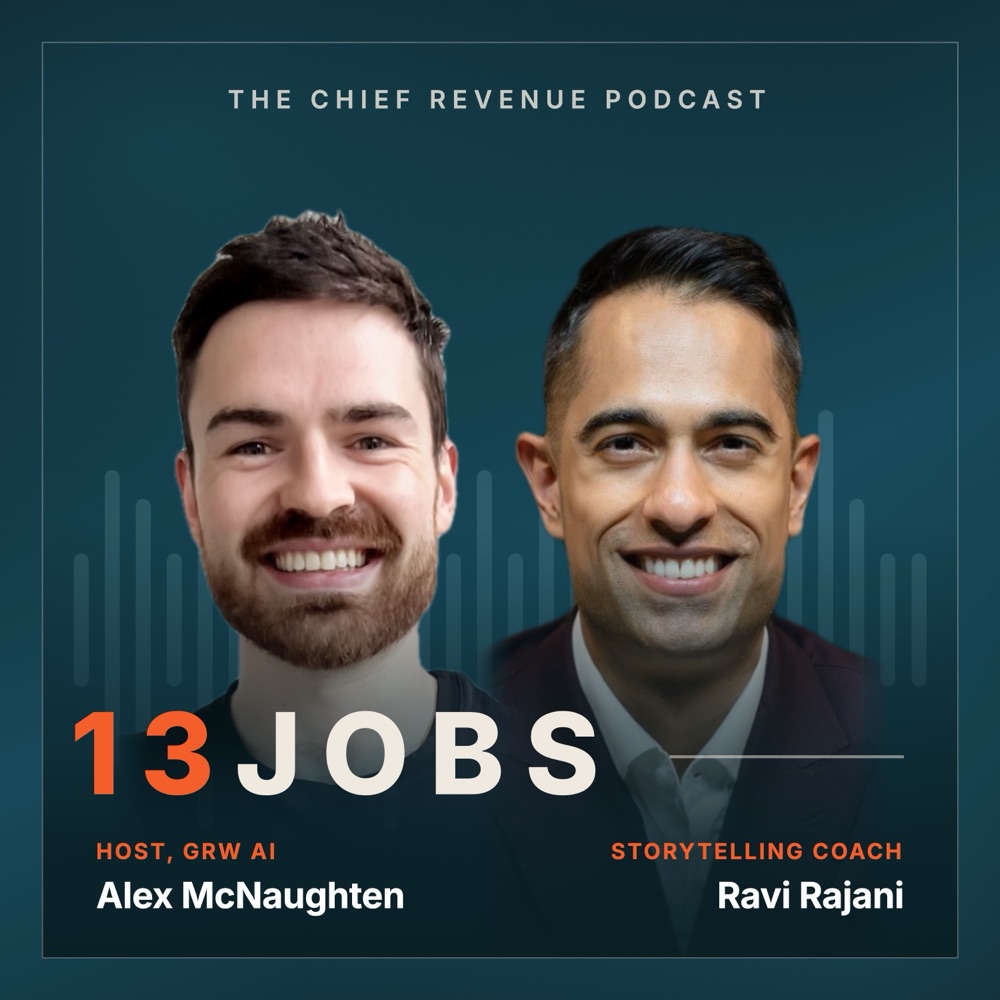
 Hosted by Alex McNaughten
Ravi Rajani · Storytelling Coach
Ravi Rajani helps B2B SaaS sales teams put storytelling into their sales process, so that a call builds trust rather than a feature comparison. He is a keynote speaker and the host of The Influential Communicator podcast.
He was put into dance school as a child, found theatre as a teenager, and then spent years delivering pitches in investment banking and sales before pressing eject in August 2016.
In this episode, we discuss:
- Nobody grows up planning to work in storytelling
- Pressing eject in 2016
- Leading with something emotional, before the product
- A customer success story is not a case study
- What a story has to do to earn its place in a pitch
- The two roads, about eighty percent of the way through
- Think like a comedian on length
- Make the customer the hero, not yourself
- The magnetic message that comes before any story
- The trusted advisor story, for the C-suite call
- Where to start: forget all of it and pick one
- The one thing: take the framework, then break it
Quote of the show
“A lot of salespeople don't share customer success stories. They share case studies.”
Key takeaways
- A case study is not a story. Names, a real main character, something unfolding rather than summarised. My client in technology is not a story; Chad at ezyVet is.
- Earn the story first. On a cold call the story is not the opener. A magnetic message buys the curiosity, and the story is what you spend it on.
- Think like a comedian. A comedian cuts every word that does not serve the punchline. The same test tells you how long a sales story should be.
- Two roads, late in the pitch. Once there is enough trust, paint what happens if they act and what happens if they do not. Placed early it is pressure; placed late it is clarity.
- The customer is the hero. A doctor pushing a medicine they are paid to push is the version nobody wants. Putting yourself at the centre of the story reads the same way.
- Reveal something they do not know. The faster you tell a senior decision maker something new, the faster you are worth their time. That is the job of the story, not decoration.
- Borrow the framework, then break it. Copying a mentor wholesale produces a bad imitation. Find one that resonates, give yourself room inside it, and eventually make your own.
Transcript
Ravi, how are you?
What's up, bro?
I'm good, man.
How are you?
I'm very well. I'm very well. Uh, and good, good to have you on the show. Um, so Ravi, tell us a little bit about yourself. Um, you're the man to talk to about storytelling in sales, but tell us a little bit about yourself.
So they say. So they say. But, um, dude, man, I didn't, I didn't pop out the womb and say, you know what, I want to work in storytelling. I want to have a company around that. I want to be a speaker. Like, it just, you know, like most people, it just wasn't that linear.
But it all started for me, dude, when I was about 8 years old, and my mum literally shoved me into the same dance school as my little sister. I remember at that time I was so fuming, Alex. I was like, man, why has she done this to me? I'm the only dude in school in dance class.
Like, what is this? But the truth is, deep down, I was like, man, this is amazing. Like, I've never felt more alive in my entire life.
I see you alive.
Oh, bro, yeah, deep down. But on the, you know, on the face— to the world and on the face of it, I was like, man, I really want to quit. Eventually she did let me quit, my mum. But I stumbled into theater as a teen. And then growing up, people were always like, yo, Raph, you're gonna take this whole speaking, presenting, or acting thing seriously?
Because we think you're pretty good at it. And I was like, no. My ego was like, no way, you kidding me? Go make some money. So I ended up in business school and ended up on the trading floor at Citibank where I began my career in corporate sales. It's what I really wanted to do.
I had it in my mind. I was like, you know what? This is exactly my dream. When I got there, some people describe it like the gold medal effect. When you get what you want, you're like, ah, is that it? You know, I've reached this goal now of getting into the bank that I wanted.
Is that it?
So it's kind of what I felt. You know, once I got there, I started to feel like, man, there's something else out there for me. But I didn't know what it was at the time. So I pressed eject in August 2016. And that's when I started doing TV appearances over here in the UK.
I started doing radio, started doing coaching. I started leading and building sales teams in early-stage startups. And dude, there were 3 things that I realized. It slapped me in the face. I was like, wow, man, why are so many sales teams stuck selling with features? Number 2, why do their presentations have no personality?
It was like it was illegal to showcase who you really are. And number 3 was, why do they not include any storytelling? And man, that's what led me to my big mission today, which is helping sales teams sell more with story and doing it in a way which is authentic and without compromising who they truly are.
Wow. That's the story. That's a good story. It's a good start. And I completely agree with you, you know, having worked with a lot of companies and sales teams is I've seen the same as you that sales folk are typically pushing features and functionality and feeds and speeds. What's wrong with that though?
Why is that not the way to do it?
Well, firstly, I feel like there's so much in this sales space. When you log on to LinkedIn or you look anywhere, it's like, you should do this and you should do that. You know, I'm telling you from my perspective, this is what I believe. You know, you know, for me, there is no formula.
There's, there's different ways of doing it. You've got to find your own. But for me personally, in my perspective, Feature selling sucks because the idea is we as human beings are hardwired to love stories. You know, when we hear a good story, how many movies, books do we read, TV shows that we love?
They're all based around a narrative, very specific story, and we're bought into the main characters. Like how many, you know, the TV series Friends, like so many people love that because of the main characters. They get bought into Ross, they get bought into Rachel, they get bought into their journey. They see themselves in their challenges, their transformations, their desires.
And that's why storytelling is so beautiful inside of the sales process because your ideal clients, for example, in a customer success story, can see themselves, if done correctly, in the challenges of the individual and the company that you're speaking about, in the transformation. And if done correctly, you can position yourself as the potential guide to helping them on that journey towards pain to glory.
But if you're just talking about features, sometimes it can feel scripted. There's a lack of connection involved. Sometimes you're just focusing on the transaction. You're not focusing on the transformation. I mean, I could go on, but the widget, this tiny widget inside of your software, isn't what is going to transport your client to a place where they can imagine what it would look like if that problem was actually solved?
Yes, it would be using that widget, but are we really taking them to a place where they can mentally rehearse solving that problem potentially with you or just solving that problem altogether? But man, I could go on about this. But the truth is, is features tell and stories sell because features are very factually driven.
Yeah, I agree with you. And I'd say like The common sales presentation that I see goes a little something like this before, you know, before I've worked with a company is here's a little bit about us. Here's a little bit about our product or service. Here's the cool shit we can do. Here's a couple of companies we've worked with.
Are you interested? What do you propose as a better narrative? Like how would you tell a narrative through story that would be more compelling than that?
Yeah. And I'll answer this through— let me share a few stories that I would share in a sales presentation, which would be an alternative. Now, the first thing that people miss on is that they don't lead with any— anything emotional. They don't lead with an emotional narrative or a story. Now, for me, starting with a connection-focused story that is very tied into 2 things: the million-dollar problem you solve and the source of your client's pain.
Is very, very critical. And I'll tell you why. Because you don't want to tell a story at the beginning, which is just this one time at band camp. It's like, what business value does that story actually provide? So you've got to tie it into something that adds business value. And for me, that's figuring out what the million-dollar problem is for your client.
Let's say it's being invisible online and not having a social media presence. And as a result, they can't generate as many leads as they'd like to. Let's call it that. And then the source of that pain is, for one person, imposter syndrome. For the other person, it's time. So the connection-focused story should be focused on the source of the pain.
And it should be very, very short and succinct. You know, in the first couple of minutes, your audience, for argument's sake, your prospects are trust neutral. They could be trust negative. They could be slightly trust positive. But let's assume that they're trust neutral. Now, your connection-focused story in the first 90 seconds to 2 minutes, it should be designed to accelerate trust.
As quickly as possible and collapse time to make people feel like, man, not only do I feel like I've known this person for so long, I'm starting to feel like I could trust them. And then it really boils down to the trusted advisor story. And I remember this really specifically when I worked in banking.
I remember at the start, I was cold calling and I was speaking to CFOs and all these C-suite decision makers. And I was like, man, like they've got so much more knowledge than me. What am I going to say to them? Like, you know, I've just started my grad job. Like, why would they want to hear from me?
And I remember this one morning, I walked past my colleague Nick's desk. And on Nick's monitor, there was a yellow sticky note. And I was like, what does that say? And I looked closer and it said, teach them something that they don't already know. And I was like, ah, what do you mean by that?
I asked him.
I was like, dude, what's that? Tell me what you mean by that. And ultimately, the goal is to Really understand that the quicker you can reveal a piece of information to a C-suite decision maker that they don't know, you're adding value to them. So the trusted advisor story is based on 3 things.
Number one, tell them, tell them what's going on in the industry, in the wider market right now. Okay? Secondly, reveal the villain that is agitating their pain and people just like them who you're serving. And then finally, give them a prediction. Give them a prediction of what you believe could happen over the next 12 months.
Why? Because people love people who believe in something because most people don't believe in anything. Right? So those 3 things can really position you as a trusted advisor, somebody who they can trust to solve their problem potentially, and an advisor, meaning somebody who has expertise and is a consultant in their eyes. So that's the second story I think is super important.
Now, the third one, a lot of clients, if you look at Steve Jobs's Macintosh presentation, right? I think it was when he released the first Macintosh in the '80s. He didn't start with his solution. He started with highlighting the villain, a.k.a. IBM, and then he spoke about his solution. So that's what we're looking at here, right?
We've built trust through a connection-focused story. There's plenty of things we could do in between, but giving you a high-level overview here. And then we position ourselves as a trusted advisor. The next story is why you're really different. You know, why you? And now this could be done through several different ways. This could be your founder's story.
This could be the vision that you have as a company over the next 3 years. It could be your brand story. But one thing I see a lot of companies miss out on is describing their secret sauce. And the product story behind their secret sauce. Meaning what is your unique process or proprietary process to generate results?
Because people can never compete on 2 things. They can't compete against your story, and they can't compete or replicate your unique process to generate a specific outcome. So really describing, you know, through storytelling, why you? Why are you unique? Why are you the only solution to your client's problem? A lot of people do that through competitor analysis.
And they say, look at our competitors. And now this is what we do. It's highly predictable. And that's the issue. When your prospect knows what to expect, they switch off. And then the next few stories I think are pretty common. You know, the customer success story. We don't need to really dig. We can dig deeper into that.
But a lot of A lot of salespeople don't share customer success stories. They share case studies. They can feel very, very different. And customer success stories should be that—.
Stories about your customers, real people, real names, you know, actually talk about Chad at EasyVet, not just, you know, my client in technology, right?
Exactly, brother. You know, for example, they should be attention-grabbing. They should have a connection-focused and relevant main character. They should be organically unfolding in a story arc. They should be very focused on revealing a relatable villain, and they should nurture trust. I call it the ACORN checklist, right? Ralph Emerson once said, hey, you know, one acorn, I think it was something like one acorn has the ability to plant thousands of trees.
And the way I see it is one story has the ability to foster and facilitate thousands of connections and relationships. When shared correctly. So that's the ACORN checklist to give you a quick insight. And that's how you really transform a case study into a customer success story. A few other stories is the cost of inaction story.
Now, sometimes reps do this too early, right? They get really excited at the beginning and they say, hey, this is what you're going to lose if you don't partner with us. But the truth is, is if you haven't built enough trust, they're going to be like, okay, well, Sounds good. Well, you don't really know my problem yet.
You haven't taken the time to listen.
Blah, blah, blah, blah, blah.
So I always recommend this around 80% of the way through the presentation. Once you've built enough trust and you're through the presentation. But what does somebody have to lose? Now you can paint a picture of the 2 roads. One road is if they go down the same route in the next 2 years, what would happen?
Road number 2, not if they partnered with you to solve their problem. If they solved their problem, what would life look like? Because if they partner with you, it's predictable again. And if you partnered with us, this is what life would look like. Right? And it's predictable. So the cost of inaction. Right?
And that really also ties to loss aversion as well. You know, the idea about loss aversion and us being more motivated to prevent losses than acquire equivalent gains in our life. So that's another one. And I think Those stories, I'm thinking about it now, are super, super critical in any sales presentation. And I think to get the audience started, I think I mentioned 5 there.
Those 5 stories would be probably the most helpful.
And you would weave those all through one sales presentation? Yeah. Yeah.
And it can sound quite overwhelming the way I've just said it. And people say, how long should they be, Rob? How long should the stories be, man? And I always say, think like a comedian. And they say, what do you mean think like a comedian? Like think like Kevin Hart? I'm like, yeah, think like Kevin Hart.
Because think about it like this. The longer your story, the bigger the expectation of an impactful punchline. Now, I don't know if you've ever had a friend, right? You're out with a group of friends. And there's always that one friend telling these 20-minute stories. You don't want to be rude. And at the end, there's no punchline.
You're like, wow, I just wasted 19 minutes of my life. So the idea is sharing shorter stories to begin with and then layering in longer ones as you walk through the sales process. But can you imagine if your First connection-focused story was ten minutes, five minutes. No, man, it's it's really got to be less ideally ninety seconds or less.
You know, less than two minutes fine, but it's got to be short, man. They got to be short.
And one thing you said that's interesting, or I'm paraphrasing a bit, is putting the customer in as the main character in the story sometimes rather than— so you talked about the 2 roads rather than making yourself the hero of that story, it's actually you want to make— talk about the customer's, you know, road A versus road B and not be predictable and say, oh, this is what's going to happen if you work with us.
Can you just explain that a little bit more as to why that's better?
Yeah, you know, if you think about, um, let's say a doctor, and let's say they're being paid a bonus if they push a certain medicine Right? How would you feel if, even if, you know, you've got this problem and they're pushing this medicine to you, even if there could be a better one out there, but they've got this incentive to direct you towards that?
You feel like, man, but you say, should I go get another opinion? Should I look? Should I get a second opinion? Think about brokerages. When brokers, there's certain brokers which only give you options where they're getting paid commission. And there's other brokerages when you're getting a mortgage will say, here's the whole market.
Who do you trust more? Because I know who I trust more. I'm like, let me speak to who's going to show me the whole market because they're going to be more independent in their advice. So that's what we're looking at here is that when you're giving this advice, it's not, here's what you could do with our solution.
It's really, this is what life will look like, man. Like, by the way, you could do a great job doing exactly what you're doing. Here's what life will look like in 2 years. You may stumble upon this issue. But the question is, is if you did take action and actually solve that problem, this is what life could also look like.
And it's the idea of really describing that, using sensory language to really describe that as well. And it's not about then saying, well, hey, here's our product which can help you do that. Because once again, it's predictable. And the problem is, is a lot of presentations these days are highly predictable. And here's what happens.
Okay? A long time ago, I was going to gym at the same time every single morning.
Right?
Every single morning, I'd get there, Alex, and I had no idea how I got to the other end. It's like I sleptwalked there. I was so tired. I got there, and I was like, man, I don't even know how I got here, but let's get it. Let's go. Right? One morning on a weekend, my wife's like, Rav, should we go to the spa?
You know, like, should we go to a spa down the road? I'm like, yeah, okay, let's do that. She goes, you can go to the gym. We can go for a swim. I was like, that sounds dope.
Let's do that.
We get in the car. My phone goes out of battery and Google Maps goes. And I'm like, man, I don't know how I'm getting there now. Right? I didn't have the, you know, the old school A to Z as we call here in the UK, which is like a map. I didn't have that.
So my wife didn't have her phone. I'm literally clutching the wheel because I'm like, man, where's the wrong turning? Where am I going to go? I was paying more attention because the journey from A to B was unpredictable. So what I'm trying to do here also in this story Is be unpredictable, right?
Got to take that client through a journey that isn't expected. If it is, they're going to switch off, and the game isn't. You're not competing against your competitors in that moment. You're competing against other things that are pulling for their attention. You need to earn it and then learn how to keep it.
It's a really good point. How do you do this when you have on a cold call, for example? So, you know, where you have really limited attention, how would you use storytelling to grab someone's attention on a cold call in the first, you know, 20 seconds?
Yeah, good question, man. And the question is, I wouldn't share a story in the first 20 seconds. Yeah, I would— I mean, you could, but there's different ways to look at it. Um, I talk about it in the terms of sharing your magnetic message, which can be that hook which explains what you do in a really unpredictable, interesting, and unique way, which then earns you the opportunity to share a story.
Because if you came out of the gate, think about it. If you came out of the gate, you're an SDR, you're doing outbound cold calling, and suddenly they say, they pick up the phone, they're like, hey, is Jim around? Oh yeah, this is Jim speaking. And you're like, thanks, Jim. In 1994, our founder sailed across the Atlantic.
It's like, I don't know what you do. I don't know who you are. Like the first question is always, To the person on the phone, is this going to waste my time? What's in it for me? So for me, you know, a lot of stuff like you teach, for example, I'm sure, which is how to earn the prospect's attention.
You need to get their prospect's attention, right? And that could be through a magnetic message. So, you know, like for example, so you know how B2B SaaS sales teams, they really get stuck with selling with features and they just get stuck and it loses them deals. They end up extending the sales cycle.
Da-da-da-da.
Well, that's actually what we do. We help to do whatever it could be. It could be some form of a magnetic message. Message to spark their curiosity and interest enough for them to go, huh, like, okay, like tell me more about X. And then what you're really, one story that SDRs could share in this process would be the trusted advisor story.
Right.
That's a powerful one. Because if you're speaking with a C-suite decision maker and you're struggling with imposter syndrome, that trusted advisor story is a powerful one to educate showcase expertise and position yourself as a thought leader in the space. And then the next story a lot of people also think about is they say, when I say this, I say share a customer success story, they go, oh yeah.
And this kind of, this partner, this company that partnered with us, you know, James, who was a VP of sales at Salesloft, and this is the results that he's now getting. Here's something to remember. The job isn't to sell the product. The job is to sell the demo, the next stage of the sales process.
So the key thing to remember is Inside of the transformation of a succinct customer success story, you're not sharing the transformation that somebody got from using your product and now they're with you for 12 months. That's too much. You're sharing what transformation they received and golden nuggets from attending the demo. Now, that's the key because a lot of people go from 0 to 100 real quick, as Drake would say.
Right. What we're talking about is just taking them to the next stage of the sales process. So what I'm saying there is 3 things. A magnetic message to really hook that person you're speaking to, a trusted advisor story, and a customer success story, but which is linked to the next stage of the sales process.
That's really interesting. I haven't heard— I think you're the first person I've spoken to who's described it in that way. Most of the advice I've seen out there has been around telling the customer success story, the whole story, on that cold call. But I actually, I think you make a really good point there as it could almost be too much at that early stage.
And would it be almost better to tell a story about why someone took a demo with you?
Yeah, exactly. What, why did somebody take a demo with you and then what they listened to or achieved on that demo? And it could even be an objection handling story about somebody else who was resistant towards a demo. And then once they had the demo, they realized this one thing about their company, that it wasn't a lead gen issue.
It was an XYZ issue. And what you're really doing there is not saying, you know, a lot of people go straight to, oh, so we work with this client who's just like you, $15 million in revenue. And then they're now working with us. And these are the results that they're getting. Imagine if somebody interrupted your day and in 3 minutes, you're already learning about how somebody just like you has used their solution for a year and they're now generating billions of dollars or whatever.
It's like, whoa, right? It's, it's, we're trying to go for the right hook, as Gary Vee would say, and we're not, we're not actually jabbing here. So we've got to be a bit more patient and focus on building trust. But also the thing to remember here is, is it depends if it's outbound or inbound.
Yeah.
It depends, you know, there's, there's a lot of contextual things that we have to think about there. But if we're talking pure outbound here where somebody doesn't have a Scooby-Doo as to who you are and you've just interrupted them, then yeah, this, in my opinion, my perspective would apply.
Yeah, I agree. I think one of the things we teach is try and demonstrate that you've overcome that objection before with other clients. And I suppose that's actually where your storytelling idea, you know, that I think That's kind of the similar kind of thinking you're having here is demonstrate through a story that you've heard this before and you can understand where they're at in their current decision-making process on the call where it is today.
Coming back to the why you story. Hmm. Could you give an example of a good why you story? Because I think this is something that I see people struggling with is especially in competitive, um, competitive sales where there's lots of vendors out there. I think people really struggle sometimes to differentiate. So could you mind giving us an example of breaking down what makes a good why you story?
Yeah, man, definitely. And I'll tell you what, I'm going to answer that. I'm going to take it back ever so slightly and, uh, talk about the magnetic message, right, that people actually use to earn the story now, earn the right to share a story. Now, if you think about When sales reps say, "Hey," or somebody says, "Hey, what do you guys do?" Sometimes you get a very elongated response that's not powerful, not really—it's not really packing a punch.
It's not succinct. So, you know, for example, if you take a look at LinkedIn, you know those I help statements. I help people do XYZ. There's nothing wrong with that. I help client X achieve Y. Without Zed, whatever. So there's so— that's arguably, it's quite outplayed now, overplayed now. You know, you see it everywhere on LinkedIn.
People expect a lot. So you've got to figure out a way to be unique. And one of the best ways to think about it is through an analogy. And I think it was when Steve Jobs released the first i— what was it? Not iTunes. It was the iPod. I think it was the first ever iPod.
And instead of saying, oh, it's got 30 gigabytes, it's this, that, or the other, he said, it's like having 30,000 songs in your pocket. Right? And it's that analogy which people are like, oh, bing. Like it makes sense. So if you've got an analogy which you can use to describe your business, like if you could relate it to what, I don't know, a lot of people say we're the Uber of X.
And it's like really easy to explain. Right? So think about analogy. I digress. So the why you story. Now there's so many ways you can slice this. There's so many ways to look at it. I'll give you 2 things to think about here. The first thing is, did you ever see 8 Mile?
Yes.
The movie, right? So yeah, so B-Rabbit at the end, what he does is, is to explain to the crowd why he should be the winner versus Papa Doc or whoever it was. He's basically talking about why you— it's like, why me? Here's why you need to vote for me, right? And what he does is he openly shares his flaws.
He openly shares the things that somebody could use against him and makes it magnetizing in front of his ideal client. Right. And he appeals to me in a way that Papa Doc definitely couldn't. Papa Doc chokes. Now, that's similar to what somebody could do in a why you story. And if you take a look at the marketing from really, really large or upcoming, not large actually, upcoming challenger banks, these startup challenger banks, you'll see what they do.
They basically take a look at the incumbents and the large established ones. And they say things like, hey, if you want customer service from somebody who doesn't care about you, hey, if you actually want to feel just like a number, and if you want to get ripped off with fees every single month, then hey, you know what?
Maybe we're not the right people for you. But if you want Customer service from people who know, who truly care about their customers. Da da da da da. Then maybe we're a good fit. And that's like one of the ways people use their flaws of being nimble, lean infrastructure as a way to compete against some established competitors and really turn their flaws into positives.
Now that's what a lot of early startups struggle with is how do they differentiate themselves against the big guns, the people who are already there. And that concept of the 8-mile moment is powerful for people to do. It's really, really powerful. The second thing is, what is your proprietary process? How did it come to fruition?
Why are you so passionate about it? And what is the vision that you have for the impact that it's going to have in the world? A lot of people talk about how products and secret sauces were formed. But they need to take people on a journey as well of here's where we're going over the next 3 years.
People get excited about that, right? Especially if you're a small company now and you want, you know, it's more exciting and more press-worthy to talk about, hey, this is the impact. We're going to impact a billion lives over the next 5 years through this versus we started yesterday. Right? So it's more exciting to talk about the vision and take people on that journey of the future.
But I'll give you an example of my process, right? So inside of my company, my business, I have what I call my Story Selling Blueprint or framework. Now that is my unique method that I use to generate results for clients. And people say, well, what do you mean? Like story, right? What does that acronym stand for?
And I say, well, S stands for simplifying the storytelling fundamentals. Right? I'm talking about ensuring that your team are actually sharing succinct stories without rambling or boring your prospects on calls and demos. And then it's T, which is tactically building your very own story bank. So that's knowing the exact stories to embed at the exact right time inside of your sales deck without death by PowerPoint, right?
Because nobody wants that. And then it's O. It's obtaining delivery mastery. So that's teaching your teams how to become world-class communicators when they share that story. And then it's R. You've got to ramp results for a 30-day period. It's hooking KPIs to storytelling. So it's not a load of fluff and you're getting tangible results.
And then it's why. It's yield long-term results. And that's where we hook things to OKRs that you truly care about and help your team ditch features for good and start story selling. Right? So that proprietary framework is my vehicle. It's my vehicle to generate results. Nobody else has that vehicle except my company.
Nobody else has my story except me. So instead of discounting, competing on price, compete on things where you have an unfair advantage. And that's your story and your unique method. Most companies are loose on those 2.
Yeah, for sure. Where does a company start? Because like we've talked a lot today and for some, you know, imagine you're a startup and you're listening to this and you think, okay, God, like, I don't have a story. Where do I start? Have you got any kind of practical advice for someone who's right at the start of their journey or maybe first day in sales today?
Yes, I do.
Yes, you do. Sure.
I would say I do. I do. I would say number one, forget everything I've just said now because you're going to result in overwhelm. So let's just delete your mind. You know, when Will Smith in Men in Black, he has that little laser, it's like, forget what you learned. Let's click on that.
But here's what I would do. Okay? I would start with, if I was a salesperson starting my first job, I would start with a 10-day video challenge. I would pick somebody else who's in the onboarding. I would set up a WhatsApp group. Okay? And every day before 9:00 PM, the both of you have to send across a video which is less than 60 seconds on a specific topic that you pre-agree on.
Okay? Get used to sharing stories in a virtual setting. Now, how would you structure those stories? Well, I talk about something called the PSA framework. A lot of people call it the SPA framework. A guy called Victor Antonio calls it that. A lot of people in school learned it as PEE. I like to think about it like PSA.
Point, story, audience impact. What is the point you're trying to make? Get to the punchline. What is the context, the conflict, the turning point, and the transformation of the story? And then what's the impact for the audience? What does it mean for them? Simple as that. 59 seconds, 10 topics, 10 days. 99% of people don't do this.
They quit or they think it's too much effort. The ones that do, oh my gosh. The sales reps that I've coached to do this, they said, I now feel like I could just start posting videos on LinkedIn and start doing video prospecting. I'm not scared of it anymore. I'm ready. Let's go. I'd somebody say, let's do it 20 days.
I took somebody through to 20 days because they were so excited. So start with that, right? Start with that and then refine as you go.
It's good advice. It's brilliant advice. Um, Ravi, I could talk to you on this topic for a lot longer, but we are, we are at time. I've got my one last question for you, which is, you know, knowing everything you know now If you were to go back to day one of your first, you know, sales role, what's the one piece of advice you'd give yourself?
Don't try and emulate mentors. Find a framework that you resonate with. Give yourself freedom within that framework. And then break it and create your own. I think so much of the time we will see frameworks from mentors and we see, oh, this person is doing that, and we try and morph ourselves into that individual, right?
Versus owning our personality and bringing who we truly are to the table. So what I'm really trying to say there is this is more advice for anybody on their first day versus specifically myself, but it's Man, you as an individual, just because you don't have the 40 years worth of experience as the CFO doesn't make them better than you.
They're just further down the road. You're still a human being. Own it. You can still pull confidence from other areas of your life, right? It doesn't make you less than. You are enough, my friend. That's what I would say. I'll say, you are enough, dude or dudette.
Brilliant advice. Ravi, thank you so much for your time today. It's been brilliant. Where can people find you, connect with you? If they want to learn more about you?
Yeah, man. So I'd say one thing that I'm really passionate about at the moment that I'm working on is my podcast, The Influential Communicator. So it's designed for salespeople to help them sell more by becoming effective communicators. And you can catch it on Apple, Spotify. Yeah, all the platforms these days. You can catch it on there.
And yeah, add me on LinkedIn. You know, I'm always open to new connections. I'm keen. I'm always good with a voice note or a quick video to people. So yeah, let's let's connect if you've got any questions on the back of today. Let's hang out too.
Thanks so much, Ravi.
Pleasure to have you on. Thanks, brother. Peace.