
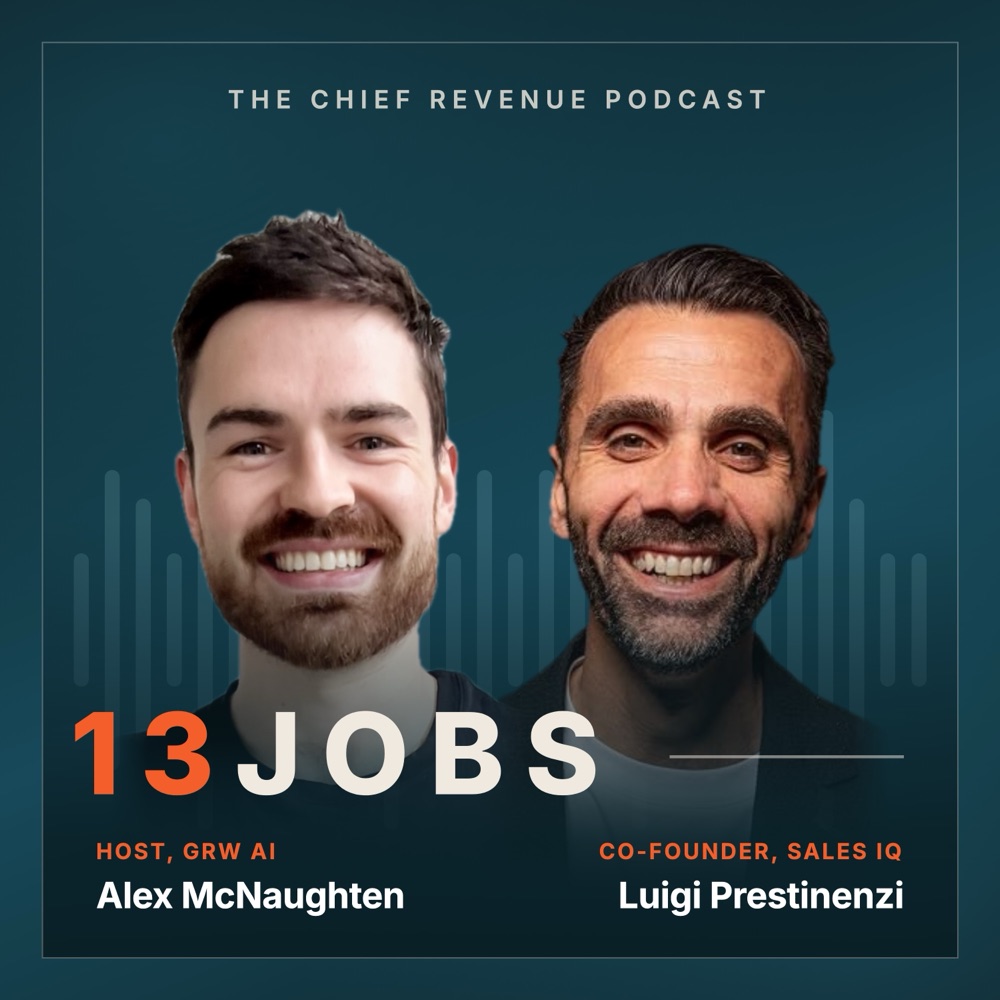
Be competent before you're confident
Luigi had cancer young, which is why health is the one thing in his calendar that never moves. The rest is about what a seller can and cannot control.
 Hosted by Alex McNaughten
Luigi Prestinenzi · Co-founder, Sales IQ
Luigi Prestinenzi is the co-founder and head of growth at Sales IQ, which trains and coaches sales teams at companies including HubSpot, DocuSign, SAP and Salesforce. He has been selling for around twenty years, having started in contact centres straight out of school.
He hosts the Sales IQ Podcast, and spends a lot of his time on the part of the job most training skips: what happens in a seller's head between calls.
In this episode, we discuss:
- Falling into sales straight out of school
- Turning forty, and what mindset actually means
- A world of abundance, and what the last two years opened up
- You are going to lose more than you win
- The most dangerous sentence a trainer hears
- Still getting hung up on, and why it lands differently now
- When rejection is feedback on the message, not on you
- Call calibrations, and coaching yourself
- Not carrying the last call into the next one
- Rushing between calls is what actually breaks them
- Health as the one non-negotiable in the calendar
- The one thing: competent before confident
Quote of the show
“Positivity breeds positivity.”
Key takeaways
- Separate what you control from what you do not. Nobody has a seventy percent close rate. Losing is the job. How you turn up to the next call is the part that is yours.
- Rejection is sometimes information. Before deciding it was not personal, check the message. Was the research there, was it relevant, was it personalised. Sometimes it was, and you caught them on a bad day.
- Watch your own calls back. The recordings exist and nobody enjoys hearing themselves. It is the cheapest coaching available, and the three to six month mark, when autopilot sets in, is when it matters most.
- Contain the last call. Write the notes, close it out, stand up, walk, eat something. Carrying a bad call into the next one is how one becomes three.
- Momentum runs both ways. A booked meeting tends to be followed by another. Getting back on the phone while the good one is still fresh is a deliberate act, not luck.
- Most bad calls are preparation failures. Five back-to-backs with no gap means arriving without reading the notes. That is a scheduling problem being mistaken for a skill problem.
- Block the health, like a meeting. He had cancer young and cannot be a father, a provider or an employee without his health. It goes in the calendar as an appointment, moved but never cancelled.
Transcript
Luigi, good to have you on. How are you doing, my friend?
Mate, thank you very much for having me on your podcast, Alex. I've seen so many incredible thought leaders in this space on your podcast. I was getting jealous that I haven't been on.
I'm glad, I'm glad we managed to make it happen. So Luigi, for those who don't know you, you're the head of growth at SalesIQ, but tell us a little bit about your story in sales.
Yeah, well, I'm pretty fortunate that I fell into this career because I struggled in school and I didn't really enjoy it and I wasn't very academic. And I started in selling. I basically started selling as soon as I left school, working in contact centers. We'd call it the role today would be an SDR, but it was back in the day was a telemarketer.
I was the pain in the ass that was ringing people. You know, trying to sell stuff. Old school, you know, touchpads, lists, rulers, and pens, right? So I've done door-to-door, worked in business-to-business sales, managed teams, been head of marketing in one part of my career. But fundamentally, fundamentally, I'm an individual contributor. I'm a salesperson.
I'm a salesperson at heart, man. So I'm a sales professional. Who loves everything about selling, but because of the career that I've had, um, I've also built a skill set in enablement. So I work in the enablement space with a lot of sales leaders, a lot of companies, a lot of salespeople, really helping them elevate the profession and helping them build the skills to be the best they can be.
And I think that's something that we both really share. And you know why I love what you're doing is we both have this passion for just leveling sales It's leveling up the sales profession, right? It's the Wild West out there. And, you know, I think part of that is, part of that is there's really no barrier to entry.
Anyone can get into it.
Yeah.
And, you know, there's great salespeople out there and then there's also not so great buying experiences out there. So it's awesome. I love the work you're doing. And look, today we're going to talk about a topic that maybe doesn't get enough attention. I feel like we often talk about activity and tactics, but A really key part of being good and effective in sales is mindset.
Yeah. So so we're going to talk a little bit about that today. But you know, just to start us off, we were talking just before we hit record. What does mindset mean to you? Like what does that actually? What's it all about?
Yeah, I think for me, you know, like it's it's I've been on a journey on with this topic for a long time. I'm just turned forty, reflecting on. It's interesting, you know, I never thought I would— before I turned 40, I wasn't really thinking about what 40 meant. But then as I got really close to it, I started reflecting on certain things in my life, certain milestones.
And, you know, when I look back, I think I've had a, a long journey when it comes to personal and professional development. I mean, I've been really active on this, on this journey for, I don't know, I reckon nearly 20 years. I've taken it quite seriously, my personal development. For me, I think mindset's all about the way we show up.
And, you know, some— to some degree, um, I think it can get a bad rap. You know, people go, oh yeah, that's the common thing, it's the fallback, you know, mindset. But I think the reality is, in order to be successful in anything— and I really only talk about selling, right, because selling is something that I've achieved some incredible results— it always comes back to the mindset that I brought to the table.
Yeah, it's always come back to the way in which I've showed up. And if I look at the days that don't go well, when I look at the deals that might have gone a bit south, um, and when things didn't go the way that I thought they would go, in some cases it wasn't a result of my skill set, it was a result of the way that I behaved through the process.
It was a way that, you know, my mindset Because in, in some respect, you can actually have a negative mindset. Yeah, there's positive and negative, right? And if you're in the negative zone, then it can impact the outcome, it can impact your performance. And this is why I sort of say that it's absolutely fundamental for every seller to always be prospecting and have a robust pipeline, because when you don't have a robust pipeline, when you don't have enough opportunities you have essentially a scarcity mindset.
You don't have enough and you become desperate. There are things that you might do that you might not normally do, right, which create barriers and barriers to selling. It creates that— those issues that we've seen so many sellers create, right? The stereotypical car salespeople, you know, the dodgy, the sleazy, the commission breath.
And I genuinely feel that And my opinion on this is sellers that do have those attributes, they're not bad people necessarily. I think maybe some have poor ethics, but I think most people get up saying, I want to contribute in a positive way. But when your back's up, you know, your back's on the wall, you're struggling to close deals, the ones that you have got, you're desperate for them to close.
And sometimes you exhibit certain attributes and behaviors. That don't necessarily represent who you are. Yeah. So for me, when I talk about mindset, I talk about knowing that there are only— there are certain things I can control and there are certain things I can't control. And I've just got to maintain the focus on what I can control.
And that's what's helped me in my career achieve some great results. I've closed, you know, deals, $10 grand, $50 grand, a mil, $5, $10 and my largest was almost $20 mil. All of those deals was, I attribute that success to my mindset. Yeah.
And that's a really, I think it's a really interesting point you've made there around that scarcity. Scarcity mindset is where you don't think there's enough. You show up a certain way and you might not even realize it. So I think if I understood what you've said there correctly is if you focus on the right activity and the things that you can control, That's going to have a positive impact on your mindset because you're not going to be worried about not having enough.
You're going to be like, I'm doing the things I need to do, so there's enough out there. One thing we often hear about when it comes to mindset is this idea of abundance mindset.
Yeah.
You know, there's heaps, there's lots out there. What does that mean to you? Or does that mean anything to you?
Absolutely. I mean, I— That's a statement that I use often. You know, we live in a world of abundance. And I truly believe that. And I truly believe that COVID for many of us was an incredible opportunity. You know, it opened up the borders for many people that— take our business, for example, take what you do.
Pre-COVID, mate, I was spending more time on a plane. You know, I had my platinum membership. I was flying in and out. It was great doing a lot of face-to-face stuff. But what COVID has done for us It's essentially allowed me to do what I do to more people and do what I do with more people, access more markets.
I never did stuff, you know, like I have been these past 2 years. I haven't trained as many people as I have in the last 2 years. So again, and again, that's a mindset, you know, really going, you know, saying that we actually do live in a world of abundance if we decide and choose to see it.
And my son, for example, I'll give you an example. He's 16. He just turned 16, and I, I absolutely adore him. And he's always had a growth mindset, and he, he's just— he's an aspiring footballer. He wants to become a professional footballer, and he's had a bit of a setback this last couple of weeks, right?
And yesterday he, he struggled. He actually— very, very, very rarely will he, he show that level of emotion, right? He actually broke down a little bit, and I sat next to him and I gave him a hug and put my arm around him and, and I told him it was absolutely fine to feel like this.
Yeah, yeah, it's fine, mate. You know, like, sometimes things don't go to plan. But what he started to do was he started to go below that line, like he was looking for others to blame. And that's when I said to him, mate, it's okay to feel like this. We can't be blaming others for where we're at.
Like, you can't control the coach's decision. You can't control if you got selected or you didn't, right? What you can control is the way you respond.
Yeah.
And for me, that applies to everyone in sales because there's got— we are going to lose more deals than we win. That's the reality. I've never met somebody that's had like a 70% conversion rate, man. Like, uh, yeah, neither.
If you ever do find that person, let me know because I want to know what they're doing.
Yeah, I need to hire them, man. Um, but do you get where I'm coming from? Like, we have to deal with the fact that we're not all— things aren't always going to go— I can't control that.
No.
But I can control the way I show up. And you know what, to my son's credit, he got up this morning and he's back at it, you know. And he's been doing a mindset course with a guy called Shannon Cole from Sydney. He's an ex-A-League footballer. He's journaling. Like, you know, like I said, I take my hat off to him, man.
For a 16-year-old to be doing that, but for me, that's a definition. And and you know whether he becomes a professional footballer or not, I do believe he will. He's got the he's got the attributes and he's got the mindset to achieve that. But whether he achieves that goal or not, I think what he's doing is he's putting in place really strong habits that he can build on that, right?
And this is what I take back to every sales professional: is don't focus on the things you can't control. Focus on the things that you. Can. How do you prepare yourself? How do you research? If you are new to a market, if you're new, if you're a new SDR, hey, that's not a weakness.
That's a great opportunity, man.
Yeah.
Because you are a sponge. You're— you've got no baggage, you've got no bad habits. You can literally create the path moving forward, right? You've got so much learning, um, And so again, that's a mindset thing. Yeah.
And you've—.
You probably see this is I train people that are 30, 40, 50, and they've got the mindset of, well, I've been doing this for 10 years, what do I have to change?
Yeah.
Which for me is the most dangerous statement to hear, right? Like, man, if you've got that closed mindset, you're done. Like, your career is pretty much over in this space, man, because, uh, if you're not innovating you're gonna die because there's a youngster yapping at your heels who's, who's hungry and who's learning.
But then I coach, I coach a guy from Canada, um, Danielle, uh, from a company, uh, he sells IBM i, one of the top performers in his company globally. And he's in his 50s, man. And does this guy have a growth mindset? He comes to every single training session that we have every week.
He's adopting new practices. He's changed his working environment. He's doing video as part of his sales process. Like That's f*cking awesome, man. That is, you know, so it goes to show age is not a barrier if you choose to adopt the right mindset.
Yeah. Well, it's like if you, you know, bring it back to your example, and this is one that resonates with a lot of the folks we work with, is like you're, you're an SDR, you're just starting, and you're getting rejected 30 times a day on the phone. There's 2 ways you can look at that.
You can look at that and think cold calling's hard, it's impossible, no one wants to hear from me, or Or you can look at it and think, okay, how do I make it so I only get rejected 25 times next week? You know, how do I improve? How do I say the— how do I connect with my, you know, potential buyers better?
And, you know, that's what we see with the SDRs that are crushing it. That's how they look at it. They don't see the rejection and blame everyone else. They just look at themselves and think, okay, that sucked, but how can I be better next time?
Yeah. Yeah, and look, I can empathize with him, right? Because nobody likes being rejected, man. It's not a nice feeling, you know.
I've—.
Even now, I'm, I'm like, I've been doing this my whole life, there's moments where I, you know, I got hung up on. I was doing a live cold calling session 2 weeks ago in front of one of my clients, and the guy hung up on me, man. And it doesn't— it doesn't do good for your ego, right?
You go, f*ck, how did that happen? You know, and then I could have done this differently. But that's just— that's part of the, part of the role, man. Like, and my analogy that I use to people that— because some people really fear this. I say, look, what's the worst thing that can happen?
And somebody, like in our job, like, hang up. Okay, cool, mate. If, if you're a fireman, what's the worst thing that can happen? You can die in a fire, right?
Yeah.
If you're the guy cleaning the building, if you're a guy cleaning the, the windows on the 89th floor, the worst thing that can happen is you can fall and die, right? What's the worst thing that can happen in sales? The worst is possibly lose your job, but the worst when it comes to a call is somebody hangs up on you.
You know what? I can deal with that. I can deal with that every day of the week.
Yeah. Yeah, exactly. And the other thing that I'd be interested to hear your thoughts on this is, you know, what I try and teach, especially the juniors, we focus on teaching juniors, right? And the thing we always say to them is it's not personal. It's not that they're rejecting you as an individual.
You know, it's not— they're not rejecting you, Chad, or you, Becca. They're just rejecting. Maybe they don't have a problem you can solve right now. Maybe they're good. They're not rejecting who you are as a person. I don't know. Does that resonate? Is that something you ever used or how do you think about this?
Absolutely. But I often say, right, like sometimes though, if we are getting that rejection, we've got to just stop and have a look at our message. Like we've got to take a step back. And again, this is why I love what we do. Alex, because, you know, I think I've learned heaps, but man, the learning opportunity in front of me is massive, right?
Because there's so much change happening. So I'm still a student of this, of this journey, right? And if I send an email that might not be, you know— and again, this is why I think there is no kind of cookie-cutter approach to this as well, right? Because what Jason— you've had Jason Bay, you know, what his structure teaches is fantastic, but then Cole Coleman teaches an entirely different structure that works.
I've done different structures that works. They work when you spend time focusing on the buyer and you personalize and create relevance when we, when we talk about outreach, right?
Yeah.
But this is again why when, when rejection occurs, sometimes you go, well, actually what I said was, was it was, it was, I had my relevance, I had my, like, the research was there, I personalized. Hey, it could have been that that person, I've caught that person just at a bad time. It's not about me, it's about them.
Sometimes though, if we're making a call and we are getting rejected, we might have to just stop and think to ourselves, you know, am I maybe, you know, leading with a friend-based open, or am I leading with a narrative that talks to their outcomes? And again, this goes down to the mindset. We live in a world where everything's pretty much recorded.
They're using Gong, Chorus, air call, whatever. I often say to sellers, like, how many calls have you listened to in the past 48 hours?
Yeah.
If things aren't going well, like, when are you doing call calibrations? Because if you're not taking advantage of the tech that's available to actually do self-coaching, then you're not showing up to be the best you can be each and every day, right? And again, this goes down to that mindset and being accountable, um, and actually wanting to learn from the process as Yeah.
One of the things on that, such a good point, is what can happen, and I've seen this a few times, it's not when people are early on, it might be when they're 3 to 6 months in and they start to get into autopilot mode.
Yeah.
And they stop learning for like that moment because they think, I've got it. And that's like the constant reminder I have with these, with the reps that we're coaching is don't let yourself slip into autopilot. Make sure you're consciously doing what you're doing and paying attention. To how people are responding to you.
Because if you're not doing that, you're not improving. And what you were just saying there about listening to calls back, absolutely. It's one of the easiest and best ways you can improve. I love it.
I love call deliberations, man.
Yeah, it's a great way to figure out where you're doing well and also where you're not. And it's also— and it can be uncomfortable. I don't think anyone likes hearing themselves recorded, but It's a, it's a missed gold mine if you're not, if you're not doing it. What would you say to someone who's just starting off in their sales career?
You know, what, from a mindset perspective, you know, we've talked a little bit about lifelong learning. We've talked about control what you can control. Is there anything else that you'd really try and stress for someone who's just ripping into their sales career or, or anyone?
Yeah, I think, I think it's important that they're surrounding themselves, they're creating an environment where they can get access to people that can help them, right?
Yeah.
So, um, whether it's reading books, whether it's listening to— I mean, this— look, we are fortunate we've got so many— there's so much content out there for people today. Like, you know, when we were still— when I know when I was starting out, there was some great books, there was some great videos, but now we have podcasts, there's YouTube, and you can create an environment where you're learning every day, right?
So the first thing is build— create that rhythm that will help you to show up the best way you can. So for me, I'm very big on routine. Um, I try to train in the morning because it gives me that positive endorphin so that I can show up.
As in exercise?
Yeah.
Gotcha.
Um, I can't— sometimes I can't do it every day just because of the more my time zones that I'm working in, but I try to listen to some form of podcast or something that gets me kind of, you know, feeling good. Um, I've been like loving the Marketing Millennials podcast with Daniel Murray.
I listen to, um, The Sales Evangelist with Donald C. Kelly. Like, I've got a few go-tos that I listen to, and it's actually really cool, right? Because It stimulates thought for you about certain things that I'm talking about with prospects. Yeah, so it just again gets me in the right frame of mind.
I'm thinking in a positive way, um, and that way at least I can show up before work already, already preparing myself to kind of be, be that person that will help myself. Yeah, because sales is a transference of enthusiasm. Brian Tracy, you know, says this. Um, and there's— yeah, I remember when I had my best year ever, I listened to the same CD.
This is how old I am. The same CD every single day in the car driving to appointments.
As in music?
Nah, man, listening to Paul J. Meyer.
Oh, okay.
This Paul J. Meyer is an incredible, you know, um, personal development guy from Waco, Texas. Passed away in 2011, I think, or 2009. Um, and man, I listened to the same thing literally on repeat, right? The spaced repetition stuff. But the stuff that he would say, I can still, I can still remember it today.
Yeah. But what it did for me, it just kept me in that right frame of mind.
Do you mind sharing what it was?
Uh, it's Paul J. White. It's the best of. So we had this best of Paul. I've got his, you know, um, Wheel of Life and some of his other CDs here. Um, but it's Success Motivation International. Can just jump on YouTube and just find the best of Paul J. Meyer, and, uh, it's awesome, man.
Like, you know, he just, just says certain things that really get you, get you in the right frame of mind. So for me, my morning routine is pretty important, and I do know if I don't run that routine how I can sometimes feel a bit groggy because I'm not mentally preparing myself. Yeah.
How do you snap yourself? So here's a question for you, and it's something I get asked a little bit, is if you had a bad call or you've had a fight with your partner or you've had something going on, whatever it might be, like life's happened, how do you— do you have any tips for people how they can just snap back into that state of like game on?
Yeah, it's a hard one, right? And we all experience life, especially I think the last 2 years with lockdown, were kind of always in the same environment. This, this again, for me, the way that I do it, if I've got to get up, if I'm feeling it— because the one thing you don't want to do is bring the negativity from one call to the next.
No, exactly.
Because you can bring it with you. That's why I also talk about, you know, I've got a great little environment around me. I've got things that mean— are meaningful to me, pictures of my kids, um, I get up if you— when I'm, when I'm doing certain calls, I've got my AirPods on and I walk around when I talk.
Yeah, it's been something I've done even when I was 20, working 19 in content.
Boiler room stuff.
Yeah, it's important, man, because you need that energy, right?
Yeah.
If sh*t goes wrong, you just sometimes just got to get up, okay, go for a walk, have something to eat, like just disconnect from that call and then go back and hit it again, right? Um, but then on the flip side, when you book— like, one of the things that I always do when I actually book someone in— so I'm calling, got my trigger event, I've booked them in for a meeting— I might— I stay on that, on that, on the phone, man, because—.
Right.
I've got that positive momentum, and usually I'll get like another or another. Yeah, because positivity breeds positivity. Like, you actually will see success from it. So, um, that's my advice, man. If, if, if you ever do feel like this call has hit you Just get up, get some blood flowing. You know, I make a cup of tea.
I stopped drinking coffee because I'm drinking too much coffee.
End up shaking by the end of the day when you have 5 or 6 coffees.
Yeah, man. Um, listen to music. Music's a good one, man. Like, it's amazing the, the power of what music can do for you. I chuck a bit of Avicii on. Um, I love it, man. Like, a little bit of Avicii, a little bit of music. It's a bit of creativity.
Yep.
It's amazing what it can do for your—.
The way that you feel. Yeah.
Yeah.
Mine's— I do stand-up comedy. I'll listen to stand-up comedy if I'm like a bit down in the dumps or my energy's a bit off, is I'll put some stand-up comedy on. Even if I'm driving, I'll just have it like a list and that'll put me in a good mood. It'll put me in that positive state.
That's been a little kind of trick that I learned that worked for me really well. But music is the other one. Absolutely. And I really, really resonate with what you say about if you had a bad call, bad meeting, stand up, get away from your desk, do something active, even if it's only for a few minutes.
Yeah, because it just helps you break that pattern of negativity.
Yeah, absolutely. I think, but one of the things that we need to also recognize, right, and again, I'm guilty of this myself, right? So the things that I talk about are the things that I experience in my role all the time. Sometimes when you're busy, like you're actually under the pump, you've got back-to-back Zoom calls, meetings, you know, etc., you can sometimes rush through tasks.
Yep.
And so sometimes you'll have a call which doesn't go well, not because you haven't got the right skill set, but because you're so rushed you didn't prepare for it beforehand. You've then rushed into the call, you haven't looked at your call notes, or you haven't, you know, done the right level of research to turn up to that discovery call, and then things didn't go to plan.
So I think the, the one thing that we do need to identify if that happens, we've got to be consciously aware to say, well, actually, hang on a second, I've actually got to stop. I'm just going to step back, really plan my day a little bit better.
Yeah.
So I'm giving myself the space and the respect of the prospects and the clients that I'm talking to, right? Because ultimately we're not then delivering them the type of experience, and we know that what influences a buyer the most, over 54%, is the buying experience that we create, right? So that's more than anything— brand, product, and price.
So if we know experience matters and we're so busy, which happens, that we can't deliver that experience, then we need to identify that and make a change, right? And again, I'm guilty of this. You know, I find myself and I keep going, Why have I got back-to-back Zooms? Yeah, it shouldn't happen, right?
So now I'm being very deliberate that I'm always giving myself space between meetings because I need to wrap up my last. If I've got some notes, got to get those notes down, and then I've got to make sure I'm capturing the actions from the last meeting, right? Otherwise you forget sh*t. Um, I've been very diligent with at my to-do list.
I've got a little app that I'm using right now, and I plug everything in there, and I tick things off, and I move it like a Kanban. And that's helping me immensely, you know, managing my actions and my tasks, right?
Yeah.
Just to, again, give myself some freedom in my mind so that I can then talk to the next client knowing that I've contained what I did with the previous on my list or in my CRM, wherever that information Yeah.
I think that's brilliant advice. I think that's one of the things that separates average to good sales professionals and the really top of the top sales professionals is their ability to manage their time well.
Yeah.
And how diligent they are with their scheduling. Because you're right, you can't show up at your best if you've just done 5 back-to-backs. You haven't even done the notes from the first 3 and you've got things on your mind and you're stressing about, oh, what was that last thing? You know? So it's, it's, it's brilliant advice, I think, for anyone at this stage of their sales career or in leadership, you know, as well.
Yeah. Um, I also find time blocking is pretty important.
Yeah.
Um, like for example, I, I fell into some bad habits where I was working long hours, and one of my non-negotiables, for example, is exercise and health. Yeah. And I say that because, um, I've had some health challenges when I was younger. I had cancer when I was younger.
Wow.
So for me, I made health the priority because I couldn't do anything else. I couldn't be a father, a provider, I couldn't work if my health wasn't there. Um, but I felt— and I've been consistent on this for like 15 years, right? Um, but this sort of— I can't blame the pandemic, but being in the lockdown we were at last year, I was finding myself working just way too many hours.
Yeah.
And I wasn't exercising, right? Um, so now I'm in my calendar, I block that out. I actually put, you know, and if I have to, if I go tomorrow I've got an early meeting, then I block it in the afternoon. I'm actually putting an appointment. Yeah, right. Or I'll say, right, I'm starting at 4 today, at 10 AM that's blocked, I'm going for a run, I'm going to the gym.
And I'll be— I'm doing that now. I'm back to 6 days a week.
Yeah. Um, it makes a difference.
Absolutely. Time blocking. I time block for prospecting, I time block for researching. So why shouldn't I prioritize my health, for example?
It's brilliant advice. And I think body and mind are so interwoven that I think it makes such a difference to your mental state in, in, in whatever profession you are. But certainly in sales, if you're looking after your body, if you're sleeping enough, doing some exercise, it makes a big difference to, you know, how you can show up.
Luigi, this has been a great conversation. There's been some absolute gold nuggets in there of, you know, tips for anyone at any stage in their sales career, really. Just one final question. Go back to your first ever sales role, you know, day one. What was— what would be the one piece of advice you'd give young Luigi as you're starting out that you wish you'd known back then?
Yeah, if I could go back and give myself advice, it would probably be don't be cocky, don't be confident, become— be competent, right?
Yeah, good advice.
Confidence earlier, because that confidence allows you to become confident. Yeah, versus thinking that, you know, sales is about selling anything to anyone, selling ice to Eskimos, when it's far from it. That's far from it. That's not a description of what sales— a true sales professional is.
Focus on being competent. It's good advice.
Yeah, be competent. Really know your buyer. Really know what outcomes they are seeking to achieve. And then make it a mission just to, just to achieve that outcome, right? And I reckon if I'd have done that, I probably would have saved about 4 years of my life.
Oh well, the beauty of hindsight, right? Maybe you can save some other people who are at the start of their careers those 4 years. Luigi, this has been a great chat. Where can people find you or connect with you if they want to get in touch?
So a couple of places. I do have a podcast like yourself. It's called the Sales IQ Podcast. You can jump on Spotify, iTunes, wherever you listen to your podcasts. Um, also LinkedIn. If you type in Luigi, L-U-I-G-I, hopefully I come up the top. I haven't really seen too many Luigis that come up on the top when you type that in.
Um, connect with me on LinkedIn, um, send me hello, and I'll also give you access, as I said, to a link to our ebook, which is all around mindset, covers a whole bunch of other things. Um, And hopefully your audience gets some value out of that as well.
Yeah, we'll pop that in the link in the description. Luigi, thank you so much for your time. It's been a pleasure chatting to you today and look forward to seeing you again soon.
Yeah, thanks, Alex, and thanks for what you do for our community, mate.
Appreciate it. You as well.