
Watch the game tape back
Cian's firm asks the buyer why the vendor lost. Vendors are consistently surprised twice: that customers agree to talk at all, and by what they say.
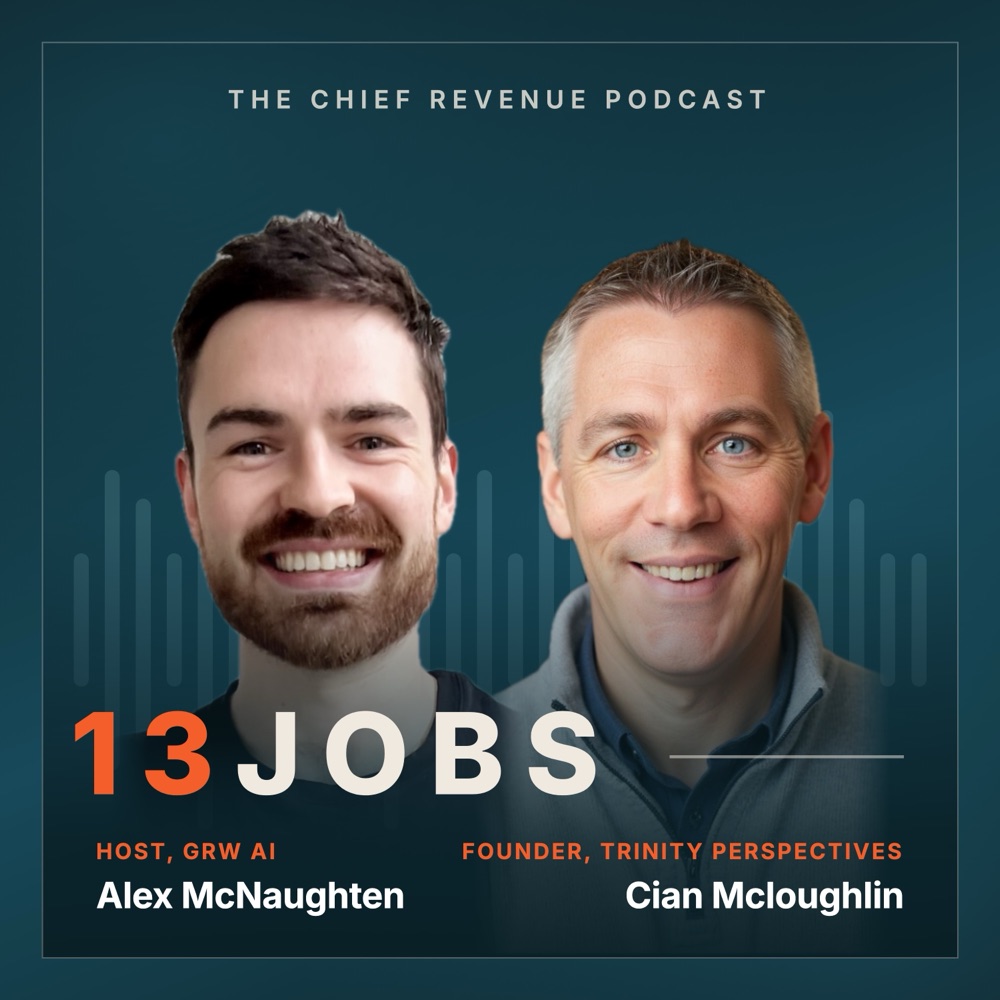
 Hosted by Alex McNaughten
Cian Mcloughlin · Founder, Trinity Perspectives
Cian McLoughlin spent his first decade in enterprise software at companies including Cognos and SAP, then left in 2011 to start Trinity Perspectives, a sales training and advisory business working mostly with large tech and telco firms.
Trinity does something unusual: it goes and interviews the vendor's customers about what actually influenced their buying decision, then reverse engineers the findings back to the vendor. He is also the author of Rebirth of the Salesman.
In this episode, we discuss:
- A decade at Cognos and SAP, then Trinity Perspectives
- Professionals watch the game tape back
- The CRM dropdown that asks the fewest follow-up questions
- Win reviews matter as much as loss reviews
- Two surprises: that customers talk, and what they say
- Creating enough separation for someone to be candid
- Whether the culture can actually hear the answer
- Your team on the ground are amazing; your head office is not
- Doing it as one rep, with no programme behind you
- Ask during the cycle, not after it has closed
- The wastage nobody in the industry wants to name
- Nobody wants to be sold to; everybody wants to be helped
Quote of the show
“Nobody wants to be sold to, but everybody wants to be helped.”
Key takeaways
- The internal debrief is a guess. A few people in a room agreeing it was probably price, then a dropdown in the CRM, then on to the next one. That becomes the accepted narrative and it is nobody's actual reason.
- Check which option is cheapest to click. One chief executive ran two dummy opportunities through his own pipeline and found the two reasons his data showed most were exactly the two that triggered no follow-up questions.
- You earned the feedback. If the sales execution was decent, most customers will give it, out of professional courtesy and because they may want to work with you later. Vendors consistently assume otherwise.
- Separation is what makes it candid. Nobody wants to tell a rep to their face that they were unresponsive. A third party, or at least someone other than the rep, gets the version that is actually useful.
- A blame culture cannot use the answers. Some organisations hear something politically inconvenient and bury it. The willingness to take the medicine has to exist before the review is worth running.
- Do wins too. Losing teaches you what to stop. Winning teaches you which behaviours to name, repeat and spread across the team, which is the part most companies skip.
- A rep can start alone. Ask for feedback on one specific part rather than the whole deal, tell them plainly you want the honest version, and ask while the cycle is live. Occasionally that conversation turns the deal around.
Transcript
Kian, good to have you on. How are you, my friend?
Doing well, thank you. Apart from having a couple of jet-lagged young children at home, I'm ready to roll.
Yeah, the jet lag can definitely wipe you out. So tell us about yourself for those who don't know you, haven't come across you before. Tell us about you, your journey, what you're up to today.
Sure. So I have spent probably the last 20+ years in the B2B sales industry for my sins, the first 10 working with enterprise software companies. So organizations like Cognos and SAP. And then I stepped out in 2011. to set up a sales training and advisory business called Trinity Perspectives. So that was kind of the last decade has been more working with and advising predominantly big tech and telco firms from around the world.
And we do something which is a little bit unique or maybe a little bit different. We help businesses better understand why they win and lose the key deals they pitch for. So we actually go in and we engage with their end customer and find out what influenced their buying decision. And we take all the stuff they they tell us and we kind of crunch it together into findings and recommendations and then reverse engineer that back into the vendor so that they can sweat the asset of their cost of sale and actually extract some value from all the time and the effort and the energy they put into their bids and their pursuits.
So yeah, that's kind of what's been keeping me busy for the last 10 years or so.
Right. And yeah, it's an interesting— it's one of the reasons I really want to talk to you because you've you take this idea of, I guess, advisory training kind of from the end of really getting looking at the customer and their experience and starting there.
Yeah.
And it's not something that, you know, that many sales professionals and organizations, I think, do particularly well is actually understand the reasons why their customers are buying from them, but equally why their customers aren't buying from them as well.
And that was probably the catalyst for me, Alex, in terms of starting this business in the first place. Because in my own sales career, I kept having this kind of recurring thought, which is, you know, I'm putting all this time and effort and energy and blood and sweat and tears into these pursuits.
And, you know, enterprise sales at a company like SAP, 3, 6, 9-month sales cycles.
Yeah.
So, you know, you're talking a high cost of sale. And at the end, you know, we'd win some, we'd lose some, but invariably what would happen is we would sit in a small meeting room and say, what do you think happened on that one? And then, what do you think? And then we'd bat it around between ourselves and then we'd select a couple of default reasons or decision criteria.
And that would become the accepted narrative for what had happened on that deal. So look, I reckon we lost on price. I reckon we were a little bit above their budget. I think we were probably not quite as aligned with the executive leadership team as we should have been. And I think they were probably always leaning toward, yeah, yeah, we all agreed, boom, right?
And that would be it. And we, we, that, and that sounds, you know, plausible enough. And we'd pop it in the CRM somewhere and we'd move on to the next one. And for me, that was just crazy, you know? And then as I started, you know, I had a lot of friends in, in the industry and I started to, how do you do this?
How do you— Well, we don't, we don't do that. We just, yeah, we just do a debrief internally. And, and I just looked at this and I had this kind of, I don't know, emperor's new clothes moment, which was, well, I've played sport all my life. You know, what do the best professionals do?
They watch the game tape back. They identify, you know, weaknesses and look to improve on them. They look at their competition and identify their strengths and how are they going to, you know, compete against them in the future. And then they get better. And we call ourselves sales professionals, but we can't actually call ourselves professionals if we don't do the professional thing.
And for me, this was a really glaring omission for us as an industry, was at the end of the sales cycle, win, lose, or draw, we should be doing some analysis on why did we win, why did we lose, and what can we do better next time around. And so ultimately, I kind of set out to crack that nut and build a business, and now we deliver that service for companies all over the world.
Yeah, it's It's interesting, just going back to what you say, because I can remember it distinctly as a sales professional myself, was when I was selling for bigger companies would be there was a dropdown box in the CRM and it was the why did you lose? And the majority of the time, the answers given there were not particularly helpful.
And we actually honestly, a lot of the time didn't really know. We were like, oh well, we were in a competitive situation, so they must have gone with a competitor. So we'd put that in.
Yep.
But the problem with that, right, is that the business was collecting, I suppose, what they thought was useful data. But the reality is junk in. And what are you going to do with it?
Well, and it gets even more worrying because we had a company that reached out to us at one stage and said, look, we're interested in exploring why we win and lose. Here's the 2 primary reasons that we know at this stage. And I said, how do you know that? And they said, well, because, you know, this is what our CRM data is telling us.
So I said to— and this was the CEO— I said to the CEO, do me a favor and put in a couple of dummy opportunities and just work them through your pipeline. And then at the end, get to the, you know, closed won, closed lost, closed, do nothing dropdown and tell me, is it— are these 2 criteria the ones that have the least additional scrutiny after you pick them?
Just, just, it's just, you know, hypothetical. So he went through it and he came back to me, he's like, oh my God, yeah, these 2. That's— you just click that and then you move on. If you, if you click competitive loss, there's a whole lot of additional things. If you complete, you know, click this one, there's a whole So what we're really doing is we're saying to people, look, we don't really care.
We're not really that interested. You just pick whatever you think and then we'll all move on to the next one and we'll forget about it.
Yeah.
But it makes no sense. And it makes no sense when we're losing, but it also makes no sense when we're winning. Because if I'm winning, I want to identify what are the behaviors or the traits or the characteristics that are actually making me successful so I can repeat them. And so we can share them across the team and so we can level up everyone.
If we're not doing that, then, you know, we're just throwing mud against the wall and hoping some of it sticks. And that just doesn't make sense. In times of plenty, you can kind of get away with it because there's enough opportunities and we're all sort of, you know, hitting our number or getting close.
But, you know, as things get tighter and customers, you know, buying criteria shifts, this stuff is— it's not just a nice to have, it's an absolute must-have.
So you're a business today you're doing it, maybe you're tracking some really not particularly helpful win-loss reasons, uh, maybe you're doing nothing at all. But where do you start?
So, you know, you might think I might— my response would be, oh well, bring in an organization as an independent third party. But you don't have to do that at all. The way I look at it is this: if you've done a halfway decent job in the sales execution piece, then you've earned the right to that feedback.
Right.
Now, one of the biggest surprises that we get when we talk to organizations all the time is 2 big ones, right? The first one is they don't think the customers will share this feedback with us, right? That's the big— they're like, why would they? Particularly in a losing situation, why would they? And there's a whole lot of reasons, from professional courtesy, you know, because you've done a good job, so you've earned the right to the feedback, and then you ask for it and you actually do get some feedback.
But there's a whole lot of reasons that are actually in the best interests of the customer to give feedback to a vendor that's interested, that wants to take some action, that wants to improve, that wants to innovate. Because even if they didn't pick you this time around, that doesn't mean the doors are closed and they have no intention of engaging with you down the track.
And if you're prepared to go away and listen to them, there's a whole lot of reasons why companies will do it. So that's the first big surprise. The second big surprise is they just can't believe what we find out. They're like, how did you get them to tell you this? How did you get them to open up to that extent?
Like, you know, we've known these— this organization for 6 months and they've never shared as openly. But, and again, you know, I'd like to pretend it's a secret sauce, but it isn't. It's saying, it's creating an environment where they can be honest, where they can be candid, where they don't feel that what they say is on the one hand gonna throw anyone under the bus, 'cause that's not what they wanna do.
Mm-hmm.
If they're taking the time to give feedback, they're not doing that to, you know, point the finger of blame. They're doing it to be constructive. But also you have to create enough separation allow them to be honest, because it's a little bit of an awkward process. When I first started doing win-loss reviews, when I was still employed in the corporate world, I very quickly realized I was putting a customer in a slightly awkward position if I was asking them to give me feedback about me, about my team, about my peers.
Because it's just in a human-to-human environment, it's very difficult for me to say, look, Alex, you did a bit of a crap job there, to be honest.
Yeah.
You weren't very responsive. Your attendance was didn't read very well, you didn't do very good. It's just awkward. So maybe I kind of, I prevaricate and I dance around and I kind of, it's not you, it's me kind of stuff. We don't want that. We want to create an environment where they can feel really, really comfortable, be as honest as they feel they're willing to be.
But then the flip side is when we get the information, we also need to be able to do something with it. So I was in a difficult position because now I was finding out things about myself that maybe I didn't want to share with others. I was finding out things about my colleagues and peers.
That made it kind of difficult for me. I was hearing things about my boss that, you know, how do I communicate that up the line? And then what do I do with all of this information? Because there's no point shining a light on these topics if we're going to sweep it back under the carpet.
Because like, either I haven't got the bandwidth or I haven't got the political capital to do something with it, or really it isn't my job. And that's one of the key things. It almost never is somebody's exclusive job. There's very, very few people that I've ever come across where you say, What do you do?
I'm responsible for win-loss analysis or win-loss reviews or post-sales debriefs. It just doesn't happen. Usually it's someone's kind of 2%, 5%, 10% of their job. So my— that was a very long-winded answer, apologies. My advice would be get somebody in the organization who's sufficiently senior to have a conversation, you know, at a peer-to-peer level, because you can't have a junior person having a conversation with a senior person at the customer side and really trying to delve into what happened.
So, so make sure it's kind of like for like in terms of experience. Make sure it isn't somebody who was involved in the sales cycle itself.
Right.
So you create that separation and the awkwardness goes away, but also make sure it's someone who has enough political capital or enough authority or seniority to actually do something with the insights they get. Because otherwise you're kind of left with this sort of holding the apple and it's like, ah, it's kind of difficult.
Why having— why us as an independent organization works quite well is because not only does it allow us to capture the feedback in a way that tends to make people feel more comfortable on the customer side, but then we can actually do something with it. So we don't just say, here's what we heard.
We then interpret that and say, here's our findings, here's our recommendation, here's what we think you should do, here's the prioritization, and here's who we think should own it. Now again, no obligation for, for a vendor to to take action on all of that, but at least they've got something which is really tangible, backed up by very specific feedback from their customers.
Because we record that, we transcribe that, we make all that available. So now you've got something which is kind of like pretty meaty, pretty specific that you can go away and take some action on versus the scattergun that we usually get, which is, what are we going to do this month from a sales enablement perspective?
I don't know, let's do some negotiation training or let's do some discovery. And that might be helpful, But is that the thing that we actually need? Usually, we don't know. Customers have the answers to most of those questions. Let's just go and ask them and then do something about it.
So in order for it to really work at an organizational level, there needs to be buy-in at a senior level that you're actually going to do something with the data you're collecting. Because otherwise, it's just nice to know. But unless you actually have buy-in to action it in a meaningful way, it's pointless.
That, you know, it's really interesting that you raised that because that's one of the biggest issues. If you don't have a willingness as an organization to take your medicine when you hear stuff, if the culture is more a culture of blame or a culture of, you know, sort of, you know, pushing things in a different direction, then you're better off not doing it in the first place.
Sure.
Because it puts you in an awkward position. And we've had a number of situations like this where companies have said, this is too politically sensitive or too hard. Or it's beyond our remit. And so they try and bury it deep again. And that doesn't work very well because now internal team members have recognized it, but also customers have recognized it because you've actually asked them.
Yes.
But we've also had other organizations. We have this customer of ours in North America, and some of the feedback they got from the first batch of lost reviews was, your team on the ground are amazing, your head office team are appalling. You know, very, very slow to respond, giving mixed messaging, pricing is all over the place, etc.
And we were getting this relatively consistently. And so they went away and changed their operating model in North America to go from a head office and field team to a hub and spoke model where they had hubs in, you know, a couple of the key cities and they could be much more responsive.
And everything shifted inside their business. I mean, they changed a whole lot of other stuff. So what they did was they got all the feedback, And then they kind of traffic lighted it. Red was bad, orange was kind of neutral to maybe slightly bad, green was obviously positive. And then they put a whole team together internally and said, what are we going to do to turn this red to orange, orange to green, green maintain that and spread those learnings across the business?
And they were really— they institutionalized the learnings, took major action and have just seen a vast— I mean, they were a good organization anyway, but they had some some internal tangent, you know, issues. Um, most of the, most of the, the answers to the hard questions that we have inside our businesses reside with our customers.
And we've earned the right to get those answers. We just struggle with the mechanism for extracting them.
What about if you're a sales rep? And, you know, you don't— might not have the business buy-in to do this sort of thing, but you're looking to really just improve as a sales rep, you know, you're trying to be the best sales professional you can possibly be.
Yeah.
Um, how would you, you know, how would you go about using some of these principles as a, as a, as a sole sales professional?
Well, I think there's, there's 2 pieces to that. One is you could certainly ask to get some feedback yourself, and you could make that a little bit more specific than just, you know, the end-to-end what Because what we tend to do is we say, hey, can we talk to you about the end-to-end buying journey that you went on?
And can we kind of ask you questions like, what was it like at the very front end? So you could kind of narrow the focus a little bit and you could just talk about the interactions that you had with the customer all the way through.
Right.
You want to contextualize it for them because just human nature is I don't want to hurt your feelings. So what I would say to you in that situation is, look, I'm really, really interested in this. This is really valuable for me. Please don't sort of try and protect my feelings. Give me as much feedback as you feel comfortable, but then make sure you're asking quite specific questions.
Not like, was I good or was I bad? But during the discovery, did you feel I took enough time to really develop an understanding? And then did I apply the insights you shared with me through the sales cycle? And kind of make it a little bit more specific. You know, you'll be judged on the quality of the questions that you ask.
So ask better questions and you'll get better feedback. So you can absolutely do that. But if you do that for a period of time and you start to get some real value from that, then I would strongly encourage you then go to someone in a position of authority inside your business and say, I think we need to be doing this as an organization.
Sure.
Because if you're getting value as an individual, imagine how much more you could get if you started to do this, you know, built this in as a consistent step in your sales process. So yeah, you can kind of crawl, walk, run, start to do them yourself. But over time, if you're getting value, I think you can make a pretty strong case.
There's not a lot of effort required to do it. You've already dropped your cost of sale. So you've earned the right to it. Now it's just about what the mechanism is for actually capturing that and then what you're going to do with it from that point onwards.
And I suppose in terms of getting over the fear of hurting someone's feelings, If you're the sales professional and you're actually asking for feedback on your sales process, I suppose it's a little bit like when you're doing discovery and it's just about creating a very transparent environment through powerful questions and also just setting the scene that where, you know, where this is coming from, the why of your— the why you're doing it.
Yeah, very much so. And if you can do that, you'll But you've raised an interesting point there as well. We always encourage salespeople to ask the question while they're still engaged in the sales cycle. So if you ask me for feedback and the deal's already lost, you know, at the back of my mind, I'm thinking, okay, all right, maybe there's an ulterior motive here.
Maybe, you know, Alex wants to try and get back in by the back door, or maybe he wants to, you know, call foul on my process. But if you let me know during the sales cycle that win, lose, or draw, you're going to want to get some feedback from me, is that okay?
I'm more inclined to say yes at that stage. And, you know, I'm less inclined to feel a little bit, you know, suspect about your motives.
Yeah, I think that's a really good point. Because you're right. And I used to do this when I was selling B2B SaaS. And I would always ask why I lost a deal. And a couple of times that actually helped me turn a bad deal around. Yep. So, you know, that can happen. But I think you raise a really, really good point there is it's far easier to get that feedback And almost, you know, when we talk about it, almost like trial closing all the way through your sale, preempting potential objections and asking your prospect, okay, well, how's this going for you?
Are you getting value from our conversations? Is there anything you're not getting? And if you can do that throughout your sale, it's far better. You're absolutely right to collect that feedback then rather than dump it all on them. Where it could feel like a Hail Mary, uh, trying to save a deal. Yeah, it's a really good point.
Yeah.
Um, should you do loss reviews, in your opinion, for all sales of all sizes, you know, so right down to SME sales, or, or are there some nuances in terms of how you do it, in your view?
Yeah, so it's a great question and it's one that I've been wrestling with for, for years and years. So where the world I came from was kind of enterprise, longer sales cycles, higher cost of sale. So it was actually really easy to, to justify doing that additional bit of scrutiny at the end, because if you've dropped, you know, $50,000 or $100,000 on a pursuit over an extended period of time, then bringing someone in to interview 2 or 3 people makes perfect sense.
The question we've been getting asked repeatedly is, How can we do this at scale? How can we do this for our run rate volume deals rather than just our major bids and strategic deals? And the answer I've had for the longest time is, not quite sure. Maybe you can do it internally, maybe you can do it yourselves.
And so about 18 months ago, we embarked on saying, all right, how could we crack this nut? Because this is a really big nut to crack. If there's a lot of SaaS companies, there's always value in getting the feedback. The question is, what's the capture mechanism? So what we've done at Trinity is we've actually built an application that says, all right, let's pull all the opportunities out of CRM that we want to, or load them manually, and then identify the ones that we think we'd like to get some feedback from, if it's a win review, a loss review, or do nothing.
And what we've done is we've effectively created our, what we call the kind of the golden question set. So what's the sort of the least information, both quantitative and qualitative, we're keen to get from the customer about the engagement. And we marry that up to the buying cycle they've gone through. So we ask them questions here, what brought you to market in the first place?
And what are your trusted information sources? Right the way through to the purchase at the very, very end and potentially even the onboarding. And we build in quantitative and qualitative. So we give them the chance to answer questions with an audio recording or a video recording or type it in. They can do it on their phone.
They can do it— Trying to make it really easy. So it's not customer sat. It's not NPS. It's not just a kind of a bland survey. This is a quite a detailed conversation with them, you know, anywhere from maybe 6 to 8 minutes of their time, recognizing that we've had a reasonable number of interactions with them, you know, maybe 2, 3, or 4 interactions or more in the sales cycle, which is what earns you the right to that little bit more feedback.
You know, you jump out of an Uber, you're going to get, you know, one question or maybe 2 questions immediately. So So we're all kind of more comfortable with giving feedback. It's just how much feedback and then what do we do with it?
Yeah.
So we've built this application. And to be honest, the jury was out. My view was it's possible that customers will agree to a 45-minute interview, but not agree to a 5-minute, what feels like a survey, because in the past, surveys have sort of disappeared into the ether. And if it doesn't get action, then why would I give you my time?
But actually what we're seeing is they're giving, they're giving really detailed feedback through that process. So where we want to get to is we want to be able to say to companies, not just top end of town, but mid-market and even lower mid-market, here's a, here's an application. Um, we're not going to charge you based on the number of reviews you do, so do as many as you want to, and then capture and aggregate the feedback.
So now you can see the trends across the data. Why did I lose my last 20 deals? Here's 2 or 3 things that were consistent. Why did we win our last 20 or 30 deals? And then also see some other interesting qualitative feedback around what are our customers actually saying. So one of our new, like, early stage beta customers that's been using it, a couple of really interesting things have come out.
The board has a much higher role in terms of influence in their customers than they ever anticipated. So we're asking, you know, you know, from a decision tree perspective, like in order of priority, tell us who's the most important. And the board is coming in number 1 or number 2 most of the time.
And they never even anticipated that. So they haven't got any content, any marketing, any collateral that speaks to the board at all. So that's—.
We're not even talking to the board in the sales cycle, right?
Never talked to them. Never, never. It doesn't even occur to them. And yet here's this incredibly influential group that aren't even on the radar. So that's one of the things. The other thing is this organization has put a lot of focus on discovery over the last 12 to 18 months. They've armed their team with more, just more time and also more knowledge to do that discovery.
And that's coming through really, really strongly in the feedback. They're saying, you went a lot deeper than any of the other vendors. You took more time to listen and understand our business, and then you played that back to us.
Okay.
So, you know, whether it's by accident or design, their win rate of net new business is higher than it's ever been. And this is a very established business because they're starting to say, okay, we're seeing the behaviors that are working for us. So now we can spread them across the organization. So my— maybe it's a pipe dream, maybe it's unrealistic, but my view is, you know, if you look at most sales cycles, if you put them up on a wall and it's like, you know, from find opportunities here to, you know, moving through to closing, there's a step in that process that's missing.
And the step that's missing is you know, win-loss analysis or post-sales debrief. And we should be doing that on a consistent basis because we're leaving so much gold, so much value sitting on the table that our cost of sale is paid for. You know, we've earned the right to this, but we just don't kind of know how to do it.
So we just leave it there. We think it might be a bit awkward or a bit uncomfortable, and we just move on to the next one. We can't afford to do that. There's so much competitive intel. There's so much valuable— not even just sales enablement, it's You know, the feedback we get about marketing, it's about legal, it's about pricing, it's about pre-sales, it's about value engineering.
There's all of this stuff that can make us better as a business that is available to us. We just need, we just need to pull it out and, you know, kind of finesse it a little bit. So yeah.
Yeah, look, I think it's a very, very strong case. And, you know, I saw it as a rep, even though I probably wasn't doing it in the best way.
Yep.
That I was getting some useful insights and it was making me better as a rep. And, you know, if you can extrapolate that across the sales team and then also start to impact other parts of the business as well.
Yeah.
And how it all comes together to create a really compelling buying experience, then yeah, why wouldn't you?
Why wouldn't you? And, you know, it's—.
I'm doing a sell for you here, but I'm on board with it. You know, I think it's so important.
But, you know, here's the thing, like, forget about, forget about us as a business. This is, this is about us as an industry because there's so much wastage. There is so much wastage going on. Like, you know, we'll talk to, we'll talk to a vendor and they'll say, okay, we were in a competitive shootout with 7 or 8 other companies and we all responded to the tender and we all did this and we all did this.
So, so you've got 7 or 8 companies that have cost of sale in the hundreds of thousands to get to the start line. And then they go into, you know, demos and pilots and, you know, proof of concepts and, and then shortlist to 3 and then jump them through some more hoops. You're talking hundreds of thousands into the millions of dollars of cost of sale for some of these very, very large.
And that goes on all day, every day. And, you know, I'm not pointing the finger, but there's a number of organizations that just toss out tenders left, right, and center.
Yes.
Just, you know, just to sort of keep the vendors busy while they do some other things. And all of this effort is being wasted. And for me, that is just the dirty secret of our industry. So we need to do something about that. And if we can't fundamentally change how customers buy, then at the very least, we can recognize that we should be getting some value back in return.
So, so at a, at a macro level, that is the big challenge. It's how do we reduce the wastage? Or how do we at least extract some value in return? At a micro level, something you said is very, very relevant here as well, which is It's hard to be in sales. It's a tough gig.
You know, you've done it, I've done it. Losing a deal that you, you're very invested in, you know, it really hits hard. But there's an opportunity to give a huge gift to, to salespeople, which is I will tell you what really happened. We will find that out for you and we will tell you.
And quite often as a salesperson, you think, ah, it's probably me, I probably dropped the ball. And then we get this feedback, and I would say 9.5 times out of 10 They're like, actually, Alex did a really good job. We were very impressed, but then this happened and that happened. And then, you know, that was a challenge for us.
And so it's very cathartic to find out what actually happened. We can get rid of all the assumptions and all of the sort of, you know, the self-doubt and discover, oh, it was these 3 things. And then we can go away and address that. That's a huge gift to give to salespeople to say, you know, you did a good job, you didn't win, but here's the 2 or 3 things you can now go away and have a look at, or this is what we need to do at an organizational level to to better support you for the next one.
And then you can kind of shake it off and move on versus kind of getting all the battle scars that we get without actually learning any lessons because we don't know. And I come back to this comment about being a professional or a sales professional. We can't call ourselves that. You're just a sales rep.
You're just a salesperson. Unless we're doing professional things at each step of the journey, it's just a gig, just a job. And the professionalism is about saying, how do I level up? How do I get better? How do I improve? Because one of the things we've learned in talking to all these customers is you're not 50% better or 50% worse than, than your closest competition.
It's all of these little tiny 1% and 2% increments right the way through the sales engagement. And that's what we're hearing from customers. The biggest surprise to me in a decade or more than a decade of doing this is We talked to all these customers, C-suite decision makers, heads of procurement, people who were involved in the business.
And invariably, they talked to us about the people that they engaged with on the vendor side. Sarah was amazing. She took the time to listen and understand. Greg was just— he came with so much knowledge and he pointed out risk factors that we hadn't even imagined and challenged us. And I'm thinking, but like, these are enterprise sales cycles, technology-driven, surely it's product and price.
But the realization, this is the big realization for me, is product and price is super, super important if you want to get from the long list to the short list. But as soon as you've got from the long list to the short list, then the customer is effectively saying, look, these 3 can do it and they're in the right ballpark from a pricing perspective.
Now, how do we differentiate them? And then it's all about the quality of your people, all about your purpose, all about, you know, what you're going to be like to work with when, you know, when the project goes south and you You have to really kind of step up. These are the things that, you know, we're buying with our hearts and we're justifying with our heads.
But as an industry, we tend to sell to people's heads. We don't really think about what are the underlying factors that are going to influence them to make a buying decision. So it's— and this stuff keeps coming out as we do these win-loss reviews. They talk about the people all the time and that the people are the personification of the brand on the business card.
Sorry, I get really excited. Apologies.
No, no, I'm with you. And I think one of the things that we share a real passion for is this idea of professionalizing selling. And because I absolutely 100% agree with you, in general, salespeople are not necessarily professionals. It's the Wild West out there. There's no criteria to become, to get into sales.
I was a uni dropout and I fell into it. And that, you know, and that's, I think we surveyed quite a lot of sales leaders across Australia and New Zealand, well over 200.
Yeah.
And we found that it was something like 73% of them had fallen into sales. They didn't choose it.
Um, I, I played football for a team and I wanted to stay in Australia because I met a girl, and one of the guys on the football team was a recruiter and he said, I'll get you 5 interviews at 5. And one of those companies happened to be a little software company, and I talked my way in, and, and that was like 20 plus.
It's ridiculous. I agree with you, everyone just kind of falls in. But how you come in is one thing, what you do when you come in is the next question.
That's right.
And as an industry, we need to be able to give people not just the professional standards and expectations, but the ability to feel proud of what they do rather than hiding behind, you know, account manager, this, that, and the other, never putting the word sales. I've never had the word sales on a business card in 20 years, even though I've carried a quota or managed teams across all of those roles.
Yeah, because there's still a huge stigma attached.
That's right.
But you did a university degree and a postgrad and now you're in sales. Oh, that's, that's not great. Actually, it is great, but But we don't think of it that way.
It's so true. Look, I could go on about— I think we could both probably go on about this one for a long time, but very, very much agree. And, you know, one of the things that I think separates a profession to just a job is this idea of lifelong learning, lifelong development. And, you know, what you've spoken about today is an aspect of that because you learn far more from your losses a lot of the time than you do from anything else.
And if you don't have a structured way of actually getting those nuggets of learning from the deals that you've lost, then how can you really hope to reach your full potential?
Correct.
And, you know, it kind of just begs the question, like, why do we accept that there's a 20% conversion rate? Why? You know, like, you know, when you go into an organization and they say, oh yeah, we need a 4x coverage on our pipeline. Why is that? You know, like, why?
Because we lose so much. Okay, well, instead of 4 times cover, shall we address why you're losing so much? And maybe you only need twice cover. You know, I completely agree with you. I completely agree with you. It's all these— there's all of these little, you know, kind of accepted, um, truths about sales that are total bullshit if you ask me.
Uh, never respond to a tender that you haven't written. And, you know, all this, it's like nonsense. No, no, you know, don't come in with these preconceived notions. You're losing, you're losing, you know, 4 out of 5 deals because your discovery is crap, because your, your, your templated responses are boring and generic and bland, because you're doing a show up and throw up and talking about your product when you haven't earned the right yet because you don't know anything about, you know, your, your follow-up is poor.
I could like, I could go chapter and verse through the 10 top 10 reasons that you're losing deals. And the top 10 reasons that you're winning because we've heard this stuff and we've got the data to back it up over a decade. Fix that stuff. Don't just try and get yourself 4 times cover because then all it means is, you know, a whole lot of other companies are going to think you're bad as well.
Yeah, absolutely. Look, I could talk to you about this all day, but we're running out of time. So I just want to ask you one last question, which is Knowing everything you know today, yeah, and you go back to your first day in sales, okay, your first day on the job, what's the one thing you wish you'd known then that you know now?
Oh, there's so many I could, I could talk about, but I think the one thing I wish I'd known then is that nobody wants to be sold to, but everybody wants to be helped. So don't sell. The best salespeople don't sell. All they do is focus on earning the right to move to the next step of the process by doing a really good job at each interaction.
So they take the pressure off their own shoulders. I'm not stressed because I don't want to sell you anything. All I want to do is, is have a really good interaction. So that's where I'm going to put my focus. So if it's a first meeting, I'm going to do some really good discovery.
I'm going to come in with some good questions. I'm going to put an agenda together. I'm going to put some structure around it. I'm going to follow up in a timely fashion. And then you'll go, you know what, that was a good interaction with Kian. Well, yeah, we'll definitely keep him in for the next round.
And then if the next round is a demo, then I need to make sure I do a really good job at that step of the journey. And then that earns me the right to keep moving through the process. So, so it takes the pressure off me, take— and then, and then you don't feel the pressure.
All you feel is this has been good, you know, because you're judging me in terms of what am I going to be like to work with. Through the sales cycle. So we need to treat customers like customers before they ever become customers in terms of how we actually interact with them, in my experience, because they're buying you as the personification of the brand before they ever buy that brand.
So we just need to, you know, give them that opportunity. And so that, I think there's a million other things I could say, but that's probably the big one for me is like you don't need to sell to be successful in sales. In fact, It's kind of, it's counterintuitive, but the people who sell the least are the ones who are the most successful.
Yeah, I think you're spot on there. It's if you focus on just helping people through every interaction you have with them, you'll actually sell more.
You will. Because what you're doing is you add a little bit of value and then they want to reciprocate a little bit of value back to you. And that's just the human condition. It's a much, much nicer way. It's a more enjoyable way to do it. And as luck would have it, it also makes you way more successful.
It's been brilliant chatting to you today. I really enjoyed it. And I think there's a lot of gold in there for sales professionals, sales leaders, business owners, business leaders as well. So thanks for coming on. Where can people find you if they want to connect with you?
There's probably a couple of places you can have a look. So LinkedIn, I share a reasonable amount of content on LinkedIn. So just head there and reach out. If you're going to connect with me, please send me a message when you connect because it just gives a little bit more context instead of either me saying yes or no.
We start off on the right foot, but I always try and share some content of value. And then if you're interested in Win Loss and you want to find out a little bit about it, head to usetrinity.com. So we're soft launching our new platform. So we haven't launched it to the public yet, but what I'm doing is I'm I'm writing kind of a monthly, almost like a, I don't know what you call it, like a blog or an email, just sharing the journey that we're going on, the journey of being a startup, the journey of how to institutionalize win-loss reviews.
So if that's of interest to you, then subscribe there and you'll get that in your inbox once a month. And we'll kind of take you on that journey with us until we publicly launch later this year. So yeah, they're probably the 2 places you can head.
Brilliant. Thanks again for coming on. Pleasure to chat to you. I look forward to chatting again soon.
Thank you for having me. Cheers, Alex.