
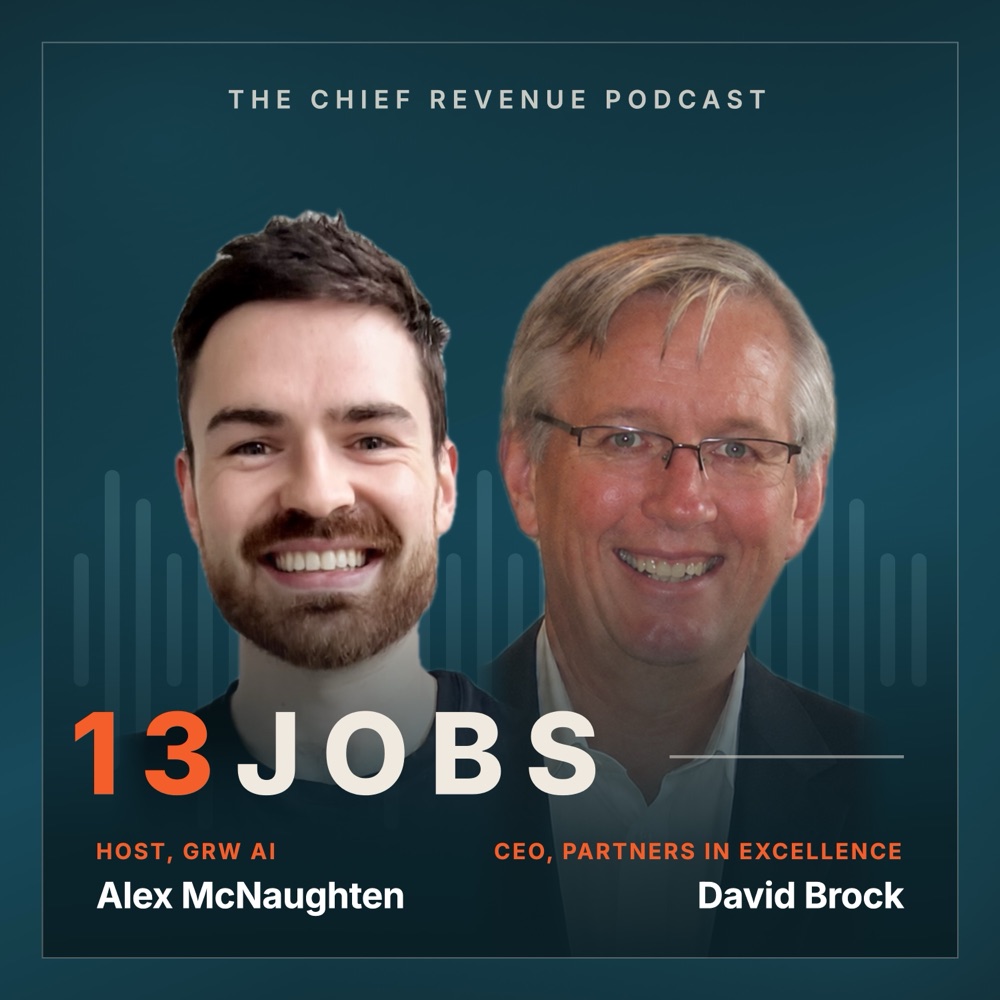
The work you enable, not the work you do
David wrote a survival guide for frontline sales managers because he kept watching good ones fail. Barely anything is spent training them, and most are handed the job for the wrong reason.
 Hosted by Alex McNaughten
David Brock · CEO, Partners in EXCELLENCE
David Brock runs Partners in EXCELLENCE, a boutique consulting firm of about fifteen people scattered around the world, all of whom have held senior executive positions, mostly in technology. Their clients are roughly half technology and industrial, a quarter professional services, and a quarter everything else.
He is the author of the Sales Manager Survival Guide, which he wrote after years of watching capable frontline managers struggle in a job nobody had defined for them.
In this episode, we discuss:
- A boutique firm of fifteen, spread around the world
- Why he wrote a survival guide for sales managers
- What gets spent training managers, against training reps
- The double whammy of promoting your best seller
- Making the numbers is your people's job, not yours
- What the job actually is
- Being asked, plainly, whether he could give up his own deals
- Coaching is not a separate item on the calendar
- The questions to ask before the call, not a month afterwards
- Whether people feel heard, included, and that they have a future
- Laying off a third of a company, and doing it with compassion
- The one thing: he was nowhere near as good as he thought
Quote of the show
“It's not the work I do and the results I produce. It's the work I enable my people to do, and I revel in, and I'm proud of, and I'm happy for their success.”
Key takeaways
- The job is not making the numbers. Ninety five percent of managers say it is. It is their people's job. The manager's job is maximising what those people can do, which is a harder and much less flattering task.
- Promoting your best seller costs twice. You lose the seller and you gain a manager who may have none of the competencies for it. Define the competencies, then hire and develop against them.
- Ask the question out loud. When they promoted him they told him plainly that his giant deals would now be his people's deals, and asked whether he could live with that. Most organisations never ask.
- Coaching is not a separate activity. Treated as its own calendar block, it is the first thing dropped when the quarter gets tight. Woven into the work, it survives, and it stops being something anyone has to find time for.
- Coach before the call, not after it. What are your objectives, what do you want from me, what do you want to happen. Asking a month later, about a call nobody remembers, teaches nothing.
- The senior job is the workplace. Strategy, structure and talent are the visible parts. Whether people feel heard, included and able to grow is what actually shows up in tenure.
- The humbling is the education. He arrived at IBM selling to major New York banks convinced he was the smartest person in the room. Getting his teeth kicked in a few times is what he would give his younger self earlier.
Transcript
David, thank you for joining us today. How are you?
Good, good. Thanks for inviting me, Alex. I'm really flattered that you want me on your podcast.
No, it's an absolute pleasure to have you on. So David, for those who don't know you, you are an author of The Sales Manager Survival Guide, and then you're also the CEO of Partners Excellence. So tell us a little bit about yourself.
Super. Yeah, so first, I run a boutique consulting company called Partners in Excellence. There are about 15 of us scattered around the world. All of us have held kind of senior executive positions, primarily in technology companies. And so we do a huge amount of kind of business strategy consulting, covering the whole strategy of a company, and then a lot of the kind of customer-facing strategies.
So sales, marketing, customer experience, go-to-market strategies, and those kinds of things. And our clients are typically, um, I'll call it Fortune or Global 250 corporations.
Yep.
About 50% are technology or industrial products, about 25% professional services, and 25% a mix of everything from consumer products and retail to not-for-profit to basic materials and so on. Gotcha. And then I'm also the author of Sales Manager Survival Guide. It's a, it's kind of a desk reference for frontline sales managers. And then this fall, you'll see the Sales Executive Survival Guide coming out.
Fantastic. And this sort of brings us on to our topic. So maybe the first question I'll ask you is, why did you write that book? Like, what made you write the Sales Manager Survival Guide?
Well, it came through, I mean, just seeing lots of really, really good frontline sales managers just struggling to be successful. You know, they wanted to be successful, but they didn't know how. They didn't know really what the job was. They didn't know how to spend their time, and so on and so forth.
There's a piece of data in there at the time, you know, people were spending somewhere in North America, say somewhere around $2 billion a year in sales training.
Right.
If you look at what they were spending on sales, frontline sales management training, it was less than $300 million a year. So there's a huge underinvestment in what I think is probably one of the most difficult and one of the most important jobs in sales.
Yeah, that's a crazy disparity between what's being spent on sales training and on leadership, you know, the people who are tasked with leading those salespeople. What's driven that? Where's that come from?
I think it comes from probably decades of just bad habits. This is the way we always did it. And you see all the mistakes, you see things like, You know, who's our candidate for an open sales manager's job? Well, it's typically our best salesperson.
Hmm.
But our best salesperson, just because, uh, somebody is a high-performing salesperson doesn't mean they could be a good manager. And we've seen so many times where you get kind of a double whammy. You lose your best salesperson, you put that person into management and they're an absolute disaster. And all that. So, and I think it's just bad habit.
This is the way we've always done it, and we keep doing it, and we sometimes somehow manage to muddle through. You know, a question is things as simple as a question I often ask frontline sales managers is, what's your job?
Hmm.
And 95% of the time they come back and say, It's to make the numbers. And I say, no, that's your people's job. Yes, your job is to maximize their performance, enabling them to achieve their goals. And that's— that job is very, very different than this, this whole thing of I go in there to make the numbers.
What's that difference, David? Because I think a lot of sales managers get this wrong or don't understand the distinction. What is that key difference in terms of what— where should they be spending their time?
The key thing any, any manager or any leader does is they get things done through their people, right? And so what that is, is things like making sure I have the right people in the first place, making sure they have the systems, processes, tools, training programs, all that sort of stuff to enable them to do their job, coaching them and developing them to perform their job at the highest levels possible.
You know, so that's the job of anybody from— I've been CEO of technology companies, I've been EVP of sales, I've been frontline sales managers, all the way down to individual contributors. But if you look at that, any manager has that job. And, and so a frontline sales manager has to figure out, how do I do the job?
So very seldom are they told that's what their job is, and then they don't know how to do the job. What they do is they do what they knew before, and that was as a salesperson. So they go out and, uh, do deals. They, you know, have these big S's on their chest, you know, going in trying to be super seller.
Taking the— often taking the responsibility of the deal away from the salesperson, and so on and so forth. So, you know, there's been this dynamic of underinvesting in developing managers at all levels, people not really understanding their job, and it's created this perpetual effect that really drags down performance of organizations.
I want to bring it back to something you touched on earlier, which is this And we've seen it, you know, anyone who's been in sales has seen this before where you just— the best salesperson is promoted to a sales leadership role. They're put in that manager role. And that's not always the best move.
They're not always, you know, yes, there are some crossover skills, but there's equally some things that necessarily don't translate across so well to leadership. Who should be put in that sales manager role if it's not the best salesperson? And how does an organization evaluate that?
So, so I think you have to look at saying, you know, what is a sales manager's job? What are the competencies the person needs to have to move into the job? And how do we further develop those competencies? You know, so those competencies overlap a lot with traditional sales competencies, but they're also very, very different.
So, you know, the matter of As a salesperson, you know, I'm chartered to go out and do deals, and my ego is built around doing deals and, you know, doing the biggest, toughest, meanest deals in the world and so on and so forth and getting rewarded for that. My ego as a manager is exactly the opposite of that.
I have to revel in my people's success. I have to be driven by sublimating the ego I used to have as a salesperson and the joy I took out of doing deals to my ego as a sales manager that says, I get huge amount of reward from seeing the accomplishment of my people.
Hmm.
And so there's a huge mindset and orientation shift. It's not the work I do and the results I produce. It's the work I enable my people to do, and I revel in, and I'm proud of, and I'm happy for their success.
It is. It's a it's a it's a shift, and I think it's something that I've seen some sales managers not understand, and they're still wanting to be the hero. And how does you know? If you're a senior sales leader or a business owner or, you know, and you're trying to figure this out and you're trying to find and identify that right fit sales manager, how do you do it?
What do you, you know, how do you evaluate them?
I think a lot of senior sales managers or CEOs of small companies and so on and so forth don't know the difference in the roles.
Right.
And so they have to be very clear and You know, in my very first management job, you know, my manager— I worked for a very, very large technology organization.
Mm-hmm.
And from the top down, they said, once you're in a manager's role, your job is to get things done through people. It's your people that produce the results, but you enable— and they just drilled that into you. So I grew up in a management culture where they knew what that role was.
Right.
When they put me into that role, they didn't put me in because I was necessarily the best salesperson, even though I was a very, very good salesperson. They put me in because I displayed the competencies, I displayed the characteristics, right, and the behaviors that they expected in managers. And we had— when I was interviewing for my first job, we talked about those issues.
And we talked very bluntly about my ego.
Mm-hmm.
You know, I had closed a number of gigantic deals and was well known in my company, and they said, Dave, these deals are no longer your deals. They're going to be your people's deals. Are you going to be happy with that? You know, so, so I think, you know, senior executives or managers hiring managers don't understand that themselves, and partly because they grew up in the same system themselves, so they didn't know what those things were.
So, you know, part of—.
Right, so the key thing here is actually defining what that sales manager needs to do and what their attitudes need to be for success is the key. And then you go look for that and you interview for that and you measure people against the right thing. And you're saying that actually that's part of the— one of the big problems is that because we're not identifying that, we're not effectively writing our job descriptions in the right way and looking for the right things, we're getting the wrong people.
I'm a big fan of developing competency models, and if you read any of my books, what you see, there's always big sections on competency models. What's the competency model you have for a high-performing salesperson. Both, you know, what are their attitudes, what are their behaviors, what are their experiences, mindset, all those kinds of things.
But likewise, you have to develop a competency model for key managerial roles. And those competencies are different from what I look for in a salesperson, but you have to outline them. It's kind of like having— when you develop this, it's kind of like having a Picture of your ideal manager, or a picture of your ideal salesperson.
Now, as I start looking for people to fill that role, I want to match that picture as closely as I can. But the pictures are different between being a salesperson and a frontline sales manager.
Yeah, and we've got to get the picture right at the start. Just bringing it on to that. The development issue right now in terms of underinvestment in sales managers compared to salespeople? Um, how do we change that?
I mean, clearly there's, there's formal training. You know, my company does a lot of training of sales managers and sales executives. There are a number of people that do that, but I think even more important than that is, is one, clearly defining the role and realize that senior management, just as our people need coaching and development, managers at all levels need coaching and development.
And so, you know, one of the things I don't see, middle managers are not coaching their frontline managers.
Right.
I've been CEO of publicly held companies. I'm CEO of a small private company. Company. I have a board of directors. I have a coach. I expect my board of directors to be coaching me on how to be a better CEO of this company, how I develop as an individual. And I have a professional coach helping me, you know, become better as a coach and better as a leader.
And so we don't invest in that, whether it's investing in outside resources or I'm just such a big fan of You know, senior managers need to be coaching the managers underneath them, need to be developing, and so on. How I coach a frontline sales manager is different than how frontline sales manager coaches a salesperson, but the fact that you're coaching them and developing them and helping drive the right kinds of behaviors is critical, and it's not being done.
I think because I've done a fair bit of leadership coaching, one of the challenges or one of the pushbacks that sales leaders, sales managers often say is, I've got so much to do, I don't have time to coach my people, or I don't have time to coach them as much as I'd like.
I think that's one objection that I've sort of heard quite a few times from various sales leaders over the years. What do you say to that?
Well, I think that's a fundamental misunderstanding of what coaching is and how to do that well. And too often I see the same thing. We treat coaching as distinct from business management, right? And when the going gets tough, guess what gets sacrificed? Coaching 100% of the time. But instead, what we have to do is we have to integrate them and say, When I'm doing business management stuff, it's probably the most appropriate and relevant time for me to be coaching them.
So when I'm doing a pipeline review, I integrate my coaching into that. When I'm doing an account or deal or whatever it is review, I integrate coaching into that. You know, when— and here it's, it's it's popular, but when I'm standing in line with somebody at Starbucks, I can have one or two sentences and have a nice coaching conversation with that.
So we as leaders need to find opportunities to coach and integrate that in with the flow of the business. As long as we treat it as distinct from everything else, it never gets done. And, and, and when we do do it, it's not as relevant and as impactful as it should be when it's integrated into the business.
I think that's a really good point. And you summed it up really nicely there, as often managers, leaders think of coaching as this separate thing that they have to plan time for. And yes, you can plan special coaching time with your reps. Absolutely. But you're right, it can be integrated into all the other things you're doing into your pipeline reviews.
If you're doing a ride-along with a rep and, you know, you stand, like you said, standing in line for that coffee, there's so many coaching opportunities just throughout the normal business day. It's just, I suppose, being a little bit more engaged and looking for them.
Well, yeah, and it's, you know, a ride-along is a perfect example. As we're riding along or as we're getting ready for the Zoom call or whatever it is, What are your objectives? What do you want to accomplish? What do you want me to do to help you accomplish those objectives? Why did you choose those objectives?
Do you have a stretch goal? Can you accomplish more? You know, and then after that, you know, as we're returning from that meeting, or 5 minutes— for 5 minutes after we hang up from the Zoom call, did you accomplish everything you wanted to accomplish? What did you miss? What could you have done better?
How would you have changed the meeting? You know, just some— in, in those few questions, engaging the salesperson in those questions are the most impactful because they're right around the moment of it happening.
Yeah.
It's going to be much more relevant. And what they're going to do is they're going to carry that into their next call or the next meeting. Even though you aren't there. So there's— doing coaching in this way has this huge magnifying impact.
I think people don't realize that that's coaching, is asking some of those open-ended, powerful questions and getting someone to think about their behavior and previous, you know, actions, you know, that day, or maybe that hour, or, you know, in the call just before. That's coaching.
Well, and think of the way it's traditionally done is, is, you know, I might sit down with you, Alex, and say, Alex, remember that call you made a month ago? What were your objectives? And you can barely remember what the call was, let alone what the objectives are, what the outcome was, and so on and so forth.
So there's, you know, the lack of timeliness, the lack of relevance, and so on and so forth. But that's the way we do coaching. We decouple it from the business management process where we get greater power by integrating it into everything that we do.
I think that's— it's really, really good advice. And it's such an important thing, I think, for anyone in a leadership role to understand. I just want to bring it up a level now and talk a little bit about senior leadership and some of the the challenges there because they're slightly different. You know, if we're looking at like a Chief Revenue Officer, VP of Sales, what's different about what's required from that role to the frontline sales manager in your view?
Yeah, I think so much of the time when we're in that role, we think it's all about developing the right strategies. Putting the right organizational structures in place, you know, making sure we have the right talent, making sure we have all the systems, tools, processes, and all that, and making sure everything comes together.
And so they're rather what I call kind of the mechanistic pieces of the job. What we've actually found, and what we've actually found through data from the Great Resignation and all that reinforcing this, is it goes back to principles we've known for decades. It's all about purpose, it's all about culture, it's all about values, and it's about leadership that demonstrates these every minute, every day.
Right.
So it's basically about, are we creating workplaces where people feel heard? Where they feel included, where they feel they have a future in that, that organization, where they can grow and develop. You know, I get into debates with a lot of people that say, well, Gen Zs will never stay in a job longer than a year.
And I said, well, gee, I know hundreds of Gen Zs that have stayed in jobs for many, many years because they're in a place where they can thrive. Um, and all people want to do is they want to be at something where they can contribute, where they can grow, where they can develop, where they can be recognized, and they can be a part of something that's aligned with their own value system.
And I think so much in sales, particularly in the last 10 years, we've seen the pendulum swing in exactly the opposite direction Where salespeople— where people become replaceable widgets, where we run things mechanistically, we run things basically because the numbers, and we have no loyalty to the people. We don't show them any growth.
They're there to do the task and to do it as well as possible, otherwise we'll find somebody to do that. So what we're seeing is a dynamic And we see this through decreasing tenures and things like that. We see a dynamic that drives exactly the opposite direction of maximizing performance of the organization.
I think that's— it's such a problem at the moment, this idea of tenure. And I think, you know, we were talking just before we clicked record that it's down to 11 months for sales professionals now. And, you know, ramp times can be 3 to 12 months. Sales cycles can be long, 6 months, 12 months, 18 months.
So this whole sales talent lifecycle is broken in its current, you know, where we are today, it's very broken. And I think, you know, some of those things you've just touched on are so— some of the driving reasons behind that is lack of purpose. You know, lack of connection. How do you as a senior leader come in and start to rebuild that?
You know, say you've just taken on a CRO role, VP of Sales role, how do you start to rebuild that and start to put in place those right fundamentals that are going to, you know, turn the ship?
I think, well, one is it's difficult for the CRO to do something that's different from the corporation.
Yeah.
So this has to be something that's driven from the top down of the organization, who we are, what our purpose is, what our values are, and then it has to be demonstrated every day. So I— but I think any senior leader has to be very clear about what those are, and they have to walk the talk all the time.
Because, you know, my dad used to say, don't do as I do, do as I say. But I did as he did, and we all do. And so, you know, if we aren't walking the talk and doing that every day, then we aren't demonstrating, we aren't setting ourselves up to be examples of the behaviors and expectations that we want.
You know, we want salespeople to care about their customers. But if senior leaders don't care about their people, and their people are senior leaders' customers, then how are we ever going to expect our salespeople to care about their customers? If we want salespeople to create value with their customers, to create meaning with their customers, if we as leaders aren't creating value for our people, how do we expect salespeople to do that?
Because Just like children, we emulate the behaviors we see of our parents, and and our people emulate our behaviors. And so there's so much inconsistency where people are saying one thing and doing another thing. You know, I have right now we're going through some interesting challenges with potential. Kind of global recession, I have all sorts of leaders calling me up saying, I'm going to have to lay off a number of people.
And, you know, and some of them are leaping to that conclusion way too quickly. I had a conversation 3 weeks ago with a CEO. And he said, across my organization, I'm going to have to lay off hundreds and hundreds of people. And because it was a publicly held organization, I looked at their financials.
I said, if you and your top 3 executives deferred your bonus this year, you'd cover the expense for that. He says, I can't do that. And I said, your bonus is more important to you than keeping hundreds of people on board. And remember too that you're not only affecting those hundreds of people that you're laying off, you're affecting hundreds of families.
Hmm.
You know, one of the most tragic things I ever have had to do— I came into an organization as a CRO. It had been badly mismanaged, and I was brought in to turn it around. And within 90 days, I had no other alternative. I laid off over 1,500 people, 1,500 families I affected, and it wasn't their fault.
It was through mismanagement.
And it sounds like that was quite hard for you. Sounds like that was not an easy decision to, to get to.
Um, well, it was one that I had to go through. And then what you do is you do it with compassion. You say, what can we do to help you get a job? And I had each one of the managers for the people they laid off, I said, you are now accountable to be a career counselor for this person until they get a job.
And I'm tracking this. You know, because it was our failure as a management team, and they— we were impacting them and their families. So we owned a responsibility to help them as much as possible.
Absolutely. David, this has been a fascinating conversation. Like, I'm sure I could— we could keep going for quite a lot longer because it's an area that really interests me. But we are coming up to time and I just want to ask you one final question. So it's a bit unrelated, but we ask everyone who comes on the show this one question.
Knowing everything you know today, go back to your first ever sales role.
Mm-hmm.
What's the one thing that you know now that you'd wish you'd known day one of your first ever sales role?
That I wasn't as smart and good as I thought I was.
Okay. And is that something you learned a little bit later along the way?
After I got my teeth kicked in a few times, yeah. Is I came into a job, I came in as a salesperson to IBM selling to major, major banks in New York City. I had been— had some success both in college and some previous jobs and was considered myself a real hotshot. And I thought I was, you know, God's gift to selling computers.
And little did I know that I wasn't as good as I thought I was. And I learned that pretty quickly. But fortunately, I had great management. And I also had some great kind of peer mentors. That said, you know, everybody goes through that. Now how do we pick you up and help you develop to achieve your full potential?
I think it's a very important lesson, and I think anyone in sales needs to learn that at least once or realize that quicker, um, because being humble and appreciating that you don't know everything and actually being more of a lifelong student is what I've noticed among all the top performers I've ever worked with, is they were students the whole way through.
They always thought, how can I get better? Who can I learn from? And how can I learn more?
But we see that with the Dunning-Kruger effect, is that you see things that early on we think we know more than we really do, and we reach a certain point where all of a sudden we realized how little we know. But then we open ourselves up to learning those things.
That's right. Exactly. David, this has been an absolute pleasure. I really appreciate you coming on. Where can people find you or connect with you if they want to learn more?
On LinkedIn. It's— just reach out to me on LinkedIn and connect or engage me in conversations. I blog very frequently at partnersinexcellenceblog.com or at Twitter @DavidABrock.
Fantastic. David, thank you very much and we'll chat again soon.
Okay, great. Thanks so much for inviting me, Alex. I enjoyed it.