
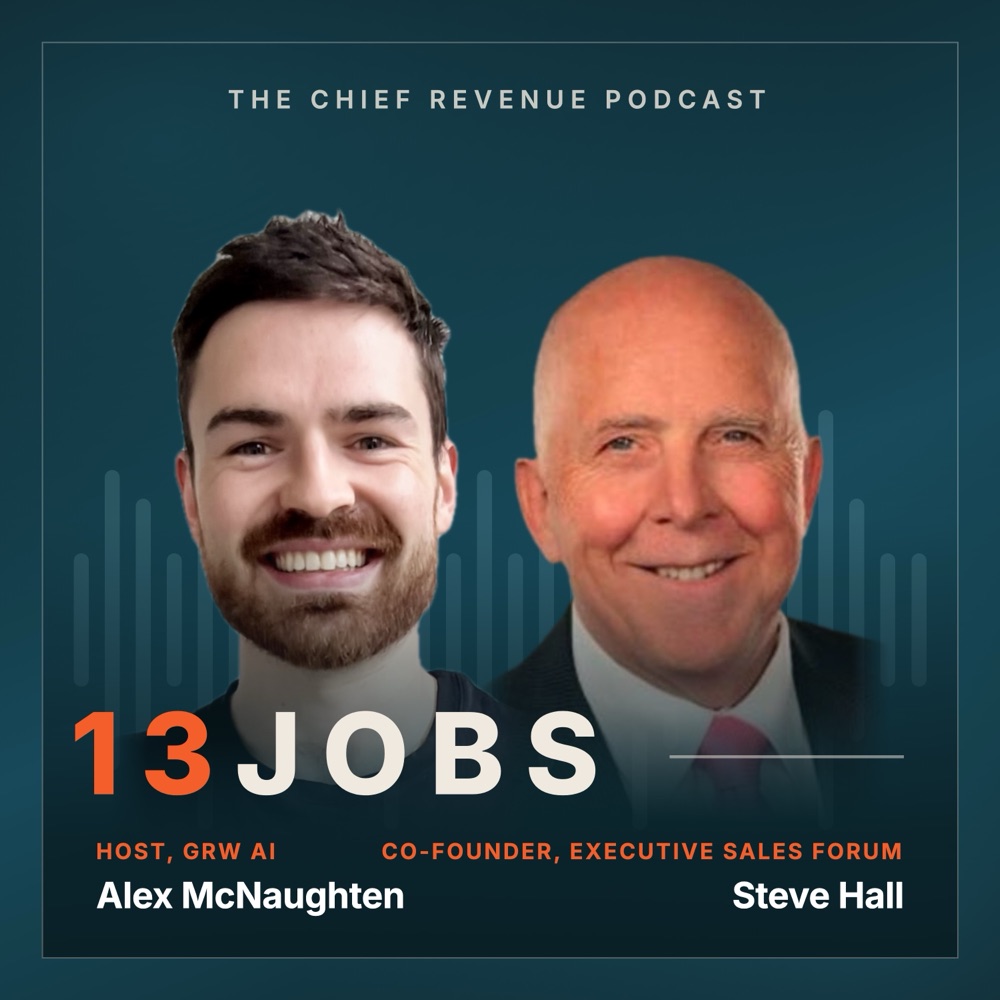
Constructively lazy
Steve got his first successful sales job at 42. The question he puts to any seller is not how to do more, it is how to do as little as possible and still win.
 Hosted by Alex McNaughten
Steve Hall · Co-founder, Executive Sales Forum
Steve Hall is one of Australia's leading authorities on selling at C level, and co-founder of Executive Sales Forum International, a peer advisory and coaching service for senior sales executives across Australia, New Zealand, the US and Canada.
He was a medical rep in the 1970s before anything else worked out, and did not land what he calls his first successful sales job until he was 42. For the past decade he has spent his time helping people work out what is relevant to a senior executive, get in front of one, and know what to do afterwards.
In this episode, we discuss:
- A first successful sales job at forty two
- The reasons to want a meeting at the top of the house
- Being asked to see more doctors than a day allows
- What the reps actually did with their activity targets
- SDR teams done properly, and what that takes
- Hiring SDRs in their fifties, sixties and seventies
- An ideal company profile, and knowing which companies fit it
- Using their own annual report as the hook
- What people get wrong on the call itself
- LinkedIn as the new spam
- The different kinds of trust
- The one thing: ask how little you can do and still win
Quote of the show
“How can I do as little as possible to succeed?”
Key takeaways
- Activity targets get gamed, always. Reps in the seventies were asked to see more doctors than the driving time allowed. Everyone found a way to report the number. Nothing about that has changed, only the tooling.
- The list is the work. Not everyone who could use your product is worth a call. Work out which companies genuinely fit, then find something specific about each one, which is why this is rarely a marketing job.
- Read the annual report. A chief executive who said something publicly about a priority has handed you the opening line. It is about them, it is verifiable, and it is not a value proposition.
- You need curiosity plus a reason to spend time. Something that makes them want to know more, and something that makes the next conversation worth their while. Preferably not that conversation, right then.
- Older SDRs work. One firm hires people in their fifties, sixties and seventies who have run businesses and can talk to an executive as a peer. It requires a long-term view rather than instant gratification.
- There are several kinds of trust. Trust that you will do the right thing, and trust that you understand their world. The second is the one a seller can build fast, by knowing their business properly before speaking.
- Look at all of it through their eyes. If I were this person, in this company, in this situation, what would my concerns and priorities be. That question does most of the work.
Transcript
Steve, how are you?
I'm good, thank you, my man. How are you?
I'm very well, thanks. Very well. It's good to be talking to you again. And for those of you who don't know Steve, spoke to Steve last year, it would have been. But for those of you who don't know, Steve is a leading C-level sales authority and sales coach. And he also in 2020 was listed in Top Sales World's top 50 keynote speakers, which is a pretty cool achievement.
But tell us a little bit about yourself, Steve. There's my quick introduction, but tell us a little bit about yourself.
Well, I'll try and speak as if I'm a keynote speaker in spite of my funny, funny Pompey accent and my inability to say the letter R properly. Um, you know, basically I've spent— I got my first successful sales job when I was 42. Before that was I did a heap of other things.
So I was a late starter to big ticket sales. The advantage of that was that I had a lot of experience in business and in dealing with senior executives because I'd been a professional services manager and a marketing manager and a project manager, as well as I had a lot of experience dealing with people lower down the rung because I'd picked fruit and used guillotines and done a heap of manual jobs.
So I had a big reasonable grasp of business from both ends of the spectrum and also in a wide variety of industries. And I think that's quite a big help when you're in sales. It's not a luxury that a lot of younger salespeople have, of course. And then I spent about 14 years selling ERP software, which is software that runs companies, mainly to publishers and consumer electronics distributors.
And I ended up in charge of sales worldwide for a small company. And then we got we got acquired, uh, and I ended up in my last year, um, as a global account manager based in Paris working on a couple of worldwide accounts. Uh, and then I came back and I've been working myself in various, um, roles ever since.
You know, it's like, yeah, yeah, you probably don't at your age, but you know, you get to a certain age and you think, I can't work for anyone, for anyone else, I've got to work for myself. And you sort of cast around what to do, for what to do. So I did a bit of project management, then I did a bit of sales consulting, then I, I realized that most salespeople don't know what senior executives think about or care about.
They don't know how to talk to them. They don't know how to get meetings with them. And when they do get meetings with them, they don't know what to do with them. So, um, so that's— I began to specialize in that. And, um, for the past 10 years, that's been my area of focus, helping sales executives understand the C-level or senior executives, get meetings with them make sure those meetings go as productively as possible, and then have an idea of what to do at the end of the meeting.
Hmm.
If they have got a sales opportunity or if they haven't got a sales opportunity, because there's a number— if you could have a meeting with the top person or the most appropriate executive in your biggest ideal company, your ideal target, there's a number of different results that can come out of a meeting.
They can say, gosh, I'm so glad you came. We are looking for exactly what you've got. Hmm. And you've got that. More relevant. We've got that problem you've described to us, and maybe you can help us. Go and speak to George or Bert or Mary or whoever. That's one option. Another option is they say, well, actually, we started looking for what you sell, and that's what most salespeople want.
But the problem with that is that potentially they've already been talking to other people who are way ahead of you. So that's good and bad. Or they might say, look, we bought one last week and we're not going to buy another one for 10 years, which is not so good. At least you know where you stand.
Or they may say, and this is the one that gets a lot of people, that is going to be a problem at some stage, or is getting to be a problem, it's not our priority right now. And you have to have a strategy for how you keep in touch, how you nurture them.
And you can try and make it a problem now for them, but that can be quite challenging. Or you've got to work out a way to keep in touch with them, nurture them without annoying the hell out of them, so that when they are ready to move on, what it is you sell, you've got a relationship and they trust you.
They trust you as someone that's going to advise them and help them rather than someone that's going to try and push something on them that they don't necessarily want right now. So exactly, it's a long introduction. I'm sorry about that.
No, no, it's, it's good. Uh, and you touched on a few interesting things. I just like to say one thing. Uh, you said I probably would understand, um, about not wanting to work for someone else. I actually got to that point in my life at like 25. I got there very, very quickly.
Uh, probably, probably a personality thing more than anything. But I think you made some good points around, um, you know, most or a lot of salespeople, a lot of sales execs don't know how to speak to executives. They don't, they don't know how to think like them.
That's right. And then that's not, not entirely their fault. I mean, a lot of the sales practices we have aren't designed to teach them or to help them do that. A lot of the things, you know, one of the things I'm talking about at the moment is the question I think every successful salesperson should ask themselves.
We talk about questions a lot, but it's always questions we ask prospects and customers. But there are questions you should ask yourself as well. And one question I try and ask myself is, how can I achieve what I want? How can I get what I want with as little work and as little effort as possible?
You know, I'm a great believer in constructive laziness. And unfortunately, a lot of companies have a belief that you need— that sales is a numbers game, so you've got to just get the numbers and you can't measure results, so you have to measure activity. So they start measuring activity and it becomes an end in itself.
You must do a certain number of calls or put out a certain number of proposals or close a certain number of deals by the end of the quarter, which I understand, but which can get in the way when the customer doesn't want to be closed and you've got to make your quota. That can lead to— that can tempt people to pressure, put pressure on customers, it's counterproductive.
So there's a lot of micromanagement, and because it— because of the micromanagement, because salespeople really don't like being micromanaged, they start to dislike the job or dislike the drudgery. And therefore you've got to put in additional systems to make sure they don't lie and micromanage them even more. When I sold, I did have a job as a salesperson, sort of, when I was in my late 20s.
I was a medical rep. Working with Merck, Sharp Dohme. It's not really selling because you don't do prospecting, you know who all the doctors are you sell to, you can get appointments with the doctors, give sales reps appointments, and MSD was the biggest, you know, the biggest company, so most doctors would see me.
So that wasn't the problem. And it wasn't proper, it wasn't closing deals because you don't get them to sign an order, you hope that they're going to prescribe your drugs. So it was a form of selling but not the same. And our targets were set from the USA. And I worked in country Oxfordshire and Wiltshire, and these surgeries were a long way apart, and a lot of the surgeries only had one person.
And I know this is— I know people, you know, people in America find it hard to believe, but the doctor's top priority wasn't seeing me, was actually seeing patients. I know that's mean of them. And so they would say, okay, you can come along at the end of the surgery, and believe it or not, the cheek of it, if they had a patient in there, they would make me wait sometimes for an hour or 2.
It was terrible. Bloody prospects. Um, and, and, and then so you had to— it was physically impossible to see the number of doctors that they expected you to see in one day. Um, you know, you couldn't drive between them in time. And it was the case everywhere. So basically everybody lied. You know, you— if you didn't, if you didn't meet the quota of activity you got told off.
So everyone just made it up. And it's the same in a lot of cases. You know, people, if you give people unrealistic targets, they resent it and they cheat and they lie. So then you've got to put in systems to stop them cheating and lying. So then they hate the micromanagement even more and they get burnt out and they leave, which is why that turnover of B2B salespeople, their tenure is about 15 to 16 months on average.
Which means that the companies have to hire new people and train them. The customers have to get used to new salespeople and new people that come in haven't got a grasp on them. And it's just an ever decreasing circle into the pits of hell.
So what are you saying? I think it's a really good point. And I just wanna make sure that I understand what you're saying here. Are you saying here that activity metrics shouldn't be used or are you saying that they should be given a far greater importance deeper and more accurate level of thought when setting any kind of activity metrics?
I'm saying they need a level of thought. I mean, you need to— again, I'll go back to the '70s, my days as a medical rep. When me and the other reps used to talk, we used to say, look at all this rubbish about seeing this many doctors and then detailing this many products in a meeting, you know, it's garbage.
But if you can have one good meeting a day with someone and persuade them to prescribe one of your products, you've more than achieved your goals. Because that would— that would— you would easily make your targets doing that. So I'm saying that, yes, by all means have activity and goals, but think about them and look, look at the quality as well as the quantity.
I mean, if you look at the way that we get— you know, I've got a big issue with SDRs. The, the idea of an SDR in such— to some degree was, was quite good. It was take some of the work away from account managers that stops them selling effectively and winning deals. That's a great idea.
But the way they do it with SDRs, get younger, cheaper, less experienced person to call and, what's the word, qualify people so that the account executive doesn't waste their time on unqualified prospects, is inherently flawed because prospects don't like that. Senior executives are really not that keen on talk on being qualified by inexperienced SDRs that can't have a decent business conversation with them.
And it would be bad enough if one company does it, but when everybody that's trying to sell to that particular executive does the same thing and he gets— he or she gets 3 or 4 or 5 calls a day from 12-year-old SDRs trying to qualify them, they stop taking— they stop answering the phone.
And when they get 5,000 emails in an email, what do you call it, a cadence, sales cadence, you've got someone you want to get to, so you've got to email them and then try and connect them on LinkedIn, then you send them a message on LinkedIn, then you call them, then you email them, and you build this cadence which is sort of like designed to herd them along this imaginary buyer's journey.
And everyone's doing it, so these poor decision makers are being bombarded by sales cadences. Again, they just turn up, they don't read their emails, they delete all their emails before reading them, um, they don't take phone calls, and it just— again, it's a problem that is exacerbated because everyone thinks what they do is important.
They don't think about the fact that everybody, everybody else is doing the same thing. So my solution to that is don't do what everybody else is doing. Do less, but do it better to the right people at the right time.
Okay. So I'd like to unpack this a little bit because I think there's a lot there and there's probably a semi-controversial thing you've just said around SDRs, I think. Because they're very, uh, they're used a lot now and a lot of— and I've seen them work very well. I've also seen them not work so well.
And I think I'd say the observation I've made between the, the SDR teams that do really well versus the companies that try and do SDRs but it doesn't work out is in a level of coaching and enablement and structure in that team. That's been my observation, is the teams that are coached well You know, I think you can take a youngster and make them presentable and proficient relatively quickly if you invest in them.
But I think if you take youngsters and just put them on the phones and say, go call CEOs without any kind of guidance, I think that's an absolute recipe for disaster. What are your thoughts? Do you think there's a way you can do it right?
Oh, there's definitely a way you can do it right, but it requires the sales leaders to have the right approach and to do what you said, to coach them, but not just coach them in techniques to get meetings. And this, if someone is going to call the senior executive, you need to first of all make sure that the senior executive you're calling is potentially the right person.
You don't just go out and get a list and say, call a lot and see which ones are hot and which ones are not. Secondly, you've got to know what your objective is. Is your objective to qualify them, or is it your objective to start a business conversation? Because people don't particularly like being qualified.
Are you looking for a lead, someone that's currently looking? Well, if you stumble across one, fine, but basically someone that's currently looking for whatever it is you sell started the process a long time ago because no one wakes up in the morning and thinks, I need to buy accounts payable automation. I think I'll buy an accounts payable automation system today.
They think, oh, we've got a bit of a problem here. There's a new law coming that says that we have to pay our suppliers in the next— within a certain amount of time, and we can't really do that with our system. How are we going to handle that? And they think about it and they talk among themselves, and then they think, well, one of the ways we could do that is through accounts payable automation.
And then they think, oh well, they say to their minions, go out there and look at the market and see who does this. And the minions go out and do all the searches and things, and when you get an inbound call from a minion saying, tell me about your accounts payable automation, salespeople jump at it.
Oh, what an opportunity! But it's not. It's just some minion doing research. The people that need to be talking to are the ones that got the minion to do the job for them in the first place. And then by the time that they get to the, oh yes, we've decided we've got— we're going to need an accounts payable automation system, and they've narrowed it down to 4 vendors, if you call them then Oh, you're too late, you're not on the shortlist, or we could put you on the shortlist, but they've already talked to a heap of people and they already know a heap of stuff and you're a bit late to the party.
And you possibly, you could win through a superior product or better selling techniques, but your chances are much, much slimmer than if you're talking to the people at the top earlier on about their business problems, rather than if you're talking to the people lower down about their need to buy a particular product.
So when you're talking SDRs, You've got to look, what's your objective and what are you looking for and what are you trying to achieve? And you're not, you're not trying to— you're trying to see if that person potentially has a problem and what their perspective of the problem is that you can help before you start pitching the fact that you can solve that problem.
Um, so I think, yes, you're right, it can be done. I've seen it, I've seen it done very well too. I've got a friend, um, John Bidwani, who runs the database department, and he hires people, SDRs, who are in their 50s and 60s and 70s who've got a lot of business experience, and he trains them in the particular business problems that his clients can help resolve.
And they call people and they talk to them and they nurture them and they build relationships over time so that they know who's going to be coming to market in the next 6, 12, 18 months. And so by the time they do come into the market, these guys have been talking to them for for several months.
And when they do eventually hand them over to the clients' account executives, they've got a real relationship with them and a heap of information about what they care about and what they use and what they think and all that other stuff.
Hmm.
Now that requires, and again, they still find people that are looking now, but that requires an investment and a long-term strategy rather than instant gratification. So badly, Badly trained or managed SDR teams are like a bar of chocolate, you know, you get a quick hit, but it doesn't, it's not good for you in the long term.
Right.
So, you know, you use the term constructively lazy, I think, if I've got that right. Um, imagine you're in your 20s again and you are starting an SDR job. How would you do it?
Well, If you're starting an SDR job, you're not— you're going to do it the way that you're told to do it, because then you're probably going to be told, do it this way. So the question— so the question is more a question for the sales leaders or for the SDR managers. But the question is this, how can I do as little as possible and still achieve my goals?
And I don't mean make as few calls as possible, but for instance, if I've got Let's, let's take a salesperson. Let's not say they're an accountant. Let's just take a salesperson. I've got a territory and my territory has got 1,000, 5,000, 10,000 customers in it. All right, what's the— how do I find and focus on the percentage of customers that I can handle physically with my, you know, with, with my bandwidth that'll give me the best bang for my buck?
So that means that you don't just get a list. I'll tell you a quick story. When I first started, um, with the ERP company, um, I started looking at selling to publishers because they had software that was specific for publishers. And we bought a list, you know, you go out and you buy a list.
And we went to Dun Bradstreet or someone and got a list of publishers, and they use SIC codes and industry codes. So I got this list and I went through it, and I think there's about 200 people in this. And a heap of them were printers, not publishers, so they did that. We didn't sell to printers.
And a heap of them published newsletters, newspapers, and we didn't publish newspapers. And a heap of them had nothing to do with publishing. They were, you know, something, something relevant. And the number of people in that, actually in there that were actually book publishers that published books and distributed, or book distributors, which was our sweet spot, was about a quarter of them at most.
And because I already knew a fair bit about publishing There was a whole heap of other people that weren't in there for whatever reason, different company name or anything. So I, you know, I intrinsically distrust lists that you buy. And the sad thing was that 12, 15 years later, 12 years later, when I was about to leave that company because we purchased, um, so one of the marketing people came to me and said, oh Steve, we're running by a list of publishers, can you help us with that?
I said, well, what happened to our— the list I put together? Because I the time I left that company to go to Paris, I developed a list of every sizable publisher in— not in the world, but certainly in Australia and New Zealand. And I knew them all. I said, what happened to our list?
Oh, we changed CRMs and we lost it. Sad story. Anyway, so basically the first thing is which of the companies that are closest to your ideal company profile? You've got— assuming you've got an ideal company profile, companies that are likely to have the type of problem I can solve or problems that I can solve, then who are those specific companies?
It's all about having an ideal company profile, but you need to know which companies fit that profile. So I'll give you an example. I've got a client that does AP and AR automation software. Pretty much everyone has AP. So their question is how big the companies they want to deal with, where are they, things like that.
And are, you know, do we have other people in the same industry as them so we've got credibility? That's a part of their ideal customer profile. With the cancer scene, a whole heap of companies don't have a cancer scene. If you're a B2C, or if you sell houses, or you're BHP and you sell iron ore and all you do is dig stuff out of the ground and send it off to China, then your AR, you're likely to have a— less likely to have a complex AR.
So the first question is which companies fit my ideal customer profile? Have I thought about my ideal customer profile? And okay, which ones of these do I think I can get into? And then the next question is, okay, which ones of these are worth looking at? What do I know about these? Now we talk about taking work off the salespeople that other people can do for them, and one thing that other people can do for them is they can do research.
There's this There's this school of thought that says, oh, should SDRs do research before they call someone? No, it's a waste of time, just call them. Well, no, someone should do research to find out that company is appropriate. If you can see, if you can find out that they bought an ERP last week, they're probably not going to be doing a whole amount of other IT projects for the next foreseeable future, and they're certainly not going to buy a new ERP.
So that's a task that can be handed off to a bright university student or someone offshore or someone that isn't a sales job, but it's a critical part of sales. So I'm thinking, okay, and then when you've narrowed it down to the companies that are likely to have, um, an issue you can help with, the next question is, okay, who are the specific people I want to speak to?
Who is the CFO or the head of accounts or the financial controller or the head of accounts payable or whoever it might be? And where do I want to start in this account? And then the next question is, okay, When I call people, why do I call— why am I calling this specific person?
If I'm trying to get into a particular company and I've got the name of the CFO and the financial controller and the head of accounts payable and the head of accounts receivable, for instance, and an accounts payable clerk, then you might want to call the accounts payable clerk not to try and tell them something, but to say, tell me about your processes.
How do you do this? Do you have that issue? Does this happen? And then you learn a bit more, and then you can go to— then, and then you can go to someone and someone else and say, look, I've been told that you do this, this, and this. Is that the case? And that way you find out people who've just bought something, and you find out what problems they've got.
And then you can call the, uh, head— the person at the top, the, um, CFO, and say, look, you know, I've been— in your annual report you said that these— this, this, and this, uh, are key issues for you. And I've actually been talking to a few of your people, and they tell me you also have that, that, and that problem.
Those problems are leading to that problem, and I can possibly help you with that. And that's— now that takes more time, takes a lot more time, takes a lot more research. The salesperson, the SDR, doesn't have to do the research, but they've got to use their brains to use the research to get the information so that when they do call the key person, they're not— it's not, you know, it's not a one-size-fits-all value proposition.
It's a value proposition for that person in that company at that time.
So I think just backing it up slightly again, just unpack some of this. So it starts, it starts with, and doing this well is really, it starts with actually the list and making sure you've gone after the right kind of companies and not just a generic list of everyone. It's actually, you have to refine that down to the ones who really meet your ideal customer profile.
Yeah, well, what I always say is that, you know, if, if a salesman can sell ice cream to Eskimos, why would you do that when you could sell a lot more to Arabs?
Right, right, exactly. So, you know, first things first is get that, get that list to a point where it's actually people who are likely to want to buy from you or at least have a problem you can solve for them. And that doesn't necessarily have to be done by the salesperson or SDR.
You know, that could be a role in itself in terms of research or sales, you know, sales admin, sales support. Is often, often the function.
Um, and then, you know, if I can just interrupt, it's also often done within marketing, but the problem with giving it to marketing is that they tend to take a more market-wide broad-brush approach, whereas we're trying to find specific companies with specific instances. So marketing has a role to play because you've got to look credible.
I spoke to someone— I've interrupted, sorry— I spoke to someone a while back and she published an article on LinkedIn about printers And it was quite fascinating. It talked about the challenge with printers in terms of firmware and how they could be a gateway into the company for people doing, you know, printing viruses and things like that.
It was a very erudite, well-researched article. And I thought, gosh, that's fascinating. I didn't know any of that. I thought this person's obviously going to do well because she's really thinking about the things from the customer's perspective. And I actually gave her a call to say, oh yeah, well done. It was a really good article.
And then I went to their website and their website said Sharp printers are cheap this week and Canon printers. And it just did the 2 different match. So there's a role for marketing, that your marketing has to talk about the issues you solve, the problems, rather than about your new office and how great you are.
But in terms of, um, wherever— yes, it starts with a list, and the list is, you know, calling someone that's never going to use your product is just a total waste of time.
And then, you know, then it's about, okay, actually, who in this account should we reach out to first? And and, you know, putting a bit of a plan in place to really fact-find before maybe you go straight to the top.
That's right. I mean, there is a caveat. I'm talking high-value sales. You couldn't do that if you were selling pencil sharpeners. But if you're selling something that brings in— if the lifetime value of a customer is quarter of a million dollars or more, and that could be over 5 years or even 10 years, it could be a one-off sale.
But if you're gonna get quarter of a million dollars up to, you know, tens of millions of dollars from one customer. It's worth putting in the effort to talk to the right person, the right message.
I agree with you. And in terms of the cold call, in terms of the call itself, what are people doing wrong? What would be a long list?
So a long, long list. Well, first of all, they're thinking that you'd see a lot of debate of which is better, the phone or email or LinkedIn or social media. And you see a lot about your value, your unique value proposition. And they miss the point. But the point is this, you know that this person is someone you want to get to, right?
You want to have a conversation for them. So the first thing is you've got to know what your objective is. And people that make it too big, they, oh, I want to get to this person so I can sell to them and tell them how great we are and how wonderful we've done.
They're not listening, they don't care, they've got their own concerns. Your first objective when you make a call is to get them to put aside enough time to give you enough attention so you can have a decent conversation with them. And you can't— the chances of you actually doing a cold call And having a decent meaningful conversation with them when they've got their PA coming in and there's someone else on the phone and they've got their computer in front of them where they're— or their papers in front of them that they were working when you called them and their daughter's just called in sick and to get them to have an intelligent conversation is not impossible but it's very, very difficult.
So your first objective is to get them to schedule in enough time, even if it's 10 minutes, that's all you need is 10 minutes, enough, that's all you should ask for. 'Cause asking for 10 minutes is not that big an ask. Asking for half an hour, bit much that. If I gave half an hour to everyone that asked me for half an hour on LinkedIn, I wouldn't be on this call now.
I'd be talking to people that want to speak to me on LinkedIn. So your first objective is to just get them to pay attention to you for 10 minutes. That's it. And how do you do that?
Like what worked really well for you when you were doing this?
Well, I still do do it occasionally. I don't do it day in, day out because it's tedious, but I still do call people. You basically got to find out a hook that makes them interested and say, look, you know, I, I read in your annual report that, you know, you— this, this, this, and this, or I did my research and discovered that, or I saw this.
I'll give you an example, right? I'll give you an example. Um, it's a customer complaint example. I had an issue with my telecom provider. I wanted to do something for me. And they wouldn't do it. I called up there and it was a really silly little thing. I won't bore you with details.
I said, we're moving house and I need this to happen. Oh no, we can't do that. Why not? Oh, it's our process. Our procedures won't allow us to do that. I said, it doesn't make sense. It's a little thing. Oh no, no, we can't do that. So I did a bit of research and I found that the managing director of customer service had just done an article saying how he totally fixed up customer service and they're a responsive organization and customers love the blah, blah, blah.
So I called up. And I didn't speak to him, I spoke to his executive assistant. I said, look, I said, I've just been reading an article that Bill did with Marketing Magazine, and in it he says that, you know, you're responsive to customers. Now I'm writing an article on LinkedIn about how your reality doesn't match the promise, and I just wondered if you'd like to comment before I publish it.
And the next thing I knew, they were all over me, you know.
Right.
So I found a bit of leverage. Now that's slightly different, but you basically, you know, basically say, You find something. You need 2 things. You need something that will make them curious, that's about them, and make them want to know more. And then you need a way to get it to them. So it could be, you know, I, I heard you on the radio.
I heard you on the radio. I called when I was working with a company that sold, um, smart water systems. I heard some expert on the radio, um, talking about them and things like that, and I just called him and said, hi, I heard you on the radio 10 minutes ago, can we talk?
You, you use what you've got.
Right.
And what you've got is different for everyone, and therefore there's no general rule. But you need to find something that gets their attention immediately and makes them want to give you more time. Not a lot more time, and ideally not then, because if they say, tell me now, well, they're really not ready.
They're probably just trying to get rid of you, and you'd probably want to say, look, you know, I know that you're busy right now, and actually, to be honest, I'm busy right now. So can we just schedule a 10-minute call next week or whenever?
Right.
So step 1 is to get a meeting. How do you get, how do you get that message to them? It depends. Some people don't answer the phone ever, right? I've got a customer that never answers the phone. If I want to get to him, I've got to text him, but he never answers his mobile, literally.
So you might phone them. Someone said to me the other day, someone that does outsourced SDR work and it's very good. So what do you do when no one answers the phone? I said, well, what can you do? You've got to find another way. The best alternative way is if they've got an executive assistant, which— whereas it's easier for senior executives because they're more likely to have an EA, but you can usually get through to the EA.
So then the question is, what do you say to the EA? And it's normally— I normally say to an executive assistant, hi, this is Steve, um, I wanted to have a— I wanted to have a quick chat with Alex about, uh, Alex, can I You know, what, how do I do that? They'll say, well, what's it about?
Oh, it's about blah blah, and you tell them a little message, you know. Um, you know, do I schedule that through you, or, you know, or do I speak to Alex direct? And they'll normally say, oh, well, I mean, can you tell me more? And then you say, well, I'll tell you what, how about I send you an email with some more details?
And they say, okay. So you send them an email, then because they've agreed to it and because you put the heading of, hello, hi Janice, we were just talking, here's the email I promised, so they know it's from you. They read the email. So then you've got to be able to put your message in an email.
So you use a combination, and obviously the best possible way to get to anyone is through a referral. And that doesn't have to be a get George to call Bill on my behalf to say, Bill, you should speak to Steve. It's you get— you call Bill or Bill's EA or send something saying Mary said I should speak to you.
So you just need to be able to use someone's name, but that person you need to be credible enough with that person for them to be willing for you to use their name, and that person's got to be credible enough with the person that you're trying to get to for them to take a recommendation from them.
So again, even a referral takes thought. Will— does this person trust me enough to give— to let me use their name? And obviously you can have permission. And does the person I'm trying to get to trust this person enough to want to talk to me based upon the fact that she recommended me.
Yes.
Yeah. And then you've got LinkedIn. I mean, but LinkedIn's become the new spam, hasn't it? I mean, how many people do you get sending you information wanting you to schedule just a half hour and I'm too lazy to do it myself, so use my Calendly to do it?
More than I can count.
That's right.
And ever increasing the larger my network gets.
That's right. So it's, you know, it just, you know, it, it— so, and then there's always a, there's always a written letter. There's always get in the car if it depends where they are, get in the car and drive there and walk through the door. Well, how many people do that anymore?
None. Virtually none. Yeah.
I mean, you would only, you would only do that. I have done that, but you wouldn't only do that, you know, if other, other means aren't working or other means aren't available. But sometimes it can work. Go to reception. So look, I, I was hoping to schedule a meeting with, uh, with, with Bill.
Or Mary or whoever, and I'm having difficulty getting through. I wonder, does he have an executive assistant? If they do, great, could I have a chat to them? And even if you get the executive assistant's phone number and you know that their name is, I don't know, Wilberforce, and you can pick up the phone and say, oh, hi, is that Wilberforce?
Oh, great, look, I'm just trying to schedule a meeting with Anne, what's the best way to do that? So which channel do you use for this person at this time in this company to get this message, which is relevant to them, to them?
You mentioned a word there, trust. Have you found any, or do you have any tactics or things that you've done consistently to build trust faster?
That's that last word. It makes it more complex, of course. Trust has to be earned. I think you can put it this way: if you speak to someone you've never met before, they're much more likely to trust, at least give you a little bit of trust or a bit of the benefit of the doubt towards trust, if you've researched them, if you understand them, if you look at things from their perspective, and if you can ask them questions that they identify with.
Again, I'll give you an example. When I used to sell publishing software, one of the big issues in publishing is returns management. Most books are sold on seller return. There's a complex set of returns procedures and rules that says when booksellers can return books. A lot of booksellers ignore them. So when the physical returns come in and when the claims come into the return, there's a big process around handling that.
That's a big issue. Now, I had a— I had one customer that, um, you know, management companies like Arthur Andersen, as it was in those days, you would go into them and say, okay, now we know we can help, we're business experts. How do returns work? And they'd ask, you know, and then, and they'd take other notes of how returns work.
I'd go in and say, okay, well, look, obviously you're going to have returns of about what your trade books would be, what, 18%, 20%? And your academic books would probably be more like 10%, 12%. And I said, and when they come into the warehouse, you've got to put them out the way and they're going to manage them.
And you're going to get these claims in and you've got to reconcile the claims against the actual returns and look at the returns rules. You've got to decide whether to actually accept the return or not? And do you get situations where Target and Kmart actually send you back books and claim they're not even your books?
And they're nodding their head, oh yeah, we've got that, we've got that. Oh well, we've got a system that handles all that.
Right, right.
So that builds trust, maybe not in you as a person, but in your knowledge of what they do. There's different types of trust. Trust that you do the right thing, trust that you understand them. Um, you know, I trust my brother that he would never rip me off. But I wouldn't trust him to advise me on sales because he's a teacher and he's got no idea.
Yeah. Yeah. No, it makes sense. Steve, this has been great. I've got one last question for you. And it's the question we ask everyone now is if you were to go back in time, first day, and I think you said you got into sales when you were 43, 42?
42. Yeah.
42. So you go back, day 1, Steve's first day on the job of sales. What's the one thing you wish you knew that would've made your life significantly easier and made you perform a lot better?
What I've just said. And I would ask myself, how can I do as little as possible to succeed? And one of the answers would be look at almost everything, not quite, but almost everything through the eyes of the of the prospect, not your own.
Right, right.
So switch your— I said almost everything.
No, that's good. Switch your focus to what the other person's thinking and caring about. Try to put yourself in their shoes, not how can I shift this product.
Yeah, I think say, if I were this person in this company in this situation, what would my concerns be and what would be my priorities?
Great advice, Steve. It's been— it's always good to chat to you. I always enjoy it and always learn something. Where can others find you if they want to connect or, or, yeah, or learn from you directly?
Um, what's— I've managed to appropriate a hashtag both on Twitter, but it will be very political, so I wouldn't go there, and also, and also on LinkedIn, um, as Steve Hall Sydney. If you search for Steve Hall Sydney, all one word, that's me on YouTube. And on YouTube too.
Brilliant, Steve. Thanks so much and chat to you soon.
Take care.