
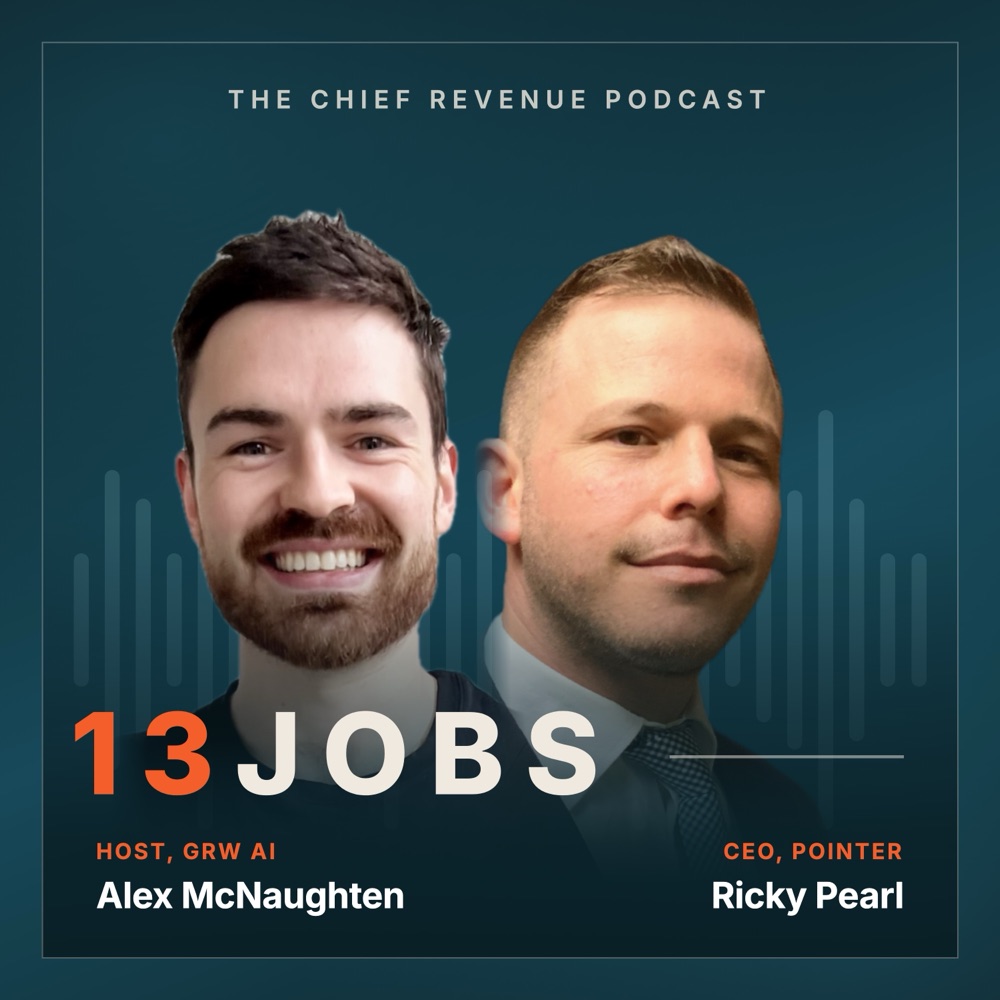
SDRs don't fail, companies fail the SDR
Ricky runs outsourced SDR teams for other people. His view is that the script, the targeting and the coaching are the company's job, and very little is left that is the rep's fault.
 Hosted by Alex McNaughten
Ricky Pearl · CEO, Pointer
Ricky Pearl is the chief executive of Pointer, an outsourced sales agency that runs top-of-funnel business development for B2B companies, mostly Australian seed and Series A businesses, and then helps them build the function in-house.
He is South African, and started out running his own businesses there, including a chain of laser hair removal clinics. Selling has been part of every job he has had since.
In this episode, we discuss:
- Pointer, and growing without the growing pains
- Laser hair removal clinics in South Africa
- Not the ten percent who fail, the seventy percent under quota
- Two problems: the people and the technology
- Ninety percent of the time, the company failed the rep
- Introverts outperform, and other things nobody expects
- What he actually hires for
- Fighter pilots taking notes from someone half their age
- Who should write the script, and it is not the newest hire
- Three to five years of skill, asked of a first job
- A first-week meeting with AirAsia, off a practised script
- Show me your to-do list
Quote of the show
“SDRs don't fail. Companies fail the SDR.”
Key takeaways
- Look inwards before you blame the hire. The script, the list, the targeting, the coaching and the tooling all belong to the company. What is left that a rep can get wrong is effort and coachability.
- The classic SDR profile is wrong. Introverts tend to outperform extroverts, and the hungriest candidate is not automatically the best one. He hires for maturity, coachability and curiosity, from people who treat the role as an investment.
- The hardest part is not the cold call. That is the part everyone is nervous about and the part technology and practice fix fastest. The difficulty is everything around it.
- Messaging is a founder-level job. If your positioning were locked down enough to hand to a junior, you could run it as an ad instead. Leaving it to the newest person on the team is the most common own goal.
- New reps should be a vessel first. They do not write their scripts or their emails for the first six months. They dial, they send, they get coached on objections, and independence arrives later.
- Then let them off the script. Once the base works, bringing themselves to the call is the upgrade, not the starting point. A rep managed out elsewhere started landing meetings on a practised script in week one.
- Check the unit economics before hiring at all. Some companies spend more on the function than the contracts it wins are worth. Occasionally the honest answer is that outbound is not the right motion for you.
Transcript
Ricky, thanks for coming on the show. How you doing?
Yeah, great to be here. Doing great.
Yeah, it's awesome. And look, for those of you who don't know Ricky, who haven't come across him on LinkedIn or elsewhere, he's the CEO of Pointer. And Ricky, tell us a little bit about Pointer, what you do, and also how you got into the world of sales.
Sure. So Pointer is an outsourced sales agency. We help companies grow without the growing pains. A lot of fantastic products out there, fantastic companies out there, founders that have phenomenal ideas or built a good product. And if they could just introduce that product to more people who might benefit from it, they could succeed.
We're helping them succeed by taking that very challenging and painful work away from them and providing it as a service.
That's awesome. And Ricky, tell us a little bit, you know, give us a short version of how you got into the world of business-to-business selling.
It's just always been part of the work that I've had to do. I originally owned my own businesses back in South Africa. I'm sure you can hear the dirty accent. And in founding my own business, very weird businesses. I had a chain of laser hair removal clinics, cosmetics factory, you know, very different.
But the one thing they all had in common is it didn't matter what the product was, you had to be able to generate revenue. And my job essentially became a salesperson regardless of if I was the CEO, the founder, or whatever I was doing. I had to be able to sell the business internally.
I had to be able to sell the vision, the mission, the purpose. It was always about selling for me. It aligned with my skill set, and that's kind of what I got into. I landed up working at a not-for-profit for 5 years as the CEO there. And same story, I'm running this massive not-for-profit.
What's my job? I'm a salesperson. I've got to bring in funds. I've got to sell the mission, the vision, the purpose to the volunteers, to the community, to the government. And that was the gig. That's been that consistent thread through everything I do is if I wanted to succeed, I have to be able to sell it.
Right, right. And then, you know, now you're helping other companies do the same. Through the work you're doing, which is awesome. And you're bang on, right? Like, it doesn't really matter what you're doing. You're in the business of selling in some way, shape, or form.
Getting my kids to eat dinner is a sales masterclass these days.
Getting them to eat their greens, I'm sure, is probably the most challenging part about it. And look, today we're going to talk about something that, look, I think we're both super interested in and, you know, we're both sort of in this world of SDRs, right? Is, you know, why it works and what— sorry, why it doesn't work when organizations try and build out SDR teams.
And then also what organizations can do better to, you know, reduce the risk of that happening. So just as an opening question, Ricky, from what you've seen, Why do you think, what stops SDRs being successful in organizations?
Yeah, I'd start by prefacing it by saying that the vast majority of SDRs and BDRs fail. I think scoping how big this problem is, is important because this isn't, we're not talking about the 10% that fail here. We're talking about the 70% that are under quota. Yep. And what the vast majority that don't last a year.
It's an interesting one. Just on that, Ricky, I'll just throw in a stat that I heard today because it's top of mind chatting to a, you know, a large global consulting organization. And they said that if an organization's hiring SDRs, typically 30 to 40% of them will not work out, as in they'll churn.
They won't, you know, they'll churn out of the team. So you're not wrong when you say it's a huge problem.
And at 30 to 40%, I think that's a company that knows their business, has good systems, has good structures, has good processes. They're at the 30 to 40%. The companies that are doing this for the first time don't have that sales maturity within their organization. I'm going to be well above that.
Yeah, yeah, yeah. It's a good point. So yeah, no, that's, I think that's a good way of prefacing it. So yeah, what do you see?
They fail.
Why do they fail?
There's 2 big parts to this pie of being a good SDR or BDR. I mean, those terms are used interchangeably between Australia, New Zealand, and the US. One, there's a people problem, and 2, there's a technology problem. The work we're trying to do is hard psychologically, and that doesn't change. You can get good technologies that help you make more phone calls, send more emails, Do more activities, but it doesn't take away the people problem.
That rejection is hard; it goes against our core beings. That we we aren't built with this level of resilience. The the pressures are extremely high, and that people challenge doesn't go away. On the other hand, the technology challenge also often isn't resolved effectively, and so now you have this. I don't know, this crescendo of these 2 problems coming together and causing this eruption, which is, you know, a failed sales process.
Yeah, yeah.
And they'll blame it on the person, of course. The SDR failed. But in my world, 90% of the time, SDRs don't fail. Companies fail the SDR.
It's an interesting way of looking at it, and I like how you split it out between the 2 areas there. So you've got the, you know, the individual side of it, the who, and then we've got the, you know, the process, the tooling, the organization and their level of readiness, I suppose. Just diving into the individual, because I'm curious on your take on this.
Do you think anyone can be an SDR? Do you think some people are better suited for it?
I think some people are better suited for it, for sure. However, anyone can do it, right? And what people classically think makes a good SDR is not what makes a good SDR.
Yeah, okay. And I tend to agree with you. I'd love to hear your view on this. Like, what do you think makes a good SDR? What are you seeing?
Well, if I was to ask a few questions, right? Um, yeah, what is better, introvert or extroverts? People go, oh, sales, this is cold calling, extroverts, right? And I actually find introverts typically tend to outperform.
Yep.
Then you might say, well, what do you want? Someone who's ambitious or someone who's looking for consistency? What kind of a personality profile do you want? And they'll always be, oh, I want the ambitious person to be in sales. And I'll be like, well, yes, But how long do you want them in this junior role for?
Because if you want someone to be in this role more than 9 months, well, if you want someone who's super ambitious, unless you have a role more senior for them within 9 months, they're leaving your organization.
Yeah. Right.
So like all of these classic things, or whatever people think they want, they don't want. And the things that are attributes that we look for, we look for maturity in people that understand the long game. They understand that their time as an SDR is an investment in their future. And that if they are able to master these skills, even if they're earning $10,000 less or $20,000 less or even $30,000 less, 10 years from now, when they're earning half a million dollars in their pay, in their commission check, the $10,000 that they sacrificed this year is irrelevant.
Yes. Yes.
And we're looking for those forward thinkers that are ambitious but have a very mature understanding of their long-term plans in business.
Yeah, it's— I think the expression that comes to mind is long-term selfish, you know. It's like— and I'm stealing this from a guy, Marcus, who I had on the podcast.
Yeah, you've been talking to Marcus. I saw he was on your podcast recently.
And I think, you know, he uses that phrase. I think it's quite a good— quite— it kind of summarizes it quite nicely. It's like, you know, it's doing the right things today that long term will get you that half a million dollar commission, you know, commission payment at the end of the year, right?
But it starts by getting the basics today. And it's a balance because you're right, you know, the super ambitious rep who, you know, who's going to be bored of being an SDR in 3 months and expect to jump straight away, it's probably not the one you really want when you think about it, unless you've got AE roles that you need to fill.
And, you know, not every company does have that. So you're right, it's, it's, I think you're bang on. A lot of companies either don't know what they're looking for or looking for the wrong things. A few of the things we, you know, we, we see is, I tend to agree with you on the introverted piece.
It's, you know, the classic extrovert is not necessarily the person you want. That doesn't mean extroverts can't be good at it, but it's, it's, it's often the ambivert or the introvert who typically will be better because they listen more.
There's so many parts to it. I'll often tell my new SDRs when they've got some cold call reluctance, you know, they're training, they're nervous about the outcomes. And I tell them straight away, the hardest part of your job is not going to be the cold call. And trust me when I tell you this, when you get someone on the phone, it's going to feel good.
The hardest part of your job is going to be sitting on that phone for hours on end listening to ringing and the dial tone and getting voice messages and not getting through to people. And that's going to become your ultimate frustration that you're going to hate about the job.
Yeah.
You can solve that with technology. But there's, there's just this absolute melting pot of the business not knowing what they're looking for and looking for the wrong things. The SDR not necessarily appreciating what the job is because this is new for them too.
Sure.
So they think this job is going to be X, but actually the job's going to be Y. And aligning all of these people and these outcomes all these processes for the greater good, for this outcome, which is business development, which is mutual success.
Yeah.
Or not just you, but for you, your staff, your company, the companies you're selling to, helping them get better. Like bringing everyone together and aligning those visions is, is something that just takes that maturity in these people. And that's why the main thing I'm looking for in my SDRs, the final thing we're always interested in Is a deep desire to learn.
Yep.
That coachability, that curiosity. Because I know where they are now is not going to be where they're going to be in six months' time. What they think now is not going to be what they're thinking in six months' time. And I want to know: Do they have that mental agility to take those steps to be somewhere completely different?
Or are they on this fixed path of what they perceive to be a way? That goes from I break cold calling, I smash it, I land up winning at that. Then I move to becoming an account executive, and I crush deals and I close deals. Like, is this their vision? Are they actually open to exploring the psychology of sales and what that means and how that starts in this role, but transitions into almost like a business psychologist?
Yeah, it's, I think the willingness and ability to learn and, you know, you used a word, one of my favorite words is the idea of curiosity. That seems to set apart the okay performers and the, you know, the really top performers is their curiosity in terms of like, how can I be better?
How can I improve my call? How can I improve my outreach? How can I ask better questions? Like all of these things is like, they're always, all the top performers are always asking themselves and challenging themselves on that and always open to feedback when they get it. Whereas the okay performers or the not-so-good performers often are too proud or have too much of an ego to listen and learn.
It's dropping that ego. If you ever go or have experience in militaries, you'll have these top Air Force pilots, best in the world, that actually get in the cockpits of fighter jets. During their training sessions, they'll get into a simulator. They'll go run through the simulator. After the simulation, they'll sit down in front of this kid who's run the simulation who will provide them feedback, right?
You know, here's the top fighter pilots getting feedback from the simulation engineer.
Yes.
You know, all of whatever age they are and experienced they are, maybe even never even been in a real cockpit before, and they'll give them feedback, and the pilots will sit there and say, thank you, right?
Yeah.
That's why I'm here to learn. I don't care who I learn from. I want to be better so that when I'm out there, I can win. So though that humility, lowering of that ego and that curiosity also then plays into empathy, which is something incredibly, you know, it's a bit of a buzzword in sales these days, but it is a buzzword for a reason.
It's genuinely required to be a phenomenal salesperson is empathy and empathy. Goes hand in glove with curiosity.
Yeah, I don't disagree with you. Okay, so that's the individual. Let's assume we've got the awesome person now. Look at it now. Let's look at it from that second lens that you mentioned is, I guess, the company lens and their process and all the rest of it. What are the big things that they're doing wrong that are leading to some of these You know, because if you said right at the start of this, you said, you know, 90% of the time it's the company that fails the SDR.
How are they doing that? How are they failing?
So on this people side, right, it can work with an introvert or an extrovert. It can work with someone who's curious or someone who's just— who's less curious but willing to follow a rule book. It can work. You can make it work with a lot. On the company side is where you start getting a lot more rigidity and absolute must-haves or requirements for a successful operation.
Let's just say this. You have an SDR who's willing to perform activities, willing to perform them to the best of their ability, and is coachable. That's all you have. You have a human who's willing to do things, cold call, email, you know, some of the hard work. And is willing to learn and able to learn.
That's all you need. Everything else is on the company. Everything else. Because if this person isn't getting better from call to call to call, week by week, and not getting better on the outcomes, well, if they're coachable, well, then the problem is on the coach. The company doesn't have the systems and the structures in place to performance, to improve their input, their performance.
Or let's say the message isn't resonating. The call script is just getting hung up on. Well, is it some 19-year-old's job to write a cold call script with a very precise precision message about the value proposition of your company? No, that's a market— that's the marketing department's job. Like, they've got to control the message.
And if you don't have a marketing department, it's the founder or the head of sales. It's a senior position who should be constructing a message. Maybe they're not delivering the message right, but okay, this goes back to, well, if they're coachable, are you coaching them? So let's say the message now isn't working.
That's the company fault. What about the emails aren't getting responses? Same story. Are you leaving email writing up to the most junior, inexperienced member of the team for something that's incredibly difficult to begin with?
Yeah.
Or do you have more senior input into constructing your message, which like your message fits, your product message fits, is core to your product market fit, core to your go-to-market strategy? You're leaving this up to your SDR, like your most— and I don't mean SDR in a diminishing way. I just mean like the newest member to your team.
Yeah. Yeah.
Absolutely not. So now the script's not their fault. The resonation of that script's not their fault. The response rates to the emails is not their fault. Well, let's say maybe they're emailing the wrong people. That could be you're not, you're not targeting the right people. Do they get to pick who your audience is?
Do you leave your SDR to pick who your ideal client profile is and understand the pain points of that persona? Absolutely not. This is again senior strategic leadership. Who's your ideal client profile? All right, well, if you're not hitting the right people, that's the company's fault too. What happens if the emails aren't getting delivered?
Same story. Your SDR is no technical expert on setting up email systems, understanding the nuances of email delivery, particularly for cold email.
Yeah.
Which does technically meet the definition of spam, no matter which way you want to cut it. So again, that's the company's fault. Like, what else? What actually could it be that's the SDR's fault other than they're not putting in enough effort or they're not coachable?
I think you've summed it up so nicely. And it's one of the, I think that's, you know, that little 2 minutes you've just run there, that little 2-minute monologue is one of the nicest ways I've heard anyone ever describe this because I've seen this time and time again, particularly when I used to do a lot of advisory work.
Is that companies would just, they would have hired a salesperson, hired an SDR and expect them to do it, you know, to figure it out.
A big hole, which is revenue generation.
Yeah.
Plugging that hole with a, I don't know, $60,000, $70,000, $80,000, $100,000 human being who's expected to do some of the most complicated work within a sales function.
Yeah, yeah.
And the SDR, this is the actual SDR model itself is semi-broken in that The skill sets required to actually do well as an SDR could probably take 3 to 5 years worth of experience to learn. But it's a role that is your first role and people are typically only in for a year or so.
So there's challenges to begin with.
Sure.
And if you're not layering on all of that experience from your existing team and kind of not hand-feeding it, but delivering that to your SDR that they have a formula for success, Yeah. It's guaranteed to fail.
Yeah.
Almost guaranteed. You might get lucky. Listen, some products are so good they do sell themselves.
But in general, it's not like that. And, you know, just because something breaks, you know, breaks the rule doesn't make that the rule, you know. It's sort of, yeah, it's, you summed it up so well. Like, why would you expect your junior resource to be able to define your ideal customer profile and then also figure out the best way to get their attention and then also be able to speak to them with the exact right things and ask the right questions and convert the meeting.
Like, how could you possibly expect them to do that? And by the way, you're gonna build the list and, you know, figure out all the email sequencing. It's absurd.
Because if you had that message so locked down, well, then surely you could just target them with that message on Facebook adverts or Google adverts. You wouldn't even need the SDR to begin with. Getting that messaging right is part of the SDR function, but that requires this SDR to make 100 phone calls or have 100 conversations, then leadership to listen to those calls and understand what that feedback is from the market to tweak the script, to tweak the approach, to iterate.
If there was a delivery issue, coach that rep up on delivering it better, but maybe there's a messaging issue. In which case they need to take that to the marketing and the sales leadership team to say, how are we going to iterate this message? We went in with pain point A, maybe we need to go with pain point B.
Or maybe it's not about talking about a pain point, maybe it's talking about a beneficial outcome. Like there's lots of different ways to, you know, a product helps reduce costs and save time. On a cold call, you have an option of usually talking about one. So maybe it's the wrong one, but reducing time and saving costs increases profits.
So maybe we need to be talking about increasing profits. All of these things are potentials, but that's a marketing message fit.
Yeah.
Not a 21-year-old or however old, let me not say 21-year-old, you could get a 50-year-old SDR, but it's not your newest hire's job to figure that out.
No. The other thing you just touched on there, you said the idea of being an SDR, you know, the SDR function is kind of broken because you could say that some of the skills that you need to be a really good SDR might take you 3 to 5 years to learn. I think it's a really good point because it's not an easy thing to do, you know, to generate interest off a cold call, for example.
It's not easy to handle objections on the fly. It's not an easy thing. And I think what we've seen from the organizations we've worked with when we're alongside coaching their SDRs, you know, once we've deployed them in this organization, placed them in organization, then we've wrapped the ongoing coaching around them. Is that it takes a lot of— there's a lot of learning, like teaching to be done during especially the first 3 months for that person to be effective and successful.
And, you know, I guess the reason we exist is because organizations aren't schooled up to do that themselves. They don't have the coaching skill set.
So people often come to me and ask that. They'll say, oh, we could hire in-house. And I'll say, that's fine. Of course you could hire in-house and there's benefits to hiring in-house. The primary benefit, which you all know very well, is you get to coach up junior reps to eventually become senior reps, to eventually become sales leadership throughout your own organization, instilling the right cultures.
They understand your market, your customers, your product. That's the primary benefit. But I'll say, well, who's call coaching?
Yeah.
Are you the founder? Are you listening to the cold calls and call coaching?
Yeah.
You could tell them what might work for you. What works for you as the founder is, hi, I'm the founder.
Yes.
That's actually what works for you, not your call scripts.
Sure.
Who's going to do the call coaching? Who's going to be sitting there when the CEO responds to them on LinkedIn and accepts their connection request and they say, we weren't meant to go after the CEO, but I just added them. What do I message them? Should I respond? Should I message? Should I not?
Is that a pitch slap? Is that not a pitch slap? Is that doing brand damage? Is that not doing brand damage? Where do we go? And they need that constant support.
Yeah, yeah. And that's, you know, that's why we're seeing the reps we do, we provide that to, they ramp in half the time and then they're ready for, you know, like you said, more senior roles quicker. So, you know, they're ready to take on a half a million dollar quota within 9 months as a full sales cycle rep.
But that's because they've really had a lot of support during that time.
Yeah.
Whereas companies that don't invest in that in some way, shape, or form, whether they do it themselves or they use other, you know, they use partners to do it, If they're not doing that, there's no way that that same rep is going to be anywhere near as successful if you don't invest in them.
Without a doubt. When we hire a new rep, that rep is a vessel for myself.
They're using—.
When I say myself, it's— I'm not usually writing the script. We've got a copywriter and we've got SDR managers and the likes, but they're not writing their first script. They're not writing their emails. They're not doing any of it. They are making dials and saying what we tell them to say. That is what they are to begin with.
They're a vessel. So it's essentially me, a better voice. You don't get the dirty South African accent. You get a better local Australian accent making the calls. But they're me on that call.
Yeah. Yeah.
With time, they will learn, you know, because every time they get an objection, they may mess it up. And then I'll coach them and we'll practice and we'll roleplay. And, and so we go. With time, they will become independent.
Yes.
And eventually, once we're onto our second ideal client profile or we're helping a customer enter a new market, they now have that experience to be able to do a lot more of that without us. And eventually they become fully independent. But for the first 6 months, they are literally a voice box. Yeah.
Doing the activities that they're told to do. You know what? They appreciate that. This isn't diminishing them in any way. This is giving them structure and support in a nurturing environment where they can build up their confidence because they are not accountable for the outcomes. Yeah, I'm accountable to begin with.
Yeah. And they can then start to find their personal voice and figure out what works for them individually once they've got that down, you know. And then what we start to see is as reps get more confident is they start to have fun and they start to, you know, bring their personality into calls.
And that's awesome. But that takes— you've got to have the basics down first before you can have, you know, that confidence to make a joke and know that it's gonna be taken in the right way or have fun on your calls.
We had just this week, we've got 3 new SDRs starting. One of them landed a meeting with AirAsia in their first week.
Cool.
With C-level for AirAsia. And how were they able to do that? Well, this was the person and they knew what to say and they had practiced that script. Another one got meetings. They were doing construction technology within Australia and got a meeting on their very first call block.
Wow.
Because they had practiced saying the script the way we trained them to say the script. And the script works. That's why we write it. That's what— yeah, but I know it works because this isn't my first call script.
No, I know. Exactly.
And Now they have that script locked down. Now I can say, hey, if you ever hear an opportunity to bring in a laugh, to bring in a chuckle, to build rapport and go off script, do it. That's what you can now focus on.
Yes.
Bringing yourself to these calls. But you have this base, which is a successful base of this call script to operate from. And I really feel like I think they like it. We brought on an SDR recently who was below quota and being performance managed out of another company. And I saw absolute massive potential in this individual.
They were one of the rare breeds that we do look for, absolutely extroverted, terrible with admin, and missed a lot of the things we normally want within an SDR.
Yeah.
Because in our SDR interviews, we always say, show me your to-do list. How do you structure your day? Because there's a lot of activities to manage and people—.
Yeah.
Well-structured and coordinated within themselves typically perform better. And it's one less thing for us to coach. Like, that's something I'm willing to hire for. They show me their to-do list and there's different colors and there are different tabs. I'll be like, wow, this person I'm going to hire. But this person wasn't that.
But I needed a gun on the phone, right? I want to just make phone calls. I like— Ricky, don't give me any admin. Can I please just make cold calls? I'm like, I need one of those on my team, right? And they went from being performance managed out and failing to being our top performer.
This human being hasn't changed. No, it's the same person with the same attributes. It's just the support and the structure around them to be able to use those, those attributes to the best of their abilities.
So in other words, build the machine and plug people into it. Don't expect people to come in and build the machine for you.
Not your SDR.
No.
If you're hiring someone with experience, different story. But most, most outbound strategies— oh, let me not use the word strategies— most outbound systems we say needs a layer of strategy, a layer of management, and a layer of execution. When they bring in one person, they either bring in this VP of sales who comes in at that strategy layer, but they don't want to execute.
No, I don't want to be doing cold calls all day. Or they'll try get that middle management who's now lacking a little bit on strategy and a little bit reluctant to be doing all the execution. And they're like, I'm happy to do this for 6 months until we can hire the next person.
But there's pressure now. If you don't hire within 6 months, they're going to move on. And are they actually ready to take on that strategy role themselves as well? And so wherever your gap is, that's where your system will break.
Yeah.
And, and so what we try and do is bring in that layer of strategy, bring in that layer of management and that layer of execution, and people can hire Pointer for any one of those. So they just need execution. Well, we'll do strategy, management, and execution. If they have their own SDR, we can just manage their SDR in-house and they're in our Slack groups and we're talking to them every day and doing the one-on-ones and the performance management and the coaching and—.
Right.
As if we were their SDR or BDR manager in-house. Or we could just come in at a strategic level and saying like, hey, this is the system, this is the formula to build a solid outbound machine. Because often we often we see this too. We don't talk about it. It was not spoken about a lot.
That strategic layer. Yeah, everyone thinks outbound. They're talking calls. They're talking emails. But at that strategic layer, we come into some shops where. Outbound doesn't even make sense for them. Like, hold on, you cannot get a positive ROI from doing outbound unless you're getting this kind of a conversion. Are you getting that kind of a conversion?
Is that feasible? And they're like, no, it's not feasible. Like, well, yeah, you've lost this right at the get-go.
Yeah, yeah, yeah. So the numbers just don't work. So actually, it's not the best approach for you.
Absolutely. A lot of the advice we get, obviously, you know, ANZ's very different to the US. Some of these companies are currently generating in their capital raises, let's just say 10x revenue. Like, what's this, a conservative capital raise that they're doing? Call it 10x on revenue is conservative. Some companies are getting wild numbers.
Yep.
But 10 times revenue is quite conservative. So if an SDR brings in a contract that is $10,000 a month, or just call it $100,000 a year, they're going to raise $1 million off the back of that at the next capital raise. So these companies are often spending more than $100,000 to generate that $100,000.
Some of them will spend $300,000 to generate it. And that's not good business fundamentals. That maybe works in the States where you're going from funding round to funding round, But when that dries up, you get what we're seeing now, which is just wild layoffs because this wasn't good fundamental business. Or it doesn't work here in Australia, New Zealand, where we are more conservative and we want good business fundamentals.
That if you are bringing in $100,000 of revenue, looking at your lifetime customer value, it has to make sense based on your cash flow and your runway or based on like you know, that year. If I'm spending $100,000, I need to bring in $100,000 plus.
Yeah, yeah. But the basic unit economics, which not all companies look at.
No. So they're getting it wrong even there. So like, there's a lot, there's a lot of places where the system can go wrong, um, and a lot of places where it can go right. Because fundamentally, this is the core to sales, what these SDRs are doing, isn't it? Yeah, they are Starting conversations with people who have a problem that you solve.
Ricky, I really enjoy, I've really enjoyed this chat and I like how you've broken it up. And I think we, it's been one of those conversations where I just pretty much agree with everything you said. So it hasn't been a, it hasn't been a, you know, it hasn't been a back and forth in that sense.
It's just been, it's been, I think, 2 people very much in tune with how we think about you know, the SDR, the outbound function. Any final thoughts on this in terms of, you know, if you were a company, maybe you've just raised or maybe you're, you know, thinking about starting to build your first outbound function, anything else you'd like to add that you haven't already said?
I've said a lot. Yeah, maybe I need to say something controversial so that you disagree with parts of it. No, I think the, the main, the main statement I have is outbound has to have that strategy, that management, and that execution. They have to be aligned. And if an SDR or BDR fails that or isn't hitting quota, that is a red flag that your sales systems, that your revenue engine has major flaws in it.
Yeah.
Yes, you may have had a bad person, But the chances are with a good system, a bad person can still succeed. Yeah. So look inwards rather than looking outwards.
I think it's a good philosophy. Ricky, the last question, and this is something we ask everyone, is knowing everything you know today, go back to your first ever day on the job in sales. What is the one thing young Ricky would You know, should have known that would have made life a lot better?
Wow. I think it's a big, it's a big question that, Alex, you've got. Um, I think networking, that net, like the long term in business will always catch up. You will eventually be at your long term. And don't only look for those short-term wins.
Right.
Look for those long-term wins. And I think if I'd made a lot more of those long-term decisions, we— yeah, I think that that's probably the main thing that I'd be saying is like, I get very hungry for some short-term instant validation when it comes to revenue. Yep. But always look at that long term.
Cool. I think it's good advice is think about the bigger picture, not just this week, month. Ricky, it's been a pleasure having you on and I've really enjoyed this chat. Where can people find you if they want to connect with you? You know, where's the best place for people to connect with you?
So always on LinkedIn, you can get me, you can connect with me there. Or on the website, pointerstrategy.com.au. Ricky@pointerstrategy.com.au. Get a hold of me there, LinkedIn, anywhere else.
Brilliant. Ricky, thank you very much and look forward to chatting with you again soon.
Been a pleasure being on here.