
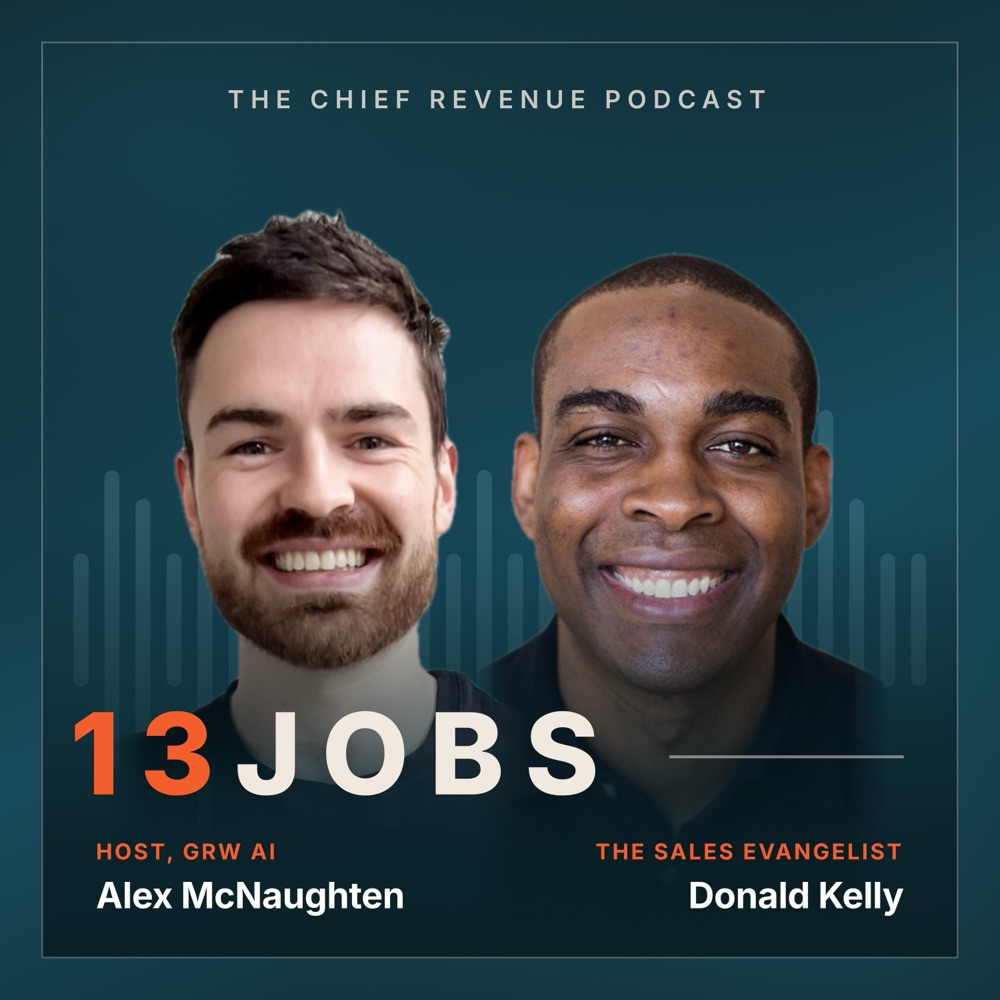
Building pipeline on LinkedIn without pitching
Nobody opens LinkedIn hoping to be sold to. Donald's answer is to become the person they were already there to learn from.
 Hosted by Alex McNaughten
Donald Kelly · The Sales Evangelist
Donald Kelly is the founder of The Sales Evangelist and the host of its podcast, which he started in 2012 to share what was working for him as an individual contributor. It grew into coaching, then consulting, speaking and cohort-based training, and he left his day job for it in 2015.
The work now centres on top-of-funnel strategy: teaching individuals and teams how to build pipeline through outreach that people actually want to receive.
He is an award-winning speaker, sales trainer and coach, and believes anyone can sell given the desire and the right training.
In this episode, we discuss:
- The gumball machine problem, and why patience is the whole game
- The superstition of "it worked once", and doing the maths on a thousand requests
- 44% of executives discovering solutions through social, and what that changes
- Making your profile look like someone worth accepting
- Where to start as a brand new SDR with a hundred connections
- The Navigator list, and what fifty personalised requests a week compounds into
- Mining your own case studies for the problems worth posting about
- Turning the objections you get into content
- Why most reps never start, and what the first months actually feel like
- Why the platform rewards the people who post
- Personalised connection requests, and when you can get away without one
- Worthy of the conversation, and the day that stopped being obvious
Quote of the show
“LinkedIn is not a place where you go on and you put a quarter in and then you get a gumball.”
Key takeaways
- It is a networking platform people started mining for leads. Treating an accepted connection as permission to pitch is the clash underneath almost every bad message in your inbox.
- Do the maths on your own success story. A thousand connection requests for one deal is not a method that worked. It is a method that barely survived, and the superstition around it keeps reps repeating it.
- Executives are there to learn, not to buy. 44% say they discover new solutions through social. Be the thing they came for and the connection request stops needing to do the persuading.
- Your profile decides whether the request gets accepted. Before anyone reads your message they check whether you look like someone worth learning from. That is the asset to fix first.
- A new SDR has more to say than they think. Read your own company's case studies for the problems they describe, then post about those. You do not have to be the expert, you have to have found the detail.
- Objections are content. Every objection you hear is a post. Ask internally how the team handles it, then answer it in public instead of one prospect at a time.
- Personalise the request, or earn the right to skip it. Donald can send blank requests because people recognise the name. Everyone else is competing against "I'd love to add you to my professional network".
Transcript
Donald, good to have you back, my friend. How are you?
Alex, I'm super grateful, man. I can't complain. Life has been good. Thanks for having me back on the show. I must have did something okay the first time to come back.
So definitely good to have you back. So for those who don't know Donald Kelly, you're the founder of The Sales Evangelist, but tell us and the audience a little bit more about you, how you came to be and what you're focused on.
Yeah, man, I started a podcast back in 2012, 2013 era, and it just grew. I started sharing tips how to help other sellers, individual contributors like myself. And we— from that, I started coaching, and then from there went to consulting and speaking and developing training content like cohorts. And it just grew. And that evolved in 2015, 2016.
I left my full-time day job, and now what we mainly do is teach top-of-funnel strategies strategies on, again, cohort base, how to help individuals and teams be able to maximize their outreach and to build pipeline. And it's fun, it's great. So we do stuff here in North America and I have clients in EU as well as in South America as well.
So yeah, that's a little bit about us.
Very cool. And yeah, you've been in the podcast game a lot longer than most. You know, 2012, that's before most people were. We're getting into this space. Very cool.
Yeah.
And look, today we're going to talk about, you know, the theme of outbound, but more specifically LinkedIn and building pipeline and doing it the right way on LinkedIn. Because there's— we've all experienced the wrong way. We've all experienced bad LinkedIn outreach. So maybe let's start with like quickly just get out of the way, like, okay, what are people doing wrong?
When they're trying to build pipeline through LinkedIn. And then let's talk about actually how can people do it? So yeah, what are people doing wrong?
The biggest thing I think people are doing wrong when it comes to LinkedIn is they are, they're too hung up, they're not patient enough. And what I mean by this is LinkedIn is not a place where you go on and you put a quarter in and then you get a gumball. Like it's not like something you just go and instantaneously you get the success.
It takes time because literally it was built as a networking platform, and then people started to exploit it as an opportunity to get leads because now you've got all these business professionals gathered in one place. And because they see this as a lead, they're treating it like their CRM. If I have Alex in my CRM, therefore I can pitch Alex.
If somebody is connecting with me, therefore they're telling me they want to buy from me. And that's not the case. It originally was a networking platform. And so the premise is most people are going on it for that purpose. Most of your, you know, ICP, ideal customer profile, And then now you have like, you have salespeople who can do sales strategies according to that.
So, that's the very first thing that I would say. And the second piece that ties very close to that, because they're trying to get the instantaneous result from LinkedIn, they're pitch slapping. Let me enunciate my words, P-I-T-C-H slapping, where I connect with you, you connect back to me or send a connection request, you accept my connection request.
Mm-hmm.
Therefore, now I have all rights to pitch you about my offering. And usually, I say 99% of the time, that doesn't work. And that makes a bad LinkedIn environment relationship because again, people are here to network for the most part. Salespeople are here to try to get new business. And that's the clash that I'm seeing as far as some of the top of the funnel activities and what they're doing wrong.
Yeah, it's, I can understand how it happens because, you know, salespeople have pressure, to hit targets. They got, you know, sometimes volume metrics they have to hit in terms of number of outreaches that they're doing, etc., etc. So it— I can understand how it happens. Um, what I have struggled with is certainly in the last couple of years is like how it's still so bad.
It's like the average is still so bad.
Yeah.
And I'm wondering like, are people having some success or are people just, you know, with, with bad outreach or are they simply just ticking a box? Because I, you know, like, I don't know if it's the same for you, but like every time I open my LinkedIn, there's probably like 5 to 10 outreach messages in my inbox every day.
I think there's a common— I think it is, they are seeing success, but it's not a lot. Sales is one of those things where it— I feel like many salespeople are superstitious. Like, and what I mean, and I think this is all human beings, but we get superstitious. It's like, this worked in the past.
I did this and I did this and this person accepted my connection request and they bought from me. Well, like, let's do the data though. How many individuals actually did that?
Hmm.
Well, it took me 1,000 connection requests, but I got one. And it's like, ding, ding, ding, ding, freaking ding. That's horrible. Like, if it took you that many to get to one person that accepted and actually took the bait, then that sucks. And it's the same thing then when you see with like email.
So, I think the idea of the volume approach, because we've been told, again, we have pressure and we can, you know, we know the you know, some people will go to fall in this camp and I think there's a combination, healthy combination of both, but they'll fall into the camp and say, well, sales is a numbers game.
And if it's a numbers game, therefore, for as many invites that I send and for as many messages that I pitch, there are people that are going to respond back to me. And the law of averages tells you, yes, that will be the case. However, it is not scalable, nor is it effective.
So, it's like, you might as well just, you know, take any random phone numbers like back in the days in the phone book and just call all of them. It just doesn't necessarily prove to be as efficient. So I think that's the issue that we're seeing where there's still enough, not enough, still seeing some flicker of hope.
Therefore, they keep doing that. But I think we've come to the end of that lifecycle, so to speak.
And I really like how you sort of open this up about people not being patient enough. Talk to me a little bit more around that. Like, what did you mean by not being patient?
Yeah, because go back to human behavior and the way we interact. Like Jeffrey Gitomer said it way back in the days, people love to buy but they hate to be sold. So, no one, absolutely no one is like, I'm going on LinkedIn this morning and I'm going to get sold. I can't wait for Alex's message.
I'm ready to buy.
Yeah.
Nobody goes in that frame of thought. So, they go on for a different reason. And here's some data as well. So, HubSpot shared in their their CEO at Inbound last year, she had a keynote, and one of the things she stated was that 44%, 44% of executives say that they discover new products or discover new solutions via social media.
44%! Wow.
This—.
And the reason why they were bringing this up, because such a stark difference from in the past where many people were doing searches through Google to find and discover things. So this tells me several things: that the executives are active on on platforms such as LinkedIn. And 2, they're open to learning because they're discovering.
So 44%. So we take— think about this. The problem that I find is that most salespeople, because if I'm going on a platform to learn, not to buy, I'm going on there to learn and to discover new opportunities and to see what's working, what's going on. And you are coming on to sell.
We automatically have a clash. But if you can come on here to teach, and I'm coming to learn, then we have a good marriage coming in because that's what I'm looking to do. I'm looking for somebody to teach me something. So the patient side comes in here and this is critical because only about maybe at this point, Alex, is like maybe 5% of LinkedIn users.
They have a billion active users, a billion users now. And let's say half of them, half, you know, 500 million are active on the platform. Only about that, let's say 3% to 5% of them are actually posting regularly on the platform and regularly you could classify as like monthly. So there's still like a large percentage of people not doing it.
So there's not many people providing the education or the learning.
Right.
Therefore, what I'm saying is that you need to be patient. So as a sales rep, if I was on LinkedIn as an individual contributor starting over, which I still do for myself, I sell. But if I were to do it as an individual contributor, I would look at a way to be able to be more patient and to provide more education.
So let's say I sell to HR directors. They're a tough one. Let's say, let's say I sell to, you know, IT directors, or if I sell to marketing directors, CMOs. We know they're on LinkedIn. What is the biggest challenge that they typically have top of funnel when it comes to our pipeline or to our business?
So maybe the HR, the marketing directors, the biggest question that they're having is things around better ways to generate leads and maybe we have a CRM or some automation tool and so leads is an important one for them, their ability to be able to make sure sales best qualify leads. Maybe it's working with their CRO, the newest roles of CRO and how those functions help an organization?
So now literally I have like 3 weeks worth of content right there that I could share stuff on because as a sales rep, I'm a consultant in that space and I get these questions regularly. If I answer those questions, there's a high probability that that 44% of executives, some of them are going to be out there and see the content that I'm having and be more willing to be able to follow me.
Now, they're not going to all buy from me but they're going to follow me and start engaging with me. And my— I start looking more like a thought leader. Now, the other step to that too, instead of you saying, well, Donald, I know that takes time as well and I'm posting content.
Yeah.
That too is that you want to be able to make sure your profile looks like somebody that provides that information if 44% of them are willing to go on there to be able to learn. So let's say I do do a search in Sales Navigator and I see these ICPs and some of those ICPs are again those executives that are on the platform to learn.
When I send a connection request, how likely are those persons to accept my connection request if they see that I'm a teacher of information? They see my posts, they see my profile and they say, man, this person clearly knows a lot about marketing challenges. I'm looking to learn about marketing challenges. I'm willing to connect with this person because they're on the platform to connect and to learn, not to buy.
So that as you start that, as you start that relationship and you start engaging with them, you're gonna see that naturally this leads to— I find that it leads to— you grabbed their attention already. That attention leads to engagement. Engagement leads to conversation. Conversation leads to opportunities. And that's what you want. And that's the patient side.
So that was a really long explanation. Yeah, but if people are coming to to learn, you need to go on that platform to teach and you need to look at it as a way that I can provide that first grab their attention. Once I grab the attention, I can engage with them, start that conversation via the DMs, and then that usually leads to opportunities.
And we can go into some ideas how you married that transition.
Yeah, I think it's a really good way of— a nice way of thinking about it. My follow-up question and a thought that immediately came to mind because I get all of that, is I'm a new SDR and I'm like right at the start of my career and I'm thinking I don't have anything to teach people.
I'm 20, I'm like, I'm 21, I'm straight outta school. I got, you know, 100 connections on LinkedIn. Like where do I even start? How do I, like what do I do? How do I start? Yeah, yeah. I'm just curious if you have any thoughts on that for someone who's just kicking off their career.
Yeah, 2 things first. I would say if you're doing this, you get Navigator. If you have to get it out of your pocket, you get it. Just stop eating, freaking Uber Eats for, you know, several months. And you can always get my free trial. You get 2 months trial from me. LinkedIn gives me that.
So it's linkedin.com/tsc, by the way. So you can get a 2-month trial. So 60 days. So you got 60 days there already. And now you're going to go ahead and cut off Uber Eats for another 3, you know, couple months. And now you have like 6, 5 months worth of use of Navigator.
Now, here's what I want you to think about as you're doing this. Is you want to make sure that you're reaching out to the right pool of people. If you have 100 people, and I do this, I teach a class for my alma mater, a sales class. They developed a sales program and I'm fortunate to get an opportunity to be there to share stuff with them virtually.
But every student in that class has an assignment every week to connect with 50 people on LinkedIn, to find 50 new connection requests or somewhere around that number because I want them to be able to build their network.
Yeah.
And any SDRs can do this right out the gate. So you find, you start using Navigator, you build your ICP, and if you do a focus list and say you find, you know, build a list of 100 people on Navigator and you send them a personalized connection request every single week, I mean, that's a lot, but, you know, let's just say 50.
You're going to have at the end of the month, you have 200 individuals that you've sent connection requests to, and you're probably going to get a 50% conversion rate. So 50% of these people. So then now in your pool, you just have 300 ICPs. And I'm not saying you need 3,000, but 300 ICPs that could buy from you covering the territory that you focus on or the SMB market in that niche.
Like, this becomes really powerful. Now, I promise you, I'll answer your question, you know, a little bit further. Now, I don't know anything about it. I would beg to differ. If you've been in any trainings with your company for the past 2 weeks, you probably know more than the average individual. And you can also do something very, very easy.
You can also go back to the case studies that you look at on your company's website or testimonials. Then if you don't have any case studies on your company website, you can always just go steal it. What I mean is go and find information. One of the things, and I give you this because I did it, not steal, but I borrowed information.
There was a company that I worked with and the competitor, they had amazing case study, Alex. I mean, these things were detailed and I'm just like, oh my goodness, holy dope, like amazing stuff. But the thing that I found, even though it wasn't our company, the challenges being described were the same exact challenges that we solved for.
Mm-hmm.
Because our solution was pretty much like similar. So you can use those case studies and then share. You're not going to share everything on the net. Read the case study and understand the problem, understand the solution, and then therefore you can post about it. So let me give you an example. It was a paperless company and the name was Laserfiche.
So Laserfiche, you know, the clerks at the City of Miami were able to streamline their operations. As soon as you start reading that case study, they're going to talk about the problem, the top problems that people have. That's all you want. To be able to really focus on. So I might say, you know, the human resource— sorry, clerks, city-county clerks face many challenges.
The number one challenge facing city-county clerks, the number one challenge facing them is the bunch of requests that they get on a day-to-day basis, blah blah blah blah blah. And all I do, I'm taking the problems from the case study from the competitor. And then what's the tip that I might give? Here's some simple things you can do.
1, organize your files. 2, find a reputable company that can do it for you or a solution. Or 3, start off digital from the very very jump. And if you're trying to migrate, you know, find people in your space that have done this already. I'm curious to learn about you. How many of you guys have went digital with your files?
But dude, I didn't need to do anything with that, but it takes a little bit of work. And it's the same concept. You can also just curate content. You can go and just put in Google Alerts, you know, information about clerks or information about marketing directors, HR directors, and you're going to get articles that pop up.
And you take one of those and just curate it. And I would say something to the nature of, Saw this, my mind was blown with how simple you can organize your HR, set up your HR department. So often, HR directors get confused about it. Love that James Doe wrote this piece because you could probably tag that person because they're probably on LinkedIn on 5 ways HR departments can become more efficient.
Thought it was brilliant.
Hmm.
Curious, let me know in the comments which one you feel is the best for you. Now, this is— I don't know anything. I'm a 20-year-old, but I do know how to search. I do know how to find detail, find information, and that's all you're doing there. So I just gave you a couple of things that you can do on that standpoint.
And any objections you get, go back into your company and ask them, how do we overcome this objection? Take that objection and make it into a post. So it might say something to the nature of, we're not interested in an HR solution. Well, not interested, like I get this one often and maybe I can write a post about that.
You know, one of the biggest— I'll start off that post by saying, not interested. Not interested. And then I might say, this is one of the top things that I hear from HR solution— HR directors, you know, or this is one of the top things I hear from companies when it comes towards HR.
Maybe because one, they have solution in place. Two, they have a system that they've done over and over. Three, change is really, really challenging. And I get all of that. Where, you know, here are some things to be considered though. One, Companies, everyone, companies evolving. Number 2, blah, blah, blah, blah. 3, blah, blah, blah.
But all it is is sharing intel on that answer. And those are things that people, that 44%, again, that's what they're looking for. They're looking for learning how they can solve problems to real-life business problems that they're facing rather than just like, you know, our marketing team did a blog, here's the post.
Like, give me your insight on it.
Yeah.
Show me that you know some stuff and show me that you are relevant for me to have the time to to converse with you as an expert.
I think that's such good advice. Um, and it does blow my mind a little bit that more sales pros aren't doing this actually, because it is, it's quite easy to do in the grand scheme of things. Like it doesn't take that much time. Um, we've all got—.
Why do you feel they're not doing it? This is your show, I'm doing an interview.
No, it's a really good question. I think, I think it's uncomfortable because, you know, and I'd like to hear your view on this, but I think it feels uncomfortable to kind of put yourself out there.
Yes.
And I think there's also this probably a feeling of like, hey, I actually don't know that much, so like who's going to listen to me anyway? Like these are all the feelings like before when I first started sharing content, like actively, you know, when was that? Maybe 6 years ago. These are the feelings I was having.
I was— and you feel like you're just kind of throwing it into the vacuum. Your engagement sucks. It's like no one cares. And, and it's like, I don't know, I, I think there's— I think that's part of it.
Um, yeah.
I think also the other side of it is perhaps people don't realize how effective it can be when it— when you actually get into the swing of it. Um, I think that might also be a factor. What do you think?
So go back to what you said about— you point out to my thing about patience. Like, it takes time. I'm not saying you do this right off the bat and all of a sudden your engagement is going to go out the roof. But what happens is that LinkedIn is in the game of making money.
I don't care how you look at it. If they're charging for like every little piece of solution now, like, think about this. They're making money from the ad dollars. If they can make money from people being on the platform and from the ad dollars, they're going to reward the people who are engaging and who are sharing.
So if you share something once and you're like, nobody liked it, 2 times, 3 times, nobody— it didn't get a a lot from it, then screw— like, don't screw it, give up on everything. Like, just keep going. Like, it takes time. Like, nobody makes one phone call and then gets a hold of a prospect and closes the biggest deal of their career.
Like, could that happen? Of course, probability could be in your favor, but usually it's going to take time. It's going to take like a month of you doing calls every single day and then you get into the rhythm of things and you start making it. It's the same exact thing, same exact motion.
So you share pieces of content. The thing that I find, and I work with a LinkedIn, a part of the Creator Program, so I got a coach like back in the days, and one of the things dude said that blew my mind, he said, he asked me the same question, why are people not posting on LinkedIn?
And I said, and he said, and he said it's because of professional network. And I'm like, what? He said, yeah, professional network. When LinkedIn first started, people just saw it as a professional network. So think about this, professional. On Instagram, I can drop a picture of my, you know, meal, you know, my French toast or whatever, it's okay.
On Facebook, I I can put something about my dog, but when it comes to LinkedIn, it's like, my goodness, man, the judge is on this. My CEO is on this. Like freaking my, my, you know, my college professors on this platform. These are all professionals in my eyes. I don't want to post something that sounds dumb.
What do I know? And that's— this is what happens with so many people. That's why there's such a small percentage of folks that are posting professional network. So I don't want to look like an idiot for my professional, but I'm willing to look like an idiot on to those professionals though on Instagram and Facebook because of the branding, right?
Because it's not like you don't have judges on LinkedIn— on Instagram. It's not like you don't have judges. I mean, you know, professors on Instagram. You do. And those people probably are in your network still. But we find that LinkedIn, it's just that it's going to go to the body of judges of the social posts and see how expert of a knowledge you have when in actuality, it's not the case.
And that leaves room for so many other people like you and me who will go and post content and find way more success. Success because we're not afraid of doing that. I don't know if that makes sense.
I think that's a really good insight there. It's people, you're right, people are very comfortable sharing stuff on Instagram and Facebook, but just because of how LinkedIn is framed in their mind, they feel more, you know, they feel less confident to do it there.
Yeah.
I've got a more tactical question for you and I'm, you know—.
Please.
Connection requests, personalized or like, yeah, I know. How do you do them? Because I know it's going to be a question, but how do you do a LinkedIn connection?
This is controversial, and I love it. So there are different things on this. If I did a connection request to someone, I can do— I can go out and do connection requests without a personal message, and I can have success. On it. Why do you think that's the case?
You've got a bit of brand. You've got a good profile.
Exactly. Yeah. Exactly. This is what I feel. Totally truth. And in the space that we're in, like people know me. They'll go back and look and they'll see the 19,000 connections. I mean, you know, folks, there's a lot of credibility. Salesforce, HubSpot, LinkedIn. Like they'll see all of that. If you're in an industry where you're known and you have a lot of those, your market share and they know you, then I think it's going to be easier.
Now, I just did an episode on this. So, I was like, I was just dancing there. And we're doing an audio live on it coming up in a couple of weeks. But here's what I feel. Go back to the data again. I don't have hard data on this. But LinkedIn does. LinkedIn has been doing this forever.
What is LinkedIn charging for now? Connection request messages. Why in the world would an organization that's trying to make money start charging for something that doesn't work? It doesn't make sense. Of course it works. That's why they're trying to monetize it. So you only get 3 connection requests with a— you get more connection requests, but 3 with a personalized message now because they want you to upgrade to the higher version because they see that the data improves— proves that if people see a message from somebody they don't know, there's a higher chance of that person connecting back to them.
That's my belief on that. But again, for me, I don't care, screw it. But I do send a personalized connection request message. But some people might say, well, I send messages and it doesn't work. Well, before you throw the baby out the bathwater, keep the baby here, throw the water out. But here's the thing that I would tell you is that most of your messages suck.
And I'm just telling you that because it's dumb messages. Go back to what we were saying. The messages are like, I see that you have— I see that you're connected with Alex, would love to connect with you. I was like, that's such a dumb connection request message.
Mm-hmm.
Or, you know, I see that we have mutual connection requests. Like, no crap, Sherlock. Like, that doesn't doesn't give me anything compelling. I'm not going to accept that. And then the other one is like the dumb one too. I'd love to add you to my professional network. Like all of these things just suck.
So the messages suck. So if I'm getting 10 sucky messages, then am I going to respond to those? Of course I'm not going to respond to them. And that doesn't make it fun. And so I'll come back to this and wrap this all together. But what does work though is when you do— I'll give you an example, a use case of one that I did.
I saw a guy and when we build our list in Sales Navigator, when we build a list in Sales Navigator, We then send, you know, we find 3 individuals in the organization. We find people at least like that sales leader or somebody that's new to the organization or have posted on a platform in the past 90 days or 30 days.
Why this is critical for me? Because that starts my engagement process with you. And there's a dude, simple use case, this happened times and times again, but he was, he's a new CMO. We produce podcasts with TSC Studios. That's the other side of our company. And we produce for other brands. So he's new to the organization.
Their company had a podcast. They stopped doing it. They had five-minute episodes. The podcasts were inconsistent, and I see that there's a lot that I could offer this company when it comes to our production side. So anyways, I hit dude up, but I still haven't pitched him yet. He did a post, and he shared the how he reshared stuff because he's just curating.
He shared that LinkedIn now has videos, and literally one of the content creators that I respect and follow, Lloyd, he posted something about this over the weekend. So I was like, "This is dope," and I commented on it. Nobody has commented on this guy's post, so I commented. On it, like oh my goodness, this is something that I just heard about.
I've been waiting for this for a long time. Awesome, thanks for posting. Sent him a connection request and I tied back to that post again. Everyone that I send connection requests to, the majority of them have posts because I filter and navigate it for people who are posting on the platform. So it's not a question anymore.
So I sent dude a connection request and this was something that I tied back into. I was like love the post about the video. I just heard about it from my friend the other day. I've been waiting for this for a minute. Curious, are you guys taking advantage of videos on LinkedIn? Permission to connect here on LinkedIn.
But this was something that he was passionate enough about or was curating enough about that I used in the freaking connection request message. And I started with— I ended with a question instead of like— I asked that permission to add, permission to connect. It's weird, but people respond to that. I get the coolest things or some of the cutest messages like permission granted or open sesame.
Like people start engaging. And what am I on this platform for, Alex? I told you. I grab attention, then I get engagement. Once I get engagement, I start conversations. Those conversations lead to opportunities time and time again. And this is what we teach over and over. So the connection requests that I'm sending, they're hyper-personalized, but they're not just like dumb stuff.
Like, would love to see you're into marketing, would love to add you to my network. It's like, I'm really focusing on what that person is posting, or I might tie back to it somehow. And if, again, if it's a job position, I might say, hey Alex, saw that you guys— saw you just reshare I tagged somebody in the post that you guys are looking for a new IT director.
Is this something that you are going to— you're championing or somebody else championing? Permission to connect here on LinkedIn. If you reshared that darn post from your marketing team or from your company, you're more than likely going to be willing to respond back to me because it's not a sales pitch. It's just a dude asking a question trying to help you out.
Yeah.
Like say, yeah, it's not me but I actually know the IT director you should connect with. Come on. Now the reason why— again, go back to— so with all of this, this is my argument why this is the case. There are people that will accept your connection request because you're probably gonna bring that up.
Like, so what if people still— people still gonna accept your connection requests even if you don't have messages? And there's a lot of us that do that.
Yeah.
But I can tell you on mine, I filter first. I look for anybody that sends a message because I'm trying to see if there's an opportunity or something beneficial there. And then more than likely, if somebody— the law of averages again— because people are accepting your connection requests, you may say, then that leads me to start a conversation.
And you could do that. I would rather start that conversation before I send a connection request in the hopes that that person is going to accept, and then it's going to be easier for me to start a conversation. I don't know if that makes sense. No, it does. So I like to— because it then it shows that curiosity, like, okay, this Donald guy, of course I want to connect back to him.
So that's the philosophy. And then it's not just me with my profile. I teach this all the time. So I teach this to the clients and they do the same thing. We are, we're in the camp camp. Donald's in the camp firmly, and I plant a flag that you need to do a personalized connection request, and for those reasons.
Nice, nice. Um, no, it should— it's good to settle that one because I know that one, there's mixed messages out there about what works and how to do it. And I, I, I, I've, I've always seen better success with personalization, and like exactly as you described, like the best results are always when you go the extra mile and there's a clear reason why you're reaching out.
And it's, you know, like you said, it's usually curiosity-based or like there's something actually like real there. And it's not just the, hey, I see that we have many mutual connections, would love to add you to my professional network. That doesn't work. And that reeks of automation and not in a good way.
Yeah.
Donald, I've got a final— oh, sorry, finish your thought. And then I'll ask you one more question.
Yeah, I've come— I've been in the— I'm a firm believer that in order to be successful, do the opposite of what everyone else is doing. And that's one of the things that I find. If I were to look at 10 sales reps and they're sending connection requests, I would absolutely promise that maybe at least 50 to 60% of them is going to do, I want to add you to my network, as opposed to somebody really personalizing an outreach.
Yeah.
Last question for you today. Knowing everything you know now, go back to your first day on the job in sales. What's the one thing you take back? What's the one thing you take back with you to young Donald, first day on the job?
The one thing I'll take back to young DK, um, Is that you're telling them you're worthy of the conversation. Um, and this goes to something you shared as well. Let me explain. You're worthy of the conversation. I had this problem where I felt intimidated by people who had titles like executives or VP or C-suite.
And it came when I first went into the company. I didn't have that trepidation, but then the CEO said, you're going to be talking to people in a C-suite. What can make you possibly talk to them. And ever since then, I was like, oh my goodness, well, I guess they're more important. In my view before, they're just another person.
But now that my executive deemed that that's important, the C-suite, I started having— well, I don't feel I'm worthy to have that conversation. I'm just a junior seller. I'm just a BDR. I'm just in inside sales. But in actuality, I know— when I started making calls, I started realizing I knew more about going paperless with our software than the VP executive of 20 years at the bank did because they'd never ever utilized that solution.
So, even though I was on the job for 3 weeks or a month, I knew more based on the things that I studied and learned than they did. They knew way more about banking and running a business, but not about going paperless with a digital solution. And that allowed me to understand that I was worthy to be in that room.
I didn't want to show that I— I didn't need to show feel anymore that I know more as you. I just know more about this problem than you, and that's what you're hiring me for. So, I'm worthy to be there. I'm worthy to call you. I'm worthy to have that conversation. And that's what I would tell DK.
I think he would have been way more successful if he started off with that knowledge.
I really like that, worthy of the conversation. I think that's a great message to finish up our conversation. Uh, it's great to be talking to you again. I've really enjoyed this. Where can people find you if they want to connect with you, consume your content? I know you put out some awesome content, but yeah, tell, tell people where they can find you and connect with you.
I appreciate it, man. Alex, thanks again for having me on our show. Um, LinkedIn is where I camp out, so you can find me on LinkedIn. I post there regularly. You can also send me— go to thesalesevangelist.com. That's home, and we have content there, whether it's our podcasts, we have free offerings and educations.
And at the bottom of the homepage, you can find a thing on how to get responses on LinkedIn. So we provide a lot of good stuff there. So take out, have at it, but definitely hit me up on LinkedIn. Tell me you heard me on the show. It'd be great.
And personalize your connection request when you reach out. And personalize it. Awesome to have you on the show, man. And really good to see you. I appreciate it. I'll speak to you soon.
Thanks, man.