
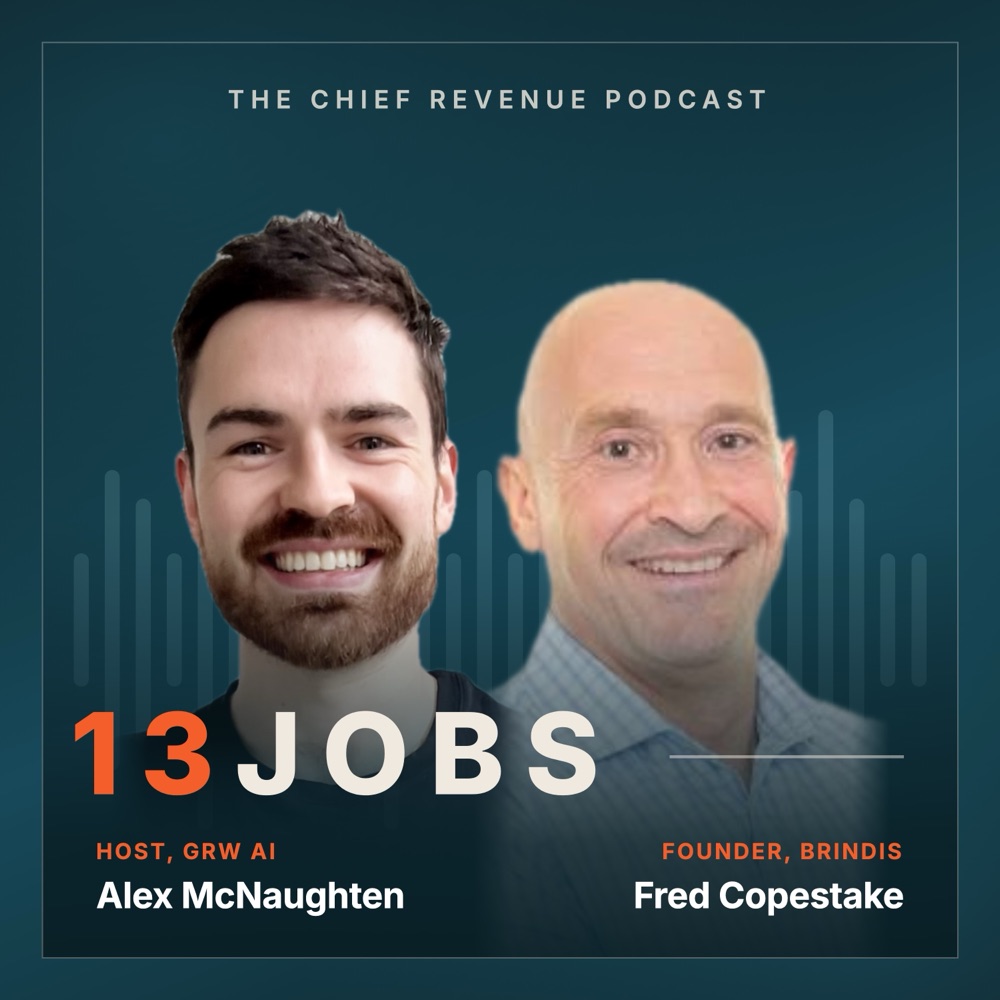
Keep the process, bin the eighties
Fred walks the decades from the fifties forward, keeping what still works, tweaking what nearly does, and naming the one that should be thrown out whole.
 Hosted by Alex McNaughten
Fred Copestake · Founder, Brindis
Fred Copestake is the founder of Brindis, a sales training consultancy specialising in collaborative selling. Over 23 years he has been around the world fourteen times, worked in 36 countries and trained more than 10,000 salespeople.
He wrote Selling Through Partnering Skills off the back of the patterns he kept seeing, and then Hybrid Selling during lockdown, when the pace of change made keeping up its own problem. He describes himself as a geek about the research, on the grounds that it is the only way to tell what is worth keeping.
In this episode, we discuss:
- Fourteen laps of the world and ten thousand salespeople
- The fifties: process, structure, and doing it right twice
- The sixties: psychology, and reading a style before you meet
- The seventies: benefits, and being product-trained to within an inch
- Ban yourself from demoing, and fill the time with questions
- The eighties: thirty closers, and the decade to bin
- The nineties: consultative selling, and where some people stopped
- The noughties: value is whatever the customer says it is
- The twenties: think like a partner and the questions change
- Childlike, not childish, and not being afraid to ask
- Augment the human, then make sure you do not lose the human
- What no model will tell you about the room
Quote of the show
“Customers are hiding because they're not getting anything from it.”
Key takeaways
- Every decade left something worth keeping. Process from the fifties, psychology from the sixties, benefits from the seventies, questions from the nineties, value from the noughties. The tweaks are modern; the foundations are not.
- The eighties are the exception. Thirty named closers tested the next morning. Sales is a series of advancements, so get commitment to the next logical step and leave the boomerang close where it fell.
- Be more expert in the customer than in the product. Reeling off features is a comfort zone. If that is all you can do, someone will point out you could get a job as a website.
- Ban yourself from demoing. Split discovery and demo into two meetings. You have to ask more questions because there is time to fill, you give time back to the buyer, and you get to write a proposal that answers what they actually said.
- Buyers are hiding for a reason. They still have the problems. What they are avoiding is the conversation that adds nothing to solving them, which is why bringing a perspective is the price of entry.
- Think like a partner. Not a partner agreement, the mindset. What are they trying to achieve, what does good look like for them, and what happens twelve months after the paperwork.
- AI augments; it does not read the room. Use it to research, to think through what a buyer might be facing, to map a growing decision-making unit. It will not tell you that two people on the board will not look at each other.
Transcript
Fred, good to have you on the show. How you doing, buddy?
Yeah, good. Thank you. Thanks for inviting me.
No, it's a pleasure. It's awesome to have you on. It's awesome. It's great. I love connecting with people on the other side of the world. LinkedIn's a great platform for that. And look, I came across your profile and liked the content you're putting out and you agreed to jump on the podcast. So there's a couple of things we want to talk about today in this I wanna talk about how sales has evolved and also some of the concepts that, you know, that you're evangelizing, like collaborative selling.
For those of you who don't know Fred, what's the best way to describe you? You're an author, you're a, you know, you build a consulting business in the sales realm, but do you wanna give yourself, give a, you know, a quick introduction on yourself and how you came to be here?
Yeah, I mean, I guess the pitch, the learn pitch that I use is that, you know, I'm founder of Bryndis Sales Training Consultancy. Last 23 years, I've been around the world 14 times, worked in 36 different countries, trained over 10,000 salespeople, which, mate, that's a real privilege to do that. First up, real good fun as well.
Yeah.
But most importantly, what it helped me do is really recognize the challenges that salespeople have. And certainly kind of the more modern challenges people have. And it's because of that I was able to say, right, yeah, let's do stuff to deal with this, like getting people buying up to date. That's why I wrote the first book, Selling Through Partnering Skills, because that's kind of one of the ways to overcome some of these challenges I spotted.
And I've kind of built all my stuff around that, like the collaborative selling approach. Book 2, as I was saying to you just offline, it came because, well, when the first book came out, it was COVID at the same time. So It doesn't make it any less relevant. It makes it more so.
But then there was other challenges which people need to be aware of based on change and speed of change. So look, because I couldn't go anywhere, we were all locked down, weren't we? I thought, well, actually keep myself amused and produce some more stuff to help salespeople with future-proofing themselves, basically. That's why I put that together.
So yeah, that's the quick version.
No, it's awesome. And it's good to be productive in that lockdown. Not much else people could do really other than, I think, what did you say before, before we hit record? Watch Tiger King.
I watched that as well, but yeah, I clearly wasn't— I wanted to know what everyone was talking about.
So let's start with how has sales evolved? What's changed? You know, you've been doing this a long time, so you've seen some of these changes firsthand.
I have. I'm also a bit of a geek in sort of researching this stuff and understanding it to be able to make sure that we are still using the things which are relevant and good. Making the necessary tweaks and binning the sh*te, you know, stuff which isn't helpful and not very good. So I kind of, you know, went back, looked to the '50s, you know, we could do a little time tour actually.
I sort of went back to the '50s and kind of, you know, what's going on in the world of sales? What can we take and what do we need to tweak? And it's kind of interesting. So when you look at what's going on in sales world, it's reflecting wider world. So, you know, '50s, it was all about rebuilding, wasn't it?
You know, after World War II, it was all about being effective. That's what economies were trying to do. And so were salespeople. So it's all about process. It was all about methodology. It was all about having structure and doing the right things time and time again. Now, if you argue with me and say we don't need that in sales today, I would look at you like, what?
You're crazy, man. I mean, we need to have good solid process, don't we?
I'd argue that we need more of it in most companies, not less.
So would I. Yeah. Because when you look at the processes and I actually use a '50s process in what I train still. But for me, a meeting process, AIDA, attention, interest, desire, action. It's a cracking way to break down the call. Yeah, still works. But there's processes that we need to introduce that didn't exist then.
How to write a social media post, how to construct a video message. I mean, you know, weren't doing that in the '50s, which might have been a better time to work. I don't know. But yeah, so all those kinds of ways and giving yourself a structure and frameworks to just not keep reinventing the wheel, do best practice.
So, you know, I kind of think we could take a lot from that. Yeah.
Well, I suppose, you know, yes, a lot's changed, but fundamentally people are still people and they're wired, you know, it's not like we've evolved massively as a species in the time since the '50s. We're still human. So a lot of the same things that worked back then, the fundamentals, like, you know, you talked about the structure of a call, they still apply.
Yeah. And it's interesting what you say because when you look at what was going on in the '60s, a lot of the stuff around sales was to do with psychology, right? So that was where a lot of the personality style stuff was coming from. Yeah. Looking at trying to understand what people's preferences are.
How do they think? How can we adapt what we say and do? I mean, it's all good solid stuff. Again, I thoroughly recommend we still do that. But again, you can look at modern tweaks and this is the one that does some people's heads in. It's like you can adapt your personal style to somebody before you meet them.
People are like, what? How? Well, you look at your Humantics, Crystal Knows and some of those things, some of the tech that reads the style and will give you those prompters.
Yeah.
So again, it's an older style of sales but with a more modern with more than a spin on it. The neuroscience that we, you know, we know how the brain works better now. FMRI gives us access to that. So again, why would you not learn that stuff and then apply that kind of thinking better?
Do you think there's any, you know, on this area of psychology and personality, you know, if you're a sales rep today and you have not even dived into that at all, like let's say you've just about got your process down, Yeah. Where should you start? Because psychology can seem very overwhelming. So like, what would you do?
You're a bit, you know, you're newer to sales, where would you start?
Right. First up, one size does not fit all. So you will have a style, your natural style, and that'd be the style that you would like to be sold to. That's great. 25% of the people you talk to, you probably click with and you might notice that. There's others that you'll probably find they're really difficult.
No, no, they're not being difficult on purpose. They're just different in preferences to you.
Yeah.
So just understanding personality styles, social styles, DISC is quite good, or even just the colors, red, blues, yellows, greens, or birds. Some people are like doves. They're friendly, they're nice. They're, you know, some people like peacocks, they like to show off. And like, you know, some people are like eagles swooping, very driven and targeted.
And other people are like kind of But owls, wise old owls, they think about stuff a lot. You know, there's loads of models which are pretty easy to tap into, but Humantics, which gives you free goes, and Crystal Knows, attach it into your LinkedIn, not necessarily to be reading the people, but just to be reading the prompts about how these different styles work.
Yeah, very quick way to get up to speed on that.
Yeah, I think that's a great tip. I think tools like, you know, the ones you mentioned are an easy way to kind of get a, what's the word I'm looking for, a step ahead of your competition who aren't thinking that way. And, you know, if you go into a sales conversation having done that research and your competition hasn't, then you're already ahead of them.
Yeah, it's just think about how can you flex your behavior and your communication to make it better for the other person, to make it more comfortable for them because they're receiving info and doing stuff in a way which suits their preference. Actually, the other way, I had to change this a little bit ago.
I was running some training and I talked about, it's like the people in Star Trek, you know, and everyone's looking at me going, no, we don't. What do you mean? Spock? Spock's analytical. Kirk's the driver. They're like, I don't know who you are about. Speaking to millennials, probably. Harry Potter houses. Harry Potter houses.
Look at the character of the Harry Potter house. Is they're all actually slightly different. And if you look at the people in, they reflect the house. I was like, oh yeah. I'm like, oh good. My goodness.
Yeah.
It's another way, another little way you could do that. Yeah. You know, people see your CRM and you've put Fred Cope Steak, Gryffindor. That's the style.
That would be quite a fun way of categorizing it, to be honest.
It works. It works.
Okay. Should we carry it? Yeah, I was gonna say, should we carry on through the years?
So, so what we do, so we've got these things which are solid, been there before, and we're putting these modern tweaks on them. Yeah, look at '70s. A lot of stuff in '70s was talking about benefit selling. Well, okay, we are not going to argue benefit selling. Features, advantages, benefits, what it is, what it has, what it does, what it does for the customer.
Again, we should be talking about that. If you can't talk about that, I wouldn't give you a phone No car keys, anything. I wouldn't know how to talk to customers. However, I think the modern tweak we've got to make is to beware overdoing it. And I see people, I don't know if you've seen this, you come across people which have been product trained to within an inch of their life.
Yeah.
They've had so much product training that it becomes a comfort zone and they'll be able to reel off features, even benefits, to be fair. But it's actually not good enough. We need to be taking the benefits, but the insights that go with them that stimulate the conversations to help people to think about them.
And then this is, you're gonna start to see this as we go through this, helping people to think, being a sense maker, that's kind of where sales is heading. So be careful not to be such a product expert that you're gonna show off this wonderful knowledge you've got because people won't care. Well, that's it.
Sorry.
No, it's absolutely right. And You know, actually, and maybe, I don't know, this is the right or wrong thing, but it seemed to work through my career as I actively tried to not learn too much about the product because it would force me to actually pay attention to the customer and their issues rather than just coming in as like a walking demo.
And that seemed to work quite well when I was, you know, a rep in my early 20s was I would spend more time learning about my customers and their industry than I would just memorizing features.
Totally. I mean, that's a brilliant piece of advice. I mean, and if there's somebody that's that desperate to get right down into the weeds with the techie stuff, there'll probably be somebody you can call on to do that. That's it, you know, become more of an expert in the customer than in the product and talk more about them than you because that's what they're more interested in and you will do better.
We know that. Yeah, it's most people's, everyone's favorite subject, isn't it?
Well, that it is, it is, it's so true. Everyone loves talking about themselves and their world. And you can always say to a customer in the middle of a meeting, hey, you know what, I don't actually know 100% what that feature is all about, but let me get back to you. I'll send you a demo recording or we'll schedule some more time or I'll bring in another person to the conversation.
That's far better.
Yeah.
And if you've had an hour-long chat, about the customer and their genuine problems and their goals and all the rest of it than just walking in as a demo. Because one thing I always say to reps, and, you know, I'm getting the sense you're probably gonna agree to me, is, you know, if all you can do is just rattle off features and benefits, you're no better than a one-pager.
So you don't really need to be there.
Um, somebody once said to me you could get yourself a job as a website.
Yeah, well, exactly, exactly.
I thought that's quite No, there is. And I mean, some advice I sometimes give is say to people that, you know, I know that there's gonna be a pressure in like disco demo, get it all done. Come on. Yeah, fast, fast, fast. To even say to yourself, right, I'm not going to demo, I'm only going to disco and then I'm going to do that in a separate meeting.
I'm gonna take the pressure off myself. I'm not allowed, it's banned. So you have to ask more questions because you've now got the time to fill.
Yeah.
Yeah. What you can also do is then spend less time, which means you give time back to somebody and that'll put you in a really good light with them as well.
Yeah.
And give yourself the space to say, right, this has been an excellent conversation. Let me go away and think about how I can just really make sure what we're doing is gonna answer what you just said. Now, even if you could just do that off cuff, saying that you're gonna put that extra effort in and then you can actually go and write your proposal and then present the proposal to people.
It just has so many better effects, I think. Yeah, a lot of sales managers will probably hate me for saying that, but a lot of CROs will prefer it because it makes more money. So, you know, I'd go down that route. Pressure off yourself.
No, I agree. And that comes back to the process and actually having the right process. And rather than the classic, hey, we've got some interest, let's dive straight into a demo, it's actually you break the two out into two meetings. And it works so much better. And I think the big one you've mentioned there is it gives you a chance to prepare a really good proposal, like a personalized tailored proposal and walk someone through it rather than, oh, we've had this demo, I'm just gonna flick this off and Hail Mary, hopefully 1 in 10 of them will close.
Yeah. I mean, look, I've been trading a long time and so it used to be that you'd always like, you'd go away, so much stuff would be face to face. You'd go away, you'd write the proposal, you'd turn back to make the presentation. And that's like your script. That's kind of, you know, it's up your sleeve.
You kind of, and then say, look, I will leave you with that. I'll leave you with my script. Um, you know, so it's, it's more about doing actually better questions, which is why I would do that. But then it does have the knock-on effects of having better, um, better outputs at the end.
The 80s.
Oh, sorry. Well, yeah, it's probably where we, well, no, no, it's probably where we start to lose the plot a little bit. In the '80s, right? Because that's where it was this kind of close, close, close, greed is good, you know, and all those weird manipulative odd closers that people were taught. I mean, I inherited a training course.
First job was with a— first training job was with a training company.
Yeah.
And I kind of looked at the training and one of them was like, you know, the 30 closers that people had to use or to learn and were tested the next day, you know, like trial, direct, alternative, assumptive, boomerang, kangaroo, bloody this, that, the other Ben Franklin, some or other. It's like, come on, you know, that even that whole mentality is just not helpful.
So this is actually the area, it's the decade where I think we need to bin most of sales activity at the time because it's just not conducive with the way we need to be today.
And it was sort of like pressure selling environment, wasn't it? Like the '80s, obviously before my time, but from what I've heard speaking to people is that was all Yeah, it was all about kind of almost manipulating the customer into a decision fast then and there.
It was and it's not good and people know what's going on, not effective. So, you know, what we can take from there is, you know, sales is and always has been a series of advancements. Yes, we want to get commitment to the next logical step, you know, closing step if you like. So I just don't even like the word close because it's just of that mentality, getting commitment to the next step and keep doing that.
You don't want a kind of a continuation, you know, where you get stuck and someone's like, oh yeah, it's really interesting. Oh, we'll have a think about that. Yes, they're interested. No, no. What's the next logical step? Yeah.
You know?
Yeah. So it's just make sure that we're doing something that's moved us on. I mean, the '80s gave us that, if anything, but, you know, let's move on. Okay.
Moving swiftly on.
Well, yeah, because if you— '90s, sea change in sales, but it's like a C rather than sea that you swim in.
Yeah.
See, consultative because that's what, that's when that was born, you know. Neil Rackham and the team looked at what the best salespeople were doing and they found they weren't actually doing what they were trained to do, which is all that closing stuff. They were asking questions and they're asking better questions and they're asking questions which understood someone's need.
The need being the difference between where they are now and where they wanted to be. And then by understanding the impact to that need and making that kind of gap wider, that would be the kind of the impetus it would give somebody to do something. And that's when SPIN Selling was born. And then some people were doing that naturally.
I'm a bit dubious about natural born salespeople, but some people were just doing that. They kind of figured, probably didn't realize, but unconsciously that was what they were doing. That was their model. We can train that and we can use it as a good solid basis. It's a solid basis. Yeah, I think some people are more— we need it.
I think some people are more naturally curious and maybe those were the folks who were kind of just doing it off the cuff potentially. But yeah, I think it's a great base. I think thinking in that with that lens is not to say features and benefits aren't important, but thinking with a Hey, Mr.
or Mrs. Customer, you're here today and you're trying to get to here and there's this gap in the middle and it's costing you X. And, you know, having that kind of conversation is a lot more powerful as a basis.
It's a basis. It's almost, for me now, it's almost like table stakes. You've got to understand that and that kind of pro— yeah, that way of process methodology. I don't know what you want to call it, but way of working. To be in any way, shape, or form useful to help someone think.
There we go. Second time I said it, you know, becoming more of a sense maker because it's helping them understand where they've got those gaps, you know. So unfortunately, this is where it stops for some people, right? A '90s methodology. Find the pain, hammer on the pain, pain, pain, pain.
Yeah.
And then I can take your pain away. It's like, well, yeah, it'll kind of work. But it's not as elegant and as modern as it could be. Have that as a tool in your bag, but there's other ways of doing it. And actually, I would say, I don't know, I mean, like challenger sale, for me, it's a kind of consultative sale.
They probably hate me saying that.
Yeah.
That's just the way I advise it. It's just, it's a means of asking questions again in a clever way because you're bringing in a bit more insight, adding perspectives, coming with a bit more opinion. Having that kind of quite brave mindset to be able to do it in that way. But it's a kind of consultative sell.
So yeah, we need it. But if that's all you're gonna rely on, you're old-fashioned, mate. Yeah.
Interesting.
I always say that to people and it winds them up sometimes. But, you know, it's easy to defend because it's saying, well, hang on a minute, you know, that was '90s. Look in noughties, we moved into more value-based selling. Now that's the stuff we were training at the time. Value-based selling. What is value?
Loads of people tell you and you go, well, you're all wrong because what you think value is, is wrong. It's what the customer thinks it is.
Yeah.
And again, that's kind of the 1-minute, 10-second guide to value-based selling. It's like working to understand what's important to the customer. So what's the value to them? Then trying to figure, well, how can we do stuff together to make sure we're gonna deliver that? We're getting on the track to collaborative selling now.
So it's consultative, but we're adding more into it and you need those skills to be able to do that.
Yeah. So it's, you know, really we're just layering the different decades, excluding perhaps the '80s. We're just layering the things that we've learned throughout the decades from a sales perspective. And I think, you know, it's interesting you mentioned Challenger. That was the very first methodology I was formally trained in was Challenger selling back in, when was I, 20, 21, I think, 21, maybe 22.
And that at the time was really quite powerful for where I was at in a sales career.
Yeah.
And, you know, then getting, you know, then, you know, moving into that kind of value-based as well, bringing that in on top of the consulting. So you're not just talking about pain the whole time, which is your right where some salespeople get stuck is like it's pain, pain, pain. It's like, oh, now you're just associated with the negative.
Let's talk a little bit about what the customer's goals are and like what does good look like for them? And, you know, where do they want to be in 12 months?
And bringing more to the party. That's what I say to salespeople because that's what the naughty certainly taught us. And to be fair, that's what Challenger does. I mean, that's 2009, '10, wasn't it really? Yeah. Where it sort of came out because they're saying, well, actually, yeah, we get consultative selling, we get insight perspectives and how we use them.
And that's what we need to do. You just can't rock up and just ask the questions. We need to prime the pump. We need to share a little bit. We need to call out and say, look, this is stuff that I understand is going on in your world, in your industry. You know, if you can't do that, you probably shouldn't be having the conversations because you're not gonna add anything to the discussions.
And that is why people are finding it harder and harder to talk to customers. So I said, that's why customers are hiding because they're not getting anything from it. They have the pains, they've got the problems, but they're wasting time talking to salespeople who bring nothing to help them deal with it. So they might as well try and sort it out themselves.
When you can bring something in, shine a light, give a different perspective and it isn't your bloody product or your solution. Yeah, it could end up as that. Yeah. But it's helping them to think, that's when they're gonna say, hey, this is the kind of person I want to talk to because they're helping me sort this stuff out.
Yeah.
And that's very much what the value-based selling and, you know, what you learned first start, the challenge-based selling, challenge style selling helps us to do.
Yeah.
I mean, people, people take sales as simple and there's so many moving parts and stuff to it.
There are. And I think one of the challenges I've seen over the last, I don't know how many years I've been doing kind of in this consulting and then launching Apprento a couple of years ago is like the things that we've seen is that most sales scripts and qualification frameworks that companies are using, it's, they're very us-focused.
So they're asking questions from a lens of I'm the seller and I wanna know these things. And if I could change one thing just tomorrow that I know would change, like massively impact sales would be rip up all the scripts and frameworks and questions that people are asking. And just redo them with a customer lens to actually learn about the customer.
100%. We are so much on the same page. I mean, and that's why I wrote the book, you know, because if we look, if you kind of move swiftly, we can get through the 10s because the 10s was applying quite a lot of that stuff though. We kind of got this extra weird layer of, at the time I was calling it sales stature because I didn't know what else to call it, which was that you've got to project that you're the kind of person that they would want to work with.
Yeah.
You know, the go-to because the stuff you do in meetings, because of the stuff you would put out about yourself.
Yeah.
Because we were just starting to be able to use social media to do that and, you know, kind of build a personal brand, we would now call it, you know. So actually, personal branding goes back a bit about, it goes back even further. I mean, start in the '50s reputation, you know, it's the same.
We were bringing that into play, but it was because you were doing all this good stuff that would help people to do stuff.
Yeah.
So again, we keep moving on like you're saying. So where do we go in the 20s? So 20s for me where I now talk about collaborative selling and being different to consultative is it's taking all these things, it's bringing them along with us, the bits that we still like, but it's just changing that mindset to think like a partner.
Okay. So I know in channel, you know, people have partners and it's quite a popular thing to set up partner agreements. Okay, fine. You have to then. And no, and actually make sure you are thinking like a partner because some of them are just words.
Yep.
But any salesperson, any salesperson, any industry, that's what I would say. If you think like a partner, then it just starts to change what you say and do. Because as you say, the perspective you start taking is the customers. What are they trying to achieve? What are the outcomes they're looking for? How does my partner come out of this benefiting and what's going to be good for them?
Because then I can start to make that stuff happen. Yeah. Now I do have to make stuff happen for me as well. Yes. Mutual benefit, win-win. But thinking like a partner, that, that's why I get so excited about this stuff. That's why I'll jump on any podcast and talk about it because, you know, we can, we can spread the word, Alex.
So, you know, yeah, that's what we need to do. So it is rip up some of the BANT scripts and, you know, let me just ask this stuff because it's for me to decide if I want to do this stuff. And to kind of, you know, I'm asking questions to help you think because that's what a good partner would do.
They look after the other.
Is part of that also having a slightly longer-term view when you're speaking to a customer and not just thinking to the point of close, but it's actually, you know, where are we gonna be in 12 months or 24 months? Is that part of the lens that you think about?
Yeah, it is because you're thinking about their outcomes. You're thinking about the results that you're trying to help them achieve. Not sign this piece of paper, mate. Yeah. So you're already thinking about down the line, they bought this stuff off me. Is it going to be right for them? And are they going to get the stuff that we talked about?
Yeah.
So I mean, if you want to push this and take it to the extreme, you know, let's pretend we're selling a used car, you know, and then thinking like a partner would change, you know, do I stand in front of the ding? Do I just try and flog it off on you and just push you down the road?
And if the wheel falls off, well, that's your problem, mate. Or if I'm thinking, well, actually, no, let me ask you questions about why you want this, what you're gonna use it for, where you're gonna travel to, what family you've got that kind of thing? Is it gonna be a good fit? And help you think about it.
Well, then it is gonna help me present that used car better to you.
Yeah.
Or even saying, actually, no, I think you're looking at the wrong thing. I know you want that nice shiny red sporty number, but really what you just told me is you need that big boxy safe thing, you know. So even then, that thought process, that mindset, it helps you just be a I was gonna say better salesperson, better person.
Yeah. It's like one of the things where I always try and I say to new reps is like, and you know, most of them are early 20s when they're getting into sales. It's don't lose your childlike curiosity, like regain it somehow. Um, you know, what do kids do all the time? They always, they ask why and what and how and they, it's amazing.
Like we forget how to do open-ended questions as we get older. We get more and more closed-minded. And actually to be good at sales, it's regain your childlike curiosity. And that's almost half the battle if you can just change your lens.
Being childlike in sales is massive because of what you've said. Also, children are so creative, which is another really useful sales skill. You know, give a kid a Christmas present and they'll play with the present for an hour and they'll play with the box for days because the box becomes like a fire engine or fort or whatever.
It's all these things. So yeah, this childlike not childish, totally different. Childlike attitude into sales and not being afraid of asking questions. You know, I think we probably get told when we're young, stop asking questions, it's bad.
Yeah.
Which means they have to come on sales training, which is quite cool. No, I think there's that, you know, and this, we need to get better at that. And sort of there's another thing certainly in the, probably a lot of the people that you're working with, there's a pressure, or I suspect there's a pressure to prove that you know things and that by asking questions, you might look as though you're a bit inexperienced and don't really know and don't belong there.
Yeah.
Now, that's your job is to ask questions again, not for your checklist. You probably should have done that stuff beforehand. It's for the person in front of you to be able to go, It's a good question. I need to think about that. If you get that response, you're doing a brilliant job.
Yeah.
You know, you're helping them to understand stuff and make sense of stuff, you know. So, but I know, I know exactly where people come from. And then, yeah, but they might think that I'm not very good. It's so funny. An experienced person you're speaking to would understand what's going on there and would recognize it as you are doing a decent job if they're being conscious.
What they're probably more doing is thinking about what you just asked them. Like, gosh, I never realized that.
So yeah, well, there's a couple, there was a moment I realized this and I kind of fell into the world of consulting when I was quite young. I was 25 and I started semi by accident, a consulting business. And I realized that I was being paid to ask people questions quite quickly. I was like, wait a minute, I'm not talking as much as I thought I would be.
You know, like I kind of exactly as you described and it was the same mindset that took me through quite a lot of my sales career was like this, like I need to know more. About everything than the person I'm speaking with. It's like, actually, you don't. You need to know more about some things, but not everything.
And, and actually, the real power is in the asking the questions. Um, because if you can help someone through your questions think about something in a different way, or realize something that they, they, you know, realize then that they had a challenge they maybe hadn't even thought about That's much more powerful than coming into the conversation and saying, I know a lot about A, B, and C.
So yeah, I think that's— and I don't know about you, but I found when I realized, when I started to catch on to this, I found it really freeing because it meant that I could have conversations with really senior people and not have to worry and be insecure about not knowing as much about certain things as them.
Yeah. And the daft thing is, The knowledge that you are turning up with for the thing that you, if you get to talk about, you need to talk about, you probably do know more about them anyway.
Well, there is that.
That's not their job to know that level of detail. So you've got enough actually, but that's not what the principal job is for. Hence, going back to what we were saying, split your meetings out. So your job in this first section, the first half, sports analogy, you know, is to get in there, ask questions, get them thinking.
Yeah. So they're going, no, this is really useful. Yeah. Well, okay, let me go away based on what you said. I'll put something together and I'll, and that's where you split that, you sort of, sorry, spin the listen-talk ratio back around because you will be probably talking a bit more. That's because they've given you so much stuff and they've done a lot of thinking.
They're kind of ready and kind of eager to hear what you've got to say. But I mean, questioning skills, I mean, they'll always be core to sales, always be right at the center of it.
What do you think about, and this is sort of a hot topic at the moment with ChatGPT and all the rest of it, and I've got a stance on this, but I'd love to know yours. It's like, how do you think AI is gonna impact sales? Do you know, do you think it's gonna get rid of salespeople within 5 years or, you know, where do you think it's gonna go?
Oh, is it gonna get rid of salespeople? I mean, it's an awesome tool and then really, I mean, I know it's it's not been around that long for me to really start getting my head around it. You know, if we kind of answer the question as a kind of an individual contributor, you know, a salesperson.
Not someone who can go off and buy all the tools that have been loaded up with, you know, with AI into the back of it. ChatGPT on my laptop, as is my camera, as is my pen and paper, right? To use it to to kind of research, to get to help you start to think about what are the challenges that somebody might have, what ways might they want to address those challenges.
And so kind of, it sounds a bit weird, this, but think of it like a person that you're asking advice from in how to approach this other person.
Yeah.
Yeah. So yeah, I was messing around the other day with this. I was looking at for instance, people working in flavors and fragrances. I've worked in that sector quite a lot. So I kind of know the answers, which is why I was asking ChatGPT, what are the challenges that company who is working in that would need, would have in the current environment?
Yeah.
Wow. Yeah. How would they Deal with those challenges? How could a salesperson help them? Whoa. And even if you want to go as far as, you know, what could a salesperson ask to help the customer understand? So as a research tool and setting you up for that, you can use it to, and this is the phrase for me, augment the human.
Correct.
I don't think it's gonna, I don't think it's gonna replace you. If it can, it's probably because you're not very good at what you're doing. Whereas if you're good at what you're doing and you can take these into sort of how you can make yourself even better, then the future is very, very bright.
Yeah.
Again, an analogy would be like, you know, have you seen the Formula 1 racing cars? I mean, Lewis Hamilton will be the best driver in the world. Shame the marshals aren't so good. But anyway, different. Look at all the driver aids he's got.
Oh yeah.
So you're getting somebody who's awesome and giving them even more awesomeness to be able to kind of do their profession as best they possibly can.
That's right.
You know, so it's kind of using it sensibly. And because we sort of talked about augmenting the human, for me, the next step is then to make sure you're not losing the human.
Yeah.
So make sure you are positioning yourself as the person who's driving this, there front and center, is able to take some of the artificially synthesized stuff and is kind of using your own human brain to work it out in this particular context with this person to have that conversation as, you know, a real life human being, if you like.
So it can up the level of what we can do and there'll be the haves and have-nots because the people refuse that it's gonna help them. Will go, no, no, no, no, not for me. Lots of people won't even send video now, you know, and all that sort of stuff.
Yeah.
The ones who get it and are sending video and they're sort of using a bit of Humantik stuff and they're sort of making sure they're putting their LinkedIn profiles on daily and now they're sort of using ChatGPT to get a little bit of extra help in just understanding the people they're gonna speak to and the challenges they might be having.
We're gonna get a big gap. Yeah, I agree.
And I think the augment is the perfect word because I My stance and look, I'm never too fixed on these things because the rate of technology changes so fast. But right now I think that you can't replace the human to human connection and certainly higher value complex selling. You could make an argument that in really transactional stuff that you can, but if we're looking at kind of higher value complex B2B selling, I don't think it can, the human to human connection can't be replaced.
And I actually see a lot of this AI tech freeing salespeople up to actually connect more with their customers.
Yeah.
And giving them, like you said, deeper insights. They can have a deeper and better conversation earlier on or accelerate the learning journey. You know, you're bringing a new rep into the organization, it can accelerate their learning journey. So I think augment is the perfect word. But you're right, that might really accelerate the gap.
Between how an average performer performs and how someone who's really invested in being the best they can possibly be, I think you're right, that gap might start to, to, um, to, yeah, increase.
It's kind of, it's kind of the same as training if you think about it. You know, what we've been saying for years and years is, you know, you could just stay the same as everyone else or just invest in yourself and get better at it. Invest in yourself, get better at it, plus use these tools, plus, plus, plus.
You can there's stuff which can really catapult people into, you know, the box seats and early doors as well. I think there's a lot of first mover advantage on some of this.
Yeah.
But, you know, you're still gonna need that, you know, again, but then let's look at the human bits that you also need to make sure you're developing. So, you know, again, let's think of a B2B complex sale. More and more people are involved. Decision-making unit is increasing. We know that. What are we saying?
4 or 5 years ago, there was 5.6 people involved. Not sure what 0.6 a person is, but anyway, maybe they were already slightly interested.
Yeah.
But now we're up to 10, 11, 12, whatever. It's gonna get more and more. So yeah, we could use the AI to go, who are the people involved? We'll map them, you know, get on Sales Navigator, right? So this person, Alex, you know, what is important to it? Well, the computer says it's this because he's a CFO, right?
Okay, get that. But what about Alex the person? What's he trying to do? Is he trying to get promoted? Is he just trying to see out the rest of his days, you know, a nice pension? Is he lazy? Is he, you know, these kinds of things? And I'm not sure that the AI can help us with that.
No.
And then when we look at the decision-making unit and we're mapping it, and again, there's some wonderful funky stuff that either we manually put stuff in or we'll start to pull data. But is it picking up that Alex and Fred hate each other? No, they're sat on the board and they won't even look at each other across the table.
Fred's constantly trying to pull the rug from under his feet, whereas Alex is trying to stitch it big time. Now, I'm not sure the AI will know that. That's the sort of the finger on the pulse and that human bit which people start to get by talking to other people or being in there and sensing the temperature and all that sort of stuff, you know.
So that's where it will stay.
Yeah.
Human. And it's those bits that we can do. And as you say, have more time to do that because we've sort of done some of the dull stuff and, you know, the heavy lifting stuff. Mechanically so we can start to do the really kind of the humanity bit better.
Fred, I could probably talk to you for another hour on some of these topics, but we're coming up to time. So I just wanna ask you one last question is knowing everything you know today, go back to your first day on the job in sales. What's the one thing that would have been the biggest game changer for you?
What's one thing, the biggest game changer, first day on the job? Actually, first day on the job, because it was quite a long time ago, it would be about questioning skills. Now, I mean, there's all this wonderful funky stuff and I could, versions of that question, I'll often say like, I wish I'd written a book earlier and I wish I'd invented artificial intelligence or something like that.
No, but On that day, so what we're talking mid or early '90s, you know, there's a lot of product training going on. There was a lot of learn this, be able to sort of talk the hind legs off somebody about all these wonderful, and there were features anyway, weren't even that good at selling benefits, to be fair.
If I'd have worked out questioning skills better, I think I was naturally pretty good on the interpersonal stuff, which is probably what got me the job. But if I'd have been more conscious and more deliberate in asking better levels of questions, that would have probably like got me, got me places a bit faster.
Yeah, Fred, this has been great. I've really enjoyed this conversation. Um, where, where can people find you if they want to connect with you, if they want to engage with more of your content, buy your book?
Uh, link, yeah, LinkedIn. LinkedIn would be the best thing. Yeah, on there I try and post stuff regularly. I try to post reasonably useful stuff. You can tell when I'm feeling a bit more frivolous. Actually, you could tell when I haven't got quite as much engagement as I want because there'll be a cat picture.
Doesn't make me a bad person. But no, joking apart, I will try to put decent stuff out on there. And if anyone's hearing this and connects, you know, let me know that that's where you've heard us. And, you know, any questions people have or want to explore stuff further, you know, give me a shout.
Awesome. Hey Fred, thanks so much for this. It's been great to get to know you, go through the decades of selling with you, and yeah, look forward to staying in touch.
Can't wait to, mate.