
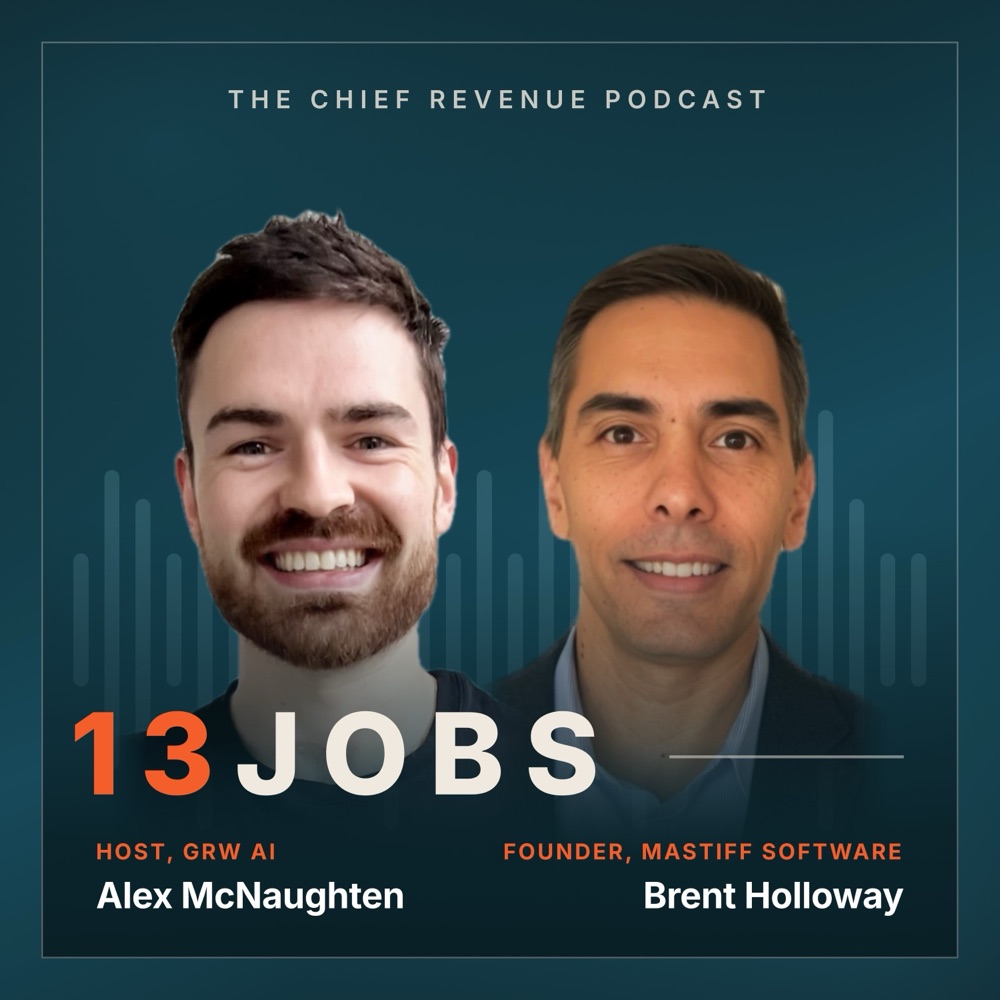
Coaching and the unit economics of selling
Brent gave up a rep to hire a fourth manager, and the coaching that bought back paid for itself.
 Hosted by Alex McNaughten
Brent Holloway · Founder, Mastiff Software
Brent Holloway is the founder of Mastiff Software, which builds a sales productivity and ICP platform for go-to-market leaders. He has spent more than 25 years in enterprise software sales and leadership.
He started as employee number 12 at Blue Pumpkin Software, a company with one paying customer at the time, and stayed through two acquisitions across a 14-year run. Three years at HP gave him his first second-line leadership role. At Talend he grew the sales team from 5 to 52 quota-carrying reps through an IPO in 2016 and a take-private in 2021, then spent two years at Harness before moving into go-to-market advisory work.
He co-authored Sales 2.0: Improve Business Results Using Innovative Sales Practices and Technology with Anneke Seley, published by John Wiley & Sons.
In this episode, we discuss:
- A biology degree, employee number 12 at Blue Pumpkin, and a fourteen-year run
- What coaching actually is, and why the best coaches guide rather than tell
- The GROW framework: goals, reality, options, way forward
- The questions that make coaching stick, and why being told rarely does
- Trading a rep for a fourth manager, and the maths that justified it
- The mistake almost every first-time leader makes
- How to actually ask someone to mentor you, and what to call it
- The right coaching cadence, and keeping it out of the forecast review
- Tying each rep's coaching to a KPI so you can tell whether it worked
- The sales velocity formula, and what unit economics really means
- Product market fit, go-to-market fit, growth and moat: when the economics start to matter
- Single-threading, and the book that changed his career
Quote of the show
“Even if you think you're too busy and you're not doing it today, it's probably worth sacrificing something that you are doing to make coaching part of the cadence.”
Key takeaways
- Coaching is guiding, not telling. First-time leaders default to "I have done this, here is what to do". The follow-through comes when the rep reaches the conclusion themselves.
- Span of control is a coaching decision, not a headcount one. Going from ten reps per manager to seven cost one rep and bought back the attention to coach. The remaining 29 only had to lift 3.3% to break even.
- Coaching gets its own call. Woven into a forecast review it quietly disappears. Weekly if you can manage it, every two weeks at worst, separate from the pipeline conversation.
- Attribute coaching per rep, not per team. Win rate for one, average deal size for another. Team-level attribution is hopeless because product and market move at the same time. Individual KPIs are measurable.
- Unit economics is not a finance buzzword. Opportunities worked, times win rate, times deal size, over cycle length. Run it by segment and region and the inefficient patterns show up immediately.
- There is no single ICP. What makes an efficient cycle in EMEA is not what makes one in the US, or in enterprise against SMB. Work out the account characteristics per role before standardising.
- Single-threading is the expensive shortcut. Covering every buying influence is more work per deal, and far less work than missing quota and having to run four times as many.
Transcript
Brent, thanks for coming on the podcast. How are you today?
Great. Thanks for having me, Alex. Good to see you.
So for those who don't know Brent Holloway, you are an experienced sales leader. You've been VP of Sales at a number of organizations and today you help organizations to build out high-performing sales teams. But tell us a little bit about yourself. Tell us your story.
Yeah, you bet. So I finished college, UC Santa Barbara, with a biology degree of all things. And quickly realized that wasn't going to be the right major for my career. But I was grateful to know an angel investor in a little software company called Blue Pumpkin Software. And he said, Brent, if you're not going to be an attorney or a doctor in the Bay Area, go into software sales.
And so, fortunately, he helped me get my first BDR position with Blue Pumpkin. I was employee number 12. We had one paying customer, and that turned into a 7-year run. We grew to a couple hundred employees and learned a lot. Got my first management opportunity after 7 years. We were acquired twice, actually.
And so it's really a 14-year run with what started out as Blue Pumpkin. Then 3 years at HP. I'm grateful for that experience. That was my first opportunity to do second-line sales leadership and learned a lot there. Then 7 years at Talend. We had a really good run at Talend. My team grew from 5 to 52.
quota-carrying reps and about the same in the BDR org. IPO in 2016, went private by way of Thoma Bravo in 2021. Then 2 years with Harness. They're a DevOps leader based in San Francisco, one of many unicorns there in the city. And then for the last year, I've been doing go-to-market consulting. So really enjoy helping founders and CROs of these startups and scale-ups grow more efficiently.
Yeah, you've had, you've had a pretty impressive experience and you've definitely done a lot of reps in this space, you know, building, building teams or starting as a rep and building teams. And that kind of brings us on to our topic for today, which is coaching and the importance of coaching and embedding coaching culture to driving performance.
So I think first question, let's just like define coaching. Like, what is coaching to you?
Good question. Helping people, I would say, get to better outcomes, but not necessarily just telling them what to do, but sort of guiding them. I think I've learned over the years that, I mean, sometimes you need to be told what to do, but the best coaches sort of guide you and help you really internalize and learn and figure things out with coaching, but not just, again, the direct being told what to do.
Mm-hmm.
I think I, I learned a lot at HP. This goes back, it was a little over 10 years now, but we had a 3-day, like, intensive offsite and we learned the GROW framework. Coincidental that your business is, is grow.ai, but the GROW. Are you familiar with GROW, by the way? That, that framework?
I don't believe I am. No.
Yeah. So it's GROW. It's goals, reality, options, and way forward. Like, those are the, the 4 elements that you really dig into. And what I took away from that was kind of the, the approach of measure twice, cut once, really taking your time to think through options, not especially on a strategic important decision to, to really follow that framework and, and think carefully about the options before you jump on what otherwise might just come to mind.
So it was a good, really good training. And I think I've consciously and subconsciously applied some of the learnings from that. That GROW framework over the years.
And you said when you, when I asked you first, like, what is coaching? You know, you said, I'm paraphrasing, but like helping someone think things through, not always giving them the answers. How do you do that? What does that actually look like? Because I feel like this is where a lot of people get confused around what coaching is and they think it's telling or showing.
Yeah. But often it's not. Often it's— often the best coaches actually just help you figure out things for yourself and kind of just guide you there. So what does it look like?
Yeah, it could be a balance. I mean, part of a manager doing his or her job is to share their experiences or what they've seen work for others. So I guess there's an element of telling there. But sometimes I think the person being coached will internalize it more if they've— if they can apply it to a real-world scenario that they just heard about.
Like, they'll maybe be more likely to believe it and get behind it. But, um, yeah, I mean, I think you can only lead people so much by telling them, like, they gotta, they gotta feel good about it. They gotta, they gotta believe in it. And through, through guided questions, I think you're more likely to coach them in a, in a way that's going to get the follow-through.
I think they're more likely if they come to the conclusion, uh, that something is, is true or not, that they're more likely to follow through on it. So, Yeah, good, good questions. How do you do it? Going back to your question, it's probably a series of questions. You know, why is that so?
What have you tried in the past that was or wasn't successful? What did you learn from that? So there's, there's a lot of questions I think you can ask that help them come to what they feel is best for them. And now, as a coach, you've got to tell them whether or not you agree, I think, right?
You're not going to totally let them go awry, but Yeah, to me, I've internalized that over the years. I've seen, I know when I'm being coached in that way and it doesn't bother me even though it's a tactic, I guess you could say, but it's a legitimate one where you're trying to help people.
So it works.
And then one of the things I've noticed over the years is that you can, the bigger the organization gets, the harder this sort of coaching culture is to scale. You know, when it's a VP and a few reps, it's easier to have that dynamic. But then suddenly when you've got, when you're managing managers and you've got 50, 100 reps that report to you, it's much harder then to make sure that filters down the organization.
What are some things that you did to ensure that as the organization grew that this was embedded in the culture?
Yeah, a couple of thoughts there. First of all, it's that frontline manager I think is super critical and having reasonable ratios. It's hard to be a really effective and understand the dynamics of what each individual is going through if you have, let's say, 10 people on your team as opposed to 5 or 6 people on a team.
Like, massive difference. It may not sound like a big difference, but I've seen huge differences in frontline managers. In fact, going back to HP, I remember one of my frontline leaders said, Brent, I know it doesn't sound huge. I've got 10 people on my team, but at times I forget their names. It was a bit of an exaggeration, but I think he was illustrating the point that he was struggling to be the best frontline leader.
And so we had a dilemma. I remember I had an opportunity. I had 30 inside sellers at the time. We had just come off of a good year where 21 of the 30 made their quota. But the 3 managers who each had 10 people on their team said, I'm spread really thin. And so I had an opportunity to hire a 4th manager.
But the VP that I reported up to said, if you want that 4th manager, you're going to have to sacrifice one of your 30 reps. So which rather have 3 managers and 30 reps or 4 managers and 29 reps? And so we did some back-of-the-envelope math and thought through the impact, both qualitative and quantitative.
And we promoted one of the top performers, ended up being my right-hand man at Talend for 7 years. But I think it was a good trade-off. So those 29 people had to offset that 30th person, right? So right there, that's like a 3.3% improvement in productivity just to break even.
Yes.
But I believe that it would happen because these 4 managers now had teams of 7 or 8 people per leader instead of 10. And I think it was a good trade-off. So going back to your question, I think having a reasonable ratio of, of reps to managers is an important element of being able to be your best as a coach so you can be present and really understand the nuances of, of what they're going through.
But that's tough right now, right? So many companies have these efficiency initiatives where they want to get more done with fewer people. So, you know, having a better ratio is not necessarily attractive on paper, but if you really think through it, it's probably a wise investment if you're spread to like 10 reps per manager or more.
And I think 10 is the average right now across organizations, which is a lot.
That is a lot.
That's a lot of people.
Probably trending up. I haven't seen the latest data on that, but if it's trending up to 10, that's not surprising because of these efficiency initiatives. But at some point, it's just like so many companies are radically changing the ratio of BDR to AE. And then you hear this, this term of the, you know, the $250,000 BDR, which is the AE building his or her own pipeline.
So I think at some point the efficiency initiative becomes counterproductive. So the same could be true of managers.
The craziest one I heard recently was a, was a leader who had 20 or 25 direct reports. And I just thought, well, like, there's nothing you can— you can't do anything there. You know, you're basically just admin all the time and one-on-ones. Yeah, you know, just getting through one-on-ones.
Yeah, exactly. There's your month, half your week right there. Exactly.
Um, did you ever see— did you ever have any challenges, um, with getting frontline managers to kind of approach coaching in the same way you do, or, or just in general in terms of leadership?
Yeah.
And how did you handle those?
First-time leaders often make the same mistake that I made as a first-time leader, which was the, hey, I've done this before, I'm going to tell you what to do. So that whole conversation we were having around guiding people and asking questions and leading that way, I think, is a learned skill. And so, you know, later in my career when I was managing managers, I would kind of share that story and help them be that type of a leader that can coach through questioning rather than just, you know, telling and giving directive orders all the time.
So yeah, that was a lesson learned that, you know, going back, I wish I had learned earlier. But like a lot of things, you know, it takes some experience and mistakes before you get better at this.
Completely. Yes, my first leadership role was full of mistakes. Best rep promoted, well, only rep at the first rep promoted into VP and into a rapidly growing company and many, many, many mistakes along the way. I feel sorry for the team I had at that point in my career in a lot of ways.
Who did you learn this off? Like, who did you have, like coaches, mentors throughout your career who really instilled this in you?
Yeah, I've been very fortunate. I encourage everybody to seek a mentor if you don't already have one. One mutual connection that I know we share, Alex, and we didn't talk about this, but Annika Seely was a mentor to me early on and co-author of the book. You know, she was the real brains behind the project.
But, you know, she's been, she's seen a lot, right? She managed Marc Benioff as one of her inside reps at Oracle in the late '80s and early '90s, and then built a very successful consulting business around, mostly around go-to-market best practices. And she was really good to me. Another leader who's had a huge influence on me personally is Brad Stratton.
So we worked together at Witness Systems, which is the company that acquired Blue Pumpkin, and learned a lot from him. And then overlapped for several years. And then he became the head of sales at Talend and brought me in. And that was a really great run. And he's one of those people that knows how to coach.
Mm-hmm.
He's very strategic. I think, thinks, you know, several quarters ahead. He's not just trying to optimize for tomorrow, but really thinking strategically about what you're doing and your career path. Like, he truly cares and wants to help people achieve their goals, both professionally and personally. And, uh, yeah, going back to like the question base, like, you know, definitely would ask you some challenging questions, but always you could tell his, his heart was in it and wants you to, um, get better and do it on your own and not just be told what to do.
So, yeah, that he's, uh, an example of someone that's had a big impact on my career and many other careers too. Also a PTC guy, for whatever that's worth. Um, so many good leaders have come out of PTC, right? The, the John McMahon. Team of leaders. A lot of people have come out of that.
Just read The Qualified Sales Leader from John McMahon. Great book. Some good coaching elements in that book as well.
You used an interesting kind of phrase. You said seek a mentor.
Yeah.
Is this something that you went out looking for or were these people you reported to or is it both? Like, because I think one thing I've noticed over the years is not everyone seems to have a mentor. Even later into their career, they've never had one. You know, they've never had that person who's really kind of took them under their wing, so to speak.
Yeah.
What was the process of finding your mentors?
Yeah, in Annika's case, I think I asked, like she was leading a Bay Area group of sales managers and I would go to these sessions and learn and then I wanted to work on this book project with her and then it just sort of happened naturally from there. But she was very receptive to my questions, and I probably asked too many at times, but she was, you know, really good to me.
In the case of Brad, I was probably just more fortunate. I didn't necessarily seek it. But sometimes when people are good to you and they give you, like, insights— and actually, Brad wasn't even my direct manager for a while there. But, like, yeah, it takes some courage to ask. It might be uncomfortable to say, hey, like, you know, and maybe you don't use the word mentor.
You could say coach. People like to coach. But, you know, Can I, can I take you out to lunch and bend your ear a little bit? And then maybe it evolves from there into a more regular series of coaching sessions. And a great coach doesn't have to be your direct manager, right? It can be somebody else that you know and respect in your business or just in the industry.
But yeah, it takes guts, but I think you should ask. If you don't feel like you have a go-to mentor that really cares about you and your development, then go seek one.
Yeah.
And you might get shot down once or twice, and that's okay. Keep trying.
I think that's such good advice because if I think back to my career and other peers along my journey, almost all of us have had key people at different phases in our career that we went to for advice, caught up with regularly, and who kind of imparted wisdom upon us. And like, goodness, I have so many people now who, you know, I'm blessed that give their time and energy helping.
And it's, it makes a huge difference. And I think it genuinely can change someone's career trajectory is having that right coach mentor along their journey.
Totally agree. I mean, we all have these pivotal opportunities in our career. Could be a job change, could be, you know, a path of one sort or another. But to be able to talk those things through with a mentor who probably understands the consequences of them better than you do is, can absolutely be transformational in your career.
So totally agree.
What is the right coaching cadence? Like, how often does it need to be? Because I think one of the, one of the things that sometimes prevents people from doing it is they just think they don't have enough time.
Yeah.
So yeah, what, any ideas on that?
Yeah, I would say weekly and I would say if you're not prioritizing it, then you're missing an opportunity to have, you know, high impact effect on your team. So there's, even if you think you're too busy and you're not doing it today, it's probably worth sacrificing something that you are doing to make coaching part of the cadence.
And I think, I don't know if it was 10 years ago, but a while back I learned that coaching sessions really should be separate from like a— I mean, you do elements of coaching in a forecast review, but it's different to have a standalone call related to coaching than just trying to weave it into something else that you're doing.
So maybe it's biweekly to start, but at least biweekly I think is my short answer to your question. You have a nice cadence around coaching.
And separate to forecasting. So you would have— so would you structure your week with like one-on-one where you go through forecast and maybe some deals with your reps, and then you would have a separate conversation that was more about them?
Yeah, not, not early in my career, but, um, like I said, maybe 10 years ago when I started to recognize that this was a best practice. Yeah, it's, it's a separate call and it's, it's worth the time, uh, in terms of, you know, having a high impact on your team. You know, there's not many other things you can do that are more impactful than that level of coaching.
So, you know, and I suppose that's where it comes back to rep-to-manager ratio being so important, because if you're having you know, 2 calls per rep, you know, whether it's biweekly or weekly, depending on how you're structuring it. If you've got a team of 20, that's just not gonna work, right?
Yeah, but go back to my HP example, going from 10 to 7, that, that one change probably made each of those managers that much more involved and able to do coaching and have a big impact. So yeah, the trade-off that I had to make was actually pretty easy in hindsight, you know, To a worthwhile trade-off to improve that ratio.
Was the performance increase?
I'm sorry.
Did performance increase in that HP example?
Yeah, I mean, we thankfully went up and to the right. Now, how much we went up and to the right because of that change as opposed to new products and market conditions and other things, it's always hard to do the attribution, right? But I, I can tell you that the managers appreciated it and I think the reps did as well because they liked having that extra time with their manager for coaching.
So I would say it was a good move.
I think one of the unappreciated parts of why it's so important is you actually increase tenure of people. People stay around longer when they feel like they're being invested in.
Yeah, absolutely.
So yes, you can get the numerical increases, but there is that side too. But you have raised an interesting point, which is it's hard to attribute. So I think that's sometimes where it drops off. Because it's not a direct attribution from I coached my people. So now they're performing 10% better because like you said, maybe it was we launched a new product, maybe it was something else.
Well, let me pause on that because I do think you can measure it to some degree, right? Your coaching initiatives, I think, should be tied to some KPI of some sort. Now, some coaching is career-oriented and much longer-term initiatives. But let's say that, you know, Rep A needs coaching around their win rate and Rep B needs more coaching around their average deal size because they're spending too much time, you know, in the weeds.
So if you start to have specific KPIs that you're coaching to, then I do think you can start to correlate the personalized coaching with whatever that KPI is. Maybe that is hard to measure across the entire team, but at the individual level, you should, you should be able to measure your coaching. In some way to see if it's sticking and having an effect.
And that comes down fundamentally to frontline managers being, doing that work and then seeing the effectiveness of their efforts there.
Definitely. And the second line manager is responsible for making sure that coaching is happening and that the frontline managers are thinking along those lines.
Is there anything else you think that's really important to this topic that we haven't touched on? Yeah, like what questions haven't I asked you around coaching specifically? Or yeah, just around this topic of like coaching and sales performance in an organization.
Yeah, so related to sales performance, let's talk about unit economics a little bit because I think that's an element that good leaders need to make sure their frontline managers and that their reps are thinking about. It's top of mind to me because this is a lot of what we do in the consulting business is around unit economics.
And frankly, it's coaching for founders too, and even CROs to really think through what are the unit economics. And let's talk for a second about unit economics. I used to think it was a fancy finance buzzword, but it's really the fundamentals of efficient selling, right?
Yes.
It's the sales velocity formula that many of your listeners have probably seen. It's in the numerator, it's the number of opportunities that you work times the win rate times the average deal size divided by the average sales cycle length. And with those 4 inputs, you get sales per unit of time, you know, bookings per quarter, bookings per year.
And I think the coaching element of this is first just starting by taking an assessment of where are you today? Like, what do those unit economics look like at the business level, the team level for new logos versus upselling in EMEA versus the Americas? And you start there. If it's not where you want it to be, and it typically isn't, right?
Like most of the sales leaders and founders that I'm talking to are having average sales productivity of anywhere from like 50 to 70% of where they'd like it to be on average. Of course, there's always the outliers in both directions, but on average, you know, sales productivity is not where most companies want it to be.
So then, you know, you gotta look for patterns. A lot you can do through a win-loss analysis, looking at what are the patterns where you consistently have efficient unit economics, you know, enough juice for the squeeze, so to speak, so that you can get to that $800K quota or whatever the target is for that rep.
And then equally important, look for the patterns where you're consistently inefficient.
Yeah.
Like when we do our assessments and talk to them, we'll dig in and we'll find that there's scenarios where they've worked 100 opportunities in the last 6 months, with a 10% win rate. And until they see the data and it kind of smacks them in the face, it's like, wow, why do we keep doing this?
Like, it's, it's just, it doesn't work. Like, we, we gotta do something different. You either gotta sell it through a different channel or not provide a POV if the, if the ACV amount is too small, or just do something different and refocus that time where you're consistently inefficient to efficient. So this whole is like the science of scaling.
I think so much of coaching is on, on the soft skills, which of course very important, right?
Yeah.
Asking good questions and, and having all of the soft skills that are important to be a good sales professional, I really enjoy the science part of it, which I think is equally important. The science being the math and the numbers and making sure that you're not doing just a great job of the soft skills, but applying it to the right opportunity types.
Yeah.
So you can get the best of both worlds.
Well, I think that's a really good point, right? Is use the math to inform where you actually need to pull, like what levers you actually need to pull across the organization. I know we have some listeners of the podcast that are very early stage startups. How soon should organizations start to understand their unit economics?
Like, when should they make that investment in figuring it out? Like, is it once they have product market fit? Is it before that? Like, how do you think about it?
Yeah, great question. So I'm influenced here by what I've learned from people like Mark Roberge. He's the founder of Stage 2 Capital and he's got a a free white paper that he's a ton of free resources that are out there. But one of them is Science of Scaling, right? And they talk about the 3 phases, phase 1 being product market fit, then go-to-market fit, and then growth and moat.
Like those are the kind of the 3 macro phases and product market fit, you know, that maybe the first half a million or million in ARR, founder-led sales, the unit economics are not so important. You're trying to prove that it works. It's more about what they call leading indicators of retention, like, you know, usage that then, that results in a renewal, which is a lagging indicator.
It's not to say that unit economics don't matter at all, right? You don't want your founder working his or her tail off and getting, you know, $50,000 in the first year, like they want something, but it's less important, I would say, to get to that 3, 4, 5x bookings relative to the— to the OTE of that person.
Phase 2, again, typically half a million, million, maybe a little over a million in ARR. Maybe you got a seed round of funding. That's when unit economics really come into play.
Yeah.
This is a really tricky transition phase. And I've seen this happen multiple times where great on the founders, right? They got it to a million in ARR. Only 4% of SaaS companies achieve that milestone, but they did it inefficiently.
Yes.
Now they're hiring salespeople and they can't just say, do what I did, because if they, if they did what I did, then they're going to get, you know, $200K in ARR and they're paying that person $200K and it's 1x. Like it's just the math doesn't work.
So, Yep.
At that point, they really need to think through that formula that we talked about and make sure that they're getting enough dollars per unit of time to generate the 3, 4, or 5x, you know, return on AE salary.
What are the mistakes that people make when they're going through that transition? Is it purely just trying to replicate what the founder was doing and that just is just not replicable a lot of the time because the founder's doing things that just don't work for, you know, salespeople when you bring them in?
I think that that's one potential mistake. Another is assuming that there's this one-size-fits-all ICP as they start to hire salespeople. And when we, when we dig into the data, almost always there are significantly different criteria of what makes for a good, efficient sales cycle in Europe versus the US, in the enterprise team versus the SMB team.
So there isn't typically a one-size-fits-all. That's a mistake that I would say is fairly easily corrected. But to really understand the ICP elements for each role, think about it at each role of the business, what's best for the enterprise rep, the strategic rep, the SMB rep, the EMEA rep, you know, for whatever that role is, they typically have their own account characteristics that make for good or bad unit economics.
Right. And then you mentioned the 3 macro measures, 3 stages moving from the 2nd to the 3rd stage, like what has to change at that point?
Yeah, in growth and moat, it could be product differentiation. Many times it's not the product, but it's the you know, having an advantage around partners and distribution that would be difficult for your competitors to catch up to. So yeah, that's the third phase. And yeah.
Anything else you think we haven't touched on today as it relates, like any other lessons you've got from, you know, your success in sales and sales leadership that you'd love to share?
Yeah. Well, you know, if we want to talk about mistakes, because people ask me like, what if you could go back, like what's a mistake that you made that you you'd tell others. And this is one that I do tell the, um, the reps that are earlier in their career that I, that I advise.
So when I was, I was a rep, I was fortunate. Another mentor that I haven't mentioned yet is, is Greg Carter. He was a, a field rep at Blue Pumpkin and sort of took me under his wing. I was his BDR, I think, for 6 months or a year. And, um, I became a rep and he, he remained as a, a mentor to me.
And I think he, he kind of was analyzing what I was doing and he said effectively, Brent, you're, you're single threading your deals. And I absolutely was, right? And, uh, he introduced me to Miller Heiman Strategic Selling. Great book. Probably had more influence on my career than any other single book. The principles still live today.
And I remember thinking, boy, this is a lot of work. I got to cover all of these buying influences in each of my deals. Like, that just sounds like a lot of work. I was like, yeah, it is a lot of work, but it's, it's a lot less work than trying to make your quota single-threading, you know, all these deals.
Like, this is how good salespeople do their, their business. They engage with the user buyers in this way and the technical buyers and the economic buyer. And you gotta, you gotta understand all the buying influences. So I think a lot of new reps, even today, I see them overemphasizing a relationship with one person in the opportunity.
Yep.
And if you're working, you know, even a, even a $10K deal typically has multiple stakeholders. And, you know, the research from the Challenger Sale and the Challenger Customer shows that there's more and more buying influences on a an IT SaaS type solution sale. So, yeah, you gotta cover your bases. I'd say that's my number one early lesson that absolutely changed my career was, was Greg's advice, reading that book.
Again, I think it's still relevant today, Miller Heiman. If you don't like reading, you can watch probably summaries of it on, on YouTube, but so many good takeaways from that book that can— it's, it's a, it's such a common mistake and it's, it's easily corrected.
Yes, I think that's such good advice. And, you know, yes, it adds work, but it's a lot easier, like you said, than not winning as many deals. So, yeah, you have to work 4 times as many deals.
That's actually more work to get to the same outcome, right?
Exactly. Go slow to go fast. Brent, this has been a fantastic conversation. I've really enjoyed it. And we've covered a fair bit of ground. You mentioned earlier on that you and Annika wrote a book. What's the name of that book and where can people go find it?
Yep, Sales 2.0. It's available on Amazon. I think we've sold several thousand copies and you can probably still get a few on Amazon.
Very cool.
Now, to be fair, like Miller Heiman, I think the core principles of the book still hold today. It's about, you know, using innovation in sales to be more efficient. Has a heavy focus on commercial sales. So those are some focus areas for Annika and myself. The technology chapters at the end are probably a bit dated.
So, but conceptually, it's still, you know, still applies that we didn't have AI in 2008 when the book came out.
Yes, the technology landscape in the sales org has definitely shifted in that time. Brent, final question, like, where can people find you if they want to connect with you? They want to, you know, consume your content, where's the best place to find you?
Yeah, thanks for asking. So I lead a small go-to-market advisory business. It's sassalessalesadvisors.com. I know it's a mouthful, but yeah, we offer a lot of free resources on the website. There's a page on the ICP platform. We offer a free assessment for companies with at least 5 salespeople to kind of show what we do.
We'll take a look at your win-loss data and analyze it in some fairly unique ways and typically give some actionable insights so that you can then redirect your outbound and your ABM campaigns towards those scenarios that are typically more efficient.
Awesome. Brent, thank you for coming on the show. It's been a great conversation. I've really enjoyed it. I think there's some absolute gold in there for the listeners. And yeah, look forward to doing another one of these in the future.
Thank you so much. Appreciate it.