
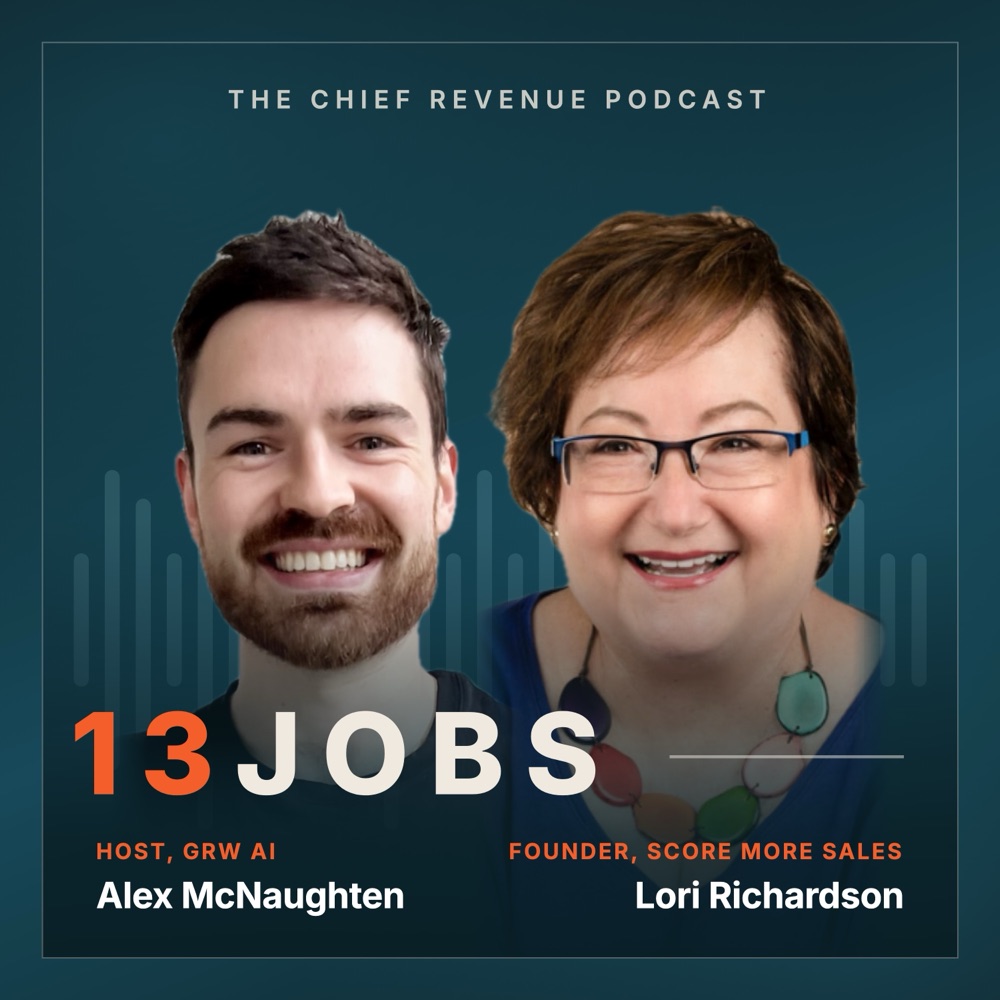
On coaching sales teams
Coachability is the trait Lori screens for above all others. What great coaching actually looks like, and why the C players still get it.
 Hosted by Alex McNaughten
Lori Richardson · Founder, Score More Sales
Lori Richardson is a longtime B2B sales strategist, author, and speaker, best known for helping companies build stronger sales teams and for championing women in sales leadership. She spent over two decades in tech sales before founding Score More Sales, a consultancy that works with leaders in SaaS, tech, telecom, manufacturing, distribution, financial services and professional services to solve sales problems and grow revenue.
She is also the founder and president of Women Sales Pros, a network and advisory group focused on increasing the number of women in B2B sales and sales leadership roles.
Beyond consulting, Lori coaches at Harvard Business School, runs the popular podcast “Conversations with Women in Sales,” and is recognized widely as a top sales influencer and #womeninsales advocate.
In this episode, we discuss:
- 1.How to spot coachability in an interview, and the exercise she borrowed from Mark Roberge
- 2.Whether coachability can be taught, or whether some people simply have the final answer
- 3.Low coachability plus no will to succeed, and why that combination is the one to walk away from
- 4.A players still need coaching, and why it doubles as a retention strategy
- 5.The middle group with grit, and why that is where the return is
- 6.Why writing off the C players and withholding coaching backfires
- 7.The top performer who won't be coached, and the athlete comparison
- 8.When the lone wolf's behaviour starts costing you the rest of the team
- 9.What great coaching actually looks like in a session
- 10.The line between coaching and training
- 11.The competencies that matter now, and the ones AI does not bring
- 12.The SDR role as a conductor rather than a data gatherer
- 13.What she would tell her younger self, including negotiating the contract
Quote of the show
“Great coaching is a learning opportunity for me, and it's not just talking. It's actually trying something different. I'm not telling you what to do, but I'm asking you, can you think back and give me some feedback on this situation?”
Key takeaways
- Coachability is the trait to screen for. Offer a suggestion and watch what comes back. "Already tried that, doesn't work" tells you more than any answer they rehearsed.
- Low coachability plus no will is the exit sign. Skills can be taught. What cannot be taught is the thing that makes someone pick up the phone one more time on a Friday afternoon.
- Your A players need coaching too. Not because their numbers are short, but because being seen and stretched is what keeps them. Coaching the top is a retention strategy.
- Never withhold coaching as a punishment. Telling someone they get development once they earn it reads as a penalty and guarantees they stay where they are. Offer it to everyone; just don't spend equally.
- Coaching is questions, training is answers. "Here's the way we found to be best" is training. Coaching is asking which conversation went badly this week and what they would do differently.
- The differentiator now is what AI doesn't do. Empathy, listening, reading the room and adjusting mid-conversation. The soft skills the profession undervalued for years are the ones left standing.
- The SDR job is becoming a conductor role. Nobody needs a person to gather lists and titles anymore. The role that survives works with the AI, reads what is missing and pulls the right people in.
Transcript
Lori, I'm so glad to have you on the podcast.
Alex, it's so great to be here. Good to see you again.
Likewise. So for those who don't know Lori, you're the founder and CEO of ScoreMore Sales, the sales strategy firm. But please tell the audience a little bit about you and your story.
Yeah. Well, I started in sales a long, long time ago. I started in technology and I sold all sorts of different services and products for about 12, 13 years. And then I decided that I wanted to help other companies sell better and have better sales teams. So I launched Scormer Sales when I was in Boston, and I've been running that ever since.
And while I was doing that, I found that there were not a lot of women in sales, in business-to-business selling.
Yeah.
Probably noticed. So I work as one of my projects is to work to get more women into sales and sales leadership and do that through the podcast Conversations with Women in Sales, as well as a newsletter and occasional events. Otherwise, I'm a sales strategist helping companies to solve their sales, B2B sales issues, go-to-market stuff.
And I've been wanting to get you on this podcast for a long time. We've been friends for a little while now, and I'm so excited to have you on the podcast. And just before we started recording, we were, we started touching on some of the topics we're gonna cover today, like how do you know if someone's coachable and what skills do we need in 2025, you know, in sales to be successful?
But like as a starting point, like let's start with the coachability side because I think it's something that a lot of like inexperienced leaders and experienced leaders struggle with is You know, someone might be telling you that they're coachable, they might say all the right things, but how do you actually know if someone's receptive to coaching?
Yeah, I'm thinking of so many different things I wanna say. But first of all, I would say that you can tell whether it's in business or non-business when you offer a suggestion to someone and they immediately say, no, no, no, that won't work because You know, they put up the, no, already tried that, doesn't work.
You know, very people that are very set on what they believe in. And in interviews, one of the best things I ever read was from Marc Roberge. You know, Marc, Mm-hmm. In his book, he has this, he had this exercise that he taught some of the reps at HubSpot to do, or not the reps, but the managers when they were interviewing.
Was to ask a potential hire how they would do something and then immediately say, okay, now let's say you had a different circumstance and you didn't have any budget, or, you know, he would make it so that you had to think on your feet and provide a different way to do that. And what's interesting is that sometimes people will just say, well, you couldn't do it that way, or—.
Mm-hmm.
Um, that wouldn't work, or that's silly, or, you know, they come up with a lot of defensive answers. And when someone goes, oh, interesting, you know, maybe I would do— and, and you can see them kind of thinking out loud, and they're, they're thinking because they're, they're accepting the coaching that, you know, maybe there's another way to do something.
So that's, that's the no-cost way to do it. I also work with tools that companies, you know, work with us on that will help show whether someone is coachable or not. And that's the best way for me is to show through data how many people on your team are coachable and whether the managers are open to feedback and whether the managers will hold people accountable because that's all connected, right?
Yeah.
It's pointless to coach someone if no one's going to hold them accountable.
So are you saying that the sort of the data shows that some people are just inherently better at receiving coaching and feedback and other people just— what, you, you, you can't coach them? Like, is that, is that what the data says?
Well, it's not nature versus nurture kind of thing. I mean, you can, you can be taught to be more coachable, but right, some people— we all know someone, you could probably think of someone who just is very difficult to offer ideas to. Sometimes they're in our family.
Yeah, that's exactly where my mind went, Lori, was immediately to family.
Yeah, I won't name names, but I have family members like this that they have the final answer. They know the best way. I've even had one of my siblings say, I know what's best. It doesn't really matter what you think. And so, you know, that's someone you would not want to hire because It's just going to be— coachability is such an important piece of it for sales reps being successful and also sales managers.
Right.
That if I knew someone had low coachability and if that was coupled with the fact that they didn't really have the will to be successful, because you can have the skills, you know, we go in and teach, you know, teach us how to close, teach us some openings. How do we have, you know, better inquiry?
And, and ultimately, if, if you don't really have the will to be successful, you know, what's gonna get— take you to make one— what will it take you to make one more call this week? It's Friday when we're recording, right?
Mm-hmm.
Um, you know, for me, it's 1:25 here. I could call it a day as soon as we're done. Or I can, you know, reach out to a few more people. What makes me do that? And that's, those are the people that we wanna hire and you can measure that.
One of the things that, you know, I've noticed consistently across organizations is you have, and it's a pretty common like distribution, right? Is you have about 20% of the team who are just crushing it, doing really well. They, they're that, that person you just described. They're the ones who make the extra calls.
They'll go the extra mile. Then you kind of have that 50-60% in the middle who are kind of like good enough and you can work with them and improve them. And then you have that bottom 20%, like roughly speaking. What do you do with those 3 buckets in an organization from a coaching standpoint?
Yeah. So some people call your A players, your B players. A players, they're doing well. They still need to be coached. They need to be encouraged. And seen for what they're doing. Some people think you just ignore those people and just focus on the middle. But don't ignore your top producers because they're gonna feel ignored and they're gonna go elsewhere, you know, where they might get a little more recognition.
Typically, that's the case.
So for the A players, sorry, just to stop you there, Laurie. So for the A players, coaching is as much a retention strategy As it is around performance.
Absolutely. And, and no matter how good they are and no matter what numbers they're pulling in, we can all be better. We can do things differently. And they've— there are lessons that they need to learn, which is— I saw you had a post about what is coaching really, right? And, and there should be a lesson involved.
There should be something that I can learn if you're coaching me and something that I can practice and work on so that I'm actually doing something. It's, it's not just listening. And hearing you tell me that I need to do something, but it's, it's me talking back and then me actually doing it and trying it and then getting back to you.
This happened. Hey, I got better. We closed. This came to closure quicker. So good things that are happening are proof of, you know, good coaching situations. So, so yeah, the A players, we don't want to neglect them. But they're going to be a little more on their own. They need a different level of our support, right?
The B players or whoever you put in the middle, I believe there's less of those than you're saying.
Okay.
I think there are a lot of weak salespeople on a sales team.
Right.
And that could be more than half. It could be half. And so, I want to get that top group that is actually having some kind of will to be successful. They have some grit. They will do follow-up. They will listen. They are coachable. And they will take responsibility. You know, that's a really important thing.
And they're not just calling it in, but they'll actually do some work, make some improvements. And we work really closely with that group. To ensure that they hear what we're saying, they take the actions, and we're able to follow up and see what they're doing, what they're producing.
Got it.
That's where the best efforts can happen right there.
And what about the C players, Laurie? What do you do with them? Do you invest in coaching them? Like, how do you think about that? Because I think that's often a— maybe it's something I've seen in organizations where leaders end up spending a lot of time with the bottom performers.
Yeah.
And is that the right thing to do? Like, how do you think about it?
No, the worst thing to do is to just write them off and say you don't get coaching until you're a player. Because I've actually seen people do that and it's like you're penalized.
Yeah.
You can't participate in the, you know, the extra learning because you're not in that group yet. So don't do that. But you don't spend too much time either. You offer it. And if people don't take you up on it, they cancel. You know, that's a classic thing of someone who's not fully engaged, who's not taking responsibility.
Oh, Alex, I gotta go. I forgot to tell you, I gotta go. Um, they're, they're bailing. Um, it's very obvious. It's very, very obvious. And so you offer the help and you don't push it on them. If they don't accept it, then when you have future discussions, you can bring that up that, you know, we've offered these different services and you don't seem to be making the time or, you know, consistently showing up.
And so, um, you know, we probably— it doesn't make sense for us to keep doing that, does it? You know, and give them another out. And, and I'm still— I'm, I'm never going to give up on someone. I mean, I'm a teacher at heart. That's what I wanted to be when I was little.
I want to be a teacher. And so, uh, I'm going to keep trying, but I'm not going out of my way. And, you know, put the effort in that middle, the top middle of the group.
Top middle.
Yeah.
What do you do? Because I think this is another thing I've seen over the years is where you have top performers who are not coachable. So they're crushing it, they're doing the numbers, but they think they know everything. How do you handle that situation? Because I think that's always a difficult one for leaders.
Yeah, it, You definitely have to weigh it because I associate it like sports.
Okay.
Top athletes. When a top athlete is so good, let's take baseball, they're hitting the home runs, you know, their stats are unbelievable, but they won't, you know, sometimes there's problems in, you know, with the other people, like they don't all get along, people don't get along. And so it becomes a lot of issues.
And, and so what do you do? I mean, do you keep someone who's causing problems potentially? Um, when you say they're not coachable, if they're hitting their numbers, there must be something that they're doing wrong, right? I mean, or what would you say? What have you run into?
I, I would just say it's the sort of person who they might fit into the classic lone wolf kind of persona where they're very good, they're hitting their numbers, they're not much of a team player, and they're not really open and receptive to feedback.
Yeah.
So they're just kind of off on their own over here. And I think it puts leaders in a tricky spot sometimes because if that person's doing like 150 to 200% of their quota, it's a big portion of your number.
You gotta weigh it, right?
You don't wanna rock the boat too much, but then at the same time, you're setting a difficult precedent But then you have the rest of the team looking at being like, oh, well, why is, why is Laurie treated differently to everyone? So it's just, yeah, it's a tricky one.
Yeah. As long— there are different behaviors, I think, that you would want to look at. If it's something where other people on the team are going like, why does Bob get to get away with that? Nobody else gets to, you know, act like that. Or, or he's, you know, disrespecting other people. Like, that's a problem and it hurts the rest of the team.
So it's definitely a time where you got to tell them, you know, here's what's happening and we need to talk about some feedback. And I want you to have someone coach you. You know, maybe we need to get someone on the outside that, that you might respect differently, or, you know, but if, if it's just a matter that they're forgetful or messy or, you know, then, then it's like we might be able to work around it.
But when it affects the other people on the team— then it's a problem. And, and just like sports, when you get rid of that, even a top player, when you remove them from the team, it, it usually brings the rest of the team up because they see that you're not going to take crap from anyone, no matter, no matter who they are, no matter how successful they are.
And other times you have to see where did they get those deals? Like, are they just farming some deals that, that they've gotten a long time ago? Are they actually good at bringing in new business? Because that's another thing that I'd be looking at as well. Just because someone is a top producer, it doesn't mean that they won that business in the first place.
Sometimes it was handed to them. Um, sometimes because they're kind of a bully, they get the top opportunities. Yeah. So it really just depends.
You touched on this a little bit in one of your answers earlier, but what does great coaching look like? Because I think it's, um, I think often people think of coaching as just like giving feedback or like, oh, maybe I'll just listen to some Gong transcripts and, you know, highlight a couple of things, and they think that that's coaching.
But yeah, I'm curious, like, how do you define— what does great coaching look like to you?
Yeah, great coaching is a learning opportunity for me, and it's not, like I said, it's not just talking. It's actually trying something different. It's like me saying, Alex, think about the conversations that you had this week. Which one didn't go as well as you thought it might? Then you would tell me, and maybe we could do that with GROW.
But to find out what didn't go well and what could you have done differently. I'm not telling you what to do, but I'm asking you, can you think back and give me some feedback on this situation? And, and then tell me about one that went really well. Why do you think it went so well?
Because I want you to learn. I want you to think and, and not just learn how to respond with a canned answer.
Wow.
I want you to be able to think about it. And, and then I want you to try it out so that next time when we talk, we can follow up and see if that, you know, try— that's why we like A/B testing so much. You know, try it the one way, Try it the other way.
And sometimes there's a third way that you might try it. And what's the most elegant solution? Because there's always— things are always changing. Things are always different, especially when we're dealing with human beings and we're dealing with sales and technology and AI and all these other things. We have to be very open to possibilities.
And we also want to get feedback if we have blind spots. You know, that's something I just don't see. That I can get feedback on from someone who's my coach.
What I'm hearing there is it's Socratic. It's not just telling or giving feedback. It's actually asking questions.
Yeah, because that's training. That's training.
Yeah, exactly.
Let me tell you how to do it, Alex. Here's the way. Here's the way we found to be best. That's training.
So for you, it's actually like great coaching looks like helping someone think about situations or think through problems for themselves. And it's a collaborative journey to find the best answer.
Yeah. And I like that you said collaborative because there's a joke that like, oh, you have all the answers within you, you know. Well, you don't always have all the answers.
That's definitely not true. Yeah.
Yeah. So I'm not saying just pull it out, you have it in there, just keep digging deeper. But maybe I can prompt some ideas and, and from that you can think Further, you know, go full circle with that. Yeah.
The other thing we were speaking about, and we've, I know we've had conversations about this in the past off camera, is that sales is changing pretty rapidly. Yeah. And it, look, it's been changing for years really when you think about it. It's changed a lot just in the last 5 years and it's now seems like it's accelerating that change.
Yeah.
What are you seeing from a— what skills are required in 2025? Like, what is— what are the core competencies that a rep needs in your opinion to be successful in 2025?
Yeah. Well, I'm still gonna be strong on being coachable and having the will to be successful and all the things that go with that, being able to take responsibility. Being, you know, somewhat of an optimist in terms of what's going on in your head. You need to support yourself to success, just like an athlete would too.
And, and in addition to that, especially with AI, we need the skills that AI doesn't bring yet. The empathy.
Right.
The grit, the communication skills, listening skills. The, you know, what we call reading the room, right? Read the room, Alex, right?
Yeah.
All those things AI is not going to do now. Maybe it'll do at some point, but for now we need to be able to really listen to what a customer or prospect is saying and then be able to interpret it in different ways and give feedback and listen. And then respond in a way that could be helpful for them, that's adding value to them, and not just an informational answer.
We need more than— we have all the information we could stand. But what humans can bring now are what we called for years soft skills.
Mm-hmm.
You know, and they were very undervalued for many, many years because, oh, soft skills, you know, anybody can, that's not a big deal. It was very much something we would never talk about previously.
It does seem that we've gone almost full circle in sales. Like it's sort of, we, I think we've gone through a period and certainly when I came up in sales that it was very much process, product knowledge, industry knowledge, and those are kind of the key things that you were taught with a little bit of frameworks.
And then like, here's some smart questions to ask in your discovery. And that was kind of like, that's what sales is. I know I'm oversimplifying a little bit, but it does seem like we're now going back to a place of, well, actually, it's the human piece.
It's humanness.
That the humanness that is actually what's differentiating you in your sales motion and the ability to, you know, read a room and think, you know what, I'm actually gonna change. I'm actually not gonna follow this typical sales process right now because I can see that this person is actually further ahead. So they don't need to go through this linear process.
Yeah.
I'm gonna adjust on the fly. And I think it's that that is helping salespeople stand out in a world of Where AI can do the information.
Right. And when you think of the years where, you know, tech was booming and the rep would just keep the demo going about blah, blah, blah. And I'm just going, stop, you know, I'm a business person. I don't need all the, I don't need to know all the things, you know, I don't need to know all the details, but they didn't see it, you know, they didn't, that rep will not be around.
They will not be around because they, they, if they can't figure that out, then they're not gonna be a fit for the future sellers.
Yeah, I was having a really interesting conversation this morning and we were talking about the, how the SDR role is changing and sort of being, you know, there's, I guess, under threat, put it that way. And then the interesting challenge that creates to organizations who've traditionally used the SDR part of the business as the feeder for their AEs.
And I'm curious if you've, what's your opinion on this, how you've, you know, what you're seeing in customers you're speaking to?
Well, I started as a full cycle rep years ago, you know, I picked up the phone when someone would call in, they did call in and that was a full, we could help them from start to finish. So that's not a new idea, but I think that we're going back to that because what many SDRs did for 80% of their day was look for information, right?
Yeah.
I mean, they were just, they were looking for lists and names and roles and titles. And, and, and now that we don't need that, they are not necessarily trained to do other things. They're not trained to be full-cycle reps. And so we're gonna have to think about that. Every company will do something different, but I've I've heard a number of leaders that I've talked to that are hiring more full-cycle AEs now and less, less in the SDR role.
I mean, right, it didn't really exist before Salesforce, you know, SDRs. We did fine in sales for many years without SDRs.
So you think we just kind of go back to many more full-cycle reps and fewer SDR-type roles.
I heard someone, I can't remember, I'd love to give credit to who said this, but someone who said it's more of a conductor role. Like there's definitely a role for a newer person that can help work with their AI to get the insights and get the information and maybe get that to an AE who's been around longer.
Maybe they're working up into that role. There's still a progression that's possible, but they need to do different skills. You know, they're not just searching for data. We don't need that person anymore.
Well, no, because that's now fully automated.
Right. We need a thinking person to go, okay, we have the data. What are we missing? Maybe get the, you know, maybe I need to get this person over here to get in on the call. I had a call with someone recently, and I realized that an advisory board member for this organization I was working with probably should get on a call to talk to this person just because of what I picked up in the call.
I mean, that's a thinking, thinking issue. And, and so I put those 2 people together. You know, that's the kind of role I think that we'll have for maybe a lower-level person. But everybody needs to be trained on the value that we're adding the customer. We've never done that well in sales. So I really want to see— I hope that this next iteration, our next era, if you will, you know, involves— because we have all the information at our fingertips, will we actually look at it?
Will we hear it? Will we see it, you know, before we open our mouth? And say, oh, who are you, Alex? What kind, you know, what kind of a podcast do you do? But I've actually seen your podcast and I've heard your podcast. And so that's what we need to bring is, you know, make good use of our potential buyer's time.
Why do you think we have historically as a profession been bad at this? Because, It to me seems almost inexcusable in the last, certainly the last 5 to 7 years with LinkedIn and Google and so on to do some cursory research. Like, why is it that the sales profession has been lazy in this area historically?
In tech, certainly because of all the money that was just being thrown around. It was just too much money. It was just throw money at something, just hire more people. You know, people didn't think things through like they're doing now. You know, now people are being very resourceful. They're being very thoughtful in my mind, the people that I'm talking to.
They're not out wasting money. They're not out even spending money in some cases. And they're cautiously moving forward to build their teams and to— to get their services to, you know, to buyers that really need their services.
So what, you think it was more just a phenomenon due to how easy money was for a while?
Definitely in tech, I think so. Yeah, I just think we had got some really bad habits.
I can definitely, I think I tend to agree with you there. I think it's less It's funny, right? It's like actually less prevalent outside of tech a lot of the time. Like, I feel like outside of tech, selling is better often.
Agree. Plus, those are people that have real products that go on order. You know, I tell people in SaaS sometimes, like, you've never had a backordered product, have you?
No.
Imagine if you're selling and the factory can't make it or it's being shipped and it's not arrived yet. Like, that's hard.
That's really hard. Yeah. Yeah. Last question for you, Laurie, for today anyway, is knowing everything you know today, go back to your very first day on the job in sales. What would you, what would, what would be a piece of advice you'd give younger Laurie?
Yeah. Well, I was very stressed out because it was, I was on straight commission. So I couldn't fail, you know, I had a guarantee for about a month or something, maybe 2 months. But I had to be successful. So I think I put a lot of pressure on myself. And I would tell younger Lori 2 things.
One is that it's going to be okay. You know, it's all— you're a learner, you're a lifelong learner. Just, you know, keep thinking and learning and talking to people and getting better and better. And the other I would say is negotiate your Your contracts, because I didn't know I could negotiate my salary when I started.
Oh, interesting. Yeah, that's a really good piece of advice, especially for younger—.
Yeah, I literally had guys that I worked with that made more money than me, and I was a single parent, and it made me mad when I learned about it, you know, because— but then you try the next role, you try to make that, you know, solve that problem when you go on.
But even today, I find myself, if someone asks me like, hey, we're doing this content project, can you contribute this or that? And I'll say, is anybody getting paid? They are, I wanna— and if they're not, you know, I'm happy to do it, but I don't wanna not ask. Yeah, so that's, that's like an issue I carry over from those many years ago.
I think it's great advice because I think when you're first coming into the workforce, you don't know. Like, you don't know sometimes if no one's told you, you don't know what's appropriate and how to do it.
More men negotiate salaries than women do.
So interesting.
The women need to remember that.
Interesting. This has been a great conversation.
You too.
And we could keep this going for a lot longer, but I'm conscious of your time. Where can people find you if they want to connect with you? I know you put out a lot of amazing content, like where's the best place to connect with you and find you?
Yeah, I'm at Score More Sales on LinkedIn. Score More Sales, many places, Instagram and I don't know, different social media. And we have a website, scoremoresales.com with a blog.
So amazing.
Yeah. And continue success to you guys.
Thanks, Lori. Well, we appreciate all your support on this journey and thank you for coming on the podcast. It's been great to have this kind of conversation with you and I'm sure we'll do another one of these in the future.
My pleasure.
All right.