
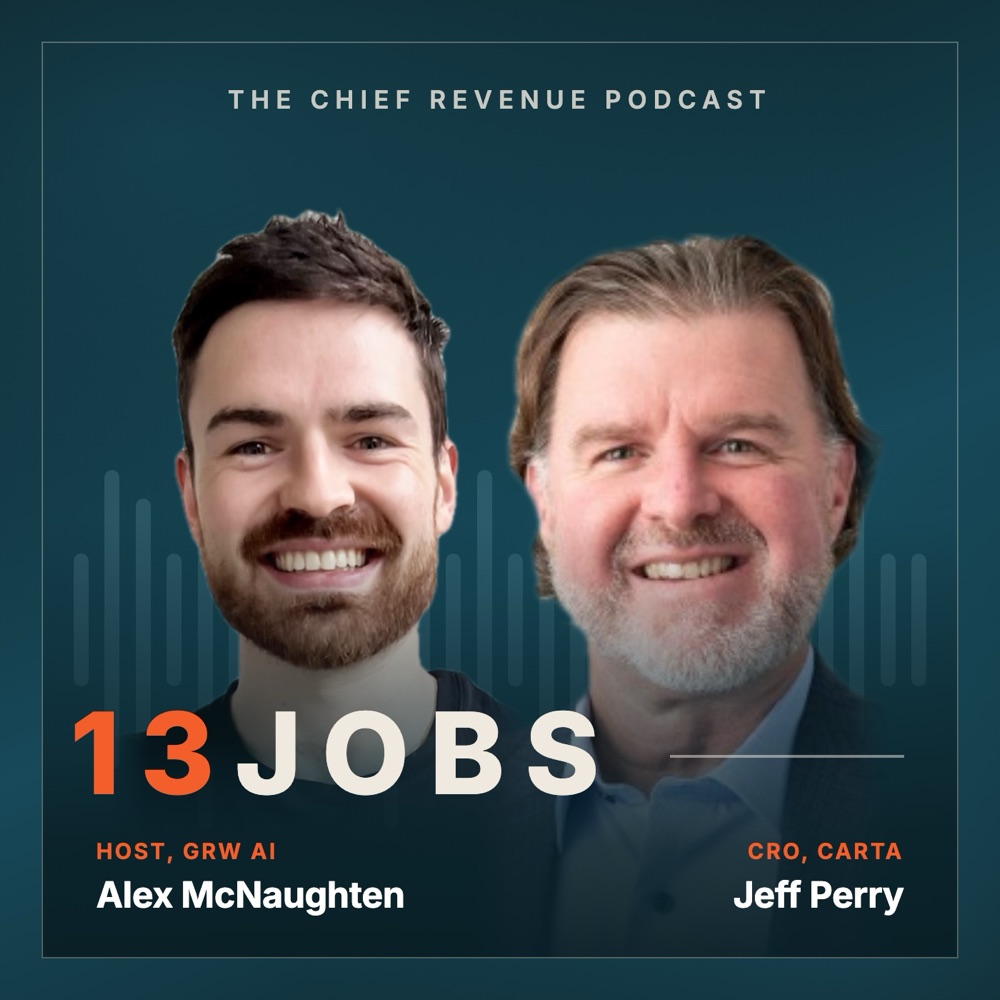
On capacity alignment when building sales orgs
Why hiring five more AEs rarely produces five AEs worth of ARR, and what Jeff watches instead as Carta scales.
 Hosted by Alex McNaughten
Jeff Perry · CRO, Carta
Jeff Perry is the Chief Revenue Officer at Carta, where he has dramatically scaled the revenue team. Responsible for all Carta core software revenue, Jeff is also accountable for creating synergy across all go-to-market functions and working with Carta's Product and Engineering teams to deliver a great customer experience. Prior to joining Carta, Jeff grew the SMB sales organization, including New Business and Upsell motions at DocuSign, along with several vertical teams. Before that, Jeff spent 13 years at Oracle where he ultimately served as Vice President of Sales. Jeff holds a Bachelor of Science in Political Science from Santa Clara University.
In this episode, we discuss:
- 1.What has actually changed in sales lately, and where AI does and doesn't fit yet
- 2.How Jeff separates real AI tooling from snake oil as a buyer
- 3.Why capacity alignment changes with the size and stage of the business
- 4.The maths behind "five more AEs" and why the ARR rarely follows
- 5.When capacity planning starts to matter, and when RevOps becomes essential
- 6.Setting quota between "everybody crushes it" and "nobody can hit it"
- 7.How far into the weeds a CRO should go, and hiring people better than you
- 8.Why sales training dies without daily reinforcement from leadership
- 9.Carrying big-company training culture into a smaller org
- 10.Why top of funnel got harder after the great tool-spend reset
- 11.The advice Jeff would give himself on day one in sales
Quote of the show
“If I hire five more AEs, is each AE going to then perform an additional 750K of ARR, meaning I'm going to do an additional almost 4 million in ARR just by hiring to that capacity? I find it doesn't typically work out that way.”
Key takeaways
- Being "behind on capacity" is not automatically a problem. At any moment the business has headwinds, tailwinds and live experiments running. Read the moment before you hire against it.
- Headcount is rarely the lever. Work out what is actually generating pipeline first, whether that is people, outbound, events or webinars. Adding closers to a top-of-funnel problem just adds cost.
- Around $5M ARR, watch capacity closely. That is also the point where a RevOps or sales ops function starts paying for itself as you plan the next stage of growth.
- Quota is part data, part eye test. Everyone smashing quota means the targets were wrong; nobody hitting it kills the org. Analytics help, but so does knowing whose calendar is full and who is asking questions.
- Training without reinforcement is a wasted week. Sandler only worked at Carta because leaders asked Sandler questions in every deal review, not because everyone attended the course.
- Surround yourself with people better than you. Newer leaders feel they need every answer; the job is to let experts own their areas and supplement where you have the experience.
- Top of funnel is harder because buying got disciplined. After the post-COVID reset of 300-plus tools, every purchase gets vetted. Account-based targeting and a crisp message beat spray and pray.
Transcript
I'm great, Alex. Thank you for having me. Nice to see you again.
Yeah. And for those who don't know Jeff, CRO of Carta, but you've worked at kind of like the who's who of technology companies over your career. Tell us a little bit about how you got into sales and how you ended up at Carta.
Yeah, well, thank you. Thanks for having me. And, you know, love talking about sales and sort of the career path and the journey. Yeah, I've been at Carta for just about seven years now. And prior to that, in sales capacities, I was at Oracle for about 15 years. And then in between Oracle and Carta, I spent four years at DocuSign as well. So along the way, I've done a little bit of everything from SMB to enterprise and all different types of products along the way. And also built sort of upsell, cross-sell motions, everything from SDRs to post-sales. So I guess I'm aging myself by all the different types of experiences I've gained along the way.
But always something to learn, always something to kind of modify, a bunch of new challenges. Feels like every month, every quarter, the market is moving. Carta is like extremely fast paced and innovative. And it's such a different company from when I joined seven years ago that there's always something new in front of us to be solving as an organization.
Before we dive into our topic for the day, just like a quick question. It's like, what do you think's changed? Like, what do you think some of the biggest changes have been in sales recently in the last sort of three to five years?
Yeah, well, obviously, the most recent one that sort of can't be denied is where does AI fit into everyone's strategy? And I think that story is still being told. So there's not sort of the perfect answer to that yet. But that's the obvious and most recent, like what is new and different. But I think, you know, most of it is like been fairly consistent as far as like organizations have different challenges along the way. And then you figure out what to what to solve. But for me, like nothing really has changed at the core of what like the SaaS sales is, which is, you know, finding a pain that a customer has and matching it to hopefully a solution that we provide and being able to clearly articulate and communicate, you know, what that pain is, what the solution is and how we solve it for other customers and how we think that will help you.
And, you know, that's sort of the philosophy we've taken as we built different businesses inside of Carta is like, what's the next problem to solve? And then how do we do that for customers?
Makes sense. And yeah, I think the AI thing, I like how you put it there, that story still being written. Like, I don't think anyone's like necessarily fully figured out exactly how to best leverage it if they go to market.
Yeah, yeah. I've gone to a few sort of I'd call industry or role dinners, CRO dinners. And, you know, I went to a couple of them hoping that someone was going to unveil like the perfect tech stack of what you're supposed to do and how to solve it. And I guess good and bad. I didn't find the silver bullet walking out of the dinner, but I did walk out feeling like, OK, I'm not the only one that is still like help trying to help figure this out.
And so, you know, there's a lot of a lot of good technologies out there. You know, internally, I've heard it also called there's a lot of snake oil out there as well. And so we're trying to vet like a couple of things, like where do we have processes internally that AI can be used? And then where can we use our own AI tools to use them? Or where do we need to supplement from other companies that have created tools that can help benefit what we do? And, you know, I, of course, think of that with sort of the revenue hat on and sort of things that are applicable inside of my organization. But we're doing that all across Carta.
Makes sense. How do you figure out snake oil versus real? Because I think I've heard this from a lot of people, right? There's a lot of like flashy demos and, you know, big promises in AI. And then I think there's been a lot of disappointment too. How do you figure that out during your buying journey? Because I think that's something a lot of leaders are struggling with right now.
Yeah. I'm not sure we exactly know, but to me, it's kind of like like old school fundamentals of like, you know, working through a sales cycle, but as the customer and actually like having the proof points validated, like show me how you do this, show me specifically how you do this, show me how you've done it for other companies. What does that look like for, you know, for their business? What would that look like for us? And I would say like we go into it probably with even a more skeptical mindset than we typically would have because the sort of the alerts are up to you know make sure that you properly vetted these things.
Yeah, okay, that's an interesting insight, but that's not the topic today. The topic for today is capacity alignment when building out a sales organization. And we were, before we started recording, we were touching on this, but maybe just to frame this, you said something interesting like capacity alignment will change depending on like the phase of your business, like where you're at in the journey. So I'd love you to unpack that a little bit more.
Yeah, I guess like AI, this is another one that I don't think has like a perfect silver bullet solve answer to it. And you know, I've toggled with this many times at prior companies and at Carta and in different organizations, and trying to figure out like we all want the like most optimally run organization possible, right? Which is like the optimal number of AEs, the right quota set, the right attainment levels met, the right growth trajectory for that organization.
The reality is at any given moment or within any month or within any quarter or within a year, there's going to be some ebb and flow to the business. And there's all these other variables that impact that along the way. It could be external market conditions out of your control. It could be testing that you've done on search spend and change that. And that could impact inbound lead flow that therefore then impacts number of leads per AE that are driven. And so I think you have to just be mindful of like at any given moment, you're going to go through some experiences of like some testing or some headwinds against you or some tailwinds behind you that make things look better than they are at any given moment as well. And finding out like what really works, you know, for for you and that segment. You know, I can't tell you how many times I've had someone from an ops team tell me like we're getting close to being behind on capacity. And I'm like, you're not wrong.
In this case, is that necessarily a bad thing or is it an okay thing as we're figuring out, like, what's working and what's not? And what I've always found is, like, just saying, well, hiring, you know, if I hire five more AEs, is each AE going to then perform an additional 750K of ARR, meaning I'm going to do an additional almost 4 million in ARR just by hiring to that capacity? And I find, like, it doesn't typically work out that way. More importantly, you got to figure out like what are the things that you're doing to build pipeline that gives people the opportunity to be able to sell more. And then you reach a point where it's like, are people like too busy in seat to be able to actually follow up and respond to the amount of inbound leads that you actually have. Great problems to have, right? In fact, early days, these problems happened at Carta where cap table business was growing extremely quickly and the team was smaller and they were learning and growing and you know there were situations where there were people that you know almost didn't have enough time in the day to field all of the inbound leads that were coming in. So then you start to do the capacity build and that's an area where like yes having more people would help but I don't think that's always the the silver bullet solve.
Yeah, it makes sense, right? And I think it's like particularly hard for early stage companies where everything like feels like, you know, you kind of want to be at that point where it's feeling stretched and you're too busy, and you can get there really quickly. At what point in like a company's journey should they be thinking much more seriously around this idea of capacity planning and kind of trying to be more formulaic about it? When does that happen?
You know, I don't know the exact call it like ARR amount, but from what I've gathered in sort of time period of like Carta's journey, you know, you probably reach a point at like getting above 5 million or so in ARR where it's like, okay, now like I need to watch this closely. I think it's also probably a point where like a rev ops team, a sales ops team becomes even more important and valuable as you're thinking about like scaling the organization. And then you're thinking about, okay, if I can do 5 million this year, you know, can I do 14 million next year and how do I continue to grow at that pace? And then like as I said earlier, like what are the most important levers that help you get that growth? Is it just like adding more bodies because it's truly a capacity problem to get to the amount of leads? Or is it like adding bodies that help generate more leads to then have to add more bodies to close the leads as well? Right, I think that's the important distinction is like what are the things that are bringing you leads? Is it people, is it outbound marketing, is it you know live events, is it webinars, whatever it might be, like what is actually like driving the top of funnel for you.
Got it. So it's like you've got to think through it not just from a headcount perspective, you've actually got to think through all of the other aspects that feed into this. Otherwise you can just hire headcount but then find actually they're not busy because you've got an inbound motion and you haven't invested over here on all your marketing, and all of a sudden like you're saying what's wrong with all the AEs, like they should be outbounding to create their own. It's like, well, that wasn't the model that you hired for. So yeah, you got to think through like each of these variables. What about things like setting quota? Because I think this is like part science, part art, right? And it all kind of feeds into this capacity planning phase. Like how do you go about doing that in a way where the AEs can hit a realistic number or get close to the realistic number, but then also it works from a business perspective?
Yeah, also a slippery slope, right? Like no one wants an organization where like everyone is far exceeding, you know, quota amounts. That just clearly means like the targets weren't appropriately set. And like sure, is it great for a couple AEs that are able to maximize on a plan for a short period of time? That's fine, but it's not sustainable for a company, so it doesn't really make sense. On the flip side, no one wants to be part of an organization where it's impossible to hit a quota and they don't see either themselves with a path to be successful or anyone in their seats around them having success either. And so you got to find this fine balance I think of like pushing the limit to where you want to be to have acceptable growth targets for the organization, and then what is sort of optimal by productivity levels inside of the organization. And some of it like of course like data analytics help you with all of that. Some of it is like the basic eye test too. Like sales leaders are smart, like you can see who's busy, who has an active calendar, who's asking a lot of questions, who has follow-up on opportunities. You get a real quick sense if you're close to your team on like who's active, who's productive, or where like just things aren't as productive as you think they should be.
When you, like as the CRO, how into the weeds of the detail do you have to go as you're doing this? I'm just curious, like as the exec, how do you think about this stuff?
It changes, right? Like the size and stage of where you're at changes like what dictates what level of inspection you need to do on things. You know, we're at a very different size and stage now where there's my business that I don't need to have as much oversight on. There's other parts that are like big investment pieces and I need to spend a lot more time on the hiring, the onboarding, like bringing people on board, the top of funnel, making sure that we're doing all the right things, not just in sales, but in marketing and in business development and our channel avenues to be able to build pipeline.
And so I have to allocate my time dependent on sort of where the future growth needs are for the company. And I think that's different than like, you know, someone in an earlier stage company where it's like, you know, one product, one organization, build, get as many of the next leads as you possibly can. And then some of it, to answer the other part of the question, is just like who the individual is.
You know, some people like to be sort of much hands off. Others are involved in a little bit of everything. Some could argue are involved in too much and don't need to be. You know, I think that's always hard for a leader is to like, where am I, where do I lean in more? Where do I give some independence and freedom for people to operate and let them have ownership? And I think that comes from just sort of years of experience and understanding like the organization and people. And, you know, I've always taken the approach of like, OK, I trust that I'm surrounding myself with really good people and people that, frankly, in many cases do things much better than I do. And that's totally OK. Like, it's harder to admit that when you're younger and less experienced because you think you have to be the leader that has all the answers. I think, you know, as you gain some years, some wisdom, some experience, you realize like surrounding yourself with really great people is actually totally OK. And in fact, like empower them to go do the things that they're great at and know that like there's other things that I just have different experiences with and I can help supplement in those ways too. And I think that becomes more important as organizations get much bigger as well.
I think you hit on something interesting. Like it's really hard. Like new leaders, I think, really struggle with that. Like when you're first promoted to leadership and like, you know, suddenly you've got 10 people reporting to you and you do feel like you have to know everything. Like I remember I felt that in my first leadership role. And yeah, you figure out later on that actually it's okay to not know everything. And like some of the people in your team are actually going to be way better than you at different things. And that's actually a good thing.
I think it took my time at Carta for me to learn that about myself. You know, there's still a few individuals that are here as part of my team and they're important, impactful leaders. But I think when I joined, they were probably looking at me to like have all the answers because I was sort of the new guy with experience from the outside. And I was looking at them like, hey, please help teach me some of these things because you guys actually have far more experience than I do in this specific area. Right. And especially in regards to like cap table software sales. And so that helped me just realize, like, I need them to be great at what they really do well. And then let me help with the other things about like scaling an organization and, you know, the training of an organization and the growth path and all these other things that we needed to focus on to get us to the next phase of the company. But yeah, it takes a little bit of experience and confidence over time to be okay like not having to be the expert in everything.
Yeah, for sure. And I do think that mentality helps empower others to feel like a sense of responsibility as well and contribution, which I think is important. You mentioned training just then and that was something that when you came to Carta that you were, I guess, like helping them level up is what I've heard, correct me if I'm wrong. But yeah, talk to me a little around that.
Yeah. So I think I did help us level up in a couple ways. I think some of it is just sort of like the things I would do in managing the day-to-day of the operations of the business, like how you run a forecast call, like how you check total top of funnel pipeline, what level of your pipeline is at committed status versus just sort of open pipeline versus best case scenario. Just the rigor of the consistency and then the questions and inspection of the business, I think, is one way of training.
The other is the more, and so we did that, and I think we helped in that way. The other is also just sort of the more like formal training curriculum. And, you know, I fortunately had the opportunity of kind of growing up through and learning through the Oracle ecosystem, which was great at training and had resources to help bring in external trainers. And we used Sandler, and that's what I learned and grew up on. And over the years, I brought Sandler to DocuSign as well. And then when I got to Carta, I brought Sandler to Carta too. And I think it was great for giving a basic foundational level of sales skills training to folks that in many cases didn't have a ton of sales experience. And so it helped with the foundation and the core of being able to, like I said earlier, match a solution with the pain that a customer is having.
You mentioned that Oracle did this really well. What did they do so well compared to the other organizations you've worked at?
They just had the resource behind it. Like you felt like you were part of, this will come off in maybe a negative way, I don't intend it to be that way, but you felt like you were kind of a number in a system because they had a system that they could put you through and like you, you know, you were scheduled to be in this training on this day or this week from this time period, and like everyone went through it. Like, you know, you were part of the army that went through all of the trainings. And you know, there were presentation skills trainings, they did like Toastmasters, you know, every Wednesday for, you know, lunch was brought in. And so like this training philosophy was like heavily ingrained in everyone. And actually think it was like, you know, openly talked about. Like I had friends that moved from other parts of the country to Redwood Shores California to get a job at Oracle in entry-level sales to get training, knowing that at some point like they would move back to the Midwest or where they came from, but they wanted that on their resume because it was so highly thought of, you know, at that time period.
Aside from resources, what other limiting factors do other companies have that prevents them from doing that sort of thing?
Yeah, well, so the resources are great and that helps like, you know, implement the training, but the training becomes no good if it's not like followed up on. And so like if you don't have the then like leadership layer, you know, sort of implemented as well, like instilled to be like we're going to reinforce, constantly reinforce this training. And so like if I, you know, I went through Sandler training and then if I'm talking to my boss about a deal that I'm forecasting and if my boss isn't asking me some of the Sandler questions to understand if I like found the pain with the customer or did I get to like who's gonna, you know, actually be the signer for the contract, whatever the layer of detail, that reinforcement of the training wasn't there on literally a daily basis, then the training was like, sounded like a cool thing to do and yeah we put everyone through training for a week, but like you kind of just wasted it if you don't have the reinforcement part.
How do you embed that? And I think as a small company, you know, all the other things that are going to get thrown at you, like do you think, oh wow, let me make sure I'm doing deal inspection or deal war, pipeline war rooms, to go through every opportunity to understand like are we reinforcing the trainings that the AEs learn so that everyone's getting better and better for it? You probably get thrown at you like, oh, such and such customer is going to churn. Let's go help save that customer, and all these different things that get thrown at you in a small company versus like just the rigor of the size and scale.
It sounds like a lot of this is also cultural. You have to build this into the culture of the sales organization. Like how do you go about changing an org's culture in that way so that that just becomes the norm, that's how they operate?
Yeah, it definitely has to happen that way. And I think that's actually why people like myself have gotten opportunities outside of big companies over time, is because you bring someone that can help like institute that culture inside of a smaller organization. But it would be hard to do had you not like lived it or done it before as well.
Makes sense. So you take the learning from the bigger companies you work at and then actually bring that and embed that into a small organization as they're scaling up.
That's right. But that also comes with other challenges, like the classic, you know, are you a big company person or a small company person. So you might be thinking you're bringing the big company person that can instill that culture, but are they someone that can still like operate in sort of the, you know, the nimble, fast paced startup environment or not? You know, some can do it and thrive. Others don't.
Last thing I wanted to touch with you on is, you've mentioned top of funnel a few times in this conversation. And obviously, what I'm hearing from people is top of funnel is getting harder and harder and harder. And I'm just curious, like, as you're thinking about capacity planning and top of funnel, what's changed recently in like the last, I don't know, say three to five years, in terms of how you think about top of funnel and what's working?
Yeah, you know, I'm not sure that it's changed, it probably just, we all just maybe feel it a little closer. You know, and I think it comes down to this, like no organization is saying like let's go see how much we can possibly spend and we don't care if we're wasting. Or like instead of, you know, do more with less, like do less with more. Like no one is saying that, right? And so when you're evaluating like technologies or a tool as a customer, like it's getting harder and harder. So building top of funnel, like I'm not surprised that it gets harder. People are being more thoughtful about the spend that they do, like what's the CAC, what's the value add by each tool that you're bringing into the system.
And, you know, there are times where like everyone gets a little bit loose. And, you know, we went through this as a company as well. We had, you know, 300 and some odd tools, software tools being used at one given time. And I think most companies did this. Like, when you went through COVID, it was a chance to do sort of a level set of like what are all the tools that we're paying for and which are the ones that are like most critical to run the business. And it helped us kind of weed that down. And I think from there, that just became how people operate. Because it was very easy for people to just like, oh, I'm going to try this tool and use this in this organization. And no one else in the company even knew. And then all of a sudden like you pick your head up seven years later and anyone that wanted to buy anything inside a company was kind of doing that for most companies. And now all of a sudden you had sort of the great reset of like licenses and where to spend. And then I think it just became like standard practice. Like we can't be just like this free in how much we're spending. And I think we're seeing the residual effect of that, the evaluation process now.
So does that mean like when you're doing top of funnel, you just have to be so much more targeted and like so much more effective at it? You know, you can't just do the spray and pray approach.
Definitely. Account-based marketing, I think, is so much more important now. And it's business dependent. For what we do, it's extremely important. Having a very clear, crisp, concise message of what you do and how you do it, I think is really important. And then getting that in the hands of the specific ICP or the decision-making slash influencer inside of, for us, venture firms and private equity firms or founders of portfolio companies. Like know your audience and then know the message to get to the audience, I think is even that much more important now. And I say that also as someone that gets prospected to like all day as well. The amount of vendors that want to offer us different solutions is like, you can get inundated with it. And so what really resonates with what you're doing and will impact your business is important.
One last question for you, Jeff. You've had an incredible career and knowing everything you know today, go back to your first day on the job in sales. What's like the one piece of advice, the one thing you'd tell your younger self, day one?
Yeah, I would say just be open-minded is the number one thing. I think when I came through the Oracle system, most people felt like, oh, when I come to Oracle, I'm going to get trained in this inside sales organization. And then my path is to become what was called the field rep at the time. And that was like the career destination. Like how do you get yourself out of inside sales into field sales? For no other reason aside from people felt like the field sales people made so much more money and that was your chance to like earn that much more. Right. And so, you know, the reality is like there was probably a bunch of like wasted cycles and mind spent on like thinking how to get those type of jobs instead of like just becoming really, really good at the inside sales role because you learn so many skills from it. And then who knows? Like I ended up not even going down a path of field sales and chose more of the management route instead because that was presented to me as an option. Which, you know, when I was in college, there was no sales as a major or classes. And so this was sort of new and open to, you know, to people in sort of my demographic at that time period of like who would have thought, who would have known there is this career path and how rewarding it can be in many ways, whether it's financially, if that's your main motivation as an individual contributor, or if your path takes you down a path of leadership instead, and that has obviously a financial reward, but so many other hidden benefits in that as well as far as the amount of other career paths and career opportunities you can create for people that work in your organization too.
I think it's great advice, being open and not hyper fixated just on the one path. Like actually be open because yeah, you might find something else along that journey that's even better.
I think that's right. And it's hard at the time because you know you're figuring out like life and paying bills and earning and all that. And you know, it can get really cloudy. And then the worst thing that can happen is like one of your friends gets that promotion, and especially at somewhere like Oracle, someone got it and I was like, oh, I got to be the next one to get it. And it's like, yeah, is that really the end state goal?
Jeff, it's been a great conversation. There's been so many gems and learnings throughout. But for the audience, if they want to connect with you, consume more of your content, where's the best place to find you?
Yeah, well thanks for having me Alex, really enjoyed talking with you. And yeah, I'm on LinkedIn, just you know, Jeff Perry, I'm at Carta. And that's the best place to find me and I'm happy to connect with anyone and always willing to share stories and thoughts, so feel free to reach out.
Thank you. Awesome, thanks Jeff.
Yeah, thank you.